Search

Showing posts with label Criminal Procedure. Show all posts

30 October 2024

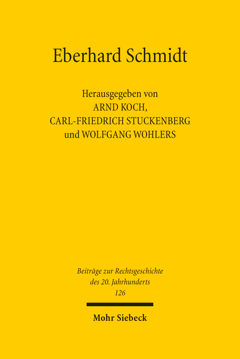
BOOK: Arnd KOCH, Carl-Friedrich STUCKENBERG & Wolfgang WOHLERS (eds.), Eberhard Schmidt. Strafrechtshistoriker, Strafprozessualist und Strafrechtler [Beiträge zur Rechtsgeschichte des 20. Jahrhunderts; 126] (Tübingen: Mohr Siebeck, 2024), 279 p., ISBN 978-3-16-162153-6

 Cover von 'undefined'
ABOUT THE BOOK:
 
Eberhard Schmidt (1891-1977) war als Jurist im Kaiserreich, in der Weimarer Republik, im NS-Staat und in der Bundesrepublik tätig, sein wissenschaftliches Werk umfasst neben dem materiellen Strafrecht die Strafrechtsgeschichte und das Strafprozessrecht. Schmidt gilt als Stammvater des Arztstrafrechts und war Schüler Franz von Liszts, dessen Lehrbuch er fortführte und dessen Ideen er in die Beratungen der Großen Strafrechtskommission der 1950er Jahre einbrachte. Als Rechtshistoriker prägte Schmidt die strafrechtsgeschichtlichen Vorstellungen mehrerer Juristengenerationen. Im Strafprozessrecht, dem er sich nach 1945 zuwandte, gilt sein »Lehrkommentar« als epochale wissenschaftliche Leistung. Die Beiträge des Bandes nehmen eine wissenschaftshistorische Verortung des Schmidt´schen Werkes vor und gehen der Frage nach, welche seiner Arbeiten auch aus heutiger Sicht von bleibendem Wert sind.
 
TABLE OF CONTENTS:
 
Klaus-Peter Schroeder: Eberhard Schmidt (1891-1977) - Die »peregrinatio academica« eines deutschen Strafrechtslehrers - Arnd Koch: Eberhard Schmidt und das Dritte Reich - Milan Kuhli: Eberhard Schmidt als Rechtshistoriker - Mathias Schmoeckel: Der Inquisitionsprozess und seine Geschichten - Sven Großmann: Eberhard Schmidt und die Entwicklung des reformierten Strafverfahrens - Carl-Friedrich Stuckenberg: Die wissenschaftliche Behandlung des Strafprozessrechts - Wolfgang Wohlers: Die Rechtsstaatlichkeit des Strafverfahrens: Justizförmigkeit vs. Zweckmäßigkeit - Martin Löhnig: Das Richterbild bei Eberhard Schmidt - Heike Jung: Eberhard Schmidt und das Arztrecht - Thomas Weigend: Eberhard Schmidt und Franz von Liszts »Lehrbuch des Deutschen Strafrechts« - Sascha Ziemann: Eberhard Schmidt und das Erbe der Liszt-Schule nach 1945 - Wolfgang Frisch: Eberhard Schmidt als Kriminalpolitiker, insbesondere in der Strafrechtsreform der 1950er Jahre - Franz Streng: Eberhard Schmidt und der Strafvollzug
 
Read more here.

09 June 2020

BOOK: Alessia Maria DI STEFANO, Il corso di diritto penale (1840-1843) di Emerico Amari, un maestro della penalistica civile tra illuminismo e positivismo (Torino: Giappichelli, 2018). ISBN: 9788892115262, pp. 328, € 41,00

Il corso di diritto penale (1840-1843) di Emerico Amari, un maestro della penalistica civile tra illuminismo e positivismo


ABOUT THE BOOK

Nel corso di lezioni di «dritto penale e procedura» tenuto nell’Università di Palermo a partire dal 1840, Emerico Amari filtra con la sua sensibilità i risultati più significativi della riflessione dei giuristi intorno ai problemi principali del diritto penale quali il metodo, il fondamento del potere di punire e la funzione della pena.
Cattolico e liberale, figura di spicco del Risorgimento siciliano, saldamente ancorato ai capisaldi della cultura illuminista e attento alle novità del positivismo, Amari combatte le sue battaglie per la libertà politica ed economica soprattutto dalle pagine dei più importanti periodici isolani, convinto che l’intellettuale debba contribuire attivamente al progresso sociale mettendo a disposizione della collettività in generale e dei governanti in particolare i propri studi e le proprie conoscenze, al fine di far emergere le criticità dei sistemi sociopolitici e di suggerire le riforme più utili per favorire il progresso. La battaglia per l'abolizione della pena di morte, che coinvolge e affascina gli studenti palermitani e spaventa le gerarchie, la partecipazione alla rivoluzione del ’48, non sono che alcuni tra i tanti tratti che segnano la personalità di Amari, un protagonista di quella stagione della cultura giuridica che Sbriccoli ha definito penalistica civile.

ABOUT THE AUTHOR

Alessia Maria Di Stefano dal dicembre 2018 è ricercatore a tempo determinato presso il Dipartimento di Giurisprudenza dell’Università degli Studi di Catania. Ha conseguito il titolo di Dottore di ricerca in Storia del Diritto presso l’Università di Macerata (2010); già assegnista di ricerca presso il Dipartimento di Giurisprudenza dell’ateneo catanese (2012), ha svolto periodi di ricerca all’estero presso la School of Law – UC Berkeley e il Max-Planck-Institut für europäische Rechtsgeschichte di Frankfurt am Main.Ha insegnato Storia del diritto medievale e moderno all’Università degli Studi di Palermo, corso di Laurea Magistrale in Giurisprudenza di Trapani .

TABLE OF CONTENTS

A pdf version of the the table of contents can be downloaded here

More information here

05 May 2020

CALL FOR PAPERS: Brazilian Journal of Criminal Procedure - Special issue on the history of criminal procedure (DEADLINE: 15 May 2021)


(Source: ibraspp.com.br)

In order to broaden its scope and the quality of the scientific articles published, the editorial board of Revista Brasileira de Direito Processual Penal announces a public call for authors to a thematic dossier on the history of criminal procedure, that will be published in 2021.

Contributions can be written in English, Spanish, Portuguese or Italian, and will be submitted to peer review. The editors are professor Ricardo Sontag (Universidade Federal de Minas Gerais) and professor Georges Martyn (Ghent University). More info can be found on the website of the journal or please contact Georges.Martyn@UGent.be.

Contributions, to be submitted by May 15th, 2021, should touch aspects of ‘modernity’ of criminal procedure: Modernity - which we will limit to, for the purposes of this dossier, taking into account local variations, the period that goes from the end of the 18th century, has in the 19th century a period of extraordinary importance, and prolongs into the 20th century - has known important changes in criminal procedure, some with more distant origins, others less. Criminal procedure, as the juridical dimension of criminal justice practices, is an extremely relevant part of the formation of the modern State, whose connections with society and with the legal rule have been profoundly transformed during this period. Between demands to promote ‘public’ security on the one hand and individual freedom on the other, much changed in the relationships between political power (and its institutionalization in the Public Prosecutor), victim and defendant; as well as in the role of the various formal sources of law (legislation, case-law, doctrine, foreign influences, etc.) and of the judges; the configuration of new procedural models in connection with the problem of evidence and criminal prosecution; the role of publicity and public opinion (including the institution, as well as the crises, of the jury); and these are only a few examples. Many problems arose at the crossroads of the ongoing ‘civilization’ tendency of criminal justice and the expansion of State control machinery. The historiography of the last decades has been exploring ever more the rich diversity of sources: history of criminal justice (focusing on sociological aspects) and history of law (focusing on dogmatic aspects) are no longer incommunicable planets. All the aspects mentioned above, even though institutes and mere legal aspects of criminal procedure, can also be studied from a broader historiographical point of view. Perhaps this is even one of the main features of the historiography of the last decades, that broke with the principle that there would be sources relevant exclusively to historians of law - the “legal” ones - and others that would be the exclusive research material, for example, for social historians. The idea is to consider the law as it is established in a certain context, with connections, at each moment of a different nature, with other sectors. This call for papers aims, therefore, to include studies that address the legal dimension of criminal justice in Modernity.

20 January 2020

BOOK: Ronnie BLOEMBERG, The Development of the Criminal Law of Evidence in the Netherlands, France and Germany between 1750 and 1870 (Leiden - New York: Brill, 2020). ISBN 978-90-04-41502-7, €152.00


(Source: Brill)

Brill is publishing a new book on the development of the criminal law of evidence in the Netherlands, France and Germany between 1750 and 1870.

ABOUT THE BOOK

This book describes the development of the criminal law of evidence in the Netherlands, France and Germany between 1750 and 1870. In this period the development occurred that the so-called system of legal proofs was replaced with the (largely) free evaluation of the evidence. The system of legal proofs, which had functioned since the late middle ages, consisted of a set of strict evidentiary rules which predetermined when a judge could convict someone. In this book an explanation is given of the question why between 1750 and 1870 the strict evidentiary rules were replaced with the free evaluation of the evidence. The thesis of this research is that the reform was induced by a change in the underlying epistemological and political-constitutional discourses which together provided the ideas which inspired a significant reform of the criminal law of evidence.

ABOUT THE AUTHOR

Ronnie Bloemberg, PhD (2018), performed his PhD between 2014 and 2018 at the Rijksuniversiteit Groningen in the Netherlands. He has published several articles on the history of the criminal law of evidence in Dutch and international journals, and is currently working as a lawyer.
TABLE OF CONTENTS
  Acknowledgements
  1Introduction
 1.1The Connection with the Criminal Justice System as a Whole
 1.2The Theoretical Framework
 1.3The Approach and Limitations
 1.4The Periodization
 1.5The Structure and Content of the Chapters


Part 1: The Theoretical Framework and the Development of the Criminal Law of Evidence in France and Germany

  2The Characteristics of the System of Legal Proofs
 2.1Introduction
 2.2The Abandonment of the Ordeal and the Development of the Inquisitorial Procedure
 2.3The Central Characteristics of the System of Legal Proofs
 2.4The Thesis of Langbein
 2.5Conclusion
  3The Theoretical Framework
 3.1Introduction
 3.2The Political-constitutional Discourse
 3.3The Epistemological Discourse
 3.4Conclusion
  4The Reform of the Criminal Law of Evidence in France 1750–1870
 4.1Introduction
 4.2The Regulation of the Criminal Law of Evidence in France until 1789
 4.3The Reform Discussion on the Criminal Law of Evidence between 1750 and 1789
 4.4The Discussions in the Constitutional Assembly (1789–1791)
 4.5The Development of the Criminal Law of Evidence between 1791 and 1814
 4.6The Criminal Law of Evidence between 1815 and 1848
 4.7Conclusion
  5The Development of the German Criminal Law of Evidence 1750–1870
 5.1Introduction
 5.21750–1812: The Abolition of Judicial Torture and the Start of the Reform Debate
 5.3The German Discussion between 1812 and 1848
 5.4The Discussion on the Criminal Law of Evidence between 1848 and the 1870s
 5.5Conclusion


Part 2: The Development of the Criminal Law of Evidence in the Netherlands 1750–1870

  6The Criminal Law of Evidence in the Dutch Republic between 1600 and 1795
 6.1Introduction
 6.2The Regulation of the Criminal Law of Evidence in the juridical Literature
 6.3The Practice of the Criminal Law of Evidence in the Dutch Republic
 6.4Conclusion
  7The Criminal Law of Evidence under Discussion: 1750–1795
 7.1Introduction
 7.2Criticisms on the Use of Judicial Torture 1600–1750
 7.3The Reform-literature between 1750 and 1795
 7.4Reforms of (criminal) Ordinances in the Second Half of the Eighteenth Century
 7.5Conclusion
  8The Criminal Law of Evidence in the Franco-Batavian Period 1795–1813
 8.1Introduction
 8.2The Reform of the Criminal Law of Evidence in the National Legislation 1795–1810
 8.3The Juridical Literature between 1795 and 1810
 8.4The Incorporation of the Netherlands into the French Empire 1810–1813
 8.5Conclusion
  9The Criminal Law of Evidence in the United Kingdom of the Netherlands 1813–1830
 9.1Introduction
 9.2The Development of the Discussion in the Juridical Literature between 1813 and 1830
 9.3The Attempts to Create New Substantive and Procedural Criminal Codes 1813–1830
 9.4The Consequences of the Belgian Separation from the Netherlands
 9.5Conclusion
  10The Criminal Law of Evidence in the Netherlands between 1838 and 1870
 10.1Introduction
 10.2The Discussion on the Criminal Law of Evidence between 1838 and 1860
 10.3The Discussion Regarding the Abolition of the Negative System of Legal Proofs in the 1860s
 10.4Changes in the Criminal Law of Evidence after 1870
 10.5Conclusion
  11Conclusion
 11.1Introduction
 11.2The Theoretical Framework
 11.3The Connection with the Criminal Justice System as a Whole
 11.4A Comparison between the Netherlands, France and Germany
 11.5The Developments in the Late Nineteenth and Twentieth Centuries
  Bibliography
  Index 
More information here

29 March 2015

BOOK: "Sanctuary and Crime in the Middle Ages, 400-1500 ", by Karl Shoemaker


Sanctuary and Crime in the Middle Ages, 400-1500, by Karl Shoemaker, (University of Wisconsin, Madison)

Sanctuary and Crime in the Middle Ages, 400–1500 rethinks the history of sanctuary protections for criminals in the Western legal tradition. From the twilight of the Roman Empire until the sixteenth century, every major medieval legal tradition afforded protections to fugitive criminals who took sanctuary in churches. Sanctuary-seeking criminals might have been required to perform penance or go into exile, but they were guaranteed immunity from corporal and capital punishment. In the sixteenth century, sanctuary protections were abolished throughout Europe, uprooting an ancient tradition and replacing it with a new set of juridical arguments about law, crime, and the power to punish.