Search

Showing posts with label theory and history of international law. Show all posts

15 April 2025

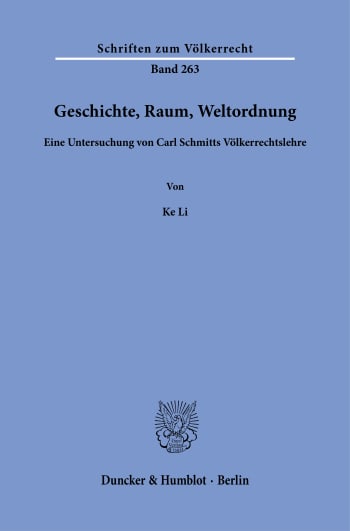
BOOK: Ke LI, Geschichte, Raum, Weltordnung. Eine Untersuchung von Carl Schmitts Völkerrechtslehre [Schriften zum Völkerrecht; 263] (Berlin: Duncker & Humblot, 2025), 273 p., ISBN:978-3-428-18832-1

Cover: Geschichte, Raum, Weltordnung
About the book:

Diese Studie konzentriert […] sich auf ein Thema, das umfangreiche Debatten ausgelöst hat – was wenig überrascht, da das Bestehen von Kontroversen gerade die Bedeutung und Notwendigkeit weiterer Forschung bestätigt. Bemerkenswert ist jedoch, dass die Diskussionen um Carl Schmitts Völkerrechtslehre weit über den Rahmen üblicher wissenschaftlicher Meinungsverschiedenheiten hinausgehen. Für einige ist Schmitts Theorie ein veraltetes, negatives Erbe, während sie für andere eine treffende Diagnose der aktuellen globalen Krise oder sogar eine mutige Prophezeiung der zukünftigen Weltordnung darstellt.

Diese diametral entgegengesetzten Bewertungen treffen in einem Punkt zusammen, was selbst Ausdruck der dialektischen Bewegung der Geschichte ist: Das Weltsystem und seine Wissensgrundlagen, die wir einst kannten, unterliegen einer intensiven, tiefgreifenden Neuordnung.

(Aus dem Vorwort)

Table of contents:

A. Das Völkerrecht als Angelpunkt der Weltgeschichte: Erläuterung der These von Carl Schmitt
Weltgeschichte und Völkerrecht – Raum, Weltordnung und Völkerrecht – Gliederung der Arbeit

B. Prolog: Zuordnung Schmitts Völkerrechtslehre
Das Jus Publicum Europaeum in der Rechtsgeschichte – Schmitts jus publicum Europaeum als globale Raumordnung – Das Völkerrecht: eine rationalistische (Un-)Ordnung? – Abschied vom 19. Jahrhundert: die Aufhebung der These Webers durch Schmitt

C. Geistiges Postulat: Metaphysik, Metahistorie, Metaphorik im Konzept des Nomos
Etymologische und begriffliche Auslegung – Pluralität als metaphysische Kritik des Subjektivismus – Metahistorie statt Metaphysik – Schritt zurück zur Metapher

D. Ideengeschichtliche Voraussetzung: Philosophie und Historie
Der Zusammenbruch des Dualismus in den Geisteswissenschaften des 19. Jahrhunderts – Das Verschwinden der Metaphysik in der Geschichte

E. Institutioneller Präzedenzfall: Organische Weltordnung
Zur Körperfrage des Politischen – Intermezzo der Gouvernementalität: Biopolitik als Geopolitik – Das Vorbild »Mitteleuropa«

F. Schmitts jus publicum Europaeum: Völkerrecht als Raumordnung
Landnahme und das globale Liniendenken – Innen und außen, Europa und Nicht-Europa – Seenahme und maritime Existenz – Lex fundamentalis: Gegensatz und Gleichgewicht der Räume

G. Die neue Auffassung der Völkerrechtslehre und die Auflösung des jus publicum Europaeum
Die Geburt des universellen Völkerrechts – Universelles Völkerrecht und Staat – Von Koexistenz zur Civitas Maxima – Der Bedeutungswandel des gerechten Krieges im Völkerrecht – Genealogie und Universalität des Völkerrechts – Weg zum Großraummodus

H. Der Großraum als Paradigma des Ordnungsprinzips
Schmitts Großraum: Begriff, Eigenschaft und Elemente – Großraum, Reich, Imperialismus – Großraum, Völkerrecht, konkrete Ordnung – Großraum, Raumrevolution und Universalismus

I. Epilog: Sprung aus dem Dschungel der »-ismen«

Find more here.

04 September 2023

SYMPOSIUM KEYNOTE: Prof. Martti Koskenniemi on "The Law of an International Civil Society: The Road not Taken" (Brussels: Vrije Universiteit Brussel, 15 SEPT 2023)


                                            (image source: VUB/MARCOM)

On Friday 15 September, at the invitation of drs. Wouter De Rycke and dr. Raphaël Cahen, Prof. em. dr. dr. h.c. mult. Martti Koskenniemi (University of Helsinki, doctor honoris causa of the Vrije Universiteit Brussel in 2023) will hold a public keynote entitled: 

The Law of an International Civil Society: The Road not Taken


This lecture will take place in Room I.0.02 on the VUB's Campus of Humanities, Sciences and Engineering at 09:45. It is also possible to attend the lecture online. 


Prof. Koskenniemi's lecture is the keynote of a symposium  Imagining Peace in the Long Nineteenth Century (1789-1914). In Search of New Actors and Vocabularies assembled by drs. Wouter De Rycke and dr. Raphaël Cahen

The symposium ‘Imagining Peace in the Long Nineteenth Century. In search of New Actors and Vocabularies’ aims to investigate unofficial forms of normative peace-thinking in the long nineteenth century. In the period roughly between 1789 and 1914, political, legal, economic, and cultural developments made a radical and lasting impact on the possible representations of peace. Significant sections of European and American society came to define peace not simply as the mere ‘absence of war’, but as a desirable, long-term condition in which disputes were consistently settled pacifically. Changing patterns of communication and political agency increasingly enabled new actors from within civil society to contest these realities. Outside of the narrow circles olaat f government and high diplomacy, a plethora of new actors campaigned for a new kind of international law. Their ideal was ‘peace through law’. Our symposium investigates the legal imagination of ordinary lawyers, philanthropists, economists, feminists, nationalists, and pacifists. In his public opening lecture, professor Koskenniemi will engage with these questions. What were the roads not taken? 


Contact the organizers for further information. Full program here

10 October 2022

REMINDER CFP, Workshop Series: New Directions in the Theory & History of International Law - Workshop II: "Beauty and Power: Aesthetics, History, & International Law" - Geneva, October 19-20, 2023 [deadline 25 November 2022]


The field of international legal history finds itself at a crossroads. After some decades, the tone of the literature on the “turn to history” has turned from celebration to self-critique. Indeed, the last couple of years has witnessed increased calls to pursue new directions in international legal history, departing from the “well-worn paths” initially explored. In this vein, some urge for a localized approach to the study of “legal politics,” while others push for a “history of international law in the vernacular,” a “grassroots analysis,” or a “radical historical critique.” In my own work, I have argued for a (new) materialist approach,  which resonates with other broader drives for the retrieval of Marxist perspectives in international legal history. Moreover, the “marked absences” of class, gender, and race from the traditional canon of the discipline seem like an increasingly inexcusable exclusion.  In sum, the stage is set for a profound reconsideration of the aims, methodologies, and archives of contemporary international legal history.

With this in mind, the interdisciplinary workshop series “New Directions in the Theory & History of International Law” aims to create a space where emerging and senior scholars of different traditions can meet and rethink on the past, present, and future of the theory and history of the discipline. For this purpose, the Geneva Graduate Institute will host a series of two-day academic workshops to promote productive conversations between different disciplinary sensibilities and perspectives along three core issues over the next three years.

These three cross-cutting themes are:

  • Political Economy, History, and International Law - held on June 2-3, 2022
    with Professor Susan Marks, London School of Economics

  • Beauty and Power: Aesthetics, History, and International Law - October 19-20, 2023
    with Professor Kate Miles, University of Cambridge

  • Space and Scale in International Legal History - Spring 2024 (tentative date TBD)
    with Professor Luis Eslava, University of Kent

Scholars who would like to present a paper at the second workshop on “Beauty and Power: Aesthetics, History, & International Law” are invited to submit a title and abstract (250─500 words) to daniel.quiroga@graduateinstitute.ch before November 25, 2022 (23:59 Geneva Time - CEST). A decision on acceptance of the abstract will be communicated by late October. We expect to host these workshops in person, but hybrid participation might be considered depending on the overall sanitary situation and the guidelines issued by the Geneva Graduate Institute. We are keen on exploring options for a collective publication effort after the workshop. As such, we encourage potential participants to bear this in mind as they prepare their abstracts.


All the relevant info here.

06 June 2022

L&C Talk: Daniel QUIROGA-VILLAMARIN, ""Suitable Palaces": Navigating Layers of World Ordering at the Centre William Rappard (1923-2013)" (Brussels: VUB, 10 JUNE 2022) [Hybrid]


(Source: VUB CORE)

Daniel Quiroga-Villamarin, currently visiting our research group from Geneva, will hold an L&C Talk on Friday 10 June. This talk will be hybrid (on-campus - Vergaderzaal PE (3C204) and online, on Teams).

Abstract:

While the intellectual trajectories of international law's "move to Institutions" in the early twentieth century has been often explored in the literature, most accounts divorce their analysis from the seemingly banal histories of "buildings, staffs, and letterheads." Conversely, in this article, I place the spatiality of the Centre William Rappard at the forefront of the history of 20th century internationalisms. Erected to serve the International Labor Organization (in 1926), this building was, among other things, repurposed to host the World Trade Organization (in 1975). In this piece, I reconstruct how struggles over claims of universality can be explored through disputes related to the materiality of this infrastructure of global governance.


Please contact Arno Swyngedouw for the MS Teams Link:  arno.swyngedouw@vub.be