Search

Showing posts with label pacifism. Show all posts

21 March 2025

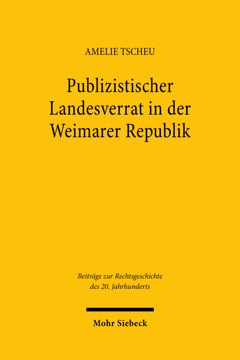
BOOK: Amelie TSCHEU, Publizistischer Landesverrat in der Weimarer Republik [Beiträge zur Rechtsgeschichte des 20. Jahrhunderts] (Tübingen: Mohr Siebeck, 2024), 380 p., ISBN 978-3-16-163808-4

 Cover von 'undefined'

Book abstract:

Nach der Niederlage im 1. Weltkrieg verpflichtete der Versailler Friedensvertrag das Deutsche Reich zu einer weitreichenden militärischen Abrüstung. Pazifistischen Journalisten, die über illegale Rüstungsmaßnahmen der Reichswehr berichteten, drohte unter dem Vorwurf des publizistischen Landesverrats ein Verfahren vor dem Leipziger Reichsgericht. Dessen Urteile gegen Kritiker der illegalen Rüstung gelten in der bisherigen Forschung als exemplarischer Beleg der antirepublikanischen Weimarer Justiz. Demgegenüber zeigt Amelie Tscheu die kontinuierliche Wechselwirkung zwischen der Rechtsprechung des Reichsgerichts und der Außen- und Militärpolitik der Weimarer Regierungskabinette im Verlauf der 1920er- und frühen 30er-Jahre auf. Sie verbindet die Analyse klassisch rechtswissenschaftlicher und allgemein geschichtswissenschaftlicher Quellen, um den publizistischen Landesverrat als politische Straftat im Spannungsfeld von Recht und Politik zu begreifen.

Table of contents: 

Einleitung
A. Einführung in die Thematik des publizistischen Landesverrats in der Weimarer Republik

B. Vom Kaiserreich zur Republik

C. Die Verfahren wegen publizistischen Landesverrats im Kontext der militärpolitischen Entwicklungen

D. Der publizistische Landesverrat als politische Straftat und das Verhältnis der Judikative zum republikanischen Staatssystem

E. Der Fall Felix Fechenbach vor dem bayerischen Volksgericht 1922 und das Verfahren gegen Walter Oehme (Urteil vom 28.08.1923 - 7J69/23)

F. Der Ponton-Prozess gegen Friedrich Küster und Berthold Jacob (Urteil vom 14.03.1928 - 7J63/25, RGSt 62,65)

G. Der Weltbühne-Prozess gegen Carl von Ossietzky und Walter Kreiser (Urteil vom 23.11.1931 - 7J35/29)

Read more here.

05 September 2023

SYMPOSIUM: 'Imagining Peace in the Long Nineteenth Century (1789-1914). In Search of New Actors and Vocabularies' (Brussels: Vrije Universiteit Brussel, 15 SEPT 2023) [Hybrid]


Imagining Peace in the Long Nineteenth Century (1789-1914)  
In Search of New Actors and Vocabularies  


Programme

15 September 2023

Room I.0.02

9:30 – 9:45
Opening remarks and introduction by Wouter De Rycke & Raphaël Cahen (Vrije Universiteit Brussel)

9:45 – 10:30
Public keynote by Martti Koskenniemi (University of Helsinki)

The Law of an International Civil Society: The Road not Taken.

10:30 – 11:00
Discussion and audience questions

Room PL.5.5.61

11:30 – 12:00
Stella Ghervas (University of California – Los Angeles)

From Projects to Pacts: The Peace Plan as Genre in the Age of Revolutions.

12:00 – 13:00

Lunch break

13:00 – 13:30
Hendrik Simon (Peace Research Institute Frankfurt)

Imagining Perpetual Peace - A Forgotten Kantian Debate in Early 19th Century.

13:30 – 14:00

Jakob Zollmann (Berlin Social Science Center)

Eduard Loewenthal and the Future of Peace in Imperial Germany. Considerations of a would-be Nobel Peace Prize Winner.

14:00 – 14:30
Miroslav Šedivý (University of Pardubice)

The Search for New International Law and Lasting Peace in Mid-19th Century Geopolitical Debates. German and Italian Nationalist Responses to Insecurity.

14:30 – 15:00
Wouter De Rycke (Vrije Universiteit Brussel)

Justifying Utopia. The Mid-Nineteenth Century International Peace Movement and International Law.

15:00 – 15:30

Coffee break

15:30 – 16:00
Eliana Augusti (University of Salento)

The Imagined Peace and the Lost Words in the European Long Nineteenth Century.

16:00 – 16:30
Miloš Vec (University of Vienna)

Neither War nor Peace? Armed Reprisals in 19th-Century International Legal Doctrine.

16:30 – 17:00
Thomas Hippler (University de Caen Normandie)

17:00 – 17: 30

Concluding remarks

10 December 2021

BOOK: Petra SCHÖNEMANN-BERHENS, Alfred Hermann Fried: Peace Activist and Nobel Prize Laureate (Leiden: Brill, 2021). ISBN: 978-90-04-47037-8, € 116.00

(Source: Brill)

ABOUT THE BOOK

Petra Schönemann-Behrens provides an informative review of the life and times of Alfred H. Fried (1864-1921), a significant if underappreciated German pacifist of the late nineteenth century and early twentieth century. In response to the militarism and international anarchy of the European states, Fried developed his unique notion of “revolutionary” or “scientific” pacifism, differentiating it from reform pacifism, in order to address the material causes of war. As theorist, practitioner, and journalist, Fried advanced radical ideas at the time: the formation of a pan-European union, the establishment of an effective international court of arbitration, the elimination of a secretive diplomatic class, and the expansion of international economic and cultural cooperation. 

This book is a translation of the German biography Alfred H. Fried: Friedensaktivist–Nobelpreisträger, published by Römerhof Verlag in 2011, and commemorates the 100th anniversary of Fried’s death. 

ABOUT THE AUTHOR AND TRANSLATORS

Petra Schönemann-Behrens, Dr. phil. (2004), is a teacher of history, ethics and German at Gymnasium Wildeshausen near Oldenburg, Germany. She has published articles on historical peace research, mainly on A. H. Fried, and contributed to various radio and TV programs on this topic. 

Edward T. Larkin, Ph.D. (1986), is Professor Emeritus of German at the University of New Hampshire (USA). In addition to having published numerous articles on major German and Austrian authors, he has also published six book-length translations. 

Thomas B. Ahrens, Ph.D. (1998), is Director of Convocations at Berea College (USA). A long-time college educator and academic author, he has published translations of Austrian authors in the refereed online journal No Man’s Land as well as two novels.

TABLE OF CONTENTS

Foreword 
Preface 
Acknowledgments 

1 Childhood and Youth 
 1 The Early Years 
 2 Apprenticeship with a Bookseller and Fried’s First Experiences of Pacifism 

2 The Berlin Years 1884–1903 
 1 From Apprentice Bookseller to Publisher 
 2 Alfred H. Fried and Company 
 3 The Path to the Peace Movement 
 4 Experiments 
  4.1 Fried’s Hygienic Trash Collection and Removal Apparatus 
  4.2 The Self-Dating Envelope 
  4.3 An Election Atlas 
  4.4 Supplemental Encyclopedia 
 5 The Conference at The Hague 1899 
  5.1 The Founding of the Friedens-Warte in 1899 
 6 Consolidation Attempts around 1900 
  6.1 Esperanto 
 7 Flight from Berlin (1903) 

3 The Vienna Years, 1903–1915 
 1 A Reluctant Return Home 
 2 Fried, von Suttner, and the Austrian Peace Society 
 3 Work as a Journalist to 1907 
 4 Impulses from the Hague 
 5 The Foundations of Revolutionary Pacifism, 1908 
 6 Integration and Recognition 
 7 The Association of International Understanding 
 8 Nobel Peace Prize in 1911 and Honorary Doctorate in 1913 
 9 Before the Great War 

4 In Swiss Exile 1914/15–1919 
 1 The Move to Berne 
 2 1916: In the Crossfire of the Critics 
 3 Swiss Exile from 1917 to the End of the War 
 4 After the War – the Final Months in Switzerland 

5 Everywhere a Foreigner 
 1 Back to Vienna, via Munich 
 2 Final Works and Plans 
 3 Obituaries and Testimonials 

6 Survivors and Successors 
 1 Therese Fried 
 2 Fried and German Pacifism after 1921 

Die Friedens-Warte 
 1 The First Years 1899–1904 
 2 Consolidation Phase 1904–1909 
 3 Period of Growth, 1910–1914 
 4 War Censorship and the Path into Exile 
 5 Die Friedens-Warte in Swiss Exile 
 6 The Friedens-Warte after the War, 1918–1919 
 7 The Conflict over Succession, 1921–1924 
 8 The Friedens-Warte under Hans Wehberg, 1924 – 1962 
 9 A New Beginning in 1974 

Epilogue 
Appendix 1: To my beloved wife 
Appendix 2: Program of Revolutionary Pacifism, 1908 
Bibliography 
Index 


More information with the publisher.