Search

Showing posts with label US Supreme Court. Show all posts

25 January 2023

BOOK: Mary ZIEGLER, Roe: The History of a National Obsession (New Haven, CT: Yale University Press, 2023), 248 pp., ISBN 9780300266108, $27


(image source: Yale University Press)
Book description:
What explains the insistent pull of Roe v. Wade? Abortion law expert Mary Ziegler argues that the U.S. Supreme Court decision, which decriminalized abortion in 1973 and was overturned in 2022, had a hold on us that was not simply the result of polarized abortion politics. Rather, Roe took on meanings far beyond its original purpose of protecting the privacy of the doctor-patient relationship. It forced us to confront questions about sexual violence, judicial activism and restraint, racial justice, religious liberty, the role of science in politics, and much more.

In this history of what the Supreme Court’s best-known decision has meant, Ziegler identifies the inconsistencies and unsettled issues in our abortion politics. She urges us to rediscover the nuance that has long resided where we would least expect to find it—in the meaning of Roe itself.
About the author: 
Mary Ziegler is the Martin Luther King Jr. Professor of Law at the University of California, Davis, and author of six books on the law, history, and politics of abortion and American conservatism. 
More information can be found here

02 April 2020

BOOK: Edward A. PURCELL, Antonin Scalia and American Constitutionalism : The Historical Significance of a Judicial Icon (Oxford: Oxford University Press, 2020). ISBN 9780197508763, £22.99


(Source: OUP)

Oxford University Press is publishing a new book on the historical significance of former USSC Justice Antonin Scalia.

ABOUT THE BOOK

Antonin Scalia and American Constitutionalism is an in-depth study of Justice Antonin Scalia's jurisprudence, his work on the Supreme Court, and his significance in the history of American constitutionalism. After tracing Scalia's rise to Associate Justice and his subsequent emergence as a hero of the Republican Party and the political right, this book reviews and criticizes his general jurisprudential theory, arguing that he failed to produce either the objective method he claimed or the correct constitutional results he promised. Focusing on his judicial performance over his thirty years on the Court, it examines his decisions and opinions on virtually all of the constitutional issues he addressed from the fundamentals of structure (federalism, separation of powers, and the Article III judicial power) to specific interpretations of most major constitutional provisions involving governmental powers and the rights of individuals under the Bill of Rights and the Fourteenth Amendment. This book argues that Scalia applied his jurisprudential theories in inconsistent and contradictory ways and often ignored, distorted, or abandoned the interpretive methods he proclaimed to reach the results he sought, results that were aligned with and supported by the post-Reagan Republican coalition. Scalia was far more consistent in enforcing such ideologically compatible results than he was in following his proclaimed jurisprudential theories. Finally, assessing Scalia's historical significance, Antonin Scalia and American Constitutionalism argues that his jurisprudence and career are particularly illuminating because they exemplify—contrary to his persistent claims—three paramount characteristics of American constitutionalism: the inherent inadequacy of originalism and other formal interpretive methodologies to produce consistent and correct answers to controverted constitutional questions; the close relationship that exists, particularly so in Scalia's case, between constitutional theories and interpretations on one hand and substantive political goals and values on the other; and the unavoidably living nature of American constitutionalism itself. All in all, Scalia stands as a towering figure of irony because his judicial career deconstructed the central claims of his own jurisprudence.

ABOUT THE AUTHOR

Edward A. Purcell, Jr., Joseph Solomon Distinguished Professor of Law, New York Law School

TABLE OF CONTENTS

Acknowledgments
Introduction
I. PUBLIC ACTOR
Chapter 1: Icon
Chapter 2: Theorist
II. SUPREME COURT JUSTICE
Chapter 3: An Angle of Vision
Chapter 4: A Subjective Jurisprudence: The Structural Constitution
Chapter 5: An Inconsistent Jurisprudence: The Doctrinal Spectrum
Chapter 6: A Manipulative Jurisprudence: Unprincipled and Expedient Reasoning
Chapter 7: An Arbitrary Jurisprudence: Heller
Chapter 8: An Ignored Jurisprudence: Bush v. Gore
Chapter 9: An Abandoned Jurisprudence: The Nature of the Federal Judicial Power
III. HISTORICAL FIGURE
Chapter 10: The Methodological Fallacy
Chapter 11: The Fusion of Jurisprudence and Politics
Chapter 12: The Nature of American Constitutionalism

More info here

29 November 2019

BOOK: Geoffrey R. STONE and David A. STRAUSS, Democracy and Equality The Enduring Constitutional Vision of the Warren Court (Oxford: Oxford University Press, 2019). ISBN 9780190938208, $24.95


(Source: OUP)

Oxford University Press has published a new book on the US Supreme Court during Chief Justice Warren’s period.

ABOUT THE BOOK

From 1953 to 1969, the Supreme Court under Chief Justice Earl Warren brought about many of the proudest achievements of American constitutional law. The Warren declared racial segregation and laws forbidding interracial marriage to be unconstitutional; it expanded the right of citizens to criticize public officials; it held school prayer unconstitutional; and it ruled that people accused of a crime must be given a lawyer even if they can't afford one. Yet, despite those and other achievements, conservative critics have fiercely accused the justices of the Warren Court of abusing their authority by supposedly imposing their own opinions on the nation.

As the eminent legal scholars Geoffrey R. Stone and David A. Strauss demonstrate inDemocracy and Equality, the Warren Court's approach to the Constitution was consistent with the most basic values of our Constitution and with the most fundamental responsibilities of our judiciary. Stone and Strauss describe the Warren Court's extraordinary achievements by reviewing its jurisprudence across a range of issues addressing our nation's commitment to the values of democracy and equality. In each chapter, they tell the story of a critical decision, exploring the historical and legal context of each case, the Court's reasoning, and how the justices of the Warren Court fulfilled the Court's most important responsibilities.

This powerfully argued evaluation of the Warren Court's legacy, in commemoration of the 50th anniversary of the end of the Warren Court, both celebrates and defends the Warren Court's achievements against almost sixty-five years of unrelenting and unwarranted attacks by conservatives. It demonstrates not only why the Warren Court's approach to constitutional interpretation was correct and admirable, but also why the approach of the Warren Court was far superior to that of the increasingly conservative justices who have dominated the Supreme Court over the past half-century.

ABOUT THE AUTHORS

Geoffrey R. Stone is the Edward H. Levi Distinguished Service Professor at the University of Chicago. He has served as Dean of the University of Chicago Law School and as Provost of the University of Chicago, and is the author of many books on constitutional law, including Sex and the Constitution and Perilous Times.


David A. Strauss is the Gerald Ratner Distinguished Service Professor of Law and the Faculty Director of the Supreme Court and Appellate Clinic at the University of Chicago. He is the author of many important articles on constitutional law and of the influential book The Living Constitution.

TABLE OF CONTENTS

Introduction
Chapter 1:Brown v. Board of Education (1954) Chapter 2: Mapp v. Ohio (1961)
Chapter 3: Engel v. Vitale (1962)
Chapter 4: Gideon v. Wainwright (1963) Chapter 5: New York Times v. Sullivan (1964) Chapter 6: Reynolds v. Sims (1964)
Chapter 7: Griswold v. Connecticut (1965)
Chapter 8: Miranda v. Arizona (1966)
Chapter 9: Loving v. Virginia (1967) Chapter 10: Katz v. United States (1967) Chapter 11: Shapiro v. Thomson (1969)
Chapter 12: Brandenburg v. Ohio (1969)
Notes
Bibliography

More information here

29 August 2019

BOOK: David G. DALIN, Jewish Justices of the Supreme Court From Brandeis to Kagan (Lebanon (New Hampshire): Brandeis University Press, 2017). ISBN 978-1-61168-238-0, $35.00


Brandeis University Press has published a book on Jewish justices in the history of the US Supreme Court in 2017 which we had not yet reported on. 

ABOUT THE BOOK

The first history of the eight Jewish men and women who have served or who currently serve as justices of the Supreme Court

Jewish Justices of the Supreme Court examines the lives, legal careers, and legacies of the eight Jews who have served or who currently serve as justices of the U.S. Supreme Court: Louis D. Brandeis, Benjamin Cardozo, Felix Frankfurter, Arthur Goldberg, Abe Fortas, Ruth Bader Ginsburg, Stephen G. Breyer, and Elena Kagan.

David Dalin discusses the relationship that these Jewish justices have had with the presidents who appointed them, and given the judges’ Jewish background, investigates the antisemitism some of the justices encountered in their ascent within the legal profession before their appointment, as well as the role that antisemitism played in the attendant political debates and Senate confirmation battles.
Other topics and themes include the changing role of Jews within the American legal profession and the views and judicial opinions of each of the justices on freedom of speech, freedom of religion, the death penalty, the right to privacy, gender equality, and the rights of criminal defendants, among other issues.

TABLE OF CONTENTS
• Acknowledgments
• Before Brandeis: Presidents, Presidential Appointments, and America’s Jews, 1813–1912
• Louis D. Brandeis: “People’s Attorney,” Presidential Adviser, and Zionist
• Justice Brandeis: Supreme Court Nomination and Senate Confirmation Fight
• Benjamin N. Cardozo: Redeeming the Family Name
• Felix Frankfurter: City College to the New Deal
• Mr. Justice Frankfurter: The Court Years
• Arthur J. Goldberg: A Promising Tenure Cut Short
• Abe Fortas: A Tale of Achievement and Scandal
• Three Jewish Justices: Ginsburg, Breyer, and Kagan Join the Court
• Notes
• Index
ABOUT THE AUTHOR
DAVID G. DALIN, a historian and rabbi, is the author, coauthor or editor of eleven books, including Religion and State in the American Jewish Experience (coauthored with Jonathan D. Sarna) and The Presidents of the United States and the Jews. His articles and book reviews have appeared in a variety of publications, including American Jewish History, Commentary, Modern Judaism, the Weekly Standard, the American Jewish Year Book, and the Jewish Review of Books.

All info here

11 July 2019

BOOK: Keith E. WHITTINGTON, Repugnant Laws : Judicial Review of Acts of Congress from the Founding to the Present (Lawrence: University Press of Kansas, 2019). ISBN 9780700627790, €42.43


(Source: Bookdepository)

The University Press of Kansas has published a new book on judicial review, and the striking down of statutes by the USSC.

ABOUT THE BOOK

When the Supreme Court strikes down favored legislation, politicians cry judicial activism. When the law is one politicians oppose, the court is heroically righting a wrong. In our polarized moment of partisan fervor, the Supreme Court's routine work of judicial review is increasingly viewed through a political lens, decried by one side or the other as judicial overreach, or "legislating from the bench." But is this really the case? Keith E. Whittington asks in Repugnant Laws, a first-of-its-kind history of judicial review.

A thorough examination of the record of judicial review requires first a comprehensive inventory of relevant cases. To this end, Whittington revises the extant catalog of cases in which the court has struck down a federal statute and adds to this, for the first time, a complete catalog of cases upholding laws of Congress against constitutional challenges. With reference to this inventory, Whittington is then able to offer a reassessment of the prevalence of judicial review, an account of how the power of judicial review has evolved over time, and a persuasive challenge to the idea of an antidemocratic, heroic court. In this analysis, it becomes apparent that that the court is political and often partisan, operating as a political ally to dominant political coalitions; vulnerable and largely unable to sustain consistent opposition to the policy priorities of empowered political majorities; and quasi-independent, actively exercising the power of judicial review to pursue the justices' own priorities within bounds of what is politically tolerable.

The court, Repugnant Laws suggests, is a political institution operating in a political environment to advance controversial principles, often with the aid of political leaders who sometimes encourage and generally tolerate the judicial nullification of federal laws because it serves their own interests to do so. In the midst of heated battles over partisan and activist Supreme Court justices, Keith Whittington's work reminds us that, for better or for worse, the court reflects the politics of its time.

ABOUT THE AUTHOR

Keith E. Whittington is William Nelson Cromwell Professor of Politics at Princeton University. His many books include Political Foundations of Judicial Supremacy, Speak Freely, and, also from Kansas, Constitutional Interpretation. 

More information here

02 May 2019

BOOK: Stephen BUDIANSKY, Oliver Wendell Holmes : A Life in War, Law, and Ideas (New York: W.W. Norton & Company, Inc., 2019). ISBN 978-0-393-63472-3, $29.95


(Source: W.W. Norton)

W.W. Norton is publishing a new book on Oliver Wendell Holmes.

ABOUT THE BOOK

The extraordinary story of the U.S. Supreme Court’s most influential justice.
Oliver Wendell Holmes twice escaped death as a young Union officer in the Civil War when musket balls missed his heart and spinal cord by a fraction of an inch at the Battles of Ball’s Bluff and Antietam. He lived ever after with unwavering moral courage, unremitting scorn for dogma, and an insatiable intellectual curiosity.

Named to the Supreme Court by Theodore Roosevelt at age sixty-one, he served for nearly three decades, writing a series of famous, eloquent, and often dissenting opinions that would prove prophetic in securing freedom of speech, protecting the rights of criminal defendants, and ending the Court’s reactionary resistance to social and economic reforms.

As a pioneering legal scholar, Holmes revolutionized the understanding of common law by showing how the law always evolved to meet the changing needs of society. As an enthusiastic friend and indefatigable correspondent, he wrote thousands of personal letters brimming with humorous philosophical insights, trenchant comments on the current scene, and an abiding joy in fighting the good fight.

Drawing on many previously unpublished letters and records, Stephen Budiansky’s definitive biography offers the fullest portrait yet of this pivotal American figure, whose zest for life, wit, and intellect left a profound legacy in law and Constitutional rights, and who was an inspiring example of how to lead a meaningful life in a world of uncertainty and upheaval.

ABOUT THE AUTHOR

Stephen Budiansky is a historian, author, and journalist whose writing has appeared in the Atlantic, the New York Times, the Wall Street Journal, and the Washington Post. A recipient of the Guggenheim Fellowship, he resides in Loudoun County, Virginia.

More information here

22 April 2019

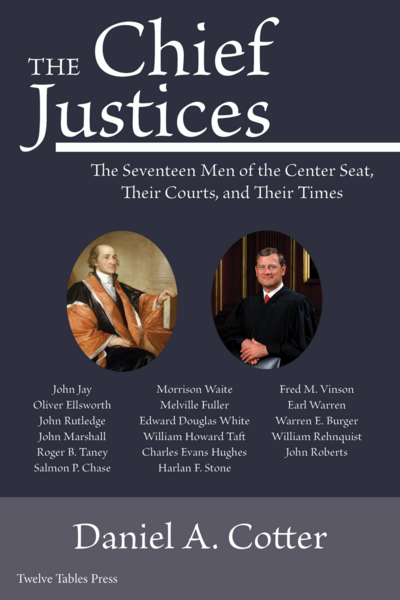
BOOK: Daniel A. COTTER, The Chief Justices - The Seventeen Men at the Center Seat, Their Courts, and Their Times (Northport: Twelve Tables Press, 2019). ISBN 978-1-94607-425-6, $26.95


(Source: CAP Press)

Twelve Tables Press has published a new book on the Chief Justices of the USSC.

ABOUT THE BOOK

Since the beginning of the Supreme Court of the United States in 1789, seventeen men have held the Chief Justice position. The first three held the position for a total of eleven years, and the next two (Marshall and Taney) held the Chief Justice position for the next sixty-three years (the two longest chiefs in our history). This book seeks to examine the position of Chief Justice more closely, to describe the position's origins and duties, and to explore the court under each of the seventeen chiefs. Discussions cover the background and careers of the chiefs before becoming Chief Justice as well as the cultural times, in order to put their rise and tenure in our nation's context, while discussing some of the key associate justices who sat with each of the seventeen. Each chapter also focuses on some key decisions of the Chief Justices' courts.

ABOUT THE AUTHOR

Daniel A. Cotter is a lawyer who practices corporate, transactional, privacy, and insurance, regulatory law in Chicago. He is a Past President of the Chicago Bar Association and an Adjunct Professor at the John Marshall Law School, where he teaches a course on SCOTUS and judicial biography.

TABLE OF CONTENTS

Can be found here

More information here

17 October 2018

BOOK: Steven T. SEITZ, The Supreme Court, the Constitution, and William Rehnquist (Lanham: Rowman & Littlefield, 2018). ISBN 978-1-4985-6882-1, $105.00


Rowman & Littlefield is publishing a book on the history of several constitutional clauses as interpreted in particular by the Rehnquist Court.

ABOUT THE BOOK

The Founding Fathers wrote the Constitution at a level sufficiently general to guide lawmaking while avoiding great detail. This four-page document has guided the United States of America for more than two centuries. The Supreme Court has parsed the document into clauses, which plaintiffs and defendants invoke in cases or controversies before the Court. Some, like the Interstate Commerce Clause, are central to the survival of a government of multiple sovereignties. The practice of observing case precedents allows orderly development of the law and consistent direction to the lower courts. The Court itself claimed the final power of judicial review, despite efforts to the contrary by the executive and legislative branches of the national government and the state supreme courts. The Court then limited its own awesome power through a series of self-imposed rules of justiciability. These rules set the conditions under which the Court may exercise the extraordinary final power of judicial review. Some of these self-imposed limits are prudential, some logical, and some inviting periodic revision. This book examines the detailed unfolding of several Constitutional clauses and the rules of justiciability. For each clause and each rule of justiciability, the book begins with the brilliant foundations laid by Chief Justice John Marshall, then to the anti-Federalist era, the Civil War, the dominance of laissez faire and social Darwinism, the Great Depression redirection, the civil rights era, and finally the often-hapless efforts of Chief Justice Rehnquist

ABOUT THE AUTHOR

Steven T. Seitz is associate professor of political science at University of Illinois at Urbana–Champaign.

TABLE OF CONTENTS

Preface
Chapter 1: State Sovereignty
Chapter 2: Full Faith and Credit
Chapter 3: Privileges and Immunities
Chapter 4: Interstate Commerce Clause
Chapter 5: The Administrative State
Chapter 6: Justiciability and Habeas Corpus
Chapter 7: Standing, Ripeness, Political Question
Chapter 8: Federal Question
Works Cited
Cases Cited

More information here

10 July 2018

BOOK : Stephanie L. SLATER, Edward Terry Sanford - A Tennessean on the U.S. Supreme Court (Knoxville: The University of Tennessee Press, 2018). ISBN 9781621903697, $65.00


The University of Tennessee Press has recently published a book on the life of Justice Sanford.

ABOUT THE BOOK

In Edward Terry Sanford: A Tennessean on the U.S. Supreme Court, Stephanie Slater uncovers the life and work of Edward Terry Sanford (1865–1930), the only Supreme Court justice who obtained his undergraduate degree from the University of Tennessee.  Born and raised in Knoxville, Sanford served as an associate justice on the United States Supreme Court from 1923 until his death in 1930.  He was one of only six Tennesseans to serve on the nation’s highest Court.

Slater’s delineation of Sanford’s contributions to the legal profession illuminates one of Tennessee’s favorite sons whose story had, until now, been largely left in the dark.  Slater frames Sanford’s personality and jurisprudence in a post-Civil War and Taft-era context, one that helps readers better understand both the man and his contributions to the Supreme Court.

From Slater’s important work we learn about Sanford’s early upbringing, the lasting impression a largely pro-Union East Tennessee would leave upon Sanford, his rise from a skilled lawyer to federal judge during the rapid industrialization of Knoxville and the surrounding area, and his eventual appointment to the Supreme Court.  Within Sanford’s rich legacy is the pivotal role he played in writing the majority opinion in the landmark 1925 case, Gitlow v. New York, a decision which became a critical legal precedent for the expansion of civil rights and civil liberties in the 1950s and 1960s.

Slater provides a keen look into the life of a Knoxville native whose life and career may now be appreciated and studied by a new generation. Sanford, his character, and his life as a Tennessean on the Supreme Court are sure to intrigue legal scholars, students of Tennessee culture and history, and general audiences alike.

ABOUT THE AUTHOR

Stephanie L. Slater, a three-time graduate of the University of Tennessee, has worked in the state and federal court systems in Tennessee since obtaining her J.D. in 1990. Her articles have appeared in the Journal of Supreme Court History and Tennessee Law Review.

More information here