Search

Showing posts with label American civil war. Show all posts

23 March 2020

BOOK REVIEWS: American Journal of Legal History on the crime of laesio majestatis under the French Revolution, and on Southern Law Colleges during the American Civil War (Advance articles)

(image source: Oxford Journals)

Chrystelle Gazeau (Lyon III) reviewed  Jean-Christophe Gaven, Le crime de lèse-nation: histoire d'une invention juridique et politique, 1789-1791, Paris,  Presses de Sciences Po, Domaine droit,  2016, pp.  559

First paragraph:
The security principle which emerged in 1789 during the Enlightenment has two complementary implications: the protection of the individual in the exercise of his or her rights and the protection of the community. It acknowledges that the State must have the means to assume the protective role assigned to it under the social contract, but which it could not perform if it was itself in danger. As is well known, the debates concerning the equilibrium between protection of the individual and protection of the State continues to this day among the democracies. Under exceptional circumstances, could the State be at risk of losing its founding liberal aspirations? 
Kelly Kennington (Auburn University) reviewed  Alfred L.Brophy, University, Court, & Slave: Pro-Slavery Thought in Southern Colleges & Courts & the Coming of Civil War (New York:  Oxford University Press,  2016). xxvi,  373pp. $41.95. 978-0-19-996423-9.
First paragraph:
In his most recent book, legal scholar Al Brophy investigates the world of antebellum intellectuals who debated the issue of slavery. Bringing together the writings of academics at southern universities and the opinions of appellate judges in cases related to slavery is his primary goal, but these two source bases are just the beginning of his sweeping survey of slavery ideology from the 1830s to secession. His impressive research and broad thinking on the subject allow Brophy to make larger claims about the role of law and constitutionalism in American culture, as well as the importance of the antebellum era to later jurisprudence.  
More information with Oxford Journals.

22 October 2019

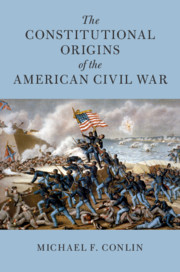
BOOK: Michael F. CONLIN, The Constitutional Origins of the American Civil War (Cambridge: Cambridge University Press, 2019). ISBN 9781108495271, £ 39.99


(Source: CUP)

Cambridge University Press has recently published a book on the constitutional origins of the US Civil War.

ABOUT THE BOOK

In an incisive analysis of over two dozen clauses as well as several 'unwritten' rules and practices, The Constitutional Origins of the American Civil War shows how the Constitution aggravated the sectional conflict over slavery to the point of civil war. Going beyond the fugitive slave clause, the three-fifths clause, and the international slave trade clause, Michael F. Conlin demonstrates that many more constitutional provisions and practices played a crucial role in the bloody conflict that claimed the lives of over 750,000 Americans. He also reveals that ordinary Americans in the mid-nineteenth century had a surprisingly sophisticated knowledge of the provisions and the methods of interpretation of the Constitution. Lastly, Conlin reminds us that many of the debates that divide Americans today were present in the 1850s: minority rights vs. majority rule, original intent vs. a living Constitution, state's rights vs. federal supremacy, judicial activism vs. legislative prerogative, secession vs. union, and counter-majoritarianism vs. democracy.

ABOUT THE AUTHOR

Michael F. ConlinEastern Washington University

Michael F. Conlin is Professor of History at Eastern Washington University and author of One Nation Divided by Slavery: Remembering the American Revolution while Marching toward the Civil War (2015).

TABLE OF CONTENTS

1. The original intent of the slaveholding founders
2. Two constitutional wrongs did not guarantee a constitutional right
3. The tyranny of the Northern majority
4. The spirit of 1787
5. The constitutional right of secession
Epilogue: the Founders' constitution no more.

More information here

05 June 2019

BOOK: Robert ICENHAUER-RAMIREZ, Treason on Trial : The United States v. Jefferson Davis (Baton Rouge: LSU Press, 2019). ISBN 9780807170809, $55.00


(Source: LSU Press)

LSU Press has published a new book on the indictment of Jefferson Davis after the US civil war.

ABOUT THE BOOK

In the immediate aftermath of the Civil War, federal officials captured, imprisoned, and indicted Jefferson Davis for treason. He faced execution if found guilty for his role in levying war against the United States. Although the federal government pursued the charges for over four years, the case never went to trial. Most historical analyses of the case focus on interpreting the political reasons why that happened by analyzing the reasons in the broadest national contours. According to Robert Icenhauer-Ramirez, these global assessments, while important, do not attempt to discern how the lives and experiences of those individuals responsible for either prosecuting or defending Davis, or those with a direct interest in the outcome, influenced the handling of the case. He argues that while national politics had a role in the direction of the case, it was the actions and decisions of lesser-known men and women that ultimately were responsible for the failure to convict Davis. Treason on Trial: The United States v. Jefferson Davis focuses on precisely why that happened.

ABOUT THE AUTHOR

Robert Icenhauer-Ramirez is an attorney based in Austin, TX. He earned a doctorate in history at the University of Texas, Austin.

More information here

26 October 2018

BOOK: Paul FINKELMAN and Donald R. KENNON, eds., Civil War Congress and the Creation of Modern America: A Revolution on the Home Front (Athens: Ohio University Press, 2018). ISBN 978-0-8214-2338-7, $35.00


In December, Ohio University Press is publishing a new book on Congress during the Civil War.

ABOUT THE BOOK

Most literature on the Civil War focuses on soldiers, battles, and politics. But for every soldier in the United States Army, there were nine civilians at home. The war affected those left on the home front in many ways. Westward expansion and land ownership increased. The draft disrupted families while a shortage of male workers created opportunities for women that were previously unknown.

The war also enlarged the national government in ways unimagined before 1861. The Homestead Act, the Land Grant College Act, civil rights legislation, the use of paper currency, and creation of the Internal Revenue Service to collect taxes to pay for the war all illustrate how the war fundamentally, and permanently, changed the nation.

The essays in this book, drawn from a wide range of historical expertise and approaching the topic from a variety of angles, explore the changes in life at home that led to a revolution in American society and set the stage for the making of modern America.

Contributors: Jean H. Baker, Jenny Bourne, Paul Finkelman, Guy Gugliotta, Daniel W. Stowell, Peter Wallenstein, Jennifer L. Weber.

ABOUT THE EDITORS

Paul Finkelman is an expert on constitutional history, the law of slavery, and the American Civil War. He coedits the Ohio University Press series New Approaches to Midwestern Studies and is the president of Gratz College.  

Donald R. Kennon is the former chief historian and vice president of the United States Capitol Historical Society. He is editor of the Ohio University Press series Perspectives on the History of Congress, 1789–1801

More information here