The Rechtsgeschiedenis Blog just announced the following:
A few days ago the French legal history blog Nomôdos, the twin sister of the e-journal Clio@Themis, announced the first issue of the Rivista di Diritto Ellenico, a journal devoted to the study of ancient Greek law.
This new journal is edited by scholars at Torino, Isernia and Verona. The Rivista di Diritto Ellenico is published in open access, but there is a connection with the publishing firm Edizioni dell’Orso in Alessandria. The first issue of the Rivista di Diritto Ellenico contains eleven articles and seven book reviews. The translation in Italian of an article from 1963 by Hans-Julius Wolff, ‘Verjährung von Ansprüchen nach Attischen Recht’, is a service which could very well be inspired by the translation into French of classic articles in each issue of Clio@Themis. All contributions in the first issue are in Italian. However, the editors invite authors to submit articles in Italian, English, French, German, Dutch, Spanish and modern Greek.
Search
18 December 2011
15 December 2011
NOTICE: 66th Session of the Société Internationale ‘Fernand de Visscher’ pour l’Histoire des Droits de l’Antiquité (SIHDA)
The following notice on 66th Session of the Société Internationale ‘Fernand de Visscher’ pour l’Histoire des Droits de l’Antiquité (SIHDA) will take place from 18-21 September 2012 in Oxford.

The notice reads:
First circular
Oxford
14 December 2011
Dear colleages,
I am very pleased to invite you to the 66th Session of the Société Internationale ‘Fernand de Visscher’ pour l’Histoire des Droits de l’Antiquité (SIHDA), which will take place from 18 to 21 September 2012 in Oxford. In accordance with the decision taken by the last General Assembly, the theme of the congress will be Reception of Law.
In this First Circular I shall provide you with general information regarding the congress. In the course of January you will receive a Second Circular with information on how to registration.
The congress will start in the afternoon of Tuesday 18 September and end on Friday 21 September with the General Assembly. A Banquet dinner is foreseen for that Friday night, and excursions are planned for Saturday 22 September.
The theme is ‘Reception of Law’. It is a wide theme, which covers, e.g., the reception of Assyrian law by the Mesopotamians, Greek law by Egyptians, Roman law by the Greeks in the 4th and 5th century, by the Gallic population in the 6th century, but also, as the name of our association implies (‘Histoire des droits de l’Antiquité’), the reception of Roman law after 1100, and I welcome particularly contributions concerning the reception of Roman law after 1100 in Europe, the ‘Civil Law’. Yet, as is the custom of our association, papers on other themes than the proposed are of course always welcome and appreciated, in one of the five accepted languages (French, English, German, Italian and Spanish).
11 December 2011
NOTICE: Griffith Law School’s Legal History Seminar Series
Information on the Griffith Law School (Australia) Legal History Seminar Series. The Series:
is a gesture to the interdisciplinary turns in legal history, and a contribution to the innovation at the heart of much contemporary legal history scholarship.

The LHSS aims to showcase legal history’s international and comparative flavour; it welcomes all who are interested in legal history’s present and future significance. Its aim is to participate in reinvigorating, and enlivening, an interest in the critically reflective directions of legal history, both in Queensland and elsewhere.
is a gesture to the interdisciplinary turns in legal history, and a contribution to the innovation at the heart of much contemporary legal history scholarship.
The LHSS aims to showcase legal history’s international and comparative flavour; it welcomes all who are interested in legal history’s present and future significance. Its aim is to participate in reinvigorating, and enlivening, an interest in the critically reflective directions of legal history, both in Queensland and elsewhere.
26 November 2011
CALL FOR PAPERS: New Historia et Ius Journal
Historia et Ius is an on-line International journal dedicated to medieval, modern and contemporary historical legal studies. Founded after the initiative of a group Italian legal historians, the journal is supported by an editorial board composed by European legal historians of high scientific profile.

The journal’s main purpose is to provide an agile and easy to use tool aimed at disseminating the results of legal-historical researches at the international level, as well as facilitating the exchange of ideas and methods.
Historia et Ius, International journal of medieval and modern legal history, invites interested scholars to send articles and texts for publication in the No. 1 of the journal, which will be posted on the web on the 1st of July, 2012. Articles and texts for publication should be sent to the editorial board by the 29th of February, 2012.
REMINDER: ESCLH Conference (9-10 July 2012)
The Second ESCLH Conference will be held in Amsterdam from 9-10 July 2012. The theme is:

Under the heading “Definitions and Challenges” the confernce will try to delineate the landmarks which fruitful legal historical comparison requires and to trace the specific problems that a comparative-historical approach of the various branches of law may encounter. The keynote address will be delivered by David Ibbetson, Regius Professor of Civil Law at the University of Cambridge.
The deadline for proposals is 1 January 2012. For additional information, see the original conference notice and the conference website.
COMPARATIVE LEGAL HISTORY
Definitions and Challenges

Under the heading “Definitions and Challenges” the confernce will try to delineate the landmarks which fruitful legal historical comparison requires and to trace the specific problems that a comparative-historical approach of the various branches of law may encounter. The keynote address will be delivered by David Ibbetson, Regius Professor of Civil Law at the University of Cambridge.
The deadline for proposals is 1 January 2012. For additional information, see the original conference notice and the conference website.
25 November 2011
NOTICE: The Irish Legal History Bursary
The Irish Legal History Bursary
The Irish Legal History Society administers the Irish Legal History Bursary which was established to subvent the travelling expenses of postgraduate students undertaking research into any aspect to Irish legal history.
1. Eligibility:
1.1 Applicants for the Bursary should normally hold at least a second class degree in law or history.
1.2 The Bursary is restricted to student members of the Irish Legal History Society; student membership costs €20 / £15 per annum. Details and membership forms are available at: http://www.ilhs.eu/become_a_member.asp
1.3 The award may be made to any postgraduate student undertaking research into any aspect of Irish legal history. Preference will be shown to postgraduate research students, but others are eligible to apply, including those pursuing taught postgraduate degree programmes provided that such programmes have a substantial research component.
1.4 ‘Legal history’ includes the development or history of legal rules, legal institutions, legal procedures or the legal profession; biographical sketches of legal personalities; the development of legal theories or ideas; comparative legal history.
23 November 2011
Call for Papers: 2012 Meeting of the American Society for Legal History
The 2012 meeting of the American Society for Legal History will take place in St. Louis, Missouri, November 8-11, 2012. The ASLH invites proposals on any facet or period of legal history, anywhere in the world. In selecting presenters, the Program Committee will give preference to those who did not present at last year’s meeting. Among the people selected to present, limited financial assistance will be available for those in need—with special priority given to graduate students and post-docs, as well as scholars traveling from abroad.
14 November 2011
CALL FOR PAPERS: British Crime Historians Symposium 3
Call for papers: British Crime Historians Symposium 3
6-7 September, 2012, The Open University, Milton Keynes
Following on from the success of the British Crime Historians Symposia at Leeds Metropolitan University in 2008 and Sheffield University in 2010, the Open University is pleased to host the next in Milton Keynes on September 6th and 7th, 2012.
We are also especially keen to accept papers which:
* survey the historiography of this field,
* discuss methodological questions with a broader applicability,* analyse historiographical developments in other countries with a view to informing the research agenda in the British Isles, or
* assess the public history of criminal justice.
11 November 2011
New Issue: Journal of the History of International Law - Revue d'histoire du droit international XIII (2011), nr. 2
The latest issue of the Journal of the History of International Law / Revue d'histoire du droit international (Vol. XIII (2011), nr. 2) appeared earlier this week:
Contents:
- John Quigley, Britain's Secret Re-Assessment of the Balfour Declaration. The Perfidy of Albion
- Yang Zewei, Western International Law and China's Confucianism in the 19th Century. Collision and Integration
- Awalou Ouedraogo, La neutralité et l'émergence du concept de due diligence en droit international. L'affaire de l'Alabama revisitée
- Frederik Dhondt, From Contract to Treaty. The Legal Transformation of the Spanish Succession 1659-1713
- William E. Butler, David Bailie Warden and the Development of American Consular Law
03 November 2011
CALLS FOR APPLICATIONS: IMéRA and IEA
Dear colleagues,
Are you looking for a new job or challenge? Good news! I can draw your attention to the following calls for application in France:
- l'Institut Méditerranéen de Recherches Avancées (IMéRA)
02 November 2011
CALL FOR PAPERS: Violence Studies Conference 2012
I've been asked to post the following:

The Humanities Research Institute at the University of Newcastle invites academics from a wide a variety of disciplines — including anthropology, art, criminology, history, international relations, law, literature, psychology, philosophy, political science and sociology — to submit proposals for panels and individual papers at its conference, Histories of Violence, to be held in the city of Newcastle from 21-23 August 2012.
Plenary speakers:
Arjun Appadurai, New York University
Rosemary Gartner, University of Toronto
Gyanendra Pandey, Emory University
Violence Studies Conference 2012
Call for Papers
The Humanities Research Institute at the University of Newcastle invites academics from a wide a variety of disciplines — including anthropology, art, criminology, history, international relations, law, literature, psychology, philosophy, political science and sociology — to submit proposals for panels and individual papers at its conference, Histories of Violence, to be held in the city of Newcastle from 21-23 August 2012.
Plenary speakers:
Arjun Appadurai, New York University
Rosemary Gartner, University of Toronto
Gyanendra Pandey, Emory University
01 November 2011
CALL FOR PAPERS: Entanglements in Legal History: Conceptual Approaches to Global Legal History
I've been asked to post the following exciting conference:
Global History, World History, Imperial History, Atlantic or Pacific History: the variety of transnational historiography is growing ever larger. Hitherto, legal historians have rarely participated in these discourses. On a favourable interpretation, one could argue that legal historians have always thought, researched and worked transnationally – yet this might have different reasons.
It is certain that, in legal history, the exchange and overlapping of different normative spheres beyond territorially-constrained statehood has been the norm: the tiered territorial and legal spheres of influence of antique empires, stratified societies with their regulations tied to civil status, the coexistence of secular normativity and clerical normativity intersecting the secular realm, and finally the complex processes of the period of the ‘Reception’ belong to the classic objects of legal historical research. It has also become clear that the encounter of two hitherto co-existing normative orders, through the intensified exchange and communication since the 16th and particularly during the 19th century in two waves of globalisation, has attracted the interest of legal history.
Entanglements in Legal History:
Conceptual Approaches to Global Legal History
Conference of Legal Historian, Lucerne – 2-6 September 2012
It is certain that, in legal history, the exchange and overlapping of different normative spheres beyond territorially-constrained statehood has been the norm: the tiered territorial and legal spheres of influence of antique empires, stratified societies with their regulations tied to civil status, the coexistence of secular normativity and clerical normativity intersecting the secular realm, and finally the complex processes of the period of the ‘Reception’ belong to the classic objects of legal historical research. It has also become clear that the encounter of two hitherto co-existing normative orders, through the intensified exchange and communication since the 16th and particularly during the 19th century in two waves of globalisation, has attracted the interest of legal history.
29 October 2011
NOTICE: Becker on Medicine, Law, and the State in Imperial Russia
Elisa M Becker (George Washington University)'s Medicine, Law, and the State in Imperial Russia, from the Central European University (CEU) Press might be of interest:
Examines the theoretical and practical outlook of forensic physicians in Imperial Russia, from the 18th to the early 20th centuries, arguing that the interaction between state and these professionals shaped processes of reform in contemporary Russia. It demonstrates the ways in which the professional evolution of forensic psychiatry in Russia took a different turn from Western models, and how the process of professionalization in late imperial Russia became associated with liberal legal reform and led to the transformation of the autocratic state system.
19 October 2011
Call for Papers: XVIIIth Annual Forum of Young Legal Historians (30 May-2 June 2012)
The XVIIIth Annual Forum of Young Legal Historians of the Association of Young Legal Historians (AYLH) will be held in Vienna from 30 May-2 June 2012. The theme is “Making things legal”: Law-making and procedural reality in the European legal traditions:

The secular tradition of modern European jurisprudence agrees on the basic assumption that law is actually ‘made’ in one way or another. The conditions and procedures of law-making are subject to constant change and, accordingly, the creation of legal norms is one of the major areas of research for legal historians. The questions they ask relate to the legitimacy of normative acts, their economic, political and social impetus or even the media of their representation. Scholars direct their attention at all stages of the legislative process, i.e. from the very first considerations to the publication of a legal act.
14 October 2011
NOTICE: Brown and Donlan on The Laws and Other Legalities of Ireland, 1689–1850
Michael Brown (Aberdeen) and Seán Patrick Donlan (Limerick) have published, with Ashgate, The Laws and Other Legalities of Ireland, 1689–1850:
This collection is the first to concentrate attention on the actual relationship that existed between the Irish population and the state under which they lived from the War of the Two Kings (1689–1691) and the Great Famine (1845–1849). Particular attention is paid to an understanding of the legal character of the state and the reach of the rule of law, addressing such themes as how law was made and put into effect; how ordinary people experienced the law and social regulations; and how Catholics related to the legal institutions of the Protestant confessional state. These themes will help to situate the study of Irish society into the mainstream of English and European social history.
The contents include:
- The laws in Ireland, 1689–1850: a brief introduction, Michael Brown and Seán Patrick Donlan
07 October 2011
NOTICE: Rockwell on Spanish and Mexican Law (Lawbook Exchange)
As part of its extraordinary and ongoing mission to republish valuable legal texts of the past, the Lawbook Exchange has announced the publication of
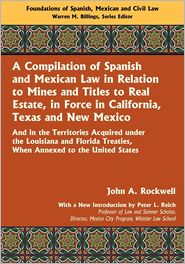
John A Rockwell, A Compilation of Spanish and Mexican Law in Relation to Mines and Titles to Real Estate, in Force in California, Texas and New Mexico; and in the Territories Acquired Under the Louisiana and Florida Treaties When Annexed to the United States (1851), with a new introduction by Peter L Reich
This is the latest text from the Foundations of Spanish, Mexican and Civil Law series (Warren M Billings, series editor). Other titles in the series include:
- Laws and Decrees of the State of Coahuila and Texas in Spanish and English (1839), JP Kimball, trs., with a new introduction by Joseph W McKnight.
- Joseph M White, A New Collection of Laws, Charters and Local Ordinances of the Governments of Great Britain, France and Spain: Relating to the Concessions of Land in their Respective Colonies, Together with the Laws of Mexico and Texas on the Same Subject, to Which is Prefixed Judge Johnson's Translation of Azo and Manuel's Institutes of the Civil Law of Spain (1839), with a new introduction by Agustin Parise.
06 October 2011
NOTICE: Morigiwa, Stolleis, and Halperin on the Interpretation of Law in the Age of Enlightenment
I’ve just become aware of the release (by Springer) of a very interesting text by Yasutomo Morigiwa, Michael Stolleis, and Jean-Louis Halperin (eds), Interpretation of Law in the Age of Enlightenment: From the Rule of the King to the Rule of Law (2011):
This book examines the actual practice of the interpretation of law in the Age of Enlightenment versus the ideology of the Age and explains the reason for and difference between the two. The ideology of the Age of Enlightenment was that law, i.e., the will of the sovereign, can be explicitly and appropriately stated, thus making interpretation redundant. However, the reality was that in the 18th century, there was no one leading source of national law that would be the object of interpretation. Instead, there was a plurality of sources of law: the Roman Law, local customary law, and the royal ordinance. Yet, in deciding a case in a court of law, the law must speak with one voice, making interpretation to unify the norms inevitable. This book discusses the process involved and the role played by justification in terms of reason - the hallmark of Enlightenment.
The table of contents includes:
Editors’ Preface; Morigiwa Yasutomo, Michael Stolleis, Jean-Louis Halpérin.- Foreword from the Herstec Project; Sato Shoichi.- About the Contributors.- I. Introduction.- Judicial Interpretation in Transition from the Ancien Régime to Constitutionalism; Michael Stolleis.- II. The case of France.- Legal Interpretation in France under the Reign of Louis XVI through the Gazette des Tribunaux; Jean-Louis Halpérin.- Legal Interpretation through the Case Law Book of the Parlement de Flandre; Serge Dauchy.- II. The case of Germany.- The Object of Interpretation: Legislation and Competing Normative Sources of Law in Europe during the 16th to 18th Centuries; Heinz Mohnhaupt.- The Concept and Means of Legal Interpretation in the 18th Century; Jan Schröder.- Necessity: Pandectists between Norm and Reality (1780-1870); Hans-Peter Haferkamp.- IV. The Nature of Legal Interpretation.- Interpretation by Another Name; Morigiwa Yasutomo.- What is Interpretation of the Law for the French Judge? Michel Troper.- The Craft of Interpretation ; Bradley Wendel.- Concluding Remarks.- Legal Interpretation in 18th Century Europe: Doctrinal Debates versus Political Change ; Jean-Louis Halpérin.- Index.
30 September 2011
NOTICE: SOLON's Law, Crime and History
SOLON's (2011) 1 Law, Crime & History e-journal is now available.

Contributions include the following articles:
- David Cox, ‘The Wolves let loose at Wolverhampton’: A study of the South Staffordshire Election ‘Riots’, May 1835' 1-31
- Iain Channing, 'Freedom of Expression from the ‘Age of Extremes’ to the ‘Age of Terror’: Reflections on Public Order Law and the Legal Responses to Political and Religious Extremism in 1930s Britain and the Post 9/11 32-57
- Chris Monaghan, In Defence of Intrinsic Human Rights: Edmund Burke’s Controversial Prosecution of Warren Hastings, Governor-General of Bengal 58-107
- Lisa Denmark, Worshipping Bacchus: Prohibition in Savannah, 1899-1922 109-140
- James Windle, Ominous Parallels and Optimistic Differences: Opium in China and Afghanistan 141-164
- Haia Shpayer-Makov, Revisiting the Detective Figure in Late Victorian and Edwardian Fiction: A View from the Perspective of Police History 165-193
26 September 2011
CALL FOR PAPERS: Second EUROPEAN SOCIETY FOR COMPARATIVE LEGAL HISTORY Conference (Amsterdam 9-10 July 2012
The Second ESCLH Conference will be held in Amsterdam from 9-10 July 2012. The theme is:
Comparative Legal History is a relatively young discipline. It focuses explicitly on the comparison of legal ideas and legal institutions in divergent legal traditions. The European Society for Comparative Legal History (ESCLH) was founded in 2009 in order to promote such comparison. Its Inaugural Conference (Valencia, 5-6 July 2010) showed that it is not always easy to find material which is suitable for serious comparison and to establish the criteria which have to be met in order to come to grips with this material.
The Second ESCLH Conference, which will take place on 9-10 July 2012 at Amsterdam and will be hosted by the VU University, aims at addressing this fundamental problem. Under the heading “Definitions and Challenges” it will try to delineate the landmarks which fruitful legal historical comparison requires and to trace the specific problems that a comparative-historical approach of the various branches of law may encounter. The keynote address will be delivered by David Ibbetson, Regius Professor of Civil Law at the University of Cambridge.
As regards the papers for the parallel sessions, the Conference first of all hopes to provide a venue for legal historians and comparatists to present their investigations in order to discuss their work, exchange ideas and broaden their views. For this reason you are invited to propose papers on any subject within the field of comparative legal history.
However, following the methodological problems dealt with under the heading “Definitions and Challenges”, this Conference also aims at presenting investigations into specific areas of law, where legal historical comparison has proven to be fruitful. These investigations have in common that they do not depart from normative legal concepts (which sometimes only seemingly appear to be comparable) but from functional problems of a more factual, meta-juridical nature.
The first is ‘Fascist Criminal Law’ (co-ordinator: Stephen Skinner, University of Exeter). This theme is important in both historical and contemporary terms. A recurrent theme in recent and ongoing work on law and democracy in Europe has been the challenge of dealing with ‘darker’ aspects of law’s ideological, substantive and methodological roots in anti-democratic legal orders. In terms of legal history, grappling with the meanings of ‘fascism’ and the ideological, rhetorical and substantive dimensions of criminal law under fascist regimes requires a comparative approach in order to identify the distinguishing characteristics of such regimes. Arguably, the area of criminal law brings into sharp relief the power-relationship between State and citizen, and as such, it is a key area of law to be studied in order to understand the nature of fascist systems.
The second area, ‘Corporate law’ (co-ordinator: Tammo Wallinga, University of Antwerp), is a field of law which can be analyzed from various legal perspectives, without focussing on the comparison of a specific dogmatic concept. Just as the theme ‘Fascist Criminal law’ touches upon fundamental issues, such as the relationship between State and citizen, corporate law has its own characteristic issues: various types of enterprise – market-related or not – establishment and organization of a company, the relationship with consumers, civil authorities, debtors and creditors, workers’ rights, etc. Here, comparison aims at understanding the changing nature of corporate law within a changing economic context, from medieval society, through the ages of early capitalism and industrialisation to present day issues.
Factual information:
- Please indicate whether your paper is related to the general theme (Comparative Legal History, Definitions and Challenges), one of the specific fields of law (Fascist Criminal Law, Corporate Law) or another subject.
- In January 2012 it will be announced which papers are accepted. The abstracts of these papers will shortly thereafter be made available on the Conference-website.
Additional information, including advice on accommodation and directions, is available on the Conference-website.
COMPARATIVE LEGAL HISTORY
Definitions and Challenges
Comparative Legal History is a relatively young discipline. It focuses explicitly on the comparison of legal ideas and legal institutions in divergent legal traditions. The European Society for Comparative Legal History (ESCLH) was founded in 2009 in order to promote such comparison. Its Inaugural Conference (Valencia, 5-6 July 2010) showed that it is not always easy to find material which is suitable for serious comparison and to establish the criteria which have to be met in order to come to grips with this material.The Second ESCLH Conference, which will take place on 9-10 July 2012 at Amsterdam and will be hosted by the VU University, aims at addressing this fundamental problem. Under the heading “Definitions and Challenges” it will try to delineate the landmarks which fruitful legal historical comparison requires and to trace the specific problems that a comparative-historical approach of the various branches of law may encounter. The keynote address will be delivered by David Ibbetson, Regius Professor of Civil Law at the University of Cambridge.
As regards the papers for the parallel sessions, the Conference first of all hopes to provide a venue for legal historians and comparatists to present their investigations in order to discuss their work, exchange ideas and broaden their views. For this reason you are invited to propose papers on any subject within the field of comparative legal history.
However, following the methodological problems dealt with under the heading “Definitions and Challenges”, this Conference also aims at presenting investigations into specific areas of law, where legal historical comparison has proven to be fruitful. These investigations have in common that they do not depart from normative legal concepts (which sometimes only seemingly appear to be comparable) but from functional problems of a more factual, meta-juridical nature.
The first is ‘Fascist Criminal Law’ (co-ordinator: Stephen Skinner, University of Exeter). This theme is important in both historical and contemporary terms. A recurrent theme in recent and ongoing work on law and democracy in Europe has been the challenge of dealing with ‘darker’ aspects of law’s ideological, substantive and methodological roots in anti-democratic legal orders. In terms of legal history, grappling with the meanings of ‘fascism’ and the ideological, rhetorical and substantive dimensions of criminal law under fascist regimes requires a comparative approach in order to identify the distinguishing characteristics of such regimes. Arguably, the area of criminal law brings into sharp relief the power-relationship between State and citizen, and as such, it is a key area of law to be studied in order to understand the nature of fascist systems.
The second area, ‘Corporate law’ (co-ordinator: Tammo Wallinga, University of Antwerp), is a field of law which can be analyzed from various legal perspectives, without focussing on the comparison of a specific dogmatic concept. Just as the theme ‘Fascist Criminal law’ touches upon fundamental issues, such as the relationship between State and citizen, corporate law has its own characteristic issues: various types of enterprise – market-related or not – establishment and organization of a company, the relationship with consumers, civil authorities, debtors and creditors, workers’ rights, etc. Here, comparison aims at understanding the changing nature of corporate law within a changing economic context, from medieval society, through the ages of early capitalism and industrialisation to present day issues.
- Those interested in presenting a paper at the ESCLH Conference 2012 are requested to submit the title of their paper and a short abstract (approximately 250 words) before January 1st to the organizing committee c/o Jan Hallebeek, VU University Amsterdam (j.hallebeek@vu.nl).
- Papers should deal with a topic within the field of comparative legal history. Presentations should not exceed 15 minutes and should be in English. - Please indicate whether your paper is related to the general theme (Comparative Legal History, Definitions and Challenges), one of the specific fields of law (Fascist Criminal Law, Corporate Law) or another subject.
- In January 2012 it will be announced which papers are accepted. The abstracts of these papers will shortly thereafter be made available on the Conference-website.
Additional information, including advice on accommodation and directions, is available on the Conference-website.
09 September 2011
NOTICE: Law and Governance in pre-Modern Britain (14-15 October - London, Ontario, Canada)
The Department of History at the University of Western Ontario will host a conference on “Law and Governance in pre-Modern Britain”, on 14-15 October 2011.
Speakers include Paul Brand (All Souls College, Oxford), C.W. Brooks (University of Durham), Sara Butler (Loyola University, New Orleans), Charles Donahue (Harvard University), R.H. Helmholz (University of Chicago), Richard Kaeuper (University of Rochester), James Masschaele (Rutgers University), Shannon McSheffrey (Concordia University), Cynthia Neville (Dalhousie University), Bruce O’Brien (University of Mary Washington), Lisi Oliver (Louisiana State University), Robert Palmer (University of Houston), Robin Chapman Stacey (University of Washington) and Tim Stretton (St. Mary’s University).
Subscribe to:
Posts (Atom)