Search

Showing posts with label jurisdiction. Show all posts

26 March 2026

BOOK: Lars REGULA & Jörg ULBERT (eds.), Consular Jurisdiction. On the History of the Judicial Functions of Consulates (12th–20th Century) [Legal History Library, eds. Dirk HEIRBAUT, Matthew C. MIROW, Michelle McKINLEY & C.H VAN REE, 83; Studies in the History of International Law, ed. Randall LESAFFER, 30] (Leiden/Boston: Martinus Nijhoff/Brill, 2026), ISBN 978-90-04-75519-2

(image source: Brill)

Abstract:
For today’s practitioners, the history of the judicial functions of consulates is far more colourful and obscure than modern consular law might suggest. Take, for instance, Consul Annibale de Rossetti in Egypt, who had to arbitrate a lawsuit between two German merchants and was completely overwhelmed. De Rossetti neither knew German nor was he familiar with the law he was expected to apply. Modern consuls often react with disbelief at the fact that their predecessors acted not only as judges, but also as regulatory authorities and bailiffs. This volume brings together contributions on the history of the legal roles and functions of consulates, spanning from America to China and from their origins in the Middle Ages to the modern consulate.

Résumé:

L’histoire des fonctions judiciaires des consulats est bien plus riche et obscure pour les praticiens d’aujourd’hui que ne le laisse penser le droit consulaire moderne. Par exemple, lorsque le consul Annibale de Rossetti, en Égypte, dut trancher un litige entre deux commerçants allemands, il fut dépassé par la situation. De Rossetti ne connaissait ni l’allemand, ni le droit qu’il était censé appliquer. Les consuls modernes réagissent souvent avec incrédulité en apprenant que leurs prédécesseurs exerçaient à la fois les fonctions de juges, d’autorités réglementaires et d’huissiers de justice. De volume réunit des contributions portant sur l’histoire des rôles et fonctions juridiques des consulats, de l’Amérique à la Chine, depuis leurs origins au Moyen Âge jusqu’au consulat moderne. 

Contributors:

Marcella Aglietti, Eleonora Angella, Arnaud Bartolomei, Thibault Bechini, Giorgio Ennas, Ana Belem Fernández Castro, Juliette Françoise, Laura Galoppini, Sacha Gauthier Olssy, Thomas Gidney, Berna Kamay-Ulusay, Jessica Marglin, Cédric Quertier, Lars Regula, Victor Simon, Jörg Ulbert, and Dominique Valérian.

On the editors:

Lars Regula, University of Hamburg, is a Ph.D. student at the Chair for Legal History. His research deals with German consular jurisdiction in the Ottoman Empire. Jörg Ulbert, Ph.D. (2001), Université de Bretagne-Sud, is maître de conférences at the same university. He has published monographs and many articles on diplomatic and consular history, including Consul et services consulaires au XIXe siècle (2010) with Lukian Prijac. 

Read more here: DOI: 10.1163/9789004755192.

22 April 2025

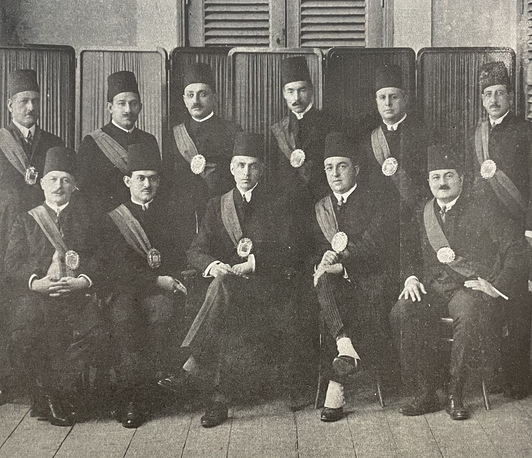
CALL FOR PAPERS: The Mixed Courts of Egypt, 1876-1949: between imperial internationalism and shared legal knowledge (Frankfurt: MPILHLT, 23-24 FEB 2026) [DEADLINE 1 JUL 2025]

(image source: MPILHLT)


How did the Mixed Courts of Egypt impact legal knowledge and societies on both sides of the Mediterranean? 150 years after these once highly influential institutions heard their first cases, the Max Planck Institute for Legal History and Legal Theory will dedicate a workshop to this question.
The event will take place in Frankfurt am Main on 23-24 February 2026. It is organized by Dr. Michel Erpelding, head of the newly constituted Max Planck research group ‘The hidden heritage of the European Union: the legacy of the law of the League of Nations’, and Mrs Aya Bejermi, whose work as a researcher within that group focusses on mixed courts established in semi-colonial contexts.

Topics of interest
The organizers have issued a call for papers (available in three languages) inviting submissions on topics such as the normative production and environment of the Mixed Courts, their relation to the political context during the time of their operation, and the sociology of actors involved with them.
The call welcomes papers based on archival sources and/or on doctrinal writings and the case law of Mixed Courts.

Submission details
Abstracts of no more than 500 words, written in English, French or Arabic and including the author’s name, e-mail address and a short curriculum vitae, should be submitted to erpelding@lhlt.mpg.de by 1st July 2025. Successful applicants will be notified via e-mail by 1st September 2025 and are expected to produce a summary draft paper by 31st January 2026.
The event will be held in person with no conference fee. Financial support for travel and accommodation is available. For more information, please contact Dr. Michel Erpelding.