Search

Showing posts with label diplomatics. Show all posts

05 October 2023

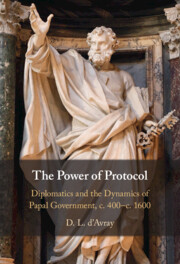
BOOK: David L. D’AVRAY, The Power of Protocol Diplomatics and the Dynamics of Papal Government, c. 400 – c.1600 (Cambridge: Cambridge University Press, 2023). ISBN: 9781009361118


ABOUT THE BOOK

How did the papacy govern European religious life without a proper bureaucracy and the normal resources of a state? From late Antiquity, papal responses were in demand. The 'apostolic see' took over from Roman emperors the discourse and demeanour of a religious ruler of the Latin world. Over the centuries, it acquired governmental authority analogous to that of a secular state – except that it lacked powers of physical enforcement, a solid financial base (aside from short periods) and a bureaucracy as defined by Max Weber. Through the discipline of Applied Diplomatics, which investigates the structures and settings of documents to solve substantive historical problems, The Power of Protocol explores how such a demand for papal services was met. It is about the genesis and structure of papal documents – a key to papal history generally – from the Roman empire to after the Council of Trent in the sixteenth century, and is the only book of its kind.


ABOUT THE AUTHOR

David L. d'Avray is Professor Emeritus of History at University College London and a Supernumerary Fellow of Jesus College Oxford. He has published widely on medieval preaching, death and kingship, marriage, rationalities, and the papacy. He has published ten books, the last six with Cambridge, including most recently Papal Jurisprudence, 385–1234: Social Origins and Medieval Reception of Canon Law (2022). He has been a Fellow of the British Academy since 2005 and Corresponding Fellow of the Medieval Academy of America since 2016.


TABLE OF CONTENTS

1. Introduction

2. The history of papal diplomatic

3. Papal documents, c. 400 – c. 1150

4. The religious governance of the Latin world, 1150–1378

5. From schism to counter reformation, c. 1450–c.1600

6. Retrospective: some long-term continuities

Reproductions.


More information can be found here.

18 February 2022

DATABASE: Cartae Europae Medii Aevi


The aim of Cartae Europae Medii Aevi is to offer historians multiple resources for the study of medieval diplomatic documents on a European scale, including the corpus of the same name. The website already contains several sections:

In its current state, the database contains over 270,000 documents. We obviously wish to continue the development of the corpus (plain text charters, editions, features, tools, etc.), with with updates in the coming months. A dataset will soon be available for download.
Charters are one of the most widespread cultural legacies of medieval Europe. They are found in hundreds of thousands, probably millions, and are present in almost every archive in the world. Because they constituted a fundamental memorial support for the institutions or individuals who produced or received them, they were often kept until modern times by the institutions responsible for them – most often ecclesiastical. Sometimes destroyed during the 16th-18th centuries, they were nevertheless generally preserved by archivists and carefully examined by historians, who found in them a fundamental doorway for the study of medieval society as early as the 17th century.

Charters constitute essential material for understanding the evolution of the medieval system, both material and ideal, its written practices, but also its thinking and the tensions that run through it. By making it possible to interrogate a very large number of charters simultaneously, the aim is to study the chronology of the phenomena, but also their geography and their impact. The global consultation of the corpus also allows the comparison of chancery and scriptoria practices on a very large scale, making it possible to observe circulations well beyond regional or national borders.
Conservation and Edition
Published en masse in the 19th and 20th centuries, in regional or national collections, the charters are indeed a monument for historians. Digitised in the context of more or less extensive scientific programmes from the 1960s onwards, they were often grouped together in corpuses isolated from each other until the 2000s. Since 2009, the corpus of the Cartae Europae Medii Aevi (CEMA) has aimed to bring them together in a single set, both for conservation and for the interrogation of the files.
While our initial objective was primarily to produce a dataset for our data mining experiments, it soon became apparent that it would be desirable to disseminate this collection to a wider audience. In this perspective, in addition to the consultation of the proceedings on the present website, we would like to eventually propose a dataset, in agreement with our partners. It will make it possible to establish a ground truth for statistical and linguistic surveys on charters on a European scale. However, such a project would obviously not be possible without the previous programmes which, as early as the 1960s, chose to convert these documents into computer format. As the saying goes, the CEMA are nani gigantum humeris insidentes.
Digitizing Charters
The corpus thus counts today more than 270,000 documents, corresponding to about 80 million words. Most of the texts are in Latin, but some are also found in vernacular languages – from Old French to Norwegian, Middle High German and Hispanic languages. Our aim is to provide a site where all historians can simultaneously find these invaluable resources for the study of Europe’s past, facilitating regional as well as national comparisons.

The database can be reach at this link.