Search

Showing posts with label Political Economy. Show all posts

10 November 2020

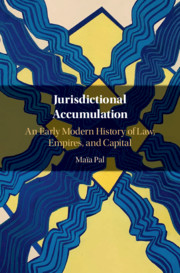
BOOK: Maia PAL, Jurisdictional Accumulation - An Early Modern History of Law, Empires, and Capital (Cambridge: Cambridge University Press, 2020). ISBN 9781108497206, 85.00 GBP.


(Source: CUP)

Cambridge University Press is publishing an early modern history of law, empires and capital.

ABOUT THE BOOK

The majority of European early modern empires – the Castilian, French, Dutch, and English/British – developed practices of jurisdictional accumulation, distinguished by the three categories of extensions, transports, and transplants of authority. This book is concerned with various diplomatic and colonial agents which enabled the transports and transplants of sovereign authority. Through historical analyses of ambassadors and consuls in the Mediterranean based on primary and secondary material, and on the empires' Atlantic imperial expansions and conquests, the book makes a major analytical contribution to historical sociology. As an interdisciplinary exercise in conceptual innovation based on a Political Marxist framework and its concept of social property relations, the book goes beyond common binaries in both conventional and critical histories. The new concept of jurisdictional accumulation brings ambassadors, consuls, merchants, and lawyers out of the shadows of empire and onto the main stage of the construction of modern international relations and international law.

ABOUT THE AUTHOR

Maïa Pal, Oxford Brookes University

Maïa Pal is Senior Lecturer in International Relations, Department of Social Sciences, Oxford Brookes University.

TABLE OF CONTENTS

1. Early Modern Extraterritoriality

2. Historical sociology, Marxism, and law

3. Social property relations

4. Ambassadors

5. Consuls

6. Colonial practices of jurisdictional accumulation

7. Analytical crossroads: Dominium, consuls, and extraterritoriality

8. Conclusion

Index.


More info here

05 May 2020

BOOK: Grietje Baars, The Corporation, Law, and Capitalism A Radical Perspective on the Role of Law in the Global Political Economy (Chicago: Haymarket Books, 2020). ISBN 9781642591873, 36.00 USD


(Source: Haymarket Books

Haymarket Books is publishing a book on a Marxist perspective on the role of law in the global political economy, as part of its historical materialism book series.

ABOUT THE BOOK

This radical and innovative volume develops a Marxist understanding of the symbiosis between law and capital in our society.

In The Corporation, Law and Capitalism, Grietje Baars offers a radical Marxist perspective on the role of law in the global political economy. Closing a major gap in historical-materialist scholarship, Baars demonstrates how the corporation, capitalism’s main engine from city-state and colonial times to the present multinational, is a masterpiece of legal technology. The symbiosis between law and capital becomes acutely apparent in the question of ‘corporate accountability’. Baars provides a detailed analysis of corporate human rights and war crimes trials, from the Nuremberg industrialists’ trials to current efforts. The book shows that precisely because of law’s relationship to capital, law cannot prevent or remedy the ‘externalities’ produced by corporate capitalism. This realisation will generate the space required to formulate a different answer to ‘the question of the corporation’, and to global corporate capitalism more broadly, outside of the law.

More info here

12 September 2019

BOOK: Guillaume-François LE TROSNE, Les lois naturelles de l'ordre social [ed. Thérence CARVALHO] [Naissance de l'Économie politique, vol. 13](Genève: Slatkine Érudition, 2019), 512 p. ISBN 9782051028424, € 65

(image source: univ-droit)

Book abstract:
Magistrat au présidial d’Orléans, Guillaume-François Le Trosne (1728- 1780) est à la fois le disciple de Robert-Joseph Pothier, le plus éminent jurisconsulte de son temps, et de François Quesnay, le chef de file du mouvement physiocratique. Ce double héritage fait de lui un auteur remarquable et unique du siècle des Lumières. Sa vie durant, il s’évertue à lier le droit et l’économie politique dans une science totale de la société qui développerait les lois naturelles de l’ordre social. Cette édition aspire à éclairer son oeuvre d’un jour nouveau en rassemblant trois de ses textes les plus importants publiés en 1777 : – De l’ordre social, composé de onze discours, dans lequel il développe ses principales opinions économiques, politiques et juridiques, comme la liberté du commerce, la mise en place d’un impôt territorial unique ou l’établissement d’une hiérarchie normative à prédominance jusnaturaliste ; – De l’intérêt social, par rapport à la valeur, à la circulation, à l’industrie et au commerce intérieur et extérieur , son ouvrage le plus théorique en matière d’économie politique où il répond aux critiques formulées à l’encontre de la physiocratie par son ami, l’abbé de Condillac, dans son livre Le commerce et le gouvernement, considérés relativement l’un à l’autre, publié en 1776 ; – ses Vues sur la justice criminelle, opuscule dans lequel il apporte un volet pénal à la physiocratie en détaillant ses propositions en ce qui concerne la législation criminelle et l’administration de la justice. Outre la version intégrale de ces textes, ce volume intègre, pour la première fois, l’ensemble des préfaces et des notes issues des différentes rééditions. Il comprend également des annonces de presse, des extraits de correspondance, une présentation, une chronologie et des notes entièrement nouvelles. Redécouvrir l’oeuvre de Le Trosne permet en définitive de mieux comprendre les grands débats intellectuels qui agitent le XVIIIe siècle et de puiser aux sources d’une pensée économique fondée sur la liberté.
(source: univ-droit)

06 August 2018

CALL FOR PAPERS: A Global History of Free Ports: The Development of European Political Economy in the Atlantic and Asia, University of Helsinki (DEADLINE 31 OCTOBER 2018)


Via the University of Helsinki, we learned of a call for papers on the history of free ports, which might also be of interest to legal historians. Here the call:

A Global History of Free Ports: The Development of European Political Economy in the Atlantic and Asia

University of Helsinki, Centre for Intellectual History, 6-7 June 2019

The free port is a curious phenomenon. It developed historically in Italy during the waning years of the Renaissance, when competition to attract trade from the burgeoning Atlantic sphere prompted some states to open their ports to foreign merchants and their goods. In time, the free port came to be defined as a territorial exclave endowed with its own economic policies, often of a liberal (or even libertine) cast; that is, as a place where merchants could do business with minimal interference from state authorities. From Italy, the free port spread to the rest of Europe; in the eighteenth century to the Caribbean; and, in the nineteenth and twentieth centuries, to the rest of the world. But though the free port is a curious institution, it is not a marginal one. Many of the most famous ports in history—from Genoa and Hamburg to Singapore and Hong Kong—were free ports. Such ports were central to the trading systems in which they were situated, whether in brokering commerce between distant localities, plugging a host state into the circuits of international exchange, or servicing a network of more regional ports. And ultimately, the free port is one of the ancestors of the modern special economic zone, of which there are more than six thousand in the world today. The history of the free port is global and deserves to be told as such.

This conference aims to explore the history of political economy between Europe, the Atlantic and Asia. How did European geopolitical schemes and visions of commercial competition and peace spill over to the Atlantic and Asia between the eighteenth and nineteenth centuries? How did European states model their national interests by establishing free entrepots or free ports? How was the reform of European commercial competition theorised by statesmen and political writers, and how was it operationalised through fiscal mechanisms, legal constructions, trading institutions, and merchant networks?

We invite scholars to propose papers dealing with these subjects. Rather than focus on one single aspect or context, we prefer broadly thematic or comparative analyses that are of interest to a wider academic audience.

Abstracts (of ca. 500 words) and titles may be sent by email to koen.stapelbroek@helsinki.fi and ctazzara@scrippscollege.edu by 31 October 2018. Invited speakers are subsequently requested to provide short papers that will be pre-circulated among participants. A selection of revised papers will be included in a book publication, based on this and related academic conferences.

More info here