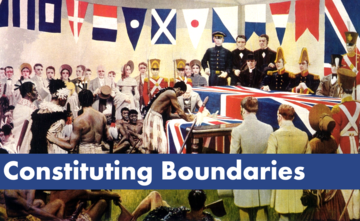
We learned of a call for papers for a conference at Oxford
on the process and effects of constitution-making in colonial and postcolonial
polities across the world since the American Revolution. Here the call:
Monday 20th and Tuesday 21st April 2020
Pembroke College, Oxford
In their function as frames of government, constitutions
draw boundaries of belonging. The act of making a constitution makes a claim
for the existence of a political community, and their texts define the terms of
citizenship and of political participation in that community, including and
excluding individuals based on race, gender, sexuality, disability, class, and
religion.
After 1776, the rebellious states of British North America
strove to create ‘government[s] of laws, not of men.’ To achieve their goal,
they composed new systems of government on paper, culminating in the creation
of the US Constitution in 1787. Countless other nations and empires have
followed suit. Constitution-making — successful or otherwise — is a common
feature of moments of social and political upheaval in modern global history.
Some constitution-makers have eradicated slavery, thrown off empire, and
legislated for social justice, as in Haiti in 1805, the Cherokee Nation in 1827,
India in 1950 and South Africa in 1996. Others have consolidated imperial
dominion and codified racial discrimination and exploitation, as in the settler
nations of the United States, Canada, Australia, New Zealand, and Rhodesia.
With the support of TORCH | The Oxford Research Centre in
the Humanities, the
Andrew W. Mellon
Foundation, and the
Quill
Project at Pembroke College, this interdisciplinary conference will
bring together scholars with a common interest in the process and effects of
constitution-making in colonial and postcolonial polities across the world
since the American Revolution. The principal focus of discussion will be on the
intersection between constitution-making and identity formation.
The convenors invite proposals for individual papers and
panels from scholars working in history, literature, the arts, law, area
studies, political science, philosophy, and digital humanities. We are looking
for papers and panels on topics related to the conference theme. These may
include, but are not limited to:
· The influence of Western and non-Western political thought
on global constitution-making
· Settler colonies, constitutions, and empire
· Constitution-making among indigenous nations
· Imperial constitutions in European empires
· Resistance to colonial/noncolonial constitutions and
constitution-making
· Decolonization and constituting new nations
· Constitutional amendment and the inclusion of Othered
groups
· Artistic, literary, and cultural responses to
constitution-making
· How constitutional provisions have been used to control
indigenous peoples
· Gender and constitution-making
· Sexuality, LGBT+ rights, and constitutional law
· Mental and physical health and constitutions
· Violence, warfare, and coercion in the creation of
constitutional settlements
· The role of public opinion and popular ratification in
establishing the authority of constitutions
· The social and economic effects of constitutional change
· Crime, criminals, and constitutional rights
· Constitutions and social hierarchy
· Rights and constitutions – consideration of social,
economic, religious, and civil rights in constitution-making
· National identity and the colonial/postcolonial
constitution
· Constitutions and voting qualifications, for example
property, literacy, and gender
· Religious influences on constitutions and their makers
· Modes and processes of constitution-making across time and
space
· Constitutional Pan-Africanism and Pan-Arabism
· Radical constitutionalism and redefining imperial polities
Registration
The conference is open to doctoral students and
post-doctoral researchers from the UK or abroad, working in any field which
addresses the central theme.
The registration fee will be £50 per person. There will be
an optional conference dinner, and accommodation in Pembroke College, at
additional cost. Estimated cost for the conference dinner is £40 per person
(wine extra), while ensuite rooms with breakfast start at £75 per night.
Proposals for individual 20-minute papers should include a
300-word abstract and a 100-word biography. Panel proposals should include a
500-word description of the focus of the panel, and brief biographies of all
participants. These should be received by 17th November 2019.