Description:
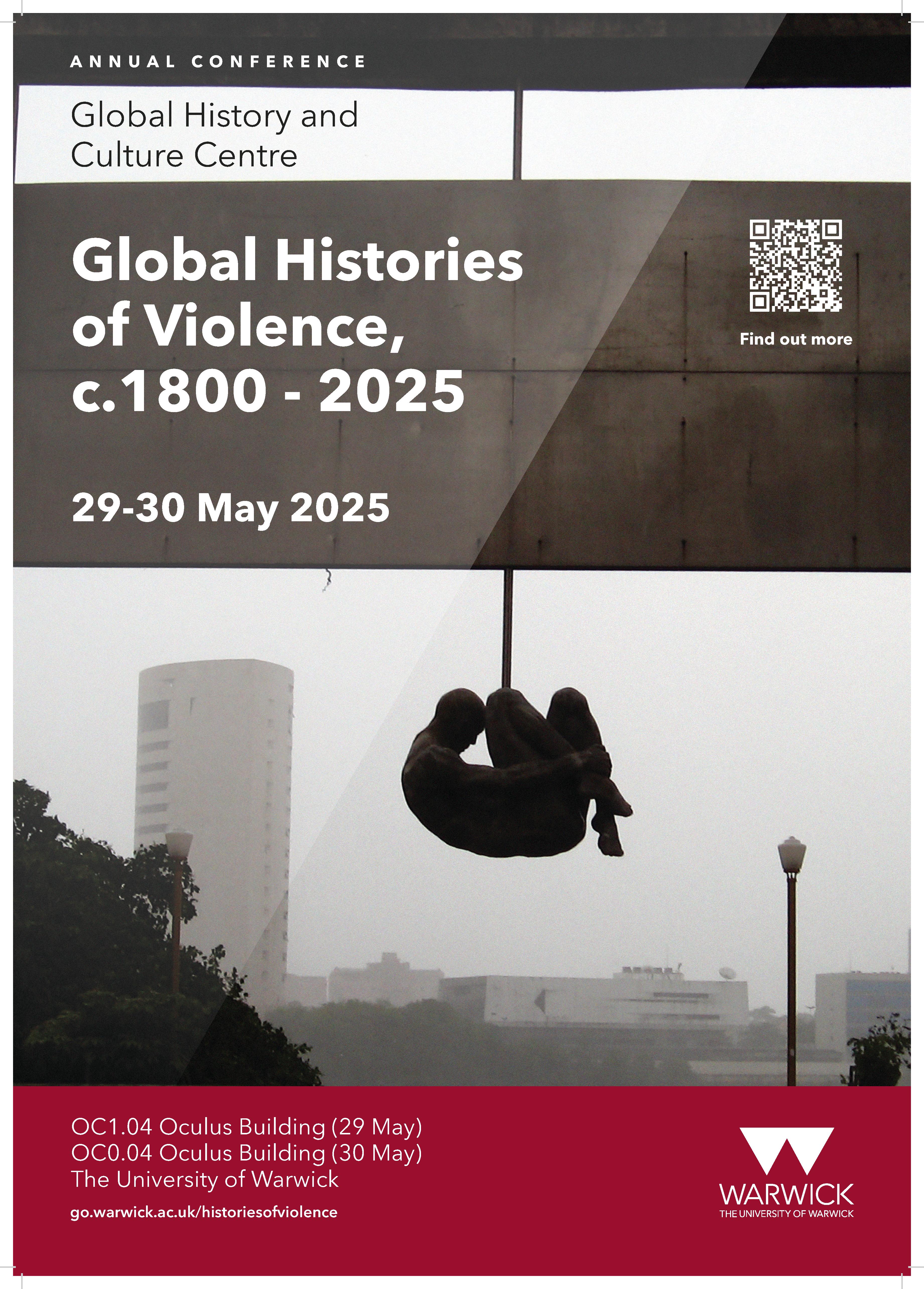
Histories of violence have become a commonplace theme in the study of Global History over the past decade, perhaps especially so in relation to imperialism and colonialisms in the nineteenth and twentieth centuries. Violence is about oppression and domination, but it often means far more than warfare, and in this conference we aim to explore the wide variety of registers through which global violence histories can be recognised and examined.
How can we research and write global histories of violence in ways that properly reflect cultural distinctions, that take account of the agency of local actors at all levels, and that embrace conceptual traditions from different parts of the world? The papers at this conference will reflect these aspirations in setting out histories from many cultures and many locations. Histories of violence have previously too often been written about in abstract ways, without description and even without explanation: in recent decades this has changed dramatically, with graphic and often disturbingly detailed histories being constructed around the violent events that shaped imperial and colonial relations in many parts of the world, or that mobilised revolts, ideologies or social movements across the globe. The narrative of these violence histories, once dominated only by the shallow stories of the victors, now more accurately reflects wider and diverse perspectives, familiarising us with victims and perpetrators alike. And everywhere, violence has its afterlife, casts its shadow, and leaves it legacies.
Our panels in this conference will take up these issues in focussing upon themes in the history of violence from around the globe – massacres, punishment, states of exception, organised crime, incarceration, sexual violence, terrorists, insurgencies and decolonization – each one illustrated by papers that will empirically explore the character and meaning of that violence in its context, while also opening up a comparative discussion about the impact and legacy of violent histories.
Program:
Thursday 29 May, OC1.04 Oculus Building
10.00 – 10.30 Registration and coffee/tea
10.30 – 10.45 Welcome
10.45 – 11.45 Session 1 STATES OF EXCEPTION
Chair – David M Anderson The University of Warwick
Black Ops in Kenya’s Colonial Emergency: the Pseudo Gangs, Frankie Vetch Freelance
State of Exception and the Making of Violence in Northern Kenya
Evelyne Owino University of Bonn
11.45 – 13.15 Session 2 MASSACRE
Chair – Niels Boender, University of Edinburgh
The 1860 Damascus Massacre: When Extermination Becomes a Reasonable Solution
Eugene Rogan, St Antony’s College, University of Oxford
"We're Not Great at Telling the Truth" - the 'Mystery' of the My Lai Massacre
Kim A. Wagner, Queen Mary, University of London
How to Hide a Massacre: Monte de Chila and the 'Dirty War' in Mexico, Thom Rath, University College London
13.15 – 14.00 Lunch
14.00 – 15.30 Session 3 PUNISHMENT
Chair – Doreen Kembabazi The University of Warwick
Theatres of the Revolution: ZANLA bases in Gaza Province and Guerrilla Violence in Zimbabwe's Liberation War, 1976-80, Gerald Mazarire University of Birmingham
The Long Shadow of Violence from the Abyssinian Campaign, 1867-68, Zoe Cormack British Museum
The Meanings of Murder: Ecological Violence and Panther-Men Rumours in the Ivorian-Guinean Forest Zone, 1890–1940,
Wallace Teska Trinity College, Cambridge
15.30 – 16.00 coffee/tea
16.00 – 17.30 Session 4 ORGANISED CRIME
Chair - John Dickie University College London
The Mafia, Unseemly Capital, and the Post-WWII Economic Transformation of Phoenix, Arizona
Jake Newbery University College London
'The Biggest Mafia Was the State’: a Brief History of Mexican Cartels, Ben Smith The University of Warwick
The Geography of Nawabari: Measuring the Effect of Yakuza Offices in Neighbourhoods,
Martina Baradel University of Oxford
17.30 – 18.30 Session 5 INCARCERATION – Keynote Lecture
Violence, Punishment and Resistance in Prisons and Penal Colonies in the Nineteenth-Century British Imperial World,
Clare Anderson University of Leicester
19.00 Drinks and Conference dinner
.
Friday 30 May, OC0.04 Oculus Building
9.00 – 10.00 Session 6 SEXUAL VIOLENCE
Chair – Sacha Hepburn The University of Warwick
State Security Forces and Sexual Crimes in Kenya’s Counter-Insurgencies, 1952-1991
David M Anderson The University of Warwick
Sexual Violence and Conceptions of Harm in Apartheid South Africa, Emily Bridger Exeter University
10.00 – 11.00 Session 7 TERRORISTS
Chair – Karuti Kanyinga University of Nairobi
British Service Women and Violence during The Troubles in Northern Ireland,
Hannah West Anglia Ruskin University
Terrorist Informers in Northern Ireland as Both Perpetrators and Victims of Violent Offences,
Samantha Newbery Salford University
11.00 – 11.30 coffee
11.30 – 13.00 Session 8 INSURGENCY
Chair – Dan Branch The University of Warwick
Shoulder Pole and 2 Baskets’: Exhibiting Forced Resettlement in Malaya, Carl Warner Imperial War Museum
Beyond Institutional Narratives: Re-examining the Cyprus Emergency at the Imperial War Museum
Megan Joyce Imperial War Museum
Civil War’ Violence, Anti-Colonial Conflict: Kenya’s Mau Mau at the Imperial War Museum, Niels Boender University of Edinburgh
13.00 – 14.00 lunch
14.00 – 15.00 Session 9 DECOLONIZATION – Keynote Lecture
Violence and the Global History of Decolonization, Martin Thomas Exeter University
15.00 – 15.30 coffee/tea
15.30 – 17.00 Session 10 Roundtable: WHAT IS COLONIAL VIOLENCE?
Chair - David M Anderson The University of Warwick
Panel: Roel Frakking, Karuti Kanyinga, Doreen Kembabazi, Martin Thomas, Kim Wagner
17.00 – 17.15 Closing remarks, David M Anderson The University of Warwick
Read more here.