Search

Showing posts with label United Nations. Show all posts

15 October 2020

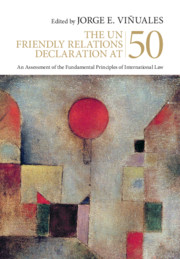
BOOK: Jorge E. VINUALES, ed., The UN Friendly Relations Declaration at 50 An Assessment of the Fundamental Principles of International Law (Cambridge: Cambridge University Press, 2020). ISBN 9781108483810, $ 210.00


(Source: CUP)

Cambridge University Press is publishing a book on 50 years of the UN Friendly Relations Act.

ABOUT THE BOOK

The year 2020 marks the 75th anniversary of the United Nations Organisation, and the 50th anniversary of the United Nations Friendly Relations Declaration, which states the fundamental principles of the international legal order. In commemoration, some of the world's most prominent international law scholars from all continents have come together to offer a comprehensive study of the fundamental principles of international law. Each chapter in this volume reflects decades of experience, work and reflection by the most authoritative voices of the field. At the same time, the book is an invitation to end narrow specialisation and re-engage with the wider body of rules and processes that lie at the foundations of the international legal order.

ABOUT THE AUTHOR

Jorge E. ViñualesUniversity of Cambridge

Jorge E. Viñuales holds the Harold Samuel Chair at the University of Cambridge and is a Fellow of the Lauterpacht Centre for International Law and of Clare College. He is also a Member (Associé) of the Institut de Droit International. At Cambridge, he founded and directed the Cambridge Centre for Environment, Energy and Natural Resource Governance (C-EENRG). Professor Viñuales has published many studies on international law, and he has wide experience as counsel, expert and adjudicator.

TABLE OF CONTENTS

Foreword Georges Abi-Saab
1. Introduction: the fundamental principles of international law – an enduring ideal? Jorge E. Viñuales
2. The historical origins and setting of the Friendly Relations Declaration Samuel Moyn and Umut Özsu
Part I. The Principles of the Friendly Relations Declaration:
3. The prohibition of the use of force Olivier Corten
4. Peaceful settlement of international disputes Shotaro Hamamoto
5. The duty not to intervene in matters within domestic jurisdiction Dire Tladi
6. Co-operation Laurence Boisson de Chazournes and Jason Rudall
7. Self-determination Marcelo G. Kohen
8. Sovereign equality Martti Koskenniemi and Ville Kari
9. Good faith Guillaume Futhazar and Anne Peters
Part II. Fundamental Principles of International Law Beyond the Friendly Relations Declaration:
10. Human rights protection as a principle Eibe Riedel
11. The fundamental principles of international humanitarian law Jia Bing Bing
12. Prevention of environmental harm Leslie-Anne Duvic-Paoli and Jorge E. Viñuales
13. Freedoms in common areas Tullio Treves
14. Principles governing the global economy Jürgen Kurtz, Jorge E. Viñuales and Michael Waibel
15. The Friendly Relations Declaration at 50 Pierre-Marie Dupuy.
More info here

07 May 2020

JOB: 3 PhD and 1 Post-doc position – ERC: “Challenging the Liberal World Order from Within: The Invisible History of the United Nations and the Global South” at Leiden University (DEADLINE: 31 May 2020)


We learned of four positions at Leiden University within the new ERC-funded project “Challenging the Liberal World Order from Within: The Invisible History of the United Nations and the Global South”.

The three PhD projects are:

PhD project 1: African Activism at the UN

This project will be carried out by a candidate with expertise in African history. Knowledge of the French language is essential, knowledge of relevant African and other languages will be an advantage.
This PhD project will examine the contributions of 2-3 small to large states in Eastern and Western Africa (Ethiopia, Ghana, Senegal, Tanzania) in the thematic areas. They will define what perceptions of the UN were, the relationship of these countries to others in the region and internationally (especially considering the interplay between Pan-Africanism and African nationalism) and what their role was in developing agendas for reform. This project will trace the contribution of these countries to developments in the area of decolonization, economic development and human rights and should draw connections between the selected cases and other actors in Asia and Latin America. In particular, the project should highlight different African conceptions of decolonization and show how these played out in the general debates at the UN, providing a precursor for economic development and human rights. The PhD researcher will conduct relevant research in national African archives, UN archives and relevant archives of non-state actors such as the African Union in Addis Ababa.

PhD project 2: Beyond Bandung, Asia at the UN

This project will be carried out by a candidate with expertise in the history of Asia and/or South-East Asia. Knowledge of the relevant languages will be an advantage.
This PhD project will examine the contributions of 2-3 small to large states in Asia/South East Asia (China, India, Indonesia, Thailand) in the thematic areas. The research must include either China or India (with a preference for both) among other countries. The project will examine the contributions of these actors to decolonization, economic sovereignty and human rights generally, before focusing on one key aspect. In particular, the project should examine how the role of Asian states evolved from the Bandung moment in 1955, to their strong role in contesting the meaning of development in the 1970s. The candidate will conduct relevant research in national Asian and UN archives, especially ECOSOC and UNCTAD and the Nehru Memorial Museum and Library in Delhi and the archives of the Economic Commission for Asia and the Pacific in Bangkok among other non-state archives.

PhD project 3: Latin America and the UN

This project will be carried out by a candidate with expertise in the history of Latin America. Knowledge of the Spanish language will be essential, knowledge of Portuguese will be an advantage.
This PhD project will examine the contributions of 2-3 small to large states in Latin America (Argentina, Brazil, Chile, Ecuador) and the Caribbean nations. The project will analyze the contributions of the selected actors to decolonization, economic development and human rights. In particular, it will investigate how Latin American actors forged alliances with African and Asian counterparts at the UN around issues of economic development. It will trace the emergence of the agenda for the creation of UNCTAD and examine how this was transformed into a wider crusade for the NIEO. It will also investigate how meanings of human rights were contested and examine in particular the contributions of the actors to the creation of the ICESCR. The candidate will conduct research in relevant national archives and the Economic Commission for Latin American and the Caribbean in Santiago. They will also conduct research in the archives of ECOSOC, UNCTAD, Frondizi Archives, Centro de Estudios Nacionales, Buenos Aires and Raúl Prebisch Papers, Prebisch Foundation, Buenos Aires, among others.

The Post Doc project:

Postdoc researcher: The United Nations as a Dynamic Globalizing Force

Project description
The main aim of this project is to reveal and unravel the invisible histories of the UN, transcending the dominant Western perspective to recover the historical agency of Global South actors. The research will investigate how the UN has both facilitated and limited their role in shaping global order. This will be an important contribution to current debates about UN reform and assessments of its performance, safeguarding against further marginalization of these actors. Within this overarching project, a 4,5 year postdoc position is available: The United Nation as a Dynamic Globalizing Force
The Postdoc will develop two parts of the main project. The first, essential to the overall research project, is a categorization of changes to the UN, keeping track of what structural, methodological and institutional changes were produced in the years under study. The second is a research element which analyzes the reception of Global South initiatives in Britain, France, Germany and the United States which is important to show how changes to the UN were perceived and what were the reactions to, and the success and failures of, efforts to alter political dynamics and redefine norms relating to decolonization (especially questions of contested sovereignty), economic sovereignty and human rights (especially the advancement of economic and social rights).

More information on the projects can be found here and here

18 November 2019

CALL FOR PAPERS: “Hidden Figures”: The United Nations War Crimes Commission and the Codification of the international criminal Law (Ludwigsburg, 20-21 February 2020) (DEADLINE: 30 November 2019)


(Source: Hsozkult)

Via Hsozkult, We learned of a call for papers for junior researchers on the impact of the UNWCC (created during World War II) on the Codification of the international criminal law.

““Crimes against peace” and “crimes against humanity” are undoubtfully two elements of a crime which have acquired enormous resonance in the legal and moral discussions in the aftermath of the WWII. They are often connected to the International Military Tribunal and the person of the American chief prosecutor at Nuremberg, Robert Jackson, who also was the head of the American delegation to the London Conference. It is frequently overlooked, that the way for the London Charter was paved by the United Nations War Crimes Commission (UNWCC). The UNWCC was established in October 1943 by seventeen of the Allied nations, including the European occupied countries like France and Poland but also New Zeeland and China, the only Non-Western independent nation. Its main function was to formulate and implement general measures for trial and punishment of alleged Axis war criminals. […]”

The full call can be found on Hsozkult

24 September 2019

CALL FOR PUBLICATIONS: Special Issue, Journal of Contemporary History "The UN and the Colonial World. New Questions and New Directions" (DEADLINE: 1 November 2019)


(Source: H-Announce)

We learned of a call for publications by the Journal of Contemporary History on the UN and the colonial world. Here the call:

Description 

Onek Adyanga and Giusi Russo, guest editors, are seeking abstract submissions; a selection of papers based on the abstracts will be considered by the Journal of Contemporary History for potential publication in a special issue on the United Nations, its agencies, and the colonial world across the spectrum of colonialism, the era of decolonization, and its legacy. 

Historians are still debating whether the UN promoted or discouraged imperialism. The guest editors contend that the UN did both – condoned and condemned colonialism – and it is important to trace the historical forces that allowed for an apparently contradictory dynamic. The UN is expressive of both nationhood and transnational organizing. It is an entity that includes its own personnel as well as official representatives of member states and NGOs. Within these multiple roles, it might be argued that the UN contested traditional imperial power in a sphere of symbolic legitimacy. Simultaneously, the UN used the typical language of the civilizing mission, made more complex then by the technocratic approach. 

The UN sanitized the colonial language, inserted tropes of human rights, sex equality, and other measurements of progress along with theories of modernization and technocracy that dominated internationalism in the postwar. The creation of the Trusteeship Council gave voice to both traditional colonizer and colonized groups. Petitions, for example, reveal a microcosm of everyday life that highlight the individual experience within the larger dimension of internationalism. Moreover, the UN inserted de facto colonies within international provisions by defining them "non-self-governing territory" which challenged the national sovereignty of colonial powers.  

The guest editors aim to explore whether the UN in itself, and more broadly internationalism, can represent an unexplored way to look at the history of empires. The United Nations has been the source of critique for its inefficiency and for having promoted a strict geopolitical order that has remained somewhat unchallenged. Historians have looked at measurements of success, signs of coherence, and the effectiveness of international legal instruments. Few accounts encourage scholars to move beyond the traditional understanding of success and failure in favor of an approach that looks at the UN as a reflection of postwar narratives of internationalism, new standards, and a new language. The guest editors are especially keen to explore the extent to, and manner by which, traditional imperial tropes and logics were changed.   


Themes 

  • The encounters between the United Nations and traditional imperial powers, and the manner by which these two negotiated the contours of a new international system. 
  • The shaping influence of specialized UN agencies, such as the WHO, ILO, UNICEF, and UNESCO, and the internal alignments and conflict in matters of colonialism/decolonization and the UN. 
  • Race, gender, and sexuality as mediated by the UN. 
  • Technocracy, colonialism, and the UN. 
  • Internationalism, empires, and pan-regional organizations and the UN.
  • Human rights, local dimensions, and international standards in the colonial sphere.
  • Petitions and the microcosm of the colonial world.
  • The UN and imagining the post-colonial nation. 
  • The UN and the representations of the colonial world. 
  • Memory and the United Nations in the post-colonial world. 
  • The UN Seminars and the production and legitimation of various kinds of specialized legal, administrative, and cultural practices.
  • UN Advisory Projects, and the refiguration of older colonial languages of control into newer, and contested, forms of knowledge.

Submission Procedures 

An abstract of 500 words should be submitted by November 1st, 2019 to both guest editors, Dr. Onek Adyanga at onek.adyanga@millersville.edu and Dr. Giusi Russo at grusso@mc3.edu.

(Source: H-Announce)