Almost one hundred years ago, in 1927, the Franco-Italian draft for a common Code of Obligations was drawn up. As is well known, it did not become law in either Italy or France. Nevertheless, it is worth taking a closer look at this important draft, which eminent scholars from both countries have already undertaken. It seems important to me to now also look at the transnational impact history of the draft. In other words, not only the question of whether the new Italian Codice civile, which was created shortly afterwards, or the Code civil, which was reformed decades later, benefited - explicitly or implicitly - from the work of the Franco-Italian commission. In fact, the draft was to a certain extent a reference work for every legislator, which probably influenced the legislation on obligations in numerous states to a greater or lesser extent. Poland, Albania or Greece come to mind spontaneously, for example, but this list is by no means exhaustive. Moreover, the draft was very closely observed and received by German legal scholars - and certainly not only by them. I would therefore like to organise a conference in summer 2025 to examine the history of the draft's impact. Together, we could then publish a monograph with our findings in a reputable publishing house to mark the centenary of the draft. I would be delighted if this topic were to meet with your interest, and I would ask that you kindly acknowledge this call and forward it to other colleagues.The small print: I request your suggestions for topics by 31 July 2024 (martin.loehnig@ur.de). I will compile the conference programme by 31 August 2024 and submit proposals for the exact date of the conference. The travel and hotel costs of all speakers will of course be reimbursed.Kind regardsMartin Löhnig
Search
15 May 2024
CALL FOR TOPICS: Conference about the Franco-Italian draft for a common Code of Obligations in Regensburg in summer 2025 (Regensburg: Universität Regensburg Deadline: 31 JUL 2024)
16 August 2022
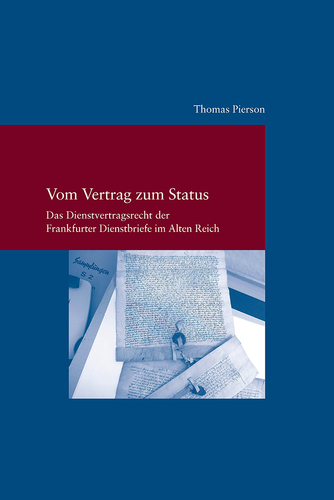
BOOK REVIEW: Achim SEIFERT, "Thomas Pierson, Vom Vertrag zum Status. Das Dienstvertragsrecht der Frankfurter Dientsbriefe im Alten Reich" (Forum Historiae Iuris, 11 APR 2022) (OPEN ACCESS)
Prof. dr. Achim Seifert (Jena) reviewed Thomas Pierson's Vom Vertrag zum Status. Das Dienstvertragsrecht der Frankfurter Dienstbriefe im Alten Reich (vol. 321 in the series Studien zur europäischen Rechtsgeschichte) for Forum Historiae Iuris.
Read the review here: DOI 10.26032/fhi-2022-004.
23 September 2021
BOOK : Scott VEITCH, Obligations, new trajectories in Law (Routledge, London, 2021), ISBN : 978-0-3673-4598-3, pp. 132, 37,59£
About the Book :
Obligations: New Trajectories in Law provides a critical analysis of the role of obligations in contemporary legal and social practices.
As rights have become the preeminent feature of modern political and legal discourse, the work of obligations has been overshadowed. Questioning and correcting this dominant image of our time, this book brings obligations back into view in a way that fits better with the realities of contemporary social life. Following a historical account of the changing place and priorities of obligations in modernity, the book analyses how obligations and practices of obedience are core to understanding how law sustains conditions of inequality. But it also explores the enduring role obligations play in furthering individual and collective well-being, highlighting their significance in practices that prioritize human and environmental needs, common goods, and solidarity. In doing so, it also offers an alternative and cogent assessment of the force, and the potential, of obligations in contemporary societies.
This original jurisprudential contribution will appeal to an academic and student readership in law, politics, and the social sciences.
About the author :
Scott Veitch is Paul KC Chung Professor in Jurisprudence at the University of Hong Kong.
Table of content :
1. The Priority of Obligations: Introductory Observations
2. The Place of Obligations: Modern Antecedents
3. Shifting Priorities: Into the Modern
4. The Ecology of Obligations: Situating the Legal Bond
5. Hybrids in Action: Three Contemporary Legal Formations
6. Obligations, Needs, Solidarities: Old and New Trajectories