Search

Showing posts with label Medieval legal manuscripts. Show all posts

17 April 2025

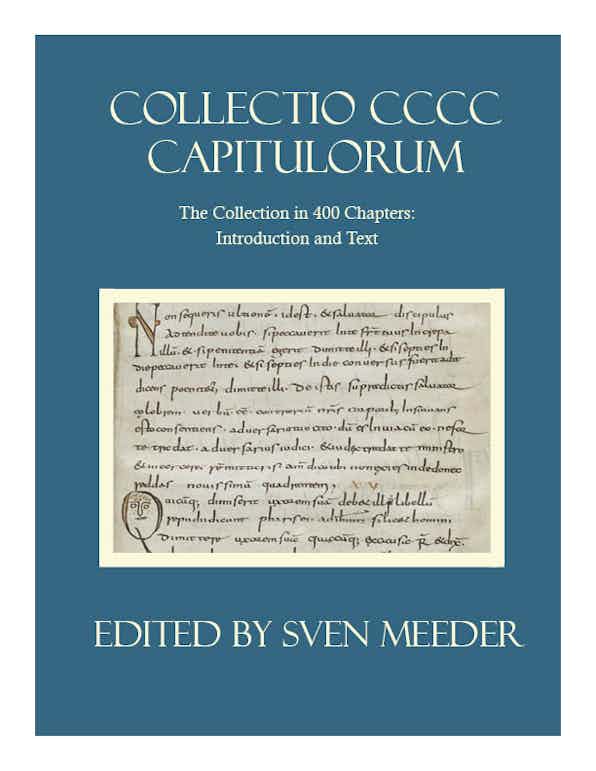
BOOK: Sven MEEDER (ed.), Collectio CCCC capitulorum, The Collection in 400 Chapters. Introduction and Text (Washington DC: The Catholic University of America Press, 2025), 300 p. ISBN : 978-0-81323-847-0, USD 85,00


Abstract: 

Surviving in three ninth-century manuscripts, the collection of canon law known as the Collectio 400 capitulorum is a remarkable and understudied witness to the scholarly vitality of the Carolingian period. Its 404 chapters offer ecclesiastical rules and moral guidelines taken from an unusually wide variety of authoritative sources. In addition to the customary canonical texts, such as the acts of the ecumenical councils and papal letters, the compiler of this collection drew his canons from the bible, Roman law, local Gallic synods, the Church Fathers, as well as Frankish and Insular penitential works.
Although the Collectio 400 capitulorum is a so-called systematic collection, eminent scholars of canon law commented on its lack of structure. Even ‘with the best will in the world’, the collection’s system eluded them. Despite its flaws, however, there is evidence that the collection gained some popularity in the ninth century, apparently providing the basis for the Poenitentiale Martenianum, directly or indirectly influencing Hrabanus Maurus and Benedictus Levita. The ninth-century appreciation is understandable for, as one of the many products of the vigorous canonical activity of the eighth and ninth centuries, the Collectio 400 capitulorum impresses in its handling of the canonical material as well as the breadth of sources and the topics covered.
This book constitutes the first in-depth study of this intriguing canonical collection, with a detailed description of the extant manuscript witnesses, its sources, and its influence. The critical edition offers scholars of the early Middle Ages in general and canon law in particular access to an instructive, if unpolished, product of Carolingian legal thought.


On the author

Sven Meeder is Lecturer in Medieval History at Radboud University Nijmegen.


More information can be found here.

04 September 2024

CONFERENCE: Legal Manuscripts in the Frankish World and the Transformation of Early Medieval Legal Cultures (8th-11th Centuries) (Köln: University of Cologne, 16–17 SEPT 2024)

(Image source: University of Cologne)


The codicological turn has been a game-changer in studying early medieval legal cultures over the past 40 years. The pioneering work of Hubert Mordek, Rosamond McKitterick, and others has shown that legal manuscripts were unique collections of texts, sometimes fragmentary and marred by scribal errors, but always connected to specific interests and local production conditions. This shift has led historians to turn from studying texts presented in critical editions to studying texts transmitted in manuscripts. The enormous increase in digitized manuscripts has further reinforced this “whole-book approach” in recent years. Today, it is no longer possible to conduct research into the legal history of the early Middle Ages while ignoring where and when individual manuscripts were created and transmitted. The whole-book approach is a method that underpins our international research collaboration that lasted for four years and materialized in biannual Zoom meetings. In taking an interdisciplinary approach, historians, legal historians, and art historians from Germany, Austria, France, Italy, the U.S.A., and Japan have analysed individual early medieval law manuscripts of the Carolingian empire, where Roman, Frankish, and other legal traditions coexisted and became deeply influenced by ecclesiastical law. This conference is the second of two concluding events — the first having occurred at the University of Tokyo in March 2024 – and will try to enhance our understanding by working on a typology of early medieval legal manuscripts.


PROGRAMME

Monday, 16th September

  • 9:00-9:10 Stefan Esders: Introduction. Towards a typology of early medieval law manuscripts

Session 1: The usefulness of ancient texts

  • 9:10-10:00 François Bougard: Isidore of Seville: The toolbox of early medieval legal manuscripts
  • 10:30-11:20 Luca Loschiavo: The medieval life of the Collatio legum Mosaicarum et Romanarum. Around the Possible (and Targeted) Sending of Roman Law Texts from Rome towards the Frankish Kingdom

Session 2: Legal Pluralism

  • 11:20-12:10 Shigeto Kikuchi: King, law and ordeal: Paris, BnF, Lat. 4628 as a lawbook
  • 13:30-14:20 Helmut Reimitz: Patterns of legal pluralism: Histories of law in Paris, BnF, Lat. 10758

[Transfer to Düsseldorf] 17:30 Book presentation at the Academy of Sciences, Humanities and the Arts in Düsseldorf (for invited guest only)


Tuesday, 17th September

Session 3: Canon law manuscripts

  • 9:30-10:20 Rosamond McKitterick: Einsiedeln, Stiftsbibliothek MS 191 and its implications
  • 10:20-11:10 Till Stüber: From Carthage to Bavaria. Observations on the canonical mss. of Freising (Munich clm 6243) and Würzburg (M.p.th.f.146)

Session 4: Exceptional compilations

  • 11:40-12:30 Osamu Kano: Tours or the royal court? On the origin of the manuscript Paris, BnF, Lat. 2718
  • 13:30-14:20 Britta Mischke: Lupus’ Liber legum in the Mainz legal compendium Gotha Memb. I. 84

Session 5: A case study from different angles: St Gall 731

  • 14:20-15:10 Beatrice Kitzinger/Jennifer Davis: Integrating Text and Image: A Case Study of the Wandalgarius Codex
  • 15:40-16:30 Grigorii Borisov: Revisiting the law book of Uuandalgarius: A paleographer’s point of view
  • 16:30-17:00 Karl Ubl: Conclusion and final discussion


More information can be found here


02 February 2024

WORKSHOP: 'Droit et littérature. Un regard croisé sur les textes médiévaux' (Geneva: Université de Genève, 16 FEB 2024)


 Droit et littérature. Un regard croisé sur les textes médiévaux


Journée d'études ¦ le 16 février 2024

Uni Mail, Salle M1193 ¦ Bd du Pont d'Arve 40 ¦ 1205 Genève


Comité scientifique et d'organisation :

Dr. Ignazio Alessi

Dr Gavino Scala


09.00 - 09.15 Introduction

Dr. Ignazio ALESSI et Dr. Gavino SCALA (Université de Genève)


09.15 - 10.00

Prof. Sara MENZINGER (Università degli studi Roma Tre)

Dante and the Law. Notes from some recent studies


10.00 Pause café


10.30 – 11.30

Cassandre CRESPIN (Sorbonne Université, Paris)

La fiction judiciaire amoureuse au Moyen Âge (XIIe-XVe s.)

Marta MILAZZO (Università degli studi di Padova)

« Droit non »: una formula da rileggere ancora


11.30 – 12.30

Farzad FALLAH (Geneva Graduate Institute of International and Development Studies,

Genève)

Speculative interpretation in the jurisprudence Muhammad ibn Idris al-Shafi’i:

narrativization in the service of textualism

Dr. Vincenzo Roberto IMPERIA (Università degli studi di Palermo)

Intrecci letterari e giuridici nell’epistolario di Pierre de Blois


12.30 Repas de midi


14.15 - 15.00

Prof. Claudio LAGOMARSINI (Università degli studi di Siena)

« Par bataille ou par juise » : la pratique de l’ordalie dans le Lancelot-Graal


15.00 – 16.00

Federico NOVELLO (Università degli studi di Siena –Universität Zürich)

Processo al lupo, processo all’uomo: la giustizia ne « Levallet aus douze fames »

Davide NOVATI (Scuola Normale Superiore, Pise –Universität Zürich)

Il supplizio del duca di Bellegarde e altri casi di punizioniesemplari nella narrativa romanza

medievale


16.00 pause café


16.30 - 17.00

Prof. Dijana ZRNIC (Banja Luka University)

Dušan’s code, between law and literature


17.00 – 18.00

Chen CUI (Université de Lausanne – Birkbeck College,London)

Entre homélie et textes juridiques: nouvelles perspectivessur la valeur littéraire de l’oeuvre

de l’archevêqueWulfstan d’York

Dr. Matthew CLEARY (Max Planck Institute, Heidelberg)

Exploring legal and linguistic dimensions in late medieval English jurisprudence: William

Lyndwood’s « Provinciale» and inheritance practices


18.00 CLÔTURE

Dr. Adrien WYSSBROD (Université de Fribourg – Institutde recherche A. Piaget,

Neuchâtel)


18.15 Apéritif dînatoire

18 September 2023

SYMPOSIUM: The Illuminated Legal Manuscript, Results Achieved and Future Research Objectives (Lisbon: Pharmacy Museum Auditorium, 20 SEPT 2023)


To celebrate its fifth year of existence, the IUS ILLUMINATUM Research Team (https://iusilluminata.fcsh.unl.pt), organizes on September 20th, 2023, in collaboration with the Institute of Medieval Studies (IEM) of NOVA /FCSH, the Istituto Italiano di Cultura of Lisbon, the Lisbon Pharmacy Museum and the Portuguese Institute of Heraldry its 4th International Vorkshop entitled The Illuminated Legal Manuscript: Results Achieved and Future Research Objectives.

The event, which will take place in person in Lisbon, at the Auditorium of the Lisbon Pharmacy Museum, aims to communicate to a wider audience the results of the investigations carried out by the team members during the fifth year of its existence, to make a balance of what has already been done and outline possible research perspectives. This Workshop also aims to provide an overview of the development of research on illuminated legal manuscripts in Europe, with the aim of reflecting on the methodological implications and the practical and theoretical challenges that this research entails. During this scientific event, different case studies related to some regions of the European territory will be analysed through an interdisciplinary approach to overcome limits and open innovative and fruitful research avenues.


***

Programme

20 September 2023


10.00–10.30 Keynote Speaker: Il monachesimo, Benedetto e la regola - Gabriele Archetti (Università Cattolica del Sacro Cuore)

10.30–10.50 Regole monastiche e iconografia - Francesca Stroppa (Università Cattolica del Sacro Cuore)

10.50–11.10 Dalle regole alla regola: il corpus regularum del codice sangallese 914 - Simona Gavinelli (Università Cattolica del Sacro Cuore)


11.30–11.50 Images of Judging - Martin Sunnqvist (Lunds Universitet)

11.50–12.10 Enluminure héraldique et d’armoriaux au Portugal à la fin du Moyen-âge - Miguel Metelo de Seixas (IEMNOVA/FCSH)

12.10–12.30 Repertorios decorativos para las cartas de profesión de los conventos toledanos - Jaime Moraleda Moraleda (Universidad de Castilla – La Mancha)

12.30–12.55 Imaginer la justice criminelle avec les coutumes de Toulouse - Héléna D.M. Lagreou (The University of Cambridge)

12.55 – 13.30 Debate


15.30–16.00 Keynote Speaker: L’albero di Jesse nell’atrio della basilica di S. Felice a Cimitile tra stratigrafie e iconografia - Carlo Ebanista (Università del Molise)

16.00–16.20 Una aproximación a los manuscritos iluminados de los fueros hispanos bajomedievales – Jorge Prádanos Fernández (Universidad Complutense de Madrid)

16.20–16.40 A História da iluminura e a Arqueologia da Idade Média: duas disciplinas em diálogo e em colaboração – Maria Alessandra Bilotta (IEM-NOVA/FCSH), Sara Prata (IEM-NOVA/FCSH)


17.00–17.20 Testimoni miniati del Decretum Gratiani a Montecassino - Andrea Improta (Università di Cassino e del Lazio Meridionale)

17.20–17.40 Os manuscritos do projecto iForal: a escrita da norma - Filipa Roldão (Centro de História – Universidade de Lisboa)

17.40–18.00 Ofícios da escrita no alto Alentejo (1438-1521). Um projeto em curso – Marcelo Andrade (IEM-NOVA/FCSH)

18.00–18.20 Os “Foros de Guarda”, um testemunho para a circulação de manuscritos ibéricos: a realeza na legislação de Afonso X – João Costa Silva (IEM-NOVA/FCSH)

18.20-18.40 Debate


More information can be found here.

17 September 2020

WEBINAR: "Il manoscritto giuridico miniato" - 22 settembre 2020, ore 10.30-19.30, 2° Workshop internazionale dell'équipe di ricerca IUS ILLUMINATUM. (on Zoom)


(Source: Storia del diritto medievale e moderno)


Through the website "Storia del diritto medievale e moderno", we learned about the webinar "Il manoscritto giuridico miniato", 22 settembre 2020 - ore 10.30-19.30, 2° Workshop internazionale dell'équipe di ricerca IUS ILLUMINATUM.

For more information and to download the program click here.

01 July 2020

CALL FOR PAPERS: Clio@Themis thematic issue on “Droit et image: les manuscrits juridiques enluminés” (DEADLINE : 1 September 2020)


(Source: Clio@Themis)

Clio@Themis has a call for papers for a 2021 thematic issue on “Droit et image: les manuscrits juridiques enluminés”. Here the call:

Dossier thématique de Clio@Thémis consacré aux enluminures dans les manuscrits juridiques
(2021)

Au cours des vingt dernières années, l’étude des manuscrits juridiques enluminés a reçu un nouvel élan et un nouvel intérêt de la part des historiens de l’enluminure, grâce notamment aux études pionnières et essentielles de Susan L’Engle et Robert Gibbs (coordinateurs scientifiques en 2001 de l’exposition Illuminating the Law. Medieval Legal Manuscripts in Cambridge Collections), de Gaspar Coll i Rosell, Massimo Medica, et de certains historiens du droit, en particulier Mario Ascheri, responsable, en 1996, de la coordination scientifique d’une remarquable exposition sur les manuscrits juridiques enluminés de la Biblioteca Comunale degli Intronati de Sienne, ainsi que Martin Bertram, responsable de la coordination scientifique, en 2010, avec Silvia Di Paolo, d’un important colloque sur les illustrations des Décrétales (Decretales pictae. Le miniature nei manoscritti delle Decretali di Gregorio IX [Liber Extra]). Grâce à ces contributions fondamentales, les dernières années ont vu une intensification des études, des recherches et des initiatives scientifiques concernant les manuscrits juridiques enluminés.

Dans ce contexte stimulant de réflexion et de discussion, la revue électronique Clio@Themis, en collaboration avec l’équipe de recherche IUS ILLUMINATUM de la Faculté des Sciences Sociales et Humaines de l’Universidade Nova de Lisbonne, a décidé de consacrer un dossier thématique, prévu pour l’année 2021, aux Manuscrits juridiques enluminés. Le dossier, placé sous la coordination scientifique de Maria Alessandra Bilotta (IEM-FCSH/NOVA, chercheur principal de l’équipe IUS ILLUMINATUM) et de Serge Dauchy (Centre d’histoire judiciaire, CNRS, Lille), vise à créer une opportunité de dialogue entre les historiens de l’enluminure et les historiens du droit et une occasion d’explorer les différents aspects de la décoration et de l’illustration du manuscrit juridique médiéval.
Les communications (20 à 25 p.), seront rédigées en français, en anglais, en espagnol ou en italien. Seules les illustrations libres de droit ou pour lesquelles une autorisation gracieuse de publication aura été accordée, pourront être publiées (en couleur) en ligne.

Les contributions pourront porter, sans exhaustivité, sur les questions suivantes :

  1. La relation entre le texte et l’image dans les manuscrits juridiques
  2. La décoration marginale dans les manuscrits juridiques enluminés
  3. La circulation des manuscrits juridiques enluminés dans l’Europe au Moyen Âge
  4. L’étude des fragments des manuscrits juridiques enluminés
  5. La production de manuscrits juridiques enluminés
  6. Les peciae et les manuscrits juridiques enluminés
  7. Les coutumiers, les Livres juratoires et les Statuti enluminés
  8. La transition du manuscrit juridique enluminé au livre imprimé
Les propositions de titres (à envoyer avant le 1er septembre 2020) et les contributions (à envoyer jusqu’au 31 décembre 2020) pourront être communiqués aux adresses :

More info with Clio@Themis

18 September 2019

WORKSHOP: The Illuminated Legal Manuscript: Production, Circulation and Use in Medieval Europe (Lisbon, 20 September 2019)


(Source: Ius Illuminatum)

We learned of an International Workshop on illuminated legal manuscripts in Medieval Europe later this week in Lisbon.


The Illuminated Legal Manuscript:
Production, Circulation and Use in Medieval Europe
International Workshop of the research team IUS ILLUMINATUM

Lisbon, Friday 20th September 2019
Faculdade de Ciências Sociais e Humanas
Universidade NOVA de Lisboa
Auditorium 2 – Torre B
Avenida de Berna, 26-C – Lisbon

Organisation:
Instituto de Estudos Medievais (IEM-FCSH/NOVA)
Oficina de investigação IUS ILLUMINATUM

Scientific Coordination and Organization:
Maria Alessandra Bilotta (IEM-FCSH/NOVA – PI of the research team IUS ILLUMINATUM)

Website of IUS ILLUMINATUM: http://iusilluminata.fcsh.unl.pt

9.30 Opening Session
Maria João Branco (Director of IEM-FCSH/NOVA); Maria Alessandra Bilotta (IEM-FCSH/NOVA – PI of the research team IUS ILLUMINATUM); Catarina Tente (Assistant Vice-Dean Research Projects Management Support – IEM-FCSH/NOVA)

Chair of the sessions: Teresa D’Urso, Università della Campania “Luigi Vanvitelli”

Session 1: Italy

10.00 Nuove indagini sui manoscritti giuridici miniati a Napoli
Andrea Improta, Università degli Studi dell’Aquila

10.30 Nuove riflessioni su due manoscritti giuridici trecenteschi miniati a Bologna: le Decretali V e le Institutiones XIV della Biblioteca Capitolare di Vercelli
Gianluca del Monaco, Università di Bologna

11.00 Coffee-Break

Session 2: Spain

11.30 “Esta mi carta de previlleio rrodado. Productores y espectadores para un documento de lujo
Maria Teresa Chicote Pompanin, The Warburg Institute (School of Advanced Study, University of London) – Ángel Fuentes Ortiz, Universidad Complutense de Madrid

12.00 Manuscritos jurídicos en Salamanca durante el siglo XV. El caso del Colegio Mayor de san Bartolomé
Jorge Jiménez López, Universidad de Salamanca

12.30 Estudiar las Siete Partidas desde la História del arte
Jorge Prádanos Fernández, Universidad Complutense de Madrid

13.00 Debate

13.30 Lunch

Chair of the sessions:  João Carvalho Dias, Fundação Calouste Gulbenkian

Session 3: France

15.00 Onze années de recherche sur les manuscrits juridiques du Midi de la France : résultats, bilans et perspectives de recherches  
               Maria Alessandra Bilotta, IEM-FCSH/NOVA

15.30 Literary and Iconographic Representations of the Jouvenel des Ursins Family: A Preliminary Survey.
               André Vitoria, IEM-FCSH/NOVA - LAMOP

16.00 Coffee-Break

Session 4: Poland

16.30 Manuscrits juridiques enluminés dans les collections polonaises – état de la recherche et individuation des bibliothèques.              
Arkadiusz Adamczuk, Katolicki Uniwersytet Lubelski Jana Pawła II, Lublin


Interdisciplinary research perspectives

17.00 O estudo da heráldica nos manuscritos jurídicos iluminados: novas pistas de investigação
Maria Alessandra Bilotta, IEM-FCSH/NOVA; Miguel Metelo de Seixas, IEM-FCSH/NOVA

17.15 A documentação digital e a virtualização 3D para o estudo dos manuscritos jurídicos iluminados: novas pistas de trabalho
Maria Alessandra Bilotta, IEM-FCSH/NOVA; Rolando Volzone, DINÂMIA’CET – IUL, ISCTE

17.30 O estudo dos manuscritos jurídicos iluminados como “objetos arqueológicos”: perspetivas de investigação Maria Alessandra Bilotta, IEM-FCSH/NOVA; Catarina Tente, IEM-FCSH/NOVA

17.45 Round table coordinated by Maria João Branco (Director of IEM-FCSH/NOVA)

18.45. Final discussion and debate

19.00 Closing Remarks  


About IUS ILLUMINATUM:


IUS ILLUMINATUM is an international scientific team composed of medieval art historians belonging to different European academic institutions, all specializing in illuminated legal manuscripts. The formation of this research group is linked to the current research project “ManJurEurIt. Manuscritos Jurídicos Europeus Itinerantes” of Maria Alessandra Bilotta, researcher in the NOVA School of Social Sciences and Humanities of Lisbon and member of the Institute for Medieval Studies (IEM) at the same University, who is the coordinator and principal investigator of the team. The project “ManJurEurIt. Manuscritos Jurídicos Europeus Itinerantes” aims to investigate the circulation of legal manuscripts in Portugal and their connections to artistic and social mobility in Mediterranean Europe. The research team intends to carry on a comparative study of the artistic, cultural and social currents revealed by the production and the circulation of illuminated legal manuscripts in medieval Europe. Each of the team members proposes to investigate these phenomena through the study of specific types of legal manuscripts, within a definite region of Europe. The team will be considering also the material aspects of the medieval legal book, with the collaboration of codicologists and archaeologists, analysing such books as archaeological artifacts. Finally, another purpose of the team’s work is to help promote and amplify the discussion of our issues by organizing scientific meetings and establishing contacts and interdisciplinary collaborations with other research groups and scientific institutions. IUS ILLUMINATUM has its headquarters at the Institute for Medieval Studies (IEM) in the NOVA School of Social Sciences and Humanities of Lisbon, while the members retain their own academic affiliations.

20 February 2019

BOOK: Charlene M. ESKA, A Raven’s Battle-cry: The Limits of Judgment in the Medieval Irish Legal Tract Anfuigell (Leiden-New York: Brill, 2019). ISBN 978-90-04-39198-7, €90.00


(Source: Brill)

Brill has published a critical edition and translation of the previously unpublished medieval Irish legal tract Anfuigell.

ABOUT THE BOOK

In A Raven’s Battle-cry Charlene M. Eska presents a critical edition and translation of the previously unpublished medieval Irish legal tract Anfuigell. Although the Old Irish text itself is fragmentary, the copious accompanying commentaries provide a wealth of legal, historical, and linguistic information not found elsewhere in the medieval Irish legal corpus. Anfuigell contains a wide range of topics relating to the role of the judge in deciding difficult cases, including kingship, raiding, poets, shipwreck, marriage, fosterage, divorce, and contracts relating to land and livestock.

ABOUT THE AUTHOR

Charlene M. Eska, Ph.D. (2006), in Celtic Languages and Literatures, Harvard University, is an Associate Professor in the Department of English at Virginia Polytechnic Institute & State University. Her publications focus on medieval Irish legal texts and manuscripts, and include Cáin Lánamna: An Old Irish Tract on Marriage and Divorce Law (Brill, 2010).

TABLE OF CONTENTS

Acknowledgements Abbreviations Plates
Introduction
Summary of the Text
Manuscript Sources
Concordances
Editorial Method
Notes on Dating and Orthography
Anfuigell: Text, Variants, Commentary, and Translation
Appendix 1: Text and commentary from source C Appendix 2: Commentary from § 32 source T Appendix 3: Commentary from § 51 source T Appendix 4: List of variant MS readings against CIH Appendix 5: Regarding Aidbred ‘Claiming’ Appendix 6: O’Davoren’s Glossay no. 862(3) and CIH 1452.11–24 Glossary Bibliography Index

More information here

13 August 2018

CALL FOR PAPERS: IMC Leeds, 1-4 July, 2019 The Materiality of Law Manuscripts (DEADLINE: 1 SEPTEMBER 2018)

(Source: British Library)
We learned of a Call for Papers from “The Transformations of Medieval Law” Project, on the materiality of medieval and early modern law mansuscripts. Here the call: 

In connection with the 2019 congress theme of Materialities, we are seeking papers for sessions on the materiality of medieval and early modern law manuscripts. This session explores the materiality of medieval legal texts at different stages of their use, from their initial production and layout, to binding with other texts, marks made by users, translation, and printing. We are particularly interested in how the materiality of legal manuscripts reflects how they transformed through time as needs of their users changed.

Topics might include but are not limited to:
• the production of law manuscripts
• the layout of law manuscripts
• the compilation of law manuscripts
• user marks in law manuscripts
• the translation of law manuscripts
• multilingual law manuscripts
• the transition from manuscript to printing

We welcome research on manuscripts from any legal tradition and comparative approaches.
Please send abstracts of no more than 250 words including five keywords to Helen F. Leslie-Jacobsen (helen.leslie@uib.no), no later than the 1st September 2018.

Sponsors: “The Transformations of Medieval Law” Project (Bergen Research Foundation and University of Bergen, Norway)

11 December 2015

NOTICE: Carnet de recherche "Manuscrits juridiques du Midi" (2015)


Manuscrits juridiques du Midi, nouveau carnet de recherche concernant la production des manuscrits juridiques enluminés dans le Midi de la France 

click here to access the carnet

Le carnet Manuscrits juridiques enluminés du Midi de la France, a pour objectif de rendre compte de l’enquête en cours sur la production de manuscrits juridiques enluminés dans le Midi de la France (XIIIe – XVe siècle) et rassemble des contenus variés (publications, nouvelles, événements scientifiques, programmes des séminaire et colloques organisés dans ce cadre) autour de l’étude scientifique de cette production. Ce carnet est directement lié au projet de recherche post-doctorale en cours mené par Maria Alessandra Bilotta (IEM-FCSH-UNL) sur « Production et ornementation des manuscrits juridiques portugais entre le XIVe et le XVe s. et leurs relations avec les productions et l’ornementation du Midi de la France (en particulier Toulouse, Avignon et Montpellier) et les régions nord méditerranéennes (Italie et Catalogne) », mené à l’Institut d’études médiévales (IEM) de l’Université Nouvelle de Lisbonne et financé par la FCT (SFRH / BPD / 74298 / 2010).

30 September 2015

EXHIBITION: "Wenn Bücher Recht haben/When books lay down the law" (St. Gall, until November 8 2015)


WHAT Wenn Bücher Recht haben. Justitia und ihre Helfer in Handschriften der Stiftsbibliothek St.Gallen/When books lay down the law. Law and lawmakers in the manuscripts at the Abbey Library of St. Gall, exhibition

WHEN until November 8 2015 - 

WHERE St. Gall Abbey Library/Stiftsbibliothek St. Gallen

all information here

Wenn Bücher Recht haben: Erstmals widmet die Stiftsbibliothek St. Gallen eine Jahresausstellung dem mittelalterlichen Recht und den Rechtshandschriften. Anhand ihrer einzigartigen Handschriftensammlung führt sie durch die faszinierende Entwicklung des Rechts von der Antike bis zum Ende des Mittelalters. Die Ausstellung präsentiert den Kaiser und den Papst als Quellen des Rechts und behandelt Themen wie den Gerichtsprozess und das Buss-, Beicht- und Ablasswesen. Berühmte Handschriften mit den frühmittelalterlichen Volksrechten der Langobarden, Franken und Alemannen werden gezeigt und beschrieben sowie bedeutende Zeugnisse aus der Entstehungszeit der Rechtswissenschaft und der Universitäten im 12. Jahrhundert vorgestellt

For the first time, the Abbey Library of St. Gall is devoting its annual exhibition to the subject of medieval law and legal manuscripts. Based on the Abbey Library’s unique collection of manuscripts, the exhibition reveals the fascinating development of jurisprudence from Antiquity until the end of the Middle Ages. For example, the Emperor and the Pope are presented as lawmakers. You will also gain an insight into judicial processes as well as the rules concerning penance, confession and indulgences. Famous manuscripts containing the early medieval laws of the Lombards, Franks and Alemans are displayed and described, as well as important witnesses to the origins of jurisprudence and the revival of interest in the study of law during the 12th century


31 August 2015

CALL FOR PAPERS: "Legal Circulation and Artistic, Intellectual and Cultural Practices in Medieval Europe (13th-16th Centuries)" (Lissabon, 25-27 Feb 2016) (DEADLINE 30 Oct 2015)

(image source: Medieval Europe in Motion)


Nomôdos signals the following call for papers:

Summary and thematic axes:
Le colloque international Medieval Europe in Motion 3 poursuit la série de rencontres scientifiques inaugurée en 2013 par l’Institut d’Études Médiévales (IEM) de l’Université Nouvelle de Lisbonne sur la thématique des mobilités artistiques et culturelles en Europe au Moyen Âge (https://sites.google.com/site/medievaleuropeinmotion2013/home). 

L’objectif principal de ce nouveau colloque, en continuité thématique avec les deux éditions précédentes, est d’analyser les phénomènes de circulation et de mobilité des élites lettrées (clercs, universitaires, praticiens), des enlumineurs, des manuscrits, des textes, des modèles artistiques et des idées liés à la pratique du droit dans le territoire européen avec une attention particulière pour les contrées méridionales (péninsule Ibérique, France du Midi et Italie). 

Seront également analysées la manière dont ces phénomènes de mobilité ont interagi avec les processus de systématisation de l’enseignement et la pratique du droit, ainsi que la représentation visuelle de l’exercice du droit dans les enluminures des manuscrits. 

Il ne s’agit pas d’un sujet complètement inédit dans le contexte des études d’histoire de la culture, de l’art et de l’économie, car plusieurs rencontres concernant des problématiques proches ont été organisées depuis quelques années. Il demeure que toutes ces thématiques n’ont pas souvent été mises en relation. Le colloque se propose de mener une analyse globale des aspects liés aux mobilités culturelles et juridiques pour donner un état de la question, susciter de nouvelles perspectives de recherche, et avancer ainsi dans l’étude et la connaissance de ces problématiques. 

Pour cela, on abordera en premier lieu l’analyse du phénomène de la mobilité universitaire liée à l’enseignement du droit dans les différentes régions de l’Europe : comment cela se passait-il ? Qui voyageait ? Où les voyageurs se déplaçaient-ils et quelles étaient les villes les plus touchées par ce phénomène ? 

En second lieu, le colloque vise à montrer comment ce phénomène de mobilité a également eu une incidence sur la confection des manuscrits juridiques enluminés et comment leur circulation et celle des enlumineurs ont influencé, stimulé, ainsi que modifié les processus de production et de création iconographique et stylistique dans les régions géographiques concernées. 

Pour ce qui est du rôle des commanditaires, particuliers ou institutionnels (les commandes institutionnelles passaient souvent par le truchement d'individus, les cardinaux pour la Curie pontificale, les docteurs pour les universités, les podestats ou les juristes à leur service pour les villes et les communes), on se posera les questions suivantes : qui sont les commanditaires des manuscrits juridiques enluminés et pourquoi les possèdent-ils ? Quelles motivations sociales, politiques et économiques peuvent justifier leur commande ? 

Dans le domaine de l’illustration des manuscrits juridiques, on se demandera quels sont les modèles iconographiques utilisés pour représenter visuellement l’exercice de la justice ou la manière d’enseigner dans les manuscrits de droit enluminés. Quels sont les contextes culturels dans lesquels ces manuscrits sont produits ? De quelle manière la production de manuscrits juridiques, en particulier dans l’aire géographique considérée (France méridionale, péninsule Ibérique, Italie), a-t-elle été influencée par la présence d’enlumineurs étrangers ? 

Dans le domaine de la codicologie, on analysera les aspects matériels de ces manuscrits juridiques pour voir comment ils influencent aussi la technique de production, ainsi que les caractères physiques de l’objet-livre. 

Enfin, on cherchera à étudier ces phénomènes de mobilité et de circulation, non pas de façon isolée, mais en les intégrant dans leurs contextes sociaux, politiques, culturels et économiques. 

Dans cette perspective, les propositions de communication (20 minutes) pourront s’organiser en plusieurs axes : 
  • La peregrinatio academica dans le contexte de la culture juridique 
  • Les modalités de l’enseignement et de la pratique du droit en Europe (XIIIe-XVe siècle) 
  • Les contextes sociaux, économiques, culturels et artistiques liés à la pratique du droit. 
  • La production de livres manuscrits juridiques (enluminés ou non) : les contextes économiques et culturels de production ; le livre juridique en relation avec d’autres types de manuscrits enluminés ; la place du livre juridique dans le contexte de la production artistique médiévale ; l’institution des studia et les manuscrits juridiques enluminés ; les peciae et les manuscrits enluminés ; les manuscrits juridiques enluminés sur le Continent et en Angleterre ; la transition du manuscrit juridique enluminé au livre imprimé. 
  • Le support concret que peuvent représenter les manuscrits juridiques dans la construction d'un ordre juridique et l’affermissement de la pratique judiciaire, une dimension performative et effective du livre juridique qui peut conditionner, tout à la fois, sa production, sa circulation, sa possession et ses usages. 
  • Les personnes, les idées ainsi que les objets liés à la pratique du droit et à sa circulation dans l’Europe médiévale (XIIIe – XVe siècle).
Practical modalities:
Les propositions de communications (en français, anglais, espagnol, portugais ou italien), accompagnées d’un bref CV (1 page maximum), sont à envoyer au contact ci-dessous avant le 30 octobre 2015 : memconference2016@gmail.com. Le Comité scientifique prendra en considération l’importance des propositions en relation avec le thème du colloque et adressera sa réponse à partir du 15 novembre 2015. 

Inscription avec communication:
  • 50 euros 
 Organising committee:

Coordinateur:
  • Maria Alessandra Bilotta (IEM-FCSH-UNL – TEMPLA – LAMOP) 
  • Francisco José Díaz Marcilla (IEM-FCSH-UNL) 
  • Mário Sergio Farelo (IEM-FCSH-UNL) 
Secrétariat d’organisation : 
  • Anabel Moreno (Universidad de Girona – TEMPLA) 
Comité scientifique : 
  • Etienne Anheim (Université de Versailles Saint-Quentin-en-Yvelines) 
  • Mario Ascheri (Università « Roma Tre »)
  • François Avril (Bibliothèque nationale de France)
  • Patrick Arabeyre (Ecole nationale des chartes)
  • Maria Alessandra Bilotta (IEM – FCSH – UNL – TEMPLA - LAMOP)
  • Martin Bertram (Deutsches Historisches Institut in Rom – Roma) 
  • Gerardo Boto Varela (Universitat de Girona – TEMPLA)
  • Paolo Cherubini (Archivio Segreto Vaticano)
  • Gaspar Coll Rosell (Universitat de Barcelona)
  • Maria Helena da Cruz Coelho (Universidade de Coimbra) 
  • Fabrice Delivré (Université Paris 1 – Panthéon Sorbonne/LAMOP)
  • José Domingues (Universidade Lusíada) 
  • François Foronda (Université Paris 1 – Panthéon Sorbonne/LAMOP)
  • Robert Gibbs (University of Glasgow)
  • Stéphane Gioanni (Ecole Française de Rome)
  • Christian Heck (Université Charles De Gaulle – Lille 3)
  • Susan L’Engle (Saint Louis University - Vatican Film Library)
  • Peter Linehan (Cambridge University)
  • Guy Lobrichon (Université d'Avignon et des Pays de Vaucluse)
  • José Meirinhos (IF – Faculdade de Letras da Universidade do Porto)
  • Maria Adelaide Miranda (IEM – FCSH – UNL) 
  • Aires Augusto Nascimento (Universidade de Lisboa)
  • Ezio Ornato (CNRS - LAMOP)
  • Kenneth Pennington (The Catholic University of America)
  • Jacques Verger (Université Paris–Sorbonne)

04 December 2014

CONFERENCE: "Image et pouvoir au Moyen Âge (XIIIe-XVe siècle) : le rôle des images dans la représentation des idées politiques" (Nanterre, 5-6 December 2014)


WHAT: Image et pouvoir au Moyen Âge (XIIIe-XVe siècle) : le rôle des images dans la représentation des idées politiques, Conference

WHERE: Nanterre, Université de Nanterre –200 avenue de la République, 92001 Nanterre Cedex
Bâtiment D, UFR SSA, Salle D 201
WHEN: 5-6 December 2014

Colloque organisé par Franck Collard (Université de Paris Ouest Nanterre La Défense, CHiSCO), Frédérique Lachaud (Université de Lorraine, CRULH Metz) et Lydwine Scordia (Université de Rouen, GHRis)


Programme:
vendredi 5 décembre 2014
14h Accueil des participants
Présidence de séance : Claudia Rabel (IRHT)
14h 30-15h 10 Lindy Grant (University of Reading), « An image of power or the power of an image ? The use of the Castel of Castille in the Thirteenth century »
15h10-15h50 Julien Lepot (Orléans), « Reines et princesses dans un miroir enluminé du milieu du XIVe siècle : l’Avis aux roys (New York, Pierpont Morgan Library 456) »
Discussion et pause

20 August 2014

NOTICE: "Southern France Illuminated Juridical Manuscript Production", new Facebook page


A new Facebook page on the theme "Southern France Illuminated Juridical Manuscript Production"

Click here to see the page

An artistic crossroad between French “Midi”, Italy and Iberian Peninsula (Spain, Catalonia and Portugal) - 13th-14th centuries

The page has been created to share contents, especially publications, news, events, discoveries, related to the academic study of the southern France illuminated juridical manuscript production (13th-14th centuries) and it's directly linked to the current postdoctoral research project of Dr. Maria Alessandra Bilotta (IEM-FCSH-UNL) on «Portuguese juridical manuscripts production and illumination between 14th and 15th centuries and theirs connections with manuscripts production and illumination in the French “Midi” (specially Toulouse, Avignon and Montpellier) and in the North-Mediterranean regions (Italy and Cataluña)», carried out within the Institute of Medieval Studies (IEM: http://iem.fcsh.unl.pt/) of the Nova University of Lisbon and funded by the FCT (SFRH / BPD / 74298 / 2010).

14 January 2014

SEMINAR: "Sacrées écritures. Manuscrits bibliques et juridiques" (Paris, 23 January - 10 April 2014)


What: "Sacrées écritures. Manuscrits bibliques et juridiques", Series of meetings within the Séminaire du LAMOP "Codicologie quantitative et sociologie du livre médiéval", coordinated by François Foronda, Jean-Philippe Genet, Xavier Hermand, Aude Mairey and Ezio Ornato
Where: Université Sorbonne, Salle Perroy, 1, Rue Victor Cousin, Paris
When: 23 January 2014, 6 and 20 February 2014, 13 and 27 March 2014, 10 April 2014, 5:00 pm - 7:00 pm 

Information fforonda@univ-paris1.fr
All informations available here: http://lamop.univ-paris1.fr/spip.php?article178

23 October 2013

Seminar: Citizenship and Power Strategies between Middle Ages and Modern Era (Rome, 25 October 2013)


What: Forme di appartenenza alla civitas nell'Italia meridionale (XII-XVI sec.), 7th meeting of the seminar Cittadinanze e strategie di potere tra Medio Evo ed Età Moderna, organized by Sara Menzinger, Giuliano Milani and Massimo Vallerani in the framework of the PIMIC Project.
Where: RomaTre University, Law Department, 2nd Floor, Room 278, Via Ostiense 161, Rome.
When: 25 October 2013, 3:30 pm
 
Speakers:
Prof. Vito Lorè (Univ. RomaTre)
Prof. Serena Morelli (II Univ. of Neaples)
 
More information available HERE.
All materials available on ACADEMIA.EDU (only if you have a Facebook or Academia.edu account).  


13 May 2013

SEMINAR: Decoration of Portuguese Medieval Legal Manuscripts (University of Porto, 15 May 2013)

What: Maria Alessandra Bilotta on "A decoração nos códices medievais: tipologia e funções. O caso dos manuscritos jurídicos portugueses". 
WhereSala do Departamento de Filosofia, Gabinete de Filosofia Medieval / Instituto de Filosofia, Faculdade de Letras da Universidade do Porto. 
When: 15 May 2013, 2:30 pm.  

All information HERE