Search

Showing posts with label Medieval Legal History. Show all posts

09 July 2026

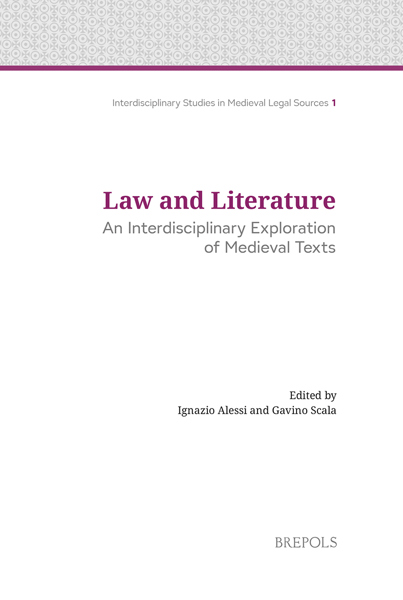
BOOK: Ignazio ALESSI & Gavino SCALA (eds.), Law and Literature. An Interdisciplinary Exploration of Medieval Texts [Interdisciplinary Studies in Medieval Legal Sources, ed. Ignazio ALESSI; 1] (Turnhout: Brepols, 2026), 243 p. ISBN 9782503620343, € 80


(image source: Brepols)

Abstract:

Throughout history, law and literature have always been in constant dialogue, sharing significant connections and exerting mutual influences. Both are artificial creations, products of human imagination that use language and metaphors to build meanings and shape the world around us. In the Middle Ages, the proximity of these two genres is even more pronounced. This is not only because many literary figures were also jurists, but also because medieval legal texts can be classified as a distinct literary genre known as ‘legal literature’. Additionally, medieval jurists did not hesitate to draw upon literary texts, understood as genuine sources of law (‘auctoritates morales’), to fill gaps in their legal knowledge. The contributions collected in this volume examine precisely this intersection between law and literature in medieval literary and legal texts. The volume follows four axes: law in literature, law as literature, literature in law, and literature as Law. The volume aims to raise awareness of the proximity of two apparently distant worlds and to provide a perspective for interdisciplinary analysis that transcends traditional rigid barriers.

Table of contents: 

Foreword Sara MENZINGER Introduction Ignazio ALESSI and Gavino SCALA ‘Par bataille ou par juise’. Ordeal by Combat in Thirteenth-Century Arthurian Prose Romances Claudio LAGOMARSINI La fiction judiciaire amoureuse (XIIe-XVe s.). Enjeux procéduraux Cassandre CRESPIN (Don’t) call me by your name. Lexical Gleanings of Droit Non Marta MILAZZO Procès du loup, procès de l’homme. La justice dans ‘Le valet aus douze femes’ Federico NOVELLO Le meurtre de Lancelot Ier dans la fin particulière des témoins Paris, Ars. 3348 et New Haven, Beineke Library, MS 227 de l’Estoire del Saint Graal. Une vendetta à l'épreuve du droit féodal Davide NOVATI Acoustic Effects and Kinesic Imagination in Archbishop Wulfstan of York’s Legal Writing Chen CUI Exploring Legal and Linguistic Dimensions in Late Medieval English Jurisprudence. William Lyndwood’s Provinciale and Inheritance Practices Matthew CLEARY Conclusions. Literature as a Field of Legal Experimentation Noëlle-Laetitia PERRET and Adrien WYSSBROD

On the editors:

Ignazio Alessi is a Research Fellow at the Centre for Research in the Arts, Social Sciences and Humanities (CRASSH), University of Cambridge, and a Postdoctoral Research Associate at Trinity Hall. He holds a joint Ph.D. in legal history from the EHESS in Paris and the University of Palermo. He was a postdoctoral researcher at the Universities of Fribourg and Geneva, and a visiting scholar at the Centre Relais Culture Europe in Paris and at Wolfson College, University of Oxford. Gavino Scala is a postdoctoral researcher at University of Geneva. He has a joint Ph.D. in Romance Philology at University of Siena and University of Zurich. He was postdoctoral researcher at University of Fribourg (CH).

Read more here

09 June 2026

SSRN PAPER: Alli ORR LARSEN & Thomas MCSWEENEY, "Medieval Treatises and the Judicial Search for a Useable Past" (Willam & Mary Law School Research Paper nr. 09-514)


(image source: SSRN)

Abstract:

The Supreme Court’s recent turn to history and tradition has prompted a renewed interest in the far distant past – the laws and customs of the Middle Ages. But medieval treatises are full of traps for the unwary. This article – a joint enterprise between a medieval legal historian and a Supreme Court scholar – carefully explores what makes these treatises uniquely complicated and easy to get wrong. To start, they are written in Latin and, sometimes, Old French. In many instances, the underlying medieval decisions they reference are destroyed and gone forever. Because there was no photocopier or even printing press back then, treatises often come in competing versions reflecting not only multiple authors but also successive copyists who made substantive changes. And legal texts were just different in the thirteenth century. Treatises were used for purposes as diverse as passing on cultural values, advising rulers on how to govern, and even teaching people the ideals of friendship. Put simply: medieval law is hard to find, hard to read, and even harder to put into context. For the American judge or law clerk who is strapped for time but wants to make a point about a long tradition, the understandable temptation is to reach for an authority like a medieval treatise that feels familiar. After all, modern legal treatises (think Wright and Miller) are recognized as trustworthy authorities to cite. And today translated versions of medieval treatises are easy to find digitally. But that ease of access and familiarity of authority are illusory. Often the very things that make these medieval texts feel familiar to modern readers would have made them idiosyncratic to thirteenth century audiences. Our goal in this article is to raise the caution flag for judicial consumption of medieval treatises: a user-friendly useable past can lead modern lawyers and jurists astray and should not be consumed without scrutiny and care.

Read more here: DOI 10.2139/ssrn.6276360.

(source: Law & Humanities Blog)

07 May 2026

SUMMER SCHOOL: Régulations économiques et économies informelles aux époques médiévale et moderne [14e école d'été d'histoire économique] (Susa, 25-27 AUG 2026) [DEADLINE 25 MAY 2026]


(image source: CTHDIP)


Abstract:

La 14e école d’été d’histoire économique qui se réunira à Suse (Piémont, Italie) les 25, 26 et 27 août 2026 aura pour thème « Régulations économiques et économies informelles aux époques médiévale et moderne ». Cette thématique permettra de poursuivre et d’approfondir celles qui ont été développées les années précédentes (la valeur des choses, la pauvreté, les biens communs, les moyens de paiement, la qualité, l’organisation du travail, les écritures de l’économie, entreprendre, la circulation des savoirs, le risque, les espaces du commerce, les économies de la nature, la guerre). La 14e école d’été d’histoire économique se propose d’aborder le thème fondamental de la régulation qui englobe pour les économistes l’ensemble des règles explicites ou implicites qui organisent et encadrent la production, l’échange et la consommation. La notion englobe ainsi la question de la fixation et de la formation des prix, les contrôles de qualité et de quantité ainsi que la mesure de la valeur. C’est par conséquent une notion qui englobe l’ensemble de la sphère économique. Son existence entraîne, par antithèse, l’existence d’une sphère informelle, qui échappe ou tente d’échapper à toute forme d’organisation ou de contrôle. Bien que la notion soit utilisée essentiellement par les économistes, elle s’applique également les époques médiévale et moderne.

Objectives and nature:

La nature du thème implique, outre la mobilisation d’historiens médiévistes et modernistes, la présence d’économistes et de juristes. De même, dans le cadre de notre partenariat avec les Archives Nationales, la participation d’un ou deux conservateurs rappelle la richesse des fonds des AN en lien avec la thématique de l’année. La méthode proposée est de faire présenter une série d’exposés par des spécialistes et de les mettre en débat. Elle permet également de faire dialoguer médiévistes et modernistes et comparer l’avancée de leurs réflexions sur un thème donné, voire d’infléchir les doctrines. Le but poursuivi est d’approfondir nos connaissances et nos réflexions tout en permettant à des doctorants ou à des postdoctorants de s’associer aux travaux par une participation active. La partition des doctorants et postdoctorants prendra la forme d’exposés et de prises de paroles dans le débat suivant les interventions.

Thematic description:

En économie, la régulation englobe l’ensemble des règles explicites ou implicites qui organisent et encadrent la production, l’échange et la consommation. La notion englobe ainsi la question de la fixation et de la formation des prix, les contrôles de qualité et de quantité ainsi que la mesure de la valeur. C’est par conséquent une notion qui englobe l’ensemble de la sphère économique. Son existence entraîne, par antithèse, l’existence d’une sphère informelle, qui échappe ou tente d’échapper à toute forme d’organisation ou de contrôle. Bien que la notion soit utilisée essentiellement par les économistes, elle s’applique également les époques médiévale et moderne. Par exemple, les tentatives carolingiennes de fixation des prix sont passées par une profonde réforme monétaire, par une redéfinition de la métrologie et par des formes d’encadrement des pratiques commerciales. Le second Moyen Âge a vu le développement des organisations de métiers qui, encadrant la production et définissant les qualités, ont caractérisé la vie économique jusqu’à la Révolution française avec la définition et l’octroi de privilèges. Le champ d’application de la notion concerne évidemment aussi la sphère fiscale, des catégories sociales et des produits particuliers étant taxés de façon spécifique ou, au contraire, exemptés. La noblesse et le clergé ne paient que peu ou pas d’impôts. Des produits comme le sel sont en revanche lourdement grevés. D’une façon qui n’est pas étonnante, ces ensembles de règlements, de normes et d’avantages qui veulent créer de l’ordre dans le domaine économique suscitent des pratiques déviantes concernant les modalités de l’échange (fraudes sur les prix, utilisation de mauvaises voire de fausses monnaies, mesures non approuvées par des autorités seigneuriales ou communales) ou de la production (fraudes sur la qualité des produits, sur les modalités de la fabrication dans le cas du textile). Les exemples abondent et l’existence de fraudes est avérée ; elles posent la question de l’efficacité des contrôles professionnels, étatiques ou seigneuriaux. La question de l’introduction des innovations dans le cadre d’économies fortement régulées et contrôlées comme celles des époques médiévale et moderne est aussi d’une importance extrême. Question d’histoire économique, la régulation économique et son corollaire l’économie informelle permettent de poser la question des cadres juridiques et moraux du développement de l’Occident latin du haut Moyen Âge à l’époque moderne en étudiant par exemple la définition de la propriété, les relations contractuelles, et le développement des juridictions civiles et commerciales. L’école d’été permettra de faire le point sur les recherches menées dans ces directions par les générations actuelles de chercheurs et de doctorants. Elle permettra de faire le point sur les questions liées à l’organisation des métiers ainsi qu’à celles liées aux échanges qu’ils soient commerciaux, dans le cadre de marchés institués, ou non commerciaux dans celui d’économies qui restent largement dominées par l’autoconsommation et la production familiale. Par ailleurs, elle permettra aussi de s’informer sur les recherches en cours sur le poids des banalités dans le cadre de l’économie seigneuriale et sur les normes sociales encadrant les pratiques de production et d’échanges. L’apport des doctorants et des post doctorants sera ici essentiel dans le partage de l’information sur les renouvellements en cours.

 Sessions:

1. L’historiographie médiévale et moderne
2. Le point de vue des économistes et des juristes
3. Régulation et encadrement des marchés
4. Régulation de l’innovation
5. Règlement des contentieux
6. Contournements : l’illicite et l’informel
7. Espace et territoire : encadrer et contrôler
ainsi que trois sessions de doctorants et post-doctorants.

Procedure:

Des places sont disponibles pour les jeunes chercheurs – doctorants ou post-doctorants – en histoire économique médiévale ou moderne, en économie, sociologie, géographie ou archéologie. Les langues de travail étant l’anglais et le français, les candidats devront avoir une connaissance minimale des deux langues (l’expression orale se fera dans la langue de son choix). Il sera demandé aux candidats une communication orale de 20 minutes en rapport avec le sujet des journées. Cette communication se fera à partir de la présentation d’un fonds d’archives ou d’une source d’histoire économique qui a été au cœur de leur recherche. L’organisation prendra en charge l’intégralité des frais de séjour lors des journées. Les frais de déplacement (aller-retour) seront remboursés jusqu’à 200 euros. Le nombre des places étant limité, les candidatures seront examinées et sélectionnées par le comité scientifique de la manifestation. Le dossier (en anglais ou en français) comprendra : – Un curriculum vitae détaillé – Une présentation (2 pages minimum) du sujet de doctorat, des sources utilisées et de la communication orale envisagée. Les dossiers de candidature sont à envoyer avant le 25 mai 2026 (réponse le 1 juin) à Emmanuel Huertas (Univ. Toulouse Jean-Jaurès) : emmanuel.huertas@univ-tlse2.fr

Scientific committee:

Anne-Laure Alard-Bonhoure | Université Paris 1 Panthéon-Sorbonne, LAMOP Michela Barbot | CNRS/ENS Paris-Saclay, IDHE.S Patrice Baubeau | Université Paris Nanterre, IDHE.S Marc Bompaire | École pratique des Hautes Études, SAPRAT Julie Claustre | Université Paris-Cité, Echelles Anne Conchon  | Université Paris 1 Panthéon-Sorbonne, IDHE.S Laurent Feller | Université Paris 1 Panthéon-Sorbonne, LAMOP Alessio Fiore | Université de Turin Florent Garnier | Univ. Toulouse Capitole, CTHDIP Agnès Gramain | Université de Lorraine, BETA Jérôme Hayez | CNRS, LAMOP Emmanuel Huertas | Université Toulouse Jean Jaurès, FRAMESPA Jean-François Moufflet | Archives Nationales Cédric Quertier | CNRS, EFR

Associated research centres:

LAMOP (UMR 8589, Paris 1, CNRS) FRAMESPA (UMR 5136, Toulouse Jean-Jaurès, CNRS) IDHE.S (UMR 8533, Paris 1, Paris Nanterre, ENS Paris-Saclay, CNRS) ECHELLES (UMR 8264, Paris Cité, CNRS) BETA (UMR 7522, Strasbourg, Lorraine, INRAE, CNRS) CTHDIP (EA 789, Univ. Toulouse Capitole) École française de Rome (EfR). La manifestation se déroule sous le patronage de l’Association Française d’Histoire économique (AFHé).

Associated institutions:

Université Paris 1 Panthéon-Sorbonne Université de Toulouse Jean-Jaurès Université de Turin Université Paris Cité Université Toulouse Capitole Archives Nationales IUF CNRS

More information here


29 April 2026

BOOK: Marek NOVÁK, Glossators and Commentators at the Strahov Library (Prague: Karolinum Press, 2025), 334 p., ISBN 978-80-246-6043-1


(image source: KP)

Abstract:

Private law in the Czech Republic, as in many countries, has its roots in Roman law, which reached its peak through codification by Emperor Justinian. However, modern civil codes are not directly based on Roman law source texts but on their later reception by medieval and modern jurists. This study aims to identify writings by authors belonging to the earliest stages of Roman law reception in the as-of-yet unsorted collection of the library of the Royal Canonry of Premonstratensians at Strahov. It discovers the works of glossators and commentators, analyses manuscripts, incunabula, and old prints and supplements the related data with examples of the used working methods. In addition, one of the results of the research was a set of proposals for correcting the library catalogue, which has already been implemented. The study therefore offers current shelf marks in alignment with the actual state of the collection and aims to serve as a practical guide for researchers interested in studying this segment of legal history.

Table of contents:

1. The beginnings of the reception of Roman law
2. Glossators
          2.1 Legal school
          2.2 Literary forms
                    2.2.1 Glossae
                    2.2.2 Summae
                    2.2.3 Tractatus
                    2.2.4 Quaestiones
                    2.2.5 Lecturae
                    2.2.6 Other forms
          2.3 Authors and writings at the Strahov Library
                    2.3.1 Accursius
                    2.3.2 Azo
                    2.3.3 Odofredus
                    2.3.4 Placentinus
                    2.3.5 Roffredus
 3. Commentators
          3.1 Legal school
          3.2 Literary forms
                    3.2.1 Commentaria
                    3.2.2 Tractatus
                    3.2.3 Consilia
                    3.2.4 Quaestiones disputatae
                    3.2.5 Repetitiones
                    3.2.6 Other forms
          3.3 Authors and writings at the Strahov Library
                    3.3.1 Accoltis Aretinus, Franciscus de
                    3.3.2 Bologninus, Ludovicus
                    3.3.3 Castro, Paulus de
                    3.3.4 Cumanus, Raphael Raymundus
                    3.3.5 Decius, Philippus
                    3.3.6 Fulgosius, Raphael
                    3.3.7 Gambilionibus, Angelus Aretinus de
                    3.3.8 Laudensis, Martinus Garratus
                    3.3.9 Mayno, Jason de
                    3.3.10 Mugellanus, Dinus de Rossonis
                    3.3.11 Penna, Lucas de
                    3.3.12 Pistorio, Cinus de Sigibuldis de
                    3.3.13 Pontanus, Ludovicus
                    3.3.14 Rosate, Albericus de
                    3.3.15 Salyceto, Bartholomaeus de
                    3.3.16 Sancto Petro, Florianus de
                    3.3.17 Saxoferrato, Bartolus de
                    3.3.18 Socinus, Bartholomaeus
                    3.3.19 Tartagnus, Alexander
                    3.3.20 Ubaldis, Angelus de

                    3.3.21 Ubaldis, Baldus de


Find more on Karolinum Press&The Chicago University Press.


20 February 2026

SEMINAR: Patrick ARABEYRE, "Le droit par l’image : l’exemple d’un manuscrit enluminé bolonais de la fin du XIIIᵉ siècle" [Les trésors de Richelieu] (Paris: BnF Richelieu, 17 MAR 2026)


(image: BnF Richelieu; source: BnF)

Abstract:

Centre majeur de l’enseignement du droit au Moyen Âge, la ville de Bologne se caractérise par la production de manuscrits juridiques. La BnF en possède une collection de premier plan, ce qui a été bien souligné par des travaux récents. Un exemplaire du Digeste Infortiatum glosé par Accurse, auteur de la Magna glossa, constitue un fleuron de ce corpus. Cette intervention soulignera la transposition du langage juridique en langage figuratif dans les manuscrits de droit romain enluminés du XIIIe au XVe siècle dans la cité universitaire.

On the seminar cycle:

La Bibliothèque nationale de France, l’Institut national d’histoire de l’art et l’École nationale des chartes - PSL organisent la 14e édition du cycle « Trésors de Richelieu », où conservateurs, chargés de collections, historiens de l’art, du spectacle, de la musique, de la littérature et spécialistes des textes partagent leurs savoirs avec un plus large public. À chaque conférence, des œuvres d’art, des manuscrits, des costumes ou des partitions musicales sortent exceptionnellement des magasins de la BnF, de l’INHA et de l’ENC, pour être présentés en direct à l’aide d’une caméra, qui en reproduit les plus infimes détails sur le grand écran de l’auditorium Jacqueline Lichtenstein. 

On the speaker:

Archiviste paléographe (prom. 1987), il a été adjoint au directeur des Archives départementales de la Côte-d’Or, puis chargé de recherche au CNRS auprès du Centre Georges-Chevrier de l’Université de Bourgogne. Il est titulaire d’un doctorat en droit et d’une habilitation à diriger des recherches en droit. Il a été élu en 2007 professeur à l'École nationale des chartes. Sa thèse d’École nationale des chartes a porté sur les écrits politiques de l’archevêque de Toulouse Bernard de Rosier (1400-1475), sa thèse de doctorat sur l’œuvre politique du canoniste toulousain Guillaume Benoît (1455-1516) – publiée sous le titre Les idées politiques à Toulouse à la veille de la Réforme en 2003 – et son habilitation sur l’historiographie, les idées politiques et l’enseignement du droit en France aux xive-xvie siècle. Il est rattaché à l’École doctorale conjointe de l’École nationale des chartes - PSL et de l’Université Paris Sorbonne. Il a été directeur du Centre Jean-Mabillon. À partir des Archives personnelles de Gabriel Le Bras (données à l’EHESS et déposées aux Archives Nationales) et des Archives du CNRS, une petite équipe associant l’ENS, l’ENC (Katia Weidenfeld et Patrick Arabeyre) et l’EHESS, se propose d’analyser les documents de ces fonds et d’organiser en 2018 une journée d’études, avec le concours de la Société d'histoire religieuse de la France. Lancement en 2018 du Séminaire "Humanisme juridique" avec l'IHD de Paris II.

On the speaker:

Archiviste paléographe (prom. 2010) et docteur en histoire de l’art, Sabine Maffre est l’auteure d’une thèse portant sur l’iconographie de Caïn et Abel en France au Moyen Âge soutenue à l’Université de Poitiers en 2023 sous la direction de Cécile Voyer. Conservatrice des bibliothèques, elle a été responsable pendant cinq ans de la bibliothèque Carnegie, bibliothèque patrimoniale à Reims. Depuis 2018, elle est chargée de collections pour la période xiiie siècle-xive siècle au service médiéval du département des Manuscrits de la Bibliothèque nationale de France. Sa thèse d’École (2010) porte sur L’iconographie de Caïn et Abel en France du xie siècle au début du xvie siècle.

 On the speaker:

Viviana Persi Chartiste. Thèse La réglementation du marché et le contrôle du commerce à Paris et à Rome, fin XVIIe-début XVIIIe siècle

Practical information:

Galerie Colbert, 2, rue Vivienne, Paris 2e (auditorium Jacqueline Lichtenstein); 18:15-19:30


 (source: PSL-ENC)


05 February 2026

BOOK: Nicolas MICHEL & Romain WAROQUIER (dir.), Pensée politique et Gouvernement dans l'Occident médiéval (XIe-début XIIIe siècle) [Rencontres, vol. 691; Civilisation médiévale, vol. 66] (Paris: Classiques Garnier, 2026), 288 p.


(image source: Classiques Garnier)

Abstract:

Comment s’opèrent le dialogue et les conditions de la négociation permanente entre norme et pratique du politique au sein des différents niveaux de pouvoir qui structurent la société occidentale du « long xiie siècle » ? Les contributions réunies dans ce volume offrent un éclairage important à cette question.

Read more here: DOI 10.48611/isbn.978-2-406-18979-4.

02 February 2026

BOOK: Pierre-Anne FORCADET & Corinne LEVELEUX-TEIXEIRA (dir.), La Nature et le Droit médiéval. Entre savoirs et normes [POLEN - Pouvoirs, lettres, normes; 38] (Paris: Classiques Garnier, 2025), 332 p.


(image source: Classiques Garnier)

Abstract:

Dans un article de 1967, Lynn White attribuait au christianisme médiéval une vision prédatrice du monde. Ce débat, relancé par la crise écologique, reste peu exploré par les juristes. Le présent ouvrage comble ce vide en étudiant les liens entre droit et nature au Moyen Âge.

Read more here: DOI 10.48611/isbn.978-2-406-18777-6.

10 December 2025

JOURNAL: Justices manifestes. Écrits, rituels et procédures judiciaires au Moyen Âge et à l'époque moderne, dir. Elisabeth SCHMIT & Aurélien PETER (Clio@Thémis 29 (2025) [OPEN ACCESS]

(image source: openedition)

Introduction (Élisabeth Schmit & Aurélien Peter)
DOI 10.4000/156ok
First paragraph:

Ce dossier se situe au croisement de deux manières d’aborder et d’écrire l’histoire de la justice1 : celle, d’une part, qui s’intéresse aux manifestations rituelles du processus judiciaire ; et celle, d’autre part, qui traite des enjeux et des pouvoirs de l’écrit dans l’action de la justice. En repartant de la métaphore théâtrale, c’est-à-dire en envisageant la scène judiciaire comme cadre spatio-temporel du déploiement du rituel, il s’agit d’en étudier précisément les modalités d’enregistrement, pour mieux comprendre comment l’écrit participe du caractère manifeste des justices médiévales et modernes – dans leur diversité. À l’intersection entre rituel et écrit judiciaires, il y a bien sûr la procédure, entendue à la fois comme la succession des étapes conduisant à l’exécution d’une décision de justice, et comme l’ensemble des règles qui encadrent chacune de ces étapes. Faire l’histoire des modalités d’enregistrement du rituel judiciaire implique dès lors d’expliciter à la fois les rapports entre rituel et procédure, et entre procédure et écrit. Les contributions qui suivent témoignent de l’intérêt, pour les historiennes et historiens de la justice, d’articuler ces deux approches, chacune ayant fait l’objet d’une historiographie féconde.

Ad arbitrium dicte nostre curie. Les équilibres de la jurisprudence du Parlement criminel au travers de l’enregistrement des peines infamantes (xive siècle) (Isabelle d'Artagnan) 
DOI 10.4000/156ol
Abstract:

This article analyzes recording strategies shaping parliamentary judicial precedents through seventy 14th century rulings involving the pillory or honorable amend. Clerks selected cases, merged uses of degrading punishments, and erased discrepancies to portray a moderately balanced justice. Three principles guided sentencing: the extent of the harm caused, the status of the parties involved, and the course of the judicial process. The criminal registers appear as a selective memory which guides the magistrates’ practice more than it records it.

 (D)écrire la procédure judiciaire criminelle à Dijon à la fin du Moyen Âge (Rudi Beaulant)
DOI 10.4000/156oo
Abstract:

The excellent preservation of sources relating to Dijon’s municipal justice system provides insight into the various stages of criminal proceedings in the late Middle Ages. Thanks to the diversity of the documents, it is possible to trace the rationalization of the content of the registers and notebooks from the second half of the 14th century to the beginning of the 16th century, which became ordinary judicial writings used in particular to facilitate the work of judges and prosecutors and, above all, to attest to the good judicial governance of the municipality, which also involved the political ritual of the inauguration of officers.

Pratiques de l’écrit et procédures de la justice ordinaire dans les villes allemandes à la fin du Moyen Âge (Dominique Adrian)
DOI 10.4000/156om
Abstract:

A trial before the council of Kempten (now in Bavaria) in 1486 offers a firsthand insight into the procedure followed in the urban courts of the late Middle Ages, for which the normative texts give only a limited account. The considerable weight of witness testimony and the complexity of the procedures used to gather it show the concern to establish an objective truth, without resorting to irrational evidence (purgatory oaths, etc.). By drafting this lengthy charter at the request of the litigants, the council aimed to guarantee the legal solidity of its decision, even in the face of the imperial courts then in full expansion.

Rendre des comptes au xvie siècle : les pratiques juridictionnelles de la Chambre des comptes de Paris dans les comptabilités urbaines de Touraine (Rémi Demoen)
DOI 10.4000/156on
Abstract:

During the Ancient Regime, the chambre des Comtes de Paris was a sovereign court whose task was to audit the accounts of all the agents who had to manage the king's funds. The ritualised practice of this exercise of control is based on a jurisdictional power that, while well researched for the late Middle Ages, remains dependent on documentary losses for the 16th century. Municipal accounts from this period offer a valuable alternative. Because they preserve traces of the judicial ritual in the Chamber as much as they are an integral part of it, these documents make it possible to propose a renewed study.

De petits bois de justice Les bandeaux gravés de Jean-Michel Papillon dans le rituel judiciaire à la fin de l’Ancien Régime (Mathias Boussemart)
DOI 10.4000/156op
Abstract:

Among the engravers producing illustrated headpieces at the end of the Ancien Régime, the renowned Jean-Michel Papillon (1698-1776) worked regularly for the judicial world, notably creating numerous headpieces related to parliamentary activity. The study of his Recueil des Papillons, held at the BNF, makes it possible to analyze in detail these seemingly innocuous images, which reveal the wide diffusion of an iconographic language shared by the judicial world of the Ancien Régime, through the miniature staging of its ritual.

Varia

De la difficulté de devenir fonctionnaire de l’État français dans un protectorat : l’exemple des contrôleurs civils au Maroc (Quentin Lohou)
DOI 10.4000/156oq
Abstract:

By establishing a “protector” state and a “protected” state, the French protectorate in Morocco recognizes the exercise of two sovereignties over the Cherifian Empire. This regime gave rise to some original legal situations, as illustrated by the hybrid status of civil controllers: these civil servants of French nationality embodied French sovereignty in Morocco, but were denied the status of civil servants of the French State until 1955. Gathered in an amicale, they strove to obtain this status until 1930.

Un fondement canonique du pouvoir constituant médiéval : « exercitus imperatorem faciat » (Decretum I, D. 93, c. 24 Legimus)
DOI 10.4000/156or
Abstract:

The Legimus canon (Decretum I, D. 93, c. 24), derived from a letter by Saint Jerome around the year 400, incidentally mentions : « exercitus imperatorem faciat ». However, the lex regia was already intended to provide, since the doctrine of Irnerius († 1130), the foundation of imperial power. Yet, by the late 12th century, the canonist Huguccio established the Legimus canon as a new foundation of imperial power within a dualist perspective. From then on, the doctrine appropriates this canonical foundation, leading to the conception of a constituent power now based on common law, or even the law of nations.

Point de vue

The many territories of Roman law (Dario Mantovani)
DOI 10.4000/156ot
Abstract:

From the 11th century onward, the study of ancient Roman law has been marked by contrasting impulses. One the one hand, Justinian’s Corpus Iuris Civilis was reinterpreted as a body of law detached from historical and geographical specificity, revitalized through academic teaching and functioning as positive law in numerous European contexts (and beyond) from the Middle Ages to the Modern era. On the other hand, when examined in its original context, it remains the law of a specific region – however vast the Roman Empire may have been. Although traditionally tied to the education of jurists in law schools, its study has also demanded a philological and historical approach to enable accurate reconstruction. Roman legal history thus stands as a telling example of the complex relationship between a geographically anchored perspective and a deterritorialized one, and between specialization and interdisciplinarity. Though often regarded as a traditional field, Roman legal history – by virtue of its layered and ambivalent legacy – has also, in key ways, prefigured contemporary methodological innovations in the social sciences and humanities.

 Read the full issue in open access here.


30 October 2025

BOOK: Ilya A. KOTLYAR (ed.), Regulae Iuris in the Medieval and Modern Age. Essential Stability v. Evolving Contexts [Legal History Library, eds. Dirk HEIRBAUT, Michelle MCKINLEY, Matthew C. MIROW & R.C. VAN RHEE; vol. 78] (Leiden/Boston: Martinus Nijhoff/Brill, 2026), ISBN 978-90-04-73609-2, € 160,93


(image source: Brill)

Abstract:

This volume is the first anthology to address the topic of the regulae iuris, or maxims of law, from a uniform methodological point of view. It approaches the regulae iuris as a dynamic system with an ever-evolving structure. The contributors of this volume, being among the leading experts in the field, look at the regulae both in their essence and in their expanding interrelationships, taking account of their changing social and cultural contexts. This volume places the crystallisation and evolution of legal rules within a history of ideas, spanning a wide historical period and going beyond the narrow confines of the history of legal thought.

Contributors:

Ilya A. Kotlyar, Adolfo Giuliani, Maria Kola, David Deroussin, Piotr Alexandrowicz, Ger Coffey, Harry Dondorp, Emanuel G.D. van Dongen, and James R. Gordley.

On the editor:

University of Edinburgh, is an independent researcher who has worked as a postdoctoral researcher at the Universities of Tilburg and Ghent. His primary research interest lies in the mutual interaction of legal doctrine and legal practice in European legal history, particularly in the areas of the law of succession and the law of obligations. 

Read more here: DOI  10.1163/9789004736092.

06 October 2025

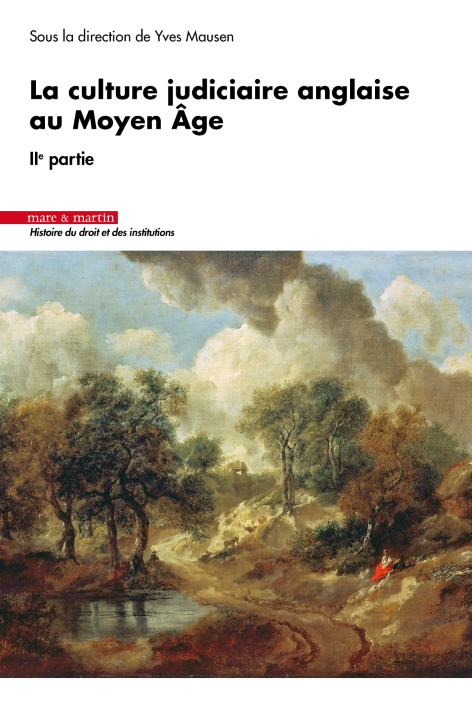
BOOK: Yves MAUSEN (dir.), La culture judiciaire anglaise au Moyen Âge, IIe partie [Histoire du droit et des institutions] (Paris: Mare & Martin, 2024), 406 p. ISBN 978-2-38600-031-7, € 39


(image source: Mare & Martin)

Abstract:
Le présent volume prend la suite d’un précédent recueil d’articles consacré, déjà, à l’histoire de la procédure du common law. S’il se concentre plus exclusivement sur les origines médiévales de celle-ci et sur ses mécanismes propres, il ne s’interdit cependant pas d’étendre par ailleurs son champ d’investigation à des aspects matériels. Telle est en effet la nature du droit anglais, que sa substance se nourrit des actions judiciaires. Le lecteur retrouvera ainsi un certain nombre de thèmes, abordés d’un point de vue complémentaire au premier volume, comme le droit du témoignage ou le trespass. Il en découvrira d’autres, qui jettent une lumière nouvelle sur des questions pourtant aussi classiques que les rapports du common law avec la coutume ou avec le droit romain, ou encore le sens originel du due process of law. Toujours suivant la méthodologie éprouvée, qui allie l’exploitation des fonds d’archives à la présentation de cas d’espèce, s’y ajoutent des considérations plus techniques sur les bills of privilege, le privilège de clergie, ou le duel judiciaire.

On the editor:

Yves Mausen, professeur agrégé des Facultés de droit, est titulaire de la Chaire d’histoire du droit et de droit des religions à l’Université de Fribourg (Suisse). Il a été élève de l’Ecole normale supérieure et membre de l’Institut universitaire de France. 

 Read more here.

08 September 2025

ARTICLE: Ron MORDECHAI MAKLEFF, "Inter-Urban Alliances and the Archives of Legitimacy in the Southern Low Countries, 1250–1450" (Past & Present CCLXVIII, nr. 1 (Aug), 3-44)


(image source: Past & Present)

Abstract:

By the thirteenth century, confederations of communes in western Europe were claiming important legal, political and military prerogatives for themselves in written charters of inter-urban alliance. Scholars have seen these alliances as a tool of the emerging economic elite or as forces of resistance to the sovereign territorial state taking shape in the late Middle Ages. To understand alternatives to princely polity formation in the wealthy, urbanized regions of Brabant, Flanders and Liège, however, this article studies urban alliances as a power in their own right by examining how new documentary practices contributed to older traditions of inter-urban collaboration. Towns and their coalitions created and distributed bilateral, multilateral and hybrid or concentric charters of alliance and kept them in their own archives, which they saw as repositories of legal security and authority. Meanwhile, archivists, chancellors and other technicians of legitimacy helped princes to consolidate legal superiority over their supposedly subject towns by spearheading the confiscation and destruction of communal archives, in particular their charters of alliance. They thus obscured the scale of inter-urban solidarity: this article reports fifty-eight unique alliances preserved in over 200 charters between 1219 and 1444 across these three regions.

Read more here: DOI 10.1093/pastj/gtae035

05 September 2025

BOOK: Julia BÜHNER, Neue Welten. Eine andere Völkerrechtsgeschichte der Eroberung der Kanarischen Inseln (1402–1496) [Studien zur europäischen Rechtsgeschichte; 349) (Frankfurt: Klostermann, 2025), XIV + 478 p. ISBN 9783465046646


(image source: Klostermann)

Abstract:
Two hundred years prior to Columbus’s “discovery” of America in 1492, Europeans were already exploring the waters of new worlds, including the Canary Islands, an archipelago off the west coast of Africa inhabited by various indigenous peoples. Focusing on the conquest of the Canary Islands, which over the course of the 15th century were subjugated by the French, Portuguese and Spanish, the study adds a new chapter to the history of international law and breaks new ground in the process: it understands the conquest as an encounter between legal and normative concepts, highlights the contribution of the indigenous Canary Islanders to the development of modern international law, and opens up a new perspective on the achievements of the School of Salamanca in international law.
Read more here.

21 August 2025

BOOK: Sari KATAJALA-PELTOMAA (ed.), A Companion to Medieval Canonization Processes. New Contexts, Perspectives, and Comparisons [Brill's Companions to the Christian Tradition, ed. Christopher M. BELLITTO; vol. 109] (Leiden/Boston: Brill, 2025), XII + 341 p. ISBN: 9789004516298, € 168,54

(Image source: Brill)


About the book:

Canonizations, which officially proclaimed a person’s sanctity, were complex, embracing theological, judicial, social, and cultural aspects of medieval Christianity. The dossiers manifest the theological ponderings while also revealing the devotional practices, daily life, and troubles of those not learned in canon law or theology.

This volume offers tools for comprehending canonization processes by investigating their judicial background and structural elements, as well as devotional aspects reflected in the depositions. It approaches canonization processes in a three-fold way: as a phenomenon of the past, as a source material with methodological challenges, and as a specific field of historical studies. Furthermore, this volume engages in innovative methodological discussions and illuminates the state-of-the-art and topical new themes.


Table of contents

Introduction: Canonization Processes in Context and Comparison (Sari Katajala-Peltomaa)

1. The Papacy on the Canonization of Saints: between Appropriation, Regulation, and Disinterest (Christian Krötzl)

2. God’s Ordinary and Extraordinary Speech: the Determination of Miracles by the Roman Congregation of Rites in the Early Modern Era (Maria Teresa Fattori)

3. Transforming an Individual into a Saint and an Accused into a Criminal. Judicial Procedure in Canonization Processes and libri maleficiorum of Italian Communes at the End of the Middle Ages (Didier Lett)

4. The Construction of Information in the Records of Medieval Canonization and Heresy Inquests: a Methodological Comparison (Saku Pihko)

5. Testimonies of the Life of the Saint in the Context of Canonization (Jenni Kuuliala)

6. Safe and Dangerous Names: Uncovering Connections and Boundaries in the Canonization Inquest for Countess Delphine de Puimichel, 1363 (Nicole Archambeau)

7. Disability, Miracle, and Sainthood in Early Fourteenth-Century Canonization Dossiers (Adelheid Russenberger)

8. “Are You Content to Die?” Death Acceptance and Death Denial in Depositions of Canonization Processes (Jyrki Nissi)

9. Writing Microhistory from the Canonizations of Bernardino of Siena and Vincent Ferrer (Laura Ackerman Smoller)

10. Experiencing the Miraculous: Lived Religion in the Depositions (Sari Katajala-Peltomaa)

11. Scent, Sight, Awe: Examining the Bodily Signs of Sainthood in the Canonization Processes of Dominican Saints (Marika Räsänen)

12. Canonizations and Jesuit Saints: the Lives and Images amid the Causes for Ignatius Loyola and Francis Xavier (Jonathan Greenwood)

On the editor

Sari Katajala-Peltomaa is currently Professor of Cultural History at the University of Turku, Finland. She has specialized in lived religion, gender, and family. Her recent publications on canonization processes include Demonic Possession and Lived Religion in Later Medieval Europe (Oxford: Oxford University Press, 2020) and edited with Christian Krötzl, Miracles in Medieval Canonization Processes: Structures, Functions, and Methodologies (Turnhout: Brepols, 2018).

More information can be found here: 10.1163/9789004726833.

02 July 2025

BOOK: Helle VOGT, Mia KORPIOLA, Else MUNDAL & Miriam JENSEN TVEIT (eds.), Gendered Punishments in Medieval Nordic Law, ca. 1100–1300 (York: ARC Humanities Press, 2025), 156 p. ISBN 9781802701845, € 119


(image source: ARC Humanities Press)

Abstract:

This book examines gendered punishments in medieval Nordic laws, ca. 1100–1300. By exploring legislation on violence, sorcery, sexual morality, and theft, it considers whether women were seen as independent legal subjects or as extensions of their families. It identifies various gendered punishments and discriminatory treatments, revealing regional differences and the influence of European legal ideologies. It also uncovers an emphasis on individual culpability for crimes, reflecting a shift from collective to individual responsibility and women’s increasing property rights. This comparative analysis offers a nuanced view of medieval Nordic law, highlighting the complex relationship between gender, law, and society during this transformative period. It explains how criminal law was influenced by canon law and German town law and offers new insights into the legal history of the Nordic region.

 Table of contents:

List of Illustrations

Abbreviations

Introduction. Gender in the Medieval Nordic Laws

Chapter 1. The Nordic Medieval Laws

Chapter 2. Violence and Homicide

Chapter 3. Sorcery and Magic

Chapter 4. Violations of the Norms of Sexual Morality

Chapter 5. Theft

Chapter 6. Comparative Observations and Main Conclusions

Bibliography

Index

 On the editors:

Helle Vogt is Professor in Legal History at University of Copenhagen, Denmark. Mia Korpiola (PhD 2004) is professor of legal history of the University of Turku. She has published extensively on Swedish and Finnish legal history. Else Mundal is professor emerita in Old Norse philology at the University of Bergen. She has published extensively on gender in medieval Norway and Iceland. In 2017, she was appointed a knight of the Icelandic Order of the Falcon. Miriam Jensen Tveit (PhD 2017) is assistant professor of medieval history at Nord University, and has published extensively on Norwegian medieval legal history.

Read more  here

24 June 2025

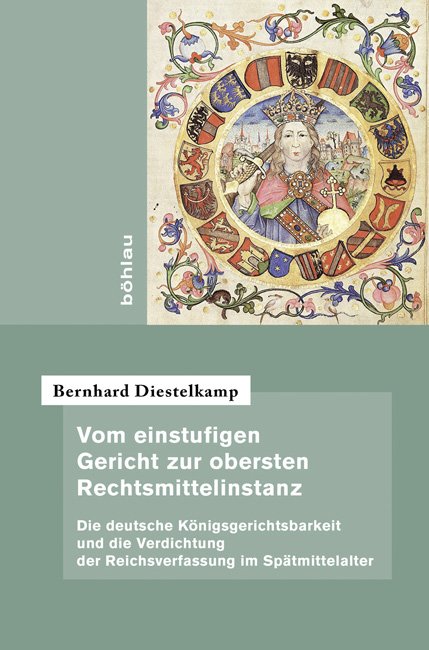
IM MEMORIAM: Miloš VEC, Herrscher müssen den Frieden sichern. Zum Tod des Rechtshistorikers Bernhard Diestelkamp (FAZ, 22 JUN 2025)

(image source: Booklooker)
 

First sentence:

Als Rechtshistoriker war Bernhard Diestelkamp ein Pionier. Sein bleibendes Verdienst ist die Erforschung der mittelalterlichen Königsgerichtsbarkeit und des Reichskammergerichts. Nun ist er im Alter von 95 Jahren gestorben.

Read more here


26 May 2025

IM MEMORIAM: Gérard Giordanengo (1944-2025)


(image source: ENC)

First paragraph:

L’École a le regret de vous faire part du décès de Gérard Giordanengo (prom. 1969), professeur honoraire à l’École, survenu le 18 mai 2025, à l’âge de 80 ans. Né à Gap (Hautes-Alpes) le 15 octobre 1944, Gérard Giordanengo est archiviste paléographe (prom. 1969) et docteur en droit. Ancien membre de l’École française de Rome (1969-1971), Gérard Giordanengo est conservateur aux archives départementales de l’Isère (1969), puis des Bouches-du-Rhône (1973). Il devient professeur à l’École nationale des chartes en 1981, où il occupe la chaire d’histoire du droit civil et du droit canonique, jusqu’en 2005.

Read further on the website of the Ecole Nationale des Chartes

21 May 2025

BOOK: Orazio CONDORELLI, Trittico siciliano. Diritto, religione e sovranità nel Regno di Sicilia in età normanno-sveva (Cosenza: Luigi Pellegrini Editore, 2025). ISBN: 979-12-205-0389-1, 20,00 €, pp. 208


ABOUT THE BOOK

Tra i secoli XII e XIII, il Regnum Siciliae emerse in Europa come istituzione che diede forte coesione politica, sotto l’idea di un potere pubblico unitario, a una vasta area territoriale dotata di una popolazione multietnica e multireligiosa. La Chiesa Romana diede legittimazione religiosa alle imprese militari dei Normanni nell’Italia meridionale e in Sicilia, e alla loro ascesa politica, che culminò con l’istituzione del Regno nel 1130. Nelle rappresentazioni testuali e iconografiche, la sovranità dei re di Sicilia si colloca al crocevia della concezione biblica di regalità e dell’idea di maiestas ereditata dalla tradizione romano-bizantina. Da Ruggero II a Federico II, la legislazione fu primaria ed essenziale espressione della concezione normanno-sveva dei compiti della regalità. In questo quadro si colloca la Legazia apostolica, istituzione che ha caratterizzato la storia delle relazioni tra potere ecclesiastico e potere politico in Sicilia dal secolo XI fino al 1871. Al di sopra dei ricorrenti conflitti tra Regno e Papato, la religione e l’idea dell’alleanza fra trono e altare furono concepite come fondamentali strumenti di governo.

ABOUT THE  AUTHOR

Orazio Condorelli è professore ordinario di Diritto e religione nell’Università di Catania e codirettore della Rivista Internazionale di Diritto Comune e della International School of Ius Commune (Erice).


More information with the publisher.

BOOK: Jonathan SEELYE MARTIN, By Consent Alone Marriage. Law and German Romance, 1186–1210 (Toronto: university of Toronto Press, 2025), 232 p. ISBN 9781487560157, 70 Can Dollar


(image source: UTP)

Abstract:

The twelfth and early thirteenth centuries saw some of the most important changes to marriage laws in European history, the foremost being the decision of the Catholic Church to recognize consent as an overriding requirement for marriage. Though this revolutionary position promised far greater personal freedom and individual autonomy, these promises went largely unfulfilled. By Consent Alone explores the developing laws of marriage in this period through the lens of the “case” (Kasus), a short narrative form that asks its audience to judge the new laws against the larger ideology of free consent. The book compares literary depictions of romance and marriage in seven canonical German romances with cases in the historical record, focusing on legal questions of consent, coerced consent, impediments to marriage, spousal abuse, and divorce. It argues that medieval German literature advocated for an expansive definition of individual and women’s rights in marriage. Comparing the fictional depictions of marriage cases with historical law, By Consent Alone provides a unique window into medieval thought and the culture of marriage, often not as it was, but as it was wished to be. By Consent Alone reveals how medieval German literature responded to the evolving laws of marriage and consent in medieval Europe.

On the author:

is an assistant professor of German at Illinois State University.


Read more here

24 April 2025

BOOK: Erika GRAHAM-GOERING, Jim VAN DER MEULEN & Frederik BUYLAERT (eds.), Lordship and the Decentralised State in Late Medieval Europe [Proceedings of the British Academy] (Oxford: OUP, 2025), 316 p. ISBN 9780197267844, 130 USD


(image source: OUP)

Table of contents:

List of Figures and Maps
List of Tables
Notes on Contributors
Acknowledgements
Foreword Justine Firnhaber-Baker
Introduction: Lordship and the Decentralised State in Late Medieval Erika Graham-Goering, Jim van der Meulen, and Frederik Bulaert
1. Lordship and the State: Alloy or Emulsion?, John Watts
Part I Case Studies of Lordship in France and the Low Countries
2. Integrative Approaches to (Co-)Lordship in Late Medieval Languedoc, Erika Graham-Goering
3. Rehabilitating Norman Lordship: The Fief of Hauberk and its Judicial Rights in the 15th and 16th Centuries, Yasline Bourgine De Meder
4. (De)Centralising Governance in Late Medieval France: Actors and Mechanisms, Georg Jostkleigrewe
5. Seigneurial Lordship and the State in the County of Flanders (c. 1350-1550), Frederick Buylaert
6. Pursuit of Nobility and the Priorities of Political Representatives in Early 15th-Century Flanders, Wim Blockmans
7. Lordship in Medieval Holland and Zeeland, Rombert Stapel and Arie van Steensel
8. Urban Political Elites and Seigneurial Lordship: Antwerp and its Hinterland (c. 1400-1550), Janna Everaert and Sieben Feys
9. The Seigneurial Landscapes of Riverine Brabant and Guelders (15th-16th Centuries), Mario Damen and Jim van der Meulen
Conclusions to Part I: Lordship, Commonwealth, Variegated Polities, and the State, Elizabeth A. R. Brown
Part II European Historiographies of Lordship
10. Lordship and State Formation in Late Medieval England, Chris Given-Wilson
11. Lordship and State Formation in Scotland, 1300-1500, Alice Taylor
12. Lordship and State Formation in the Holy Roman Empire, 1300-1550, Hillay Zmora
13. A Land of Lords: Lordship and State Formation in the Italian Peninsula, Francesco Bozzi
14. Jurisdiction: The Crooked Leg of Lordship? State Formation in Castile in the 15th Century, José Antonio Jara Fuente
15. Lordship and State in Scandinavia, c. 1300-1500, Hans Jacob Orning
Conclusions to Part II: State and Lordship: Concluding Remarks, Jean Philippe Genet
Index

On the editors:

Erika Graham-Goering, Associate Professor, University of Oslo,Jim van der Meulen, Postdoctoral Researcher, Ghent University,Frederik Buylaert, Full Professor, Ghent University Erika Graham-Goering is Associate Professor in the Department of Archaeology, Conservation, and History at the University of Oslo. Jim van der Meulen is a social historian at Ghent University with a broad specialisation in the Low Countries between 1300 and 1700, combining expertise in political, socio-economic, cultural, and environmental history. Frederik Buylaert, Professor of History at Ghent University, is a social historian of the Low Countries with a side interest in comparative history and the history of historiography. 

Read more with the publishers