Search

Showing posts with label Glossators and Commentators. Show all posts

29 April 2026

BOOK: Marek NOVÁK, Glossators and Commentators at the Strahov Library (Prague: Karolinum Press, 2025), 334 p., ISBN 978-80-246-6043-1


(image source: KP)

Abstract:

Private law in the Czech Republic, as in many countries, has its roots in Roman law, which reached its peak through codification by Emperor Justinian. However, modern civil codes are not directly based on Roman law source texts but on their later reception by medieval and modern jurists. This study aims to identify writings by authors belonging to the earliest stages of Roman law reception in the as-of-yet unsorted collection of the library of the Royal Canonry of Premonstratensians at Strahov. It discovers the works of glossators and commentators, analyses manuscripts, incunabula, and old prints and supplements the related data with examples of the used working methods. In addition, one of the results of the research was a set of proposals for correcting the library catalogue, which has already been implemented. The study therefore offers current shelf marks in alignment with the actual state of the collection and aims to serve as a practical guide for researchers interested in studying this segment of legal history.

Table of contents:

1. The beginnings of the reception of Roman law
2. Glossators
          2.1 Legal school
          2.2 Literary forms
                    2.2.1 Glossae
                    2.2.2 Summae
                    2.2.3 Tractatus
                    2.2.4 Quaestiones
                    2.2.5 Lecturae
                    2.2.6 Other forms
          2.3 Authors and writings at the Strahov Library
                    2.3.1 Accursius
                    2.3.2 Azo
                    2.3.3 Odofredus
                    2.3.4 Placentinus
                    2.3.5 Roffredus
 3. Commentators
          3.1 Legal school
          3.2 Literary forms
                    3.2.1 Commentaria
                    3.2.2 Tractatus
                    3.2.3 Consilia
                    3.2.4 Quaestiones disputatae
                    3.2.5 Repetitiones
                    3.2.6 Other forms
          3.3 Authors and writings at the Strahov Library
                    3.3.1 Accoltis Aretinus, Franciscus de
                    3.3.2 Bologninus, Ludovicus
                    3.3.3 Castro, Paulus de
                    3.3.4 Cumanus, Raphael Raymundus
                    3.3.5 Decius, Philippus
                    3.3.6 Fulgosius, Raphael
                    3.3.7 Gambilionibus, Angelus Aretinus de
                    3.3.8 Laudensis, Martinus Garratus
                    3.3.9 Mayno, Jason de
                    3.3.10 Mugellanus, Dinus de Rossonis
                    3.3.11 Penna, Lucas de
                    3.3.12 Pistorio, Cinus de Sigibuldis de
                    3.3.13 Pontanus, Ludovicus
                    3.3.14 Rosate, Albericus de
                    3.3.15 Salyceto, Bartholomaeus de
                    3.3.16 Sancto Petro, Florianus de
                    3.3.17 Saxoferrato, Bartolus de
                    3.3.18 Socinus, Bartholomaeus
                    3.3.19 Tartagnus, Alexander
                    3.3.20 Ubaldis, Angelus de

                    3.3.21 Ubaldis, Baldus de


Find more on Karolinum Press&The Chicago University Press.


07 March 2024

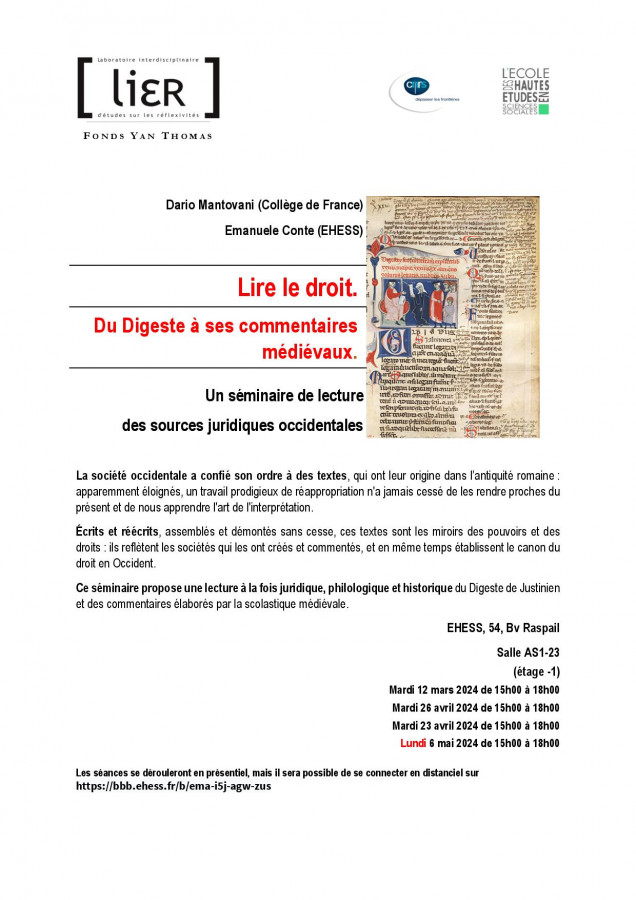
SEMINAR SERIES: Lire le droit. Du Digeste à ses commentaires médiévaux (Paris: EHESS, MAR-MAY 2024) [IN PRESENCE AND ONLINE]

(Image source: Univ.Droit)


La société occidentale a confié son ordre à des textes, qui ont leur origine dans l’antiquité romaine : apparemment éloignés, un travail prodigieux de réappropriation n'a jamais cessé de les rendre proches du présent et de nous apprendre l'art de l'interprétation. Écrits et réécrits, assemblés et démontés sans cesse, ces textes sont les miroirs des pouvoirs et des droits : ils reflètent les sociétés qui les ont créés et commentés, et en même temps établissent le canon du droit en Occident. 

Ce séminaire propose une lecture à la fois juridique, philologique et historique du Digeste de Justinien et des commentaires élaborés par la scolastique médiévale.


PROGRAMME

  • Mardi 12 mars 2024 de 15h00 à 18h00 
  • Mardi 26 mars 2024 de 15h00 à 18h00 
  • Mardi 23 avril 2024 de 15h00 à 18h00 
  • Lundi 6 mai 2024 de 15h00 à 18h00 


Les séances se dérouleront en présentiel (EHESS, 54, Bv Raspail Salle AS1-23), mais il sera possible de se connecter en distanciel au lien suivant: https://bbb.ehess.fr/b/ema-i5j-agw-zus.

More information can be found here.

09 February 2022

JOURNAL: Bulletin of Medieval Canon Law (volume 38, 2021: open source)


(Source: Wikipedia)


The annual issue of the Bulletin of Medieval Canon Law has been published. The entire volume can be found at the following link: http://legalhistorysources.com/BMCL-38-2021.pdf


***

TABLE OF CONTENTS

ARTICLES

  • Stephan Georg Kuttner by Ken Pennington
  • Stephan Kuttner at Yale by Robert Somerville
  • Stephan Kuttner: A Remembrance by Stanley Chodorow
  • Destroyed But Not Lost: A Digital Reconstruction Of The Chartrain Copy Of Burchard’s Liber Decretorum (Chartres Bm 161) by Michela Galli and Christof Rolker
  • Notas sobre la Collectio decem partium de Colonia by José Miguel Viejo-Ximénez
  • Venetiis in Rivo alto: Letters for English Recipients issued from Venice in mid-1177 by Anne J. Duggan
  • A la recherche de magister A. Notes sur le manuscrit 592 de la bibliothèque municipale de Douai by Anne Lefebvre-Teillard
  • Pacta sunt servanda: Canon Law and the Birth and Dissemination of the Legal Maxim by Piotr Alexandrowicz
  • ‘They Should be Decapitated’: The Glossa ordinaria to X 5.6 and 3.33 on Jews and Saracens by Yanchen Liu
  • ‘Qui totum sibi vendicat quod scripserat esse suum’: The Limits of Papal dominium from a Fictitious Letter of 1307 by Gabriele Bonomelli
  • ‘Publice utilitati fructificare desidero’: Brevi riflessioni sul costituzionalismo dantesco nel primo libro della Monarchia by Cecilia Natalini
  • Usury and Restitution in Late Medieval Episcopal Statutes: A Case Study in the Local Reception of Conciliar Decrees by Rowan Dorin and Raffaella Bianchi Riva
  • In Coena Domini: A Hierocratic Weapon or a Pastoral Staff? by Stefan Stantchev and Benjamin Weber


NOTES
  • Ius e Lex by Manlio Bellomo
  • Versions of a Legal Repertorium Related to the Works of Bartolus by Thomas M. Izbicki

REVIEWS
  • John Burden on Kynast Tradition und Innovation im kirchlichen Recht
  • Thomas M. Izbicki on Great French and English Jurists
  • Kyle C. Lincoln on Great Spanish Jurists
  • Sarah B. White on McSweeney, Priests of the Law
  • Select Bibliography


08 May 2020

BOOK: Alarico BARBAGLI, Profili giuridici del fallimento nel pensiero dei commentatori (Torino: Giappichelli, 2019). ISBN: 9788892105317, pp. 256, € 32,00

Profili giuridici del fallimento nel pensiero dei commentatori

ABOUT THE BOOK

Profili giuridici del fallimento nel pensiero dei commentatori" è un volume monografico che analizza il fenomeno del dissesto finanziario dal punto di vista della dottrina giuridica medievale.
Setacciando i commentari, i trattati, le grandi raccolte di consilia e i dizionari giuridici prodotti dai più importanti esponenti della scuola del commento, l’autore ne ricostruisce il pensiero focalizzando l’attenzione sui principali interrogativi posti dal fallimento al giurista medievale, riguardanti la persona del fallito, i presupposti e i sintomi della decozione, le fasi, cautelare e di merito, della procedura. "Profili giuridici del fallimento nel pensiero dei commentatori" si chiude con un ampio capitolo sul contributo offerto dalla dottrina medievale alla redazione del trattato De mercatura del giurista anconetano Benvenuto Stracca, vera pietra miliare della moderna scienza giuridica fallimentarista.

ABOUT THE AUTHOR

Alarico Barbagli è  ricercatore presso il Dipartimento di Giurisprudenza dell’Università degli Studi di Pisa, settore scientifico disciplinare: Storia del Diritto Medievale e Moderno IUS/19.

TABLE OF CONTENTS

A pdf version of the index can be downloaded here


More information here.

06 August 2018

BOOK: Manlio BELLOMO, Roffredo Beneventano, Professore a Roma [Studien zur europäischen Rechtsgeschichte 313] (Frankfurt: Klostermann, 2018). ISBN 978-3-465-04357-7, €79.00


(Source: Klostermann)

Via the Max Planck Institute for European Legal History, we learned of a new Italian language volume in their Studien zur europäischen Rechtsgeschichte series.

ABOUT THE BOOK

A well-known manuscript in the Prague National Museum contains the text published in this volume. The author was a student of Roffredus Beneventanus. He composed an apparatus of glossae recollectae and concealed his name behind a siglum consisting of three points in the shape of triangle. He used the first person in only a few instances. The work preserves important parts of Roffredus’ lecturae held in Naples between ca. 1220 and 1230 and later for a few years in a school in the Roman Curia that is not well known. The work demonstrates that, among the civil law glossators of the 13th century, Roffredus was among the first ones to use the ius canonicum extensively. It also provides us with information about the final period of Roffredus’ life.

TABLE OF CONTENTS

Prefazione
O. Condorelli – E. Conte – A. Padovani | VII
Introduzione | 1
Il manoscritto di Praga | 47
Indici – Storiograa | 291
Luoghi | 292
Manoscritti | 294
Personaggi | 294
Giuristi | 296

More information here

25 April 2014

SEMINAR: "The Use of the Glossators and Commentators by Jacques Cujas (1522-1590): A Humanist Criticism of the Medieval Jurisprudence” (Edinburgh, 2 May 2014)


What: "The Use of the Glossators and Commentators by Jacques Cujas (1522-1590): A Humanist Criticism of the Medieval Jurisprudence", Alan Watson Seminar in Legal History

Where: Lorimer Room, Old College, University of Edinburgh, Edinburgh

When: 2 May 2014, 5:30 p.m.


Speakers:

Dr. Xavier PrévostSorbonne Law School (Université Paris I) - Ecole nationale des Chartes, Paris