Search

Showing posts with label European legal history. Show all posts

24 March 2026

BOOK: David DEROUSSIN, Une introduction aux droits européens. La notion d’obligation et le contrat (Paris: Société de législation comparée, 2026), 792 p. ISBN 9782365171656


(image source: Hi-D)

Abstract:

Depuis le XVIᵉ siècle, le contrat s’impose comme l’un des piliers de l’ordre juridique européen, façonnant les échanges, les sociétés et les États. Mais comment cette institution fondamentale s’est-elle construite, transformée et adaptée à travers les frontières et les époques dans l’espace européen ? De l’héritage romain aux codifications modernes, en passant par les traditions juridiques nationales et les circulations transnationales, cet ouvrage, après avoir évoqué la notion d’obligation, retrace l’histoire comparée des droits des contrats en Allemagne, Angleterre, Belgique, Espagne, France, Italie, Portugal et Suisse jusqu’à nos jours. En croisant les approches historiques, juridiques et comparatistes, il espère mettre au jour les convergences et les divergences qui ont marqué l’évolution des droits contractuels en Europe, en soulignant l’influence persistante du droit romain, mais également les innovations apportées par les codifications nationales, ainsi que les dynamiques d’harmonisation à l’œuvre depuis le XXᵉ siècle. À travers des analyses thématiques, ce livre, publié avec le soutien de l’Université Jean Moulin-Lyon 3 et du Centre lyonnais d’histoire du droit, éclaire les défis contemporains du contrat, entre globalisation des échanges et affirmation des particularismes juridiques. Une synthèse inédite, accessible aux juristes, aux historiens et à tous ceux qui s’intéressent à la construction juridique de l’Europe et souhaitent comprendre les racines et l’avenir du droit des contrats en Europe.

On the author:

David Deroussin, Professeur à l’Université Lyon-III, Membre senior de l’Institut universitaire de France.

(source: LGDJ

16 July 2025

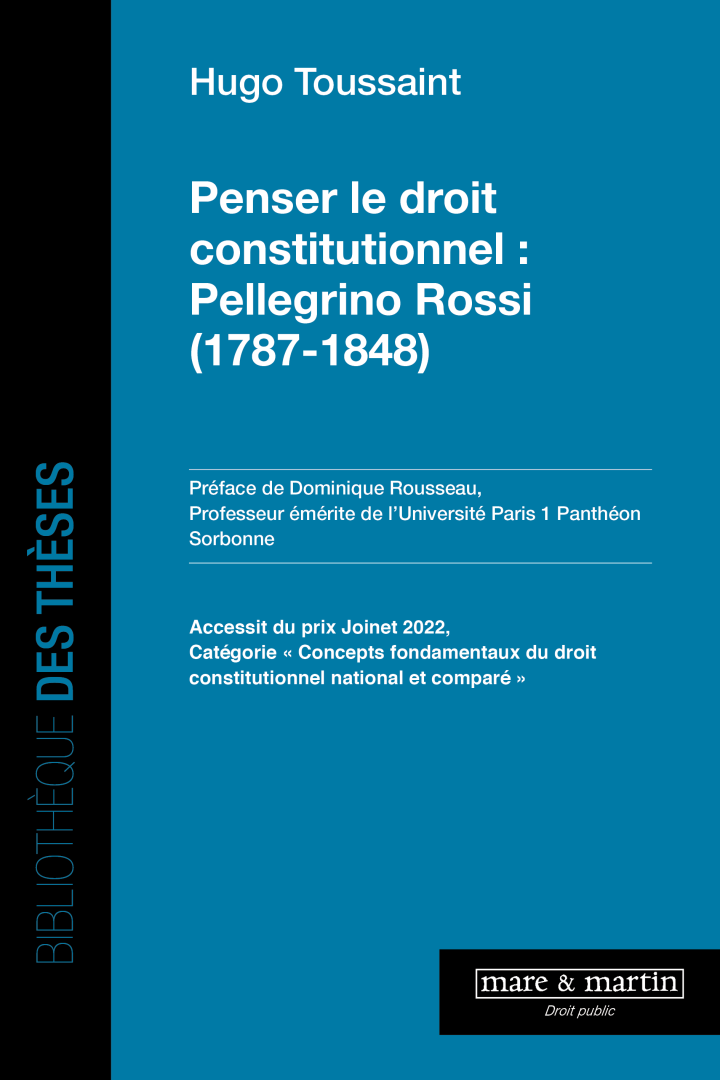
BOOK: Hugo TOUSSAINT, Penser le droit constitutionnel: Pellegrino Rossi (1787-1848) [Droit public - Bibliothèque des Thèses] (Paris: Mare & Martin, 2025), 592 p. ISBN 9782386000980, € 54

(image source: Mare & Martin)


Abstract:

Premier titulaire de la chaire de droit constitutionnel de la Faculté de droit à Paris, Pellegrino Rossi (1787-1848) demeure aujourd’hui encore une figure méconnue. Doyen de la Faculté, pair de France, académicien puis ministre du Pape Pie IX, le constitutionnaliste est une figure incontournable de la doctrine juridique du XIXe siècle. L’ouvrage se propose de mettre au jour les outils épistémologiques avec lesquels Pellegrino Rossi construit sa pensée constitutionnelle et politique. À travers l’étude des notions de personne humaine, de société et d’État, l’ouvrage démontre le ralliement de Rossi à l’éclectisme philosophiquede son temps en soulignant ses diverses inspirations comme l’historicisme et l’organicisme allemands ainsi que l’utilitarisme anglais. L’ouvrage reconstitue également le logique juridique mais également politique de la pensée de Pellegrino Rossi. En ce sens, est mis au jour le but politique de la pensée constitutionnelle de Rossi entièrement tournée vers la promotion de l’unité nationale. Enfin, l’étude se propose d’interroger la figure - communément répandue - d’un Pellegrino Rossi « libéral ». En effet, sa vision inégalitaire de la société politique, sa conception capacitaire du gouvernement représentatif ainsi que sa virulente critique de l’égalité des conditions décrite par Tocqueville dans la Démocratie en Amérique interrogent de plus en plus sa stature de « penseur libéral ».

Read more here

10 July 2025

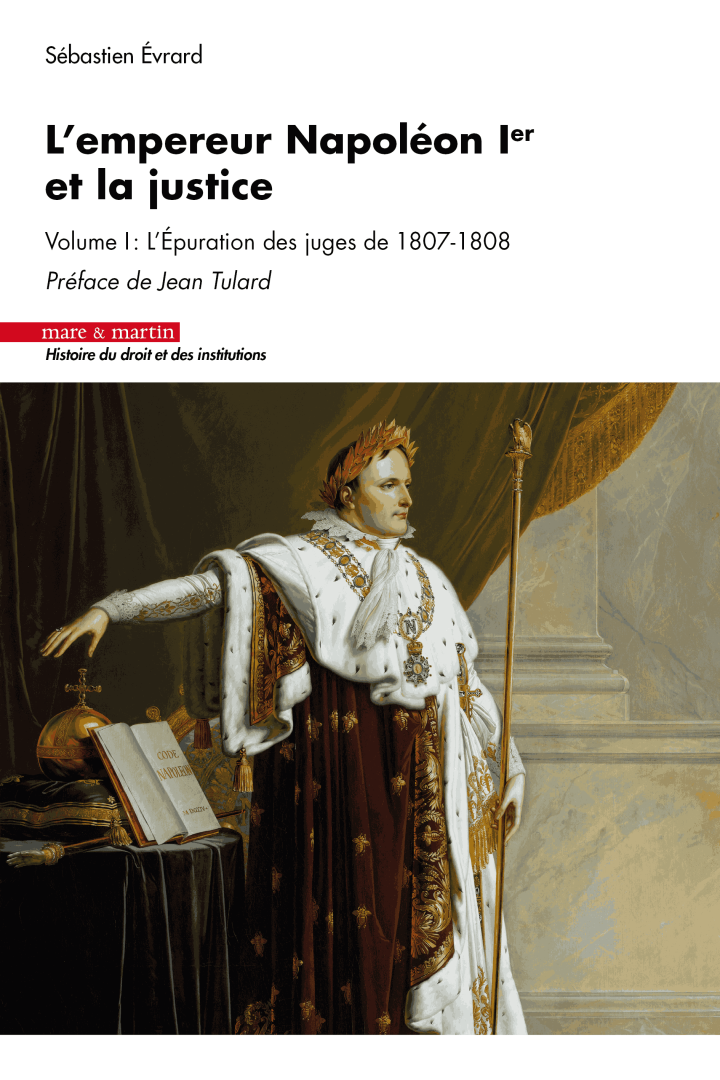
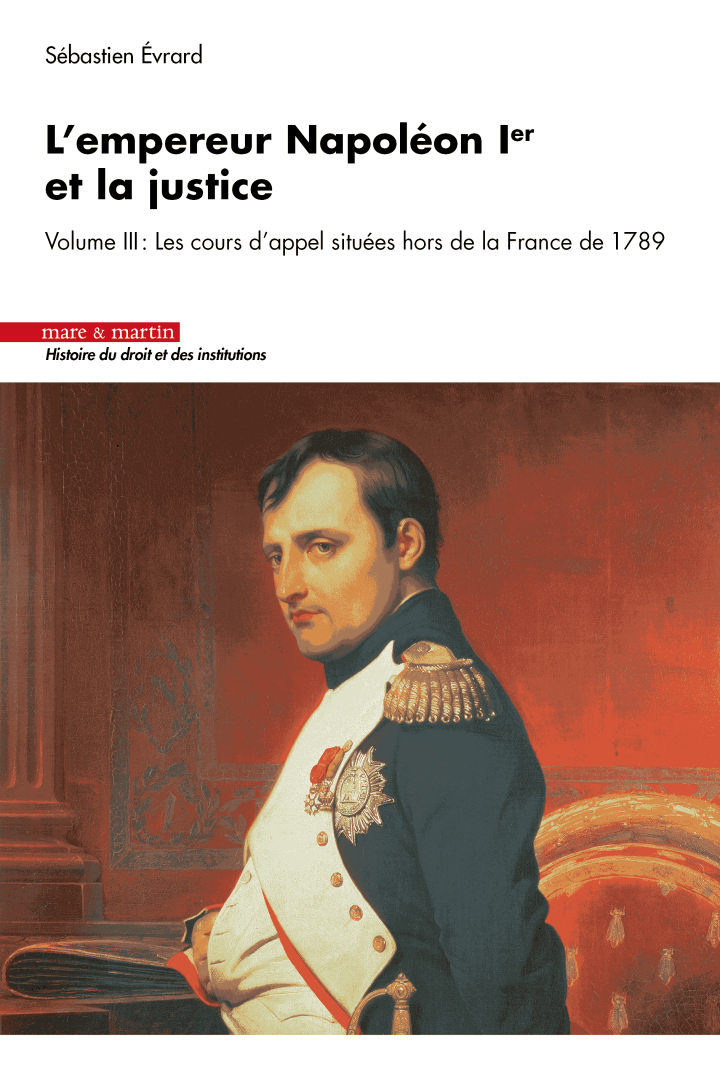
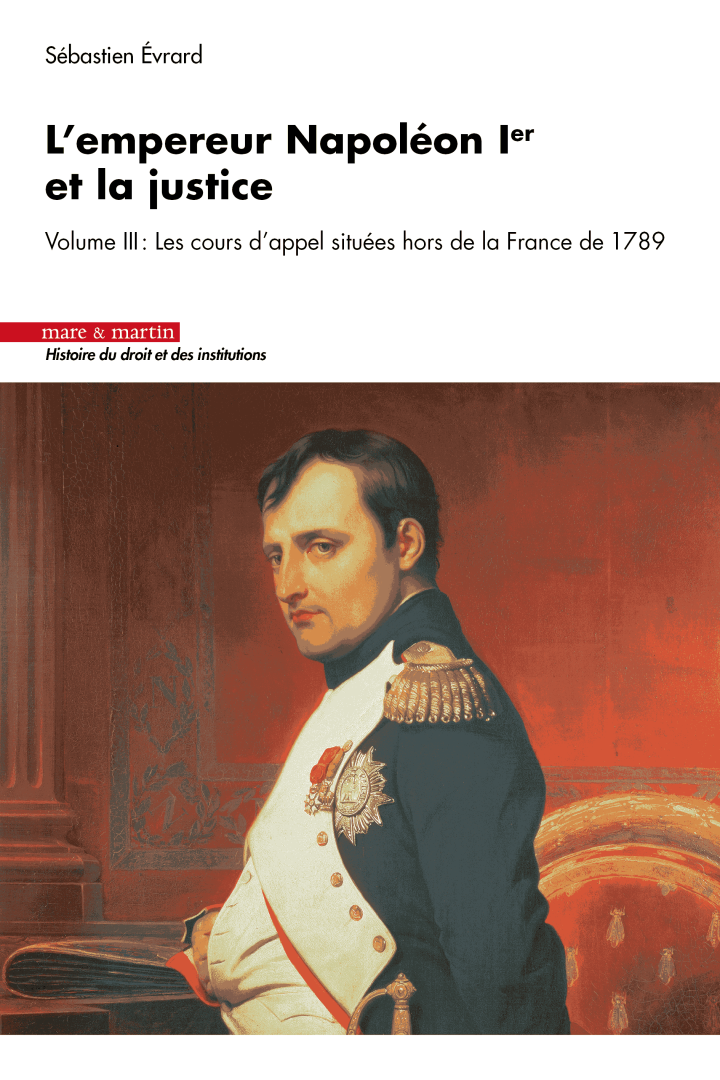
BOOK: Sébastien EVRARD, L'empereur Napoléon Ier et la Justice [Histoire du droit et des institutions] (Paris: Mare & Martin, 2025), 864 + 554 +306 p. ISBN 978-2-38600-118-5, 978-2-38600-119-2, 978-2-38600-120-8. € 66 + € 48 + € 33


(images: Mare & Martin)

Abstract vol. I:

Sous le Premier Empire, l’appareil judiciaire français fait l’objet d’une épuration sous la supervision du Sénat (1807-1808). C’est la première fois qu’une étude se propose d’examiner cette opération, ses acteurs, ses motifs, ses moyens et ses résultats grâce à un vaste corpus documentaire. Pour les juges, cette circonstance restera dans la mémoire de la justice comme une blessure, un défaut de confiance du Pouvoir envers la magistrature. En définitive, l’opération, achevée en mars 1808, frappe 167 magistrats sur 3800. Ces derniers sont examinés selon la cour d’appel à laquelle ils sont rattachés (il en existe 32). Mais un nombre bien plus important de juges ont été inquiétés par l’opération, qui touche aussi bien les départements français métropolitains, que les territoires annexés par la France (Allemagne, Belgique, Gênes, Piémont, Suisse). Près de 80 portraits illustrent des magistrats de cette époque.

Abstract vol. II:

Sous le Premier Empire, l’appareil judiciaire français fait l’objet d’une épuration sous la supervision du Sénat (1807-1808). C’est la première fois qu’une étude exhaustive se propose d’examiner cette opération, ses acteurs, ses motifs, ses moyens et ses résultats grâce à un vaste corpus documentaire. Pour les juges, cette circonstance restera dans la mémoire de la justice comme une blessure, un défaut de confiance du Pouvoir envers la magistrature. En définitive, l’opération, achevée en mars 1808, frappe 167 magistrats sur 3800. Ces derniers sont examinés selon la cour d’appel à laquelle ils sont rattachés (il en existe 32). Ce volume porte sur douze cours d’appel, depuis celle d’Agen jusqu’à celle de Riom, soit environ un tiers de l’ensemble des magistrats français, tant civils que criminels (à l’exclusion des juges de la Cour de cassation et des juges de paix). Sont ainsi dévoilées des informations sur leurs parcours : formation, professions exercées, leurs qualités comme leurs défauts. Le chef de l’État, par cette vaste et mal connue opération d’épuration, souhaitait reprendre en main le système judiciaire et éviter qu’apparaisse une sorte de gouvernement des juges.

 Abstract vol. III:

Sous le Premier Empire, l’appareil judiciaire français fit l’objet d’une épuration sous le contrôle du Sénat (1807-1808). Pour la première fois, une étude exhaustive se propose d’examiner cette opération voulue par l’empereur Napoléon. Grâce à un vaste corpus, l’auteur en dévoile les acteurs, les motifs, les moyens et les résultats, ce volume présente les données biographiques de plus de 700 juges dans le ressort de cinq cours d’appel de territoires annexés par la France lors des guerres de la Révolution et de l’Empire. Ce sont les cours de Bruxelles, Gênes, Liège, Trèves et Turin. L’ouvrage étudie en détail les personnalités visées par cette opération politico-judiciaire ainsi que les sanctions dont elles furent frappées, au moment où la magistrature de ces territoires traversait des difficultés particulières liées à l’application des règles sur la fiscalité, la conscription et la sécularisation du clergé. Pour appuyer la compréhension de cet épisode historique peu connu, l’ouvrage propose de nombreux graphiques et tableaux synoptiques, ainsi qu’une carte du système judiciaire français en 1807-1808 et les résultats de cette opération d’épuration de la magistrature.

On the author :

Sébastien Évrard, docteur en droit (université de Paris-Panthéon-Assas), est Maître de conférences à la faculté de droit de Nancy. Il est l’auteur d’une vingtaine d’ouvrages relatifs au monde des avocats, à l’édition juridique et au droit pénal sous la Révolution.

Read more here

09 July 2025

BOOK: Thomas KLEINLEIN (ed.), Weimar: une constitution mondiale? Contexte et réception de la constitution de 1919 (transl. Guy MONARD & Clothilde MELIN; preface Aurore GAILLET) (Paris: La Mémoire du Droit, 2024), € 64


(image source: MDD)

Abstract:

Ce volume est consacré au contexte international et à la réception internationale de la Constitution du Reich de Weimar. Des juristes, des politologues et des historiens procèdent à une mise en perspective internationale de la Constitution de 1919 et des discours qui s’y réfèrent. Leurs contributions mettent en évidence aussi bien les références transversales contemporaines que sa réception internationale sur l’axe historique longitudinal. Le contexte international de la Constitution de Weimar est examiné dans le sens d’une comparaison transversale. À quelles influences intellectuelles a­t­elle été soumise ? Quels modèles étrangers ont été utilisés, lesquels ont été sciemment rejetés ? L’histoire de la réception internationale de la Constitution de Weimar constitue un deuxième point fort. Quel a été son impact direct sur l’époque ? Où et quand « Weimar » a­t­il été un argument ? Quels enseignements ont été tirés ailleurs lors des débats constitutionnels ? Quels sont les effets à long terme qui se manifestent au niveau international dans les discours juridiques et intellectuels ?

Read more here

06 June 2025

BOOK: Yves JEANCLOS, Traité de droit criminel et pénal. Dimension historique, contemporaine, européenne (Paris: La Mémoire du Droit, 2024), € 49


(image source: MDD)

Abstract:

Le droit criminel et pénal est le régulateur juridique de la sécurité publique et le gardien de la paix sociale, depuis les réformes des XVIe-XVIIIe siècles jusqu’aux mutations des XXe-XXIe siècles. Il protège et défend les populations contre les infractions traditionnelles portant atteinte à la propriété, à la corporalité et à la dignité humaine. Il poursuit les auteurs d’infractions surgies avec l’évolution de l’économie, de la science, de la médecine, de la technologie et de l’informatique. Il réprime des infractions nouvelles liées à l’environnement, au trafic de stupéfiants, à l’utilisation déviante de l’informatique, au terrorisme. Du XVIe au XXe  siècle, il inflige des peines corporelles et fiscales, avant, au XXIe siècle, d’instituer des peines alternatives, plus sociales et économiques que répressives (amende forfaitaire délictuelle, stages de réinitialisation sociétale, travail d’intérêt général, détention à domicile sous surveillance électronique). Il s’efforce d’assister et d’indemniser les victimes pour les dommages subis. Le droit criminel et pénal reflète les mutations de la justice pénale sous la poussée du droit européen et de sa jurisprudence.Au XXIe siècle, il délaisse peu à peu la traditionnelle logique verticale d’imposition-infliction des peines, pour instaurer la nouvelle logique horizontale de négociation-contractualisation des sanctions.De manière continue, du XVIe siècle au XXIe siècle, au nom de l’ordre public réducteur des libertés individuelles, le droit criminel et pénal, ancré au cœur de l’architecture de sécurité intérieure voire internationale, se déploie pour garantir la paix sociale.

Read more here

30 May 2025

BOOK: Dolores FREDA, Mario PICCININI, Heikki PIHLAJAMÄKI & Chiara Maria VALSECCHI (eds.), Borders of the Early Modern Ius Commune. England, Venice and Scandinavia [Routledge Studies in Comparative Legal History, eds. Aniceto MASFERRER DOMINGO & Heikki PIHLAJAMÄKI] (London: Routledge, 2025), 366 p. ISBN 9781032535845, 116 GBP


(image source: Routledge)

Abstract:
The culture of the ius commune has been a unifying element of European and Western legal civilization. As shown by several recent studies, the influence of ius commune extended much further than its traditional core area. This volume discusses the expansion and changes of ius commune in three significant corners of Europe, which in the classical narrative either totally or partially were left out of the picture: England, Scandinavia, and Venice. The study goes beyond the traditional question of the influence of ius commune in comparing the different constellations of normativity and legal pluralism in these regions. It investigates how not only ius commune but also other forms of normativity – such as customary law, written norms, and legal practice – were used and applied, and how they circulated. The approach helps create new narratives as to how the relationship between centers and peripheries in Europe evolved in the early modern period. These new narratives are built from bottom to top; thus, based on concrete source information, and focusing on the learned legal systems and their connection to the local legal sources. The collection further looks into the circulation of professors and doctors, students, and legal texts, starting from the idea that a theoretical understanding of the forms of normativity can only emerge through concrete, multidisciplinary research recognizing the tensions between global legal unification and differentiation. The book will be essential reading for researchers and academics in Legal History, Law and Religion, Comparative Legal Studies and Early Modern History.

Table of contents:

1.      Borders of ius communeius commune at the Borders


Dolores Freda, Mario Piccinini, Heikki Pihlajamäki, and Chiara Maria Valsecchi


PART I: IUS COMMUNE AND VENICE


2. Lawyers in Venice: A Curious Business

Silvia Gasparini


3. “Negari tamen non potest Venetos ius civile romanorum colere et venerari”: Venetian Law and ius commune between the Seventeenth and Eighteenth Centurie

Claudia Passarella


4. Students, Graduates, or “Tourists”: Scholars from across the Borders in Padua in the Sixteenth and Seventeenth centuries

Donato Gallo


5. Venetian Law and ius commune: The Origins of a Controversy

Alfredo Viggiano


PART II: IUS COMMUNE AND ENGLAND


6. The Invisible Border between ius commune and Common Law: Traditional Interpretations and New Prospects

Dolores Freda


7. Legal Pluralism in the Law Courts of Early–Modern England

John Baker


8. Roman Law in Sixteenth-Century England: Professor Thomas Smith

David Ibbetson


9. Common Lawyers and Civilian Lawyers in England: Barriers and Connections

R. H. Helmholz


10. Gerard Malynes and the Ancient Law-Merchant: A View on the ius commune from the Borders

Stefania Gialdroni


PART III: IUS COMMUNE AND SCANDINAVIA


11.       Ius commune at the Merchant Courts of the Hanse Kontor in Bergen?

Sören Koch


12. The Emergence of the Profession of Procurators in Early Modern Denmark

Per Andersen


13. Adjusting the ius commune: The Swedish Legal Procedure in the Early Modern Period

Heikki Pihlajamäki


14. The Reception of the ius commune through German Law in Reformation Sweden (ca. 1530–1610): Torture, Police and Crime

Mia Korpiola


EPILOGUE


15. Re-reading Arthur Duck: Ius commune and Insular Exceptionalism

Mario Piccinini and Chiara Valsecchi

 On the editors:

Dolores Freda is Professor of Legal History in the University "Federico II" of Naples, Italy. Mario Piccinini has been Professor of Legal History at the University of Padua and is currently Senior Scholar at the same institution. Heikki Pihlajamäki is Professor of Comparative Legal History and currently Academy Professor in the University of Helsinki Chiara Maria Valsecchi is tenured Professor of Medieval and Modern Legal History in the University of Padua.

Read more here


14 May 2025

JOURNAL: Les échanges en matière de droit pénal entre les États-Unis et l’Europe (eds. Jean-Louis HALPÉRIN & Amalia D. KESSLER) (Clio@Thémis XXVIII (2025)) [OPEN ACCESS]

(image source: openedition)

Introduction (Jean-Louis Halpérin & Amalia D. Kessler)
DOI 10.4000/13wwa

Quelle connaissance et quel impact du droit criminel américain dans la France du xixe siècle ? (Jean-Louis Halpérin)
DOI 10.4000/13wwb
Abstract:

At two moments during the 19th century, French jurists were interested in American criminal law, and not only in the overseas prison systems discussed in the 1833 report by de Beaumont and Tocqueville. The first moment occurred between 1825 and 1835, when Livingston’s draft of a penal code for Louisiana was published in French, and when Livingston came to France. This project, which provided for the abolition of the death penalty, was seen as a response to the risks of increased repression by ultra-royalists on the basis of the Napoleonic Penal Code. The second moment occurred at the turn of the 20th century, when American innovations in indeterminate sentencing and juvenile courts were discussed in France. After identifying and analyzing the texts of French jurists who dealt with American criminal law in these two periods, the article examines the estrangement of French specialists of criminal law from American ideas.

Atlantic Knowledge Transfer. U.S. Criminal Law in 19th Century Germany (Sylvia Kesper-Biermann)
DOI  10.4000/13wwd
Abstract:

The article examines the transfer of legal ideas from the U.S.A. to Germany in the long 19th century. On the one hand, actors and paths of knowledge transfer are described. On the other hand, selected examples are used to examine which North American ideas, texts, and experiences were perceived and discussed in Germany. It is shown that two phases with different emphases of reception must be distinguished, namely a first phase from the 1830s to the 1850s and a second phase around the turn of the 20th century.

French and American Histories of Animal Prosecutions: Criminal Punishment and Animal Rights through the Prism of the Past (Amalia D. Kessler) 
DOI 
Abstract:

Between the early 1800s and the early 1900s, a sudden, and as yet unexplained, transatlantic literature on the history of animal prosecutions emerged. Focusing on France and the United States, this article explores the birth and evolution of this literature. A product of such developments as the rise of historicism, positivist criminology, and a social movement against animal cruelty, this literature addresses what proved to be enduring challenges of criminal punishment and animal rights. In so doing, it highlights the interrelation of these seemingly distinct domains.

Criminal Justice in Italy between the End of the Liberal State and Fascism: Transnational Perspectives between the USA and Italy (1919-1945) (Luigi Lacchè)
DOI 10.4000/13wwe
Abstract:

This article considers how American scholars and articles published in English viewed the Italian reforms of Criminal Justice implemented between the “Ferri project” (1919) and the Fascist regime. It analyzes in particular how Fascist criminal reforms have been received, interpreted and assessed from that perspective. To summarize the views of American legal thinkers on Fascist criminal reforms we can say that, despite the popularity of positivism in the U.S. at the turn of the century, the radical Ferri Code was criticized in several respects. By the mid-1930s American responses were still focused on questions of criminal science, rather than the nature of the regime itself. The isolationist policy of the U.S. did not prevent a number of scholars from assessing certain aspects of Fascist codes and criminal reforms, pointing out problems and contradictions. The transnational viewpoint is therefore important to understand better the real nature of the Fascist regime and the formal maintenance of the principle of legality.

Why and How Sexual Freedom Changed Western Criminal Law (19th and 20th centuries) (Aniceto Masferrer)
DOI 10.4000/13wwf
Abstract:

This article explains “why” and “how” the new paradigm of sexual freedom radically changed Western criminal law. “Why” touches upon the change in the moral sexual paradigm in the West at the cultural level. “How” describes the ways in which sexual (criminal) laws were reformed in accordance with the new cultural paradigm, describing the mutual influences between the US and Europe: while the US Supreme Court took the lead in forbidding states to make laws that might interfere in the sexual behaviour by resorting to the right to privacy – and this legal doctrine notably influenced most of European jurisdictions –, in Europe legal scholars and legislatures were the protagonists in undertaking criminal law reform, adjusting sexual criminal law to the new cultural ideas.

 Varia

The doctrine in power and the origins of the doctrine dirigée: the early role of the Soviet legal doctrine through the official legal journal of the RSFSR (1918-1922) (Marco Mellina)
DOI 
Abstract:

Analysing data about articles and authors from the official legal journal of the Russian Soviet Federative Socialist Republic, Proletarian Revolution and Law, this article shows that the legal doctrine writing in the journal was primarily composed by jurists who were also part of the ruling class from 1918 to 1921, effectively creating a doctrine in power. This observation partly contrasts with the dominant Western historiographical notion of Soviet legal doctrine being only directed by an external political power. However, the article also shows how, with the advent of the NEP, the establishment of the USSR, the revival of law and the consequent proliferation of legal journals, Soviet legal doctrine expanded and laid the foundations for the doctrine dirigée of later years.

Read the full issue in open access here

08 January 2025

BOOK: Christos GIANNOPOULOS & Linos-Alexandre SICILIANOS (dir.), Le patrimoine constitutionnel européen entre progression et régression. The European constitutional heritage between progression and regression. Actes du colloque coorganisé par la Fondation Marangopoulos pour les Droits de l'Homme et l'Université de Strasbourg, 4 et 5 mai 2023 [Publications de la Fondation Marangopoulos pour les Droits de l'Homme (F.M.D.H.)] (Paris: Pedone, 2024), 440 p. ISBN 9782233010797, € 64


(image source: LGDJ)

Abstract:

En associant des auteurs qui sont déjà présents sur cette discussion mais venant d'horizons disciplinaires différents, le présent ouvrage a un double objectif : D'une part, identifier, à travers l'analyse de la diversité des expériences nationales, les composantes du patrimoine constitutionnel européen en examinant les mécanismes par lesquels le « commun » est créé, qu'il soit construit par le bas, au moyen d'un travail de droit comparé, ou par le haut, au moyen de la création par les institutions européennes des standards communs qui s'appliqueront à l'échelle paneuropéenne. D'autre part, réfléchir sur les projections et les perspectives d'avenir à l'aune d'une Europe tiraillée par des crises successives en examinant la responsabilité des institutions européennes pour le développement d'une conscience patrimoniale européenne. By bringing together authors who are already involved in this discussion, but who come from different disciplinary backgrounds, the present work has a twofold objective : on the one hand, to identify, through the analysis of the diversity of national experiences, the components of the European constitutional heritage by examining the mechanisms by which the « common » is created, whether it is constructed from below, by means of comparative law work, or from above, by means of the creation by European institutions of common standards that will apply on a pan-European scale. Secondly, to reflect on future projections and prospects in the light of a Europe torn by successive crises, by examining the responsibility of European institutions for the development of a European heritage consciousness.

More information here.


09 January 2024

BOOK: Aniceto MASFERRER, C.H. VAN RHEE, Seán DONLAN & Cornelis HEESTERS (eds.), A Companion to Western Legal Traditions. From Antiquity to the Twentieth Century [Legal History Library, eds. C.H. VAN RHEE, Dirk HEIRBAUT & Matthew C. MIROW; 65] (Leiden/Boston: Martinus Nijhoff/Brill, 2023), ISBN 9789004687257, € 193,6


(image source: Brill)

Abstract:

This volume offers an extensive introduction to Western legal traditions from antiquity to the twentieth century. Drawing from a variety of scholarly writings, both in English and in translation, thirteen leading scholars present the current state of western legal history research and pave the way for new debates and future study. This is the ideal sourcebook for graduate students, as it enables them to approach the key questions of the field in an accessible way.

Contributors:

Aniceto Masferrer, C.H. (Remco) van Rhee, Seán P. Donlan, Stephan Dusil, Gerald Schwedler, Jean-Louis Halpérin, Jan Hallebeek, Agustín Parise, Heikki Pihlajamäki, Dirk Heirbaut, Bernd Kannowski, Adolfo Giuliani, Olivier Moréteau, and Jacques Vanderlinden.

 On the editors:

Aniceto Masferrer, Ph.D. (2000), is Professor of Legal History at the University of Valencia. He has published around 25 monographs and edited volumes in Spanish and English, including The Making of Dignity and Human Rights in the Western Tradition. A Retrospective Analysis (Springer, 2023). He is also the editor of GLOSSAE. European Journal of Legal History. C.H. (Remco) van Rhee, Ph.D. (1997), is Professor of European Legal History at Maastricht University. He has published widely on European legal history, the history of courts and adjudication, and modern civil procedure. He is an editor of Tijdschrift voor Rechtsgeschiedenis and contributed as chair of the working group on Obligations of the Judge and the Parties to the Model European Rules of Civil Procedure (UNIDROIT/European Law Institute, 2021). Seán P. Donlan, Ph.D. (2002), is Professor of Law at Thompson Rivers University. He has published on comparative legal history, comparative law, and Irish history. In addition to editing the journal Comparative Legal History, his edited publications include Comparative Law: Mixes, Movements, and Metaphors (Routledge, 2020) and Legal Traditions in Louisiana and the Floridas, 1763-1848 (The Law Book Exchange, 2019). Cornelis Heesters, MA, LLM, is an independent researcher, writer, editor, and translator living in Baltimore.

Read the book here: DOI  10.1163/9789004687257

16 October 2023

PODCAST: EuroStorie podcast (University of Helsinki, ONLINE)

(Image source: University of Helsinki)


The EuroStorie Podcast presents you with fresh and intriguing perspectives on European issues. In every episode we interview one specialist and focus on a certain topic related to Europe, its history, people, problems, institutions and futures. The podcast is hosted by Aada Pettersson and Floris van Doorn from the EuroStorie Centre of Excellence.

It's possible to listen to it on Spotify, Breaker, Google Podcasts, Pocket Casts and Radio Public.


LIST OF EPISODES

  • Episode 1: Europe, its hopes and fears;
  • Episode 2: The many faces of migration; 
  • Episode 3: Liberties versus restrictions; 
  • Episode 4: Looking away from Europe; 
  • Episode 5: Populism through a philosophical lens; 
  • Episode 6: Striving for Whiteness; 
  • Episode 7: European Disintegration - Is Differentiated Integration the Answer to Euroscepticism?
  • Episode 8: Belonging, Community and Solidarity: Queer Experiences of Migration; 
  • Episode 9: Visions of Europe! Politics and Identity at the Eurovision Song Contest; 
  • Episode 10: Is This Building European? Architecture, Europe and Empire; 
  • Episode 11: Vaccine Hesitancy, Health and Human Rights; 
  • Episode 12: What Is Sustainability? An Anthropologist’s Guide to Culture and the Environment; Episode 13: Socialist Justice in the GDR; 
  • Epis­ode 14: Legal Imagination and the History of International Power; 
  • Episode 15: What is biopolitics?
  • Episode 16: Sovereignty, Time and the Death of Empire in Europe


More information can be found here.


11 September 2023

BOOK: Willem ZWALVE, Power and Authority. A Trial of Two Swords. A History of the Union of the Holy Roman Empire and the Kingdom of Sicily (1186-1250) (The Hague: Eleven Publishing, 2023), 631 p. ISBN 9789462363410, € 50


(image source: Eleven)

Abstract:

On 27 January 1186 the German king Henry VI, son and heir of the Roman Emperor Frederick I ‘Barbarossa’, married Constance of Hauteville, heir to the throne of Sicily, in the Basilica of St Ambrose in Milan. The royal wedding sealed the union of the Kingdom of Sicily and the Holy Roman Empire, creating an enormous empire stretching from the shores of the North Sea to the beaches of Africa. The union also incited a major geopolitical conflict dominating European politics in the thirteenth century since it seriously compromised the sovereignty which the Roman papacy professed to exercise over all Christendom as well as the territorial integrity of the Papal State. Consequently, succeeding popes ( Innocent III, Gregory IX and Innocent IV) endeavoured to undo that union at all costs. The ensuing struggle between the Roman papacy and the Hohenstaufen emperors culminated in the deposition of the Emperor Frederick II by Pope Innocent IV on the First Council of Lyon in 1245, resulting in the final dissolution of the union of the Empire and the Kingdom of Sicily and the extermination of the Hohenstaufen race. By inviting a foreign prince, Charles of Anjou, brother to King Louis IX of France, to fight the last of the Hohenstaufens, papal politics ultimately turned the Italian peninsula into a battlefield for the two major powers of early-modern Europe: Spain and France. The origins, the vicissitudes, and the consequences of the union of the Empire and the Kingdom of Sicily are the subject of the first part of this book. The second part deals with the trial of Frederick II at Lyon, the court and its competence, the law involved and, lastly, the execution and aftermath of the sentence of the court.

On the author:

Willem Jans Zwalve was born in Groningen in the Netherlands in 1949. He studied law in the University of Groningen, writing his doctoral thesis on a subject of Roman civil procedure. Since then, he has written extensively on Roman law, comparative legal history, and Anglo-American and Dutch private law. His most recent book, Publiciteit van Jurisprudentie (2013), co-authored with his friend and colleague Corjo Jansen, is a comprehensive history of European law reporting. Willem Zwalve was Professor of Jurisprudence in Groningen University since 1987; Professor of Legal History in Leiden University since 1993; Professor of Anglo-American Private Law in Groningen University since 1994 and in the Nij megen Radboud University since 2009, retiring in 2014. He is a member of the Royal Netherlands Academy of Arts and Sciences and lives in Leiden with his wife Titia, also a lawyer. They have two children and three grandchildren. 

(source: Eleven

23 August 2023

BOOK: Marietta AUER, Thomas DUVE & Stefan VOGENAUER (Hrsg.), Michael Stolleis - zum Gedenken [Studien zur europäischen Rechtsgeschichte; band 342] (Frankfurt am Main: Vittorio Klostermann, 2023), X + 90 p., ISBN 9783465046257 € 22


(image source: Klostermann)

Abstract:

This volume presents the lectures written for the academic memorial service for Michael Stolleis (1941–2021) on June 24, 2022. They pay tribute to the many facets of the jurist and historian, the scientist as well as the university teacher. Tying in with his work, some essays shed light on the academic history of "German international law" or the history of colonial law; others highlight his great importance for European colleagues. Yet through all the contributions runs one basic idea: that legal history and legal histories inseparably belong together, as Stolleis masterfully demonstrated in his last book bearing the title "recht erzählen" (2021). Thus, personal recollections of friends and academic companions sustain the memory of an unique narrator of law. Michael Stolleis himself also has his say once again in a reprinted conversation about fathers, educational paths and contemporaneity.

Read more here

13 July 2023

CFP: Workshop 'Sovereignty and Commercial Cities (c. 1400 - c. 1650)' - Tilburg University, 14-15 December 2023 [DEADLINE 1 OCTOBER 2023]


On the 14th and 15th of December a two day workshop will be held at Tilburg University in order to bring together scholars working on urban history, legal history and economic history of the later medieval and early modern period.

The focus of this workshop is the sovereignty of cities of trade. If interested, please send in an abstract of 500 words to d.deruysscher@Tilburguniversity.edu before 1 October 2023. 

26 May 2023

BOOK: Aldo Andrea CASSI, Le danze di Clio e Astrea. Fondamenti storici del diritto europeo (Torino: Giappichelli, 2023), ISBN: 9791221100662

(Image source: Giappichelli Editore)


ABOUT THE BOOK (from the "Preludio")

Uno spettro si aggira per l’Europa del futuro: è il giurista di domani. La sua pena errabonda non è causata dal sospetto dell’uomo della strada (che imputa ad avvocati, giudici e notai alchimie tecniche care per le sue tasche o lontane dai suoi bisogni) né dall’insofferenza dei management societari (che considerano i consulenti legali come “bastoni tra le ruote” nella speditezza degli affari aziendali), né dall’esser considerato superfluo, se non nocivo, da molti intellettuali (che gli imputano aridità culturale e inerzia nelle riforme) e bistrattato dal legislatore (il quale lo mette alla prova destrutturando l’ordinamento giuridico con estemporanee e continue riscritture di esso). Non è questo il problema: il giurista sa che è da tempo così; sa che il problema non è l’immaginario collettivo su di lui, perché questo appartiene alla sua stessa Storia – e del resto altre categorie professionali non stanno meglio da quel punto di vista ... La questione è ben altra: quale che sia la figura (avvocato, magistrato, notaio, legale aziendale, funzionario amministrativo, insegnante, ecc.) in cui il futuro giurista deciderà di incarnare la propria anima, rischierà di fare una scoperta orrenda: non ce l’avrà più, l’anima. Non avrà più, dopo quasi un millennio, un’anima da giurista, perché gliel’hanno strappata dal luogo dove essa gli sarebbe stata insufflata: l’Università.


ABOUT THE AUTHOR

Aldo Andrea Cassi è professore ordinario all’Università degli Studi di Brescia, dove insegna antropologia giuridica e storia del diritto medievale e moderno. 


More information and the table of contents can be found here.

03 May 2023

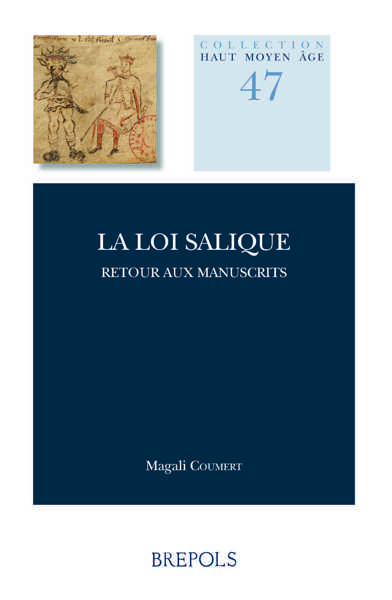
BOOK: Magali COUMERT, La loi salique – Retour aux manuscrits (Turnhout : Brepols, 2023), 430 pp, ISBN 978-2-503-59986-1, 75.00 EUR


(Source: Brepols)

Brepols has published a new work on the salic law.

ABOUT THE BOOK

La loi salique a été l’objet d’une attention approfondie à la fin du Moyen Âge, où elle fut utilisée par les partisans du roi de France pour justifier les successions royales et l’éviction du roi d’Angleterre, aussi bien qu’à l’époque moderne et contemporaine, car les érudits y ont cherché l’expression des coutumes germaniques originelles. Pour autant, elle n’a fait l’objet que d’une édition partielle et les manuscrits qui la comportent, copiés à ‘époque carolingienne, n’ont encore jamais fait l’objet d’une étude systématique. L’étude revient sur les conditions de l’échec d’une édition scientifique de la loi salique, au milieu du XXe siècle, puis se consacre aux témoins manuscrits, copiés après 750. La comparaison détaillée des différentes versions du texte et des différents recueils manuscrits jette un nouvel éclairage sur l’histoire compliquée de ce texte.

La loi salique constituait, au VIIIe, un ensemble d’articles aux contours flous, dont l’association à l’autorité royale mérovingienne n’empêchait la liberté de composition de chaque copiste, qui élaborait son propre assemblage des articles juridiques. Toutes les versions de la loi salique étaient considérées comme valables et ce n’est qu’à partir du règne de Louis le Pieux que la version la plus récente du texte fut préférée aux autres, probablement en raison de sa clarté. Le nombre important de copies de petit format du texte, dans la première moitié du IXe siècle, semble montrer le recours courant à la loi salique par les détenteurs de l’autorité dans l’ensemble de l’empire carolingien.

ABOUT THE AUTHOR

Magali Coumert est professeur d’histoire médiévale à l’université de Tours. Ses travaux portent sur le Haut Moyen Âge occidental, et plus particulièrement sur les lois, barbares et romaines, les identités ethniques, l’écriture de l’histoire et l’historiographie.

More information here

02 May 2023

CALL FOR PAPERS: Legal Unification through Jurisdiction? (DEADLINE: 15 July 2023)

Professor Löhnig has sent us the following call regarding a proposed edited collection on ‘legal unification through jurisdiction’.

CfP: Legal Unification through Jurisdiction?

Those who want to achieve territorial uniformity of law and thus create a uniform legal area can make use of various instruments. First and foremost is the instrument of legislation. A legislator who is superior to several legal areas can ensure legal unification through uniform legislation. If such a superior legislator does not exist, the law of several states can nevertheless be unified by the respective legislators enacting identical laws in a coordinated manner. However, legal unity can also be created by jurisprudence and legal education - as was the case in continental Europe up to the threshold of the 19th century; Savigny in particular had assigned the task of preserving and creating legal unity to it. Finally - and this will be the subject of this study - legal uniformity can also come about through jurisprudence or even be consciously striven for by creating a court that is superior to various legal areas. With the opening of the Reichsgericht in Leipzig on 1 October 1879, a unified supreme court was established in the German Empire. However, the creation of this court did not correspond to the creation of a uniform civil law for the empire. It took 20 years until the Civil Code, which is still in force today, came into force on 1 January 1900. How did the Imperial Court deal with the fragmentation of civil law? Did it faithfully apply the applicable particular law determined with the help of the rules of interlocal private law? Or did the court instead pursue "legal unification through jurisdiction"? And if so, by what means and in what areas? A few years ago I examined this question on the basis of the published jurisprudence of the Reichsgericht and showed how and in what areas this court actually pursued "legal unification through jurisdiction" between 1879 and 1899 and thus supported the "inner foundation of the Reich" (Löhnig, Rechtsvereinheitlichung durch Rechtsprechung? Zur Judikatur des Reichsgerichts 1879-1899, Mohr Siebeck, Tübingen 2012 = Löhnig, La unificaciòn des Derecho Civil mediante la práctica jurisprudencial del Tribunal Supremo alemán (1879-1899), Dykinson, Madrid 2018).

The situation that existed in the German Reich for twenty years is no different from the situation in Poland, Czechoslovakia, Yugoslavia, Romania, the Baltic States and (for a short time) Austria after 1918: there was a national supreme court, but no uniform codification of civil law and, moreover, no uniform codification of commercial and company law. So did the supreme courts of these states pursue "legal unification through jurisdiction" - and if so, how and in which areas of law? Moreover, lower courts may also have participated in "legal unification through jurisdiction"; a question I have not yet examined for the German Reich. Anna Klimaszewska (Gdańsk) drew my attention to a dictum by Mieczysław Honzatko in this regard. In the absence of developed legislation, jurisprudence in the former Russian partition territory was left to its own devices and applied the principles best suited to the needs of the market, which did not differ too much from those known to German law (Honzatko, Polski Kodeks Handlowy, Głos Prawa, nr 11/1933 r., pp. 635-636).

I would very much like to pursue the question of the "legal unification through jurisdiction" in the Central European states in the interwar period. To do so, I am dependent on the cooperation of numerous scholars from these states, with whom I would like to answer the above-mentioned question together, i.e. ultimately clarify what role jurisprudence had as a source of law. The more individual studies on specific areas of civil or commercial law and/or the activities of individual courts can be collected for each state, the better. For this reason, I would like to ask you for your cooperation and for the wide dissemination of this outline (also to young scholars or PhD students), and I hope that as many scholars as possible will declare their willingness to cooperate by 15 July 2023. Please send an email with a short outline of the topic and a CV to martin.loehnig@ur.de (I will reply by 31 July 2023 at the latest). In summer 2024, I would like to invite you to a meeting where we can discuss the results. Afterwards, the revised contributions will be published by a reputable academic publisher (Mohr Siebeck or BRILL).

14 April 2023

CONFERENCE: Law and Diversity - European and Latin American experiences from a legal historical perspective - Criminal law II; 3-4, 13-14 April


(Source: https://www.lhlt.mpg.de/events/34139/2373)

The tensions between equality and inequality as principles of justice and distribution, as well as between general and individual case justice, should be among the basic experiences of any normative order. The history of law bears witness to this - and of ever new attempts to soften these tensions through institutional arrangements and special protection regimes.

However, the social dimensions in which the tension between equality and inequality emerged and the legal solutions or attempts at solutions it produced varied from country to country. In the workshop and publication project "Law and Diversity - European and Latin American Experiences from a Legal Historical Perspective", contributions from various European and Latin American countries are intended to illustrate this diversity and at the same time facilitate comparison. After three previous workshops dealing with general questions, public law and private law, this workshop focuses on criminal law.


3 April 

13:30 Welcome and introduction Peter Collin / Manuel Bastias Saavedra / Massimo Meccarelli 

13:45 Codification and special law 

Main contribution Alejandro Agüero / Matias Rosso 

Comments Massimo Meccarelli Diego Nunes Martin P. Schennach 15:00 Coffee break 


15:30 Military criminal justice 

Main contribution Artur Barretto de Almeida Costa 

Comments Giacomo Pace Gravina Patrick Heinemann Beatriz Lopez Lorca 


16:45 Perpetrator Type Theory 

Main contribution Emilia Musumeci 

Comments Richard F. Wetzell Sabine Freitag Marcos Antonio Leon 

18:00 Dinner 

19:00 Transnational criminal law regimes on women trafficking and prostitution 

Main contribution Karl Härter 

Comments Christiana Schettini 


4 April 

13:30 Prison System 

Main contribution Jorge Nunez / Jose Daniel Cesano 

Comments Jean Charles Froment Mary Gibson 

14:30 Colonial criminal law 

Main contribution Olindo De Napoli 

Comments Elizabeth Kolsky 


13 April 

13:30 Welcome and introduction Peter Collin / Manuel Bastias Saavedra / Massimo Meccarelli 

13:45 Political crimes 

Main contribution Raquel Sirotti 

Comments Monica Stronati Camilo Plaza Armijo 

15:00 Coffee break 

15:30 Juvenile criminal law 

Main contribution Dominique Messineo Comments Jaime Couso Enikő Kovács-Szépvölgyi 

16:45 Abortion and criminal law 

Main contribution Julieta Di Corleto 

Comments Bárbara Madruga da Cunha Kamila Staudigl-Ciechowicz 

18:00 Dinner 

19:00 Beggars, vagrants, and the poor 

Main contribution Paulo Cruz Terra 

Comments Agustin Casagrande 


14 April 

13:30 Women and Criminal Law 

Main contribution Claudia Paiva Carvalho / Camilla de Magalhães Gomes 

Comments Monica Burman Lucia Nunovero Cisneros 

14:30 Homosexuality and criminal law 

Main contribution Thierry Delessert 

Comments Caroline Derry 


27 December 2022

BOOK TALK ANNOUNCEMENT: Ada Kuskowski, Vernacular Law: Writing and the Reinvention of Customary Law in Medieval France - 20 January 2023, 12:30--2 pm (on Zoom)


Where does law come from? In the Middle Ages, there were generally two answers: legislation and custom. Later history would see custom largely pushed out of the realm of the legal, notably because of the advent of the legislative state and philosophies of legal positivism (with some exceptions). During the Middle Ages, however, legislation was piecemeal and record-keeping nascent. Large swathes of legal life were governed not by fiat but by custom. 

What custom meant, however, went through a radical shift during the period. Between the twelfth and thirteenth centuries, custom went from being a largely oral and performed practice to one that was also conceptualized in writing. Based on French lawbooks known as coutumiers, Ada Kuskowski traces the repercussions of this transformation – in the form of custom from unwritten to written and in the language of law from elite Latin to common vernacular – on the cultural world of law. Vernacular Law offers a fresh understanding of the formation of customary law as a new field of knowledge. Instead of a fossilized and somewhat inaccurate presentation of legal practice, this book shows authors combining ideas, experience and critical thought in order to transform disparate individual customs and practices into a new medium that presented them as a cohesive 'customary law.' Medieval customary law, commonly seen a community norm repeated by rote, emerges also as a product of individual craft and a law of dynamic innovation. 


Registration Link: https://law.stanford.edu/event/sclh-presents-ada-kuskowski-and-vernacular-law-writing-and-the-reinvention-of-customary-law-in-medieval-france/


06 December 2022

JOURNAL: Journal on European History of Law 13 (2022), nr. 2


(image source:  The European Society for History of Law)


Articles:

The Habsburg Monarchy and the South-American Question 1815–1842 ( Miriam Gassner) 

Abstract: 

When the Spanish-American colonies successively declared their independence in the first half of the 19th century, the European Powers had to decide on how to deal with these newly formed republics. Already at the Congress of Vienna in 1814/15, the Holy Alliance decided to follow the principle of legitimacy set up by the French diplomate Prince Charles Maurice de Talleyrand However, the interests of the European Powers that formed the Holy Alliance were too diverse to adhere to the principle of legitimacy for long: While the eastern powers (Austria, Russia and Prussia) adhered to the principle of legitimacy and refused to recognize the newly formed Spanish-American republics, France soon followed the British path and started to recognized the Spanish-American republics as sovereign states. Only the Empire of Brazil, which was ruled by the Portuguese heir to the thron Dom Pedro and his wife the Habsburg Archduchess „Leopoldina“, was recognized by the Habsburg Monarchy as early as 1825.

The Long Struggle to Open Austria’s Law Faculties to Women. From the First Woman Doctor of Law to the First Female Law Professor (Kamila Staudigl-Ciechowicz)

Abstract:

The article outlines the hard road that led to the admission of women, first of all to the law degree, and then to academic careers at the university level in Austria. It also presents the arguments of those who advocated and opposed their admission. Taking into account contemporary literature and archival sources, the individual steps are shown – from the unsuccessful demands at the beginning of the 20th century, to the founding of a private women’s law academy 1917, to admission to law studies in 1919. It would take another few decades until 1958, when the first woman was appointed full professor at the Vienna Faculty of Law.

Auf dem Schreibtisch jedes preußischen Beamten. Fernwirkungen von Robert Graf Hue de Grais bis nach Japan (Robert von Lucius)

Abstract: 

Robert Graf Hue de Grais was a proliferate and influential writer on public law and administration. His handbook on constitution and administration in Prussia and the German Reich, published in 25 editions between 1881 and 1930, was the standard reference work for generations of Prussian civil servants in the Kaiserreich and the Weimarer Republic. It even influenced, through a translation into Japanese, administration in Japan, and was noted in the USA, Belgium, France. Count Hue de Grais was also influential through his proposals on administrative reforms, as civil servant – he was Regierungspräsident of Potsdam – and in civic education. Part of his archive is now opened, a hundred years after his death.

Die Einführung des Tatbestands der Untreue in das österreichische Strafrecht 1931 (Christoph Schmetterer)

Abstract:

In May 1931 the largest Austrian bank, the Credit-Anstalt für Handel und Gewerbe (CA) broke down and was saved by the Austrian government. Within days former CA-official Friedrich Ehrenfest was considered the main culprit of the break down. Investigations against Ehrenfest were started but during the next months it became clear that Ehrenfest couldn’t be punished under Austrian criminal law. Thus a new crime, embezzlement, was introduced retroactively in December 1931.

Old Practices, New Justifications. The Effects of transactio in criminalibus in the Age of Ius Commune (Daniela Buccomino)

 Abstract:

This paper is meant to reconstruct the crucial value attribuited to the institution of criminal transaction and its effects. For this purpose, an attempt will be made to emphasizethe indispensable role of legal science in the practical aspect of law, in a relevant moment to the political and institutional evolution of the municipalities of late medieval Italy. At the same time, the essay analyzes the implications of the relationship between doctirnal law and practical law during the period of Ius commune, through the analysis of some topical queaestione.

‘Pandemic Criminal Law’ in Continental European Legal History (Vid Žepič)

Abstract:

The article outlines the development of official criminal policy against the spread of infectious diseases, especially the plague, in continental Europe from antiquity to the end of the 18th century. The crimes and their punishments are presented on the basis of city statutes, early modern penal codes and contemporary legal doctrine. Surprisingly, even though European countries faced devastating plague pandemics, no significant criminal-law related state intervention in pandemics took place until the 16th century, except in a number of coastal cities of the Mediterranean and northern Italian cities. The prosecution of sanitary crimes was the business of sanitary magistrates, who were in charge of wide criminal jurisdiction. The ‘pandemic criminal law’ was characterised by harsh penalties resembling martial law, criminalisation of both commission and omission, intentional and negligent offences, and the departure from the principle of legality when it was already an established legal principle.

On the Origin of One Roman Law Rule in the Moravian Legal Manual from the Second Half of the 14th Century (Lenka Šmídová Malárová)

Abstract:

The Moravian legal handbook, Manipulus vel directorium iuris civilis, written by Jan of Gelnhausen in the second half of the 14th century represents an important source directly connected to the older Law Book of Jan the Notary (Brno, Czech Lands).  Manipulus reflects an extensive body of interpretive rules and definitions which his author, Jan of Gelnhausen, took over from some medieval manuscript including 16th and 17th title of 50th of Digest, an integral part of the Corpus iuris civilis. The aim of this paper is to introduce the section De regulis iuris et de verborum significatione, which includes the regulations adopted from those titles of Digest and reflects on the origin of one modified rule and its comment.

Die Sprache der Bilder in den Josephinischen Gesetzbüchern (Zdeňka Stoklásková) 

Abstract:

The imagery in Emperor Joseph II’s codes of law has not been a subject of research, which is understandable to a certain degree. The copperplate engravings from the Josephine codes of law are probably not that interesting for art historians, but they are exceptionally attractive for historians and legal historians. These copperplate engravings visualize, often very critically, some of the published codes of law. The method of study is the “language of imagery” and the “language of text”. The language of imagery is understood as an expression of the ruling power, while the language of texts in the codes of law (as well as an expression of power) is held up here as a mirror in the form of the language of contemporary authors – i.e. a juxtaposition between the official meaning and the satirical texts written at the time. The title images of the codes of law of Joseph II and Leopold II might also be interpreted as a result of the “thawing” of censorship, as the subsequent codes of law of Francis I/II do not contain allegoric engravings.

The Collective Agreement in the Interwar Czechoslovak Republic (Clash of Legal and Philosophical Ideas) (Miriam Laclavíková, Tomáš Gábriš)

Abstract:

The article describes the transformation of legal thinking in the transition from liberalism to collectivism, respectively transition from the minimal state to welfare state, on the example of the development of legal regulation of collective agreements in the interwar Czechoslovak Republic. These changes affected alike jurisprudence, legal science and legislation, but it was ultimately the legislation that had to answer the questions that both theory and practice were reluctant to resolve.

Selected Aspects of the Exchange and Removal of the Population of Hungarian Nationality from the Czechoslovak Republic (Ján Štefanica) 

Abstract:

After the Second World War, the political representation of Czechoslovakia as well as Hungary had to deal with a difficult question concerning people of Hungarian nationality, who lived in Czechoslovakia. While the issue of the expulsion of the German population from war-torn countries was addressed at the European level, the issue of expulsion of Hungarian nationals from Czechoslovakia stood behind. This article attempts to address this issue in detail.

Not only Roman Law. Political Activity of Leon Piniński (1857–1938) (Grzegorz Nancka)

Abstract:

Leon Piniński (1857–1938) was a professor of Roman law associated with the University of Lviv. His scholarly focus on Roman law was not his only area of activity. This scholar was also closely involved in political activity. Leon Piniński was a governor of Galicia. It is interesting to consider whether his political activity in any way affected his scholarly achievements. It also seems interesting to look at how this scholar is perceived nowadays and whether his political activity contributed to it. The article uses the legal-historical method.

Protected by Lex Laetoria: Two Papyri of Roman Egypt and their Effect on Roman Law (János Erdődy)

Abstract:

Lex Laetoria was a Roman Act from about the turn of the 3rd and 2nd centuries BC, granting additional protection to adults under the age of 25. Amongst its primary sources the Tabula Heracleensis, a.k.a. lex Iulia municipalis (cf. FIRA I, 112), an excerpt from the Theodosian Code (C. Th. 8, 12, 2), and four papyri (BGU II 378, BGU II 611, P. Oxy. X 1274 and P. Oxy. XVII 2111) bear greater importance. These papyri are resourceful in the debate about the actual name of the Act (lex Laetoria versus lex Plaetoria). From a legal point of view, BGU II 378 and P. Oxy. X 1274 contain a petition and a contract or agreement, respectively, where the reference to lex Laetoria is part of a legal argumentation. Besides the actual case, these papyri are significant because they give a presentation of the quotidian social and economic life and practice of the Roman world in Egypt around the 2nd century AD. By examining and analysing the cases described in these papyri, we get a closer view to the everyday reality of Roman law. The characters involved in the cases bear Roman names, the cases take place in Hellenised Egypt, the correspondence is in Greek, yet Roman law measures are used to settle the disputes. We sense multiculturalism in these documents, without the awkward feeling of being unfamiliar to Roman Egyptian culture. This paper aims to catch a glimpse of Roman law in action by multicultural approach, and to provide an example of how Rome had managed to handle herself as an Empire.

 The Emergence of the Idea of Religious Freedom in Ancient Rome (Pál Sáry)

Abstract:

It is well known that the so-called Edict of Milan, issued in 313, was a landmark in the religious history of mankind, because it declared for the first time the doctrine that freedom of religion belongs as of right to everyone. The present paper seeks to investigate the intellectual background of this famous edict. The emergence of the idea of religious freedom is linked to the persecution of Christians in the Roman Empire. This idea first appeared in the works of Christian apologists. It was Tertullian who firts emphasized that the free choice of religion is a natural right of every human being. This idea was previously unknown in the pagan world. Tertullian was a pioneering thinker because he was the first to be able to combine biblical theology with the natural law teachings of Stoic philosophy of law. Of the later apologists, Lactantius dealt with the idea of religious freedom in the most detail. Lactantius had a great influence on Constantine, who, together with Licinius, decided to issue the so-called Edict of Milan. The edict guaranteed everyone the right to choose their religion freely, but did not declare this right a natural right that the state could not restrict.

Das freie Vorbringen und seine Begrenzung nach der Kodifikation des ungarischen Zivilprozessrechts (Kristóf Szivós)

Abstract:

The first Hungarian code of civil procedure was enacted at the end of 1910, after almost thirty years of codification. Previously, the procedural regulation based on the Austrian General Judicial Ordinance of 1781. The main aim of the legislator after the Austro-Hungarian Compromise of 1867 was to introduce a procedural order that bases on the principles of orality, immediacy, and publicity. As a result, the principle of contingent cumulation (Eventualmaxime) was replaced by the principle of unity of the cause which meant that the parties could submit new allegations and proofs until the closure of the last hearing. Thy study examines this new system and the tools with which the code of civil procedure tried to avoid undue delay. The main result of the study is the determination of the boundaries of the free submission and the circumstances of the application of sanctions against undue delay.

A Special Professional Authority of Cartel Supervision in Hungary: The Cartel Committee  (Norbert Varga)

Abstract:

The Hungarian Cartel Act of 1930 regulated the cartel supervisory authorities, with the primary task of making sure that the operations of cartels were on the right path in order to protect public interests and public well-being. Cartels should provide customers with public needs goods at an affordable price. The government of Hungary wished to ensure this by creating cartel supervisory authorities in cartel matters. Amongst the specialized cartel supervisory authorities, one must emphasize the Cartel Committee, with its primary task of establishing whether or not the agreements formed by cooperating companies contain cartel-like competition-limiting clauses. In my essay, I wish to describe the establishment, the organisation and the practices of the Hungarian Cartel Committee, based on the one of the most important archival sources related to the bakery cartel.

The “Hungaricum” of the Crusader Orders: the Order of St Stephen (Orsolya Falus)

Abstract:

It was in the early 1970s that historiography "discovered" the Order of St Stephen, the “Stephanites”, the canonical order of the Hospitaller Crusaders of St Stephen, founded by King Géza II of Hungary in the 1150s in honour of King St Stephen of Hungary (977-1038), crowned: , modelled on the European knightly orders already in existence at the time. The first archaeological evidence of the existence of the order was found in 1959 during an archaeological excavation in the Danube Canyon near Esztergom. The study examines the circumstances of the founding of the Order of the Stephanites, the administrative activities of the knights in “locus credibilis authenticus”, and their role in Árpád-era Hungary.

Heidegger on Hegel’s Concept of State (András Karácsony)

Abstract:

It is often said of Heidegger that he did not engage in political philosophy. However, the publication of his legacy reveals a brief period when he was interested in politics and the state. Specifically, we can refer to two seminars Heidegger delivered in 1933/34, when he interpreted Hegel's conception of the state and debated Carl Schmitt's theory of politics. This study focuses on Heidegger's interpretation of Hegel's conception of the state. The texts on which the analysis is based are seminar notes and transcripts, and as such, only reflect the questions Heidegger raised in his lectures. More definitive texts on the subject are not available, because neither did Heidegger teach any course addressing the relevant topic after 1935, nor did he publish anything on the subject in the later decades. Accordingly, this paper is a brief presentation of a unique episode.

Some Issues Regarding Fraud in the First Hungarian Criminal Code (Sándor Madai)

Abstract:

The first Criminal Code is always of paramount importance in the life of a nation. Not only because written law, especially criminal law, has been in demand by society from the outset, but also because it is crucial for applying the law, the justice system must also adapt to this. The first Hungarian Criminal Code – the Csemegi Code – met this expectation. The following study focuses on one of the fundamental delicts of property crimes: fraud. We present the questions that the codifier had to answer, then the result of this thinking. Finally, we look at the first amendment to the Csemegi Code, which affected the crime in several respects. The study is based primarily on descriptive, historical and comparative methods, and we try to approach the subject of our study from a theoretical and practical point of view at the same time.

Papal Monarchy Challenged (Jiří Bílý)

Abstract:

The following article analyzes the power structures within the Catholic Church from a sociological and historical perspective, especially the power of the Curia in relation to the various national bishops' conferences and individual dioceses, but also in relation to the Pope, as it developed above all from the 19th century to have. Unlike the spirit of the Second Vatican Council, it is the Roman Curia, not the College of Bishops, that holds the real power in its hands. The bishops appear before the competent Vatican authorities more as supplicants than as confreres. The Curia is not even well organized internally. There are often no clear boundaries between competencies and no regular cabinet meetings between the heads of authorities. While one has long since learned in the secular area to use systems of separation of powers and mutual control in order to remain capable of learning as an organization, the Roman Church apparently believes that it can do without such „checks and balances”. As the sacred aura of the papacy fades, the institutional character of the church becomes more and more conscious, and in many ways it contradicts generally accepted socio-ethical principles such as the rule of law, subsidiarity, the participation of those concerned and administrative control. It looks as if the largest religious community in the world is ruled by a small group of old men who shirk human responsibility in the name of God and demand unconditional obedience from the bishops, priests and believers of the universal Church for their decisions, regardless of theirs Reasons and their plausibility on site. This increasingly calls into question the credibility of the church’s message itself.


Book reviews:

 
Zdeňka Kokošková, Monika Václavíková/Sedláková, Jaroslav Pažout (Hrsg.): Die Oberlandratsämter im System der Besatzungsverwaltung des Protektorats Böhmen und Mähren und ihre leitenden Beamten  (Julian Lubini)


Thomas Groß: Verwaltung und Recht in antiken Herrschaftsordnungen. Ägypten, Assyrien, Athen und Rom im Vergleich (Julian Lubini)


Christian Reiter: Einführung in das römische Privatrecht. Ausgewählte Themengebiete und Fälle (Radek Černoch)

Reports from history of law:

 
Thomas Gergen: Pfadfinden und Recht an der Saar. Rede anlässlich der Gedenkfeier zur Erinnerung an die jüdischen Pfadfinder in St. Ingbert/Saar 


Robert von Lucius: In memoriam. Prof. Dr. Michael Stolleis 


100 Jahre Fürstlicher Oberster Gerichtshof des Fürstentums Liechtenstein – Ein Interview mit Universitätsprofessor Dr. iur. Dr. phil. Thomas Gergen, Maître en droit (Luxemburg)


Petra Zapletalová: Report from the Conference “International Legal History Meeting of PhD Students”


For more information see here.