
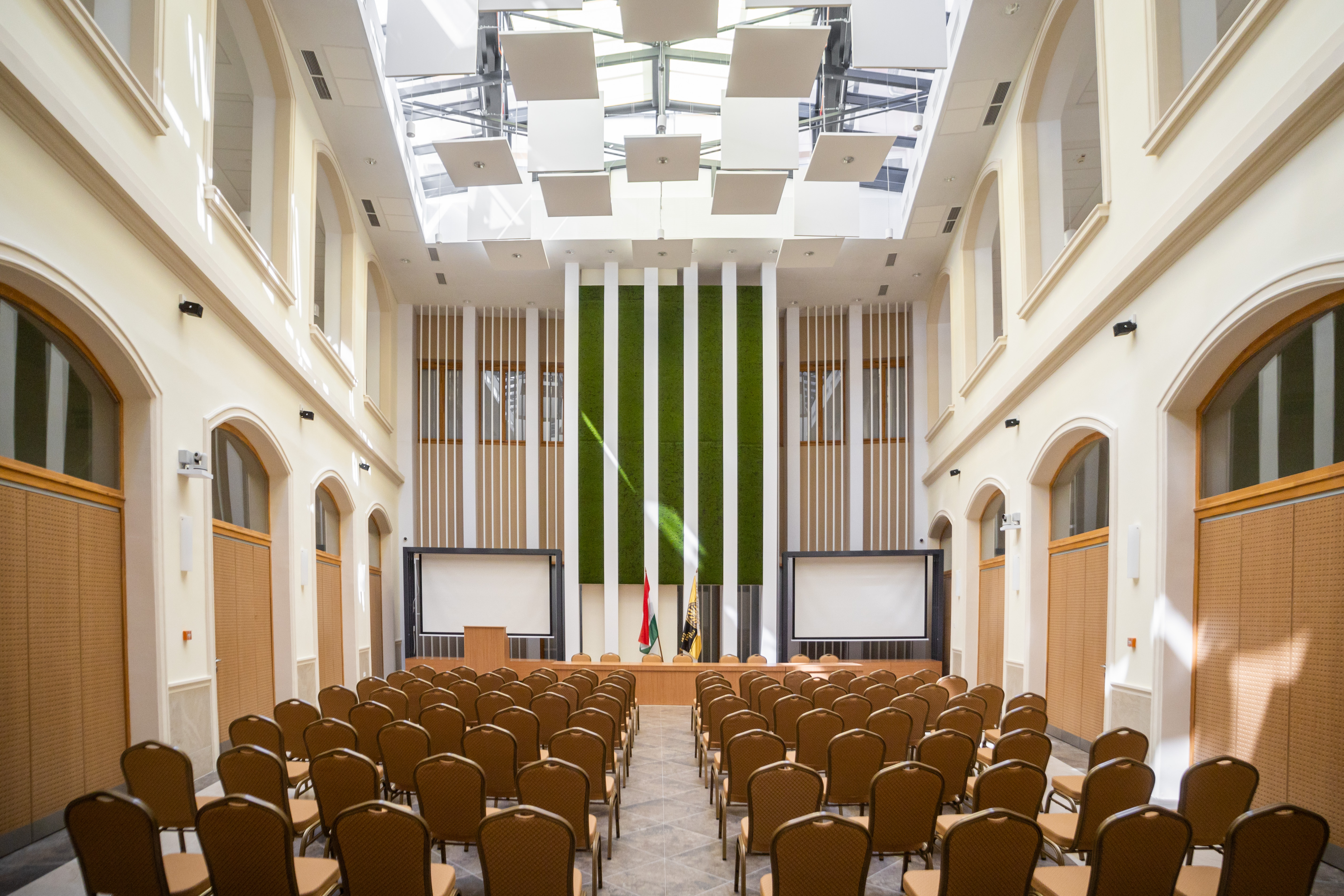
(image: aula of the Faculty of Law and Political Sciences, Szeged; source: University of Szeged)
Program
Wednesday 2 July 2025
PhD Workshop
9:00 – 9:45: Aniceto Masferrer (Professor, University of Valencia, Spain): The Ideology of Modern Codes and the Role of Judges: The Need for a Comparative Legal History Approach
9:45 – 10:30: Agustín Parise (Associate professor, University of Maastricht, Netherlands): Igniting, Developing, and Disseminating Lines of Research in Comparative Legal History
10:30 - 11:15: Maciej Mikuła (Professor, Jagiellonian University, Poland): Legal History Projects Carried Out within the Framework of Consortia Funded by the European Commission and the International Visegrad Fund: Examples Include "FONTES" and "(Dis)Continuity Legal Systems."
9:45 – 10:30: Agustín Parise (Associate professor, University of Maastricht, Netherlands): Igniting, Developing, and Disseminating Lines of Research in Comparative Legal History
10:30 - 11:15: Maciej Mikuła (Professor, Jagiellonian University, Poland): Legal History Projects Carried Out within the Framework of Consortia Funded by the European Commission and the International Visegrad Fund: Examples Include "FONTES" and "(Dis)Continuity Legal Systems."
11:15 - 12:00: Jan Halberda (Associate professor, Jagiellonian University, Poland): Legal Heritage Lab at the Jagiellonian University and its “4I”projects
Opening remarks
Welcome remarks- Márta Törőcsikné Görög (Professor, University of Szeged) Dean of the Faculty of Law and Political Sciences, University of Szeged, President of the Csongrád-Csanád County’s Frame Association of Hungarian Lawyers
Gábor Szabó (Professor, University of Szeged) President of the Board of Foundation for the University of Szeged
Opening speech
Matthew Dyson (Professor, University of Oxford) President of the European Society for Comparative Legal History Norbert Varga (Professor, University of Szeged) President of the Organising Committe of Szeged
Gábor Szabó (Professor, University of Szeged) President of the Board of Foundation for the University of Szeged
Opening speech
Matthew Dyson (Professor, University of Oxford) President of the European Society for Comparative Legal History Norbert Varga (Professor, University of Szeged) President of the Organising Committe of Szeged
Keynote
Chair: Matthew Dyson (Professor, University of Oxford, UK)
Ulrike Müßig (Head of the Chair for Civil Law, German and European Legal History, University of Passau, Germany): Rome is not Rome: The (Legal Historian) Impact of Northern European Humanism alongside the Eagerness of Reading Primary Sources within the Networks of Konrad Celtis
Chair: Matthew Dyson (Professor, University of Oxford, UK)
Ulrike Müßig (Head of the Chair for Civil Law, German and European Legal History, University of Passau, Germany): Rome is not Rome: The (Legal Historian) Impact of Northern European Humanism alongside the Eagerness of Reading Primary Sources within the Networks of Konrad Celtis
Panel 1
Traditions of Roman Law
Chair: József Benke (Professor, University of Pécs, Hungary) Michael Binder (Assistant professor, University of Vienna, Austria): Infitiando lis crescit in duplum. A Comparison of Roman Law and the Laws of Plato
Kata Horváth (PhD student, University of Szeged, Hungary): Dowry and Unjustified Enrichment in Roman Law. The Case of Ulp. 3 disp. D. 12,4,6
Henrik-Riko Held (Associate professor, University of Zagreb, Croatia): Rural Testaments from the District of Šibenik in the Early Modern Period (1637-1713): ius commune, Venetian Governance and Croatian Glagolitic Culture
Rodrick van der Smissen (PhD student, Vrije Universiteit Brussel, Belgium): Roman Law and the Formative Interpretation of History in the Nineteenth-Century
Traditions of Roman Law
Chair: József Benke (Professor, University of Pécs, Hungary) Michael Binder (Assistant professor, University of Vienna, Austria): Infitiando lis crescit in duplum. A Comparison of Roman Law and the Laws of Plato
Kata Horváth (PhD student, University of Szeged, Hungary): Dowry and Unjustified Enrichment in Roman Law. The Case of Ulp. 3 disp. D. 12,4,6
Henrik-Riko Held (Associate professor, University of Zagreb, Croatia): Rural Testaments from the District of Šibenik in the Early Modern Period (1637-1713): ius commune, Venetian Governance and Croatian Glagolitic Culture
Rodrick van der Smissen (PhD student, Vrije Universiteit Brussel, Belgium): Roman Law and the Formative Interpretation of History in the Nineteenth-Century
Panel 2
Chapters from Legal History in Medieval Europe
Chair: Maciej Mikuła (Professor, Jagiellonian University, Poland) Balázs László (External lecturer, University of Pécs, Hungary): The ‘Crown’ in the Legal Documents of the Árpád Era: from Royalty towards the State
Piotr Owsiak (Junior lawyer, Regional Chamber of Attorneys-at-Law in Cracow, Poland): Between Steppe and Puszta – Comparison of Hungarian Werböczy Code of 1514 and Kazakh Code “Bright Path of Kassim Khan” of 1510
Kaat Cappelle (Postdoctoral researcher, Ghent University, Belgium) - Klaas Van Gelder (Assistant professor, Vrije Universiteit Brussel, Belgium): Policing Villagers in Medieval and Early Modern Flanders: A Quantitative Analysis of Rural Police Regulations and a Re-Evaluation of Law-Making at the Local Level
Chapters from Legal History in Medieval Europe
Chair: Maciej Mikuła (Professor, Jagiellonian University, Poland) Balázs László (External lecturer, University of Pécs, Hungary): The ‘Crown’ in the Legal Documents of the Árpád Era: from Royalty towards the State
Piotr Owsiak (Junior lawyer, Regional Chamber of Attorneys-at-Law in Cracow, Poland): Between Steppe and Puszta – Comparison of Hungarian Werböczy Code of 1514 and Kazakh Code “Bright Path of Kassim Khan” of 1510
Kaat Cappelle (Postdoctoral researcher, Ghent University, Belgium) - Klaas Van Gelder (Assistant professor, Vrije Universiteit Brussel, Belgium): Policing Villagers in Medieval and Early Modern Flanders: A Quantitative Analysis of Rural Police Regulations and a Re-Evaluation of Law-Making at the Local Level
Panel 3
Methodological Viewpoints in Legal History Research
Chair: Michał Gałędek (Professor, University of Gdańsk, Poland) Agustín Parise (Associate professor, University of Maastricht, Netherlands): The Louisiana State Law Institute and the Development of Legal Science through Legal History and Legal Translation
Brian Buchhalter Montero (Postdoctoral researcher, Complutense University of Madrid, Spain): The Retrospective Analysis in Comparative Legal History
Tomáš Havlíček (PhD student, Masaryk University, Czech Republic): Discourse, Power, and Proportionality: A Critical Analysis of Judicial Reasoning in Europe
Adolfo Giuliani (Lawyer, Italian Ministry for Education, Italy): What is so Cool about Legal Traditions? It is about Thinking in Small-scale Models
Methodological Viewpoints in Legal History Research
Chair: Michał Gałędek (Professor, University of Gdańsk, Poland) Agustín Parise (Associate professor, University of Maastricht, Netherlands): The Louisiana State Law Institute and the Development of Legal Science through Legal History and Legal Translation
Brian Buchhalter Montero (Postdoctoral researcher, Complutense University of Madrid, Spain): The Retrospective Analysis in Comparative Legal History
Tomáš Havlíček (PhD student, Masaryk University, Czech Republic): Discourse, Power, and Proportionality: A Critical Analysis of Judicial Reasoning in Europe
Adolfo Giuliani (Lawyer, Italian Ministry for Education, Italy): What is so Cool about Legal Traditions? It is about Thinking in Small-scale Models
Panel 4
Legal Symbols in European Legal Tradition
Chair: Annamaria Monti (Professor, University of Milan, Italy) Martin Sunnqvist (Professor, University of Lund, Sweden): Symbols of Law and Jurisdiction in the Seals of the Swedish 17th Century Courts of Appeal
Zoltán Megyeri-Pálffi (Assistant professor, Eötvös Loránd University, Hungary): The Impact of Organisational and Procedural Changes on the Functional Design of Judicial Buildings in Modern Hungary
Kinga Beliznai (Associate professor, Eötvös Loránd University, Hungary): Nice and Smart Fashion is the Fashion of the Judge’s Robe
Legal Symbols in European Legal Tradition
Chair: Annamaria Monti (Professor, University of Milan, Italy) Martin Sunnqvist (Professor, University of Lund, Sweden): Symbols of Law and Jurisdiction in the Seals of the Swedish 17th Century Courts of Appeal
Zoltán Megyeri-Pálffi (Assistant professor, Eötvös Loránd University, Hungary): The Impact of Organisational and Procedural Changes on the Functional Design of Judicial Buildings in Modern Hungary
Kinga Beliznai (Associate professor, Eötvös Loránd University, Hungary): Nice and Smart Fashion is the Fashion of the Judge’s Robe
Panel 5
The Role of Legal Transfer in the Development of Law
Chair: Ulrike Müßig (Professor, University of Passau, Germany) Maciej Mikuła (Professor, Jagiellonian University, Poland): Legal Borrowing in Central and Eastern Europe in the 15th and 16th Centuries
Niels Fieremans (Postdoctoral researcher, Ghent University, Belgium): The Legal Transition of Seigneurial and Princely Courts in the Late Medieval Low Countries David Schorr (Senior lecturer, Tel Aviv University, Israel): Systemization of Law in the British Empire
Juma Noah Omollo (PhD student, Max Planck Institute for Legal History and Legal Theory, Germany): Trajectories in British Colonial Legal Transfer and Jurisdictional Preferences in Legal Construction: A Histolegal Perspective
The Role of Legal Transfer in the Development of Law
Chair: Ulrike Müßig (Professor, University of Passau, Germany) Maciej Mikuła (Professor, Jagiellonian University, Poland): Legal Borrowing in Central and Eastern Europe in the 15th and 16th Centuries
Niels Fieremans (Postdoctoral researcher, Ghent University, Belgium): The Legal Transition of Seigneurial and Princely Courts in the Late Medieval Low Countries David Schorr (Senior lecturer, Tel Aviv University, Israel): Systemization of Law in the British Empire
Juma Noah Omollo (PhD student, Max Planck Institute for Legal History and Legal Theory, Germany): Trajectories in British Colonial Legal Transfer and Jurisdictional Preferences in Legal Construction: A Histolegal Perspective
Panel 6
State, Church and Canon Law
Chair: Marju Luts-Sootak (Professor, University of Tartu, Estonia) Eszter Cs. Herger (Professor, University of Pécs, Hungary): Universal Norms of European Legal Culture: Contributions to the Interpretation of the Collatio Legum Mosaicarum et Romanarum
Piotr Alexandrowicz (Assistant professor, Adam Mickiewicz University in Poznań, Poland): Early Modern Canon Law Commentaries: A Comparative Approach
Paolo Astorri (Assistant professor, University of Copenhagen, Denmark): Ius Gentium in Early Modern Moral Theology: A Comparative Study of Protestant and Roman Catholic Thought
Rafał Kaczmarczyk (Independent scholar, Jagiellonian University, Poland): Legal position of the Muslim Religious Union in interwar Poland: copying the Russian mode
State, Church and Canon Law
Chair: Marju Luts-Sootak (Professor, University of Tartu, Estonia) Eszter Cs. Herger (Professor, University of Pécs, Hungary): Universal Norms of European Legal Culture: Contributions to the Interpretation of the Collatio Legum Mosaicarum et Romanarum
Piotr Alexandrowicz (Assistant professor, Adam Mickiewicz University in Poznań, Poland): Early Modern Canon Law Commentaries: A Comparative Approach
Paolo Astorri (Assistant professor, University of Copenhagen, Denmark): Ius Gentium in Early Modern Moral Theology: A Comparative Study of Protestant and Roman Catholic Thought
Rafał Kaczmarczyk (Independent scholar, Jagiellonian University, Poland): Legal position of the Muslim Religious Union in interwar Poland: copying the Russian mode
Panel 7
Legal Culture from Antiquity to Nowadays
Chair: Merike Ristikivi (Associate professor, University of Tartu, Estonia) Anna Ceglarska (Assistant professor, Jagiellonian University, Poland) - Iwona Barwicka-Tylek (Associate professor, Jagiellonian University, Poland): Parrhesia and isegoria in ancient Athens: Foundations of the democratic institution of free speech
Marianne Vasara-Aaltonen (University lecturer, University of Helsinki, Finland): The Women’s Movement and the History of Legal Aid: The Finnish Experience in a Comparative Perspective Bruno
Rodrigues de Lima (Postdoctoral researcher, Max Planck Institute for Legal History & Legal Theory, Germany): The Making of a Classic: Luiz Gama’s Complete Works
Kamila Staudigl-Ciechowicz (Assistant professor, University of Vienna, Austria): 'Frau Professor' - Wives of Legal Scholars between Patriarchy and Emancipation
Legal Culture from Antiquity to Nowadays
Chair: Merike Ristikivi (Associate professor, University of Tartu, Estonia) Anna Ceglarska (Assistant professor, Jagiellonian University, Poland) - Iwona Barwicka-Tylek (Associate professor, Jagiellonian University, Poland): Parrhesia and isegoria in ancient Athens: Foundations of the democratic institution of free speech
Marianne Vasara-Aaltonen (University lecturer, University of Helsinki, Finland): The Women’s Movement and the History of Legal Aid: The Finnish Experience in a Comparative Perspective Bruno
Rodrigues de Lima (Postdoctoral researcher, Max Planck Institute for Legal History & Legal Theory, Germany): The Making of a Classic: Luiz Gama’s Complete Works
Kamila Staudigl-Ciechowicz (Assistant professor, University of Vienna, Austria): 'Frau Professor' - Wives of Legal Scholars between Patriarchy and Emancipation
Panel 8
Aspects of the Development of Hungarian Private Law in the Interwar Period with an European perspective
Chair: Norbert Varga (Professor, University of Szeged, Hungary) Máté Pétervári (Assistant professor, University of Szeged, Hungary): Changes in Insolvency Law in the Shadow of the First World War in the Two Member States of the Austro-Hungarian Monarchy
Bence Krusóczki (PhD student, University of Szeged, Hungary): Comparison of the Development in Judicial Practice of Hungarian and Austrian Competition Law in Light of the First Hungarian Competition Act
Benedek Varga (PhD student, University of Szeged, Hungary): Comparison of the Hungarian and German Regulation of Fraudulent and Culpable Bankruptcy
Dénes Legeza (Researcher, Hungarian Intellectual Property Office, Hungary): The Enforcement of Public Performance Right in the Interwar Period
Aspects of the Development of Hungarian Private Law in the Interwar Period with an European perspective
Chair: Norbert Varga (Professor, University of Szeged, Hungary) Máté Pétervári (Assistant professor, University of Szeged, Hungary): Changes in Insolvency Law in the Shadow of the First World War in the Two Member States of the Austro-Hungarian Monarchy
Bence Krusóczki (PhD student, University of Szeged, Hungary): Comparison of the Development in Judicial Practice of Hungarian and Austrian Competition Law in Light of the First Hungarian Competition Act
Benedek Varga (PhD student, University of Szeged, Hungary): Comparison of the Hungarian and German Regulation of Fraudulent and Culpable Bankruptcy
Dénes Legeza (Researcher, Hungarian Intellectual Property Office, Hungary): The Enforcement of Public Performance Right in the Interwar Period
Thursday 3 July 2025
Panel 9
Entanglements and Overlaps: Legal System and Judicial Practices in the Early Modern Venetian "Terraferma”
Chair: Federica Paletti (Associate professor, University of Brescia, Italy)
Marco Castelli (Post-Doctoral Researcher, Adam Mickiewicz University in Poznań, Poland): The Local Statute Between the Defense of Tradition and an Evolutionary Interpretation: A Reflection of the Clash Between Roman and Venetian Legal Cultures
Elisabetta Fusar Poli (Professor, University of Brescia, Italy): Legal Layers in the Venetian Terraferma: Navigating Local Law and Justice
Alan Sandona (Researcher, University of Bergamo, Italy): Norms and Civil Procedural Practice in the Venetian Terraferma: A Case Study of Sixteenth-Century Rulings by the Praetorian Vicar of Vicenza
Entanglements and Overlaps: Legal System and Judicial Practices in the Early Modern Venetian "Terraferma”
Chair: Federica Paletti (Associate professor, University of Brescia, Italy)
Marco Castelli (Post-Doctoral Researcher, Adam Mickiewicz University in Poznań, Poland): The Local Statute Between the Defense of Tradition and an Evolutionary Interpretation: A Reflection of the Clash Between Roman and Venetian Legal Cultures
Elisabetta Fusar Poli (Professor, University of Brescia, Italy): Legal Layers in the Venetian Terraferma: Navigating Local Law and Justice
Alan Sandona (Researcher, University of Bergamo, Italy): Norms and Civil Procedural Practice in the Venetian Terraferma: A Case Study of Sixteenth-Century Rulings by the Praetorian Vicar of Vicenza
Panel 10
Legal Professions and Legal Education
Chair: Kamila Staudigl-Ciechowicz (Assistant professor, University of Vienna, Austria) Aya Bejermi (PhD student, University of Bordeaux, France): Transformation of Jurists in Egypt: the Emergence of Professional Legal Practice (1856-1955)
Marju Luts-Sootak (Professor, University of Tartu, Estonia) - Karl Kristofer Alp (Teaching assistant, University of Tartu, Estonia): Right of Defence by the Special Procedure of the Prosecutorial Supervision of Court Rulings in Force
Alexandra Garifullina (PhD student, University of Lille, France): Shaping the Science of International Law through Legal Education in Soviet Russia: Insights from the Archives of Vladimir Hrabar (1865-1956)
Alicia Haripershad (PhD student, Max Planck Institute for Legal History and Legal Theory, Germany): The Stains of Colonial Law? An Exploration of the Educational Framework’s Entrenchments in the Cape Colony and Northern Rhodesia c. 1880 to 1930
Legal Professions and Legal Education
Chair: Kamila Staudigl-Ciechowicz (Assistant professor, University of Vienna, Austria) Aya Bejermi (PhD student, University of Bordeaux, France): Transformation of Jurists in Egypt: the Emergence of Professional Legal Practice (1856-1955)
Marju Luts-Sootak (Professor, University of Tartu, Estonia) - Karl Kristofer Alp (Teaching assistant, University of Tartu, Estonia): Right of Defence by the Special Procedure of the Prosecutorial Supervision of Court Rulings in Force
Alexandra Garifullina (PhD student, University of Lille, France): Shaping the Science of International Law through Legal Education in Soviet Russia: Insights from the Archives of Vladimir Hrabar (1865-1956)
Alicia Haripershad (PhD student, Max Planck Institute for Legal History and Legal Theory, Germany): The Stains of Colonial Law? An Exploration of the Educational Framework’s Entrenchments in the Cape Colony and Northern Rhodesia c. 1880 to 1930
Panel 11
The Codification and Practice of Criminal Law in Europe
The Codification and Practice of Criminal Law in Europe
Chair: Massimo Meccarelli (Professor, University of Macerata, Italy)
András Biczó (Assistant lecturer, University of Debrecen, Hungary): An Examination of the Comments on the Foreign-Origin Praxis Criminalis Made by a Noble County in the Northwest Part of the Hungarian Kingdom in the Late 1720s
Szilvia Bató (Independent researcher, Hungary): German and Austrian Influences in the Mid-19th Century on Hungarian Criminal Law Codification: Crimes against Life and Physical Integrity in the 1843 Proposal and the 1869 Revision
Claudia Passarella (Assistant professor, University of Padua, Italy): A Much Needed and too Often Neglected Perspective: Criminal Trials and Archival Sources in the Late 19th and Early 20th Century
Marcin Łysko (Professor, University of Bialystok, Poland): Could the Misdemeanour Law Serve as a Tool of Political Repressions? The Adjudicating on Petty Offences in the People’s Poland in the Light of Archives of Institute of National Remembrance
András Biczó (Assistant lecturer, University of Debrecen, Hungary): An Examination of the Comments on the Foreign-Origin Praxis Criminalis Made by a Noble County in the Northwest Part of the Hungarian Kingdom in the Late 1720s
Szilvia Bató (Independent researcher, Hungary): German and Austrian Influences in the Mid-19th Century on Hungarian Criminal Law Codification: Crimes against Life and Physical Integrity in the 1843 Proposal and the 1869 Revision
Claudia Passarella (Assistant professor, University of Padua, Italy): A Much Needed and too Often Neglected Perspective: Criminal Trials and Archival Sources in the Late 19th and Early 20th Century
Marcin Łysko (Professor, University of Bialystok, Poland): Could the Misdemeanour Law Serve as a Tool of Political Repressions? The Adjudicating on Petty Offences in the People’s Poland in the Light of Archives of Institute of National Remembrance
Panel 12
Colonial Law, Policey, and the Classification of Subjects in the Portuguese Seaborne Empire (Seventeenth and Eighteenth Centuries) - cancelled
Colonial Law, Policey, and the Classification of Subjects in the Portuguese Seaborne Empire (Seventeenth and Eighteenth Centuries) - cancelled
Panel 13
Basic Principles of Private Law, Marriage Law and Law of Inheritance
Chair: Eszter Herger Cs. (Professor, University of Pécs, Hungary)
Benke József (Professor, University of Pécs, Hungary): Spirality in the European Continental History of Legal Inference on the Example of the General Prohibition of Inconsistent Behavior
Jan Halberda (Associate professor, Jagiellonian University, Poland): Principles of Community Life as the Safety Valve of Polish Private Law in the 20th and 21st c.
Nagy Péter (Assistant professor, Károli Gáspár University of the Reformed Church, Hungary): The Problems of Hungarian Marriage Law at the End of the 19th Century
Mateusz Ulanowicz (PhD student, University of Bialystok, Poland): Testate Succession in the Napoleonic Code and the Third Statute of Lithuania – a Comparative Law Analysis
Basic Principles of Private Law, Marriage Law and Law of Inheritance
Chair: Eszter Herger Cs. (Professor, University of Pécs, Hungary)
Benke József (Professor, University of Pécs, Hungary): Spirality in the European Continental History of Legal Inference on the Example of the General Prohibition of Inconsistent Behavior
Jan Halberda (Associate professor, Jagiellonian University, Poland): Principles of Community Life as the Safety Valve of Polish Private Law in the 20th and 21st c.
Nagy Péter (Assistant professor, Károli Gáspár University of the Reformed Church, Hungary): The Problems of Hungarian Marriage Law at the End of the 19th Century
Mateusz Ulanowicz (PhD student, University of Bialystok, Poland): Testate Succession in the Napoleonic Code and the Third Statute of Lithuania – a Comparative Law Analysis
Panel 14
The Functioning of Judicial System: Regulation and Practice
Chair: Martin Sunnqvist (Professor, University of Lund, Sweden)
The Functioning of Judicial System: Regulation and Practice
Chair: Martin Sunnqvist (Professor, University of Lund, Sweden)
Łukasz Gołaszewski (Assistant professor, University of Warsaw, Poland): How Do We Get to the Truth? Or Just Settle a Dispute? Evidentiary Proceedings in the Noble and Ecclesiastical Courts of the Polish-Lithuanian Commonwealth in the Light of 16th-18th Century Practice
David Irazábal (PhD student, Pompeu Fabra University, Spain): Iudex non tenetur exprimere causam in sententia? Early Modern European Judicial Reasoning in a Comparative Perspective
Thomas Mohr (Associate professor, University College Dublin, Ireland): Hungarian Influence and the Arbitration Courts of Revolutionary Ireland, 1917-1920
Paweł Kaźmierski (PhD student, Jagiellonian University, Poland): Between Provisioning and Improvisation: the Difficult Beginning of (Re)building the Common Judiciary in the Polish „Recovered Territories“ and in the Soviet Occupation Zone of Germany after WWII
David Irazábal (PhD student, Pompeu Fabra University, Spain): Iudex non tenetur exprimere causam in sententia? Early Modern European Judicial Reasoning in a Comparative Perspective
Thomas Mohr (Associate professor, University College Dublin, Ireland): Hungarian Influence and the Arbitration Courts of Revolutionary Ireland, 1917-1920
Paweł Kaźmierski (PhD student, Jagiellonian University, Poland): Between Provisioning and Improvisation: the Difficult Beginning of (Re)building the Common Judiciary in the Polish „Recovered Territories“ and in the Soviet Occupation Zone of Germany after WWII
Panel 15
Chapters from the World of Private and Commercial Law
Chair: Tamás Antal (Professor, University of Szeged, Hungary)
Ana Belem Fernandez Castro (Postdoctoral fellow, Scuola Superiore Meridionale, Italy): Forum Shopping: Why Was It Crucial in the Legal Support of Long-Distance Trade? The case of Sixteenth-Century Valencia
Sarah Limao Papa (PhD student, Goethe University Frankfurt, Germany): Immemorial Possession: Conflicts over Commons in 18th Century Portuguese America
Janwillem Oosterhuis (Associate professor, University of Maastricht, Netherlands): The Free Market in 19th Century Dutch Commercial Law
Ionut Vida-Simiti (Lecturer, Iuliu Hetieganu University of Medicine and Pharmacy from Cluj-Napoca, Romania): Medical Liability in Transylvania: Transition from the Austrian and Hungarian Legal Framework to the Romanian Legislation
João de Oliveira Geraldes (Professor, University of Lisbon, Portugal): The Acceptance of Unilateral Promises as Sources of Obligations and the Preparatory Works of the Portuguese Civil Code of 1966
Chapters from the World of Private and Commercial Law
Chair: Tamás Antal (Professor, University of Szeged, Hungary)
Ana Belem Fernandez Castro (Postdoctoral fellow, Scuola Superiore Meridionale, Italy): Forum Shopping: Why Was It Crucial in the Legal Support of Long-Distance Trade? The case of Sixteenth-Century Valencia
Sarah Limao Papa (PhD student, Goethe University Frankfurt, Germany): Immemorial Possession: Conflicts over Commons in 18th Century Portuguese America
Janwillem Oosterhuis (Associate professor, University of Maastricht, Netherlands): The Free Market in 19th Century Dutch Commercial Law
Ionut Vida-Simiti (Lecturer, Iuliu Hetieganu University of Medicine and Pharmacy from Cluj-Napoca, Romania): Medical Liability in Transylvania: Transition from the Austrian and Hungarian Legal Framework to the Romanian Legislation
João de Oliveira Geraldes (Professor, University of Lisbon, Portugal): The Acceptance of Unilateral Promises as Sources of Obligations and the Preparatory Works of the Portuguese Civil Code of 1966
Panel 16
Steps towards the Establishment of Labour and Social Law
Chair: Frederik Dhondt (Associate professor, Vrije Universiteit Brussel, Belgium)
Pieterjan Schepens (PhD student, Ghent University, Belgium): Did Guilds Lie at the Origin of Modern Social Security? The Case of Belgium
Luca Salvadori (PhD graduate, Magna Græcia University, Italy): Mutualism in 19th Century: a European Comparison
Laila Maia Galvão (Professor, Federal Institute of Paraná, Brazil): Cross-Border Influences on Social Control in Rio de Janeiro and Buenos Aires (1906-1919): The Establishment of Police Schools and the Repression of the Workers' Movement
Jasper Van de Woestijne (PhD student, Ghent University, Belgium): The Meetings of European Labour Court Judges (1984-present): Hubs of Cross-Fertilization with regard to Access to Labour Justice
Steps towards the Establishment of Labour and Social Law
Chair: Frederik Dhondt (Associate professor, Vrije Universiteit Brussel, Belgium)
Pieterjan Schepens (PhD student, Ghent University, Belgium): Did Guilds Lie at the Origin of Modern Social Security? The Case of Belgium
Luca Salvadori (PhD graduate, Magna Græcia University, Italy): Mutualism in 19th Century: a European Comparison
Laila Maia Galvão (Professor, Federal Institute of Paraná, Brazil): Cross-Border Influences on Social Control in Rio de Janeiro and Buenos Aires (1906-1919): The Establishment of Police Schools and the Repression of the Workers' Movement
Jasper Van de Woestijne (PhD student, Ghent University, Belgium): The Meetings of European Labour Court Judges (1984-present): Hubs of Cross-Fertilization with regard to Access to Labour Justice
Lunch talk - Meet the Editors of Comparative Legal History: Insights on Publishing Legal History
Moderator: David Schorr (Senior lecturer, Tel Aviv University, Israel)
Participants: Piotr Alexandrowicz (Assistant professor, Adam Mickiewicz University in Poznań, Poland) Emmanuel van Dongen (Associate professor, Utrecht University, Netherlands) Stephen Hewer (Researcher, Ghent University, Belgium) Gwilym Owen (Senior lecturer, Bangor University, UK)
Moderator: David Schorr (Senior lecturer, Tel Aviv University, Israel)
Participants: Piotr Alexandrowicz (Assistant professor, Adam Mickiewicz University in Poznań, Poland) Emmanuel van Dongen (Associate professor, Utrecht University, Netherlands) Stephen Hewer (Researcher, Ghent University, Belgium) Gwilym Owen (Senior lecturer, Bangor University, UK)
ESCLH General Assembly Meeting
Panel 17
Marriage and Divorce in the 19th-Century Western Tradition: France, Spain and Louisiana
Chair: Joshua C. Tate (Professor, Southern Methodist University, USA)
Aniceto Masferrer (Professor, University of Valencia, Spain): The Role of Nature, Natural Law and Natural Reason in the Making of Marriage in the Western Legal Tradition
Marta Cantín-Larumbe (PhD student, University of Valencia, Spain): One Matrimonial System and Two Jurisdictions: Marriage in the Spanish Nineteenth-Century Legal System. An Approach up to Promulgating the Civil Marriage Law of 1870
Julie Rocheton (Researcher, Max Planck Institute for Legal History and Legal Theory, Germany): From Partial to Total Dissolution: Divorce in 19th Century Louisiana
Patricia Plana de Juan (PhD student, University of Valencia, Spain): Morality and Marriage Agreements in the 19th Century Civil Codes of France, Spain and Louisiana
Marriage and Divorce in the 19th-Century Western Tradition: France, Spain and Louisiana
Chair: Joshua C. Tate (Professor, Southern Methodist University, USA)
Aniceto Masferrer (Professor, University of Valencia, Spain): The Role of Nature, Natural Law and Natural Reason in the Making of Marriage in the Western Legal Tradition
Marta Cantín-Larumbe (PhD student, University of Valencia, Spain): One Matrimonial System and Two Jurisdictions: Marriage in the Spanish Nineteenth-Century Legal System. An Approach up to Promulgating the Civil Marriage Law of 1870
Julie Rocheton (Researcher, Max Planck Institute for Legal History and Legal Theory, Germany): From Partial to Total Dissolution: Divorce in 19th Century Louisiana
Patricia Plana de Juan (PhD student, University of Valencia, Spain): Morality and Marriage Agreements in the 19th Century Civil Codes of France, Spain and Louisiana
Panel 18
Procedural Law Reforms in Europe
Chair: Tomáš Gábriš (Professor, University of Trnava, Slovakia)
Kacper Górski (Assistant professor, Jagiellonian University, Poland): Habeas Corpus or the Right to Due Legal Process? The Neminem Captivabimus privilege (1430–1433) in Theory and Practice in Early Modern Poland
José Franco-Chasán (Professor, University Rey Juan Carlos, Spain): A Plea for the De-romanticisation of Duel: Outlawing Honour Fighting or Common Brawling?
Izabela Wasik (PhD student, Jagiellonian University, Poland): When the Justice System is too Rapid - Ad hoc Courts in the Habsburg Monarchy Using the Example of the Kingdom of Galicia and Lodomeria in the 19th and 20th Centuries
Chair: Tomáš Gábriš (Professor, University of Trnava, Slovakia)
Kacper Górski (Assistant professor, Jagiellonian University, Poland): Habeas Corpus or the Right to Due Legal Process? The Neminem Captivabimus privilege (1430–1433) in Theory and Practice in Early Modern Poland
José Franco-Chasán (Professor, University Rey Juan Carlos, Spain): A Plea for the De-romanticisation of Duel: Outlawing Honour Fighting or Common Brawling?
Izabela Wasik (PhD student, Jagiellonian University, Poland): When the Justice System is too Rapid - Ad hoc Courts in the Habsburg Monarchy Using the Example of the Kingdom of Galicia and Lodomeria in the 19th and 20th Centuries
Panel 19
The Influence of Economic Development to the Legal System
Chair: Jan Halberda (Associate professor, Jagiellonian University, Poland)
Dariusz Piotrowski (PhD student, Jagiellonian University, Poland): Kompania Manufaktur Wełnianych (1766) – the Basis of Polish Joint-Stock Company Regulation or a ‘sui generis’ Entity Detached from Modern Times?
Balázs Pálvölgyi (Associate professor, University of Győr, Hungary): Immigrant Banking and the Limits of State Regulation: the Case of the United States and Hungary (1903-1917)
Emmanuel van Dongen (Associate professor, Utrecht University, Netherlands): The German Hyperinflation and the impact on Dutch law
Jakub Pokoj (Assistant professor, Jagiellonian University, Poland): Interwar Polish Regulations on Shortages of Basic Goods from the Archival Perspective
The Influence of Economic Development to the Legal System
Chair: Jan Halberda (Associate professor, Jagiellonian University, Poland)
Dariusz Piotrowski (PhD student, Jagiellonian University, Poland): Kompania Manufaktur Wełnianych (1766) – the Basis of Polish Joint-Stock Company Regulation or a ‘sui generis’ Entity Detached from Modern Times?
Balázs Pálvölgyi (Associate professor, University of Győr, Hungary): Immigrant Banking and the Limits of State Regulation: the Case of the United States and Hungary (1903-1917)
Emmanuel van Dongen (Associate professor, Utrecht University, Netherlands): The German Hyperinflation and the impact on Dutch law
Jakub Pokoj (Assistant professor, Jagiellonian University, Poland): Interwar Polish Regulations on Shortages of Basic Goods from the Archival Perspective
Panel 20
Expanding Constitutional Time. On the Complexity of Constitution-Making Processes in Brazil and Italy after World War II.
Chair: Elisabetta Fusar Poli (Professor, University of Brescia, Italy)
Massimo Meccarelli (Professor, University of Macerata, Italy): Before the Constituent Assembly: After-Effects of the Past and the Issue of Future in the Making of Democratic Constitution in Italy (1943-1948)
Raphael Peixoto de Paula Marques (Professor, Ufersa University, Brazil): Ambiguities of Authority: Disputes Over Constituent Power in Brazil's Transition from Authoritarianism to Democracy (1945-1946)
Expanding Constitutional Time. On the Complexity of Constitution-Making Processes in Brazil and Italy after World War II.
Chair: Elisabetta Fusar Poli (Professor, University of Brescia, Italy)
Massimo Meccarelli (Professor, University of Macerata, Italy): Before the Constituent Assembly: After-Effects of the Past and the Issue of Future in the Making of Democratic Constitution in Italy (1943-1948)
Raphael Peixoto de Paula Marques (Professor, Ufersa University, Brazil): Ambiguities of Authority: Disputes Over Constituent Power in Brazil's Transition from Authoritarianism to Democracy (1945-1946)
Ana Carolina Couto (Postdoctoral researcher, University of Macerata, Italy): Beyond the Assembly: the Socio-Economic Rights vs Market-Oriented Forces on Brazil's 1980s Constitution-Making Process
Keynote presentation
Chair: Kentaro Matsubara (Professor, University of Tokyo, Japan)
Stefan Vogenauer (Director of Max Planck Institute for Legal History and Legal Theory, Germany): Back to the European Legal Past in Building the Future of Asian Contract Laws
Chair: Kentaro Matsubara (Professor, University of Tokyo, Japan)
Stefan Vogenauer (Director of Max Planck Institute for Legal History and Legal Theory, Germany): Back to the European Legal Past in Building the Future of Asian Contract Laws
Friday 4 July 2025
Panel 21
(Re)building Legal Institutions: The Evolution of the Notariat in Estonia, Latvia, Czechoslovakia, and Hungary between the Two World Wars
Chair: Valdis Blūzma (Professor, Turiba University, Latvia)
Merike Ristikivi (Associate professor, University of Tartu, Estonia): The Development of the Notariat in Interwar Estonia
Jan Kober (Researcher, Charles University, Czech Republic): The Notaries in Czechoslovakia during the Interwar Period
Valéria Kiss (Assistant professor, Eötvös Loránd University, Hungary): The Hungarian Notariat Between the Two World Wars
Sanita Osipova (Professor, University of Latvia, Latvia): Notarial System in Latvia 1918-1940
(Re)building Legal Institutions: The Evolution of the Notariat in Estonia, Latvia, Czechoslovakia, and Hungary between the Two World Wars
Chair: Valdis Blūzma (Professor, Turiba University, Latvia)
Merike Ristikivi (Associate professor, University of Tartu, Estonia): The Development of the Notariat in Interwar Estonia
Jan Kober (Researcher, Charles University, Czech Republic): The Notaries in Czechoslovakia during the Interwar Period
Valéria Kiss (Assistant professor, Eötvös Loránd University, Hungary): The Hungarian Notariat Between the Two World Wars
Sanita Osipova (Professor, University of Latvia, Latvia): Notarial System in Latvia 1918-1940
Panel 22
The Agency and Sovereignty of Commercial Cities in Western Europe (c. 1400-c. 1700)
Chair: Aniceto Masferrer (Professor, University of Valencia, Spain)
Dave De ruysscher (Professor, University of Tilburg, Netherlands; Vrije Universiteit Brussel, Belgium): Sovereignty and Agency of Cities of Trade: Gaps and Promises
Femke Gordijn (PhD student, University of Tilburg, Netherlands): Urban Networks, Governance and Commercial Law: the Case of Southampton (c. 1420-1510)
Erik Andriws Gonzalez Barrera (PhD student, University of Tilburg, Netherlands): Sovereignty and the City: Power Dynamics between the Municipal Government and the Parliament of Toulouse during the Early Sixteenth Century
Daniel Bökenkamp (PhD student, University of Tilburg, Netherlands): Treaties of Cities and States - Sixteenth-Century Rouen as a Diplomatic Actor
The Agency and Sovereignty of Commercial Cities in Western Europe (c. 1400-c. 1700)
Chair: Aniceto Masferrer (Professor, University of Valencia, Spain)
Dave De ruysscher (Professor, University of Tilburg, Netherlands; Vrije Universiteit Brussel, Belgium): Sovereignty and Agency of Cities of Trade: Gaps and Promises
Femke Gordijn (PhD student, University of Tilburg, Netherlands): Urban Networks, Governance and Commercial Law: the Case of Southampton (c. 1420-1510)
Erik Andriws Gonzalez Barrera (PhD student, University of Tilburg, Netherlands): Sovereignty and the City: Power Dynamics between the Municipal Government and the Parliament of Toulouse during the Early Sixteenth Century
Daniel Bökenkamp (PhD student, University of Tilburg, Netherlands): Treaties of Cities and States - Sixteenth-Century Rouen as a Diplomatic Actor
Panel 23
Ubiquitous Emergencies: Revisiting the theory and praxis of emergency from a legal historical perspective
Chair: Luisa Brunori (Professor, École Normale Supérieure, France)
Cosmin Cercel (Professor, Ghent University, Belgium): Translating the Siege: Civilian and Military Authority during the Interwar Era
A. James Hannaford (PhD student, Ghent University, Belgium) - Mihai-Claudiu Dragomirescu (PhD student, Ghent University, Belgium): Understanding Emergency through the Lens of International Human Rights Law: A Historical Investigation
Louis Marius Bremond (PhD student, Ghent University, Belgium) - Elias Roberto Dessantis (PhD student, Ghent University, Belgium): When the Legitimacy Becomes the Threat: Exceptional Regimes of Emergency and Coups d’état
Ubiquitous Emergencies: Revisiting the theory and praxis of emergency from a legal historical perspective
Chair: Luisa Brunori (Professor, École Normale Supérieure, France)
Cosmin Cercel (Professor, Ghent University, Belgium): Translating the Siege: Civilian and Military Authority during the Interwar Era
A. James Hannaford (PhD student, Ghent University, Belgium) - Mihai-Claudiu Dragomirescu (PhD student, Ghent University, Belgium): Understanding Emergency through the Lens of International Human Rights Law: A Historical Investigation
Louis Marius Bremond (PhD student, Ghent University, Belgium) - Elias Roberto Dessantis (PhD student, Ghent University, Belgium): When the Legitimacy Becomes the Threat: Exceptional Regimes of Emergency and Coups d’état
Panel 24
Substantive Criminal Law from Theoretical and Practical Perspective
Chair: Matthew Dyson (Professor, University of Oxford, UK)
Pál Szabó (Assistant professor, University of Szeged, Hungary): ’in caput domini servi torquentur’ - The Rule of Torture of Servants on Suspicion of High Treason in the German Golden Bull (1356) and its Roman Legal Parallel
Mattia Rizza (PhD student, University of Milan, Italy): “Falliti sunt infames”. The Criminal Implication of the Merchant's Bankruptcy in Early Modern Italy (16th-17th Centuries)
Mlle Samantha Pratali (Associate professor, Catholic University of Lille, France): Regulating Prostitution in France from 1791 to 1946: An Example for the Future
Substantive Criminal Law from Theoretical and Practical Perspective
Chair: Matthew Dyson (Professor, University of Oxford, UK)
Pál Szabó (Assistant professor, University of Szeged, Hungary): ’in caput domini servi torquentur’ - The Rule of Torture of Servants on Suspicion of High Treason in the German Golden Bull (1356) and its Roman Legal Parallel
Mattia Rizza (PhD student, University of Milan, Italy): “Falliti sunt infames”. The Criminal Implication of the Merchant's Bankruptcy in Early Modern Italy (16th-17th Centuries)
Mlle Samantha Pratali (Associate professor, Catholic University of Lille, France): Regulating Prostitution in France from 1791 to 1946: An Example for the Future
Panel 25
Scenes of the Social Welfare System in the Hungarian Kingdom before and after the Bourgeois Transformation in a Comparative Context
Chair: Laila Maia Galvão (Professor, Federal Institute of Paraná, Brazil)
Balázs Rigó (Assistant professor, Eötvös Loránd University, Hungary): Elements of Social Care in Early Modern Corporative Societies - Guilds and Urban Statutes
Zsuzsanna Peres (Associate professor, Ludovika University of Public Service, Hungary): The Role of the Nobility in the Social Welfare System in the Early Modern Hungary and Austria
Enikő Kovács-Szépvölgyi (Assistant professor, Széchenyi István University, Hungary): Administrative Child Protection in Hungary During the Period of the Austro-Hungarian Monarchy
Scenes of the Social Welfare System in the Hungarian Kingdom before and after the Bourgeois Transformation in a Comparative Context
Chair: Laila Maia Galvão (Professor, Federal Institute of Paraná, Brazil)
Balázs Rigó (Assistant professor, Eötvös Loránd University, Hungary): Elements of Social Care in Early Modern Corporative Societies - Guilds and Urban Statutes
Zsuzsanna Peres (Associate professor, Ludovika University of Public Service, Hungary): The Role of the Nobility in the Social Welfare System in the Early Modern Hungary and Austria
Enikő Kovács-Szépvölgyi (Assistant professor, Széchenyi István University, Hungary): Administrative Child Protection in Hungary During the Period of the Austro-Hungarian Monarchy
Panel 26
Mosaics from the Sphere of Administrative Law
Chair: Máté Pétervári (Assistant professor, University of Szeged, Hungary)
Zoltán Liktor (Lecturer, Pázmány Péter Catholic University, Hungary): To Govern an Empire from the Distance – The Council of the Indies and the Viceroys of New Spain and Peru in the 16th and 17th Centuries
Livia Solana (PhD student, University of Parána, Brazil): The Construction of Transnational Spaces for the Circulation and Translation of Knowledge and an Example in the History of Administrative Law
Michał Gałędek (Professor, University of Gdańsk, Poland) – Paulina Kamińska (Assistant professor, Jagiellonian University, Poland): What Did Administrative Rights, Administrative Code, Administrative Execution and Administrative Jurisdiction Mean in the Kingdom of Poland at the Beginning of 19th Century?
Ivan Kosnica (Associate professor, University of Zagreb, Croatia) - Iva Lopižić (Associate professor, University of Zagreb, Croatia): Croatian Legal Tradition, Centralisation and the Great Prefect of the Zagreb Region (1922 – 1929)
Mosaics from the Sphere of Administrative Law
Chair: Máté Pétervári (Assistant professor, University of Szeged, Hungary)
Zoltán Liktor (Lecturer, Pázmány Péter Catholic University, Hungary): To Govern an Empire from the Distance – The Council of the Indies and the Viceroys of New Spain and Peru in the 16th and 17th Centuries
Livia Solana (PhD student, University of Parána, Brazil): The Construction of Transnational Spaces for the Circulation and Translation of Knowledge and an Example in the History of Administrative Law
Michał Gałędek (Professor, University of Gdańsk, Poland) – Paulina Kamińska (Assistant professor, Jagiellonian University, Poland): What Did Administrative Rights, Administrative Code, Administrative Execution and Administrative Jurisdiction Mean in the Kingdom of Poland at the Beginning of 19th Century?
Ivan Kosnica (Associate professor, University of Zagreb, Croatia) - Iva Lopižić (Associate professor, University of Zagreb, Croatia): Croatian Legal Tradition, Centralisation and the Great Prefect of the Zagreb Region (1922 – 1929)
Panel 27
From Law of Nations to Public International Law: Theory and Practice on the Verge of Professionalisation (1700-1870)
Chair: Cosmin Cercel (Professor, University of Ghent, Belgium)
Stefano Cattelan (Postdoctoral researcher, Vrije Universiteit Brussel, Belgium): Venetian and Nordic Neutralities at the Turn of the 18th Century: Comparative Perspectives
Frederik Dhondt (Associate professor, Vrije Universiteit Brussel, Belgium): Containing and Instrumentalising State Violence in Early Enlightement Europe (1718-1726)
Raphaël Cahen (Senior researcher, Justus-Liebig University Gießen, Germany; Vrije Universiteit Brussel, Belgium): Legal advisers in foreign affairs and the birth of the legal profession around 1860: the case of Japan and the Ottoman Empire
From Law of Nations to Public International Law: Theory and Practice on the Verge of Professionalisation (1700-1870)
Chair: Cosmin Cercel (Professor, University of Ghent, Belgium)
Stefano Cattelan (Postdoctoral researcher, Vrije Universiteit Brussel, Belgium): Venetian and Nordic Neutralities at the Turn of the 18th Century: Comparative Perspectives
Frederik Dhondt (Associate professor, Vrije Universiteit Brussel, Belgium): Containing and Instrumentalising State Violence in Early Enlightement Europe (1718-1726)
Raphaël Cahen (Senior researcher, Justus-Liebig University Gießen, Germany; Vrije Universiteit Brussel, Belgium): Legal advisers in foreign affairs and the birth of the legal profession around 1860: the case of Japan and the Ottoman Empire
Panel 28
The Codification and Practice of Legal Institutions from the Field of Property Law
Chair: Agustín Parise (Associate professor, University of Maastricht, Netherlands)
Anna Novitskaya (Postdoctoral researcher, University of Vienna, Austria): Personal” and “Real” Property Rights: The Influence of Roman Law, Natural Law, and the ABGB on the Broad Understanding of Property Rights in the Civil Code (Svod Zakonov Graždanskich) of the Russian Empire in the 19th Century
Asya Ostroukh (Senior lecturer, University of the West Indies, Barbados): Materials of Codification Commissions in Francophone Switzerland, Louisiana and Quebec as an Important Source for Understanding Modern Property Law
Piotr Pomianowski (Professor, Univesity of Warsaw, Poland): Divided Ownership in Rural Relations of the Duchy of Warsaw and the Congress Kingdom in the Light of the Primary Sources
Joshua C. Tate (Professor, Southern Methodist University, USA): From Land to Liberty: Immigration and Property Rights in the U.S. Declaration of Independence
The Codification and Practice of Legal Institutions from the Field of Property Law
Chair: Agustín Parise (Associate professor, University of Maastricht, Netherlands)
Anna Novitskaya (Postdoctoral researcher, University of Vienna, Austria): Personal” and “Real” Property Rights: The Influence of Roman Law, Natural Law, and the ABGB on the Broad Understanding of Property Rights in the Civil Code (Svod Zakonov Graždanskich) of the Russian Empire in the 19th Century
Asya Ostroukh (Senior lecturer, University of the West Indies, Barbados): Materials of Codification Commissions in Francophone Switzerland, Louisiana and Quebec as an Important Source for Understanding Modern Property Law
Piotr Pomianowski (Professor, Univesity of Warsaw, Poland): Divided Ownership in Rural Relations of the Duchy of Warsaw and the Congress Kingdom in the Light of the Primary Sources
Joshua C. Tate (Professor, Southern Methodist University, USA): From Land to Liberty: Immigration and Property Rights in the U.S. Declaration of Independence
Panel 29
Comparative Perspective on Legal Survivals in the Central European Post-Socialist Legal Space - Session 1
Chair: Piotr Eckhardt (Postdoctoral researcher, Ignatianum University in Cracow, Poland)
Rafał Mańko (Research affiliate, Central European University Democracy Institute, Hungary): Circulation of Legal Forms in Time and Space: Survivals and Revivals
Dorota Miler (Associate professor, University of Gdańsk, Poland; University of Augsburg, Germany): Intestate Rights for Individuals Living in a Common Household as a Legal Survival of Soviet Law
Peter Čuroš (Assistant professor, Institute of Political Studies, Polish Academy of Sciences, Poland): One to Rule Them All–the Slovak Public Prosecution Service
Comparative Perspective on Legal Survivals in the Central European Post-Socialist Legal Space - Session 1
Chair: Piotr Eckhardt (Postdoctoral researcher, Ignatianum University in Cracow, Poland)
Rafał Mańko (Research affiliate, Central European University Democracy Institute, Hungary): Circulation of Legal Forms in Time and Space: Survivals and Revivals
Dorota Miler (Associate professor, University of Gdańsk, Poland; University of Augsburg, Germany): Intestate Rights for Individuals Living in a Common Household as a Legal Survival of Soviet Law
Peter Čuroš (Assistant professor, Institute of Political Studies, Polish Academy of Sciences, Poland): One to Rule Them All–the Slovak Public Prosecution Service
Panel 30
Building the Public Law Based on the Past
Chair: Manuel Gutan (Professor, University of Sibiu, Romania)
László Komáromi (Associate professor, Pázmány Péter Catholic University, Hungary): Possible Precursors of the Direct Democratic Institutions of the Girondin Draft Constitution of 1793 and Their Impact on Later Constitutional Development
Dávid Surjányi (PhD student, University of Pécs, Hungary): From Napoleon to the Muslim Brotherhood — How Western Legal Impact Led to Egypt’s Partial Secularization, as well as Its Sharia-Based Antithesis: Islamism
Josep Capdeferro (Associate professor, Pompeu Fabra University, Spain): Avoiding Partiality in Major Disputes. Three Inspiring Experiences from Early Modern Catalonia
Konrad Rokicki (PhD student, University of Warsaw, Poland): State and Party Control over the Judiciary during the Stalinist Period: A Comparative Analysis of Similarities and Differences in Poland and the Lithuanian Soviet Socialist Republic
Building the Public Law Based on the Past
Chair: Manuel Gutan (Professor, University of Sibiu, Romania)
László Komáromi (Associate professor, Pázmány Péter Catholic University, Hungary): Possible Precursors of the Direct Democratic Institutions of the Girondin Draft Constitution of 1793 and Their Impact on Later Constitutional Development
Dávid Surjányi (PhD student, University of Pécs, Hungary): From Napoleon to the Muslim Brotherhood — How Western Legal Impact Led to Egypt’s Partial Secularization, as well as Its Sharia-Based Antithesis: Islamism
Josep Capdeferro (Associate professor, Pompeu Fabra University, Spain): Avoiding Partiality in Major Disputes. Three Inspiring Experiences from Early Modern Catalonia
Konrad Rokicki (PhD student, University of Warsaw, Poland): State and Party Control over the Judiciary during the Stalinist Period: A Comparative Analysis of Similarities and Differences in Poland and the Lithuanian Soviet Socialist Republic
Panel 31
The Effect of War on Law
The Effect of War on Law
Chair: Luisa Brunori (Professor, École Normale Supérieure, France)
Przemysław Gawron (Lecturer, University of Warsaw, Poland) - Jan Jerzy Sowa (Assistant professor, University of Warsaw, Poland): The Standing Army Debate in the Polish-Lithuanian Commonwealth in the 17th Century
Tania Atilano Camacho (Postdoctoral researcher, University of Zürich, Switzerland): The Practice of the Laws of War During the Independence War in Mexico
Sebastiaan Vandenbogaerde (Professor, Ghent University, Belgium): A Comparison of Belgian and French Tribunals of War Damages After World War I
Amber Gardeyn (PhD student, Ghent University, Belgium): Reshaping Europe: Post-War Institutions for Restitution in Belgium, France and the Netherlands
Przemysław Gawron (Lecturer, University of Warsaw, Poland) - Jan Jerzy Sowa (Assistant professor, University of Warsaw, Poland): The Standing Army Debate in the Polish-Lithuanian Commonwealth in the 17th Century
Tania Atilano Camacho (Postdoctoral researcher, University of Zürich, Switzerland): The Practice of the Laws of War During the Independence War in Mexico
Sebastiaan Vandenbogaerde (Professor, Ghent University, Belgium): A Comparison of Belgian and French Tribunals of War Damages After World War I
Amber Gardeyn (PhD student, Ghent University, Belgium): Reshaping Europe: Post-War Institutions for Restitution in Belgium, France and the Netherlands
Panel 32
Legal Institutions of Law of Obligations
Chair: Stefan Vogenauer (Professor, Director of Max Planck Institute for Legal History and Legal Theory, Germany)
David Magalhães (Assistant professor, University of Coimbra, Portugal): The Lessor’s Liability for Defective Objects. From Roman Law to the Draft Common Frame of Reference
Krzysztof Bokwa (Assistant professor, Jagiellonian University, Poland): Money for Pain? Non-Pecuniary Damage in Austrian law
Joó László Ádám (PhD student, University of Debrecen, Hungary): Relationships between Laesio Enormis and the Special Damage Mitigation Lawsuits following the Second Vienna Award
Legal Institutions of Law of Obligations
Chair: Stefan Vogenauer (Professor, Director of Max Planck Institute for Legal History and Legal Theory, Germany)
David Magalhães (Assistant professor, University of Coimbra, Portugal): The Lessor’s Liability for Defective Objects. From Roman Law to the Draft Common Frame of Reference
Krzysztof Bokwa (Assistant professor, Jagiellonian University, Poland): Money for Pain? Non-Pecuniary Damage in Austrian law
Joó László Ádám (PhD student, University of Debrecen, Hungary): Relationships between Laesio Enormis and the Special Damage Mitigation Lawsuits following the Second Vienna Award
Panel 33
Comparative Perspective on Legal Survivals in the Central European Post-Socialist Legal Space - Session 2.
Chair: Rafał Mańko (Research affiliate, Central European University Democracy Institute, Hungary)
Comparative Perspective on Legal Survivals in the Central European Post-Socialist Legal Space - Session 2.
Chair: Rafał Mańko (Research affiliate, Central European University Democracy Institute, Hungary)
Piotr Eckhardt (Postdoctoral researcher, Ignatianum University in Cracow, Poland): Central European Allotment Garden Management Institutions as Legal Survival of State Socialism
Ivan Tot (Associate professor, University of Zagreb, Croatia): The Influence of Socialist Legal Systems on the Yugoslav Law on Obligations and Socialist Legal Survivals in Modern Croatian Law of Obligations
Tomáš Gábriš (Professor, University of Trnava, Slovakia): The Survival of the 'separate ownership of buildings' (aedificium solo non cedit) in the Slovak Republic
Valdis Blūzma (Professor, Turiba University, Latvia): Returning to Europe: The Constitutional Designs on the Restoration of Independence of the Baltic States - Common and Different Features
Ivan Tot (Associate professor, University of Zagreb, Croatia): The Influence of Socialist Legal Systems on the Yugoslav Law on Obligations and Socialist Legal Survivals in Modern Croatian Law of Obligations
Tomáš Gábriš (Professor, University of Trnava, Slovakia): The Survival of the 'separate ownership of buildings' (aedificium solo non cedit) in the Slovak Republic
Valdis Blūzma (Professor, Turiba University, Latvia): Returning to Europe: The Constitutional Designs on the Restoration of Independence of the Baltic States - Common and Different Features
Panel 34
The Transformative Power of Certain (Constitutional) Provisions
The Transformative Power of Certain (Constitutional) Provisions
Chair: Emőd Veress (Professor, Sapientia Hungarian University of Transylvania, Romania, University of Miskolc, Hungary)
Judit Beke-Martos (Assistant professor, Ruhr University Bochum, Germany): An Executive for These United States – Creating the Office of the U.S. President
Gábor Bathó (Assistant professor, Ludovika University of Public Service, Hungary): Dangerous Cumulation of Powers” – Members of Government in the Legislation
Imre Képessy (Assistant professor, Eötvös Loránd University, Hungary): A Misinterpreted Instruction? – The Genuine Aim Behind Convening the Conference of the Justice of the Realm of 1861
Mátyás Szabó (Assistant lecturer, Ludovika University of Public Service, Hungary): The Interpretations of Hans Kelsen and István Tisza on the Legal Nature of the „Austro-Hungarian Compromise” in 1867
Judit Beke-Martos (Assistant professor, Ruhr University Bochum, Germany): An Executive for These United States – Creating the Office of the U.S. President
Gábor Bathó (Assistant professor, Ludovika University of Public Service, Hungary): Dangerous Cumulation of Powers” – Members of Government in the Legislation
Imre Képessy (Assistant professor, Eötvös Loránd University, Hungary): A Misinterpreted Instruction? – The Genuine Aim Behind Convening the Conference of the Justice of the Realm of 1861
Mátyás Szabó (Assistant lecturer, Ludovika University of Public Service, Hungary): The Interpretations of Hans Kelsen and István Tisza on the Legal Nature of the „Austro-Hungarian Compromise” in 1867
Panel 35
Protecting of Minorities and Ethnic Law
Chair: Ivan Kosnica (Associate professor, University of Zagreb, Croatia)
Stephen Hewer (Researcher, Ghent University, Belgium): Small Boats from Calais: Low Countries Immigrants to Medieval England, Medieval (Scalar?) Identities, Xenophobic Chroniclers and Legal Status
Protecting of Minorities and Ethnic Law
Chair: Ivan Kosnica (Associate professor, University of Zagreb, Croatia)
Stephen Hewer (Researcher, Ghent University, Belgium): Small Boats from Calais: Low Countries Immigrants to Medieval England, Medieval (Scalar?) Identities, Xenophobic Chroniclers and Legal Status
Hsu Yincheng (Associate professor, National Taiwan Ocean University, Taiwan): The Legal History of Mexico and Taiwan in the Postcolonial Era: The Legal Advocacy and Resistance of Indigenous Communities
Patrícia Dominika Niklai (Assistant professor, University of Pécs, Hungary): Organisations of the German Youth in Hungary during the Second World War in South Transdanubia
Patrícia Dominika Niklai (Assistant professor, University of Pécs, Hungary): Organisations of the German Youth in Hungary during the Second World War in South Transdanubia
Dóra Frey (Assistant professor, Andrássy University, Hungary): Refugees and Displaced Persons – Legal Regulation of the Consequences of Forced Migration after the Second World War in Hungary in International Comparison
Panel 36
Legal Modernisation, Traditional Belief Systems, and the Formation of Transnational East Asia
Chair: Fernanda Pirie (Professor, University of Oxford, UK)
Kentaro Matsubara (Professor, University of Tokyo, Japan): The Creation of Modern Property Regimes in China and Japan: Local Social Structuring, Religious Community-Building, and the Idea of Government
Bryan Tiojanco (Associate professor, University of Tokyo, Japan): Constitutionalism, Global Modernity, and the Separation of Church and State in the turn-of-the-Twentieth-Century
Philippine Revolution Egas Bender de Moniz Bandeira (Affiliate Researcher, Max Planck Institute for Legal History & Legal Theory, Germany): Comparative History and Constitution-Making: The Role of Comparisons between Chinese and Japanese History for Constitution-Making in Late Imperial China
Legal Modernisation, Traditional Belief Systems, and the Formation of Transnational East Asia
Chair: Fernanda Pirie (Professor, University of Oxford, UK)
Kentaro Matsubara (Professor, University of Tokyo, Japan): The Creation of Modern Property Regimes in China and Japan: Local Social Structuring, Religious Community-Building, and the Idea of Government
Bryan Tiojanco (Associate professor, University of Tokyo, Japan): Constitutionalism, Global Modernity, and the Separation of Church and State in the turn-of-the-Twentieth-Century
Philippine Revolution Egas Bender de Moniz Bandeira (Affiliate Researcher, Max Planck Institute for Legal History & Legal Theory, Germany): Comparative History and Constitution-Making: The Role of Comparisons between Chinese and Japanese History for Constitution-Making in Late Imperial China


No comments:
Post a Comment