Search

17 January 2020

BOOK: Diane URQUHART, Irish Divorce: A History (Cambridge: Cambridge University Press, 2020). ISBN 9781108717250, £ 22.99


(Source: CUP)

Cambridge University Press is publishing a new socio-legal history of divorce in Ireland.

ABOUT THE BOOK

This is the first history of Irish divorce. Spanning the island of Ireland over three centuries, it places the human experience of marriage breakdown centre stage to explore the impact of a highly restrictive and gendered law and its reform. It considers the accessibility of Irish divorce as it moved from a parliamentary process in Westminster, the Irish parliament and the Northern Ireland parliament to a court-based process. This socio-legal approach allows changing definitions of gendered marital roles and marital cruelty to be assessed. In charting the exceptionalism of Ireland's divorce provision in a European and imperial framework, the study uncovers governmental reluctance to reform Irish divorce law which spans jurisdictions and centuries. This was therefore not only a law dictated by religious strictures but also by a long-lived moral conservatism.

ABOUT THE AUTHOR

Diane Urquhart, Queen's University Belfast

Diane Urquhart is Professor of Gender History at Queen's University Belfast. She has written widely on Irish women's history and gender and is the author of The Ladies of Londonderry: Women and Political Patronage, 1800–1959 (2007) as well as Women in Ulster Politics, 1890–1940: A History Not Yet Told (2000), which was selected as an Irish Times Book of the Year. She is the editor of The Papers of the Ulster Women's Unionist Council and Executive Committee, 1911–40 (2001), co-editor of Irish Women at War: The Twentieth Century (2010) and co-author of The Irish Abortion Journey, 1922–2018 (2019) with Lindsey Earner-Byrne.

TABLE OF CONTENTS

Introduction. The 'anatomy of a divorce'
1. Divorce in two legislatures: Irish divorce, 1701–1857
2. The failings of the law: the cases of Talbot and Westmeath
3. A non-inclusive reform: Ireland and the Divorce and Matrimonial Causes Act of 1857
4. Divorce in the post-reform era of 1857–1922: 'Like diamonds, gambling, and picture-fancying, a luxury of the rich'?
5. The widening definition of marital cruelty
6. Divorce in court, 1857–1922
7. 'An exotic in very ungenial soil': divorce in the Northern Ireland parliament, 1921–1939
8. With as 'little provocative as possible': the Northern Ireland move to court
9. An 'unhappy affair': divorce in independent Ireland, 1922–1950
10. Marriage law 'in this country is an absolute shambles': the reform agenda
11. A 'curiosity [and]…an oddity': referenda in 1986 and 1995
12. The 'last stretch of a long road': the Family (Divorce) Law Act of 1996
Conclusion.

More info here

CONFERENCE: Entangled international and national legal orders in the long 19th century (Zürich: University of Zürich, 2-3 MAR 2020)


Entangled international and national legal orders

in the long 19th century 2-3 March 2020, University of Zurich

Monday, 2nd March 2020, room RAA-G-01, University of Zurich

14,15-14,30: Introductory remarks, Raphael Cahen (Vrije Universiteit Brussel), Frederik Dhondt (Vrije Universiteit Brussel/Antwerp University), Elisabetta Fiocchi Malaspina (University of Zurich)

14,30-15,15: Keynote by Andreas Thier (University of Zurich)

15,15-16,00: Frederik Dhondt, Legal arguments in the debate on recognition of Italian independence in Belgian parliament (November 1861) 

16,00-16,45: Pietro Costa (University of Florence), Nation-building and State-building in the ‘long’ Nineteenth Century: Identity Myths and Domination Strategies

16,45-17,15: Coffee Break

17,15-18,00: Raphael Cahen, Constitutional and international entanglements in nineteenth century: the case of the Litigation committee of the French foreign minister and his actors
(1835-1871)

18,00-18,45: Markus J. Prutsch (European Parliament/Heidelberg University), The “Vienna System” and the German Confederation: Stability, Sovereignty and Constitutionalism


Tuesday, 3rd March 2020, room RAA-G-01, University of Zurich

9,00-9,45: Inge Van Hulle (Tilburg University), Disentangling the Legal History of Land-Grabbing in Africa

9,45-10,30: Lisa Ford (University of New South Wales), Sovereignty, Settlement and International Law: the case of Honduras

10,30-11,00: Coffee Break

11,30-11,45: Elisabetta Fiocchi Malaspina, Colonial and International Entanglements in Nineteenth-Century Legal Discourses on Land Law and Land Registration


11,45-12,15: Concluding remarks


(more information: conferencezurich2020@gmail.com) 


JOURNAL: Revista de Historia de las Prisiones. V. 9 (2019). OPEN ACCESS


Historiografía de las Instituciones de reclusión.
Una cárcel que se decía penitenciaría: La cárcel de Belem en la ciudad de México durante el Segundo Imperio 1863-1867  (Arturo Aguilar Ochoa y Juan Alfonso Milán López). 
«Por algo están donde están». La juventud «desviada» de Montevideo : hacia la creación del radio urbano de Malvín en 1929 (Facundo Álvarez Constantin) 
Enredos punitivos: historias conectadas de transporte penal , deportación y encarcelamiento en el imperio español (1830-1898) (Christian G. De Vito). 
Una nueva cárcel penitenciaria para Montevideo: del edificio radial de Miguelete al Penal de Punta Carretas (1888-1910) (Daniel Fessler) 
Presos políticos-exiliados: Nuevas fuentes para la historia de los opcionados en la última dictadura militar en Argentina (Silvina Jensen)
Instituciones penitenciarias y derechos fundamentales.
Personas con trastorno mental grave: el éxodo tras la reforma psiquiátrica en España (María Revelles Carrasco)
Interview
Singularidades conectadas en la historia global de la prisión y de la deportación penal: entrevista con Christian G. De Vito 
Reviews
Margarita Torremocha Hernández. Cárcel de Mujeres en el antiguo régimen. Teoría y realidad penitenciaria de las galeras (Ornella Maritano) 
Matías Ruiz Díaz. La ciudad de los réprobos. Historia urbana de los espacios carcelarios de Buenos Aires, 1869-1927 (Alejo García Basalo)
More information: http://www.revistadeprisiones.com/project/numero-9-julio-diciembre-2019/

16 January 2020

BOOK: Albane GESLIN & Emmanuelle TOURME JOUANNET (dir). Le droit international de la reconnaissance, un instrument de décolonisation et de refondation du droit international ? (Nice: DICE, 2019), 204 p. ISBN 979-10-97578-07-7, OPEN ACCESS

(image source: DICE)

Book abstract:
Lorsqu’en 2011 est publié Qu’est-ce qu’une société internationale juste ? Le droit international entre développement et reconnaissance, d’Emmanuelle Tourme Jouannet, puis que paraît, l’année suivante son article « Le droit international de la reconnaissance », surgit dans le champ de la recherche française – et plus largement francophone – en droit international un nouveau paradigme, celui de la « reconnaissance ». Les réactions suscitées par ces publications furent vives. Il y eu quelques mécompréhensions du concept même de reconnaissance, et diverses critiques se firent entendre. C’est à l’occasion du premier workshop international du groupe de recherche Justice/Injustice Globale, les 8 et 9 septembre 2016, que fut abordée la question de savoir si le droit international de la reconnaissance pouvait être un instrument de décolonisation et de refondation du droit international.
On the editors:
Albane Geslin, Professeure de droit public. Sciences Po Aix - Aix Marseille Univ, Université de Toulon, Univ Pau & Pays Adour, CNRS, DICE, CERIC, Aix-en-Provence, France Emmanuelle Tourme Jouannet, Professeure de droit public, École de Droit, Sciences Po, Paris

Table of contents here.
(source: ESILHIL Blog)

JOURNAL: Diplomatic History (Vol. 44, Issue 1)


Oxford University Press has published a new issue of Diplomatic History. Here the table of contents:

CONTENTS
Diplomatic History Volume 44, Number 1, January 2020
PRESIDENTIAL ADDRESS
The Diplomat’s Two Minds: Deconstructing a Foreign Policy Myth 1
by Barbara Keys
ARTICLES
Stalin, Soviet Intelligence, and the Struggle for Iran, 1945–53 22
by Vladislav M. Zubok
Managing Imponderables: The Rise of U.S. Tourism and the
Transformation of German Diplomacy, 1890–1933 47
by Elisabeth Piller
Imperial Stepping Stone: Bridging Continental and Overseas Empire in
Alaska 76
by Michael A. Hill
Creating An American Culture Of Secrecy: Cryptography In
Wilson-Era Diplomacy 102
by Daniel Larsen
Anti-Nuclear Activism and Electoral Politics in the 1963 Test
Ban Treaty 133
by Mark Eastwood
BOOK REVIEWS
Constructing American Alienage 157
by Yucheng Qin
The Shah’s Tears 160
by Nathan J. Citino
Seeing Spaceship Earth 163
by Stephen Macekura
William Walker, Liberal Imperialist 165
by Kevin Coleman
Internationalism and Indian Independence 168
by Andrew Muldoon
Kaunda’s Diplomacy 170
by Amanda McVety
The View from Little Havana 173
by Jonathan C. Brown
Lawfare and the Debasement of Genocide 175
by Susan L. Carruthers
An Outpost of Progress 177
by Bruce Kuklick
Outside of the Bipartisan Consensus 180
by Michael Bowen

More info here

JOURNAL: Passagens: Revista de História Política e Cultura Jurídica. V. 11 (2019), nº 3. OPEN ACCESS

Cabeçalho da página
(Source: http://www.revistapassagens.uff.br/index.php/Passagens/issue/view/v11n3)

Articles:
Os significados do conceito de greve na legislação no Governo Vargas (1931-1945) (Gustavo Silveira Siqueira, Julia de Souza Rodrigues) 
Horizontes para a Constituição Nacional: reforma constitucional segundo três professores da Faculdade de Direito e Ciências Sociais da Universidade de Buenos Aires (Argentina, 1930-1950) (Ignacio Alejandro López) 
Ditadura Militar no Brasil: dos instrumentos jurídicos ditatoriais para a democracia outorgada (Daniela Richter, Thieser da Silva Farias)
Impeachment: Apontamentos para uma pesquisa histórico-jurídica sobre a Lei nº 1.079/1950 (Diego Nunes, Murilo Aparecido Carvalho da Costa De Robbio) 
O Direito e a desobediência civil: o Estado constitucional e democrático de direito jeffersoniano (Felipe Rebêlo) 
Direito e Religião: Por uma teoria geral do processo à luz da Torá (Judah Henrique Pinheiro de Figueiredo, Regio Hermilton Ribeiro Quirino, Marcos Youji Minami)
A construção do ideário contemporâneo da liberdade (Marcos Antunes Kopstein, Diego Carlos Zanella) 
Alienação parental em processos judiciais (Fábio de Carvalho Mastroianni, Fátima Regina de Freitas Vellosa, Livia Colazante Moyano Malara, Andreza Marques de Castro Leão)

Review:

LITURATERRA - Sobre religião e política mais sexo e sexualidade no Vaticano (Gisálio Cerqueira Filho, Gizlene Neder)

BOOK: Irene STOLZI (Org.). Sindacati e diritto del lavoro tra dittature e democrazie nell'Europa mediterranea e latina del XX secolo: Atti del Convegno - Firenze, 23-24 novembre 2017. [Per la Storia del Pensiero Giuridico Moderno, 121] (Milano: Giuffrè, 2019). 336 Pages. ISBN 9788828814627, 34 €.

Sindacati e diritto del lavoro tra dittature e democrazie nell'Europa mediterranea e latina del XX secolo.

This book collects the contributions to the conference held in Florence in 23-24 november 2017.

Articles:
Dittature e democrazie: itinerari (italiani) del XX secolo (Irene Stolzi)
Il lavoro come “istituzione sociale” del Novecento: la prospettiva sociologica (Rosangela Lodigiani)
« Un canone basato sui fatti »: dalle leghe bianche al sindacato libero (Aldo Carera)
La formazione della dottrina lavoristica in Francia nella prima metà del XX secolo: sindacato, Stato, corporazione (Carlos M. Herrera)
Collective labour rights and labour law under the Portuguese Estado Novo (Lesson for nowadays)  (José João Abrantes)
Trade unions and labour law in France during the second world war (Jena-Pierre Le Crom)
Modelos de derecho sindical y del trabajo entre la dictadura de Primo de Rivera y el primer Franquismo (1926-1944) (Sebastián Martín)
Labour and law in Portugal from authoritarianism to democracy: a proposal for a historical itinerary (Paula Borges Santos)
Representación y acción colectiva en España (1960-1980): el caso de comisiones obreras (Antonio Baylos)
Discutendo con i giuslavoristi
Introduzione alla discussione (Riccardo del Punta)
Il diritto sindacale e del lavoro in mezzo al guado (Umberto Romagnoli)
Corporativismo, lavoro e diritto. Tre domande e molte risposte (Lorenzo Gaeta)
Il sindacato tra dittatura e democrazia (Raffaele de Luca Tamajo)

Irene Stolzi is associate professor of Modern and Medieval Legal History at the Università degli Studi di Firenze.

15 January 2020

CALL FOR PAPERS: Annual Meeting of the American Society for Legal History (Chicago, 11-14 November 2020) (DEADLINE: 13 March 2020)


(Source: ASLH)


Via Legal History Blog, we learned of the call for papers for the ASLH’s annual meeting.


Call for Papers: 2020 ASLH Annual Meeting

The Program Committee of the ASLH invites proposals for complete panels and individual papers for the 2019 meeting to be held November 11-14 in Chicago. Panels and papers on any facet or period of legal history from anywhere in the world are welcome.  We encourage thematic proposals that transcend traditional periodization and geography.

Limited financial assistance (covering airfare and ground transportation only) is available for presenters in need, with priority given to graduate students, post-doctoral fellows and scholars from abroad.

Panel proposals should include the following: a c.v. with complete contact information for each person on the panel, including chairs and commentators; 300-word abstracts of individual papers; and a 300-word description of the panel.

The Program Committee also welcomes other forms of structured presentation for a 90-minute slot, including lightning round (1-2 chairs, 8-12 presenters for a few minutes each on projects in a related field at any stage of development), skills/pedagogical workshop (chair, 3-4 presenters), or roundtable format (1-2 chairs, 3-4 presenters). The Committee will also consider author-meets-reader panel proposals concerning books with a publication date of 2019. We encourage panels that put two or three books in conversation, with up to three commentators total. Sufficient information following the general guidelines for panel proposals should be provided for the Committee to assess the merits of the presentation.

Individual paper submissions should consist of an abstract, a draft paper (where possible), and a c.v. Given the number and high quality of panel and other complete sessions submitted, individual papers are much less likely than full sessions to be accepted.  Would-be individual paper submitters are encouraged to connect with other scholars to coordinate the submission of complete session proposals. [They may do so in the comments to this post, which LHB moderators will occasionally move up.]

The Program Committee additionally seeks proposals for full-day or half-day pre-conference symposia crafted around related themes to augment traditional conference offerings. Please provide a program title, the intended length of program, a program description, a c.v. and contact information for each presenter, and any information technology requirements. The Program Committee is available to consult with organizers of such symposia as they develop their proposal.

As a general matter, we will not be able to accommodate special scheduling requests, so prospective presenters, chairs, and commentators at the main conference should plan to be available on Friday, November 13, and Saturday, November 14.  The ASLH has a strict one-appearance policy. Prospective participants may submit proposals for multiple sessions, with the understanding that the panel chair will be responsible for promptly finding an appropriate substitute member for any session from which a participant has to withdraw.

The Program Committee encourages panels that include participants from groups historically under-represented in the organization, and that include participants who represent a diversity of rank, experience, and institutional affiliation.

The members of the Program Committee are Fahad Bishara, Eliga Gould, Sophia Lee, Tahirih Lee, Alison Lefkowitz, Cynthia Nicoletti, Bhavani Raman, Karl Shoemaker, Simon Stern, and Victor Uribe. The co-chairs of the Program Committee are professors Kristin Collins (collinsk@bu.edu) and Ari Bryen (ari.z.bryen@vanderbilt.edu).

All program presenters must be current members of the Society by the date of the Annual Meeting. All proposals must be submitted through the ASLH website, which will be available to take submissions shortly. Please visit [here] http://aslh.net for updates and additional information.

The deadline for submissions is Friday, March 13, 2020.


BOOK: Paolo PASSANITI. Il diritto cangiante: Il lungo Novecento giuridico del paesaggio italiano. [Per la storia del pensiero giuridico moderno, 122]. 256 pages. ISBN 9788828815334, 27 €

Il diritto cangiante

Abstract: Il volume ripercorre la vicenda storica della tutela del paesaggio in Italia. Un diritto cangiante in cui le previsioni normative assorbono e riproducono le mutevoli visioni culturali intorno all'idea del paesaggio, sempre stretta tra conservazione e mutevolezza. Un diritto dunque alimentato da procedure amministrative e classificazioni vincolistiche, forgiato più dai Soprintendenti che non dalla giurisprudenza, almeno per buona parte del Novecento. La legge Bottai del 1939 costituisce una sorta di architrave normativa, capace di proiettarsi nel passato e nel futuro: punto d¿arrivo delle prime tutele in tema di bellezze naturali e punto di partenza in materia paesaggistica che orienta e condiziona persino la lettura dell'art. 9 cost. sino alla grande svolta dottrinale costituita dal - paesaggio integrale - di Alberto Predieri. Una legge riletta anche come piattaforma normativa delle dichiarazioni di notevole interesse pubblico che riassumono le vicende di concreti paesaggi con storie da raccontare emergenti nelle pieghe del vincolo, spesso inefficace o tardivo. Dalle bellezze naturali al diritto ambientale, la tutela paesaggistica si evolve seguendo le dinamiche del difficile incontro tra diritto e natura. Il punto d'arrivo è costituito dall'eredità novecentesca che si ritrova all'interno del Codice dei beni culturali e del paesaggio: una sorta di ponte tra il passato che ancora risente della legge Bottai ( il Novecento da cui è difficile uscire) e il futuro della sostenibilità ambientale alla ricerca di un diritto. Quasi un secolo di tutela, dalla legge Croce sino al presente, ricostruito intorno alla mutevolezza del concetto di paesaggio: prima inteso per lungo tempo, anche dopo la Costituzione, come eccezione estetica, poi ricostruito sul piano concettuale da giuristi come Alberto Predieri e Massimo Severo Giannini nell'ottica innovativa di un diritto capace di affrontare i nodi della questione ambientale sino ad arrivare alla centralità culturale sancita dalla Convenzione europea del 2000 e nella codificazione che segna un nuovo distacco dal diritto dell'ambiente. Una storia dunque anche di paesaggi culturali e di culture del paesaggio. La storicità costituisce il filo conduttore in grado di evidenziare quello che può ancora vedersi e quello che non più essere visto e una metodologia in grado di creare un raccordo tra la tutela del paesaggio e la sostenibilità ambientale.

Paolo Passaniti is associate professor of Modern and Medieval Legal History at the Università degli Studi di Siena

JOURNAL: Revista do IHGB 180 (2019), issue 481. OPEN ACCESS

Resultado de imagem para IHGB logo"

The Revista do IHGB (Journal of the Brazilian Historical and Geographical Institute), one of the oldest still running history journals in the western world (e. 1839) has published its last issue, with some articles that could interest legal historians:

A constituição castilhista de 1891 e as origens do constitucionalismo autoritário na república brasileira/The castrilhista constitution of 1891 and the origins of the authoritarian constitutionalism in the Brazilian republic (Argemiro Cardoso Moreira Martins, Francisco Rogério Madeira Pinto)
The present paper aims to deal with one of the matrices of Brazilian authoritarian legal discourse. It identifies in Júlio de Castilhos’ work (1860-1903), especially through the formulation of the 1891 July Constitution of the State of Rio Grande do Sul, the first manifestation of an institutional project that intends to establish the concentration of powers in the figure of the Executive’s chief. Based on the constitutional text, in Castilhos’ arguments and of his defenders, it is stated that the Gaucho Constitution laid the foundations of a deeply anti-liberal legal-authoritarian grammar. The objective is to analyze the main institutional innovations that Castilhos fostered to create an authoritarian constitutional model. The Gaucho Constitution emptied the Legislative Power through the subtraction of its own function of legislate, thus shifting the political representation itself to the figure of the President. In all, it ́s completely contrasting with the liberal notion of representation, centered on parliamentary debates and the separation of the powers. It is, therefore, a strongly anti- liberal political thought, victorious in its provincial authoritarian proposals and one of the inspirations for the practices that the whole country would experience in the “Estado Novo” (1937-1945).

As razões do direito administrativo na doutrina brasileira do século XIX (1857-1884)/The reasons of administrative law in 19th century Brazilian legal doctrin (1857-1884) (Walter Guandalini Junior)
This article aims to contribute to the understanding of Brazilian legal culture, by employing content analysis method to examine the “reasons” of 19th century Brazilian administrative doctrine. The investigation of Brazilian jurists’ quotations framework allowed to observe which were the sources of administrative law at the time, what type of dialogue the legal erudite knowledge established with other fields of public law, what kind of relationship it had with foreign and pre-modern legal culture, and what differences it had in relation to private law. At the end it was possible to perceive that the main source of Brazilian administrative law in the period was positive legislation, which reflects the functions attributed to the discipline by a transitional legal culture.
Poder e punição através da clemência: o direito de graça entre direito constitucional e penal na cultura jurídica brasileira (1824-1924)/Power and punishment through clemency: pardon between constitutional and criminal law in the Brazilian legal culture (1824-1924) (Arthur Barrêtto de Almeida Costa)
Pardon is an institute that frontally contradicts legalism, by allowing the intrusion of a discretionary power in criminal law. However, it was kept in nearly all Latin-American and European countries during the 19th century. This paper aims to understand how and why this happened in Brazil. We analyzed works in constitutional and criminal law, with the support of newspapers and registers from the State Council. Three main arguments could be identified as justification for the existence of imperial mercy: conciliation of the abstract law with concrete justice; atonement of convict’s guilt and correction of legal flaws. There was a forth and peripheral argument: rewards for services to the State. Legal flaws corrected through pardon were the harshness of the June 10th of 1835 act on slave crimes repression; problems with the appeal review (recurso de revista); and the delay in death penalty abolishment. Criticism to pardon was minimum. With the emergence of the republic, some roles of executive clemency were taken by parole and criminal review (revisão criminal). Criticism grew, but was still marginal. It is possible to see, throughout the 19th century, an increasing distance between pardon and constitutional law and its approximation to criminal law. It is also possible to say that executive mercy suits Brazilian legal culture of the 19th century well. Some reasons are: its connection to the pouvoirmoderateur, a favorable international context and its usefulness in correcting legislative flaws.
More information: https://www.ihgb.org.br/revista-eletronica/artigos-481.html

BOOK: Walter GUANDALINI JR. Raízes Históricas do Direito Administrativo Brasileiro: Fontes do Direito Administrativo na Doutrina Brasileira do Século XIX (1857-1884). (Curitiba: Appris Editora, 2019). 95 pages. ISBN 978-85-473-3642-4, R$ 56.

Raízes Históricas do Direito Administrativo Brasileiro: Fontes do Direito Administrativo na Doutrina Brasileira do Século XIX (1857-1884)

(Image source: https://www.editoraappris.com.br/image.php/produtos/1570717071-artboard-5-100.jpg*255*340*C)

Abstract: Ainda são poucas as pesquisas empíricas acerca das características do pensamento jurídico desenvolvido no Brasil após a independência, e ainda menor é a quantidade dos estudos específicos sobre a história do direito administrativo no país. Este livro pretende contribuir com esse trabalho, empregando o método da análise de conteúdo para identificar, na doutrina nacional do século XIX, as “raízes históricas” do direito administrativo brasileiro. O exame das fontes jurídicas indicadas como referências pelos grandes administrativistas do período – juristas como José Antônio Pimenta Bueno, Vicente Pereira do Rego, Prudêncio Giraldes Tavares da Veiga Cabral, Paulino José Soares de Sousa, Francisco Maia de Souza Furtado de Mendonça, Antônio Joaquim Ribas e José Rubino de Oliveira – contribuiu para uma compreensão mais precisa do processo de formação do direito administrativo brasileiro, tornando possível avaliar o tipo de diálogo que o saber jurídico erudito estabelecia com outros campos de circulação do direito público, os seus padrões de relação com a cultura jurídica estrangeira e com a cultura jurídica pré-moderna, e as especificidades do discurso jurídico publicista em relação aos textos de direito privado. Com isso podemos entender melhor as características e as funções atribuídas ao direito administrativo pela cultura de transição que marcou o pensamento jurídico brasileiro do século XIX.

Walter Guandalini Jr. is professor of legal history at the Universidade Federal do Paraná.

More information: https://www.editoraappris.com.br/produto/3393-razes-histricas-do-direito-administrativo-brasileiro-fontes-do-direito-administrativo-na-doutrina-brasileira-do-sculo-xix-1857-1884

14 January 2020

BOOK: Johann P. ARNASON, ed., European Integration Historical Trajectories, Geopolitical Contexts (Edinburgh: Edinburgh University Press, 2019).


(Source: OUP)

Edinburgh University Press is publishing a book dealing with historical aspects of European integration.

ABOUT THE BOOK

Explores the historical, geopolitical and conjunctural aspects of European integration, and their relevance to understanding the current crisis

To understand the current difficulties and future prospects of European integration, multiple perspectives are required. The essays in this collection explore historical and geopolitical aspects of European integration and their relevance to interpretations of the current climate. They also examine the different regional dynamics of integration and the attitudes that result from those experiences, including in the European peripheries that are so often overshadowed by the dominant centres. In drawing all of these perspectives together, the collection allows the reader to assess the EU's current crisis in context.

ABOUT THE AUTHOR

Johann P. Arnason is Emeritus Professor of Sociology at La Trobe University, Melbourne, and Visiting Professor in the Faculty of Human Studies at Charles University, Prague. He taught sociology in Heidelberg and Bielefeld from 1972 to 1975, and at La Trobe University in Melbourne, Australia, from 1975 to 2003. He has been a visiting professor at the Ecole des Hautes Etudes en Sciences Sociales, Paris, and at the University of Leipzig, and a research fellow of the Alexander v. Humboldt-Stiftung, the Swedish Institute of Advanced Studies, the Kulturwissenschaftliches Institut (Essen), the Lichtenberg-Kolleg in Göttingen and the Max-Weber-Kolleg in Erfurt. His research interests centre on social theory and historical sociology, with particular emphasis on the comparative analysis of civilizations.

TABLE OF CONTENTS

1.Introduction: Perspectives on European Unity and Diversity
Johann P. Arnason

2. Europe as a Civilisation and the Hidden Structure of Modernity
Toby E. Huff

3. To Hell and Beyond: The European Civilisational Crisis of the Twentieth Century
Johann P. Arnason

4. The Fall of the Habsburg Monarchy and the Crisis of Contemporary Europe
Helmut Kuzmics

5. Europe in Crisis: The History, the Players and the Stakes
Dennis Smith

6. Constitutionalism, Judicialisation and Human Rights in the Integration of European Society
Paul Blokker

7. Islam and the European Crisis: Reciprocal Discrimination and Co-Radicalisation
Natalie J. Doyle

8. Central and Eastern Europe: The New Core or the Periphery of Europe
Ireneusz Pawel Karolewski

9. Scandinavia Within and Without Europe
Bo Stråth

10. Conceit and Deceit in the European Union: Imaginaries of Europe and a Pan-Eurasian Alternative
Chris Hann

More info here

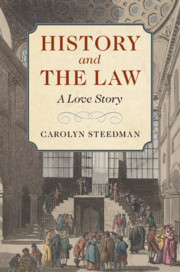
BOOK: Carolyn STEEDMAN, History and the Law - A Love Story (Cambridge: Cambridge University Press, 2020). ISBN 9781108736985, £ 22.99


(Source: CUP)

Cambridge University Press is publishing a new book on everyday legal encounters with the law in English law between the 18th-20th century.

ABOUT THE BOOK

Focusing on everyday legal experiences, from that of magistrates, novelists and political philosophers, to maidservants, pauper men and women, down-at-heel attorneys and middling-sort wives in their coverture, History and the Law reveals how people thought about, used, manipulated and resisted the law between the eighteenth and the twentieth centuries. Supported by clear, engaging examples taken from the historical record, and from the writing of historians including Laurence Sterne, William Godwin, and E. P. Thompson, who each had troubled love affairs with the law, Carolyn Steedman puts the emphasis on English poor laws, copyright law, and laws regarding women. Evocatively written and highly original, History and the Law accounts for historians' strange ambivalent love affair with the law and with legal records that appear to promise access to so many lives in the past.

ABOUT THE AUTHOR

Carolyn Steedman, University of Warwick

Carolyn Steedman is Emeritus Professor of History at the University of Warwick. Her previous books include Landscape for a Good Woman (1986), Dust (2001), Master and Servant (Cambridge, 2007), Labours Lost (Cambridge, 2009), An Everyday Life of the English Working Class (Cambridge, 2013) and Poetry for Historians (2018).

TABLE OF CONTENTS

A beginning: 'history' Stephen Dunn
1. Its ziggy shape
2. Law troubles: two historians and some threatening letters
3. Letters of the law: everyday uses of the law at the turn of the English nineteenth-century
4. The worst of it: Blackstone and women
5. Who owns Maria
6. Sisters in laws
7. Hating the law: Caleb Williams
8. The kind of law a historian loved
An ending: not a story
Bibliography
Index.

More info here

JOURNAL: Journal of the History of International Law/Revue d'histoire du droit international XXI (2019), No. 4 (December)

(image source: Brill)

International Law as Insulation – The Case of the World Bank in the Decolonization Era (Dimitri Van Den Meerssche)
Abstract:
This article maps out how (international) legal concepts and norms were employed during the inter-institutional struggle between the United Nations and the World Bank in the decolonization era. The first contribution is historiographical. Drawing on material from the Bank’s (oral) archives, the article gives an original account of the ways in which the organization bypassed the universalist aspirations that were gaining a foothold in the UN’s democratic bodies. Secondly, the paper retraces how this particular event gave rise to a clash between opposing imaginaries of international legal order, where axiological aspirations voiced by states from the Global South were ultimately frustrated by a functionalist understanding of international (institutional) law that justified the Bank’s institutional insulation. Finally, the paper aims to provide a modest methodological contribution to the field of international institutional law – a doctrinal discipline that traditionally pays little empirical attention to the historical and sociological performativity of concrete legal interventions.
 The Co-creation of Imperial Logic in South American Legal History (Fernando Pérez Godoy)
Abstract:
This study is part of the current trend of expanding ‘histories of international law’. From a regional perspective, I analyse not just the South American dimension of the process known as the ‘universalization of international law science’, but also focus on the ‘ideological use’ of ius gentium europaeum in the debate on the occupation of indigenous territories governing by the nation Mapuche in the south of Chile (1861–1883) and then the discussion on the legitimacy of the Saltpeter War between Chile and the Bolivian-Peruvian Alliance (1879–1884). I argue that the Chilean national legal discourse applied a core argument of nineteenth-century international law to legitimize its foreign policy in those conflicts: ‘the standard of civilization’. Thus, it is possible to speak about a domestic recreation of imperial logic as part of the globalization of the European law of nations in the nineteenth century.
The Impasse of Human Rights: a Note on Human Rights, Natural Rights and Continuities in International Law (Mónica García-Salmones Rovira)
Abstract:
Studies on the nature of human rights have reached an impasse largely due to a general resistance to engage with the continuity of ideas and theories drawn from religion, morality and ethics in the history of international law. With the impasse of human rights, the article refers to an epistemological deadlock about what human rights are. Studying the concept of natural rights, it is argued, offers a means of breaking this impasse and, ultimately, easing the current tension between historicism and essentialism in human rights theory. The article concludes that natural rights were means to decide the moral questions posed by the violent redistribution of (material) goods taken to be common by the theoreticians of the expanding European empires. Probing in this manner into natural rights’ early uses and embedded theories gives us new tools and fresh approaches to be employed in relation to the challenges posed by contemporary global politics.
 Sovereignty under the League of Nations Mandates: The Jurists’ Debates (Leonard V. Smith)
Abstract:
The mandate system took shape at an inflexion point in the evolution from an international system based on rule over territories to one based on rule over peoples. Political compromises made at the Paris Peace Conference resulted in the creation of a new political agent, the League of Nations Mandate, with no clear sovereign. In seeking to systematize this political outcome, jurists located sovereignty with the victorious Great Powers, the League itself, and with the peoples of the mandate territories. Yet they never achieved a consensus, which created an absence at the centre of the mandate system that politics would have to fill throughout the interwar period.
Book reviews:
Frieden durch Recht? Der Aufstieg des modernen Völkerrechts und der Friedensschluss nach dem Ersten Weltkrieg, written by Marcus M. Payk
Justice in a New World: Negotiating Legal Intelligibility in British, Iberian, and Indigenous America, edited by Brian P. Owensby and Richard J. Ross By: Daniel S. Allemann
Le droit international antiesclavagiste des ‘nations civilisées’ (1815–1945), written by Michel Erpelding By: Anne-Charlotte Martineau
(read more with Brill)
(source: ESILHIL Blog)

CALL FOR PAPERS: WORCK Conference – Reconceptualising Wage Labour (Buapest, 16-20 September 2020) (DEADLINE: 15 February 2020)


(Source: WORCK)

We learned of a call for papers on the history of wage and contracts across history.

In September 2020, the first WORCK Conference will take place at the Central European University in Budapest. It challenges the traditional narrative of labour history by addressing the ambiguities of wage and contract across history.

Hosts: Susan Zimmermann and Isidora Grubacki

The call for papers can be found here

More info here

13 January 2020

JOURNAL: Tijdschrift voor Rechtsgeschiedenis/Revue d'Histoire du Droit/The Legal History Review LXXVII (2019), Nr. 4

(image source: Brill)

The life and work Raoul Charles van Caenegem (1927-2018) (Dirk Heirbaut)
Abstract:
This article deals with the life and work of the Belgian legal historian R.C. van Caenegem. It shows how van Caenegem’s work was influenced by his teachers, first of all François-Louis Ganshof, but also many others like Theodore Plucknett. Van Caenegem’s research was very diverse and addressed different groups of readers, so that most of them only know a fragment of his work. Van Caenegem learned from Ganshof’s mistakes. Unlike his master, van Caenegem took an interest in sociology and he did not hesitate to publish the grand overviews of history which Ganshof had stopped writing in the second half of his career. Many of van Caenegem’s books on English, medieval and legal history were a product of his teaching. Whereas the books for the students in Ghent, where van Caenegem was burdened by a heavy teaching load, presented a complete survey, the books for select groups of foreign students cherry-picked from legal history and took part in discussions on larger debates. Van Caenegem’s many articles offer a better insight into his personal evolution from a scholar who started out as a jurist, but very soon lost interest in dogmatic legal history and preferred to investigate the lawmakers instead of the law itself. As a historian, van Caenegem put the middle ages first, because in his opinion the middle ages laid the foundations for the modern rule of law. However, these ‘modern’ middle ages only started in the twelfth century. Although he claimed that the future of legal historical research lays in teamwork, van Caenegem himself remained an indvidualistic scholar.
Das Legatum sub modo im klassischen Römischen Recht (Hans Ankum)
First paragraph:
Kees Cappon, der in Oktober 1992 an der Universität von Amsterdam eine Doktorarbeit über frühmittelalterliche Testamente in Utrecht1 verteidigte, trat in Juni 2019 als Professor für Allgemeine Rechtsgeschichte mit einer Abschiedsvorlesung von der Amsterdamer Universität zurück. Bei dieser Gelegenheit will ich gerne für meinen Schüler, Fakultätskollegen und Freund Kees Cappon einen Aufsatz schreiben. Es liegt auf der Hand, dass ich als Romanist bei einem Thema aus Cappons mit der iudicium ‚cum laude‘bekrönten Dissertation anknüpfe. Bei der Lektüre nach mehr als 35 Jahren des von Cappon geschriebenen Buches fiel mir seine ausführliche Behandlung des Legats unter einer Auflage2 auf. Ich habe vor, hier zu untersuchen, wie die römischen Juristen aus der klassischen Periode diese Rechtsinstitution entwickelt haben. Dabei werde ich (in Nr.2 und Nr.3) den Javolentext D. 35,1,40,5, in dem auch die Meinungen seiner Vorgänger Trebatius, Labeo und Proculus erwähnt werden, als Kerntext meines Aufsatzes ziemlich ausführlich behandeln. Die Weisen, in denen die die späteren Juristen sich bemüht haben, die Auflage zu realisieren, kommen danach (in der Nr.4) skizzenhaft zur Sprache. Am Ende (in der Nr.5) formuliere ich dann kurz einige Schlussfolgerungen.
 Antichresis: a comparative study of classical Roman law and the contractual praxis from Roman Egypt (R. Bobbink & Q. Mauer) OPEN ACCESS
Abstract:
The authors examine how papyrological sources from Roman Egypt written in Greek on antichresis relate to classical Roman law. Antichresis attested in papyrological antichretic contracts had a lot in common with antichresis emerging from Roman dispute resolutions. There was only one substantive difference: in classical Roman law, protection of the debtor was emphasized, whereas in the Greek papyrological antichretic contracts the position of the creditor was favoured. Given the similarities found, the authors conclude that antichretic loan both as an independent legal institution and as a pactum antichreticum was a pan-Mediterranean legal concept.
Moneta e cultura giuridica Un brocardo di Azzone nella costruzione del diritto pecuniario medievale (David De Concilio)
First paragraph:
Da tempo la storiografia ha riconosciuto come un fatto consolidato l’impor­tanza che il Medioevo – e in particolare le grandi trasformazioni del XII e XIII secolo – ebbe nello sviluppo del pensiero economico occidentale, sulla scia della cosiddetta rivoluzione commerciale. L’attenzione degli studiosi non poteva che cadere su uno degli aspetti fondamentali di questo fenomeno, ossia sulla dimensione centrale che il tema monetario assunse proprio in quei secoli, ­sulla sua teorizzazione e sulla sua sistemazione intellettuale. Gli studi in questo senso si collocano crocevia della multidisciplinarietà: dalla storia economica e monetaria stricto sensu 1, fino a quella del pensiero filosofico e teologico2. Anche la storiografia giuridica non è stata indifferente al tema economico e monetario, e in particolare ha indagato il concetto di moneta e i problemi giuridici da essa derivanti nell’elaborazione dottrinaria del diritto colto medievale, per quanto attiene sia all’età della Glossa che a quella del Commento3. Come infatti si vedrà in maggiore dettaglio più avanti, la cultura giuridica, fin dalla propria rinascita nella culla bolognese, fu sensibile ai problemi monetari del proprio tempo, e nello specifico alle esigenze di un mercato che proprio in quegli anni e in quella medesima area geografica vedeva una rapida ripresa ed espansione. Basti per ora accennare che i glossatori civilisti, secondo la metodologia che è loro propria, guardarono alla moneta come istituzione giuridica attraverso i testi del Corpus iuris: le prime testimonianze della loro elaborazione sul tema sono contenute nelle opere dei giuristi Bulgaro (XII sec)4 e Pillio da Medicina (m. dopo il 1207)5, per trovare infine una compiuta sistemazione nel testo che ci accingiamo a esaminare in questa sede: un passo di quella raccolta di Brocarda di Azzone che la storiografia ha ribattezzato ‘Salicta’ 6, il quale rappresenta un punto di svolta in questo percorso dottrinale.
The decline and displacement of custom in early modern Spain (Aniceto Masferrer Domingo)
Abstract:
 This article aims to describe the reasons for the decline of customary law in the early modern era. Confining the discussion to a limited geographical setting – the Iberian Peninsula – the arguments I used might be easily applied to other European jurisdictions. Part I presents an explanation of the predominance of custom in the medieval Spanish legal traditions. Part II describes the general features of the law in the early modern era, since they contributed – to a greater or lesser degree – to the demise of custom. Part III focuses more specifically on the theoretical and practical reasons for the decline and displacement of custom in early modern Spain. Part IV describes the consequences of the Decrees of Nueva Planta (1707-1718), approved by Felipe V in the context of the War of the Spanish Succession (1700-1714), regarding the development of the notion and role of custom in the eighteenth century. The article concludes with some reflections, emphasising that although customs do not easily co-exist with the state or a strong political power, neither do they entirely perish.
The long journey of ‘Privatautonomie’ The history of a concept coined and exported in times of persecution (Arndt Kiehnle)
Abstract:
Individual autonomy was rediscovered in modernity when it came to the persecution of dissenters in Germany after the Reformatio n. Since the 18th century the ‘Privatautonomie’ of the individual has been established in German private law. Later, in the 19th century, the term autonomy gained ground in the legal terminology of French private law, also thanks to the German emigrant Foelix. In the 20th century autonomy, not least thanks to German-speaking jurists who fled from the Nazis, became a legal term also used in the private law of the USA and Great Britain.
 The barratry of the shipmaster in early modern law: the approach of Italian and English law courts (Guido Rossi)
Abstract:
For a long time, the concept of barratry (at least in its maritime meaning) was one and the same on both sides of the Channel. The barratry of the shipmaster was part of the mercantile usages, and it identified the intentionally blameworthy conduct of the master. When law courts began to decide on insurance litigation they were confronted with a notion quite alien to them. Broadly speaking, the shipmaster’s barratry could well be considered a fraud of sort. But in order to decide on its occurrence in a specific case, law courts had to analyse it in legal terms, and so according to the specific legal categories of their own system. The point ceases to be trivially obvious if we think that the different legal framework of civil and common law courts progressively led to very different interpretations of the same thing. Thus, with the shift of insurance litigation from mercantile justice to law courts maritime barratry began to acquire increasingly different features in the two legal systems. Very often, the very same conduct of the shipmaster was considered as negligent by civil law courts and barratrous by common law courts. The difference was of great practical importance, for many policies excluded barratry from the risks insured against. So, depending on the kind of law court, an insurer could be charged with full liability for the mishap or walk away without paying anything. If the beginning of the story was the same, its end could not have been more different.
 Classical Roman Law, a product of interpretation from the Early Modern Times (Laurent Waelkens)
Abstract:
The study of the Roman law we know today, started in the twelfth century and was based on sources preserved from Roman Antiquity. The interpretation of these antique texts was, however, always contemporary and never reflected their original meaning. In this article we assess the importance of medieval and early modern interpretation and, by analyzing a series of thirteen classical notions of Roman law, illustrate how what we call “classical Roman law” nowadays found its origins especially in Early Modern Times. The article also brings an English summary of a series of articles we wrote in French and Dutch.
Banditisme in de Franse tijd in het Leiedepartement, 1796-1813 (Jos Monballyu)
Abstract:
Banditry and brigandage were notions defined neither in the ‘Code pénal’ of 1791 an nor in the Code Pénal of 1810. Therefore they were not used in criminal courts. Based on the stored judgments of these courts, it is not possible to calculate how many times these so-called crimes were committed in a certain period and how many people were involved. On the other hand, the ‘committing of a theft by two or more persons’, was a real criminal law concept in the ‘Code penal’ of 1791 and the ‘Code penal’ of 1810. The criminal courts took precisely account with this notion in their judgements. On the basis of the stored judgments of these criminal courts it is possible to calculate how many such gang thefts were penalized, how they were punished and how many persons were punished. In the Belgian department of the Lys (about 475.000 people), the criminal courts punished between 1796 and 1813 in total 284 gang thefts of which 222 without violence and 62 with violence. They punished by this way 387 persons, as perpetrator or accomplice, of which 261 persons for a theft without violence and 126 persons for a theft with violence. 80 persons were punished with death. For 12 of them, this was due to the fact that they had committed a murder, manslaughter or murderous assault at the same time as their gang theft. For 68 of them, this was due to the fact that their gang theft also constituted a violation of the law of 26 floral year V (May 15, 1797) or the law of 29 nivôse year VI (January 18, 1798). After the abolition of the law of 26 floréal year V in 1811, the Criminal Court of the department of the Lys no longer punished gang theft with the death.
The rise of the comparative approach in Russian legal scholarship as a factor in the modernisation of civil legislation, from the Svod Zakonov of 1833 to the Draft Civil Code of 1905 (Dmitry Poldnikov)
Abstract:
In the second half of the 19th century Russian positive law underwent a rapid and profound reform. It is best illustrated by the legislation in the domain of civil law, as one compares the pre-reformed casuistic and inconsistent Svod Zakonov (Digest of Laws) of 1833 and the ‘westernised’ Draft Civil Code of 1905. This transition was largely facilitated by the emergence of a fully-fledged comparative legislation in Russia. In this paper I investigate the decisive role of Russian legal scholarship in developing a comparative approach using an original synthesis of several streams of European legal thought, namely Savigny’s Historical School, German Pandectism, the French école de l’exégèse, and Jhering’s sociological doctrine. I argue that such legal scholars as Meyer, Pobedonostsev, Pakhman, Shershenevich, Annenkov succeeded in overcoming the ­limits of the pre-reformed, literal knowledge of the Svod Zakonov and began to study Russian civil law as part of the law of the ‘civilised nations’ through dogmatic comparison which resembled the comparative legislation in Western Europe. The evidence for this claim is taken from the main doctrinal works between 1840 and 1910 which represent both streams of comparison and it is analysed in the framework of comparative legal history. Special attention is paid to the contribution of dogmatic comparison in developing the general part of contract law as a recognisable hallmark of civil law in continental Europe which came to be adopted in the doctrinal writings and the draft legislation of the late Russian empire.
 The Dutch postwar restoration of rights regime regarding movable property (Lars Van Vliet)
Abstract:
During the Second World War Germany and German nationals looted the Netherlands and its nationals of many valuable assets, that were taken to Germany. Often the looting took the form of forced sales. In some cases, the sales price was too low, in other cases the German buyer paid market value or more, but often the buyer paid with guilders looted from the Dutch State. After the liberation of the Netherlands the ‘restoration of rights regime’ enabled victims of forced sales to seek annulment of the sales. This article concentrates on those movable goods that were sold to German buyers and that, after the war, returned from Germany to the Netherlands with the help of the Allied Forces, the so-called recuperation goods. If the seller did not seek annulment before the deadline of July 1951, for example because the price paid was considerable so that he preferred to keep the purchase price, or if his request was rejected, the Dutch State should not be forced to return these goods to their German buyer. Therefore, these goods were first subjected to Royal Decree E 133 which expropriated all German owned property in the Netherlands. Upon return to the Netherlands the recuperation goods became State property, but this measure could be undone by the seller successfully seeking annulment of the sales contract under Royal Decree E 100. However, if no annulment took place, the State remained owner of these goods.
Book reviews:
Die kaiserliche Notariatspraxis im frühneuzeitlichen Hamburg, geschreven door Sarah A. Bachmann, 2017 By: P.L. Nève
Alles is gedaan om het recht te vinden. Bijzondere rechtspleging in Leeuwarden, 1945-1949, geschreven door Michiel Severein, 2017 By: J. Monballyu
Chronique

Nécrologie: In memoriam Pieter Spierenburg 1948-2019 (Laurens Winkel)

Read all articles with Brill.

SUMMER COURSE: Rare Book School course “Law Books: History & Connoisseurship” (Yale, 7-12 June 2020)


(Source: Yale Law School)

We received news from a course offered by Michael Widener (Yale) and Ryan Greenwood (Minnesota) in Yale coming June.

The University of Virginia’s Rare Book School is now accepting applications for admission to its course, “Law Books: History & Connoisseurship,” which is scheduled for June 7-12, 2020 in the Yale Law School Library, New Haven, Connecticut. Enrollment is limited to 12 students.

The course description, advance reading list, evaluations from previous students, and a link to the application site are here: https://rarebookschool.org/courses/collections/c85/

Information on the application process, program costs, etc., is available here: https://rarebookschool.org/admissions-awards/application/

This intensive, week-long course is about building focused, interesting, and useful collections of historical materials in Anglo-American, European, and Latin American law. It is aimed at  individuals and librarians who collect historical legal materials, and the book dealers who supply them, as well as librarians developing collections from existing holdings. Lively discussion and extensive hands-on activities are hallmarks of the course.

The instructors are Mike Widener (Rare Book Librarian, Lillian Goldman Law Library, Yale Law School) and Ryan Greenwood (Curator of Rare Books and Special Collections, University of Minnesota Law Library). This will be Widener’s seventh time teaching the course, and the second time for Greenwood. Due to Widener’s retirement from Yale in April 2021, future offerings of this course are uncertain. If you have wanted to take the course, and haven’t yet attended, now is the time.
Questions about the content of the course should go to Mike Widener at: mike.widener@yale.edu. Questions about applications, registration, tuition, and housing should be directed to the Rare Book School staff at rbsprograms@virginia.edu.

BOOK: Danica SUMMERLIN, The Canons of the Third Lateran Council of 1179 Their Origins and Reception (Cambridge: Cambridge University Press, 2020). ISBN 9781107145825, $ 99.99


(Source: CUP)

Cambridge University Press is publishing a new book on the canons of the third Lateran council of 1179.  

ABOUT THE BOOK

Alexander III's 1179 Lateran Council, was, for medieval contemporaries, the first of the great papal councils of the central Middle Ages. Gathered to demonstrate the renewed unity of the Latin Church, it brought together hundreds of bishops and other ecclesiastical dignitaries to discuss and debate the laws and problems that faced that church. In this evaluation of the 1179 conciliar decrees, Danica Summerlin demonstrates how these decrees, often characterised as widespread and effective ecclesiastical legislation, emerged from local disputes which were then subjected to a period of sifting and gradual integration into the local and scholarly consciousness, in exactly the same way as other contemporary legal texts. Rather than papal mandates that were automatically observed as a result of their inherent papal authority, therefore, Summerlin reveals how conciliar decrees should be viewed as representative of contemporary discussions between the papacy, their representatives and local bishops, clerics, and scholars.

ABOUT THE AUTHOR

Danica Summerlin, University of Sheffield

Danica Summerlin is Lecturer in Medieval History at the University of Sheffield where her research focuses on the role of canon law in government and society in the central Middle Ages. She is one of three leaders of an international project revamping the Clavis Canonum, a key database for the study of medieval canonical collections available online via the Monumenta Germaniae Historica. She is the co-editor of The Use of Canon Law in Ecclesiastical Administration, 1000–1234 (2018) with Melodie H. Eichbauer.

TABLE OF CONTENTS

Introduction
1. Historical survey
2. Disputes, decretals, and the 1179 conciliar canons
3. The 1179 canons and the schools
4. The dissemination of the 1179 canons
5. Use of the canons, ca. 1179–ca. 1191
Conclusions
Appendix 1. Manuscript listing of the 1179 canons.

More info here