Search

Showing posts with label african legal history. Show all posts

05 February 2025

CALL FOR PAPERS: Beyond Development: Mapping Legal Entanglements between Africa and Europe (Vienna: Faculty of Law, 4-5 DEC 2025); DEADLINE 28 FEB 2025


The Department of Legal and Constitutional History and the African Law Association jointly invite scholars to participate in the interdisciplinary conference on the topic “Beyond Development: Mapping Legal Entanglements between Africa and Europe”, which will take place from 4 to 5 December 2025 at the Faculty of Law of the University of Vienna, Austria.

The event will also be the 49th Annual Conference of the African Law Association.

Outline of the Conference

The Portuguese colonies in Africa gained their independence 50 years ago. Although colonialism in Africa was by no means over in 1975, this date is regarded in global history as an important turning point for the political and legal independence of the African continent. The conference aims to mark this anniversary by reflecting on the past and considering the future from a legal perspective.

We invite contributions, firstly, about the relationships between the newly independent states and the former colonial empires at the intergovernmental (international law), diplomatic and economic levels, as well as in international organizations. The conference aims to provide a forum for discussing postcolonial criticism directed at outdated romanticization of development, on the one hand, and simplistic narratives of progress on the other. Which conclusions and assessments can be reached when using law as a criterion for analysis?

Secondly, the conference focuses on legal developments since independence and is interested in both grand narratives and micro-studies. The focus is on the topics of constitutional law and reform, regional inner-African legal integration, the regulation of the environment and the economy, human rights, and developments in private law in African countries, also in relation to non-state law.

Thirdly, we explicitly invite conceptual work; conventional descriptions and categories in these areas should be subjected to critical re-reading. The focus here is on interdependencies between Europe and Africa. This also includes the question of the extent to which legal developments on the African continent have triggered reforms in former colonial empires. We are particularly interested in the migration of ideas and people, the African diaspora in the former empires, and non-state networks as actors in the past and present of law.

Panels

When submitting your contribution, please indicate one or more of the following panels to which your topic should be assigned:

Panel 1: Legal entanglements between Africa and Europe

Panel 2: Postcolonial legal systems and non-state law

Panel 3: Regional integration, international organizations and international law

Panel 4: Constitution-making and constitutional reform

Panel 5: Environmental and economic regulation, human rights

Submission

Please submit your abstract in PDF format to lawinafrica.rechtsgeschichte@univie.ac.at and include the following:

 - Title of the submitted paper

 - Panel to which the paper should be assigned

- Abstract of 250–500 words

- Name(s) of the author(s)

- Affiliation(s) of the author(s)

Please note: The language for submitted contributions and of the conference is English. Manuscripts should be original contributions, and by submitting a paper, you accept that the organizers expect you to contribute a corresponding article to the conference proceedings!

The organizers will apply for funding to help cover travel and accommodation costs, especially for researchers from the Global South. However, we will only be able to confirm the extent of cost coverage at a later stage, so participants should be prepared in principle to cover their own costs.

Timeline

Abstract submission deadline 28 February 2025

Notification sent to participants 17 March 2025


(image: Juridicum, Vienna University)

29 June 2023

BOOK: Rabiat AKANDE, Entangled Domains: Empire, Law, and Religion in Northern Nigeria (Cambridge: Cambridge University Press, 2023), 202 pp, ISBN 9781316511558, £95


(image courtesy: Cambridge University Press)

Book description: 
Set in Colonial Northern Nigeria, this book confronts a paradox: the state insisted on its separation from religion even as it governed its multireligious population through what remained of the precolonial caliphate. Entangled Domains grapple with this history to offer a provocative account of secularism as a contested yet contingent mode of governing religion and religious difference. Drawing on detailed archival research, Rabiat Akande vividly illustrates constitutional struggles triggered by the colonial state's governance of religion and interrogates the legacy of that governance agenda in the postcolonial state. This book is a novel commentary on the dynamic interplay between law, faith, identity, and power in the context of the modern state's emergence from colonial processes.
Table of contents: 
Introduction
Part I. Governing Faith:
1. Jousting for souls: indirect rule, Christian missions and the governance of religious difference
2. Governing Shari'a
Part II. Constituting Difference:
3. The construction of minorities: late imperial secularity and the constitutional politics of decolonization
4. The making of the 1958 Penal Code
5. Constituting rights: Christian religious liberty in the late colonial state
Part III. Imagining the Past:
6. The 1977 Constitutional Conference and beyond
Conclusion.
About the author: 
Rabiat Akande is Assistant Professor at Osgoode Hall Law School in Toronto. She works in the fields of legal history, law and religion, constitutional and comparative constitutional law, Islamic law, International law, and (post)colonial African law and society.
More information can be found here

20 April 2023

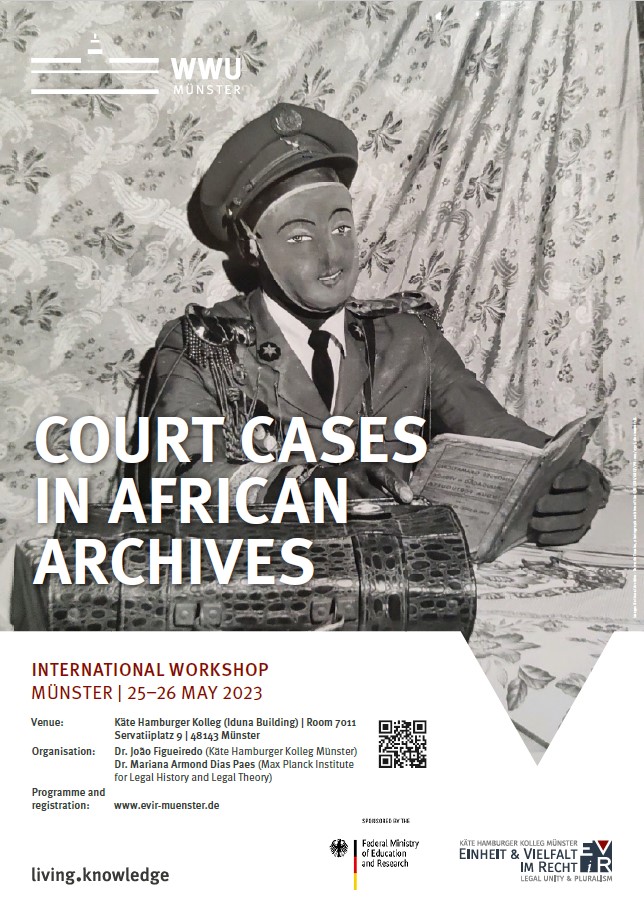
WORKSHOP: Court Cases in African Archives (Münster: Käte Hamburger Kolleg, 25-26 MAY 2023)


(image source: WMU Münster)

Concept:

Africa is usually absent from Global Legal History debates. Working on local archives, with locally produced sources such as court cases, can be a method to overcome this blind spot. Court cases are very privileged historical sources since they show the actual engagement of the local population in disputing the concrete meanings of legal norms and legal categories. They also allow us to understand better the interaction of different normative systems that shaped law and the resolution of conflicts in colonial societies. Court cases abound in Lusophone Africa archives. However, despite the richness of their collections, the documents are often unorganized and unidentified, making it very difficult for the academic community to use them. This workshop addresses the methodological challenges and historiographical opportunities of working with processes held in African archives.

Program:

Thursday, 25 May 2023

14.00 | Welcome and Introduction

14.30 | Section 1

Mariana Armond Dias Paes (Frankfurt am Main) | Court Cases and Legal Pluralism in Portuguese Colonial Africa

Luíz Cabral de Oliveira (Lisbon) | Law in Books vs Law in Action: Félix Correia de Araújo, a Remarkable Angolan Judge in the Late 18th Century

16.00 | Coffee break

16.30 | Section 2

João Figueiredo (Münster) | The Records of “Trials of Gentilic Cases” in the National Archive of Angola (AHA)

Cristina Nogueira da Silva (Lisbon) | Colonial Justice in Mozambique (1915-1954): Preserving and Changing Indigenous Customary Law

18.30 | Dinner


Friday, 26 May 2023

10.30 | Keynote

Benedetta Rossi (London) | Rethinking the Abolition of Slavery in Africa’s Legal History

12.00 | Lunch in the Kolleg

13.00 | Section 3

Esteban Salas (London) | Freedom and Portuguese Legal Anxieties in Benguela at the Turn of the Nineteenth Century

Matheus Pereira (Lisbon) | Legal Processes of Assimilation from below: African Experiences in Mozambique during Portuguese Colonial Exploitation (c. 1900-1960)

14.40 | Coffee break

15.00 | Section 4

Fernanda Thomaz (Juiz de Fora, Brazil) | Power, Discourse and Matrimonial Conflicts in the Production of Court Cases in Northern Mozambique (1930-1950)

Sophie Kotanyi (Berlin) | Contemporary Audio-Visual Archive of Palaver and Treating a Case of Involuntary Kindoki ‘Witchcraft’ by Neutralizing it

16.30 | Final Remarks

17.00 | Farewell and Outlook


More information here.

21 February 2022

ARTICLE: Richard REID, Africa’s Revolutionary Nineteenth Century and the Idea of the “Scramble” (AHR CXXVI (2021), No. 4 (Dec), 1424-1447)


(image source: OUP)

Abstract:

This paper seeks to position the Scramble for Africa in the context of the continent’s transformative, global nineteenth century. While imperial historiography develops apace, Africa-facing analyses of the continent’s partition and the processes which led to it are increasingly rare. European expansion into Africa was characterized by an aggressive dynamism, and millions of Africans experienced profound crisis in the process of the establishment of colonial rule. Yet Africa’s revolutionary nineteenth century was both driven by, and culminated in, complex processes of co-option on the part of Africans and Europeans. The paper proposes that a more Africa-centered assessment of the Scramble is possible, one which aims to contextualize the partition of the continent as part of an ongoing, endogenously shaped but often exogenously connected, transformation in political, economic, and social organization and behavior. While no single overarching theory can apply to the entire continent, it is possible to identify dynamics and processes for change that recur across Africa, from political and military reform to economic innovation. These point toward possibilities for reframing Africa’s development in the late precolonial period, and enable us to challenge the hegemony long enjoyed by scholars of European empires.

Read more with Oxford Journals (DOI 10.1093/ahr/rhab539

22 December 2021

WORKSHOP: Decolonization by Codification: The Making of the 1958 Penal Code in Late Colonial Nigeria, 4 January 2022

(Source: mpilhlt)

MPI-TAU Transnational Legal History Workshop

DATE: Jan 4, 2022 TIME: 19:00 - 20:30
SPEAKER: Rabiat Akande (Osgoode)
CONVENORS: Thomas Duve, David Schorr (TAU), Stefan Vogenauer
LOCATION: video conference
ROOM: For further information please contact mpitauwkshp@gmail.com


07 June 2021

BOOK: Andrea DE GUTTRY, Harry H.G. POST & Gabriella VENTURINI (Eds.), The 1998–2000 Eritrea-Ethiopia War and Its Aftermath in International Legal Perspective (The Hague: TMC Asser Press). ISBN 978-94-6265-439-6, open access


(Source: Springer)

Springer has published a new book on the 1998-2000 Eritrea-Ethiopia War in international legal perspective.

ABOUT THE BOOK

This book centres on the war that raged between Eritrea and Ethiopia from 1998 to 2000, a war that caused great loss of life and tremendous devastation. It analyses the war in great detail from an international legal perspective: the nature and the state of the boundary conflict preceding the actual armed conflict, the military actions themselves, the role of the UN peace-keeping mission, the responsibility for the multitude of explosive remnants of the war left behind. Ample attention is paid to the decisions of the Eritrea-Ethiopia Claims Commission and the Eritrea-Ethiopia Boundary Commission. 

This study is not limited to the war and the period immediately following it, it also examines its more extended aftermath prolonging the analysis as far as the more recent improvement in the relations between Eritrea and Ethiopia, away from a situation of ‘no war, no peace’ that prevailed after the armed conflict ended. The analysis of the war and its aftermath is not only in terms of international legal issues, it has been placed in a wider than strictly legal perspective. 

The book is a valuable work for academics and practitioners in international law, human rights and humanitarian law in particular, for political scientists, diplomats, civil servants, historians, and all those others seriously interested in the Horn of Africa.

ABOUT THE EDITORS

Andrea de Guttry is Full Professor of Public International Law at the Scuola Superiore Sant'Anna in Pisa, Italy.

Harry H.G. Post is Adjunct Professor in the Faculté Libre de Droit of the Université Catholique de Lille in Lille, France.

Gabriella Venturini is Professor Emerita in the Dipartimento di Studi internazionali, giuridici e storico-politici of the Università degli Studi di Milano in Milan, Italy.


More info and the ToC can be found here

20 May 2021

JOURNAL: C@hiers du CRHiDI. Histoire, droit, institutions, société [Special Issue Dire, appliquer et diffuser le droit. L'action des gens de justice au Congo belge (1908-1960), eds. Françoise MULLER, Bérengère PIRET, Xavier ROUSSEAUX & Nathalie TOUSIGNANT]


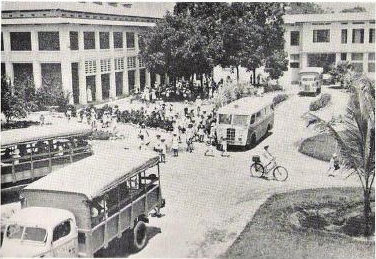
(image: Leopoldville; source: Wikimedia Commons)

Gouvernementalité en régime colonial : acteurs, vecteurs et pratiques du droit et de la justice en Afrique coloniale belge (Xavier Rousseaux) (DOI 10.25518/1370-2262.709)

La compénétration des magistratures métropolitaine et coloniale. Analyse du cas belge (1885-1939) (Françoise Muller, Amandine Dumont & Xavier Rousseaux) (DOI 10.25518/1370-2262.697)

Abstract:

Cet article traite de la compénétration des magistratures métropolitaine et coloniale belges durant la période 1885-1939. La compénétration de ces magistratures – c’est-à-dire les passages d’un corps à l’autre – s’observe à 51 reprises durant la période étudiée. Ces passages obéissent à des règles différentes selon qu’ils s’effectuent dans un sens ou dans l’autre. En dépit de propositions doctrinales et législatives répétées, les passages « colonie/métropole » (75% de l’effectif) n’ont pas fait, durant la période étudiée, l’objet d’une législation particulière facilitant l’intégration des magistrats coloniaux à la magistrature métropolitaine. Ceux-ci étaient contraints de recommencer une nouvelle carrière en métropole. Les passages « métropole/colonie » étaient mieux encadrés, assurant aux magistrats métropolitains de retrouver leur place au terme de leur séjour dans la colonie et leur permettant (en théorie) de conserver leurs droits à l’avancement.

Nomenclature du personnel judiciaire colonial. Dire le droit et rendre la justice à Stanleyville, 1935-1955 (Bérengère Piret) 

Abstract:

On considère généralement que la fonction fait l’homme, au Congo c’est davantage l’homme qui fait la fonction. En raison de la multiplicité des missions confiées aux fonctionnaire territoriaux (assurer le maintien de l’ordre et de la tranquillité publique, construire et entretenir les voies de communication comme les édifices publics, définir et faire exécuter les programmes agricoles, etc.), du contrôle réduit dont ils font l’objet et de l’absence de contre-pouvoir qui leur est opposé, leur formation et leur personnalité s’avèrent déterminantes. Loin de dresser la prosopographie du personnel du tribunal de district de Stanleyville, nous baliserons uniquement les principaux éléments de leur parcours. Ceux-ci doivent nous permettre de comprendre qui ils sont lorsqu’ils agissent au sein de ladite juridiction.

 Antoine Sohier, magistrat colonial au Congo belge (1910-1934). Éléments bio- et bibliographiques (Romain Landmeters) (DOI 10.25518/1370-2262.722)

Abstract:

L’article présente les éléments biographiques principaux et les productions bibliographiques d’Antoine Sohier en tant que magistrat au Congo belge. Il retrace notamment les grandes étapes de sa carrière coloniale entre 1910 et 1934.

Un barreau sur mesure ? Les enjeux de la création d’un Barreau colonial (1908-1932) (Jérôme de Brouwer & Maxime Jottrand) (DOI 10.25518/1370-2262.706)

Abstract:

Les premiers avocats s’installent dans la colonie au cours des années qui suivent la reprise du Congo par l’État belge. En l’absence de toute réglementation et parce qu’ils évoluent dans un environnement très différent de celui dont ils sont familiers, les avocats s’interrogent sur l’applicabilité à la colonie des règles organisant la profession et sa discipline en vigueur dans la métropole. Si à partir des années 1920 les avocats s’accordent sur la nécessité de l’organisation de la profession, ils s’opposent sur ces modalités. La perspective de l’institution d’un barreau colonial se heurte aux enjeux spécifiques liés au statut de la colonie et à sa géographie ainsi qu’à son administration.

 « S’il est construit à faux, tout risque de s’effondrer ». Le Journal des Tribunaux et le droit au Congo belge (Sebastiaan Vandenbogaerde) (DOI 10.25518/1370-2262.737)

Abstract:

Les revues juridiques forment un noyau dans un réseau élitaire où différents acteurs se rencontrent. Chaque titre a un programme dans lequel les rédacteurs s’inscrivent et essayaient de convaincre les lecteurs. Le Journal des Tribunaux et sa « petite sœur », le Journal des Tribunaux d’Outre-Mer, avaient l’idée de faire connaitre le droit au public qui n’avait pas vraiment un intérêt au droit congolais. Cette contribution se focalise sur les leaders, notamment les rédacteurs en chef, qui sont cruciaux pour la construction de la mentalité sur le droit congolais et l’impact du droit sur l’indépendance congolaise.

 « Pénétrer au mieux l’âme de nos sujets ». La perception des coutumes congolaises par les fonctionnaires territoriaux à travers leur contribution au Bulletin des Juridictions indigènes et de Droit coutumier congolais (Alix Sacré) (DOI 10.25518/1370-2262.675)

Absract:

Issu de recherches effectuées dans le cadre du projet Belgafrican Magistrates Social Networks, cet article se penche sur la contribution des fonctionnaires territoriaux du Congo belge à une revue juridique, le Bulletin des Juridictions indigènes et de Droit coutumier congolais. Il s’agit de montrer en quoi ces écrits sont particulièrement dépendants du contexte de leur rédaction, tant en termes de forme que de contenu ; en cela, ils nous informent sur les préoccupations des territoriaux, sur leur posture vis-à-vis des Congolais et sur la vision qu’ils ont de leurs coutumes. A travers l’analyse de quatre thématiques abordées par ces fonctionnaires, cet article propose ainsi une réponse supplémentaire à la question des liens entre savoir et pouvoir en contexte colonial. Le propos est illustré par plusieurs exemples, issus notamment de la carrière et des travaux rédigés par Fernand Grévisse, administrateur territorial puis commissaire de district du Haut-Katanga.

Prononcer et exercer le droit par l’administration coloniale. Les acteurs de la relégation au Congo Belge (1910-1960) (Valentine Dewulf) (DOI 10.25518/1370-2262.656)

Abstract:

Dès 1910 au Congo Belge, l’administration coloniale peut sanctionner d’une relégation, c’est-à-dire d’une déportation ou d’une interdiction de séjour, tout individu qui a nui à la tranquillité publique. La relégation constitue une sanction parapénale qui échappe au pouvoir judiciaire. Basé sur les correspondances tenues par les membres de l’administration coloniale, cet article interroge l’application de la relégation à partir des acteurs qui la décident ou qui l’influencent. Il met à jour le rôle fondamental du pouvoir local et des agents européens de terrain dans les prononcés de relégation. Il met également en évidence les différents points de vue et les intérêts qui coexistent parmi les autres acteurs d’influence de la relégation : missionnaires, acteurs économiques et pouvoir judiciaire.

Droit et justice en Afrique coloniale belge : acquis et perspectives (Nathalie Tousignant) (DOI 10.25518/1370-2262.802)

Read all articles here.


30 November 2020

BOOK: Erica HEINSEN-ROACH, Consuls and Captives: Dutch-North African Diplomacy in the Early Modern Mediterranean (Woodbridge: Boydell & Brewer, 2019). ISBN 9781580469746, 95.00 GBP


Last year, Boydell & Brewer published a new book on Dutch-North African Diplomacy in the Early Modern Mediterranean.

ABOUT THE BOOK

This work offers a new perspective on the history of diplomacy in the western Mediterranean, examining how piracy and captivity at sea forced Protestant states from northwest Europe to develop complex relationships with Islamic North Africa. Tracing how Dutch diplomats and North African officials negotiated the liberation of Dutch sailors enslaved in the Maghrib, author Erica Heinsen-Roach argues that captivity and redemption helped shape (rather than undermine) a new diplomatic order in the western Mediterranean.


Making use of extensive archival research, Consuls and Captives shows how encounters with North African society led the Protestant North to adjust to the norms and practices of the western Mediterranean. Dutch consuls became state representatives, tasked with claiming the unconditional release of captives from the Netherlands. But caught between these directives and the realities of Maghribi politics, the diplomats consented to pay ransom, participated in what they considered lavish gift-giving practices, and began to pay tribute -- all practices that were departures from the norms the Dutch States General upheld in "doing" diplomacy.


In analyzing these adjustments, Heinsen-Roach brings into question earlier interpretations of diplomacy as a progressively evolving institution anchored in the western modern tradition. Consuls and Captives shows instead that early modern diplomacy in the western Mediterranean developed in uneven ways as a product of cultural encounters. With its compelling argument and wide-ranging evidence, this book will have a strong appeal to scholars of early modern diplomacy, slavery, and Mediterranean history, as well as to specialists on the Dutch Republic.

ABOUT THE AUTHOR

Erica Heinsen-Roach is visiting assistant professor at the University of South Florida St. Petersburg.

TABLE OF CONTENTS

Global Treaty Making: From Morocco to Constantinople

Captivity and Diplomacy in Algiers and Tunis

The Consul as State Representative

Ransoming is the Norm

Collective Redemption: Naval Violence and Hostage Taking

A True Public Minister: Consuls and Jewish Mediators

The Reluctant State

The Cannon as Gift: Institutionalizing the Problem


More info here

16 July 2020

JOB: Two Academic Assistants at the Université de Dakar (DEADLINE: 31 July 2020)


We learned of a call for two academic assistants at the legal history department of the Université de Dakar. The call can be found here

09 July 2020

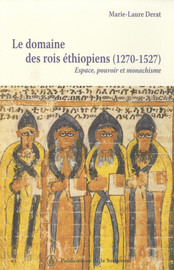
BOOK: Marie-Laure DERAT, Le domaine des rois éthiopiens (1270-1527). Espace, pouvoir et monachisme (Paris: Éditions de la Sorbonne, 2019 sur OpenEdition Books). ISBN: 9782859444808, pp. 383, € 25

Le domaine des rois éthiopiens (1270-1527)

ABOUT THE BOOK

Cet ouvrage, qui dessine une géographie historique du royaume chrétien éthiopien, retrace l'histoire de l'installation des souverains et le transfert de leur pouvoir dans deux nouvelles provinces, l'Amḥära et le Šäwa, entre la fin du xiiie et le début du xvie siècle : une nouvelle dynastie y implante son domaine royal et fonde la légitimation de son pouvoir sur le contrôle des réseaux monastiques. L'enquête, qui explore les chroniques royales, les sources hagiographiques, les récits de géographes arabes ou d'ambassades européennes, tente de démêler les étapes de l'écriture et des réécritures qui sacralisent une histoire, devenue mythe.
La rencontre du monachisme et du pouvoir dans cet espace en construction est à la fois un facteur de renforcement du pouvoir royal et un facteur de fragilisation de ce même pouvoir, lorsque les moines font du martyr, idéal de sainteté, l'expression privilégiée de leur indépendance vis-à-vis du politique.
En réponse, les souverains éthiopiens superposent aux réseaux monastiques leurs propres fondations religieuses qui, étapes pour la cour, lieux de conciles et nécropoles royales, deviennent des lieux privilégiés de l'exercice du pouvoir.

ABOUT THE AUTHOR

Marie-Laure Derat est agrégée et docteur en histoire, est chargée de recherche au CNRS dans le laboratoire « Mutations africaines dans la longue durée » (UMR 8054, Université Paris I, CNRS). Elle travaille sur le royaume chrétien d'Éthiopie du XIe au XVe siècle.

TABLE OF CONTENTS

Introduction
Chapitre 1. L’Amḥära et le Šäwa au centre du royaume ?
Première partie. L’émergence d’un nouveau domaine royal dans l’Amḥära et le Šäwa à partir du XIIIe siècle
Chapitre 2. L’Amḥära et le Šäwa, centres d’un renouveau politique
Deuxième partie. Les moines et le roi (XIIIe-XVIe siècle)
Chapitre 3. Réseaux monastiques et pouvoir royal
Chapitre 4. La confrontation de deux conceptions antagonistes du monachisme et du pouvoir (xive-xve siècle)
Chapitre 5. Les figures de l’entente (xve-xvie siècle), l’émergence de nouveaux modèles de sainteté
Troisième partie. Églises et monastères royaux, une armature politique et religieuse
Chapitre 6. Les rois bâtisseurs
Chapitre 7. Lieux et enjeux de pouvoir
Conclusion
Annexes
Bibliographie
Index


More information with the publisher.

28 May 2020

BOOK: Mamadou BADJI and Samba THIAM, eds., THALASSA ! THALASSA ! LA GRANDE MER ET SES PASSEURS : Itinéraires en Afrique de l’histoire du droit et des institutions - Mélanges En l’honneur de Bernard Durand (Paris: L’Harmattan, 2020). ISBN 978-2-343-20139-9, 49 EUR


(Source: L'Harmattan

L’Harmattan is publishing a Mélanges en l'honneur de Bernard Durand.

ABOUT THE BOOK

Le dédicataire de ces Mélanges est le fondateur de l'Ecole africaine d'histoire du droit de Dakar. Les contributions renvoient presque toutes à la métaphore de la mer, thème cher au doyen Bernard Durand. C'est que la mer, en tant que voie de communication, est propre à créer les conditions du « passage de frontière » dont l'effet immédiat est le contact entre les peuples, les cultures, les civilisations. Enjeu des relations internationales, elle nourrit des passions et suscite, en raison des ressources qu'elle recèle, bien des convoitises. Mais elle irrigue des itinéraires et, dans une large mesure, favorise les échanges. De la sorte, elle permet aux « passeurs » de se mouvoir dans des univers différents.

ABOUT THE EDITORS

Mamadou Badji et Samba Thiam sont Professeurs Titulaires à l'Université Cheikh Anta Diop de Dakar, Sénégal.

More info here

20 May 2020

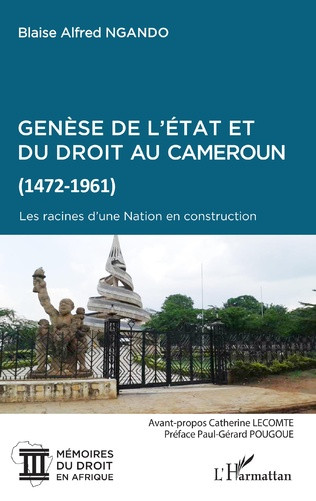
BOOK: Blaise Alfred NGANDO, Genèse de l’etat et du droit au Cameroun (1472-1961) les racines d’une nation en construction (Paris: L’Harmattan, 2020). ISBN 978-2-3431-9563-6, EUR 36.00


(Source: Harmattan)

L’Harmattan is publishing a new book on the legal history of Cameroon.

ABOUT THE BOOK

Quelles sont les racines juridiques et anthropologiques du Cameroun ? Ce livre examine cette question dans le long terme, de 1472 et de l'exploration de la côte camerounaise par les navigateurs portugais jusqu'en 1961, avec la réunification du Cameroun, analysant les chemins de traverse à partir desquels les citoyens de ce pays peuvent consolider ou réinventer leur unité nationale. Comment réagencer dans le cadre institutionnel le bijuridisme étatique issu de l'héritage colonial franco-britannique, tout en valorisant les coutumes de la société traditionnelle africaine ?

ABOUT THE AUTHOR

Blaise Alfred NGANDO est Agrégé d'histoire du droit (Major CAMES 2013). Maître de Conférences à l'Université de Yaoundé 2 - Soa, il est auteur de plusieurs publications. Il occupe depuis 2014 le poste de Directeur du Centre des Ressources Documentaires de la Faculté des Sciences Juridiques et Politiques à l'Université de Yaoundé 2 - Soa. Il est, par ailleurs, avocat aux Barreaux des Hauts de seine - France et du Cameroun.

More info here

25 October 2019

BOOK: Hlengiwe Portia DLAMINI, A Constitutional History of the Kingdom of Eswatini (Swaziland), 1960–1982 (London: Palgrave Macmillan, 2019). ISBN 978-3-030-24776-8, €84,79


(Source: Springer)

Palgrave Macmillan is publishing a new book on the constitutional history of Swaziland.

ABOUT THE BOOK

Swaziland—recently renamed Eswatini—is the only nation-state in Africa with a functioning indigenous political system. Elsewhere on the continent, most departing colonial administrators were succeeded by Western-educated elites. In Swaziland, traditional Swazi leaders managed to establish an absolute monarchy instead, qualified by the author as benevolent and people-centred, a system which they have successfully defended from competing political forces since the 1970s. This book is the first to study the constitutional history of this monarchy. It examines its origins in the colonial era, the financial support it received from white settlers and apartheid South Africa, and the challenges it faced from political parties and the judiciary, before King Sobhuza II finally consolidated power in 1978 with an auto-coup d’état. As Hlengiwe Dlamini shows, the history of constitution-making in Swaziland is rich, complex, and full of overlooked insight for historians of Africa.

ABOUT THE AUTHOR

Hlengiwe Portia Dlamini is a postdoctoral fellow in the International Studies Group at the University of the Free State, Bloemfontein, South Africa. She received her PhD from the University of Pretoria, South Africa, and her research interests include the governance of public space, community policing, the enfranchisement of women, and Islamic minorities in Swaziland. 

More information here

18 October 2019

BOOK: Marouf A. HASIAN JR., Lawfare and the Ovaherero and Nama Pursuit of Restorative Justice, 1918–2018 (Lanham: Rowman & Littlefield, 2019). ISBN 978-1-68393-188-1, £75.00


Rowman & Littlefield has published a new book on efforts towards restorative justice in former German colonial Namibia.

ABOUT THE BOOK

This book provides readers with a critical analysis of the restorative justice efforts of the Ovaherero and Nama communities in Namibia, who contend that they should receive reparations for what happened to their ancestors during, and after the 1904–1908 German-Ovaherero/Nama war. Arguing that indigenous communities who once lived in a German colony called “German South West Africa” suffered from a genocide that could be compared to the World War II Holocaust Namibian activists sued Germany and German corporations in U.S. federal courts for reparations. The author of this book uses a critical genealogical approach to all of this “lawfare” (the politicizing of the law) in order to illustrate some of the historical origins of this quest for social justice. Portions of the book also explain some of the historical and contemporary realpolitik barriers that stood in the way of Ovaherero and Nama activists who were asking for acknowledgments of the “Namibian genocide,” apologies from German officials, repatriation of human remains from colonial times as well as restitution that might help with land redistribution in today’s Namibia. This book shows many of the difficulties that confront those indigenous communities who ask twenty-first century audiences to pay restitution for large-scale colonial massacres or imperial genocides that might have taken place more than a hundred years ago.

ABOUT THE AUTHOR

Marouf Hasian Jr. is full professor in the department of communication at the University of Utah.

TABLE OF CONTENTS

Acknowledgments

1.Introduction: Colonial Unkowing, Lawfare and Transgenerational Calls for Ovaherero and Nama Reparations

2.Heroic and Tragic Tales of Colonial Deeds in German South West Africa, 1884-1908

3. The German Social Democrats’ Anti-Imperialist Rhetorics and the Promotion of “Native” Rights During the Reichstag Debates, 1904-1913

4. “Little Heaps of Sand” and the Transcontinental Debates About the Evidentiary Nature of the 1918 British Blue Book

5. Apartheid, Colonial Aphasia and Decolonizing Remembrances, 1919-1969

6. Academic Scholarship, Cold War Politics, and the Revival of Scholarly Interest in Ovaerero and Nama Social Restitution

7. The 2001 Herero People’s Reparations Case Filed in U.S. Courts

8. Realpolitik Entanglements of Namibian-German Relationships and the Dingpolitik of Ovaherero and Nama Remains

9. The 2017 Ovaherero and Nama Reparations Lawsuit

10. Contemplating the Future of Lawfare in Contests over Namibian Claims for Restorative Justice

Bibliography

Index

About the Author

More info here

23 September 2019

Jessica M. MARGLIN, La nationalité en procès : droit international privé et monde méditerranéen (Annales. Histoire, Sciences Sociales LXXIII (2018), No. 1)

(source: cairn)

Abstract:
This article uses a single, transnational legal case that played out between Italy and Tunisia in the 1870s and 1880s to tell a truly global history of international law—that is, one that goes beyond the boundaries of the West. Samama v. Samama was a fabulously complicated case that dragged on in Italian courts for almost a decade. The crux of the legal arguments concerned the nationality of Nissim Samama, a Jew born in Tunis; Samama’s nationality, in turn, would determine which legal system regulated his estate. The Italian Civil Code enshrined respect for the national law of a foreigner, but such foreigners were presumed to be Western. A case involving the national law of Tunisia and the status of Jews called the very foundations of the international legal system into question. In putting Samama’s nationality on trial, the case opened up debate over fissures in the emerging theory of international law: How could non-Western states like Tunisia fit into an international legal order? How did Islamic law intersect with international law? What was the status of Jewish nationhood in a world increasingly based on exclusive nationalities? The Samama case offers access to the voices of European international lawyers debating the ambiguities of their field, as well as those of Maghrebis articulating their own vision of international law. The resulting arguments exposed tensions inherent to an international legal system uncomfortably balanced between universalism and Western particularism.
(read more on cairn)

13 March 2019

CALL FOR PAPERS: African Legal History Symposium (Boston, 21 November 2019) (DEADLINE: 5 April 2019)


Via Legal History Blog, we learned of a call for papers for a preconference symposium on African Legal History. Here the call:

Co-conveners: Erin Braatz, Suffolk University Law School; Trina Hogg, Oregon State University; Elizabeth Thornberry, Johns Hopkins University; Charlotte Walker-Said, CUNY-John Jay College

Fortuitously, the 2019 annual meetings of the African Studies Association and the American Society for Legal History will both take place November 21-23 in Boston. In hopes of sparking a more sustained engagement across these two fields, and marking what we see as an inflection point in scholarship on African legal history, we invite paper proposals for an African Legal History preconference symposium, to be held in Boston on November 21, 2019.  The symposium will be hosted by the American Society for Legal History in coordination with the African Studies Association, with sponsorship from the Suffolk University Law School.

We seek papers in the field of African legal history, broadly construed, and are particularly excited about papers that extend the insights of established scholarship, with its focus on customary law, in new directions. We encourage paper and panel proposals on law in Africa in the pre-colonial, colonial, and post-colonial periods, British, French, Islamic, Lusophone, and indigenous African traditions, and on all types of law (family, criminal, property, constitutional, business, customary, imperial, pluralist, international, etc.) Papers may focus on any region of the continent (including North Africa and the island territories).

Please email abstracts for proposed papers to bmello@suffolk.edu, with “African Legal History Symposium” in the subject line, by 5 April 2019.  Abstracts should be no more than 300 words in length.  Full papers to be presented at the symposium will be due by November 1, 2019, for circulation to all participants.
 
Limited funding will be available to assist with the costs of travel.  Funding priority will be given to scholars based on the African continent, graduate students, adjunct instructors, and other scholars who do not have access to research funding through other sources.  

We encourage symposium participants to consider submitting proposals directly to the ASA and ASLH as well, for inclusion in the main program of those conferences.


27 August 2018

BOOK: John Idriss LAHAI, Human Rights in Sierra Leone, 1787-2016 : The Long Struggle from the Transatlantic Slave Trade to the Present (London: Routledge, 2018). ISBN 9781138604766, £115.00


(Source: Routledge)

Next month, Routledge will publish a book on the history of human rights in Sierra Leone between 1787 and 2016

ABOUT THE BOOK

This book offers an up-to-date, comprehensive interdisciplinary analyses of the multifaceted and evolving experiences of human rights in Sierra Leone between the years 1787 and 2016. It provides a balanced coverage of the local and international conditions that frame the socio-cultural, political and economic context of human rights: its rise and fall, and concerns for the broader engendered issues of the transatlantic slave trade, colonialism, women’s struggle for recognition, constitutional development, political independence, war and transitional justice (as well as 'contributive justice,' which the author introduces to explain the consequences of the problems of the temporal nature of transitional justice, and the crisis of donor fatigue towards peacebuilding activities), local government, democracy and constitutional reforms within Sierra Leone. While acknowledging the profound challenges associated with the promotion of human rights in an environment of uncertainty, political fragility, lawlessness, and deprivation, John Idriss Lahai sheds light on the often-constructive engagement of the people of Sierra Leone with a variety of societal conditions, adverse or otherwise, to influence constitutional change, the emergent postcoflict discourse on 'contributive justice,' and acceptable human rights practice.

ABOUT THE AUTHOR

John Idriss Lahai is a Research Fellow at the University of New England, Australia.

TABLE OF CONTENTS

Preface; Introduction; 1. The Transatlantic Slave Trade and the Illusions of ‘Freedom’ in The Province of Freedom, 1787 - 1790; 2. The Restitutive Justice Policy of the Sierra Leone Company, 1791-1808; 3. No Taxation without Representation, 1820-1920; 4. Citizens and Protected Persons, 1920-1951; 5. Racism and the Rise of Party Politics, 1950-1960; 6. Class Conflict: Chiefs, Politicians, and Peasants and the Revolts of 1955 and 1956; 7. Women in the Colonial Spaces: From the Founding of the Colony to 1960; 8. Political Independence and the Africanization Project, 1960 - 1967; 9. The Narratives on Human Rights in a Neopatrimonial State, 1967 - 1984; 10. Ethnopolitics, Tribal-Nationalism and the Youth Empowerment Crisis, 1985-1991; 11. (Wo)Men’s Rights in the Neopatrimonial/Ethnopolitical Spaces, 1967-1991; 12. The Idea of Liberation in the War Communities, 1991-2002: Representation, Adaptation, and Outcomes; 13. Contested Truth: The Truth Commission and Restorative Justice, 2002 – 2004; 14. The War Victims’ Fund and the Emergence of Contributive Justice after 2004; 15. The Quest for Another Province of Freedom: The Human Rights Commission and The Constitutional Review Committee, 1994-2016; 16. Conclusion

More information here

25 February 2018

JOURNAL: Histoire de la justice nr. 28 (2018/1): Justice et Oubli (France - Rwanda)

(image source: CAIRN)

The journal Histoire de la Justice (published by the Association française pour l'histoire de la justice, :ISSN 1639-4399) published its 2018 issue, devoted to Justice et oubli: Frnace - Rwanda.

Abstract:
S’interroger sur l’oubli et le droit permet de réinterroger sous un autre angle l’État et sa Justice dans leur rôle de gardiens de la mémoire judiciaire, de questionner les usages et mésusages, et d’examiner les fonctions politiques et sociales de la conservation mémorielle du crime et du criminel. Dans un contexte particulièrement ambigu, où le droit à l’oubli sonne comme une revendication de plus en plus entendue, où les juridictions européennes sanctionnent les pays, comme la France, pour une collecte trop minutieuse et une conservation trop longue des passés judiciaires, mais aussi dans un contexte où l’État, mu par une dynamique qui lui est propre, cherche davantage à tracer, à suivre, à se souvenir, pour mieux poursuivre et contrôler, il n’est pas anodin de poser un regard rétrospectif sur cette dialectique mémoire/oubli dans le champ pénal pour mieux envisager sa construction et, partant, ses effets et ses fonctions à travers le temps. Peut-être avons-nous oublié les vertus d’un oubli que les Anciens savaient à l’occasion manier pour écarter les effets mortifères d’une mémoire infinie.
À la croisée des regards (juridiques, historiques, anthropologiques, psychologiques et éthiques), l’oubli se déploie dans toutes ses dimensions sociales, politiques et judiciaires pour mieux mettre en valeur, par des études de cas et des réflexions au long cours, les ressorts d’un oubli pacificateur ou objet de luttes. Une large place est ainsi accordée aux pratiques de pardon et d’oubli au Rwanda, comme pour mieux signifier la permanente ressource qu’il offre. Enrichi des investigations menées dans le cadre d’une mission au Rwanda par des membres de l’Association française pour l'histoire de la justice, où rescapés et acteurs de la mémoire ont été écoutés, ce dossier se veut avant tout un questionnement scientifique de ce qui semble aller de soi : les vertus politiques de l’oubli judiciaire.
 Contributions by Mathieu Soula, Claude Gauvard, Stéphane Gacon, Jean-Pierre Royer, Dominique Foyer, Jean-Pierre Allinne, Pascal Texier, Jean-Paul Jean, Jean Motte dit Falisse, Benoît Guillou, Sylvie Humbert, Jean-Pierre Sagahutu, Assumpta Mugiraneza, Denis Salas, Jean-Amédée Lathoud and Cathy Leblanc.

More information on cairn.