Search

Showing posts with label Sierra Leone. Show all posts

08 July 2020

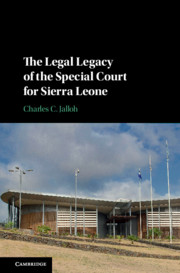
BOOK: Charles C. JALLOH, The Legal Legacy of the Special Court for Sierra Leone (Cambridge: Cambridge University Press, 2020). ISBN 9781107178311, £ 85.00


(Source: CUP)

CUP is publishing a new book on the legal legacy of the Special Court for Sierra Leone.

ABOUT THE BOOK

This important book considers whether the Special Court for Sierra Leone (SCSL), which was established jointly through an unprecedented bilateral treaty between the United Nations (UN) and Sierra Leone in 2002, has made jurisprudential contributions to the development of the nascent and still unsettled field of international criminal law. A leading authority on the application of international criminal justice in Africa, Charles Jalloh argues that the SCSL, as an innovative hybrid international penal tribunal, made useful jurisprudential additions on key legal questions concerning greatest responsibility jurisdiction, the war crime of child recruitment, forced marriage as a crime against humanity, amnesty, immunity and the relationship between truth commissions and criminal courts. He demonstrates that some of the SCSL case law broke new ground, and in so doing, bequeathed a 'legal legacy' that remains vital to the ongoing global fight against impunity for atrocity crimes and to the continued development of modern international criminal law.

ABOUT THE AUTHOR

Charles C. Jalloh, Florida International University

Charles C. Jalloh is Professor of Law at Florida International University and Member, International Law Commission. He has published widely on issues of international criminal justice, and in 2018, was the Fulbright Distinguished Chair in International Law at Lund University and the Raoul Wallenberg Institute of Human Rights and Humanitarian Law, Sweden. His prior work experience includes as a legal adviser in the Special Court for Sierra Leone, the International Criminal Tribunal for Rwanda and the International Criminal Court. He is lead editor of the Consolidated Legal Texts for the Special Court for Sierra Leone (2007), The Sierra Leone Special Court and Its Legacy (2013) and four volumes of The Law Reports of the Special Court for Sierra Leone (2012-2020). He holds degrees from Guelph, McGill, Oxford, and a PhD in international law, from University of Amsterdam.

TABLE OF CONTENTS

Preface and acknowledgements
1. Introduction
2. The sierra leone conflict
3. The establishment of the special court for sierra leone
4. The special court's jurisdiction, organization and trials
5. Greatest responsibility personal jurisdiction
6. Forced marriage as a crime against humanity
7. Child recruitment as a war crime
8. Head of state immunity
9. Amnesties
10. Special courts and truth commissions
11. Conclusion
Appendices
Bibliography/Sources Reviewed
Index.

More info here

27 August 2018

BOOK: John Idriss LAHAI, Human Rights in Sierra Leone, 1787-2016 : The Long Struggle from the Transatlantic Slave Trade to the Present (London: Routledge, 2018). ISBN 9781138604766, £115.00


(Source: Routledge)

Next month, Routledge will publish a book on the history of human rights in Sierra Leone between 1787 and 2016

ABOUT THE BOOK

This book offers an up-to-date, comprehensive interdisciplinary analyses of the multifaceted and evolving experiences of human rights in Sierra Leone between the years 1787 and 2016. It provides a balanced coverage of the local and international conditions that frame the socio-cultural, political and economic context of human rights: its rise and fall, and concerns for the broader engendered issues of the transatlantic slave trade, colonialism, women’s struggle for recognition, constitutional development, political independence, war and transitional justice (as well as 'contributive justice,' which the author introduces to explain the consequences of the problems of the temporal nature of transitional justice, and the crisis of donor fatigue towards peacebuilding activities), local government, democracy and constitutional reforms within Sierra Leone. While acknowledging the profound challenges associated with the promotion of human rights in an environment of uncertainty, political fragility, lawlessness, and deprivation, John Idriss Lahai sheds light on the often-constructive engagement of the people of Sierra Leone with a variety of societal conditions, adverse or otherwise, to influence constitutional change, the emergent postcoflict discourse on 'contributive justice,' and acceptable human rights practice.

ABOUT THE AUTHOR

John Idriss Lahai is a Research Fellow at the University of New England, Australia.

TABLE OF CONTENTS

Preface; Introduction; 1. The Transatlantic Slave Trade and the Illusions of ‘Freedom’ in The Province of Freedom, 1787 - 1790; 2. The Restitutive Justice Policy of the Sierra Leone Company, 1791-1808; 3. No Taxation without Representation, 1820-1920; 4. Citizens and Protected Persons, 1920-1951; 5. Racism and the Rise of Party Politics, 1950-1960; 6. Class Conflict: Chiefs, Politicians, and Peasants and the Revolts of 1955 and 1956; 7. Women in the Colonial Spaces: From the Founding of the Colony to 1960; 8. Political Independence and the Africanization Project, 1960 - 1967; 9. The Narratives on Human Rights in a Neopatrimonial State, 1967 - 1984; 10. Ethnopolitics, Tribal-Nationalism and the Youth Empowerment Crisis, 1985-1991; 11. (Wo)Men’s Rights in the Neopatrimonial/Ethnopolitical Spaces, 1967-1991; 12. The Idea of Liberation in the War Communities, 1991-2002: Representation, Adaptation, and Outcomes; 13. Contested Truth: The Truth Commission and Restorative Justice, 2002 – 2004; 14. The War Victims’ Fund and the Emergence of Contributive Justice after 2004; 15. The Quest for Another Province of Freedom: The Human Rights Commission and The Constitutional Review Committee, 1994-2016; 16. Conclusion

More information here