Search

12 September 2014

CFA: "Journal of Civil and Human Rights"


The Journal of Civil and Human Rights is seeking authors of articles and reviews to submit their work. The deadline is rolling. We put articles into the peer review process in the order they arrive.
More information about the journal, including the mission statement, submission guidelines, and editorial board, is available here:http://www.press.uillinois.edu/journals/jchr.html.
The Journal of Civil and Human Rights is a peer-reviewed, interdisciplinary, academic journal dedicated to studying modern U.S.-based  social justice movements and freedom struggles, including transnational ones, and their antecedents, influence, and legacies. The journal features  research-based articles, interviews, editorials, and reviews of books, films, museum exhibits, and Web sites.
Please direct all submission inquiries to Michael Ezra, editor, ezra@sonoma.edu

CFP: "All True, All Fiction: Conspiracy Theories at the Contours of Legality" (Washington D.C., 6-7 March 2015)

WHAT: All True, All Fiction: Conspiracy Theories at the Contours of Legality, 18th Annual Meeting of the ASLCH, Association for the Study of Law, Culture, and the Humanities, Call for papers

WHERE: Washington, D.C.

WHEN: 6-7 March 2015

Deadline 5 october 2014

All information here

This panel aims to analyze conspiracy theories in their connection to law and their effect on people’s relationship to legality. At first glance, law and conspiracy theories seem to share similar qualities. Both are initially suspicious of the knowledge they are provided with; both employ methods of elimination; and, ultimately, both establish a certain ‘truth’ about their cases. Yet they are situated on a conflicting ground ontologically, ultimately aiming to achieve very different purposes. Furthermore, the law’s verdict is supposed to be final, but conspiracy theories change, differ, become amended, and get replaced by others as agendas shift. Unlike legal proceedings with a conclusive endpoint, the act of conspiratorial thinking thus needs to be constantly fed with new information. In this sense, with its claim on the finality of its verdict and authority to establish facts, the law is in a position to contain conspiracy theories while at the same time, inevitably, holding the potential to produce them by its very insistence on the certainty of the truth it engenders. This panel aims to reflect on this tension by analyzing the murkiness and (un)certainty that conspiracy theories generate at once as they confront the rituals of law, captured in such realms as courtrooms, legal documents, and government declarations. Yet, rather than approaching conspiracy theories as the final contenders on a hierarchical ladder of informed knowledge, a product of a “crippled epistemology” (Sunstein and Vermeule 2009), or a potential threat or risk to society, it analyzes them as a narrative genre that helps establish people’s relationship to the state and the legal field around them. It takes as its starting point anthropological analyses that have sought to interrogate the intersections of conspiratorial thinking with rumor, gossip, secrets, witchcraft, and magic as they vacillate between the contours of legality and the purported transparency of the state. Ultimately, the panel aims to reflect on conspiracy theories as a form of legal fiction.
If you are interested in presenting on this panel, please submit an abstract of no more than 350 words to skaptan@rutgers.edu by October 5, 2014.

09 September 2014

CONFERENCE: Lay Participation in Modern Law - A Comparative Historical Analysis

LAY PARTICIPATION IN MODERN LAW: A COMPARATIVE HISTORICAL ANALYSIS

Helsinki, September 17th-19th, 2014
Venue: University of Helsinki, Faculty of Law, Porthania, Yliopistonkatu 3

Organisers: Profs. Heikki Pihlajamäki (Helsinki), Georges Martyn (Ghent), Anthony Musson (Exeter), Markus Dubber (Toronto)

Funded by: Academy of Finland, Federation of Finnish Learned Societies, Fonds Wetenschappelijk Onderzoek (Flanders)


Programme

Thursday, 18 September

Session 1: The Roots of Modern Lay Participation, 10.00-12.00
  • University of Helsinki, Porthania (Yliopistonkatu 3), room P617
  • David Mirhady (Simon Fraser University): Knowing the Law and Deciding Justice:  Lay Expertise in the Democratic Athenian Courts
  • Anthony Musson (University of Exeter): The Legacy of Magna Carta: the Enigma of the Jury

(Lunch)

08 September 2014

SEMINAR: "Les conflits d’intérêts «structurels»: L'organisation de la recherche scientifique" (Paris, 18 September 2014)


WHAT: Les conflits d’intérêts «structurels»: L'organisation de la recherche scientifique, seminar

WHERE: 9, Rue Maleur - Salle 409, Paris

WHEN: 18 September 2014, 5:00 pm - 7:30 pm

All information here

SYMPOSIUM: Meanings of Justice in New World Empires: Settler and Indigenous Law as Counterpoints

Symposium on Comparative Early Modern Legal History:
Meanings of Justice in New World Empires: Settler and Indigenous Law as Counterpoints

Date: Friday, October 10, 2014
Location: Newberry Library, Chicago
Organized by: Brian Owensby (University of Virginia) and Richard J. Ross (University of Illinois at Urbana-Champaign)

Home            Understandings of justice differed among New World empires and among the settlers, imperial officials, and indigenous peoples within each one.  This conference will focus on the array of meanings of justice, their emergence and transformation, and the implications of adopting one or another definition.  Our emphasis is less on the long-studied problem of the ethics of conquest and dispossession as on the notions of justice animating workaday negotiations, lawsuits, and assertions of right.  To this end, we are interested in the following sorts of questions: What about pre-contact legality and about European debates about law impelled empires to offer indigenous people access to settlers’ courts and legal remedies?  How did indigenous notions of legality shape natives’ resort to settlers’ law?  How and why did it occur to Indians that European law offered them a tactical opportunity?  To what extent did indigenous litigants and communities see law as a moral resource?  In what ways did Indians misconstrue settler’s legality because of their own preconceptions about justice?  How did indigenous recourse to law shape colonial and imperial legal structures?  These questions invite reflection on how settler law became intelligible—tactically, technically and morally—to natives. 

From the Europeans’ point of view, settlers thought about their own legal order by reference to highly stylized depictions of natives’ law.  Sometimes indigenous legality was treated as an example of primitivism, or savagery, or the work of the devil; sometimes as an honorable system appropriate to the social situation of Indians; sometimes as a precursor to imperial law; sometimes as reminiscent of legal systems in European antiquity or in other non-Western societies; and sometimes as an early stage in the Scottish Enlightenment’s four-stage theory of socio-legal development.  How did indigenous law serve as a contrast that helped settlers legitimate, critique, and understand their own legal system?  Conversely, in what ways did the example of settler law occasion debates about the meaning of justice within native communities?  The conference will bring together law professors, historians, and social scientists to explore how settler and indigenous law acted as counterpoints within and across European New World empires.

Brian Owensby (University of Virginia History) and Richard Ross (Illinois at Urbana-Champaign Law and History) organized “Meanings of Justice in New World Empires: Settler and Indigenous Law as Counterpoints.”  The conference is an offering of the Symposium on Comparative Early Modern Legal History, which gathers under the auspices of the Center for Renaissance Studies at the Newberry Library in Chicago in order to explore a particular topic in the comparative legal history of the Atlantic world in the period c.1492-1815.  Funding has been provided by the University of Illinois College of Law. 

            Attendance at the Symposium is free and open to the public.  Participants and attendees should preregister by contacting the Center for Renaissance Studies at the Newberry Library at 312.255.3514, or send an e-mail to renaissance@newberry.org. Papers will be precirculated electronically to all registrants. 

04 September 2014

CONFERENCE: "40.Deutscher Rechtshistorikertag", (Tubinghen, 7-11 September 2014)


WHAT: 40.Deutscher Rechtshistorikertag, Die rechtshistorischen Lehrstühle laden herzlich ein

WHERE: Tubinghen University, Law Department, Tubinghen, Germany

WHEN: 7-11 September 2014

All information here

Programm

Sonntag, 7. September 2014
Ab 13.00
Anmeldung im Kongressbüro, Neue Aula, Geschwister-Scholl-Platz, Erdgeschoss
 (ab Montag, 8. September 2014: 
Neue Aula, Dozentenzimmer, Raum 138)
13.30
HS 14
Forum Junge Rechtsgeschichte
Leitung: David von Mayenburg (Frankfurt/M.)

Vera Langer (Frankfurt): Der große Vestalinnenprozess von 115/114 v. Chr. 
– ein Ereignis im Spannungsverhältnis
 zwischen Recht und Religion

Philipp Klausberger (Wien): Überlegungen zum Verschulden im Römischen 
Haftungsrecht

15.30
Matthias Maetschke (Bonn): ‚Von Verdammung der Missethäter zur Bergarbeit‘. 
Das Scheitern der Bergwerksstrafe 
in der Habsburgermonarchie (1728-1768)

Lena Foljanty (Frankfurt/M.): Rechtskultur und Methode. Aneignung westlichen
Rechtsdenkens im Japan des 19. Jahrhunderts

17.30
Festsaal
Eröffnung des Rechtshistorikertags
Grußworte
Jörg Kinzig (Dekan der Juristischen Fakultät)
Heinz-Dieter Assmann (Prorektor der Eberhard-Karls-Universität Tübingen)
Rainer Stickelberger (MdL, Justizminister des Landes Baden-Wüttemberg)
18.30
Otfried Höffe (Tübingen): Ist Machiavelli im ‚Il Principe‘ ein Machiavellist?
19.30
Wandelhalle
Empfang

31 August 2014

BOOK: "Jews in Early Christian Law", J. V. Tolan, N. de Lange, L. Foschia, C. Nemo-Pekelman (eds.)


Jews in Early Christian Law 
Byzantium and the Latin West, 6th-11th centuries

379 p., 156 x 234 mm, 2014

All information here

The sixth to eleventh centuries are a crucial formative period for Jewish communities in Byzantium and Latin Europe: this is also a period for which sources are scarce and about which historians have often had to speculate on the basis of scant evidence. The legal sources studied in this volume provide a relative wealth of textual material concerning Jews, and for certain areas and periods are the principal sources. While this makes them particularly valuable, it also makes their interpretation difficult, given the lack of corroborative sources.
The scholars whose work has been brought together in this volume shed light on this key period of the history of Jews and of Jewish-Christian relations, focusing on key sources of the period: Byzantine imperial law, the canons of church councils, papal bulls, royal legislation from the Visigoths or Carolingians, inscriptions, and narrative sources in Hebrew, Greek and Latin. The picture that emerges from these studies is variegated. Some scholars, following Bernhard Blumenkranz, have depicted this period as one of relative tolerance towards Jews and Judaism; others have stressed the intolerance shown at key intervals by ecclesiastical authors, church councils and monarchs.
Yet perhaps more than revealing general tendencies towards "tolerance" or "intolerance", these studies bring to light the ways in which law in medieval societies serves a variety of purposes: from providing a theologically-based rationale for social tolerance, to attempting to regulate and restrict inter-religious contact, to using anti-Jewish rhetoric to assert the authority or legitimacy of one party of the Christian elite over and against another. This volume makes an important contribution not only to the history of medieval Jewish-Christian relations, but also to research on the uses and functions of law in medieval societies.

CFP: Criminal Law and Emotions in European Legal Cultures (Berlin, 2015)


What: Criminal Law and Emotions in European Legal Cultures. From 16th Century to the Present
Where: Center for the History of Emotions, Max Planck Institute for Human Development, Berlin
When: 21-22 May 2015

Deadline: October 1st 2014


Organisers
Laura Kounine
Gian Marco Vidor


Keynotes
Elizabeth Lunbeck (Vanderbilt University)
David Sabean (UCLA)


Roundtable Discussion
Dagmar Ellerbrock (MPIB/ TU Dresden)
Terry Maroney (Vanderbild University)


Legal institutions and jurists have often perceived themselves and promoted an image of their role and activity as essentially 'rational'. Yet, emotions have always been integral to the law, particularly in the case of criminal law. Emotions were and are taken explicitly or implicitly into consideration in legal debates, in law-making, in the codified norms and in their application, especially in relation to paramount categories such as free will, individual responsibility and culpability, or the aggravating and mitigating circumstances of a crime. Emotions could directly or indirectly play a role in defining what conduct was legally relevant, worthy of legal protection or in need of legal proscription; in why and how it was necessary to punish, and what feelings punishment was meant to evoke.
Legal scholars in the past did not shun the complex relationship between law and emotions. Yet it is in the last two decades that specialists from different disciplines, from law theory to psychology, from philosophy to history, have shown an increasing and lively interest in unravelling the role played by passions, feelings and sentiments in criminal law. Special attention has been focused on three key areas: norms, practices and people.
This two-day conference seeks to historicize the relationship between law and emotions, focusing on the period from the sixteenth century to the present. It aims to ask how legal definitions, categorizations and judgments were influenced by, and themselves influenced, moral and social codes; religious and ideological norms; scientific and medical expertise; and perceptions of the body, gender, age, social status. By examining the period between the sixteenth century and the present day, this conference also seeks to challenge and problematize the demarcation between the early modern and the modern period, looking at patterns and continuities, as well as points of fissure and change, in the relationship between law and emotions. In particular, it seeks to question the extent to which ideas about law and emotions fundamentally shifted around the eighteenth century—the traditional marker of the ‘modern’ period.
This conference will explore how legal professionals, as judges, prosecutors, defense attorneys and other legal officials, handled different forms of knowledge about emotions in the practice of law, in accordance with, or in opposition to, general social and cultural attitudes and public opinion. It will further investigate the presence and absence—and their meanings—of emotions in the courtroom, as a fundamental aspect of criminal law practices. It will take into consideration not only the emotions which were shown, expected and provoked but also the ones which were repressed, controlled or proscribed by different legal actors and the public. Finally it will also include analysis of how legal understandings of emotions were portrayed in the media and in the wider society.
We invite submissions from scholars of different historical disciplines, working on early modern and modern periods and particularly encourage proposals from scholars working on Northern, Central and Eastern European countries, and the non-Western world.

The conference will be held in English.

Accommodation and travel expenses for those presenting will be covered by the Max Planck Institute for Human Development. If you are interested in participating in this conference, please send us a proposal of no more than 300 words and a short CV by 1 October 2014 to cfp-emotions@mpib-berlin.mpg.de. 

Papers should be no longer than 20 minutes, in order to allow time for questions and discussion.

For more information click HERE. 

30 August 2014

ARTICLE: S. Balossino on « Notaire et institutions communales dans la basse vallée du Rhône, XIIe-XIIIe siècles »


S. BALOSSINO, « Notaire et institutions communales dans la basse vallée du Rhône, XIIe-XIIIe siècles », in "Le notaire, entre métier et espace public en Europe (Moyen Âge – Temps modernes)", L. Faggion - A. Mailloux - L. Verdon (ed.), Aix-en-Provence, Presses de l’Université de Provence, 2008, p. 183-197

All information here

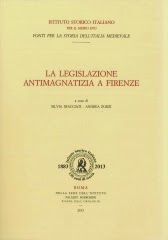
BOOK: "La legislazione antimagnatizia a Firenze", edited by Silvia Diacciati and Andrea Zorzi


"LA LEGISLAZIONE ANTIMAGNATIZIA A FIRENZE"

Istituto storico italiano per il Medioevo, Fonti per la storia dell'Italia medievale
edited by Silvia Diacciati - Andrea Zorzi, 2013, n. 36, pp. 382

All information here
Table of contents:
Introduzione
Ordinamenta Iustitie
Firenze, Archivio di Stato, Statuti del Comune di Firenze, 1 
Firenze, Biblioteca Nazionale Centrale, Fondo Nazionale, II, 1 153
Firenze, Archivio di Stato, Capitoli, Registri, 41
Firenze, Archivio di Stato, Statuti del Comune di Firenze, 2
Bibliografia
Indici 

ARTICLE: R. Gibbs on "The 13th-century development of illumination in Bolognese copies of the Decretals of Gregory IX"


R. GIBBS, "The 13th-century development of illumination in Bolognese copies of the Decretals of Gregory IX", in G.P. Brizzi, M.G. Tavoni, (ed.) "Dalla pecia all'e-book : libri per l'università : stampa, editoria, circolazione e lettura", Atti del Convegno internazionale di studi (Bologna, October 21-25 2008), CLUEB 2009, pp. 1-19

http://store.torrossa.it/pages/ipplatform/itemDetails.faces 

BOOK: "Shipping, Trade and Crusade in the Medieval Mediterranean. Studies in Honour of John Pryor", Edited by Ruthy Gertwagen and Elizabeth Jeffreys


  • Edited by Ruthy Gertwagen, Haifa University, Israel, and Elizabeth Jeffreys, University of Oxford, UK
  • May, 2012
  • The cutting-edge papers in this collection reflect the wide areas to which John Pryor has made significant contributions in the course of his scholarly career. They are written by some of the world's most distinguished practitioners in the fields of Crusading history and the maritime history of the medieval Mediterranean. His colleagues, students and friends discuss questions including ship construction in the fourth and fifteenth centuries, navigation and harbourage in the eastern Mediterranean, trade in Fatimid Egypt and along the Iberian Peninsula, military and social issues arising among the crusaders during field campaigns, and wider aspects of medieval warfare. All those with an interest in any of these subjects, whether students or specialists, will need to consult this book.
all information here

29 August 2014

VAN CAENEGEM PRIZE AWARDED TO BRAM DELBECKE


 Pictures: the certificate of the Van Caenem prize. Photo of Prof. em. dr. dr. h.c. mult. Raoul Van Caenegem congratulating Bram Delbecke.

To encourage promising young  researchers, the ESCLH established the Van Caenegem prize, named after  R.C. Van Caenegem a leading scholar  in the field of comparative legal history.  The prize is awarded biyearly to a young legal historian deemed to have written the best article in Comparative Legal History, the ESCLH journal, in the two years before ESCLH conferences.

On recommendation of the Van Caenegem Prize Committee the ESCLH has decided at its meeting in Macerata in July 2014 to give this prize to Bram Delbecke for his article

"The Political Offence and the Safeguarding of the Nation State: Constitutional Ideals, French Legal Standards and Belgian Legal Practice, 1830–70."

The members of the Van Caenegem Prize Committee were:  Kjell Åke Modéer (Lund) (president of the Committee), Thomas Duve (Frankfurt), Richard H. Helmholz (Chicago), Bruno Debaenst (Ghent) and  Kamila Staudigl-Ciechowicz (Vienna).

The motives of the Committee
“The article on the political offence and it's reproduction in the Belgium constitutional law is a convincing paper, which combines solid scholarship, readings of historical texts, with a clear question of great importance for the comparative constitutional history of Europe.  We regard it as an added value that he has brought up a problem within comparative constitutional law, also masterly handed by Raoul van Caenegem himself. Delbecke obviously masters his topic, he has both an eye for detail, while always keeping the general overview. Even if he concentrates on the legal aspects of his topic, he also contextualizes by putting the legal development in relation to socio-religious as well as economic questions. The dynamic, expressive way in which the article is written, demonstrates Bram Delbecke’s skilful approach to comparative European legal history. To sum up: It fits perfectly within the framework of “comparative legal history”.”

The board of the ESCLH wants to congratulate dr. Bram Delbecke for his fine piece of scholarship. The board and the editors of Comparative legal history call for other young legal historians who are eligible under the rules of the Van Caenegem prize to send manuscripts for review to the articles editor of Comparative legal history (Heikki.pihlajamaki@helsinki.fi).

The prize consists of certificate and a sum of money.
(text: Dirk Heirbaut (Gent))

26 August 2014

CONFERENCE: Historiography and Sources of Commercial Law

Historiography and Sources of Commercial Law
Helsinki, September 1st – 3rd, 2014

Organisers:
“The Making of Commercial Law The Making of Commercial Law: Common Practices and National Legal Rules from the Early Modern to the Modern Period”
Project funded by the Academy of Finland and Finnish Cultural Foundation
Prof. Heikki Pihlajamäki, University of Helsinki; and the
Steering Group: Prof.  Albrecht Cordes (Frankfurt), Prof. Serge Dauchy (Lille) and Prof. Dave De ruysscher (Brussels)

Programme

Monday, 1 September 2014

Session 1: Sources and Commercial Law, 9.30-12.00, venue: Lecture room P545 (Faculty Meeting Room), Faculty of Law, Porthania, Yliopistonkatu 3

Eberhard Isenmann: Legal, moral-theological and genuinely economic opinions on questions of trade and economy in 15th and early 16th century Germany
Dave De ruysscher: Merchant manuals as sources
Heikki Pihlajamäki: Constructing a Field of Law: The Birth of Commercial Law in Early Modern Sweden

CONFERENCE: What Kept the Holy Roman Empire Together: The Relationship Between Imperial and Local Jurisdiction in The Holy Roman Empire (Vienna, 2-3 October)


The Research Network on Jurisdiction in the Holy Roman Empire hosts an interesting two-day conference in Vienna, early in October.

Platform text:
Fragen nach dem Zusammen- und Wechselspiel von Reichs- und Territorialebene erscheinen aktueller denn je – insbesondere vor dem Hintergrund der vor einigen Jahren geführten Debatte um die staatliche Qualität des Reiches.
Offen ist jedoch nach wie vor, welche Bedeutung nicht nur die Rechtsprechung, sondern auch die verschiedenartig ausgestalteten Gerichtsverfassungen bei der Verdichtung der Territorien in der Praxis spielten. Die verliehenen Exemtions- und Appellationsprivilegien bewirkten, dass zahlreiche reichsmittelbare Untertanen nur eingeschränkten oder gar keinen Zugang zum Kaiser als obersten Richter besaßen. Insbesondere große Reichsstände bemühten sich im Laufe der Frühen Neuzeit um eine weitgehende Herauslösung aus der Reichsgerichtsbarkeit. Kam es in den betreffenden Regionen zu parallelen (Rechts-)Entwicklungen oder ist gleichwohl mit wechselseitigen Einflüssen zu rechnen? Auf letztere weisen aktuelle rechtshistorische Forschungen zu territorialen Obergerichten hin, und es wird mit Bezugnahme auf die Reichsgerichtsbarkeit von einer integrierenden Wirkung der Reichsgerichte gesprochen.
Auf der anderen Seite zeigen neuere kulturgeschichtlich orientierte Arbeiten, dass das Reich mehr zusammenhielt als die Reichsverfassung und das Recht. So stellten Kommunikation und Repräsentation unverzichtbare Instrumente im Kampf um Statuserhalt und Prestigegewinn dar. Zudem waren in der ständedominierten Lehnsordnung des Heiligen Römischen Reiches der soziale Rang sowie die aktive Wahrnehmung von Privilegien oder von Statusansprüchen, die nicht oder nur partiell schriftlich fixiert waren, wesentliche Fundamente. Von Interesse sind daher nicht nur Herrschaftspraktiken, die im Einklang mit der Reichsverfassung und der Rechtsordnung standen, sondern auch jene, die neben oder gegen selbige (erfolgreich oder nicht) eingesetzt wurden. All diese Faktoren besaßen eine nicht zu unterschätzende Bedeutung bei der Um- und Durchsetzung von Herrschaft über „Land und Leute“.
Sich diesen Komponenten auf aktuelle Weise zu nähern, die Ansätze zusammenzuführen und danach zu fragen, was das Reich im Inneren zusammenhielt, ist das Anliegen der 13. Nachwuchstagung des Netzwerks Reichsgerichtsbarkeit.
All jene, die an der Erforschung der Reichsgerichte interessiert sind, sind sehr herzlich eingeladen!
Wir bitten um verbindliche Anmeldung unter info@netzwerk-reichsgerichtsbarkeit.de bis zum 15. September 2014.
 Program:
Donnerstag, 2. Oktober 2014
9.30 Uhr Empfang
10.00-11.00 Uhr
Begrüßung – Mag. Thomas Just, Direktor des Haus-, Hof- und Staatsarchivs
Grußwort – Univ.-Prof. Dr. Paul Oberhammer, Dekan der Rechtswissenschaftlichen Fakultät der Universität Wien
Einführung – Dr. des. Alexander Denzler, Ellen Franke M. A., Britta Schneider M. A.
11.00-12.20 Uhr – Sektion 1
Das Reich und die Territorien – Patronage und Konkurrenz
Moderation – Avraham Siluk M. A. (Marburg)
Kommentar – Prof. Dr. Johannes Burkhardt (Augsburg)
Dr. Andreas Flurschütz da Cruz M. A. (Würzburg)
Kaiser oder Kurfürst? Rechtsprechung als Konfliktmedium. In der Konkurrenz zwischen Reich und Territorien
Sven Solterbeck M. A. (Münster)
„in regard Ihro hochgräflichen Excellenz von kaunitz=Rittberg“. Korruption und soziales Kapital am Reichskammergericht – ein Fallbeispiel
12.20-14.00 Uhr Mittagspause
14.00-15.00 Uhr
Führung durch das Magazin des Haus-, Hof- und Staatsarchivs, Erschließungsprojekt Reichshofratsakten (Wien)
15.00-17.00 Uhr – Sektion 2
Das Reich und die Territorien – Rechtsschutz in Kriegs- und Friedenszeiten?
Moderation – Josef Bongartz (Würzburg)
Kommentar – Prof. Dr. Anette Baumann M. A. (Gießen/Wetzlar)
Dr. Christian Hillen (Bonn)
Reichsgericht als Rettungsring: Die Abtei Marienstatt gegen die Grafen von Sayn
Avraham Siluk M. A. (Marburg)
Zwischen Reich und Territorium. Strukturelle und konfessionelle Herausforderungen für die politische Organisation der Juden im Reformationszeitalter
Fabian Schulze M. A. (Augsburg)
Silent leges inter arma? Zur Rolle reichsrechtlicher Normen und Verfahrensweisen bei Kontributionsforderungen im Dreißigjährigen Krieg
17.00-17.30 Uhr – Pause
17.30-18.00 Uhr – Buchpräsentation
„Die Anatomie frühneuzeitlicher Imperien“ – Hofrat Prof. Dr. Leopold Auer in Ehren zugeeignet
19.00 Uhr – Öffentlicher Abendvortrag
Hörsaal 32, Hauptgebäude der Universität Wien, Universitätsring 1, A-1010 Wien
Moderation – Britta Schneider M. A. (Würzburg/Bamberg)
Kommentar – Prof. Dr. Miloš Vec (Wien)
Dr. Stephan Wendehorst (Gießen/Wien)
Das Völkerrecht: Sprengsatz oder Klammer für das Heilige Römische Reich?
Anschließend gemeinsames Abendessen
Freitag, 3. Oktober 2014
8.30-10.30 Uhr – Sektion 3
Das Reich und die Territorien – Appellationen als Rechtsschutzfaktor?
Moderation – Dr. Stefan Andreas Stodolkowitz (Lüneburg)
Kommentar – Prof. Dr. Thomas Simon (Wien)
Hendrik Baumbach M. A. (Marburg)
Aus dem Territorium an den Kaiser, und wieder zurück! Das Verhältnis zwischen Appellation und Kommission in der Zeit Friedrichs III. als Ausdruck kaiserlicher Konfliktverwaltung
PD Dr. Robert Riemer (Greifswald)
Ich mag dich …, ich mag dich nicht … Betrachtungen zum zuweilen schwierigen Verhältnis von territorialer Gerichtsbarkeit und Reichskammergericht
Ellen Franke M. A. (Berlin)
So fern und doch so nah. Ostfriesische Appellationen vor dem Reichshofrat 1648 bis 1740
10.30-11.00 Uhr Pause
11.00-12.20 Uhr – Sektion 4
Das Reich als Rechtsverband im Spiegel der rechtsgelehrten Literatur
Moderation – Dr. des. Alexander Denzler (Eichstätt-Ingolstadt)
Kommentar – Prof. Dr. Wolfgang Sellert (Göttingen)
Dr. Stefan Andreas Stodolkowitz (Lüneburg)
De novo iudicandi genere. Neue Wege des Zivilprozesses im 18. Jahrhundert
Dr. Nils Jörn (Wismar)
Eine Bibliothek als Bindeglied zwischen dem Alten Reich und Schweden?
12.20-14.00 Uhr Mittagspause
14.00-15.20 Uhr – Sektion 5
Das Reich als Lehns- und Untertanenverband
Moderation – Ellen Franke M. A. (Berlin)
Kommentar – Prof. Dr. Siegrid Westphal (Osnabrück)
Thomas Dorfner M. A. (Aachen)
Multiplikatoren des kaiserlichen Willens. Zur Bedeutung der Reichshofratsagenten bei Lehensinvestituren (1650–1750)
Ulrich Hausmann M. A. (Eichstätt-Ingolstadt)
Ringen ums Recht: Supplikationen süddeutscher Untertanen als Schlüssel zur Reichs- und Territorialgerichtsbarkeit unter Kaiser Rudolf II. (1576–1612)
15.20-16.00 Uhr – Abschlussdiskussion
Josef Bongartz, Dr. des. Alexander Denzler, Ellen Franke M. A., Britta Schneider M. A., Dr. Stefan Andreas Stodolkowitz

Potential participants can register until 15 September 2014.

Source: HSozUKult.

20 August 2014

NOTICE: "Southern France Illuminated Juridical Manuscript Production", new Facebook page


A new Facebook page on the theme "Southern France Illuminated Juridical Manuscript Production"

Click here to see the page

An artistic crossroad between French “Midi”, Italy and Iberian Peninsula (Spain, Catalonia and Portugal) - 13th-14th centuries

The page has been created to share contents, especially publications, news, events, discoveries, related to the academic study of the southern France illuminated juridical manuscript production (13th-14th centuries) and it's directly linked to the current postdoctoral research project of Dr. Maria Alessandra Bilotta (IEM-FCSH-UNL) on «Portuguese juridical manuscripts production and illumination between 14th and 15th centuries and theirs connections with manuscripts production and illumination in the French “Midi” (specially Toulouse, Avignon and Montpellier) and in the North-Mediterranean regions (Italy and Cataluña)», carried out within the Institute of Medieval Studies (IEM: http://iem.fcsh.unl.pt/) of the Nova University of Lisbon and funded by the FCT (SFRH / BPD / 74298 / 2010).

19 August 2014

SCHOLARSHIP: Two more post-doctoral fellowships in Paris (IFER/Fernand Braudel incoming programme) DEADLINE 30 SEPTEMBER


In the same category as the previous post, calenda.org reports two more post-doctoral one year positions in the most beautiful city on earth:

Argument

Two post-doc fellowships are offered at the Collège d’études mondiales in Paris in connection with the Fernand Braudel incoming program.
These research stays are designed to enable researchers :
  • to carry out a research project in a host laboratory
  • to integrate scientific networks in France and other European countries
  • to build lasting partnerships between their home institution and the host institution. Applicant’s projects should match the areas of research of these institutions.
All social and human sciences are eligible. An interdisciplinary approach to research topics is encouraged. This programme is open to applicants from all countries, belonging to a foreign research centre, who wish to undertake a research residency in France.
The duration of the fellowship is 9 months (however, the length of the research stay can be adjusted if warranted for scientific reasons). Fellowship holders must start their research stay maximum 6 months after obtaining the grant. 

Guidelines submission

Candidates can apply to general fellowships and specific fellowships, offered by several research institutions and “Laboratories of excellence” (Labex) who are partners of the programme.
Applicants must have a PhD and reside outside France and belong to a non-French research institution (university, academy of sciences, or other research organism).
To apply please contact the Collège d’études mondiales scientific coordination: sara.guindani-riquier@msh-paris.fr; nathanael.cretin@msh-paris.fr
Applications must be submitted electronically via the online application form soon available.
Applications may be completed in French or English
Before September 30, 2014
Online application platform is open from September 1 until September 30, 2014.

Documents required

  • Application form (to be completed online).
  • Curriculum vitae.
  • List of publications.
  • Detailed research project proposal (5-8 pages, plus a bibliography of 2 pages maximum).
  • Copy of doctoral diploma.
  • Summary of applicant’s doctoral dissertation (2 pages maximum)
  • Two (2) letters of recommendation from scientific scholars. These may be included in the online application or may be sent directly to one of the following address, by email ifer.incoming@msh-paris.fr; or by post: Fernand Braudel-IFER Fellowship Programme (please specify : incoming/outgoing) ; FMSH, Office 328 ; 190 avenue de France ; 75648 Paris Cedex 13, France.The applicant must tick the appropriate box on the online form indicating that the letters will arrive separately. Please ensure that letters are received before the close of the call for applications.
  • Letter of invitation from the director of the institution or research laboratory, agreeing to host the applicant for the duration of the fellowship

Selection process

Selection is based on examination of the application files.
The selection process is competitive.
Each application is evaluated by two independent experts and by a selection
committee
The selection committee is made up of French and foreign experts.
Members of the selection committee choose applicants based on :
  • their scientific skills and their academic background
  • the appeal, quality and feasibility of their research project
  • the complementary fit between their project and research being carried out at the chosen host laboratory.
  • the letters of recommendation.
Timeline: 2 calls per year, in March and September.
The selection committee meets in June (for the March call) and in December (for the September call).
Results are announced in July for March Call and in January for September Call.

Legal status and obligations of fellowship recipients

FMSH ensures that fellows can work in an environment that is conducive to making  their research projects a success.
Selected applicants are classified as “FMSH postdoctoral fellows”; this is not an employment contract, but a fellowship that is non-taxable.
Incoming fellows are affiliated with two institutions :
  • A host laboratory (in Paris or another city in France), chosen by the fellow according to his/her project. The host laboratory (at a university or attached to the CNRS or an MSH institution belonging to the national MSH network) provides the fellow with the facilities needed to work, while integrating him/her into its teams and assisting him/her with the project.
  • At the same time, the fellow benefits from guest research status at FMSH. This status gives the fellow access to all FMSH’s facilities (library, Wi-Fi) and enables him/her to take part in FMSH’s scientific activities. Furthermore, FMSH helps its guest researchers to gain access to other scientific facilities in Paris or elsewhere in France (i.e. research centres, libraries, archives, museums, etc.). FMSH pays the deductibles for private medical/accident insurance for incoming fellows. Selected applicants are considered as “FMSH postdoctoral fellows”. This is not an employment contract, but a fellowship that is non-taxable. The amount of the fellowship is €2,000 (euros) per month.
This fellowship is awarded subject to the following conditions:
  • The recipient must be present at the host laboratory throughout the length of the fellowship.
  • The fellow must inform FMSH if, for any reason (i.e. illness, inability to enter or return to the host country, professional reasons, etc.), his/her stay is interrupted.
  • The fellow must submit a research report (3 pages) and a Working Paper (WP) at the end of the stay (following FMSH’s procedure for the publication of Working Papers and Position Papers).
  • The fellow must mention the support received from FMSH and the European Commission – Action Marie Curie COFUND in any and all publications that result from research carried out as part of this programme.
  • The fellow commits to respect the European charter for researchers (http://ec.europa.eu/eracareers/pdf/am509774CEE_EN_E4.pdf)