Search

28 January 2016

CALL FOR ABSTRACTS: Society for Legal and Institutional History of Flanders, Picardy and Wallonia (Brussels: Royal Academy, 6-7 May 2016); DEADLINE 29 Feb 2016


(image source: gal.uly.net)


The Society for Legal and Institutional History of Flanders, Picardy and Wallonia, founded in Lille in 1929, will hold its annual International Days at the Royal Academy in Brussels, on 6-7 May 2016. The event is patronized by the Committee for Legal History at the Royal Flemish Academy and supported by the Royal Military School, the Vrije Universiteit Brussel (VUB), Université Libre de Bruxelles (ULB) and the Université Saint-Louis. This organization convenes its members every year in a different country (2014: Utrecht, 2015: Compiègne). 

The annual theme of the conference is “Gens de Guerre – Gens de Robe; Public Order and Social Order”. Contributions outside this theme can be accepted as well. Dutch, French and English are accepted working languages for the event. Proposals can be sent to Prof. dr. S. Horvat (shorvat@skynet.be), until 29 February 2016.

Practical information concerning registration can be found here.

LECTURE: Prof. Martti Koskenniemi on the "Sovereignty and Property: A History of International Law" (Ghent University, Faculty of Law, International Order and Justice Lecture Series), 15 Feb 2016


(image source: hs.fi)

On Monday 15 Februari, the Lecture Series International Order and Justice (Ghent University, Faculty of Law) has the honour to welcome Prof. Martti Koskenniemi (Helsinki) for a lecture and doctoral seminar. Professor Koskenniemi will address the audience in the Academic Council Room on “Sovereignty and Property: A History of International Law” (15:00, not 10:00 as announced earlier). 

Afterwards, prof. Koskenniemi will attend a doctoral seminar and comment on presentations by PhD-researchers from the universities of Ghent, Liège and Leuven. 

The International Order and Justice Lecture Series is supported by the Vrije Universiteit Brusssel (VUB), the Katholieke Universiteit Leuven (KUL) and was made possible thanks to the financial support of  the UGent Doctoral School of Arts, Humanities and Law, the Belgian Branch of the International Law Association as well as the Belgian Society for International Law. 

Practical information and registration with Kristien.Ballegeer@UGent.be or on the Website of the Gustave Rolin Jaequemyns Institute of International Law.

26 January 2016

SEMINAR: "The legal self in the sunset of universalism" (Paris, January 28 2016)


WHAT The legal self in the sunset of universalism, seminar

WHEN January 28, 2016, 15:00-17:00

WHERE EHESS, 105 Bd Raspail, salle 1, Paris

speaker

Maria Rosaria Marella, University of Perugia, Professeure invitée a l'EHESS pour l'année 2016


25 January 2016

BOOK PRESENTATION: "L'exercice de la pensée. Machiavel Leopardi Foucault" by Alessandro Fontana (Paris, February 4 2016)


WHAT Alessandro Fontana, L'exercise de la pensée. Machiavel, Leopardi, Foucault, publications Sorbonne 2015, book presentation

WHEN February 4, 2016, 18:00

WHERE Maison d'Italie, Cité internationale universitaire, 7A Boulevard Jourdan, 75014 Paris

all information here 

SEMINAR: “Il funzionamento del corpo cittadino: spazi politici della cittadinanza e livelli di partecipazione" (Rome, February 3 2016)


WHAT Il funzionamento del corpo cittadino: spazi politici della cittadinanza e livelli di partecipazione, meeting of the Interdisciplinary Seminar on Citizenship "Cittadinanze e strategie di potere tra Medio Evo ed Età Moderna", organized by Sara Menzinger, Giuliano Milani and Massimo Vallerani

WHEN February 3 2016, 15:00

WHERE Roma Tre University, Law Faculty, Via Ostiense 159-161, room 278, second floor

program


15.00 
Giacomo Todeschini (University of Trieste): 

‘Intentio’ e ‘dominium’ come caratteri di cittadinanza: sulla complessità della rappresentazione dell’estraneo fra medioevo e modernità 

Lorenzo Tanzini (University of Cagliari): 

Il fantasma della rappresentanza: sorteggio e rotazione delle cariche nelle città comunali (secc. XIII-XIV)

roundtable coordinated by: 
Paolo Napoli (Cenj, École des Hautes Études en Sciences Sociales) and Michele Spanò (University of Turin)

SEMINAR: "Appartenance(s)" (Paris, January 29 2016)


WHAT Appartenance(s), seminar

WHEN January 29 2016, 9:00-19:00

WHERE Ecole des Hautes Etudes en Sciences Sociales, Cenj, Amphi F. Furet, 105 Bd. Raspail, 75006 Paris

M-A. Hermitte et E. Rude-Antoine
(CENJ – Yan Thomas, Institut Marcel Mauss – EHESS -CNRS-UMR 8178)

9 H – 10 H 15

Diversité des appartenances  au regard du Pacte social

Dominique Schnapper (Sociologue, directrice d’études à l’EHESS) et Paul Zawadzki (Maître de conférences en sciences politiques à l’Université de Paris 1 (GSRL))

A suivre Isaiah Berlin, J. G. Herder (1774-1803)  « est vraiment le premier à insister sur le besoin d’appartenance à une communauté en tant que besoin fondamental, aussi nécessaire que la nourriture, la boisson, la chaleur, la sécurité… ».  Au cœur de bien des polémiques, à commencer dès le XVIIIe s. par la critique de Kant, la pensée de Herder et sa réhabilitation du préjugé inaugure selon certains la réaction « anti Lumières », réactivée plus tard par la culture fasciste.  Pour d’autres, sa philosophie de l'histoire marque bien d’avantage, sur certains points, un approfondissement des Lumières. Pour certains, il est l'un des pères du nationalisme allemand, voir le grand-père du nazisme. Pour d'autres, sa vision du génie propre et incomparable de chaque peuple est en affinité avec la critique de l'ethnocentrisme. J’aimerais dans cette brève communication revenir sur deux ou trois dilemmes ainsi ouverts dans la modernité autour de la question de l’appartenance à partir de ces discussions avec (ou contre) Herder.
Ce questionnement est toujours vivace aujourd'hui. Il apparaît que l'on n’appartient pas à une culture ou un groupe social qui existeraient indépendamment de l’activité des hommes, alors qu’ils en sont le produit. Il s’agit plutôt d’identification des individus aux divers groupes ou collectivités historiques dont ils sont issus, réellement ou mythiquement. La société moderne se définit précisément par la possibilité de transcender par la citoyenneté les « appartenances » à des groupes particuliers. Les sociétés démocratiques sont formées d’individus dont les rôles et les références sont multiples. Suivant les situations sociales et les circonstances historiques, ils choisissent constamment et remettent en question diverses formes de références et d’identifications.


Nationalité et citoyenneté : diversité des formes juridiques d’appartenance(s)

10 H 15 – 11 H - Nécessité et contingence de la nationalité, Etienne Patault (Professeur de droit à l’Université de Paris 1)
Juridiquement, la distinction entre citoyenneté et nationalité est l'une des plus fuyante qui soit. Il y a une raison à cela : l’idée que l’Etat est la source naturelle du droit et que ce droit est d’abord et avant tout conçu pour les nationaux. Cette identification du droit et de l’Etat, d’un côté, et des destinataires de ce droit avec les nationaux, de l’autre, est pourtant aujourd’hui très profondément remise en cause. Cette remise en cause aboutit notamment à la renaissance en Europe d'un concept juridiquement opératoire de citoyenneté. Mais l'histoire, et notamment l'histoire coloniale, montre que ce qui émerge en Europe est un avatar de questions juridiques déjà anciennes.

15 January 2016

EVENT: Symposium on Anglicization of Law and through Law (8 April 2016)

Symposium on Comparative Early Modern Legal History:

Anglicization of Law and through Law:
Early Modern British North America, India, and Ireland Compared


Date: Friday, April 8, 2016
Location: Newberry Library, Chicago
Organized by: Jane Ohlmeyer (Trinity College, Dublin), Richard Ross (University of Illinois at Urbana-Champaign), and Philip Stern (Duke University)

            Scholars have long asked whether and how English settlements in North America, India, and Ireland converged towards metropolitan models, or anglicized, over the seventeenth and eighteenth centuries.  This question has commonly been asked about each region separately.  Our conference poses the question comparatively—and from the perspective of legal history.  We want to study the comparative anglicization of law and the anglicization of society through law in different portions of the English empire.  To this end, we are interested in the following sorts of questions: To what extent does the notion of “anglicization” make sense in the dissimilar contexts of early modern North America, Ireland, and India?  What value does the concept have as English law adapted to and conformed with extant legal systems from Belfast to Boston to Bombay?  How did local material, demographic, and ideological environments shape the meaning of anglicization?  How did imperial officials, settlers, merchants, and indigenous leaders, from their distinct perspectives, treat anglicization as a goal to be advanced, reworked, or resisted?  In what ways did each region serve as a laboratory for ideas and policies about anglicization that were later exported to other regions, and there reshaped?  The conference will bring together law professors, historians, and social scientists to think about a comparative legal and social history of anglicization across the dispersed early modern English empire.

Jane Ohlmeyer (Trinity College, Dublin), Richard Ross (University of Illinois at Urbana-Champaign), and Philip Stern (Duke University) organized “Anglicization of Law and through Law: Early Modern British North America, India, and Ireland Compared.”  The conference is an offering of the Symposium on Comparative Early Modern Legal History, which gathers every other year at the Newberry Library in Chicago in order to explore a particular topic in the comparative legal history of the Atlantic world in the period c.1492-1815.  Funding has been provided by the University of Illinois College of Law. 

            Attendance at the Symposium is free and open to the public.  Those who wish to attend should preregister by sending an email to Richard Ross at Rjross@illinois.edu.  Papers will be circulated electronically to all registrants several weeks before the conference.

For information about the conference, please consult our website at http://www.law.illinois.edu/symposium-comparative-early-modern-legal-history or contact Prof. Richard Ross at Rjross@illinois.edu or at 217-244-7890. 

                Here is the schedule:

9:00 Welcome: Jane Ohlmeyer (Trinity College, Dublin, History), Richard Ross (Illinois, Urbana-Champaign, Law and History), and Philip Stern (Duke, History)

           
9:05 to 10:35: Panel: Foundations and Constitutive Elements of Anglicization

Brendan Kane (Connecticut, History): “Criminalization as Anglicization: A Case Study of Early Modern Ireland”

Elizabeth Mancke (New Brunswick, History): “Sites of Sovereignty: The Body of the Subject and the Making of Britain’s Overseas Empire”

Brendan Gillis (Miami University, History): “Frontiers of Peace: The Anglicization of Law Enforcement in British America and India”

Commentator: Jack Greene (Johns Hopkins, History)

Chair: Richard Ross (Illinois, Urbana-Champaign, Law and History)


10:35 to 10:50: Refreshment Break


10:50 to 12:20: Panel: Circulation of Anglicization Practices among Imperial Regions

Jane Ohlmeyer (Trinity College, Dublin, History): “Anglicization of Law and through Law: Ireland and Bombay in the Seventeenth Century”

Jennifer Wells (Brown, History): “Anglicizing Social Control and Punishment, from Irish Servants to East Indian Slaves”

Paul Halliday (Virginia, History): “Building an Empire of Courts”

Commentator and Chair: Mitra Sharafi (Wisconsin, Law)


12:20 to 1:40: Lunch: Participants and audience members are invited to try the restaurants in the neighborhood around the Newberry.


1:40 to 3:10: Panel: Limits of Anglicization

Andrew MacKillop (Aberdeen, History): “‘English’ or ‘British’ Empire: Scots Law, Legal Pluralism, and the Limits of Anglicization, c. 1707-c.1820”

Julia Rudolph (North Carolina State, History): “Credit Practices and Comparative Anglicization: Ireland and North America”

Lisa Ford (New South Wales, Humanities): “Inquiring into Empire”

Commentator: Patrick Griffin (Notre Dame, History)

Chair: Philip Stern (Duke, History)


3:10 to 3:25: Refreshment Break
           

3:25 to 4:55 Panel: Ironies of Anglicization

Nicholas Canny (National University of Ireland, Galway, History): “English Law in Early Modern Ireland: An Instrument for, or an Impediment to, Anglicization?”

Mitch Fraas (University of Pennsylvania, Library): “Anglicization Beyond British North America: The Rise and Fall of British Law in Eighteenth-Century India”

Robert Travers (Cornell, History): “Anglicization as Colonial Despotism: The Judicial Reforms of Lord Cornwallis in Bengal”

Commentator: Jennifer Pitts (University of Chicago, Political Science)

Chair: Jane Ohlmeyer (Trinity College, Dublin, History)


5:00 Adjourn

13 January 2016

CONFERENCE WEBSITE: Culture, Identity and Legal Instrumentalism - 4th Biennal ESCLH-conference 2016 (Gdańsk, 28 Jun-1 Jul 2016)


Our colleagues Michał Gałędek and Anna Klimaszewska signalled the beautiful website for this year's fourth biennal ESCLH conference "Culture, Identity and Legal Instrumentalism".

Registration is open and a preliminary program is available, as well as general information on Gdańsk and its fascinating history.

The ESCLH looks forward to welcoming as many of you as possible.

 (image source: Wikimedia Commons)

09 January 2016

JOURNAL: Rechtsgeschichte - Legal History 23 (2016)

(image source: blogger)


The latest issue of Rechtsgeschichte-Legal History (ISSN 16194993) has just been published by the Max Planck Institute for European Legal History.

Presentation by Prof. Thomas Duve:
A quarter century has passed since the German Democratic Republic joined the Federal Republic of Germany on 3 October 1990 in accordance with article 23 of the German Basic Law (GG). A nation disappeared from the world map and a new legal space emerged.
Did the reunification, however, also mark a turning point in the history of legal scholarship? How has legal scholarship in Germany developed over the course of the last 25 years: during a time characterised by a dynamic globalisation, but also particularly via the digitisation and economisation of legal and scientific systems? We, at the Max Planck Institute, have been pursuing this question via discussions with other scientists and researchers from various legal sub-disciplines over the course of the past several months. These exchanges and discussions served as the impetus for Julian Krüper’s contribution, in which he broaches the topic and considers the question concerning the possibility of a contemporary history of constitutional legal science, provides a broad overview of the current debate and, finally, applies the idea of a »farewell to the interim« to this debate.

The Focus section of this issue also deals with changing legal spaces: during the first millennium as well as during the 19th and 20th centuries. Although the eleven contributions all come from different contexts, they are connected in their reflection of ›legal spaces‹ – one of the four research focus areas at the Max Planck Institute. The thematic emphasis of the first seven contributions involves the »Forms of centrality in Late Antiquity and Early Middle Ages – normative and spatial dimensions«. This was also the topic of a conference in 2012 organised by Hartmut Leppin (Professor for Ancient History at the Goethe University), Wolfram Brandes and Caspar Ehlers (Research Field »Law as a civilising factor in the first millennium« at the Max Planck Institute for European Legal History). Given that Late Antiquity and the Early Middle Ages are generally considered to be periods of decentralisation or even regionalisation, and especially since so many projects and analyses have dealt with the peripheries, it seemed appropriate to focus here on forms of centrality. For while the concept of periphery has been the subject of much debate and the meaning of the developments at the peripheries emphasised, the complimentary concept of centrality has received a great deal less attention. The central question posed in the context of the conference was directed not only at political structures, but also at various form of centrality, whereby in the broadest sense (›actual‹ existing) hierarchies as well as (future-oriented) intentions are considered. Of course, the contributions cannot cover every aspect of such a broad field. Instead, they are meant to serve as impulses in order to reflect upon the transformation of the Mediterranean world not solely in terms of a decentralisation brought about by the dissolution of a great empire, but rather from the perspective of the new centres and the wide spectrum of their different functions.

The following three articles originate from the Atlantic world. Samuel Barbosa (USP, Brazil), Benedetta Albani and Thomas Duve (Max Planck Institute for European Legal History) organised a panel entitled, ›La Formación de Espacios Jurídicos Iberoamericanos (S. XVI–XIX): Actores, Artefactos e Ideas‹ within the context of the AHILA conference ›Entre espacios: La historia latinoamericana en el contexto global‹, which also served as the same theme for the subsequent conference held in September of 2014. The aim of this conference was to ask about how legal spaces were formed in the communication between the New and Old Worlds. A large number of the contributions will appear in the Jahrbuch für Geschichte Lateinamerikas – Anuario de Historia de América Latina 52 (2015) in the form of a dossier. Three representative contributions dealing with the 19th and 20th centuries have been selected to appear in the Focus section: from the Portuguese-Brazilian Empire; from the post-independence Hispano-American legal space; and, finally, from the ecclesiastic legal space with its centre in Rome. A contribution by Massimo Meccarelli (University of Macerata, Italy) rounds out the Focus with several reflections about legal spaces.

Debates
also takes up a topic discussed in 2014 – or, in this instance, a topic that was not discussed. Peter Oestmann (University of Münster, Germany) called for a discussion at the 40th Deutschen Rechtshistorikertag in Tübingen about what it is we mean by ›theory‹ and ›praxis‹ in the context of our research. The discussion that ensued after his talk, admittedly, developed in a manner typical of many larger conferences: everyone who had something to say, felt the need to talk about his or her own work and about this or that specific detail. A debate about the actual issue posed by the speaker did not take place. In response to our invitation to follow this up in written form, we received several interesting contributions.

That things elsewhere are perhaps somewhat livelier, for instance, in France, is demonstrated by a few reviews in Critique. A glimpse into a completely different world is offered in Marginalia: in this section a description and transcription is provided of the trial conducted in Mexico in 1653 against worms. Jorge Traslosheros (UNAM, Mexico D.F.) rightly points out that we are dealing with more than just a historical curiosity here – and not only because discussions involving the legal status of humans and animals are again on the rise.

Table of Contents:
 Die Verfassung der Berliner Republik. Verfassungsrecht und Verfassungsrechtswissenschaft in zeitgeschichtlicher Perspektive (Julian Krüper)

Ravenna from imperial residence to episcopal city: processes of centrality across empires (Salvatore Cosentino)

Zentralität in der Peripherie: Kirchengebäude als Orte des »Sonderfriedens« in den frühmittelalterlichen leges (Miriam Czock)

Was Rome still a Centre of Legal Culture between the 6th and 8th Centuries?. Chasing the Manuscripts (Luca Loschiavo)

Recht und Raum in den Anfängen der karolingischen Reform. Zu den fränkischen Synoden 742–762 (Roman Deutinger)

Apostel Andreas vs. Apostel Petrus?. Rechtsräume und Apostolizität (Wolfram Brandes)

Jihad oder Parusieverzögerung?. Zur heilsgeschichtlichen Bedeutung eines Raumes außerhalb des Römischen Reiches (Caspar Ehlers)

Synoden schaffen Räume: Metropolen, Diözesen und Pfarreien in den Synodalkanones des 9. Jahrhunderts (Wilfried Hartmann)

A dimensão imperial do espaço jurídico português. Formas de imaginar a pluralidade nos espaços ultramarinos, séculos XIX e XX (Cristina Nogueira da Silva)

La formación de un espacio jurídico transnacional en el siglo XIX a partir del patronato indiano (Carlos Salinas Araneda)

Ultramar excepcional. La construcción de un espacio jurídico para España y sus colonias, 1837–1898 (Julia Solla Sastre)

The Assumed Space: Pre-reflective Spatiality and Doctrinal Configurations in Juridical Experience (Massimo Meccarelli)

Debatte
Normengeschichte, Wissenschaftsgeschichte und Praxisgeschichte. Drei Blickwinkel auf das Recht der Vergangenheit (Thomas Duve & Peter Oestmann)

Zur Epistemologie rechtsgeschichtlicher Forschung (Wolfgang Ernst)

»Textwort und Träger«. Eine Replik auf Peter Oestmann (Inge Kroppenberg & Nikolaus Linder)

Rechtsgeschichte provoziert Jurisprudenz (Kenichi Moriya)

How Much Context Can We Afford? A Comment on Peter Oestmann (Heikki Pihlajamäki)

»Nur schildern, wie es war« (Tilman Repgen)

Zwischen Kultur, Herrschaftsordnung und Dogmatik: Erkenntnisdimensionen rechtshistorischer Forschung (Andreas Thier)

Rechtsgeschichte und Bedeutung (Sandro Wiggerich)

»Rechtshistoriker als Revisionsrichter«? Über die Frage nach der Moral im Blick auf das Recht der jüngeren Vergangenheit (Jakob Zollmann)

Book reviews

Marginalien
 
Proceso judicial eclesiástico, seguido en la Audiencia del Arzobispado de México, contra unos gusanos «negros y larguillos». Año de 1653. Nota introductoria y documento (Jorge E. Trasloheros)
All articles are available in open access (PDF or HTML) here.

SEMINAR: "Le procès au Moyen Âge entre droit et théologie" (Paris, January 12 2016)


WHAT Le procès au Moyen Âge entre droit et théologie, seminar

WHEN January 12, 12:00-15:00

WHERE EHESS, Cenj, Salle des artistes, 96 Bld Raspail, 75006 Paris

Speaker

Beatrice Pasciuta, University of Palermo, professeure invitée à l'EHESS en 2016

06 January 2016

BOOK: Gerben BRUINSMA (ed.), Histories of Transnational Crime (Heidelberg/New York: Springer, 2015), 185 p. ISBN 978-1-4939-2470-7, € 103,99


(image source: Springer)


Summary:
Histories of Transnational Crime provides a broad, historical framework for understanding the developments in research of transnational crime over the centuries. This volume provides examples of transnational crime, and places them in a broad historical context, which has so far been missing from this field of study. The contributions to this comprehensive volume explore the causes and historical precursors of six main types of transnational crime: -piracy -human smuggling -arms trafficking -drug trafficking -art and antique trafficking -corporate crime. The historical contributions demonstrate that transnational crime is not a novel phenomenon of recent globalization and that, beyond organized crime groups, powerful individuals, governments and business corporations have been heavily involved. Through a systematic historical and contextual analysis of these types of transnational crime, the contributions to this volume provide a fundamental understanding of why and how various forms of transnational crime are still present in the contemporary world. In the past two decades, the study of transnational crime has developed from a subset of the study of organized crime to its own recognized field of study, covering distinct societal threats and requiring a particular approach.
Table of contents:
Criminology and Transnational Crime
Bruinsma, Gerben
Pages 1-8

Historical Piracy and its Impact
Elleman, Bruce
Pages 9-40

History of Slavery, Human Smuggling and Trafficking 1860–2010
Schrover, Marlou
Pages 41-70

The Arms Traffic in World History
Grant, Jonathan
Pages 71-90

The Criminalization of Drugs. Drugs Before they Were Criminalized
Trocki, Carl
Pages 91-102

A History of Transnational Trafficking in Stolen and Looted Art and Antiquities
Charney, Noah
Pages 103-146

Corporations and Transnational Crime
Huisman, Wim (et al.)
Pages 147-170

Criminal Organization and Transnational Crime
Kleemans, Edward R.
Pages 171-185
A free sample can be accessed here.
More information with Springer.

(source: International Law Reporter)

BLOG SERIES: Matthew C. MIROW on Latin American Constitutions (Legal History Blog)

 
 (image source: blogger)

Prof. Matthew C. Mirow (Florida International University), whose Latin American Constitutions (Cambridge UP) has been previously signaled on this blog, recently devoted a series of blog posts to this subject at the Legal History Blog.

More information here.

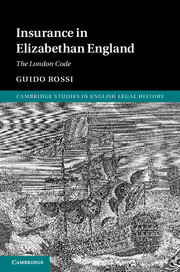
BOOK: Guido ROSSI, Insurance in Elizabethan England. The London Code [Cambridge Studies in English Legal History], Cambridge: Cambridge UP, Feb 2016 (forthcoming). ISBN 9781107112285

(image source: Cambridge UP)


Cambridge University Press announced the forthcoming publication of Guido Rossi's Insurance in Elizabethan England. The London Code.

Summary:
English insurance came into being almost entirely during the Elizabethan period. However, the Great Fire of 1666 consumed most of London's mercantile document, and therefore little is known about early English insurance. Using new archival material, this study provides the first in-depth analysis of early English insurance. It focuses on a crucial yet little-known text, the London Insurance Code of the early 1580s, and shows how London insurance customs were first imported from Italy, then influenced by the Dutch, and finally shaped in a systematic fashion in that Insurance Code. The London Insurance Code was in turn heavily influenced by coeval continental codes. This deep influence attests the strong links between English and European insurance, and questions the common/civil law divide on the history of commercial law.

04 January 2016

SEMINAR: "Le droit hors la religion" (Paris, January 12 2016)


WHAT « Le droit hors la religion », L’institution juridique du fait religieux, seminar

WHEN January 12 2016, 18:00-21:00

WHERE Paris, Cenj- Ehess


speakers

Emanuele Conte, Roma Tre University/Cenj-Ehess
Paolo Napoli, Cenj-Ehess


En interrogeant la manière dont le droit institutionnalise le fait religieux et, par conséquent, revendique historiquement son autonomie, le séminaire n’envisage surtout pas d’aborder le thème très rebattu de la laïcité. 
Il s’agira plutôt de croiser réflexion théorique et analyse historique autour d’un topos de la recherche sur le christianisme primitif : la formation de l’ekklesia en tant qu’association de fidèles. A partir de la critique qu’Erik Peterson en 1928 adresse à l’affirmation de Thomas d’Aquin selon laquelle « Jésus Christus instituit ecclesiam » (Summa contra Gentiles, l. 4, ch. 76, n.8), l’analyse portera dans un premier temps sur la tension entre l’institutionpropre au droit canonique et la constitution théologico-dogmatique qui revendique son antériorité pour expliquer la naissance de ce fait social qu’est l’ekklesia. 
L’analyse de Peterson n’est pas sans évoquer le thème de l’association et donc de la personne morale sur lesquels se sont penchés les juristes (notamment allemands) du XIX siècle alors qu’ils ont engagé une confrontation serrée avec les sources médiévales. 
Le deuxième volet du séminaire illustrera les enjeux de cette confrontation ainsi que la manière dont s’est produite une différenciation, cette fois toute interne au monde juridique, entre un droit civil réglant les rapports patrimoniaux des sujets et un droit canonique à la vocation essentiellement gestionnaire.

JOB: Junior Research Fellowship in Manuscript and Text Cultures (Oxford, 2016)


WHAT Junior Research Fellowship in Manuscript and Text Cultures, full time Job

WHEN 2016

WHERE University of Oxford, Governing Body of The Queen’s College, Oxford

deadline for submissions February 15th 2016

The Governing Body of The Queen’s College invites applications from graduates of any university for election to a three-year post-doctoral position as a Junior Research Fellow in Manuscript and Text Cultures, with a research specialism in knowledge-production and text transmission in pre-modern literate societies.

Fellowships are intended to support those at an early stage of their academic careers, and will normally be awarded to those who have recently completed their doctoral research, or are very close to completion. Candidates must not have accumulated more than seven years in full-time postgraduate study of research, nor have already held a post-doctoral research fellowship elsewhere.

The basic stipend of the Fellowship, which is pensionable under the Universities Superannuation Scheme, is £22,000 subject to adjustment in the light of any other emoluments enjoyed by the Fellow or in the light of any general alteration to University stipends. The Fellow will be entitled to free rooms in College, or to an allowance of £6,000 in lieu, and to free meals in College.
Applications should be submitted, preferably by e-mail to joyce.millar@queens.ox.ac.uk the Academic Administrator, by noon on Monday 15th February 2016. Further details can be found at www.queens.ox.ac.uk/about-queens/vacancies

02 January 2016

JOURNAL: Historia et ius, n. 8/2015 (December 2015)


Historia et ius, n. 8/2015

Temi e questioni
  • 1) Mario Caravale, L’ombra di Banquo. Il fantasma della libertà nella giuspubblicistica del primo decennio fascista - PDF
  • 2) Jacques Bouineau, De quel homme parlent les droits de l’Homme - PDF


Una cultura delle libertà: Magna Carta Libertatum (1215-2015)

  • 3) Paolo Alvazzi del Frate, Una cultura delle libertà: ottocento anni dalla Magna Carta - PDF
  • 4) Mario Caravale, La concessione della Magna Carta - PDF
  • 5) Giovanni Rossi, La Magna Carta Libertatum: note di lettura - PDF
  • 6) Lorenzo d'Avack, L’utilizzo della Magna Carta nel primo conflitto costituzionale inglese del ‘600 - PDF
  • 7) Giovanni Serges, La Magna Carta Libertatum patrimonio del costituzionalismo - PDF
  • 8) Giordano Ferri, Il costituzionalismo inglese e l’idea di Stato nell’Italia liberale: la Biblioteca di Scienze Politiche di Attilio Brunialti - PDF


Studi (valutati tramite peer review)


CFP: next issue of Glossae, European Journal of Legal History (May 15 2016)


WHAT the next issue of Glossae, European Journal of Legal History, call for papers

WHEN 2016

Deadline May 15th 2016


The next issue of Glossae will be dedicated to the 'ius commune and its reception'

Anyone who might be interested in participating should contact Wim Decock (wim.decock@law.kuleuven.be), who will be coordinating the 2016 Issue.

This issue seeks to reach out good papers on ius commune by both young, promising legal historians and well established scholars. 

For the rules for publications, click here