
(Source: Storia del diritto)

The ESCLH aims to promote comparative legal history and seeks affiliation with individuals and organisations with complementary aims.

MILHIS Talks
Voices. MILHIS Talks
MILHIS Talks is one of the three forms through which MILHIS Voices articulates its approach to legal-historical research. It is conceived as a space for encounter and discussion among legal historians and scholars from related disciplines, where dialogue functions not as a supplement to research, but as a mode of inquiry in its own right.
Rather than offering finished syntheses or formal presentations, Talks foregrounds conversation as a scholarly practice. Each encounter centres on research in progress, recent publications, methodological questions, or shared problems within legal history, creating a setting in which ideas are tested, perspectives are brought into relation, and lines of inquiry are collectively explored.
In this sense, MILHIS Talks gives concrete form to the relational dimension of research. By placing voices in direct conversation, it highlights the intellectual and social processes through which historical–legal knowledge is developed, discussed, and refined. Within the broader framework of MILHIS Voices, Talks affirms dialogue as a central component of historical–legal inquiry, fostering an open yet rigorous environment of shared reflection. MILHIS Talks opens with its first event.
MILHIS Talks meets:
Giuseppe Speciale, Full Professor of Legal History at the University of Catania
Lecture:
Il “racconto” della Costituzione (il metodo costituente e una sana ideologia)
Introduced by:
Filippo Rossi, Associate Professor of Legal History at the University of Milan
📍 Sala Senato, Law and Humanities Library, University of Milan
📅 18 February 2026
🕟 4:30 pm

Il Convegno “In dialogo sulla storia costituzionale italiana - Augusto Antonio Barbera, testimone e protagonista” – in programma nella sala Pia dell’Università LUMSA (via di Porta Castello 44, Roma) il 20 febbraio 2026, dalle ore 11.00 – è organizzato dall’Università LUMSA e dal Centro di Ricerca "Leopoldo Elia" (CREL).
Il Convegno costituisce la tappa di avvio dell’attività dell’Associazione per la storia costituzionale, una società scientifica che coinvolge studiosi di varie materie storiche e giuridiche, fondata il 7 ottobre 2025 a Roma e che ha tra i suoi soci fondatori alcuni professori dell’Università LUMSA (Francesco Bonini, Angelo Rinella, Marco Olivetti, Gian Marco Sperelli, Filippo Benedetti).
Il Convegno intende affrontare il senso degli studi di storia costituzionale in Italia attraverso il contributo di uno dei principali costituzionalisti italiani, il prof. Augusto Antonio Barbera, a lungo ordinario di diritto costituzionale nell’Università di Bologna e testimone-protagonista della storia istituzionale repubblicana nell’ultimo mezzo secolo (come parlamentare, ministro, giudice costituzionale, membro di commissioni sulle riforme costituzionali).
Le attività inizieranno con i saluti ai presenti e con una presentazione a cura del prof. Francesco Bonini (rettore dell’Università LUMSA) e del prof. Luigi Lacché (presidente dell’Associazione per la storia costituzionale).
Il contributo del prof. Barbera assumerà la forma di una intervista, condotta dai membri del direttivo dell’Associazione per la storia costituzionale. Seguirà un dibattito.
L’evento sarà trasmesso da Radio radicale

Abstract:
This Article examines the evolving concept of the material constitution and its application to the EU. The first part focuses on the theory of Italian jurist Costantino Mortati, exploring both its foundations and its contemporary relevance. Mortati’s understanding of the material constitution—deeply rooted in the framework of the modern nation-state—faces significant challenges when extended to supranational entities such as the EU. The second part turns to the work of Riccardo Monaco, who reimagined constitutional normativity in light of European integration. His analysis highlights the dynamic, institutional character of the European Communities’ legal order. The Article traces how the concept of the material constitution has been adapted—and ultimately transformed—within transnational contexts. This transformation reveals both the concept’s interpretive value and the theoretical tensions involved in applying it beyond the boundaries of the nation-state. In particular, it underscores the normative significance of the ECs’ underlying political economy.
Read the article here: DOI 10.1017/glj.2025.10168.
ABOUT THE BOOK:
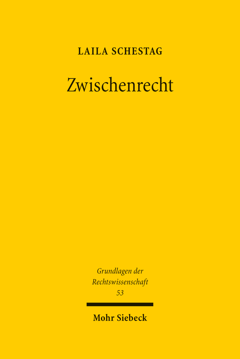
»Das Völkerrecht geht unter allen Umständen dem Bundesrecht und auch dem
Bundesverfassungsrecht vor«. Mit diesem Satz des späteren
Außenministers Heinrich von Brentano nahm der Parlamentarische Rat die
bis heute gültige Fassung von Artikel 25 GG einstimmig an. Noch in der
ersten Hälfte der 1950er Jahre stieß der Vorrang des Völkerrechts auf
breite Zustimmung. Heute weist die Verfassungsauslegung den allgemeinen
Regeln des Völkerrechts nur noch einen 'Zwischenrang' zu: Sie stehen
über dem einfachen Recht, aber unter dem Verfassungsrecht. Wie lässt
sich die radikale Offenheit des Grundgesetzes gegenüber dem Völkerrecht
im Moment der Verfassungsgebung erklären? Warum war sie nicht von Dauer?
Diesen Fragen geht Laila Schestag in ihrer ideengeschichtlichen Studie
nach. Entlang der Genese zentraler verfassungsrechtlicher Begriffe wie
'Völkerrechtsfreundlichkeit' und 'offene Staatlichkeit' zeigt sie, wie
Deutungs- und Bedeutungswandel von Artikel 25 GG den politischen
Selbstfindungsprozess der frühen Bundesrepublik spiegeln.
Die Arbeit wurde mit dem Promotionspreis der Juristischen Fakultät der Humboldt-Universität zu Berlin 2024 ausgezeichnet.
TABLE OF CONTENTS:
Recht einer Zwischenzeit. Einleitung
Erster Teil: Vor der Verfassung - Die Entstehung von Artikel 25 des Grundgesetzes
Kapitel 1. Motive
Kapitel 2. Entwürfe
Kapitel 3. Diskurse
Zweiter Teil: Unter dem Grundgesetz - Vom internationalen Provisorium zur nationalen Verfassung
Kapitel 1. Revolutionäre Popularität? Die Rangfrage zwischen 1949 und 1957
Kapitel 2. Vom besetzten Provisorium zum europäischen Staat
Kapitel 3. Saturierter Staat? Die Rangfrage zwischen 1958 und 1976
Ein vergessenes Potential? Schluss
ABOUT THE AUTHOR:
Find more here.
Abstract:
Constitutions are a product of history, but what is the role of history in interpreting and applying constitutional provisions? This volume addresses that question from a comparative perspective, examining different uses of history by courts in determining constitutional meaning. The book shows that there is considerable debate around the role of history in constitutional adjudication. Are, for example, historical public debates over the adoption of a constitution relevant to reading its provisions today? If a constitution represents a break from a prior repressive regime, should courts construe the constitution’s provisions in light of that background? Are former constitutions relevant to interpreting a new constitution? Through an assessment of current practices the volume offers some lessons for the future practices of courts as they adjudicate constitutional cases. Contributors are: Mark D. Rosen, Jorge M. Farinacci-Fernós, Justin Collings, Jean-Christophe Bédard-Rubin, Cem Tecimer, Ángel Aday Jiménez Alemán, Ana Beatriz Robalinho, Keigo Obayashi, Zoltán Szente, Shih-An Wang, and Diego Werneck Arguelhes.
On the editors:
Francesco Biagi is Senior Assistant Professor of Comparative Public Law at the University of Bologna Department of Legal Studies. His latest publications include: European Constitutional Courts and Transitions to Democracy (Cambridge University Press 2020); “Constitution Drafting After the Arab Spring: A Comparative Overview”, 29 Indiana Journal of Global Legal Studies 1 (2022). Justin O. Frosini is Associate Professor of Comparative Public Law at the Bocconi University in Milan and Adjunct Professor of Constitutional Law at Johns Hopkins University. He earned his law degree and his doctorate from the University of Bologna. His latest book is Dalla Sovranità del Parlamento alla Sovranità del Popolo. La rivoluzione costituzionale provocata dalla Brexit (Wolters Kluwer-Cedam, 2020). Jason Mazzone is the Albert E. Jenner, Jr. Professor of Law at the University of Illinois at Urbana-Champaign where he also serves as Director of the Program in Constitutional Theory, History and Law. He earned undergraduate and law degrees from Harvard University and his doctorate from Yale University.
Table of contents:
Acknowledgments
List of Tables
Notes on Contributors
Introduction
Francesco Biagi, Justin O. Frosini and Jason Mazzone
Part 1
Framing the Problem
1 History Limit or License in Constitutional Adjudication?
Mark D. Rosen
2 When History Requires the Use of History in Constitutional Adjudication
Jorge M. Farinacci-Fernós
3 Memory as Mantle Evil Pasts and Judges’ Power in Germany and South Africa
Justin Collings
Part 2
Historical Precedents and Inter-constitutional Interpretation
4 Comparing Constitutional Historicities The Case of Precedents in Canada and the United States
Jean-Christophe Bédard-Rubin
5 Inter-constitutional Interpretation A Case Study of the Articles of Confederation
Cem Tecimer
Part 3
A Matter of Narratives
6 Janus’ Third Face? The Spanish Constitutional Court at the Crossroads of History
Ángel Aday Jiménez Alemán
7 Competing Narratives The Use of Historical Arguments in Constitutional Interpretation in Brazil
Ana Beatriz Robalinho
8 Manipulating Constitutional, Legislative and Judicial History Incremental Judicial Activism in the Japanese Supreme Court
Keigo Obayashi
Part 4
New Democracies and Illiberal Regimes
9 How Not to Use History in Constitutional Interpretation The Aborted Resurrection of the Historical Constitution in Hungary
Zoltán Szente
10 Using the Authoritarian Past for Constitutional Interpretation in New Democracies The Example of the Taiwan Constitutional Court
Shih-An Wang
Conclusion Which History, Whose Past?
Diego Werneck Arguelhes
Read moer here: DOI 10.1163/9789004523739.
ABOUT THE BOOK:
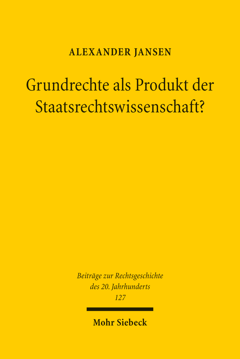
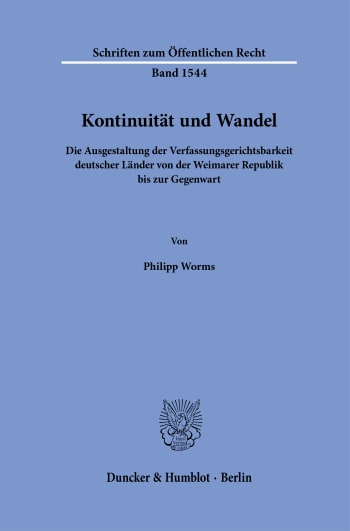
Die Abhandlung widmet sich der geschichtlichen Entwicklung der Verfassungsgerichte der Länder, um auf diese Weise einen Beitrag zur näheren Bestimmung des Verhältnisses zwischen der gegenwärtigen Landesverfassungsgerichtsbarkeit und ihren historischen Vorbildern zu leisten. Dabei untersucht der Autor in einem ersten Schritt, inwieweit die Weimarer Landesstaatsgerichtshöfe prägend waren für die Entwicklung und die Ausgestaltung der Landesverfassungsgerichte wie wir sie heute kennen. Anhand der Länder Baden-Württemberg, Bayern, Hessen und Thüringen zeigt der Autor auf, dass die Weimarer Landesstaatsgerichtshöfe trotz ihrer vergleichsweise schmalen Kompetenzkataloge den Vätern und Müttern der westdeutschen Landesverfassungen nach 1945 als Anknüpfungspunkt für die Konzeption der Landesverfassungsgerichte dienten. Dass die Weimarer Landesstaatsgerichtshöfe gleichwohl nicht den einzigen Traditionsstrang darstellten, wird ebenso deutlich. Daher beleuchtet der Autor in einem zweiten Schritt, welchen übrigen Einflussfaktoren die Ausgestaltung der Verfassungsgerichtsbarkeit nach 1945 ausgesetzt war und wie unterschiedlich stark sich diese Faktoren in den jeweiligen Ländern auswirkten.
TABLE OF CONTENTS:
Abstract:
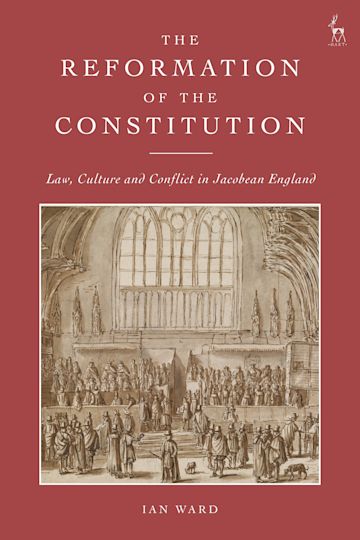
This book revisits one of the defining judicial engagements in English legal history. It provides a fresh account of the years 1606 to 1616 which witnessed a series of increasingly volatile confrontations between, on the one side, King James I and his Attorney-General, Sir Francis Bacon, and on the other, Sir Edward Coke, successively Chief Justice of Common Pleas and Lord Chief Justice. At the heart of the dispute were differing opinions regarding the nature of kingship and the reach of prerogative in reformation England. Appreciating the longer context, in the summer of 1616 King James appealed for a reformation of law and constitution to complement the reformation of his Church. Later historians would discern in these debates the seeding of a century of revolution, followed by another four centuries of reform. This book ventures the further thought that the arguments which echoed around Westminster Hall in the first years of the seventeenth century have lost little of their resonance half a millennium on. Breaks with Rome are little easier to 'get done', the margins of executive governance little easier to draw.
Table of contents:
Introduction: Irony and Rhyme 1. Reformation 2. The Aspirations of James Stuart 3. The Casebook of Sir Edward Coke 4. The Lives of Francis Bacon 5. Apotheoses Epilogue
Read more here.
“Constitution” is a rich term in Western political culture, encompassing political and juridical doctrine as well as government practices through the ages. This volume examines “constitutional moments” in history, those occasions or episodes when significant steps were taken in the definition or redefinition of polities. Their actors were writers or politicians, rulers or ruled, who found inspiration in a distant past or instead looked towards a future to be drawn anew. This book sheds light on such moments from Ancient Greece to the present day, mostly in Europe but also in the Ottoman world and the Americas, thereby uncovering a revealing variety of constitutional thinking and action throughout history.
Contributors:
Contributors are: Jon Arrieta, Niall Bond, Luc Brisson, Peter Cholakov, Nora Chonowski, Angela De Benedictis, F. Sinem Eryilmaz, Hakon Evju, Pablo Fernández Albaladejo, Javier Fernández Sebastián, Merieke Gebhardt, Xavier Gil, Mark J. Hill, Ferenc Hörcher, Jaska Kainulainen, Thomas Lorman, Adriana Luna-Fabritius, Ere Nokkala, Brian Kjaer Olesen, András Pap, Nikola Regent, Alberto Mariano Rodríguez Martínez, Pablo Sánchez León, José Reis Santos, and Ersin Yildiz.
Find more here.
Abstract:
This is the first account in English of the making of Italian nationhood from the perspective of constitutional history. It is also the first to consider the role that the House of Savoy played in this process. Bringing together influential experts in the field, the collection covers the evolution of the Italian constitution from Russian diplomacy’s little-known planning of the Risorgimento to the monarchy’s demise after its clashes with fascism. Combining systematic coverage with original research, the volume includes such varied themes as the king’s role in the Italian wars of independence, the Italian peninsula’s forgotten charters of 1848, and the story of the ephemeral building that housed the first Italian parliament. Contributors are: Carolina Armenteros, Andrea Ungari, Paolo Colombo, Frans Willem Lantink, Christian Satto, Giulio Stolfi, Valentina Villa, Tommaso Zerbi, and Romano Ferrari Zumbini.
Table of contents:
Notes on Contributors
List of Figures
Introduction
Carolina Armenteros and Andrea Ungari
1 The Savoy Monarchy and the Parliamentary System: From the Kingdom of Sardinia to the Kingdom of Italy
Andrea Ungari
2 “Changes Appropriate to the Times, and Circumstances”: The Crown and the Modernization of the State in the Kingdom of Sardinia (1814–53)
Giulio Stolfi
3 The Pact and Its Overseer: Crown and Modern Constitutionalism in the Kingdom of Sardinia (1844–52)
Romano Ferrari Zumbini
4 Constitutionalism or “Neoabsolutism”? Monarchies in Italy, 1848–1859/1866
Frans Willem Lantink
5 The Making of Italy (through the Ephemeral): The First Italian Parliament between State-Building, “Risorgimental Neo-Medievalism,” and Glorification of the House of Savoy
Tommaso Zerbi
6 More than Kings: The Role of the Italian Monarchs in the State-Building Process and Foreign Affairs
Valentina Villa
7 The Role of the Crown in the Building of an Italian Identity (1878–1922)
Paolo Colombo
8 1925: The Jubilee of King Victor Emmanuel III Monarchy and Fascism in a Year of Transition and Afterward
Christian Satto
Conclusions
Francesco Bonini
Bibliography
Index
On the editors:
Carolina Armenteros, PhD. (2005), University of Cambridge, is Professor of Humanities and Social Sciences and Director of the Center for European Studies at the Pontificia Universidad Católica Madre y Maestra. Her extensive publications on political thought include her monograph The French Idea of History: Joseph de Maistre and his Heirs, 1794-1854 (Cornell, 2011). Andrea Ungari, Ph.D. (2002), is Professor of Contemporary History at the Università Guglielmo Marconi and Professor of the Theory and History of Political Parties and Political Movements at the Università Luiss Guido Carli. He has published more than a dozen books on Italian political and institutional history, including La guerra del Re. Monarchia, sistema politico e Forze armate nella Grande Guerra (Luini, 2018).
Read more here.

Abstract:
This article attempts to recover perceptions of the Constitution of the Irish Free State at the time of its creation through analysis of Irish newspapers published in 1922. The comparative analysis of contemporary perceptions is intended to serve as a counterweight to perceptions of this Constitution presented in scholarship written in the years after 1922 that have been heavily influenced by knowledge of subsequent events. This article includes analysis of the 1922 Constitution in newspapers based in all regions of the island of Ireland. It covers the jurisdiction of ‘Southern Ireland’, that was evolving into the ‘Irish Free State’, and the jurisdiction of ‘Northern Ireland’ that was destined to remain a part of the United Kingdom. The comparative analysis examines differing viewpoints within and between these two jurisdictions. The conclusion argues that the difficulties and relatively short lifespan experienced by the Constitution of the Irish Free State could not have been easily predicted from the vantage point of 1922.
Read the article here: DOI 10.1080/2049677X.2023.2270389.

Abstract:
Dans nos imaginaires, République et Révolution française sont si intimement liées, qu’elles paraissent souvent ne faire qu’un. Pourtant, l’esprit républicain précède la fondation de la république, en septembre 1792 ; de même, la Première République voit se succéder la constitution démocratique de 1793, le gouvernement révolutionnaire, la république des « meilleurs » (1795) et le Consulat… La diversité des projets républicains vient renforcer cette complexité. Tout au long de la séquence révolutionnaire se développent ainsi non pas un républicanisme, mais des républicanismes, qui se recoupent et s’entremêlent, parfois se heurtent et s’affrontent. Ce livre entend explorer ces diverses sensibilités du républicanisme français ainsi que leurs fortunes extérieures, de la veille de la Révolution (au temps des échos de la Révolution américaine) à ses lendemains, lorsque l’Empire puis le retour des rois contraignent la république à devenir « souterraine ».
More information with the publisher (reduced rate until tomorrow).

The journal Comparative Legal History is an official academic forum of the European Society for Comparative Legal History. It was first published in 2013 and aims to offer a space for the development of comparative legal history. Based in Europe, it welcomes contributions that explore law in different times and jurisdictions from across the globe. Submissions are currently welcome and are being assessed on a rolling basis.
The journal will host a one-hour public session to discuss the contemporary rise in interest in comparative constitutional history. Editors (past and present) will present exploratory points and all attendees will be invited to join in a general discussion.
The last few years have seen an explosion of publications on comparative constitutional history, often with a global reach and covering long time spans. What explains this rise in interest in such an approach to constitutional law? What does it signify for the fields of constitutional history and comparative legal history? Is this scholarly development related to contemporary constitutional crises and debates and their global scale? How is this wave of scholarship related to other fields of comparative legal history, and in what ways does it differ from them? Does the field display any shortcomings or blind spots that should be addressed? These and other questions will be explored during this public session.
The event is free and open to the public, and it will take place via Zoom.
Registration is required by sending an email to clhdialogues@gmail.com.

Call for Papers
International conference on Constitutional Communities
8-9 February 2024 - KU Leuven (Institute of Philosophy and Faculty of Law), Belgium
Deadline for abstract submissions: 25 October 2023
Theme:
Today almost all countries are “constitutional communities” in a broad sense: their constitution provides the basic framework for their common life. This link between community and constitution is increasingly recognized and there is a growing awareness of the potential of constitutions for societal integration. Jürgen Habermas, with his notion of constitutional patriotism, made the case for a collective identity that does not rely on ethnic nationalism. At the same time, the belief that a constitutional document can be the source of a liberal collective identity has been criticized from various angles. A constitution is typically anchored at the national level, while in a globalized world social integration happens at many different levels. Moroever, courts have used the concept of “constitutional identity” to justify divergent interpretations of the rule of law and human rights and to uphold populist claims. Indigenous people sometimes see constitutional recognition as a new form of assimilation. And some critics have claimed that the concept is empty and abstract: constitutional principles are mostly the same across borders so how can they inspire a sense of community?
These developments raise important questions. How do constitutions create communities? Can they really do so? And should they? These questions can be answered from different disciplinary perspectives. Scholars in constitutional law and in the history of law have studied the working of constitutions since long. But legal and political philosophy should also weigh in, as philosophers from the past and the present have amply studied the relation between written laws and community. The issue of constitutional identity can also be approached from an empirical sociological perspective or even from a literary perspective, as it is ultimately the agency of a text that is at stake here.
By engaging in an interdisciplinary dialogue about constitutions and community, this conference aims to explore the impact that constitutions have and can have in the functioning of communities, and to contribute to our understanding of the concept of constitutional identity.
Possible paper topics:
- Constitutions and community building
- National and/or constitutional identity as legal instruments
- The relation between constitutional identity and affiliated notions (sovereignty, constituent power, representation, …)
- Constitutional recognition (of minorities, historically oppressed groups, rights of nature, …)
- Constitutional change
- Specific philosophers on the role of constitutions
- Constitutions as a literary genre
Submitting your abstract:
If you are interested in presenting your work at this conference, please submit an anonymized abstract (max. 400 words, in .doc, .docx or .pdf format) along with your name, title, and affiliation via e-mail to Ana Van Liedekerke (ana.vanliedekerke@kuleuven.be). The actual presentations can be 15 to 20 minutes long. Abstract should be submitted on 25 October 2023 (CET) at the latest. If accepted, you will be invited to develop your abstract into a full paper of around 5000 words; papers will be precirculated to all conference participants. We welcome submissions both from junior and from senior scholars. We especially encourage scholars from underrepresented groups to apply.
Conference Fee: There will be a registration fee of 75 euro to participate in the conference (40 euro for those attending just one day and reduced prices for KU Leuven students) and an additional fee of 75 euro for those wanting to attend the conference dinner.
Organizers: Raf Geenens, Stefan Sottiaux, Christophe Maes, Roger Ventura Cossin, Ana Van Liedekerke.
This conference is organized by RIPPLE (Research in Political Philosophy and Ethics Leuven) and the Leuven Centre for Public Law. It is part of an interdisciplinary research project on constitutional identity, jointly hosted by KU Leuven's Institute of Philosophy and KU Leuven's Faculty of Law and funded by FWO, the Research Foundation Flanders.

LUNEDÌ 18 SETTEMBRE
ore 15.00 - 19.00
Introduzione
Luigi LACCHÈ (Università di Macerata)
Giuseppe MECCA (Università di Macerata)
Interventi
Bernardo SORDI (Università di Firenze)
Francesco BONINI (Università di Roma LUMSA)
Luca SCUCCIMARRA (Sapienza Università di Roma)
Paolo COLOMBO (Università Cattolica del Sacro Cuore di Milano)
Anna Gianna MANCA (Università di Trento)
Francesco DI DONATO (Università di Napoli Federico II)
Sonia SCOGNAMIGLIO (Università di Napoli Parthenope)
Sandro GUERRIERI (Sapienza Università di Roma)
Discussione generale
MARTEDÌ 19 SETTEMBRE
ore 9.00 - 12.30
Interventi
Massimiliano GREGORIO (Università di Firenze)
Francesco SODDU (Università di Sassari)
Michela MINESSO (Università di Milano Statale)
Romano FERRARI ZUMBINI (LUISS Guido Carli Roma)
Marco FIORAVANTI (Università di Roma Tor Vergata)
Ronald CAR (Università di Macerata)
Alessandro TORRE (Università di Bari)
Giovanni DI COSIMO (Università di Macerata)
Discussione generale
More information can be found here.


