Search

Showing posts with label Constitutional law. Show all posts

12 June 2026

BOOK: Benjamin SCHONTHAL, Courts, Constitutions and Karma. Buddhism, Law and the Practices of Legal Pluralism in Sri Lanka [Cambridge Studies in Law & Society, eds. Mark FATHI MASSOUD & Jens MEIERHENRICH] (Cambridge: CUP, 2026)

(image source: CUP)


 Abstract:

Although rarely acknowledged, Buddhist monastics are among the most active lawmakers and jurists in Asia, operating sophisticated networks of courts and constitutions while also navigating—and shaping—secular legal systems. This book provides the first in-depth study of Buddhist monastic law and its entanglements with state law in Sri Lanka from 1800 to the present. Rather than a top-down account of colliding legal orders, Schonthal draws on nearly a decade of archival, ethnographic and empirical research to document the ways that Buddhist monks, colonial officials and contemporary lawmakers reconcile the laws of the Buddha and the laws of the land using practices of legal pluralism. Comparative in outlook and accessible in style, this book not only offers a portrait of Buddhist monastic law in action, it also yields new insights into how societies manage multi-legality and why legal pluralism leads to conflict in some settings and to compromise in others.

Table of contents:

  • 1. Monastic law, state law and the plurality of legal pluralism in Sri Lanka
  • Part I:
  • 2. The unity and diversity of Buddhist monastic law
  • 3. Jurisdictionalising Buddhism in colonial Ceylon
  • 4. Practising legal pluralism in the monastery
  • Part II:
  • 5. Like and unlike 'Law': making a monastic judiciary
  • 6. Law's Karmas: Nirvana, rebirth and the cosmological consequences of monastic law
  • Part III:
  • 7. Legalising' monastic law: the politics of legal recognition in post-colonial Sri Lanka
  • 8. Constitutionalising Vinaya
  • Conclusion: pluralising legal pluralism
  • Glossary
  • References.

On the author:

Benjamin Schonthal, University of Otago, New Zealand

(source: Legal History Blog)

08 April 2026

SSRN PAPER: Alessandro VOLPI, "Legal and Political Constitutionalism from Schmitt and Kelsen to Contemporary Debates: Notes on Constitutional Guardianship and Democracy" [OPEN ACCESS]


(image: Hanse Kelsen; Source: Wikimedia Commons)

Abstract:

This paper situates the Carl Schmitt-Hans Kelsen dispute on constitutional guardianship within the now-standard categories of political and legal constitutionalism. It examines the conflict between political and legal understandings of the constitution and of constitutional adjudication, alongside divergent conceptions of democracy that strain this institution (notably, the countermajoritarian difficulty). It begins with a close reconstruction of the Weimar-era debate-its legal and political details-covering competing views of adjudication, the constitution as a set of norms or a political decision, and alternative models of guarantees. Through comparative analysis, the paper then traces lines of continuity and discontinuity between those positions and contemporary discussions of constitutional guardianship within debates over legal versus political constitutionalism. What emerges is the enduring persistence of theoretical alternatives that deeply structure the idea of constitutional guardianship in a democratic system. At the same time, we find differences in interpretation and in proposals for legal politics concerning substantive versus procedural conceptions of the constitution, as well as divergent understandings of democratic conflict and pluralism and their implications for constitutional stability. The paper concludes by showing how certain theoretical contradictions at the heart of constitutional guardianship resist easy resolution and must be inhabited, rather than definitively overcome.

On the author:

 Max Planck Institute for the Study of Crime, Security and Law

Read more here: DOI 10.2139/ssrn.6143326.

05 February 2026

SEMINAR: 'In dialogo sulla storia costituzionale italiana: Augusto Antonio Barbera, testimone e protagonista' (Rome: Lumsa Università, 20 FEB 2026)


Il Convegno “In dialogo sulla storia costituzionale italiana - Augusto Antonio Barbera, testimone e protagonista” – in programma nella sala Pia dell’Università LUMSA (via di Porta Castello 44, Roma) il 20 febbraio 2026, dalle ore 11.00 – è organizzato dall’Università LUMSA e dal Centro di Ricerca "Leopoldo Elia" (CREL).


Il Convegno costituisce la tappa di avvio dell’attività dell’Associazione per la storia costituzionale, una società scientifica che coinvolge studiosi di varie materie storiche e giuridiche, fondata il 7 ottobre 2025 a Roma e che ha tra i suoi soci fondatori alcuni professori dell’Università LUMSA (Francesco BoniniAngelo RinellaMarco OlivettiGian Marco SperelliFilippo Benedetti).


Il Convegno intende affrontare il senso degli studi di storia costituzionale in Italia attraverso il contributo di uno dei principali costituzionalisti italiani, il prof. Augusto Antonio Barbera, a lungo ordinario di diritto costituzionale nell’Università di Bologna e testimone-protagonista della storia istituzionale repubblicana nell’ultimo mezzo secolo (come parlamentare, ministro, giudice costituzionale, membro di commissioni sulle riforme costituzionali).


Le attività inizieranno con i saluti ai presenti e con una presentazione a cura del prof. Francesco Bonini (rettore dell’Università LUMSA) e del prof. Luigi Lacché (presidente dell’Associazione per la storia costituzionale).


Il contributo del prof. Barbera assumerà la forma di una intervista, condotta dai membri del direttivo dell’Associazione per la storia costituzionale. Seguirà un dibattito.


L’evento sarà trasmesso da Radio radicale

15 October 2025

VIDEO: Michel TROPER, "J'ai fait très peu de droit à Sciences Po" (En Chair(e)) [YOUTUBE]

The Youtube-channel "EnChair(e)" publishes a long video interview with renowned French legal theorist and specialist of constitutional law Michel Troper. 

See above for the first chapter. Youtube-channel here.

07 July 2025

BOOK: Michael P. FITZSIMMONS, The Forgotten Constitution. The Origins, Realization, and Legacy of the French Constitution of 1791 (Oxford: Oxford University Press, 2025), 304 p. ISBN 9780197793947, 86 GBP


(image source: OUP)

Abstract:

The French Constitution of 1791 has a major legacy that overturned many centuries of historical tradition but remains little known outside of France. It ratified the unprecedented transformation of a society based on monarchy-centered government and legal privilege to one based on a sovereign citizenry and legal equality. Its powerful impact served as the inspiration for the wave of constitution-making that engulfed Europe during the nineteenth century and expanded globally thereafter. Furthermore, with the Declaration of the Rights of Man and Citizen as its original preamble, the Constitution of 1791 is associated with the concept of human rights proclaimed by the United Nations in the Universal Declaration of Human Rights in 1948. Drawing on wide-ranging and long-overlooked manuscript sources, The Forgotten Constitution highlights the Constitution of 1791's underappreciated importance and influence in the world. The constitution was the product of a long-term crisis of the Bourbon monarchy grounded in fears of despotism. The idea of a constitution took hold during the 1780s as the means to stabilize the kingdom through a more equitable distribution of power while attempting to accommodate a king. By making a constitution a compact between monarch and people, by its written assurance of civic and natural rights, and by its assertion of legal equality as an essential element of political legitimacy, the Constitution of 1791 codified the principles of the French Revolution. This book shows how it was the French constitutional tradition, inspired by the Constitution of 1791, that drove the Western constitutional ideal, especially in the revolutions of 1848.

Table of contents:

Introduction PART I. THE CREATION OF A BOURBON STYLE OF GOVERNMENT 1. The Rebuilding of Royal Authority 2. Louis XV: Transition and Discord over Monarchy-Centered Government PART II. THE TERMINAL CRISIS OF THE OLD REGIME 3. The Descent into Crisis 4. The Erosion of Monarchy-Centered Government 5. Toward the Estates-General PART III. THE REALIZATION OF THE CONSTITUTION 6. The Pledge of a Constitution 7. The Collapse of Monarchy-Centered Government 8. The Expansion of the Constitution 9. The Completion and Consolidation of the Constitution Conclusion Bibliography Index

On the author:

Michael P. Fitzsimmons is Professor of History Emeritus at Auburn University at Montgomery. His previous books include The Place of Words: The Académie Française and Its Dictionary during an Age of Revolution, The Night the Old Regime Ended: August 4, 1789 and The French Revolution, and The Parisian Order of Barristers and the French Revolution. 

Read more here


29 April 2025

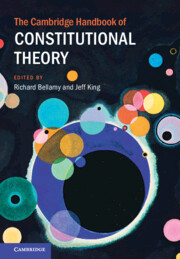
BOOK: Richard BELLAMY & Jeff KING (eds.), The Cambridge Handbook of Constitutional Theory [Cambridge Handbooks] (Cambridge: Cambridge University Press, 2025), ISBN 9781108868143, € 145,89


(image source: CUP)

Abstract: 

This Handbook brings together contributions from leading scholars of constitutional theory, with backgrounds in law, philosophy and political science. Its sixty chapters not only offer an exceptional survey of the field but also provide a major contribution to it. The book explores three main areas. First, the values upheld by a constitution, including rights, freedom, equality, dignity and well-being. Second, the modalities of a constitutional system, such as the separation of powers, democratic representation and the rule of law. Finally, the institutions through which it operates, both legal and political, including courts, elections, parliaments and international organisations. It also considers the challenges confronting constitutional arrangements from growing inequality, populism, climate change and migration.

Table of contents:

1. Introduction: of constitutions and constitutional theory Richard Bellamy and Jeff King
Part I. Values:
2. Dignity Jeremy Waldron
3. Rights Rowan Cruft
4. Equality Annabel Lever
5. Liberty Philip Pettit
6. Well-being Sarah Conly
7. Self-Government Thomas Christiano
8. Justice: procedural and substantive Rainer Forst
9. Recognition Helder De Schutter
Part II. Modalities:
10. Impartiality Matthew Kramer
11. Legitimacy Nomi Claire Lazar
12. Sovereignty David Dyzenhaus
13. Constituent power Martin Loughlin
14. Representation Nadia Urbinati
15. Deliberation Simone Chambers
16. Opposition Grégoire Webber
17. Separation of powers Jacob T. Levy
18. Rule of Law Jeff King
19. Constitutional conventions Jon Elster
20. Secularism Cécile Laborde
21. Constitutional review Christoph Möllers
22. Constitutional interpretation Timothy Endicott
23. Proportionality George Letsas
24. Civil disobedience Candice Delmas
25. Constitutional entrenchment N. W. Barber
26. Emergency powers Karin Loevy
27. Regulation Julia Black
28. Cost-benefit analysis Matthew Adler
29. Revolution Nimer Sultany
Part III. Institutions:
30. The state Anna-Bettina Kaiser
31. The material constitution Marco Goldoni
32. Federalism Stephen Tierney
33. Consociationalism Joseph Lacey and Nenad Stojanović
34. Corporatism Steven Klein
35. Guarantor (or the so-called 'Fourth Branch') institutions Tarunabh Khaitan
36. Central banks Jens van 't Klooster
37. Presidentialism, Parliamentarism, and their hybrids Steffen Ganghof
38. Prerogative Thomas Poole
39. Administrative state Blake Emerson
40. Executive rulemaking Susan Rose-Ackerman
41. Constituent assemblies Joel Colón-Ríos
42. Citizenship Elizabeth F. Cohen and Cyril Ghosh
43. Elections Daniel Weinstock
44. Political parties Jonathan White and Lea Ypi
45. Legislatures Richard Ekins
46. Referendums Silvia Suteu
47. Citizen juries/Minipublics Cristina Lafont
48. Constitutional courts and supreme courts Christine Landfried
49. Judicial independence David Kosař and Samuel Spáč
50. Bills of rights Richard Bellamy
51. Administrative law Farrah Ahmed
52. Horizontal effect Oliver Gerstenberg
53. Global and national constitutionalism Carmen E. Pavel
54. Regional integration Turkuler Isiksel
55. International organisations Anne Peters
Part IV. Challenges for Constitutional Democracy:
56. Inequality Roberto Gargarella
57. Populism Paul Blokker
58. Climate change Jocelyn Stacey
59. Migration Sarah Song
60. Constitutional hardball Mark Tushnet.

On the editors:

Richard Bellamy, University College London Richard Bellamy is a Professor of Political Science at University College London (UCL), and a Fellow of the British Academy. He is the author of eleven monographs, including Political Constitutionalism: A Republican Defence of the Constitutionality of Democracy (Cambridge University Press, 2007). Jeff King, University College London Jeff King is a Professor of Law at University College London (UCL), and was previously a Fellow and Tutor in Law at Balliol College, Oxford. His other works include Judging Social Rights (Cambridge University Press, 2012). from 2019 to 2021, he was Legal Adviser to the UK House of Lords Constitution Committee. 

Read more here

16 January 2025

BOOK: Maximilian SCHNEIDER, Delegierte Verfassungsentwicklung. Eine Studie über das Verhältnis von Entstehungs- und Geltungszeit in der Verfassungsanwendung unter besonderer Berücksichtigung der jüngeren US-amerikanischen Methodendebatte [Rechtstheorie; 12] (Tübingen: Mohr Siebeck, 2024), 430 p., ISBN 978-3-16-163775-9

Cover von 'undefined'
ABOUT THE BOOK:
 
Die Anwendung des Verfassungsrechts auf die sich stetig wandelnde Lebenswirklichkeit ist historisch gebunden, nicht aber historisch determiniert. Der Verfassungsnormsetzer delegiert Konkretisierungsspielräume an künftige Generationen, in denen sie die Entwicklung der Verfassung ohne Änderung ihres Textes vollziehen. Maximilian Schneider arbeitet das komplexe Zusammenspiel entstehungs- und geltungszeitlicher Momente in der Verfassungsanwendung heraus. Dafür nutzt er die in der deutschen Rechtswissenschaft bislang weitgehend unbeachtet gebliebenen Erkenntnispotenziale der jüngeren US-amerikanischen Methodendebatte um den Originalism. Er zeigt, wie methodologisch konsistent von entstehungszeitlicher Auslegung gesprochen werden kann, ohne dass diese in eine Versteinerung der Verfassungsanwendung mündet, und warum sie normativ geboten ist.
 
TABLE OF CONTENTS:
 
Einführung
§ 1 Verfassungsrecht im Wandel der Zeit - Ein rechtsgewinnungstheoretisches Problem
§ 2 Juristische Argumentationskriterien und die Auslegungszieldebatte in Deutschland und den USA

Erster Teil: Entstehungszeitliche Bindung
§ 3 Konzeptionen entstehungszeitlicher Verfassungsauslegung
§ 4 Entstehungszeitlich autorisierte Verfassungsdynamik - Entkräftung des Versteinerungsarguments
§ 5 Normative Bindung an die kommunikativen Intentionen des Verfassungsnormsetzers

Zweiter Teil: Geltungszeitliche Gestaltung
§ 6 Theorie des (Verfassungs-)Richterrechts
§ 7 Begründung judikativer Verfassungsentwicklung
§ 8 Die Rolle der Verfassungsrechtsprechung im Prozess der Verfassungsentwicklung
 
Find more here.

15 January 2025

BOOK: Hinnerk WISSMANN (ed.), Europäische Verfassungen 1789-1990 (Tübingen: Mohr Siebeck, 2024), 585 p., ISBN 978-3-16-164214-2

 Cover von 'undefined'
ABOUT THE BOOK:
 
Die neue Auflage der Textsammlung erscheint als Beitrag zum Verfassungsjahr 2024. Nach 75 Jahren Grundgesetz, das hier in seiner Ursprungsfassung abgedruckt wird, lässt sich erkennen: Freiheit, Demokratie und Rechtsstaat müssen immer wieder neu errungen, verteidigt und bewahrt werden, nach außen wie nach innen. Die hier versammelten historischen Verfassungstexte bezeugen das gemeinsame »Projekt Verfassungsstaat«, das Europa seit Beginn der staatsrechtlichen Moderne geprägt hat. Einen Schwerpunkt bilden deutsche (Reichs- und Landes-)Verfassungen des 19. und 20. Jahrhunderts, die typischerweise für einschlägige Lehrveranstaltungen herangezogen werden. Hinzu kommen (in deutscher Übersetzung) besonders wichtige Verfassungen europäischer Staaten ebenso wie zwischenstaatliche Vertragswerke im Zeitraum bis 1990. Ergänzt wird die Sammlung im Anhang durch die Verfassung der USA und wichtige Texte der vormodernen englischen Rechtstradition. Neu abgedruckt wird die Bill of Rights (Amendments 1-10), mit der die amerikanische Bundesverfassung 1789/1791 grundlegende Bürgerrechte aufnahm.
 
Find more here.

08 January 2025

BOOK: Christos GIANNOPOULOS & Linos-Alexandre SICILIANOS (dir.), Le patrimoine constitutionnel européen entre progression et régression. The European constitutional heritage between progression and regression. Actes du colloque coorganisé par la Fondation Marangopoulos pour les Droits de l'Homme et l'Université de Strasbourg, 4 et 5 mai 2023 [Publications de la Fondation Marangopoulos pour les Droits de l'Homme (F.M.D.H.)] (Paris: Pedone, 2024), 440 p. ISBN 9782233010797, € 64


(image source: LGDJ)

Abstract:

En associant des auteurs qui sont déjà présents sur cette discussion mais venant d'horizons disciplinaires différents, le présent ouvrage a un double objectif : D'une part, identifier, à travers l'analyse de la diversité des expériences nationales, les composantes du patrimoine constitutionnel européen en examinant les mécanismes par lesquels le « commun » est créé, qu'il soit construit par le bas, au moyen d'un travail de droit comparé, ou par le haut, au moyen de la création par les institutions européennes des standards communs qui s'appliqueront à l'échelle paneuropéenne. D'autre part, réfléchir sur les projections et les perspectives d'avenir à l'aune d'une Europe tiraillée par des crises successives en examinant la responsabilité des institutions européennes pour le développement d'une conscience patrimoniale européenne. By bringing together authors who are already involved in this discussion, but who come from different disciplinary backgrounds, the present work has a twofold objective : on the one hand, to identify, through the analysis of the diversity of national experiences, the components of the European constitutional heritage by examining the mechanisms by which the « common » is created, whether it is constructed from below, by means of comparative law work, or from above, by means of the creation by European institutions of common standards that will apply on a pan-European scale. Secondly, to reflect on future projections and prospects in the light of a Europe torn by successive crises, by examining the responsibility of European institutions for the development of a European heritage consciousness.

More information here.


28 October 2024

BOOK: Alexander JANSEN, Grundrechte als Produkt der Staatsrechtswissenschaft? [Beiträge zur Rechtsgeschichte des 20. Jahrhunderts; 127] (Tübingen: Mohr Siebeck, 2024), 193 p., ISBN 978-3-16-163845-9


 Cover von 'undefined'
ABOUT THE BOOK:
 
Die Grundrechte des Grundgesetzes werden oft als Ergebnis eines Kompromisses verstanden. Dennoch postuliert das Bundesverfassungsgericht, dass sie »eine verfassungsrechtliche Grundentscheidung« enthalten und als solche »für alle Bereiche des Rechts« gelten. Der Aussage liegt damit der Gedanke einer bewussten Entscheidung des Verfassungsgebers zugrunde. Die Grundlage für die Entscheidung des Verfassungsgebers sucht Alexander Jansen in der Staatsrechtslehre. Er untersucht, ob die Lehren der Staatsrechtler Rudolf Smend, Carl Schmitt und Richard Thoma die Entstehung der Grundrechte des Grundgesetzes beeinflusst haben. Im Mittelpunkt stehen die Beratungen des Parlamentarischen Rates über die Grundrechte, die Aufschluss über die Vorstellungen dieser Wissenschaftler geben.
 
TABLE OF CONTENTS:
 
Einleitung
A. Hinführung
B. Untersuchungsgegenstand
C. Fragestellung
D. Thesen
E. Forschungsstand
F. Gang der Untersuchung
G. Methodenfragen: Wissenschafts- und Dogmengeschichte

Kapitel 1: Integration durch Grundrechte (Rudolf Smend)
A. Vorbemerkung: Die Integrationslehre als Grundlage der Grundrechtskonzeption?
B. Wissenschaftliche Kurzbiographie
C. Die Integrationslehre als Ausgangspunkt der Grundrechtslehre
D. Die Integrationslehre im Parlamentarischen Rat
E. Fazit: Wider die integrative Grundrechtstheorie

Kapitel 2: Dezision und Grundrechte (Carl Schmitt)
A. Vorbemerkung: Der Mythos Carl Schmitt
B. Wissenschaftliche Kurzbiographie
C. Die Grundrechtslehre Carl Schmitts im Parlamentarischen Rat
D. Fazit: Der, dessen Name nicht genannt werden darf

Kapitel 3: Rechtsstaat und Grundrechte (Richard Thoma
A. Vorbemerkung: Thoma als Transporteur liberaler Grundrechtslehren?
B. Wissenschaftliche Kurzbiographie
C. Grundrechtstheorie: Grundrechte als individuelle Abwehrrechte
D. Rolle im Parlamentarischen Rat
E. Die Vorbehaltslehre Thomas im Parlamentarischen Rat
F. Fazit: Lösungsdivergenz trotz Systemkonvergenz

Schluss
A. Kenner der Grundrechtslehren
B. Grundrechte ohne Staatsrechtswissenschaft
C. Grundrechte als Vergangenheitsbewältigung
D. Verwaiste Verfassungsväter
 
Read more here

23 September 2024

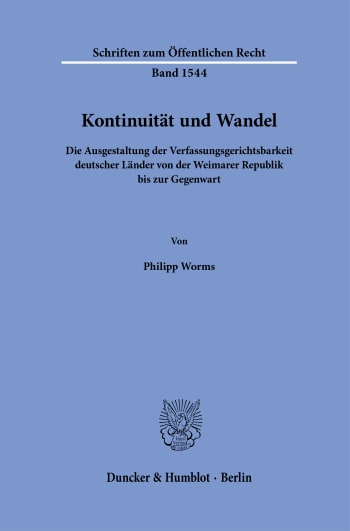
BOOK: Philipp WORMS, Kontinuität und Wandel. Die Ausgestaltung der Verfassungsgerichtsbarkeit deutscher Länder von der Weimarer Republik bis zur Gegenwart [Schriften zum Öffentlichen Recht; 1544] (Berlin: Duncker & Humblot, 2024), 310 p., ISBN 978-3-428-19237-3

 Cover: Kontinuität und Wandel

ABOUT THE BOOK:

Die Abhandlung widmet sich der geschichtlichen Entwicklung der Verfassungsgerichte der Länder, um auf diese Weise einen Beitrag zur näheren Bestimmung des Verhältnisses zwischen der gegenwärtigen Landesverfassungsgerichtsbarkeit und ihren historischen Vorbildern zu leisten. Dabei untersucht der Autor in einem ersten Schritt, inwieweit die Weimarer Landesstaatsgerichtshöfe prägend waren für die Entwicklung und die Ausgestaltung der Landesverfassungsgerichte wie wir sie heute kennen. Anhand der Länder Baden-Württemberg, Bayern, Hessen und Thüringen zeigt der Autor auf, dass die Weimarer Landesstaatsgerichtshöfe trotz ihrer vergleichsweise schmalen Kompetenzkataloge den Vätern und Müttern der westdeutschen Landesverfassungen nach 1945 als Anknüpfungspunkt für die Konzeption der Landesverfassungsgerichte dienten. Dass die Weimarer Landesstaatsgerichtshöfe gleichwohl nicht den einzigen Traditionsstrang darstellten, wird ebenso deutlich. Daher beleuchtet der Autor in einem zweiten Schritt, welchen übrigen Einflussfaktoren die Ausgestaltung der Verfassungsgerichtsbarkeit nach 1945 ausgesetzt war und wie unterschiedlich stark sich diese Faktoren in den jeweiligen Ländern auswirkten.

TABLE OF CONTENTS:

A. Einleitung

B. Methodik

Zur Auswahl der betrachteten Länder – Vorgehensweise – Maßstabsbestimmung

C. Historische Wurzeln der Verfassungsgerichtsbarkeit seit 1815
Auf Ebene des Bundes und des Reiches – Auf Ebene der Gliedstaaten

D. Staatsgerichtsbarkeit in der Weimarer Republik
Der Staatsgerichtshof für das Deutsche Reich – Allgemeine Situation der Staatsgerichtsbarkeit in den Ländern

E. Entwicklung und Ausgestaltung ausgewählter Landesverfassungsgerichte
Baden-Württemberg – Bayern – Hessen – Thüringen

F. Landesübergreifende Parallelen
Landesverfassungsgerichte als solitäre Institutionen – Parallele Entwicklungslinien

G. Landesspezifische Aspekte
Baden-Württemberg – Bayern – Hessen – Thüringen

H. Maßgebliche Einflussfaktoren
Grundgesetz und Bundesverfassungsgericht – Eigene historische Landesverfassungen – Weimarer Reichsverfassung – Andere Landesverfassungen – Ausländische Vorbilder – Besatzungsmächte – Persönlichkeiten – Gesamtwürdigung der Einflussfaktoren

I. Schlussbetrachtung

Anlage: Relevante Vorschriften zur Verfassungsgerichtsbarkeit seit 1919

Read more here.


24 April 2024

BOOK: Xavier GIL (ed.), Constitutional Moments - Founding Myths, Charters and Constitutions through History [History of European Political and Constitutional Thought; 11] (Brill, 2024), 542 p., ISBN 978-90-04-54913-5


Book-Abstract: 
      
 “Constitution” is a rich term in Western political culture, encompassing political and juridical doctrine as well as government practices through the ages. This volume examines “constitutional moments” in history, those occasions or episodes when significant steps were taken in the definition or redefinition of polities. Their actors were writers or politicians, rulers or ruled, who found inspiration in a distant past or instead looked towards a future to be drawn anew. This book sheds light on such moments from Ancient Greece to the present day, mostly in Europe but also in the Ottoman world and the Americas, thereby uncovering a revealing variety of constitutional thinking and action throughout history. 

Contributors:

Contributors are: Jon Arrieta, Niall Bond, Luc Brisson, Peter Cholakov, Nora Chonowski, Angela De Benedictis, F. Sinem Eryilmaz, Hakon Evju, Pablo Fernández Albaladejo, Javier Fernández Sebastián, Merieke Gebhardt, Xavier Gil, Mark J. Hill, Ferenc Hörcher, Jaska Kainulainen, Thomas Lorman, Adriana Luna-Fabritius, Ere Nokkala, Brian Kjaer Olesen, András Pap, Nikola Regent, Alberto Mariano Rodríguez Martínez, Pablo Sánchez León, José Reis Santos, and Ersin Yildiz.  

Find more here

04 October 2023

CFP: International conference on Constitutional Communities - 8-9 February 2024, KU Leuven (Institute of Philosophy and Faculty of Law)[DEADLINE 25 OCT 2023]


 Call for Papers

International conference on Constitutional Communities

8-9 February 2024 - KU Leuven (Institute of Philosophy and Faculty of Law), Belgium

Deadline for abstract submissions: 25 October 2023 


Theme:

Today almost all countries are “constitutional communities” in a broad sense: their constitution provides the basic framework for their common life. This link between community and constitution is increasingly recognized and there is a growing awareness of the potential of constitutions for societal integration. Jürgen Habermas, with his notion of constitutional patriotism, made the case for a collective identity that does not rely on ethnic nationalism. At the same time, the belief that a constitutional document can be the source of a liberal collective identity has been criticized from various angles. A constitution is typically anchored at the national level, while in a globalized world social integration happens at many different levels. Moroever, courts have used the concept of “constitutional identity” to justify divergent interpretations of the rule of law and human rights and to uphold populist claims. Indigenous people sometimes see constitutional recognition as a new form of assimilation. And some critics have claimed that the concept is empty and abstract: constitutional principles are mostly the same across borders so how can they inspire a sense of community?

These developments raise important questions. How do constitutions create communities? Can they really do so? And should they? These questions can be answered from different disciplinary perspectives. Scholars in constitutional law and in the history of law have studied the working of constitutions since long. But legal and political philosophy should also weigh in, as philosophers from the past and the present have amply studied the relation between written laws and community. The issue of constitutional identity can also be approached from an empirical sociological perspective or even from a literary perspective, as it is ultimately the agency of a text that is at stake here. 

By engaging in an interdisciplinary dialogue about constitutions and community, this conference aims to explore the impact that constitutions have and can have in the functioning of communities, and to contribute to our understanding of the concept of constitutional identity.


Possible paper topics: 

- Constitutions and community building

- National and/or constitutional identity as legal instruments 

- The relation between constitutional identity and affiliated notions (sovereignty, constituent power, representation, …) 

- Constitutional recognition (of minorities, historically oppressed groups, rights of nature, …)

- Constitutional change 

- Specific philosophers on the role of constitutions 

- Constitutions as a literary genre


Submitting your abstract:

If you are interested in presenting your work at this conference, please submit an anonymized abstract (max. 400 words, in .doc, .docx or .pdf format) along with your name, title, and affiliation via e-mail to Ana Van Liedekerke (ana.vanliedekerke@kuleuven.be). The actual presentations can be 15 to 20 minutes long. Abstract should be submitted on 25 October 2023 (CET) at the latest. If accepted, you will be invited to develop your abstract into a full paper of around 5000 words; papers will be precirculated to all conference participants. We welcome submissions both from junior and from senior scholars. We especially encourage scholars from underrepresented groups to apply.


Conference Fee: There will be a registration fee of 75 euro to participate in the conference (40 euro for those attending just one day and reduced prices for KU Leuven students) and an additional fee of 75 euro for those wanting to attend the conference dinner.

Organizers: Raf Geenens, Stefan Sottiaux, Christophe Maes, Roger Ventura Cossin, Ana Van Liedekerke.

This conference is organized by RIPPLE (Research in Political Philosophy and Ethics Leuven) and the Leuven Centre for Public Law. It is part of an interdisciplinary research project on constitutional identity, jointly hosted by KU Leuven's Institute of Philosophy and KU Leuven's Faculty of Law and funded by FWO, the Research Foundation Flanders.​

03 March 2022

BOOK PRESENTATION: Rule of Law vs. Majoritarian Democracy - Roma 16 marzo 2022 (also on Zoom)

 (Source: Storia del diritto)

BOOK: Gianluca RUSSO. Governare castigando: le origine dello stato territoriale fiorentino nelle trasformazioni del penale (1378-1478). (Minalo: Giuffrè, 2021). ISBN 9788828838722. € 42


(Source: https://shop.giuffre.it/024215159-governare-castigando-le-origini-dello-stato-territoriale-fiorentino-nelle-trasformazioni-del-penale-1378-1478-.html)

PARTE PRIMA LA COSTRUZIONE DEL DOMINIO SOTTO IL REGIME ALBIZZESCO(1378-1434) 
CAPITOLO PRIMO L’ORDINE PUBBLICO COME TUTELA DELL’ORDINE POLITICO. L’EMERGENZA REPRESSIVA
CAPITOLO SECONDO PROFILI EGEMONICI DEL PENALE NEGLI STATUTI FIORENTINI DEL PRIMO QUATTROCENTO
CAPITOLO TERZO IL CONTROLLO DEL CORPO SOCIALE. L’OFFENSIVA MORALIZZATRICE
CAPITOLO QUARTO STRATEGIE PENALI A « CONSERVATIONE E AUGUMENTO » DEL DOMINIO TERRITORIALE

PARTE SECONDA IL CONSOLIDAMENTO DEL DOMINIO SOTTO IL REGIME MEDICEO(1434-1478) 
CAPITOLO QUINTO GLI OTTO. DA CACCIATORI DI RIBELLI A GIUDICI CRIMINALI
CAPITOLO SESTO « IURIS ORDINE NON SERVATO ». OLTRE GLI STATUTI
CAPITOLO SETTIMO ESERCITARE RIGORE E CLEMENZA. LA VICENDA DI VOLTERRA RIBELLE
CAPITOLO OTTAVO « IL CASO DE’ PAZZI ». LO SPETTRO DEL CRIMEN MAIESTATIS
CONCLUSIONE QUATTROCENTO FIORENTINO E STATO MODERNO. SUL CRINALE TRA REPUBBLICA E PRINCIPATO

More information: https://shop.giuffre.it/024215159-governare-castigando-le-origini-dello-stato-territoriale-fiorentino-nelle-trasformazioni-del-penale-1378-1478-.html  

22 February 2022

CALL FOR PAPERS: «Les pouvoirs parlementaires et politiques en temps de crise et d’exception», Comité d’histoire parlementaire et politique (CHPP) - DEADLINE 25 April 2022


(Source: CHPP)


SUMMARY

Dans la continuité des travaux menés par ses membres depuis les années 2000, le Comité d’histoire parlementaire et politique (CHPP) célébrera scientifiquement son vingtième anniversaire les 21, 22 et 23 septembre 2022 par la tenue d’un colloque international consacré aux pouvoirs parlementaires et politiques en temps de crise et d’exception. Il réinterrogera, dans une perspective résolument comparative et de longue durée, les notions de crise, d’exception, d’état d’urgence avec les regards croisés disciplinaires les plus larges des sciences humaines et sociales : historiens, politistes, juristes, économistes, sociologues, démographes. 

ANNOUNCEMENT

Argumentaire

Le 74e congrès de la Commission internationale pour l’histoire des assemblées d’État (CIHAE) se déroulera à Paris du 21 au 23 septembre 2022. Il est organisé par la section française de la CIHAE et le Comité d’histoire parlementaire et politique (CHPP), qui célèbrera à cette occasion son vingtième anniversaire, en partenariat avec la Société française d’histoire politique, le laboratoire POLEN (Pouvoirs, lettres, normes – université d’Orléans), le centre d’études des mondes moderne et contemporain (CEMMC – Université de Bordeaux Montaigne) et le centre de la Méditerranée moderne et contemporaine (CMMC – Université de Noce Côte d’Azur).

La coordination scientifique est assurée par Jean Garrigues (président du CHPP), Pierre Allorant, (secrétaire général du CHPP) et Walter Badier (secrétaire général du CHPP).

Dans la continuité des travaux menés par ses membres depuis les années 2000, le Comité d'histoire parlementaire et politique (CHPP) célébrera scientifiquement son vingtième anniversaire les 21, 22 et 23 septembre 2022 par la tenue d’un colloque international consacré aux pouvoirs parlementaires et politiques en temps de crise et d’exception.

Il réinterrogera, dans une perspective résolument comparative et de longue durée, les notions de crise, d’exception, d’état d’urgence avec les regards croisés disciplinaires les plus larges des sciences humaines et sociales : historiens, politistes, juristes, économistes, sociologues, démographes.

Le terme de « crise » a d’abord été employé en médecine pour évoquer le « moment d’une maladie caractérisé par un changement subit et généralement décisif, en bien ou en mal » (Ambroise Paré). Par analogie, la crise en est venue à désigner une « phase grave dans l’évolution des choses des événements, des idées, une perturbation, une rupture » d’ordre économique, financière, monétaire, politique, ministérielle, institutionnelle, morale, diplomatique, internationale, militaire, voire de civilisation, opposée aux temps d’équilibre, de calme et de prospérité. Pour Georges Duhamel, « la crise de civilisation se manifeste par des troubles politiques, sociaux, économiques, certes, et tous les observateurs s’efforcent de comprendre ces troubles, de les expliquer, d’envisager leurs conséquences ».

L’exception désigne en droit tout moyen invoqué pour faire écarter une demande judiciaire sans discuter le principe du droit sur lequel elle repose, et en procédure civile le moyen de forme invoqué pour critiquer la procédure ou en suspendre l’effet. De même un tribunal d’exception, par opposition à un tribunal de droit commun, n’est compétent que pour les matières qui lui sont expressément attribuées par une loi ; un régime ou une loi d’exception déroge au droit commun à l’égard d’une catégorie de personnes. Stendhal n’a cessé de dénoncer « le régime de terreur, d’exception, de délation, de surveillance policière » de la Restauration, là où Marcel Prélot illustre la législation d’exception par le régime de Vichy qui « disperse et éloigne des postes de commande les éléments qui sont réputés faire contrepoids à l’autorité étatique ».

L’état d’urgence est une forme de régime d’exception qui permet aux autorités administratives centrales (ministère de l’Intérieur) et déconcentrées (préfectorales) de prendre des mesures temporaires de restriction des libertés, justifiées par le risque grave d’atteinte à l’ordre public, du fait de la menace terroriste (lois françaises du 3 avril 1955, article 16 de la constitution de 1958) ou récemment sanitaire.

Le séminaire du CHPP, tenu tout au long de 2021 en dépit de…la crise sanitaire, a permis d’interroger les notions de crise, d’urgence, d’exception. De quoi la crise est-elle le nom ? Comment se manifestent crise monétaire et crise financière ? Sont-elles les ferments d’une crise économique ou des révélateurs d’une crise de régime ? Vivons-nous une nouvelle crise des élites ? Comment s’articulent crise institutionnelle et crise de régime ? Ces analyses juridiques, historiques et économiques ont été complétées par un regard renouvelé sur le phénomène révolutionnaire, grâce à deux approches, par « en haut » et par « en bas », du plan national à l’échelle locale. Si présentes dans les débats publics en France et en Europe, les questions migratoires fournissent également un terrain d’observation privilégié des crises contemporaines. Géographes, sociologues et historiens s’intéressent tout à la fois aux variations des discours et des politiques menées depuis la Seconde Guerre mondiale et aux tragédies de notre actualité, de la Manche à « l’amère Méditerranée ». Enfin, face à la confusion médiatique et aux récupérations partisanes du thème de la laïcité, un retour sur les fondements de la loi de Séparation de 1905 s’est avéré indispensable pour décrypter enjeux et instrumentalisations contemporaines des postures et des polémiques relatives à la place des cultes dans l’espace public.

Le défi que souhaite relever le Comité d’Histoire Parlementaire et Politique à la faveur de ce colloque international est de multiplier les échelles afin de tester la validité et le caractère opérationnel des questionnements soumis, au plan national, lors de ses ateliers de 2021, en les transportant et transposant à l’échelle européenne et internationale, sans laisser de côté les angles locaux, régionaux et nationaux.

  • À l’occasion de ce colloque seront revisitées les notions de crise, d’état d’urgence, de pouvoirs exceptionnels et de législations d’exception, afin de vérifier leur pertinence au-delà du cadre hexagonal et les risques de pérennisation de normes présentées à l’origine comme de nature temporaire.
  • La typologie des crises, soulignée par le séminaire, sera également réinterrogée à la lumière comparatiste : crise sanitaire, migratoire, économique, financière, monétaire, sociales, institutionnelle, de régime, gouvernementale…
  • La question des échelles, du local à l’international en passant par le régional, le national, le Conseil de l’Europe et le Parlement européen (communautaire) sera mobilisée avec pour objectif d’embrasser toutes les nuances et formes de parlementarisme.
  • Dans ce cadre résolument international, les propositions de communications présentant une dimension comparée seront favorisées et valorisées.
  • Au-delà du périmètre européen, les travaux et débats gagneront à s’élargir à la dimension coloniale et impériale, en particulier à travers l’étude des assemblées spécifiques, comme celles de l’Union française, mais aussi sous l’angle de l’impact des crises coloniales sur la vie parlementaire des pays européens (Royaume-Uni, Pays-Bas, Belgique, Portugal, France…).
  • En transversalité, la thématique du genre sera privilégiée dans le but de renouveler certaines approches.

Modalités de soumission

Les propositions de communication (résumé de 1 000 signes et bref CV scientifique) doivent être adressées à Pierre Allorant (pierre-allorant@univ-orleans.fr) et à Walter Badier (walter.badier@univ-orléans.fr) au plus tard le 25 avril 2022.

Frais d’inscription au congrès : 60 euros.

Comité scientifique

  • Jean Garrigues (président du CHPP)
  • Pierre Allorant (secrétaire général du CHPP)
  • Walter Badier (secrétaire général du CHPP)

    PLACES

    • Conseil d'État
      Paris, France (75)

    EVENT FORMAT

    Full on-site event


    KEYWORDS

    • parlement, crise, exception, état d'urgence

    CONTACT(S)

    • Pierre Allorant
      courriel : pierre [dot] allorant [at] univ-orleans [dot] fr
    • Walter Badier
      courriel : walter [dot] badier [at] univ-orleans [dot] fr

    INFORMATION SOURCE

    • Walter Badier
      courriel : walter [dot] badier [at] univ-orleans [dot] fr


    27 September 2021

    JOURNAL: Historia Constitucional, nº 22 (2021). OPEN ACCESS


    (Source: http://www.historiaconstitucional.com/index.php/historiaconstitucional)

    Dossier: 1820-1821. Un bienio crucial en el mundo hispano

    España

    Iberoamérica