Search

Showing posts with label European Medieval History. Show all posts

03 December 2024

CONFERENCE: Désunions : La séparation du couple à l’initiative de l’Église dans le monde catholique (Poitiers: CESCM, 6 DEC 2024) [ONLINE]

(Image source: Carnets du CESCM)


GENERAL DATA

Journée soutenue par le CESCM (UMR 7302), le CRIHAM (UR 15507) et l’axe 2 de la MSHS de Poitiers (UAR 3565)

  • 6 décembre 2024
  • Lieu : salle Gaston Berger du CESCM / Hôtel Berthelot, 24 rue de la Chaîne, POITIERS.
  • Pour assister à la journée en distanciel merci de vous inscrire sur ce formulaire : https://forms.gle/bpmx8LZAW3kAobXeA. Le lien vous sera envoyé la veille.


SCHEDULE

  • 9h – Accueil
  • 9h15 – Introduction par Emilie Kurdziel et Marie Walin

Session du matin modérée par Justine Audebrand (U. Poitiers, CESCM)

  • 9h45 – Emilie Kurdziel (U. Poitiers, CESCM) : Les séparations forcées de couples cléricaux au XIe siècle
  • 10h25 – Nahema Hanafi (U. Angers, TEMOS) : Les prétentions dangereuses. La nullité du mariage des castrats selon le juriste Charles Ancillon
  • 11h20 – Mariela Fargas Peñarrocha (U. Barcelone, GEHMO) [distanciel] : Enlèvement et confinement : trajectoires féminines de séparation conjugale. Analyse de cas dans la Barcelone moderne

Session de l’après-midi modérée par Vincent Gourdon (CNRS, Centre Roland Mousnier)

  • 14h – Marie Walin (U. Poitiers, CRIHAM) : L’Église et ses représentants, des soutiens pour les femmes dans des procédures d’annulation de mariage en Espagne (1777-1840)
  • 14h40 – Léon Snyers (professeur agrégé d’histoire, lycée Lamartine (Paris)) : Défendre la séparation de corps : un pis-aller catholique face au projet de loi du divorce (1876-1884)
  • 15h20 – Aïcha Limbada (École Française de Rome, Centre d’Histoire du XIXe siècle) : L’accompagnement religieux des fidèles catholiques en cas de séparation matrimoniale (France, 1884-années 1920)
  • 16h – Conclusions par Emilie Kurdziel et Marie Walin

More information can be found here.


27 June 2024

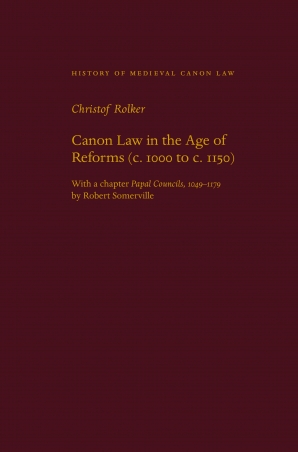
BOOK: Christof ROLKER, Canon Law in the Age of Reforms (c. 1000 to c. 1150), (Washington: The Catholic University of America, 2023). ISBN: 9780813237572


ABOUT THE BOOK

This monograph addresses the history of canon law in Western Europe between ca. 1000 and ca. 1150, specifically the collections compiled and the councils held in that time. The main part consists of an analysis of all major collections, taking into account their formal and material sources, the social and political context of their origin, the manuscript transmission, and their reception more generally. As most collections are not available in reliable editions, a considerable part of the discussion involves the analysis of medieval manuscripts. Specialized research is available for many but not all these works, but tends to be scattered across miscellaneous publications in English, German, French, Italian, and Spanish; one purpose of the book is thus to provide relatively uniform, up-to-date accounts of all major collections of the period. At the same time, the book argues that the collections are much more directly influenced by the social milieux from which they emerged, and that more groups were involved in the development of high medieval canon law than it has previously been thought. In particular, the book seeks to replace the still widely held belief that the development of canon law in the century before Gratian’s Decretum (ca. 1140) was largely driven by the Reform papacy. Instead, it is crucial to take into account the contribution of bishops, monks, and other groups with often conflicting interests. Put briefly, local needs and conflicts played a considerably more important role than central (papal) ‘reform’, on which older scholarship has largely focused.


ABOUT THE AUTHOR

Christof Rolker is a professor of medieval history at the University of Bamberg.


More information can be found here.

16 April 2024

SYMPOSIUM: Bien commun ou bien d’utilité publique ? Archéologie d’une notion et d’une pratique au Moyen Âge (Namur: Université de Namur, 7 MAY 2024)

(Image source: site PraME - UNINAMUR)


S’il est une notion qui a fait couler beaucoup d’encre et dont le sens continue pourtant à nous échapper en grande partie, c’est bien celle de bien commun. Ce concept éminemment actuel, ne cesse de susciter l’intérêt, tant au sein du milieu académique qu’auprès des acteurs du monde politique, économique, agricole, ou humanitaire. Dans son acception éthique, le bien commun semble toutefois de plus en plus considéré comme un idéal utopique, d’où le déplacement de la focale sur la notion de biens communs et de communs, dans la lignée des travaux d’Elinor Ostrom.  

Au Moyen Âge, le bonum commune,compris comme fin ultime de tout individu inscrit au sein d’une communauté, fonde toute la grammaire politique, et plus particulièrement à partir de la seconde moitié du XIIIe siècle, sous l’impulsion de la redécouverte du corpus politique aristotélicien. Quoiqu’omniprésente, la notion est comprise et utilisée de manière extrêmement diverse, selon des finalités qui semblent souvent incompatibles avec l’universalité même qui sous-tend l’idée de « commun ».

Plusieurs travaux récents ont mis en lumière le caractère extrêmement vague et ambigu de la définition même du bonum commune ; dans l’œuvre de Thomas d’Aquin, pour ne citer que lui, le concept est mobilisé à maintes et maintes reprises, dans un sens qui est loin d’être univoque, équivocité renforcée par l’absence de toute tentative définitoire par le docteur angélique. Cette polysémie, qui ne va pas sans une certaine plasticité, explique les usages extrêmement variés voire parfois opposés de la notion de bien commun au Moyen Âge, tantôt utilisée comme fer de lance de l’absolutisme pontifical, tantôt pour justifier l’existence d’institutions contraignantes censées empêcher l’avènement d’un gouvernement tyrannique. Cette journée d’étude cherche à réinterroger la notion même de bonum commune en s’intéressant aux conditions dans lesquelles celle-ci se voit mobilisée, en s’intéressant aux éventuels conflits qui surgissent dans sa confrontation avec le réel historique, tout en guettant les solutions proposées par les auteurs pour concilier théorie et pratique du bien commun, dans une approche comparable à l’analogie théologico-politique proposée par l’Aquinate. 


PROGRAMME

  • 9h   Nicolas Michel et Laura Rizzerio (Université de Namur) – Introduction

Session 1 : Présidence Xavier Hermand (Université de Namur)

  • 9h30  Sumi Shimahara, (Université Paris IV) — Le Bien commun dans le haut Moyen Age (Ve-XIe s.).
  • 10h15 Corinne Leveleux-Teixeira (Université d’Orléans) — Biens communs et nécessité dans la pensée canonique médiévale.
  • 11h15 Julien Le Mauff (Université de Lille) — « Chescun cure d’une chose en tant comme elle luy touche ». Quel bien, pour quel commun ?.
  • 12h Carole Mabboux (Université Paris 8) — Bien commun et bien de la Commune. Normes légales et didactiques (Italie, XIIIe-XIVe siècles).

Session 2 : Présidence Laura Rizzerio (Université de Namur)

  • 14h Paolo Evangelisti (Archivio storico della Camera dei deputati) — Money and markets: where trust might be expected. Architectures of creditworthiness in Franciscan economic pedagogy.
  • 14h45 Matthias Nebel (Universidad Popular Autónoma del Estado de Puebla) — Schola d’arte vénitienne: le travail comme un bien commun.
  • 15h45 Antonio Petagine (Université Roma Tre) — Thomas d’Aquin a-t-il soutenu la doctrine de la primauté du bien commun ?
  • 16h30 Alban Grandjean (Université Libre de Bruxelles) — Le Bien Commun dans la pensée de Jean d’Anneux. Un idéal politique à l’épreuve des prétentions matérielles des princes au XIVe siècle.


More information can be found here.

02 February 2024

WORKSHOP: 'Droit et littérature. Un regard croisé sur les textes médiévaux' (Geneva: Université de Genève, 16 FEB 2024)


 Droit et littérature. Un regard croisé sur les textes médiévaux


Journée d'études ¦ le 16 février 2024

Uni Mail, Salle M1193 ¦ Bd du Pont d'Arve 40 ¦ 1205 Genève


Comité scientifique et d'organisation :

Dr. Ignazio Alessi

Dr Gavino Scala


09.00 - 09.15 Introduction

Dr. Ignazio ALESSI et Dr. Gavino SCALA (Université de Genève)


09.15 - 10.00

Prof. Sara MENZINGER (Università degli studi Roma Tre)

Dante and the Law. Notes from some recent studies


10.00 Pause café


10.30 – 11.30

Cassandre CRESPIN (Sorbonne Université, Paris)

La fiction judiciaire amoureuse au Moyen Âge (XIIe-XVe s.)

Marta MILAZZO (Università degli studi di Padova)

« Droit non »: una formula da rileggere ancora


11.30 – 12.30

Farzad FALLAH (Geneva Graduate Institute of International and Development Studies,

Genève)

Speculative interpretation in the jurisprudence Muhammad ibn Idris al-Shafi’i:

narrativization in the service of textualism

Dr. Vincenzo Roberto IMPERIA (Università degli studi di Palermo)

Intrecci letterari e giuridici nell’epistolario di Pierre de Blois


12.30 Repas de midi


14.15 - 15.00

Prof. Claudio LAGOMARSINI (Università degli studi di Siena)

« Par bataille ou par juise » : la pratique de l’ordalie dans le Lancelot-Graal


15.00 – 16.00

Federico NOVELLO (Università degli studi di Siena –Universität Zürich)

Processo al lupo, processo all’uomo: la giustizia ne « Levallet aus douze fames »

Davide NOVATI (Scuola Normale Superiore, Pise –Universität Zürich)

Il supplizio del duca di Bellegarde e altri casi di punizioniesemplari nella narrativa romanza

medievale


16.00 pause café


16.30 - 17.00

Prof. Dijana ZRNIC (Banja Luka University)

Dušan’s code, between law and literature


17.00 – 18.00

Chen CUI (Université de Lausanne – Birkbeck College,London)

Entre homélie et textes juridiques: nouvelles perspectivessur la valeur littéraire de l’oeuvre

de l’archevêqueWulfstan d’York

Dr. Matthew CLEARY (Max Planck Institute, Heidelberg)

Exploring legal and linguistic dimensions in late medieval English jurisprudence: William

Lyndwood’s « Provinciale» and inheritance practices


18.00 CLÔTURE

Dr. Adrien WYSSBROD (Université de Fribourg – Institutde recherche A. Piaget,

Neuchâtel)


18.15 Apéritif dînatoire

06 October 2023

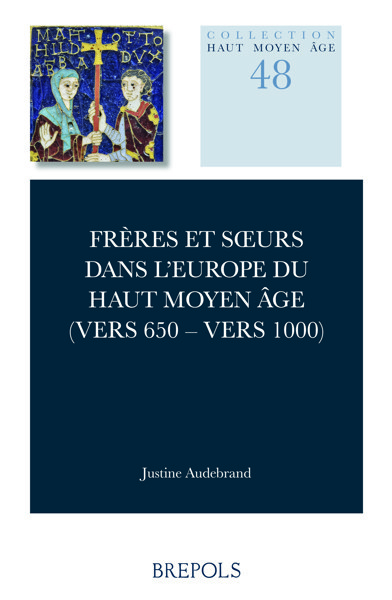
BOOK: Justine AUDEBRAND, Frères et sœurs dans l’Europe du haut Moyen Âge (vers 650 – vers 1000) (Turnhout: Brepols, 2023). ISBN: 9782503604961

(Image source: Brepols)


ABOUT THE BOOK

Les relations entre frères et sœurs constituent encore un champ mal exploré de l’étude de la famille pour la période allant de 650 à 1000. Pourtant, ce lien est un élément essentiel des sociétés du haut Moyen Âge, tant dans les mondes franc et germanique qu’en Angleterre. Dans les discours de l’Église, il est même un idéal. En outre, dans le contexte démographique médiéval, la relation adelphique - c'est-à-dire entre frères et sœurs - est souvent la plus pérenne : face à la mort précoce des parents et à un veuvage fréquent, elle accompagne les individus tout au long de leur existence. Étudier les relations adelphiques est également une manière d’envisager les relations entre hommes et femmes grâce aux dernières avancées de recherche sur le genre. Pour étudier ces liens spécifiques, il convient de s'intéresser à une large documentation et d'emprunter aux outils de la sociologie et de l'anthropologie. La relation adelphique apparaît alors une donnée importante des sociétés du haut Moyen Âge et que son étude permet de complexifier l'histoire de la famille sur cette période.


ABOUT THE AUTHOR

Justine Audebrand est agrégée et docteure en histoire médiévale, spécialiste de l'histoire de la famille et du genre au début du Moyen Âge, chercheuse au Laboratoire de Médiévistique Occidentale de Paris (LaMOP).


TABLE OF CONTENT

Introduction

  • Faire l'histoire des frères et soeurs
  • Une approche comparatiste

Chapitre 1 : Parler des frères et soeurs

  • Un vocabulaire pluriel
  • Entre le biologique et le spirituel
  • Les tournants des VIIIe et Xe siècles

Chapitre 2 : Définir les groupes adelphiques

  • Aux marges du groupe
  • La place de chacun

Chapitre 3 : De l'enfance à l'âge adulte

  • Le rôle des parents
  • Se substituer aux parents

Chapitre 4 : L'économie du pouvoir

  • Modèles royaux
  • Dans le reste de l'aristocratie

Chapitre 5 : Gérer les biens

  • Un patrimoine commun
  • Affaires de famille : les échanges au sein du groupe
  • Les monastères familliaux

Chapitre 6 : Dans l'initimité

  • Frères et soeurs solidaires
  • Sentiments adelphiques
  • L'inceste entre frère et soeur

Chapitre 7 : En guerre

  • Choisir le même camp
  • La famille déchirée

Chapitre 8 : À l'épreuve de veuvage

  • Le frère entre soutien utile et tutelle encombrante
  • La réaffirmation du lien entre soeurs

Chapitre 9 : Face à la mort

  • Assister les mourants
  • Commémorer ses frères et soeurs
  • Après la mort

Conclusion


More information can be found here.
10 July 2023

BOOK: Isabelle ROSE, Le mariage des prêtres, une hérésie ? Genèse du « nicolaïsme » (Ier-XIe siècle) (Paris: PUF, 2023). ISBN: 9782130853268


ABOUT THE BOOK

Jusqu’au XIe siècle, beaucoup de prêtres catholiques étaient mariés, sans que cela pose le moindre problème. En 1059, le milieu pontifical se mit brusquement à considérer ces clercs-là comme des pervers sexuels, mais surtout comme des hérétiques, les Nicolaïtes, qui étaient proches d’autres déviants (les simoniaques) et qu’il fallait éradiquer. Menée du Ier au XIe siècle, l’enquête explore comment l’institution catholique a construit et imposé la norme du célibat ecclésiastique, en instrumentalisant l’accusation d’hérésie. Elle montre aussi comment cette dernière a permis d’ébaucher une monarchie d’Église, centrée sur Rome, dans laquelle le souverain pontife disposait désormais d’outils de coercition interne. Plus largement, l’ouvrage retrace comment a émergé en Occident, à travers l’interdiction du mariage aux prêtres, un groupe survalorisé, exclusivement masculin et détenteur du capital culturel et économique : la caste sacerdotale.


ABOUT THE AUTHOR

Isabelle Rosé est maîtresse de conférences en histoire du Moyen Âge à l’Université Rennes 2. D’abord spécialiste du monde monastique, ses travaux portent sur l’Église au cours du premier Moyen Âge. Elle travaille désormais sur l’histoire des hérésies cléricales. Dernier ouvrage co-publié : Aux marges de l’hérésie. Inventions, formes et usages polémiques de l’accusation d’hérésie au Moyen Âge (Presses universitaires de Rennes, 2017).


TABLE OF CONTENTS

Partie I : 1059, année hérétique

  • Chapitre 1. L’année 1059 dans la tourmente
  • Chapitre 2.  Pierre Damien, pourfendeur de la sexualité et des hérésies cléricales
  • Chapitre 3.  Une définition originale de l’hérésie des Nicolaïtes en 1059

Partie II : Retour aux sources de la cléricalisation de l’hérésie des Nicolaïtes (Ier-Xe siècle) 

  • Chapitre 4.  “Invention” précoce et longue polysémie de l’hérésie des Nicolaïtes au cours d’une longue séquence patristique  (IIe-VIe siècle)
  • Chapitre 5. Actualisations de Nicolas et des Nicolaïtes pendant le haut Moyen Âge  (VIIe-Xe siècle)
  • Chapitre 6. Aux origines des « hérésies jumelles » : les déviances « simoniaque et des Néophytes »

Partie III : Jeux et enjeux des hérésies cléricales dans la construction de l’Ecclesia grégorienne (1049-1059)

  • Chapitre 7. Un banc d’essai ? La cléricalisation par Rome de l’heresis Nicolaitarum, en tant que déviance grecque (1054)
  • Chapitre 8. War on archbishops ! La primatie romaine en action contre les archevêques hérétiques en 1059
  • Chapitre 9. Le rêve éveillé d’une monarchie d’Église ? Pierre Damien, le pape et les hérésies cléricales


More information can be found here.

27 June 2023

CFP: Seventeenth International Congress of Medieval Canon Law (ICMCL) - Canterbury, UK, 7-13 July 2024 [DEADLINE 15 DEC 2023]


(Canterbury Cathedral. Source: University of Kent)


The 17th International Congress of Medieval Canon Law, co-sponsored by ICMAC (Iuris Canonici Medii Aevi Consociatio/International Society of Medieval Canon Law) will be based at the University of Kent campus in Canterbury, UK, between Sunday, 7 July, and Saturday, 13 July 2024. These congresses take place every four years on alternate sides of the Atlantic and constitute the leading academic conferences in the field of medieval canon law. Traditionally they have drawn scholars from many countries, including not only medievalists and lawyers, but also those who study related fields, such as Western jurisprudence and legal norms, Roman law, ecclesiastical and papal history, theology and biblical exegesis, manuscript studies, and the history of culture, society, and ideas.

ICMAC, the congress organisers Prof. Barbara Bombi FBA, Dr Edward Roberts, and Prof. Peter Clarke and congress programming committee invite proposals for individual 20-minute papers and for sessions (of 3 x 20-minute papers or 4 x 15-minute papers) on any aspect of medieval canon law, including, but not limited to, the following themes:

  • Texts and Jurisprudence
  • Influence of the ius commune on the Western Legal Tradition and International Law
  • Canon Law and Local Ecclesiastical History
  • Canon Law, Theology, and Pastoral Care
  • Medieval Law in Comparative Perspective

Proposals should be submitted as Word attachments via email to the congress address (icmcl2024@gmail.com) no later than 15 December 2023.

An individual paper proposal should comprise: paper title and language of presentation; a brief abstract (100-150 words); the speaker’s details (name; academic status; institutional affiliation; email address).

A session proposal should comprise the above for each paper proposed, together with: the details (as for speakers above) of the session organiser and session chair; the session title; a brief rationale (50-100 words) for the session, i.e., how the papers are related.

Proposals are welcomed from those at all stages of their academic career, including PhD students and post-doctoral researchers, as well as independent scholars. Papers may be delivered in these languages: English; French; German; Italian; or Spanish. Scholars not presenting in English are encouraged to use PowerPoint presentations and/or provide written English summaries of their papers.

Regular sessions will not feature papers on text-editing projects (but can include papers on manuscript studies). Updates on such projects will be showcased in a poster session during the Congress. Scholars who wish to present on such projects may submit two proposals if they desire, one for the poster session and another for a regular session.

The organisers would especially welcome proposals on the theme ‘Bridging the Divide’, focusing on Canterbury as a place of significance in the history of Western Christianity and medieval canon law before and after the Protestant Reformation and as the centre of the global Anglican communion. Contributions to this theme might cover such topics as:

  • Canterbury’s role in the compilation and diffusion of medieval canon law in the English Church
  • Canon law and local jurisdictions: application of canon law in the archbishops’ and other local church courts
  • Canon law and secular law: the impact of the Becket crisis on medieval canon law (especially after the Constitutions of Clarendon in 1164) and its long-term legacy
  • Global Anglicanism: the continuing influence of medieval canon law in the Anglican communion and other post-Reformation churches

Although the chronological focus of the Congress is typically c. 500 – c. 1500, we would also welcome contributions from early modernists to this theme, which is designed to bridge the all too separate study of pre- and post-Reformation Christianity and explore continuities and synergies in the history of canon law over the longue durée. Historians of early modern Catholicism are also invited to offer papers exploring continuities of pre-Tridentine canon law in Europe and the New World, including among English Catholics.

In addition, we would welcome contributions to the strand ‘Canon law and governance’, which will explore how the study of medieval canon law can help inform current public policy debates, notably on the role of international law, electoral systems, constitutional reform, and representative government. The strand will thus focus on these four topics:

  • Canon law and international law: the transnational influence of medieval canon law on the emergence of national legal systems
  • Constitutionalism and canon law: the interaction of medieval canon law and secular law in the development of governing institutions
  • Communities and canon law: the role of medieval canon law in the emergence and definition of groups and communities, such as women and clergy
  • Elections and consent: the influence of medieval canon law on the role of elections and consent in government

Papers on other aspects of medieval canon law and governance, such as human rights, are also welcome. The purpose of this strand is to show the continuing relevance of medieval canon law to political issues and appeal to a broader public audience.  Invited speakers in this special strand include:

  • Orazio Condorelli (University of Catania, Italy)
  • Christof Rolker (University of Bamberg, Germany)
  • Caroline Humfress (University of St Andrews, UK)
  • Nicholas Vincent FBA (University of East Anglia, UK)
  • Sara Butler (Ohio State University, USA)
  • Charles West (University of Sheffield, UK)
  • Dr Joseph Canning (Queens’ College, Cambridge, UK)
  • Dr Danica Summerlin (University of Sheffield, UK)
  • Kenneth Pennington (Catholic University of America, Washington DC)

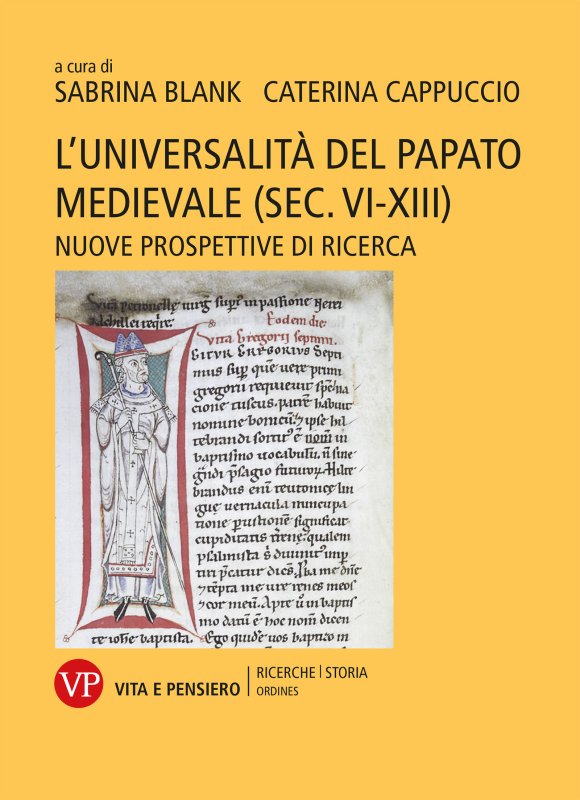
16 February 2023

BOOK: Sabrina BLANK, Caterina CAPPUCCIO (eds.), L’universalità del papato medievale (sec. VI-XIII). Nuove prospettive di ricerca (Milan: Vita e Pensiero, 2022). ISBN: 9788834348390


ABOUT THE BOOK

Il volume presenta i risultati del convegno internazionale tenutosi alla Bergische Universität di Wuppertal nel settembre 2019. I contributi raccolti si confrontano con la seconda affermazione contenuta nel dictatus papae di Gregorio VII (Quod solus Romanus pontifex iure dicatur universalis). L’affermazione dell’universalità del papato, già a più riprese indagata dalla storiografia europea, è qui l’oggetto delle ricerche di giovani studiosi e studiose sia da un punto di vista normativo, come nei casi delle elezioni papali, sia nella riflessione teologica di età altomedievale. Questa pubblicazione si inserisce nella linea delle più recenti e affermate tendenze storiografiche della medievistica e dedica particolare attenzione non solo alle norme alla base dell’universalità del papato, ma anche all’applicazione di tali teorie attraverso l’analisi di alcuni vettori dell’interazione tra il papato e le realtà locali. Lo studio di questi attori dell’interazione costituisce la base imprescindibile per la comprensione del papato medievale nelle sue relazioni con le province ecclesiastiche, con l’intento di verificare e approfondire il rapporto esistente tra norma e prassi.


ABOUT THE EDITORS

Sabrina Blank ha conseguito il dottorato di ricerca in Storia medievale presso la Bergische Universität Wuppertal. Le sue ricerche si concentrano sulle elezioni papali e la non giudicabilità del papato dall´età tardo antica al pontificato di Alessandro III. Attualmente è wissenschaftliche Mitarbeiterin presso la RWTH ad Aachen.

Caterina Cappuccio ha conseguito il dottorato di ricerca in Storia medievale presso la Bergische Universität Wuppertal in cotutela di tesi con l’Università Cattolica del Sacro Cuore. Le sue ricerche riguardano la curia romana nel XII e XIII secolo, con particolare attenzione all’istituzione della cappella papale. Attualmente è wissenschaftliche Mitarbeiterin presso la Bergische Universität di Wuppertal.


TABLE OF CONTENT

I. TEORIZZAZIONI DEL PRIMATO PETRINO

  • SABRINA BLANK: …electio uero eorum diuino iudicio est reseruata: Nichtjudizierbarkeit und Papstwahlen in den Kanonessammlungen des 11. und 12. Jahrhunderts
  • MARCO CRISTINI: In toto orbe primus omnium sacerdotum: Pope Vigilius, Arator and the Petrine Primacy
  • MARCO SIRTOLI: Poeti carolingi e primato della Sede Apostolica nel IX secolo

II. PROSPETTIVE CURIALI E PATRIMONIUM PETRI

  • ANDREA A. VERARDI: Le elezioni papali nel Liber Pontificalis romano (secoli VI-IX)
  • ENRICO VENEZIANI: Sed patitur Caelestis, ego nescio cur, aliquando quae nollet: alcune considerazioni sull’elezione di Onorio II
  • STEPHAN PONGRATZ: Kritische Partizipation – Kardinäle und Kurie in den Papstviten des Kardinals Boso
  • ERIC MÜLLER: Kaufmannbankiers und Römische Kurie. Die Rolle der mercatores im sogenannten Protokollbuch des Bassus de Civitate (1269-1276)
  • ALBERTO SPATARO: Potere spirituale e temporale nel governo del Patrimonium Sancti Petri tra XII e XIII secolo. Una proposta di rilettura a partire dal caso di Assisi

III. STRUMENTI DELL’UNIVERSALIZZAZIONE

  • MARIA VEZZONI: Alexander II and the universalis Ecclesia: from praxis to theory
  • CATERINA CICCOPIEDI: I vescovi del Nord Italia: strumento del governo papale?
  • CATERINA CAPPUCCIO: Die päpstliche Kapelle: Entwicklung und Wirksamkeit einer Institution der römischen Kurie
  • FRANCESCO D’ANGELO: La Scandinavia da terra di missione a fidelis Romanae ecclesiae. L’affermazione dell’autorità papale in Scandinavia (secoli XI-XII)


More information can be found here.

16 January 2023

BOOK: Maria FUSARO, Andrea ADDOBBATI & Luisa PICCINNO (eds.), General Average and Risk Management in Medieval and Early Modern Maritime Business (London: Palgrave, 2023), ISBN 978-3-031-04118-1 (OPEN ACCESS)

(image source: Palgrave)

About the book:
This book is open access, which means that you have free and unlimited access Explores risk management in medieval and early modern Europe, focusing on 'General Average' Investigates how stakeholders minimised risk in dangerous commercial shipping Illustrates changing concepts of political economy across space and time


Table of contents (15 chapters)

  1. Front Matter

    Pages i-xxvi