Search

Showing posts with label Medieval Canon Law. Show all posts

23 June 2026

SEMINAR: “Old Enough to Marry? Age, Memory, and Delay in York Cause Paper E 23, 1332–33” (online, 24 JUN 2026)


(Image source: University of York Digital Collections, York Cause Papers, CP E 23/1)

On Wednesday, 24 June 2026, Matthew Cleary will present a paper entitled “Old Enough to Marry? Age, Memory, and Delay in York Cause Paper E 23, 1332–33” as part of the Centre for Ius Commune seminar series at Adam Mickiewicz University. The seminar will be held online on Wednesday, 24.06.2026 at 11 am CEST.

The paper examines Crane c. Draycote (York Cause Paper E 23, 1332–33), a matrimonial dispute that turned on questions of age, consent, memory, and delay. At the heart of the case was the validity of vows exchanged eight years earlier, when Alice Draycote and William Crane were in their early teens. Witnesses for Alice maintained that both parties had been fourteen when they exchanged verba de presenti, while William claimed that he had been only thirteen and had been coerced into the agreement.

When Alice sought a judgment years later, the court was required to determine whether a valid marriage had been formed and how the passage of time affected the parties’ claims. The case reveals how canon law demanded precise temporal reckoning while generating uncertainty when remembered and lived experiences of age, consent, and delay did not fit neatly within legal categories.

The seminar offers tan opportunity to discuss the paper before its presentation at the 2026 International Medieval Congress in Leeds. At the IMC, the paper will form part of Session 1133, “Medieval Canon Law, II: Marriage and Timing”, scheduled for Wednesday, 8 July 2026, from 11:15 AM to 12:45 PM. The session is sponsored by the Iuris Canonici Medii Aevi Consociatio / International Society of Medieval Canon Law (ICMAC).

Those interested in attending are invited to email Matthew Cleary at matthew.cleary@amu.edu.pl to receive the meeting link.


26 August 2025

BOOK: Justin M. ANDERSON and Atria A. LARSON (eds.), Thomas Aquinas and Medieval Canon Law (Washington D.C.: Catholic University of America Press, 2025), 402 p. ISBN: 9780813239347

Abstract: 

Thomas Aquinas and Medieval Canon Law bridges, for the first time, two worlds of scholarship that have never been explored in book-length form and investigates an under-researched area in Thomistic studies, namely the question of how Thomas Aquinas engaged the ecclesiastical law and jurisprudence of his day.

Neither historians of medieval canon law nor experts on Thomas’s thought have previously paid much attention to the canon law tradition as a source for Thomas’s work and an influence on his thought. But, as this volume shows, his consideration of mendicant life, law, justice, oaths, penance, clerical orders, the Eucharist, baptism, property, commerce, marriage and more reveal engagement with key canon law texts and concepts and with the jurisprudence of major canonists. The book uncovers how Aquinas encountered canonical regulations and jurisprudence as a Dominican, an educator in both theology and pastoral care, and a participant in the secular-mendicant controversy. In his life, education, community, and his way of thought, Thomas Aquinas could not avoid and necessarily encountered and dealt with the canonical tradition. He did so in a distinctive way, working as he did with his theological and philosophical source material to craft his own great synthesis. What this volume shows, if nothing else, is that the canon law tradition should be taken into consideration when assessing Thomas’s synthetic thought.

Following the editors’ introduction, thirteen scholarly contributions and an epilogue explore Aquinas’s interaction with medieval canon law through four major themes: Dominican Matters; Foundations Matters of Faith, Truth, and Law; Moral Matters; and Sacramental Matters. Approximately half the contributors are specialists from the field of medieval canon law, and half are grounded in Thomistic tradition. The result is a unique and scholarly contribution to two major research areas that may open avenues for similar studies of other key figures in the scholastic tradition.

About the editors:
Justin M. Anderson is professor and Chair of Moral Theology at Immaculate Conception Seminary School of Theology at Seton Hall University. 
Atria A. Larson is associate professor of medieval christianity at Saint Louis University, and the author of Gratian's Tractatus de penitentia: A New Latin Edition with English Translation and Master of Penance: Gratian and the Development of Penitential Thought and Law in the Twelfth Century.


More information can be found here.

17 April 2025

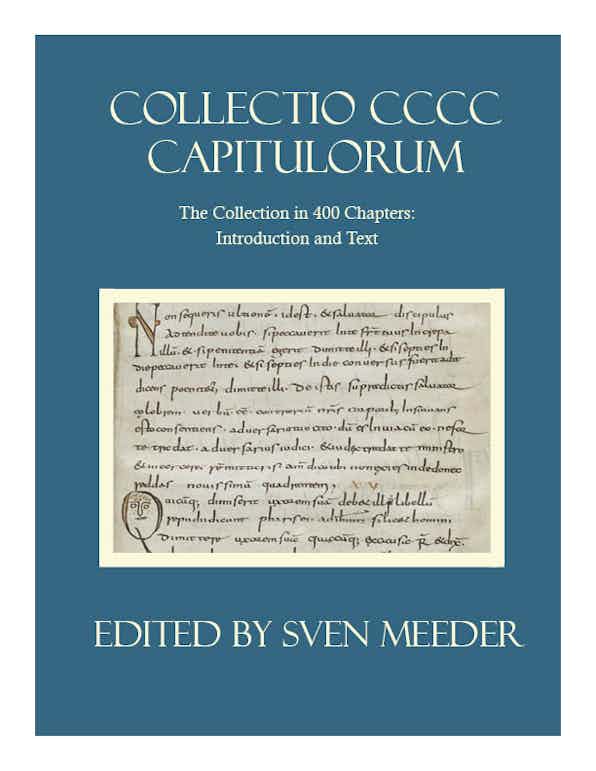
BOOK: Sven MEEDER (ed.), Collectio CCCC capitulorum, The Collection in 400 Chapters. Introduction and Text (Washington DC: The Catholic University of America Press, 2025), 300 p. ISBN : 978-0-81323-847-0, USD 85,00


Abstract: 

Surviving in three ninth-century manuscripts, the collection of canon law known as the Collectio 400 capitulorum is a remarkable and understudied witness to the scholarly vitality of the Carolingian period. Its 404 chapters offer ecclesiastical rules and moral guidelines taken from an unusually wide variety of authoritative sources. In addition to the customary canonical texts, such as the acts of the ecumenical councils and papal letters, the compiler of this collection drew his canons from the bible, Roman law, local Gallic synods, the Church Fathers, as well as Frankish and Insular penitential works.
Although the Collectio 400 capitulorum is a so-called systematic collection, eminent scholars of canon law commented on its lack of structure. Even ‘with the best will in the world’, the collection’s system eluded them. Despite its flaws, however, there is evidence that the collection gained some popularity in the ninth century, apparently providing the basis for the Poenitentiale Martenianum, directly or indirectly influencing Hrabanus Maurus and Benedictus Levita. The ninth-century appreciation is understandable for, as one of the many products of the vigorous canonical activity of the eighth and ninth centuries, the Collectio 400 capitulorum impresses in its handling of the canonical material as well as the breadth of sources and the topics covered.
This book constitutes the first in-depth study of this intriguing canonical collection, with a detailed description of the extant manuscript witnesses, its sources, and its influence. The critical edition offers scholars of the early Middle Ages in general and canon law in particular access to an instructive, if unpolished, product of Carolingian legal thought.


On the author

Sven Meeder is Lecturer in Medieval History at Radboud University Nijmegen.


More information can be found here.

28 March 2025

BOOK: Melodie H. EICHBAUER, Law in a Culture of Theology. The Use of Canon Law by Parisian Theologians, ca. 1120–ca. 1220 (London: Routledge, 2025), 278 p., ISBN: 9781032736082

(Image source: Routledge)


About the book

Law in a Culture of Theology: The Use of Canon Law by Parisian Theologians, ca. 1120–ca. 1220 considers the study of law within its intellectual environment. It demonstrates that theologians associated with the schools of Paris in the twelfth century, particularly Peter the Chanter and his circle, had a working knowledge of Romano-canonical tradition and thought about the human context of the law, which, in turn, reflected the environment in which each master worked. It begins by showing the extent to which law was woven into the fabric of the schools of Paris, and follows with individual case studies.

These case studies—marriage in Hugh of St. Victor’s De Sacramentis and Peter Lombard’s Sententiae, excommunication in Peter the Chanter’s Summa de sacramentis et animae consiliis, crusade activity and heresy in Robert of Couçon’s Summa penitentiae, homicide in Robert of Flamborough’s Liber poenitentialis, and the faces of greed in Thomas of Chobham’s Summa confessorum—demonstrate how each theologian drew upon legal thought, for what end he was using it, and how his use of law fit into contemporary legal thinking. A competency in law proved valuable to, and was tailored for, different types of ecclesiastical  roles: teachers showing students how to analytically navigate complex questions of pastoral care, papal judge-delegate on the cusp of full-time administration on behalf of the papacy, penitentiarius of St. Victor and the students at the University of Paris, or diocesan management.

This book will be a useful resource for all students and researchers interested in medieval canon law, medieval theology and pre-modern law.


About the author

Melodie H. Eichbauer is Professor of Medieval History at Florida Gulf Coast University, U.S.A. Her research focuses on the dissemination of legal knowledge; the interpretation of law; and the ways in which social, political, and intellectual developments and trends shaped both between c.1000 and c.1500. She authored the second edition of Medieval Canon Law, an expanded and revised version of the first edition by James A. Brundage (2023). She is the editor of A Cultural History of Genocide, Vol. 2: The Middle Ages (2021), the co-editor with Danica Summerlin of The Use of Canon Law in Ecclesiastical Administration, 1000–1250 (2018); and the co-editor with Kenneth Pennington of Law as Profession and Practice in Medieval Europe: Essays in Honor of James A. Brundage (2011).


Table of Contents

Introduction
1. Setting the Stage: Sharing and Producing Legal Collections in Northern France, ca. 1050–ca. 1130
2. Twelfth-Century Paris Theologians and their Engagement with Legal Knowledge
3. Hugh of St. Victor, Peter Lombard, and Northern French Canonical Collections: Intellectual Interplay on Marriage at the Dawn of the University of Paris
4. Peter the Chanter: Using Excommunication to Teach the Pragmatics of Pastoral Care
5. Robert of Courçon: Administering Crusading Activity and the Fight Against Heresy
6. Robert of Flamborough: Penitentiarius to the Students of Paris and Homicide
7. Thomas of Chobham: The Deadly Sin of Greed
Conclusion


More information can be found here.

21 February 2024

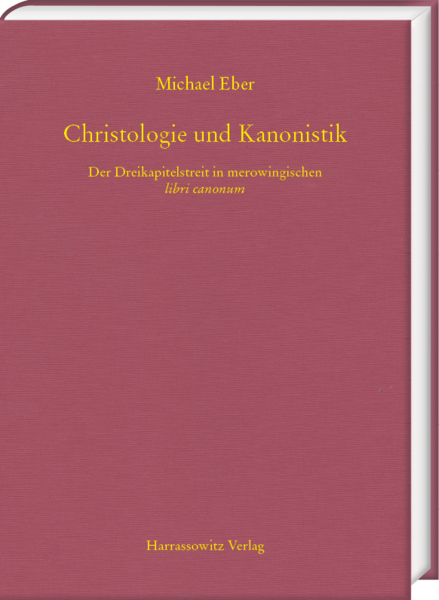
BOOK: Michael EBER, Christologie und Kanonistik. Der Dreikapitelstreit in merowingischen libri canonum (Wiesbaden: Harrassowitz Verlag, 2023). ISBN: 9783447121361

(Image source: Harrassowitz Verlag)


ABOUT THE BOOK

Um 550 beschimpfte Bischof Nicetius von Trier († 566/569) Kaiser Justinian († 565) als „Sohn des Teufels“, weil jener die sogenannten Drei Kapitel als häretisch verdammt hatte. Der sich darin zeigende ‚Dreikapitelstreit‘, eine Episode der seit dem 5. Jahrhundert tobenden Kontro-versen um die Christologie, erschütterte den gesamten Mittelmeerraum. Anders als die grobe Polemik des Nicetius vermuten lässt, zeigt vor-liegende Studie, dass sich die Bischöfe des merowingischen Frankenreichs äußert differenziert zum Dreikapitelstreit positionierten. Zumindest einige von ihnen legten dabei auch eine überraschende Offenheit für den Neo-Chalcedonismus an den Tag, jene theologische Tradition, die Justinians Religionspolitik zugrunde lag. Dies wird aufgezeigt ausgehend von drei gallischen Kirchenrechtssammlungen des späten 6. Jahrhun-derts, deren so idiosynkratische wie – auf den ersten Blick – chaotische Textzusammenstellung sehr bewusst erfolgte und eine auf theologische und ekklesiologische Kohärenz bedachte Auseinandersetzung mit den christologischen Debatten erkennen lässt. Der Band zeichnet somit ein Bild der merowingischen Episkopatsmitglieder als engagierte und selbst-bewusste Disputanten in den Fragen, die der Dreikapitelstreit aufgewor-fen hatte. Anhänge bieten zudem den Text eines bisher vernachlässigten Briefs des Bischofs Cyprian von Toulon († ca. 546) zur Christologie mit deutscher Übersetzung sowie ein kommentiertes Inhaltsverzeichnis der bislang nur unzureichend beschriebenen Collectio Sancti Mauri.


More information can be found here.

20 October 2023

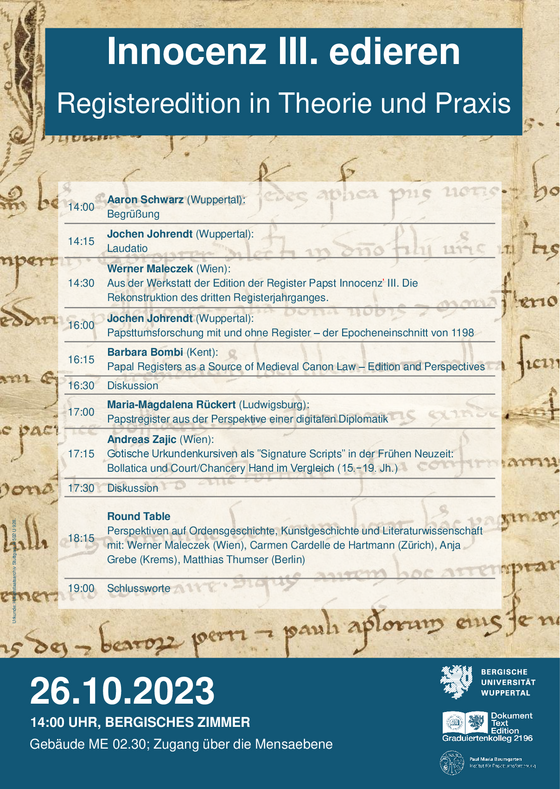
SEMINAR: Innocenz III. edieren – Registeredition in Theorie und Praxis (Wuppertal: Bergische Universität Wuppertal, 26 OCT 2023)


Unter den Quellen zur Erforschung des Papsttums im Mittelalter nehmen die päpstlichen Kanzleiregister, die seit 1198 durchgehend überliefert sind, eine besondere Stellung ein. Sie bieten, obwohl nur einen Bruchteil der in der Kanzlei der Kurie ausgestellten Urkunden umfassend, einen sowohl geographischen als auch thematischen Querschnitt durch die verschiedensten Empfänger und Agenden, mit denen die Päpste in der Ausübung ihres Amtes befasst waren. Zugleich bündeln sie einen Teil der ansonsten weit verstreuten originalen Urkundenüberlieferung.

In einer Reihe von Vorträgen werden Fragen der Editionstheorie sowie ihrer praktischen Anwendung zur Diskussion gestellt und der Wert der Register für die Geschichtsforschung herausgearbeitet werden. Vor welche methodischen Herausforderungen sehen sich Editor:innen angesichts eines fragmentierten oder ganz verlorenen Textzeugen gestellt? Wo kann eine Rekonstruktion ansetzen? Welche Bedeutung haben die Papstregister für unser Wissen um und unser Verständnis des hoch- und spätmittelalterlichen Europa? Welche Bedeutung haben sie im Kontext des sich ausbildenden und zunehmend in die europäische Rechtskultur diffundierenden kanonischen Rechts, seiner Verfeinerung und Kodifikation? Lassen sich digitale Methoden für die Erforschung von Urkunden für diese Quellengattung fruchtbar machen? Und: was kann eine diachrone Betrachtung dieser einzigartigen Serie vor dem Hintergrund sich wandelnder Schriftlichkeit für das hilfswissenschaftliche und kulturgeschichtliche Verständnis von Schrift leisten?

In einem Round Table soll anschließend den Erkenntnispotenzialen aus der Sicht verschiedener Disziplinen nachgegangen werden. Neben der Ordensgeschichte als Teil der Geschichtsforschung stehen vor allem die (vergleichende) Literaturwissenschaft und die Kunstgeschichte im Vordergrund. Wie lässt sich die Entstehung und Entwicklung einzelner religiöser Orden anhand der päpstlichen Privilegien und Mandate, die in den Registern überliefert sind, nachverfolgen? Können Papstbriefe nicht nur als rechtliche Dokumente, sondern in ihrer teils hochkomplexen Syntax und ausgefeilten Stilistik gar als literarische Texte verstanden werden? Handelt es sich bei den Registern um nüchterne Verwaltungsrepertorien oder: was sagt uns die grafische Ausgestaltung mit teils aufwendigen, teils humorvollen oder schlicht zierenden Initialen und Ornamenten über den „Sitz im Leben“ der Kurie? Welche Einflüsse zeitgenössischer Kunstentwicklungen und -konventionen lassen sich ausmachen?

Die interdisziplinäre Perspektive soll zu neuen Forschungsfragen anregen und die Quellengattung Papstregister als Gesamtphänomen besser verstehen helfen.


PROGRAM

  • 14:00 Aaron SCHWARZ (Wuppertal): Begrüßung
  • 14:15 Jochen JOHRENDT (Wuppertal): Laudatio
  • 14:30 Werner MALECZEK (Wien): Aus der Werkstatt der Edition der Register Papst Innocenz’ III. Die Rekonstruktion des dritten Registerjahrganges.


  • 16:00 Jochen JOHRENDT (Wuppertal): Papsttumsforschung mit und ohne Register – der Epocheneinschnitt von 1198
  • 16:15 Barbara BOMBI (Kent): Papal Registers as a Source of Medieval Canon Law – Edition and Perspectives
  • 16:30 Diskussion
  • 17:00 Maria-Magdalena RÜCKERT (Ludwigsburg): Papstregister aus der Perspektive einer digitalen Diplomatik
  • 17:15 Andreas ZAJIC (Wien): Gotische Urkundenkursiven als ‟Signature Scripts” in der Frühen Neuzeit: Bollatica und Court/Chancery Hand im Vergleich (15.−19. Jh.)
  • 17:30 Diskussion


  • 18:15 Round Table: Perspektiven auf Ordensgeschichte, Kunstgeschichte und Literaturwissenschaft; mit: Werner MALECZEK (Wien), Carmen CARDELLE DE HARTMANN (Zürich), Anja GREBE (Krems), Matthias THUMSER (Berlin)
  • 19:00 Schlussworte


PRACTICAL INFORMATION

  • When: 26. Oktober 2023
  • Where: Bergische Universität Wuppertal, Bergisches Zimmer Gebäude ME 02.30, Gaussstraße 20


More information can be found here.


27 June 2023

CFP: Seventeenth International Congress of Medieval Canon Law (ICMCL) - Canterbury, UK, 7-13 July 2024 [DEADLINE 15 DEC 2023]


(Canterbury Cathedral. Source: University of Kent)


The 17th International Congress of Medieval Canon Law, co-sponsored by ICMAC (Iuris Canonici Medii Aevi Consociatio/International Society of Medieval Canon Law) will be based at the University of Kent campus in Canterbury, UK, between Sunday, 7 July, and Saturday, 13 July 2024. These congresses take place every four years on alternate sides of the Atlantic and constitute the leading academic conferences in the field of medieval canon law. Traditionally they have drawn scholars from many countries, including not only medievalists and lawyers, but also those who study related fields, such as Western jurisprudence and legal norms, Roman law, ecclesiastical and papal history, theology and biblical exegesis, manuscript studies, and the history of culture, society, and ideas.

ICMAC, the congress organisers Prof. Barbara Bombi FBA, Dr Edward Roberts, and Prof. Peter Clarke and congress programming committee invite proposals for individual 20-minute papers and for sessions (of 3 x 20-minute papers or 4 x 15-minute papers) on any aspect of medieval canon law, including, but not limited to, the following themes:

  • Texts and Jurisprudence
  • Influence of the ius commune on the Western Legal Tradition and International Law
  • Canon Law and Local Ecclesiastical History
  • Canon Law, Theology, and Pastoral Care
  • Medieval Law in Comparative Perspective

Proposals should be submitted as Word attachments via email to the congress address (icmcl2024@gmail.com) no later than 15 December 2023.

An individual paper proposal should comprise: paper title and language of presentation; a brief abstract (100-150 words); the speaker’s details (name; academic status; institutional affiliation; email address).

A session proposal should comprise the above for each paper proposed, together with: the details (as for speakers above) of the session organiser and session chair; the session title; a brief rationale (50-100 words) for the session, i.e., how the papers are related.

Proposals are welcomed from those at all stages of their academic career, including PhD students and post-doctoral researchers, as well as independent scholars. Papers may be delivered in these languages: English; French; German; Italian; or Spanish. Scholars not presenting in English are encouraged to use PowerPoint presentations and/or provide written English summaries of their papers.

Regular sessions will not feature papers on text-editing projects (but can include papers on manuscript studies). Updates on such projects will be showcased in a poster session during the Congress. Scholars who wish to present on such projects may submit two proposals if they desire, one for the poster session and another for a regular session.

The organisers would especially welcome proposals on the theme ‘Bridging the Divide’, focusing on Canterbury as a place of significance in the history of Western Christianity and medieval canon law before and after the Protestant Reformation and as the centre of the global Anglican communion. Contributions to this theme might cover such topics as:

  • Canterbury’s role in the compilation and diffusion of medieval canon law in the English Church
  • Canon law and local jurisdictions: application of canon law in the archbishops’ and other local church courts
  • Canon law and secular law: the impact of the Becket crisis on medieval canon law (especially after the Constitutions of Clarendon in 1164) and its long-term legacy
  • Global Anglicanism: the continuing influence of medieval canon law in the Anglican communion and other post-Reformation churches

Although the chronological focus of the Congress is typically c. 500 – c. 1500, we would also welcome contributions from early modernists to this theme, which is designed to bridge the all too separate study of pre- and post-Reformation Christianity and explore continuities and synergies in the history of canon law over the longue durée. Historians of early modern Catholicism are also invited to offer papers exploring continuities of pre-Tridentine canon law in Europe and the New World, including among English Catholics.

In addition, we would welcome contributions to the strand ‘Canon law and governance’, which will explore how the study of medieval canon law can help inform current public policy debates, notably on the role of international law, electoral systems, constitutional reform, and representative government. The strand will thus focus on these four topics:

  • Canon law and international law: the transnational influence of medieval canon law on the emergence of national legal systems
  • Constitutionalism and canon law: the interaction of medieval canon law and secular law in the development of governing institutions
  • Communities and canon law: the role of medieval canon law in the emergence and definition of groups and communities, such as women and clergy
  • Elections and consent: the influence of medieval canon law on the role of elections and consent in government

Papers on other aspects of medieval canon law and governance, such as human rights, are also welcome. The purpose of this strand is to show the continuing relevance of medieval canon law to political issues and appeal to a broader public audience.  Invited speakers in this special strand include:

  • Orazio Condorelli (University of Catania, Italy)
  • Christof Rolker (University of Bamberg, Germany)
  • Caroline Humfress (University of St Andrews, UK)
  • Nicholas Vincent FBA (University of East Anglia, UK)
  • Sara Butler (Ohio State University, USA)
  • Charles West (University of Sheffield, UK)
  • Dr Joseph Canning (Queens’ College, Cambridge, UK)
  • Dr Danica Summerlin (University of Sheffield, UK)
  • Kenneth Pennington (Catholic University of America, Washington DC)

12 May 2020

BOOK: Cecilia NATALINI (a cura di), Questio disputata Bononie (1307-1328) di Uberto da Cesena (Foligno: Il Formichiere, 2019). ISBN: 9788894805543, pp. 120, €18,00

(Source: Il Formichiere)


ABOUT THE BOOK

A cura e con introduzione di Cecilia Natalini, prefazione di Diego Quaglioni.
Collana "Piccola biblioteca del pensiero giuridico", raccolta da Diego Quaglioni.

La lettura delle fonti giuridiche medioevali costituisce un’attrattiva non soltanto per lo studente o per lo studioso di diritto, ma anche per il lettore colto che sia spinto alla curiosità per un’età della storia ricca di fascino quale è il Medioevo. La centralità del diritto nella cultura e nella coscienza medioevali fa sì che le fonti giuridiche aprano un mondo spesso inesplorato dalla letteratura tradizionale, e tuttavia necessario per comprendere nel profondo la società dei secoli XIII e XIV. In particolare la materia suntuaria (il tenore di vita nelle sue manifestazioni quotidiane, come il vestito, il cibo, etc.) affrontata nelle quaestiones di cui si offre l’edizione mostra uno spaccato significativo della vita dei Comuni medioevali. La disciplina dei costumi, lungi dal rappresentare un fatto solamente privato o addirittura solamente etico-religioso, coinvolge la realizzazione del buon governo cittadino. In tal senso la disciplina del sumptus diviene un osservatorio d’elezione per studiare lo sviluppo dei limiti all’esercizio del potere di fronte a ciò che riguarda la soggettività. Ciò invita ad una rilessione nuova sulla relazione publico/privato, coercizione pubblica e libertà individuale. Come afferma frater Ubertus de Cesena, «secondo i nostri costumi ed anche secondo il diritto, non soltanto viene osservata la giustizia ma anche la morale».

ABOUT THE AUTHOR

Cecilia Natalini è professoressa associata di Storia del diritto medievale e moderno presso l’Università di Trento. Dopo gli studi universitari a Siena è stata ricercatrice nell’Università di Roma Tor Vergata. Ha tenuto corsi di Storia del diritto nell’Università Magna Grecia di Catanzaro, nell’Università della Calabria di Cosenza, e nell’Università Mediterranea di Reggio Calabria. I suoi studi riguardano principalmente la storia del processo medievale. Tra i suoi lavori: Convenientem reconvenire. Genesi e sistematica della riconvenzione nella dottrina dei glossatori (1120-1234), Bologna 2001 (Studi e Testi raccolti da Filippo Liotta, 5); Per la storia del foro privilegiato dei deboli nell’esperienza giuridica altomedioevale (Dal Tardo Antico a Carlo Magno), Bologna 2008 (Studi e Testi raccolti da Filippo Liotta, 14).


More information here

29 April 2020

BOOK: Michael VAN DUSSEN & Pavel SOUKUP, A Companion to the Hussites (Leiden: Brill, 2019). ISBN: 978-90-04-39786-6, pp. 454, €199.00

Cover A Companion to the Hussites
(Source: Brill)


ABOUT THE BOOK

The Hussites, as the Bohemian reformists have come to be called, became one of the most vocal and influential reform movements of the late Middle Ages, with significance for the reformations of the sixteenth century and later. They represented an interchange between “town and gown” that was largely unprecedented in medieval Europe. Scholarship on the Hussites has a long and distinguished tradition, and current studies must continually contend with a historiography that is implicated in the nationalism, confessionalism, and politics of the nineteenth and twentieth centuries. This volume gives students and scholars a clear sense of the historiography and current trends in Hussite studies, as well as concise statements on major emphases in Hussite theology, ecclesiology, philosophy, and religious practice. 

Contributors are: Eliška Baťová, Pavlína Cermanová, Dušan Coufal, Phillip Haberkern, Ota Halama, David Holeton, Stephen Lahey, Jindřich Marek, Pavel Kolář, Olivier Marin, Petra Mutlová, Pavlína Rychterová, Pavel Soukup, Michael Van Dussen, and Blanka Zilynská.

ABOUT THE AUTHORS

Michael Van Dussen is Associate Professor of Medieval Studies at McGill University. He has published articles and volumes on late-medieval religious controversy and manuscript studies, including From England to Bohemia: Heresy and Communication in the Later Middle Ages (Cambridge, 2012). 
Pavel Soukup is researcher at the Centre for Medieval Studies (Institute of Philosophy, Czech Academy of Sciences) in Prague. He has published on heresy, preaching and religious warfare in fifteenth-century Central Europe, including a monograph of Jan Hus (Stuttgart, 2014).

TABLE OF CONTENTS

Acknowledgements 
Conventions on the Use of Proper Names 
English Equivalents of Czech Names 
Notes on Contributors 
Introduction: Hussite Histories - Michael Van Dussen and Pavel Soukup 
Part 1: Influences
The Early Bohemian Reform - Olivier Marin 
Wyclif in Bohemia - Stephen E. Lahey 
Part 2: Major Figures
Major Hussite Theologians before the Compactata - Petra Mutlová 
Major Figures of Later Hussitism (1437–1471) - Jindřich Marek 
Part 3: Religious Politics
The Apocalyptic Background of Hussite Radicalism - Pavlína Cermanová 
The Utraquist Church after the Compactata - Blanka Zilynská 
Part 4: Theology and Religious Practice
Key Issues in Hussite Theology - Dušan Coufal 
Preaching, the Vernacular, and the Laity - Pavlína Rychterová 
Liturgy, Sacramental Theology, and Music - David R. Holeton, Pavel Kolář and Eliška Baťová 
Part 5: Later Developments
The Unity of Brethren (1458–1496) - Ota Halama 
The Bohemian Reformation and “The” Reformation: Hussites and Protestants in Early Modern Europe - Phillip Haberkern 

More information here

13 January 2020

BOOK: Danica SUMMERLIN, The Canons of the Third Lateran Council of 1179 Their Origins and Reception (Cambridge: Cambridge University Press, 2020). ISBN 9781107145825, $ 99.99


(Source: CUP)

Cambridge University Press is publishing a new book on the canons of the third Lateran council of 1179.  

ABOUT THE BOOK

Alexander III's 1179 Lateran Council, was, for medieval contemporaries, the first of the great papal councils of the central Middle Ages. Gathered to demonstrate the renewed unity of the Latin Church, it brought together hundreds of bishops and other ecclesiastical dignitaries to discuss and debate the laws and problems that faced that church. In this evaluation of the 1179 conciliar decrees, Danica Summerlin demonstrates how these decrees, often characterised as widespread and effective ecclesiastical legislation, emerged from local disputes which were then subjected to a period of sifting and gradual integration into the local and scholarly consciousness, in exactly the same way as other contemporary legal texts. Rather than papal mandates that were automatically observed as a result of their inherent papal authority, therefore, Summerlin reveals how conciliar decrees should be viewed as representative of contemporary discussions between the papacy, their representatives and local bishops, clerics, and scholars.

ABOUT THE AUTHOR

Danica SummerlinUniversity of Sheffield

Danica Summerlin is Lecturer in Medieval History at the University of Sheffield where her research focuses on the role of canon law in government and society in the central Middle Ages. She is one of three leaders of an international project revamping the Clavis Canonum, a key database for the study of medieval canonical collections available online via the Monumenta Germaniae Historica. She is the co-editor of The Use of Canon Law in Ecclesiastical Administration, 1000–1234 (2018) with Melodie H. Eichbauer.

TABLE OF CONTENTS

Introduction
1. Historical survey
2. Disputes, decretals, and the 1179 conciliar canons
3. The 1179 canons and the schools
4. The dissemination of the 1179 canons
5. Use of the canons, ca. 1179–ca. 1191
Conclusions
Appendix 1. Manuscript listing of the 1179 canons.

More info here

08 May 2019

CALL FOR PAPERS: 16th International Congress of Medieval Canon Law (St. Louis, 19-25 July 2020) (DEADLINE: 15 August 2019)


(Source: ICMCL 2020)

We learned of the call for papers for the 16th international congress of medieval canon law, held in 2020 in Missouri. Here the call:

The Academic Committee welcomes proposals for papers or sessions on any topic touching upon medieval canon law, including, but not limited to, the following themes:

  • Texts and Jurisprudence
  • The Influence of the ius communeon the Western Legal Tradition and International Law
  • Canon Law and Local Ecclesiastical History
  • Canon Law, Theology, and Pastoral Care
  • Medieval Law in Comparative Perspective
The chronological focus of the Congress is typically on c. 500 – c. 1500, but select papers or sessions may also be accepted on Early Christian Canon Law and, in light of the 500th anniversary of Martin Luther’s burning of the Corpus iuris canonici, Canon Law and the Reformation.

The Academic Committee invites proposals for individual 20-minute papers or complete sessions of four 20-minute papers. Papers may be delivered in the following languages: English, French, German, Italian, or Spanish. Scholars not presenting in English are encouraged to utilize PowerPoint presentations and/or to provide written English summaries of their papers.

Regular sessions will not feature papers on text-editing projects. Updates on critical editions or other text-editing projects will be showcased in a poster session during the Congress. Scholars who wish to present on such projects may submit two proposals if they desire, one for the text-editing poster session and another for a regular session.

All proposals must include, for each participant, the following information: name (with title); position and institutional affiliation; email address; postal address; language of presentation; working title of paper (or poster presentation); and a 200-250 word abstract of the paper (or poster project).

Proposals for papers or poster presentations should be submitted using this form.

Session proposals should be submitted with this form.

Proposals are due on August 15, 2019.

More information about the Congress, its sessions, special instructions for the poster session, accommodations, travel, and Saint Louis University may be found on the Congress websiteContact us with your questions.

All information to be found on the conference’s website


22 April 2019

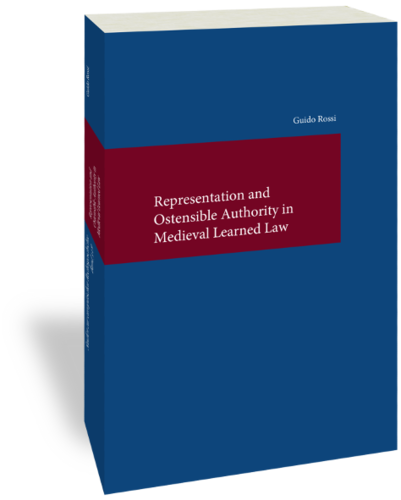
BOOK: Guido ROSSI, Representation and Ostensible Authority in Medieval Learned Law [Studien zur europäischen Rechtsgeschichte; 319] (Frankfurt: Vittorio Klostermann, 2019), XII + 598 p. ISBN 978-3-465-04390-4, € 98

(image source: Klostermann)

Book abstract:
When is it possible to hold valid an act done unlawfully? To answer the question, medieval civil lawyers focused mainly on the case of a slave elected praetor in the mistaken belief that he was a Roman citizen. Most jurists argued that the validity of an act should depend on the validity of its source. But whilst early civil lawyers thought that the source was the person vested with some specific powers (such as the judge, the notary, etc.), later on they began to think of the person as representative of an office, and to ascribe the acts directly to the office itself. This evolution – and so, the foundations of the concept of ostensible authority – was due to the influence of canon lawyers, who had to deal with a similar problem: what if a bishop was secretly heretical?
More information with the publisher.

26 March 2019

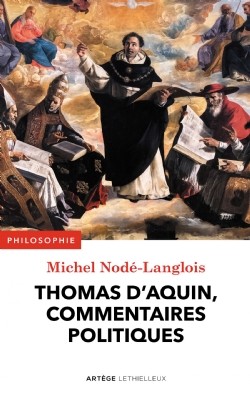
BOOK: Michel NODÉ-LANGLOIS, Thomas d'Aquin, commentaires politiques (Paris: Artège, 2019), 806 p. ISBN 978-2-2496-2637-1, € 35

(image source: univ-droit)

Book abstract:
Le travail du théologien Thomas d'Aquin a consisté en partie à commenter des oeuvres d'autres auteurs, et certains livres bibliques. Ces commentaires venaient compléter l'enseignement ex professo des Sommes et des Questions, qui ont donné lieu à un premier recueil : Thomas d'Aquin, Penser le politique (Dalloz, 2015, 608 p). À part la Politique d'Aristote, les oeuvres commentées par s. Thomas ne traitaient pas uniquement de questions de cet ordre, mais certaines de leurs parties y avaient trait : Sentences de Pierre le Lombard, synthèse, au XIIe siècle, des questions suscitées par l'explicitation du contenu de la foi chrétienne ; Éthique à Nicomaque et Métaphysique d'Aristote ; passages du Nouveau Testament importants pour l'évangélisation de la Cité humaine. Traitant de politique, Thomas use de références philosophiques plutôt que théologiques. Car la foi théologale ne dispense pas du travail d'analyse rationnelle dont les philosophes grecs ont été les premiers promoteurs : elle stimule ce travail comme une condition et un moyen de sa propre intelligence. La foi ne disqualifie pas plus la raison que la grâce ne supprime la nature : elles apportent un surcroît de perfection à ce qu'elles présupposent.
On the author:
 Michel Nodé-Langlois, ancien élève de l'École Normale Supérieure, agrégé de philosophie, professeur honoraire de philosophie en Première supérieure (khâgne classique) au lycée Pierre-de-Fermat, et chargé d'enseignement honoraire à l'Institut Catholique de Toulouse.
(source: Nomôdos)

04 December 2018

BOOK : Thomas W. SMITH and Helen KILLICK, Petitions and Strategies of Persuasion in the Middle Ages. The English Crown and the Church, c.1200-c.1550. (Suffolk: York Medieval Press, 2018). ISBN 9781903153833, £60.00


(Source: Boydell & Brewer)

Boydell & Brewer is publishing a new book on aspects of Medieval royal and canon law in England.

ABOUT THE BOOK

Late medieval petitions, providing unique insights into medieval social and legal history, have attracted increasing scholarly attention in recent years. This wide-ranging collection brings two approaches into dialogue with each other: the study of royal justice and secular petitions presented to the English crown, and the study of papal justice, canon law and ecclesiastical petitions (emphasising the international dimension of petitioning as a legal device exercising authority across Latin Christendom). In so doing, it crosses the traditional demarcation lines between secular and ecclesiastical systems of justice, of particular importance, given the participation by many litigants and legislators in both of those legal spheres.

A major focus is the mechanics of petitioning - who were the intermediaries in this process, and what were the "strategies of persuasion" they employed? The essays also re-examine the relationship between petitioners and their advisors, and the specific legal, rhetorical and linguistic choices they made in the composition of these texts. In so doing, the volume makes an important new contribution to the emerging field of late medieval supplicatory cultures. 

ABOUT THE EDITORS

THOMAS W. SMITH is a Leverhulme Early Career Fellow at the University of Leeds; HELEN KILLICK is a post-doctoral researcher at the ICMA Centre, University of Reading. 

TABLE OF CONTENTS

Foreword - W Mark Ormrod
Introduction: Medieval Petitions and Strategies of Persuasion - Thomas W. Smith and Helen Killick
Blood, Brains and Bay-Windows: The Use of English in Fifteenth-Century Parliamentary Petitions - Gwilym Dodd
Petitioners for Royal Pardon in Fourteenth-Century England - Helen Lacey
The Scribes of Petitions in Late Medieval England - Helen Killick
Patterns of Supplication and Litigation Strategies: Petitioning the Crown in the Fourteenth Century - Anthony Musson
Petitions of Conflict: The Bishop of Durham and Forfeitures of War, 1317-1333 - Matthew Phillips
A Tale of Two Abbots: Petitions for the Recovery of Churches in England by the Abbots of Jedburgh and Arbroath in 1328 - Shelagh Sneddon
'By Force and Arms': Lay Invasion, the Writ de vi laica amovenda and Tensions of State and Church in the Thirteenth and Fourteenth Centuries - Philippa M. Hoskin
The Papacy, Petitioners and Benefices in Thirteenth-Century England - Thomas W. Smith
Playing the System: Marriage Litigation in the Fourteenth Century - Frederik J G Pedersen
Killer Clergy: How did Clerics Justify Homicide in Petitions to the Apostolic Penitentiary in the Late Middle Ages? - Kirsi Salonen

More information here

22 June 2018

BOOK: Stephan DUSIL, Wissensordnungen des Rechts im Wandel - Päpstlicher Jurisdiktionsprimat und Zölibat zwischen 1000 und 1215 [Mediavalia Lovaniensia] (Leuven: Leuven University Press , 2018). ISBN 9789462701335, € 95,00


Leuven University Press has published a new book on canon law between 1000-1215

ABOUT THE BOOK

Fascinating insights into the origins of canon law as an academic discipline and legal knowledge in the High Middle Ages

Die Studie untersucht die Ordnung des mittelalterlichen Rechtswissens in vorgratianischen Sammlungen, dem Decretum Gratiani sowie den Glossen und Summen zum Dekret. Im Mittelpunkt steht also das kirchenrechtliche Wissen, das sich zwischen 1000 und 1215 grundlegend änderte: Während kirchliche Rechtsregeln um 1000 in Kanonessammlungen linear gespeichert waren, wurden sie im 12. Jahrhundert zu komplexem Rechtswissen miteinander verknüpft. Auf Basis einer umfassenden Auswertung der handschriftlichen Überlieferung wird der Wandel des Rechtswissens anhand des päpstlichen Jurisdiktionsprimats und des Zölibats analysiert. Zudem zeigt die Untersuchung den Einfluss der artes liberales und der Rhetorik bei der Ordnung kirchlicher Normen. Die Studie gibt so einen faszinierenden Einblick in die Entstehung der Kanonistik und zeigt zugleich die Vielfältigkeit und Vielschichtigkeit des juristischen Wissens im Hochmittelalter.

Between 1000 and 1215, the knowledge of canon law changed fundamentally. Although ecclesiastic rules of law had been linearly collected by 1000, they had evolved into complex, highly interlinked carriers of knowledge by 1215. By carefully examining manuscript transmission, this book elucidates the evolution of legal knowledge, taking papal jurisdictional primacy and clerical celibacy as an illustrative example. Furthermore, it shows the influence the artes liberales and rhetoric had on the organisation of canon law. This study thus offers fascinating insights into the origins of canon law as an academic discipline, thereby also demonstrating the diversity and multi-layeredness of legal knowledge in the High Middle Ages.

ABOUT THE AUTHOR

Stephan Dusil is professor of the Faculty of Law at KU Leuven

More information with the publisher

24 May 2018

BOOK: Wouter DRUWE, Scandalum in the Early Bolognese Decretistic and in Papal Decretals (Ca. 1140-1234) [Spicilegium Sacrum Lovaniense; 55] (Leuven: Peeters, 2018), X + 110 p. ISBN 978-90-429-3546-4, € 38

(image source: Peeters)

Dr. Wouter Druwé (KULeuven/Roman Law and Legal History) published Scandalum in the Early Bolognese Decretistic and in Papal Decretals (Ca. 1140-1234).

Book abstract:
The wish to avoid scandala or to put an end to scandalous situations has been and remains a continuous concern of canonists and Church authorities, at least as of the thirteenth century. As of Raymond of Penafort's Summa de paenitentia (late 1220s - early 1230s), scandalum was dealt with separately in canonical dictionaries. Legal historical research on the earlier use of the term within canon law, is however relatively scarce. Inspired by the linguistic-philosophical approach of the Begriffsgeschichte, this book offers a conceptual-historical analysis of the use of scandalum by early Bolognese decretists (ca. 1140 - ca. 1180) and in papal decretals from Alexander III (1159) until the promulgation of the Liber Extra by Gregory IX in 1234. For Gratian and the earliest generation of decretists (Paucapalea and Rolandus), scandalum was a quite insignificant notion. Gradually, with Rufinus, however, the concept gained importance, both quantitatively and qualitatively. Stephen of Tournai pointed at the horrible consequences of a scandalum for the salvation of the souls. Simon of Bisignano stressed, for instance, the opposition between scandalum and peace. Even though non of the twelfth- and early thirteenth-century sources had yet developed a consistent theory on scandalum and its legal consequences, the analysis of papal decretals shows how scandalum became a more popular concept, especially in the field of disciplinary and penal canon law. Some evidence even suggests an instrumentalism of the term by the end of the twelfth century. At the same time, increasingly popes, especially Innocent III (1198-1216), were aware of the ambivalent nature of the concept. Apart from scandalum's polysemy, the legal-political use of the term was striking: repression, reconciliation and cover-up policies could all be justified in order to avoid or to put an end to scandala, and, thus, to save one's soul and to protect the Church. This relatively open and flexible notion played an important part in the Church's peace policy as well. This study argues that scandalum can be described as 'indignation as a source of conflicts'.
More information here.

13 July 2017

BOOK: Elisabeth LUSSET, Crime, châtiment et grâce dans les monastères au Moyen Âge (XIIe-XVe siècle) (Turnhout: Brepols, 2017), 406 p. ISBN 97892503567655, € 120

(image source: Brepols)

Elisbeth Lusset (CNRS) published Crime, châtiment et grâce dans les monastères au Moyen Âge with Brepols Publishers.

Book abstract:
Ce livre analyse les crimes commis à l’intérieur des monastères médiévaux (violences, homicides ou encore vols) et la manière dont les religieux criminels étaient corrigés tant par les abbés, les évêques, les chapitres généraux des ordres religieux que par les organes de la curie romaine. Il compare, à l’échelle de l’Europe, les établissements de moines, chanoines réguliers et moniales, qu’ils appartiennent à un ordre (Cluny, Cîteaux, Prémontré, Grande Chartreuse) ou à une nébuleuse moins définie sur le plan juridique (abbayes et prieurés de moines bénédictins ou de chanoines réguliers). En explorant le fonctionnement de la justice claustrale, les peines prescrites ainsi que les mécanismes de réconciliation des criminels, l’ouvrage éclaire sous un angle nouveau les processus de construction institutionnelle et de réforme des ordres religieux entre les XIIe et XVe siècles.
On the author:
Ancienne élève de l’École normale supérieure de Lyon, ancienne pensionnaire de la Fondation Thiers, agrégée d’histoire et docteur en histoire médiévale, Élisabeth Lusset est chargée de recheche au CNRS. Elle travaille sur l’histoire comparée des ordres religieux et sur le gouvernement de l’Église médiévale.

Table of contents:
 Chapitre premier - Secreta ou detecta ?  Instances de correction des religieux criminels et production documentaireA. La correction au sein du cloître
1. Chapitre des coulpes et correction secrète des crimes
2. Les instances en charge de la correction au sein du monastère
B. La correction des criminels au sein des ordres religieux
1. Exemption et souveraineté en matière disciplinaire
2. Le chapitre général : instance législative et judiciaire suprême
C. La correction des criminels par les évêques et les archevêques normands et anglais
1. Les registres épiscopaux
2. Le contrôle disciplinaire des monastères non exempts
3. Le contrôle disciplinaire des monastères exempts
D. La correction des religieux par le pape
1. Le droit pontifical
2. Les registres de la chancellerie et de la pénitencerie apostolique
E. Pouvoirs laïques et discipline claustrale
1. La collaboration des pouvoirs ecclésiastiques et laïques
2. Une intervention croissante des juges laïques: les cas français et anglais
Chapitre II - Procédures : dénoncer, enquêter et gracierA. Dénoncer les crimes au chapitre des coulpes
B. Procédure lors des visites
1. Enquête générale
2. Enquêtes criminelles
3. Abandon des charges, sentence ou purgation canonique
C. Pétitionner le pape
1. À quel organe pontifical recourir ?
2. Le parcours des clercs réguliers et de leurs suppliques
Chapitre III – Typologie des crimes et circonstancesA. Typologie des crimes
1. Les violences physiques et verbales
2. Les homicides
3. Le vol
4. Les crimes de faux, d’incendie et de sorcellerie
B. Lieux du crime
1. Infra ou extra septa2. Les espaces sacrés : l’église et le cimetière
3. La salle capitulaire
4. Le dortoir et les chambres
5. Le cloître et le réfectoire
C. L'heure du crime
D. Crimes individuels ou collectif ?
E. Les armes du crime
1. Armes offensives
2. Crimes de poison
Chapitre IV – Mobiles du crimeA. Des crimes sous influence : colère, vin et haine
1. Ira et furore commotus2. Inebriatus et potu repletus3. Per odium et rancorem motumB. L'accès aux charges claustrales
C. Gestion et partage des biens
D. Le gouvernement de la communauté monastique
1. Les conflits entre « nations »
2. Iuniores contre seniores3. Le convers pervers
4. Le refus de l’autorité des supérieurs
5. Correction et abus
6. L’exercice trop autoritaire du pouvoir
7. Régime de faveur
E. Réformes
1. Le topos du réformateur persécuté
2. Les conflits de réforme au prisme des actes de la pratique
F. La persistance du vieil homme
1. Rhétorique de l’excuse
2. Fama et vindicta3. A verbis ad verbera. Des insultes aux coups
4. Maniement des armes
5. Poids des solidarités familiales
6. Une conversio morum en actes
Chapitre V – L’eau de tristesse et le pain de douleur - Pénitences et peinesA. Expulsion et/ou livraison au pouvoir séculier
B. Excommunications
1. Excommunicatio regularis et pénitences
2. Excommunication canonique
C. Transfert pro culpa1. Les buts du transfert pro culpa2. Les modalités du transfert pro culpa3. Résistances
4. L’encadrement de l’usage du transfert pro culpaD. L’enfermement punitif
1. Types d’enfermement
2. Généralisation de la peine de prison au XIIIe siècle
3. Conditions d’incarcération et perception de la peine
E. Scandale et sévérité des peines
Chapitre VI - Mélanger l’huile de miséricorde et le vin de la correctionA. Mitigation les peines et réconciliation des criminels
1. Des peines modulables
2. La réconciliation des criminels apostats ou expulsés
3. Réhabilitation
B. Répartition et hiérarchisation des compétences en matière d’absolution et de dispense
1. Le canon Si quis suadente et les modalités d’application de la réserve pontificale
2. La potestas absolvendi et dispensandi épiscopale
3. La potestas absolvendi et dispensandi au sein des monastères
C. L’exercice de la miséricorde pontificale
1. Crimes énormes ou ordinaires ?
2. Pourquoi s’adresser à la pénitencerie apostolique ?
D. Concilier rigueur et miséricorde
1. Résistances des prélats aux injonctions de miséricorde
2. Défense des prérogatives disciplinaires des chapitres généraux
Conclusion
Annexes
Abréviations utilisées
Sources manuscrites et imprimées
Bibliographie sélective
Index
Table des matières

11 January 2017

BOOK: Sara MCDOUGALL, Royal Bastards: the Birth of Illegitimacy, 800-1230 [Studies in Medieval History]. Oxford: OUP, 2017, 320 p. ISBN 9781098785828

(image source: OUP)

Sara McDougall (CUNY) has published a study on medieval bastardy in OUP's Studies in Medieval History series.

Book abstract:
The stigmatization as ‘bastards’ of children born outside of wedlock is commonly thought to have emerged early in Medieval European history. Christian ideas about legitimate marriage, it is assumed, set the standard for legitimate birth. Children born to anything other than marriage had fewer rights or opportunities. They certainly could not become king or queen. As this volume demonstrates, however, well into the late twelfth century, ideas of what made a child a legitimate heir had little to do with the validity of his or her parents’ union according to the dictates of Christian marriage law. Instead a child’s prospects depended upon the social status, and above all the lineage, of both parents. To inherit a royal or noble title, being born to the right father mattered immensely, but also being born to the right kind of mother. Such parents could provide the most promising futures for their children, even if doubt was cast on the validity of the parents’ marriage. Only in the late twelfth century did children born to illegal marriages begin to suffer the same disadvantages as the children born to parents of mixed social status. Even once this change took place we cannot point to ‘the Church’ as instigator. Instead, exclusion of illegitimate children from inheritance and succession was the work of individual litigants who made strategic use of Christian marriage law. This new history of illegitimacy rethinks many long-held notions of medieval social, political, and legal history.
Table of contents:
Introduction
1. The Language of Illegitimacy
2. The Carolingian Example: The Sons of Concubines
3. Illegitimacy and the Making of Medieval Dynasties 900-1050
4. Maternal Lineage and Anglo-Norman Succession 950-1150
5. Canon Law, Canonists, and Bastards in the World of Ivo of Chartres
6. Redefining Marriage and Legitimacy (1140-1200): Ideas and Practices
7. Royal Bastards of the Twelfth Century: The Monk-King of Aragon's Daughter, the Abbess-Countess of Boulogne's Daughter, and Tancred of Lecce
8. Illegitimacy and Legitimation in the Thirteenth Century: Pope Innocent III, King Philip II, and Emperor Frederick II
9. Scandal in Jerusalem: Royal Succession and Illegitimacy
10. Saint Fernando III, The Bastard King of Leon
Conclusion

More information with OUP.

(source: Legal History Blog)

02 September 2016

JOURNAL: Revue Historique de Droit Français et Étranger 2016/1


(image source: Paris II/IHD)

The Institut d'histoire du droit (Paris II) announced the publication of the first issue of 2016 for the Revue historique de droit français et étranger.
This issue contains a thematical set of articles devoted to the Fourth Council of Laterans (1215)
Table of contents:
LECTEUR LATRAN IV (1215), GENÈSE ET POSTÉRITÉ : ENJEUX POUR L’ÉVÊQUE
Brigitte Basdevant-Gaudemet, Catherine Vincent. – Avant-propos
Catherine Vincent. – L’évêque dans l’Église d’Occident au XIIIesiècle : la législation de Latran IV à l’épreuve des faits
Brigitte Basdevant-Gaudemet. – Quelques réflexions sur la Libertas Ecclesiae dans les procédures de désignations épiscopales au cours des siècles
Thibault Joubert. – L’évolution du principe électif dans les désignations épiscopales du Décret de Gratien au concile Latran III
Michèle Bégou-Davia. – Innocent III et les élections épiscopales : quelques aspects juridiques
Fabrice Delivré. – Les lois du genre. Summae, Practicae et élection des évêques en Occident (XIIe-XVe siècle)
Olivier Hanne. – L’épiscopat dans les années de l’après-concile selon les registres d’Innocent III et d’Honorius III (1215-1227)
Nicolas Warembourg. – Le sort incertain des canons du IVe concile de Latran dans la France d’Ancien Régime. Brève enquête sur la délimitation du corpus du droit canonique gallican
Cyrille Dounot. – L’héritage du IVe concile du Latran chez les canonistes français de l’époque moderne
Agostino Paravicini Bagliani. – Conclusions 

 Book reviews:
Jacques Krynen acques Krynen et Bernard d’Alteroche (dir.). – L’histoire du droit en France. Nouvelles tendances, nouveaux territoires (Xavier Prévost).
Stéphane Lajaumont. – « Un pas de deux ». Clercs et paroissiens en Limousin (vers 1660-1789) (Brigitte Basdevant-Gaudemet)
Peter Landau, Waltraud Kozur, Karin Miethaner-Vent, avec la collaboration de S. Haering, H. Hallermann, M. Petzolt, I. Grossmann (éd.). – Summa «Omnis qui iuste iudicat» sive Lipsiensis; t.III; in memoriam Rudolf Weigand (†) (Brigitte Basdevant-Gaudemet)
Martin Avenarius. – Fremde Traditionen des römischen Rechts, Einfluss, Wahrnehmung und Argument des « rimskoe pravo » im russischen Zarenreich des 19.Jahrhunderts (Danielle Anex-Cabanis)
Arndt Christoph Hendel. – „Marcelli ratio, Die Argumentationsweise des hochklassischenJuristen Ulpius Marcellus“ (Danielle Anex-Cabanis) Pio Caroni. – Schweizerisches Privatrecht I/1, „Geschichte und Geltungsbereich“ (Danielle Anex-Cabanis)
Olivier Ryckebusch et Rik Opsommer (dir.). – Guerre, frontière, barrière et paix en Flandre (André Cabanis)
Robert Jacob. – La grâce des juges. L’institution judiciaire et le sacré en Occident (André Cabanis)
Dominique Messineo. – Moralisation, correction et tutelle judiciaire au XIXe siècle (André Cabanis)
Olivier Mattéoni et Patrice Beck (dir.). – Classer, dire compter. Discipline du chiffre et fabrique d’une norme comptable à la fin du Moyen Âge (André Cabanis)
Guillaume Métairie. – Justice et juges de paix de Paris (1789-1838). Etude institutionnelle et biographique (Alexandre Lunel)
Françoise Bayard, Patrick Fridenson, Albert Rigaudiere (dir.). – Genèse des marchés (Norbert Olszak)
Andreas Fleckner. – Antike Kapitalvereinigungen. Ein Beitrag zu den konzeptionellen und historischen Grundlagen der Aktiengesellschaft (Ulrike Babusiaux)
Raymond Verdier, Nathalie Kàlnoky, Soazick Kerneis (éd.). – Les justices de l’invisible (Antoine Leca)
Béatrice Leroy. – Du franc parler en politique. Aimer et devoir écrire aux souverains en Castille au XVe siècle (Isabelle Brancourt)
Joël Hautebert et Sylvain Soleil (dir.). – La procédure et la construction de l’État en Europe (XVIe-XIXe siècle) (Thibault Desmoulins)