Search

Showing posts with label Family Law. Show all posts

02 July 2026

BOOK: Julia HÜTTEN, German Identity, Intermarriage, and Divorce in Samoa (1900–1914) [Global Perspectives on Legal History, vol. 27, eds. Marietta AUER, Thomas DUVE & Stefan VOGENAUER] (Frankfurt am Main: Max Planck Institute for Legal History and Legal Theory, 2025),192 p., ISBN 978-3-944773-52-0, € 18,21

(image source: MPILHLT)

Abstract:

Germany’s colonial past is again at the center of public debate. This book offers a focused contribution: a study of how the German administration in Samoa (1900–1914) used family law as a tool of colonial governance. Examining marriage, divorce, citizenship, legitimacy, and maintenance, Julia Hütten shows how rules on the most intimate matters became instruments of colonial power and a mirror for ideas of ‘Germanness’.

Interethnic families were already part of Samoan society when the imperial flag was raised in Apia in 1900. The new government tried to sort residents into two personal jurisdictions, ‘foreigner’ and ‘native’, yet people of mixed descent rarely fit neatly into either. The German Civil Code (BGB), which had only recently been enacted, granted citizenship to foreign wives of German husbands, but many long-standing unions in Samoa had never been registered as civil marriages. Officials responded by planning to prohibit future interethnic marriages and by compiling a register of so-called ‘half-castes’ born to unregistered unions, thereby expanding the reach of foreign jurisdiction. The formal ban on mixed marriages arrived in 1912, tightening these boundaries still further.

Fault-based divorce procedures, unfamiliar in Samoan practice, also unsettled households by compelling spouses to assign blame and expose private life to official judgment. These interventions did not simply transplant metropolitan law; they interacted with Samoan custom, missionary influence, and local knowledge, producing outcomes negotiated by officials, petitioners, and communities.

By tracing cases and policies across these 14 years, the book illuminates how colonial law marked racial boundaries, structured belonging, and reordered daily life in Samoan-German households. It also opens a window onto the German Empire itself: its anxieties about race and respectability, its administrative improvisation at the edge of empire, and the contested meanings of citizenship within a plural legal order.

On the author:

Julia Hütten is a legal historian whose research traces family law and identity in the German colonial Pacific. She holds a doctorate in law, having academic backgrounds in anthropology and information science. She held research positions at the Max Planck Institute for Legal History and Legal Theory.

Table of contents:

Foreword

List of Charts, Tables and Images

Introduction

Chapter 1: Samoa, Pearl of the South Sea

1.1 Morality and the Samoan climate

1.2 European contact and the matai political system

Chapter 2: German Identity and Colonialism

2.1 Samoan courtship ans marriage

2.2 Taupou, abstinence, and women’s sexuality

2.3 Marriage of Samoans in the Western manner

2.4 Marriage under German law

2.5 Marriages between Samoans and Chinese

Chapter 3: Breaking Up Families: The Ban on Interethnic Marriage

3.1 Changing views on race and ethnicity

3.2 Citizenship law and Deutschtum

3.3 The example set by German Southwest Africa

3.4 Defining the legal classification »native« in the German colonies

3.5 The Mischehenverbot in Samoa

3.6 Planning the Mischehenverbot

Chapter 4: Divorce and Matters of Family Law in the German Courts of Samoa

4.1 New policies in the regulation of divorce in the German empire

4.2 Application of family law from the BGB in Samoa

4.3 Grounds for divorce under the BGB

4.4 Divorces among the faʻa papālagi

4.5 Divorces among Samoans in the German courts

4.6 Women’s testimony in divorce

4.7 A change of stance of Governor Solf in 1907?

4.8 Maintenance

4.9 Maintenance of illegitimate children

4.10 Maintenance after the 1912 Mischehenverbot

4.11 Samoan divorce cases (a selection)

4.12 The case of Blanche Reid and the "Lifestyle Test"

4.13 Why the "Lifestyle Test ?"

4.14 The German interracial marriage debate (Mischehendebatte) in May 1912

Conclusion

Appendix I: Samoan terms

Appendix II: Translation of Dr. Wilhelm Solf’s opening statement to the German parliament (May 2, 1912)

Bibliography

Find more on: MPILHLT & epubli.

08 May 2026

BOOK: Nicolas RUIZ, Mariage et patrimoine dans la Lorraine du XVIIIe siècle [Histoire des temps modernes, ed. Lucien BÉLY, 13] (Paris: Classiques Garnier, 2026), 547 p. ISBN 9782406199700, €49

(image source: Classiques Garnier)


Prix Favard de Langlade 2022 de l’IIHN (Institut supérieur de l’histoire du notariat) et Prix de thèse établissement 2022 de l’université de Lorraine

Abstract:
Alors que l’ancien droit lorrain donnait au mari des pouvoirs menaçant sérieusement les droits de la femme, les actes du XVIIIe siècle mettent en évidence que les couples étaient soucieux du sort du survivant et que ceux qui passaient un contrat de mariage souhaitaient protéger les enfants du premier lit.

 Read more here: DOI 10.48611/isbn.978-2-406-19972-4.


20 January 2026

VACANCY: Postdoc (100%) - Stepchildren in early modern Brabant (Leuven: KULeuven, DEADLINE 16 FEB 2026)


(image source: Academic positions)

Abstract:

The KU Leuven Research Unit Roman Law and Legal History, which is a department of the Faculty of Law and Criminology, is an interdisciplinary and internationally oriented research group, which currently consists of four professors and about ten junior researchers. Next to a research axis on the history of international law and colonial legal history, the department has a strong focus on and track record in the study of ius commune, especially in the early modern period (15th-18th centuries). From 1 March 2026 onwards, the Research Unit (prof. dr. Wouter Druwé) will also be coordinating an interdisciplinary European MSCA Doctoral Network on the history of testamentary law and practices in the early modern period, bringing together social and legal historians from five different universities and several archives and museums in four European countries.

The current vacancy is part of a project funded by the Research Foundation - Flanders (FWO) on "Stepchildren in the early modern Duchy of Brabant: the interplay between particular law and ius commune (1425-1629)" (G027826N). The project investigates how contractual and testamentary freedom, as developed in learned law and moral theology, could, already in the early modern period, be employed to moderate the legal ramifications of the distinction between consanguineous offspring and stepchildren in particular law. In the early modern Low Countries, there were many stepfamilies (blended families), partly because of the high mortality rate. The factual omnipresence of stepchildren contrasts with the limited attention that has been given to them in both early modern particular law and legal-historical scholarship today. The project focuses on the early modern Duchy of Brabant, where the number of jurists and moral theologians that had studied Roman law increased after the foundation of the Leuven university in 1425. Learned jurists took on several functions in legal practice, as judges, aldermen, and ducal councellors. Research into the archives of the university town of Leuven, the mercantile hub of Antwerp, and the administrative city of 's-Hertogenbosch on the basis of prenuptial agreements, last wills, and donations will uncover the extent to which the learned legal tradition was employed to deviate from customary law in addressing legal challenges encountered by stepfamilies.

Read more here.

21 December 2021

BOOK: Carolyn BAUGH, Minor Marriage in Early Islamic Law (Leiden: Brill, 2017). ISBN: 978-90-04-34483-9, €99.00

(Source: Brill)

ABOUT THE BOOK

Series: Studies in Islamic Law and Society, Volume: 41

In Minor Marriage in Early Islamic Law, Carolyn Baugh offers an in-depth exploration of 8th-13th century legal sources on the marriageability of prepubescents, focusing on such issues as maintenance, sexual readiness, consent, and a father’s right to compel. Modern efforts to resist establishment of a minimum marriage age in countries such as Saudi Arabia rest on claims of early juristic consensus that fathers may compel their prepubescent daughters to marry. This work investigates such claims by highlighting the extremely nuanced discussions and debates recorded in early legal texts. From the works of famed early luminaries to the “consensus writers” of later centuries, each chapter brings new insights into a complex and enduring debate. 

ABOUT THE AUTHOR

Carolyn G. Baugh, Ph.D. (2011), University of Pennsylvania, is Assistant Professor of History at Gannon University. In addition to scholarly articles, she has translated Ibn Khaldūn’s treatise on Sufism, Shifāʾ al-sāʾil fī tahdhīb al-masāʾil for the Library of Arabic Literature.

TABLE OF CONTENTS

Part One: The Early Formative Era 
Chapter One: Contextualizing and Conceptualizing Minor Marriage 
Chapter Two: The Early Compendia 
Chapter Three: Early Ḥanafī Thought 
Chapter Four: Early Mālikī Thought 
Chapter Five: Al-Shāfiʿī 

Part Two; Consensus, Consensus Writing, Post-Formative Era Writing, and Whether Consensus Matters 
Chapter Six: Consensus 
Chapter Seven: Writing Consensus 
Chapter Eight: Post-Formative Era Thought on Minor Marriage 
Conclusion: Does Consensus Matter? 

Appendix: Excerpts from the Early Compendia 
Bibliography 
Index 


More information with the publisher.

09 June 2020

BOOK: Kenneth McK NORRIE, A History of Scottish Child Protection Law (Edinburgh: Edinburgh University Press, 2020). ISBN 9781474444170, £120.00


Edinburgh University Press is publishing a book on the history of Scottish child protection law.

ABOUT THE BOOK

Kenneth Norrie traces the assumptions that underlay child protection law at particular periods of time and identifies the pressures for change – giving a clearer understanding of how and why the contemporary law is designed and operates as it does.

Particular issues are traced in legislative detail, including court processes, the changing thresholds for state intervention, the increasing regulation of children’s homes and foster care, the developing rules on corporal punishment and the earlier practice of compulsory emigration to the colonies of children removed from their parents.

The transformation of adoption is also covered in comprehensive detail. In drawing out key themes and common threads, Norrie sets contemporary developments against their historical context and offers a fuller understanding of child protection law in Scotland.

ABOUT THE AUTHOR

Kenneth Norrie is Professor of Law at Strathclyde Law School. He has taught Family Law for over 20 years, both in Scotland and abroad and has written many of the major textbooks on the subject, as well as numerous articles on child protection and same-sex families. He has advised the Scottish Parliament on most of its recent family law legislation and was a member of the children’s panel for ten years.

The table of contents, as well as more info, can be found here

23 March 2020

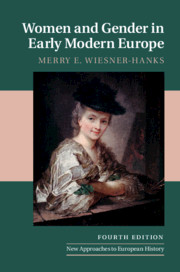
BOOK: Mary E. WIESNER-HANKS, Women and Gender in Early Modern Europe [New Approaches to European History] (Cambridge: CUP, 2020), 390 p. ISBN 9781108739351, 22,99 GBP

(image source: CUP)

Abstract:
This fourth edition of Merry E. Wiesner-Hanks's prize-winning survey features significant changes to every chapter, designed to reflect the newest scholarship. Global issues have been threaded throughout the book, while still preserving the clear thematic structure of previous editions. Thus readers will find expanded discussions of gendered racial hierarchies, migration, missionaries, and consumer goods. In addition, there is enhanced coverage of recent theoretical directions; the ideas, beliefs, and practices of ordinary people; early industrialization; women's learning, letter writing, and artistic activities; emotions and sentiments; single women and same-sex relations; masculinities; mixed-race and enslaved women; and the life course from birth to death. With geographically broad coverage, including Russia, Scandinavia, the Ottoman Empire, and the Iberian Peninsula, this remains the leading text on women and gender in Europe in this period. Accompanying this essential reading is a completely revised website featuring extensive updated bibliographies, web links, and primary source material.
On the editor:
Merry E. Wiesner-Hanks is a Distinguished Professor of History and Women's and Gender Studies at the University of Wisconsin, Milwaukee. She is the senior editor of the Sixteenth Century Journal, an editor of the Journal of Global History, the editor-in-chief of the seven-volume The Cambridge World History (Cambridge, 2015), and the author or editor of thirty books and more than 100 articles or book chapters that have appeared in English, German, French, Italian, Spanish, Greek, Chinese, Turkish, and Korean. These include A Concise History of the World (Cambridge, 2015), Early Modern Europe 1450–1789 (Cambridge, 2013), and Gender in History: Global Perspectives (2010). 
More information with the publisher.

20 December 2019

CALL FOR PAPERS: Kinship and Business. Law, Gender and Generational Perspectives (16th-20th centuries) (Bolzano, 17-19 September 2020) (DEADLINE: 28 February 2020)


(Source: UniVie)

The University of Vienna has a CFP for a conference on “Kinship and Business. Law, Gender and Generational Perspectives (16th–20th Centuries)” (conference languages: German, English, Italian). Here the call:

Organisationsteam:
Margareth Lanzinger (Institut für Wirtschafts- und Sozialgeschichte, Universität Wien)
Siglinde Clementi (Kompetenzzentrum für Regionalgeschichte, Freie Universität Bozen)
Andrea Bonoldi (Dipartimento di Economia e Management, Università di Trento)

Keynote: Martha Howell (Columbia University)

Wirtschaften gestaltet sich in und über soziale Beziehungen. In der wirtschafts- und sozialhistorischen Forschung stehen dabei je nach Perspektive ganz unterschiedliche Formen und Qualitäten sozialer Beziehungen im Fokus. Unternehmen als Form sozialer Organisation des Wirtschaftens gehören zu den etablierten Themenfeldern. In den letzten Jahrzehnten hat sich die historische Verwandtschaftsforschung konstituiert, die sich sowohl den kulturell und rechtlich geprägten Konzepten von Verwandtschaft widmet als auch spezifischen Beziehungsnetzen und Organisationsformen und damit verbundenen Praktiken des Wirtschaftens.

Ziel der Tagung ist es, Unternehmen im weitesten Sinn und Verwandtschaft – in Verbindung mit Recht, Geschlecht und Generation – in Beziehung zueinander zu setzen.

Tagungssprachen sind Deutsch, Englisch und Italienisch mit Simultanübersetzung ins Englische.
Bitte senden Sie einen Themenvorschlag (1 Seite/300 Wörter) und einen KurzCV in der gewählten Tagungssprache bis 28. Februar 2020 an:

Siglinde Clementi (Freie Universität Bozen), siglinde.clementi@unibz.it

Weiterführende Informationen in deutscher Sprache finden Sie hier.
Weiterführende Informationen in englischer Sprache finden Sie hier.

More info with the Universität Wien

27 June 2019

JOURNAL: The Journal of Legal History [Special Issue "Family Law(s) under the Roman Empire"] XX (2019), nr. 2

(image source: university of Glasgow)

Family Law(s) under the Roman Empire (Yifat Monnickendam & Paul J. du Plessis)

The Limits of Legal Pluralism in the Roman Empire (Kimberley Czajkowski)
Abstract:
The Roman empire was legally pluralistic. But what exactly does this entail in concrete terms? With the growth in historical studies of legal pluralism in the Roman empire, some significant differences in approach have emerged. This article tests and clarifies some of the limits in the current ‘legal pluralism’ conceptual landscape, focussing on disputes and dispute resolution. It is argued that a clearer distinction should be drawn between ‘normative’ and ‘jurisdictional’ pluralism, though both approaches still raise certain conceptual problems. The place of disputes within the family within this wider institutional picture is then taken as a case study in the final part of the paper, and it is suggested that while family disputes can evidence ‘legal pluralism’ in the ‘norms’ sense, there is less to suggest that there were a multitude of officially sanctioned legal fora available for resolving family disputes. As a result, many went beyond the law. This has wider implications for the study of legal pluralism in antiquity and the problem of integrating alternative dispute resolution (ADR) into the pluralistic picture
Greek Influences on Roman Dowry Law (Michael Leese)
Abstract:
Classical and Hellenistic Greek laws and dowry practices were generally more progressive and provided more protections for wives than early Roman marriage law and practice. Roman dowry law then witnessed a series of significant developments over the course of the republic, beginning with the time when the Romans were coming into increased contact with Greek culture. Changes in social attitudes towards the conditions for women in marriage, their ability to control their dowries, and their right to own property, seem to have been responsible for these transformations in Roman family law. As Romans became increasingly Hellenized, their dowry and marriage practices in general came to resemble patterns prevailing in the Greek world, perhaps as a result of individuals’ emulation of Greek laws and customs. The shift from the overall predominance of marriage in manu to marriage sine manu may therefore be explained partly by influences from the Greek world.
 Herod the Great and the Iudicium Domesticum: Legal Pluralism to Die For (Thomas A. J. McGinn)
Abstract:
The central question under consideration in this article is whether the various trials to which Herod, the well-known king of Judaea, subjected family members qualify as instances of the Roman iudicium domesticum. Modern debate among legal historians has been shaped by the views of two scholars in particular, Wolfgang Kunkel, who argues that one of them so qualifies, and Alfredo Mordechai Rabello, who contends that the rest do not, asserting that Herod simply followed the rules and procedures associated with a Hellenistic court. For the first time in modern scholarship, this article scrutinizes in detail all six examples of such trials. By itself, the evidence, though relatively copious, does not permit us to resolve this dispute as clearly and unambiguously as we would like. Much depends, for example, on precisely how one wishes to define the institution in question. Recent scholarly advances in the area of legal pluralism, however, point in the direction of a solution that does justice to both sides of this debate, as well as, perhaps, to Herod himself.
Did Roman Treatment of Freedwomen Influence Rabbinic Halakhah on the Status of Female Converts in Marriage? (Yael Wilfand)
Abstract:
 Rabbinic legal texts often pair converts with freed slaves. This association has been explained by the notion that, like converts, freed slaves joined Judaism upon manumission; therefore, freed men and women were legally viewed like converts. I suggest an inverse and more complex dynamic, through which Roman laws and concepts regarding freed persons influenced particular elements of rabbinic halakhah concerning converts, especially female converts. Since Roman freedwomen were new citizens with certain marital limitations, which have been attributed to lacking pedigree and an assumed sexual history (during servitude), their legal status offered a useful prism for considering female converts, who also had matrimonial restrictions and were without lineage. Moreover, given that a freedwoman’s prior enslavement had implications for her sexual background, female converts were viewed through that same lens. So, even though female converts may have come from non-Jewish families that considered their daughters’ virginity an important asset, the rabbinic legal linkage of freed slaves and converts affected several halakhot concerning female converts and their status in marriage, irrespective of their actual sexual history. Yet certain non-legal rabbinic teachings distinguish between these two female cohorts, resembling the differentiation between freedwomen and freeborn females that characterized the Roman world.
 Marriage and Family Law in the Ancient Church Order Literature (Joseph G. Mueller)
Abstract:
Numerous ancient texts present prescriptions on Christianity’s ethic, liturgy, leadership, and other institutions. Scholars call ‘church order literature’ a few of them composed in Greek, because of literary dependencies among them that make them an identifiable corpus. The composition of some of them seems to begin in the first century. In the fourth century, Christians began to gather them in various collections. While all these texts and their collections have no common literary genre, they do all purport to convey a tradition of apostolic teaching on the conduct of church life and its institutions. This teaching sees God’s law based on Christian scripture as the only valid law for church life. This article will present the prescriptions of that law conveyed by the ancient church order literature on the following topics: family requirements for membership in the church, prohibitions defining and defending marriage, regulations on family relationships, and restrictions on who may marry. Even in its dispositions on marriage and family, the ancient church order literature attests Christians’ contact with multiple legal regimes in the Roman empire. This literature reflects a view of the ancient Christian family that is typical in its difference from, and its similarity to, Greco-Roman conceptions.
(more information with Routledge)

08 February 2019

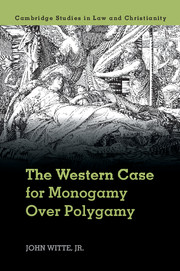
BOOK: John WITTE, The Western Case for Monogamy over Polygamy [Law and Christianity] (Cambridge: Cambridge University Press, 2015). ISBN 9781107499171, £ 37.99


(Source: CUP)

We did not yet report on this publication on monogamy in the Western tradition in Cambridge’s Law and Christianity series, which was published in 2015.

ABOUT THE BOOK

For more than 2,500 years, the Western tradition has embraced monogamous marriage as an essential institution for the flourishing of men and women, parents and children, society and the state. At the same time, polygamy has been considered a serious crime that harms wives and children, correlates with sundry other crimes and abuses, and threatens good citizenship and political stability. The West has thus long punished all manner of plural marriages and denounced the polygamous teachings of selected Jews, Muslims, Anabaptists, Mormons, and others. John Witte, Jr carefully documents the Western case for monogamy over polygamy from antiquity until today. He analyzes the historical claims that polygamy is biblical, natural, and useful alongside modern claims that anti-polygamy laws violate personal and religious freedom. While giving the pro and con arguments a full hearing, Witte concludes that the Western historical case against polygamy remains compelling and urges Western nations to hold the line on monogamy:

·         The first comprehensive history of attitudes toward polygamy in the West, from biblical times until today
·         Includes detailed case studies of polygamist prosecutions in early modern Europe and nineteenth-century America
·         Provides valuable tools for the study of polygamy including definitions of plural marital unions and a detailed background on Biblical, Talmudic, Greek and Roman law

ABOUT THE AUTHOR

John Witte, Jr, Emory University, Atlanta
John Witte, Jr is Robert W. Woodruff University Professor and Director of the Center for the Study of Law and Religion at Emory University, Atlanta. A world authority in legal history, he has directed twelve major international projects on democracy, human rights, religious liberty, marriage, family, and children. He has lectured throughout the world and published twenty-seven books, including, recently, Christianity and Human Rights: An Introduction (Cambridge, 2010) and The Sins of the Fathers: The Law and Theology of Illegitimacy Reconsidered (Cambridge, 2009).

TABLE OF CONTENTS

1. From polygamy to monogamy in ancient Judaism
2. Monogamy versus polygamy in the early church
3. Polygamy in the laws of state and church in the first millennium
4. The medieval case for monogamy over polygamy
5. Polygamous experiments in early Protestantism
6. The Calvinist case against polygamy and its civil law impact
7. The English case against polygamy: theology, politics, and the early modern common law
8. The early modern liberal case for polygamy
9. The Enlightenment liberal case against polygamy
10. The American case against polygamy.

More information here

12 July 2018

BOOK: Karen FIORENTINO & Allison FIORENTINO (dir.), Mater semper certa est ? Passé, présent, avenir d'un adage [Collection droit, bioéthique et société, vol. 18] (Bruxelles: Bruylant, 2018), 264 p. ISBN 9782802760399, € 80

(image source: Bruylant/Larcier)

Book abstract:
La preuve de la filiation maternelle, résumée par l’un des adages les plus connus en droit de la famille, Mater semper certa est, a pendant longtemps semblé être une évidence voulue par la nature, donc ne posant que peu de problème juridique, à l’inverse de la paternité. Pourtant, l’évidence a-t-elle toujours été aussi flagrante ? Pourquoi ressentir le besoin de forger un adage ? Quelle fut sa valeur et a-t-il toujours parfaitement reflété la réalité ? Force est de constater que si la maternité est certaine, la preuve de celle-ci se heurte à plusieurs difficultés tant matérielles que processuelles. Il s’agit donc ici de s’interroger sur la place accordée en droit à l’accouchement, aux liens juridiques qu’il a établis entre la mère et son enfant, aux preuves permettant de réclamer sa filiation maternelle et réévaluer ces questionnements à l’aune des avancées scientifiques actuelles. Une bonne compréhension des retombées de celles-ci passe par une analyse de l’adage sur plusieurs siècles, de son apparition dans le droit romain à son application aujourd’hui, en passant par les périodes de l’ancien droit et du droit napoléonien, socles des dispositions actuelles, mais aussi par une perspective comparatiste. En effet, sur un tel sujet, il est indispensable d’envisager non seulement le droit applicable dans d’autres États, mais aussi les éventuels conflits de loi. Le problème de la preuve pose in fine celui de l’identité de la mère et donc de la filiation de l’enfant, enjeu majeur à l’heure où le droit pour tout individu de connaître ses origines se voit accorder une place croissante dans le paysage des droits subjectifs.
On the editors:
Karen Fiorentino : Professeur des Universités, chargée de cours à Sciences Po campus de Dijon Allison Fiorentino : Maître de conférences HDR, droit privé

Contributors:
L'ouvrage rassemble les contributions de : Agathe Baroin, Annick Batteur, Lucille Boisseau-Sowinski, Mélina Douchy-Oudot, Aurélia Fautre-Robin, Allison Fiorentino, Karen Fiorentino, Élodie Hartmann, Virginie, Lemonnier-Lesage, Aude Mirkovic, Sophie Monnier, Claire Neirinck et Sandrine Tisseyre.

Table of contents here.
(source: Hi-D)

25 February 2018

BOOK: Yan THOMAS, La Mort du père [Bibliothèque Idées] (Paris: Albin Michel, 2017), ISBN 9782226314871, € 22

(image source: Albin Michel)

Book abstract:
Remettant en cause l'interprétation ordinaire du parricide qui en fait une catégorie de l'homicide relevant d'une action privée, Yan Thomas entend retracer ses origines, sa genèse et son évolution, mais aussi sa dimension symbolique et fondatrice à travers les différents régimes politiques romains. Au-delà de la lignée familiale, le père a en effet une fonction étatique. à Rome, le parricide est une injure suprême, un crime d'état. Il traduit surtout la peur obsessionnelle des pères qui craignent d'être évincés ou tués par leurs propres fils qu'ils ont privés de toute autonomie politique, personnelle et financière.Il ne s'agit pas, pour Yan Thomas, de décrire la réalité de pratiques de meurtres de pères par des fils, mais de saisir plus généralement ce que le droit de vie et de mort impose, ce qui se joue dans la substitution d'un rapport de puissance et d'un modèle juridique au lien biologique. L'auteur s'attache alors à montrer que le sens, le rôle et la structure de toute la politique romaine se comprend à l'articulation du public et du familial, et que la famille est constitutive du code politique romain. Cette enquête passionnante, qui, pour comprendre la spécificité de la notion de parricide mêle la philologie et le droit à l'archéologie et à l'anthropologie, permet à Yan Thomas de proposer une lecture inédite et éclairante de la politique romaine et de la nature même de l'état romain.
More information with the publisher.

10 February 2018

BOOK: Maria Gigliola DI RENZO VILATA (ed.), Succession Law, Practice and Society in Europe across the Centuries [Studies in the History of Law and Justice, vol. 14, eds. Georges MARTYN & Mortimer SELLERS] (Heidelberg: Springer, 2018), XXII + 659 p. ISBN 978-3-319-76257-9, € 211,99. DOI 10.1007/978-3-319-76258-6

(image source: Springer)

Book abstract:
This book presents a broad overview of succession law, encompassing aspects of family law, testamentary law and legal history. It examines society and legal practice in Europe from the Middle Ages to the present from both a legal and a sociological perspective. The contributing authors investigate various aspects of succession law that have not yet been thoroughly examined by legal historians, and in doing so they not only add to our knowledge of past succession law but also provide a valuable key to interpreting and understanding current European succession law. Readers can explore such issues as the importance of a father’s permission to marry in relation to disinheritance, as well as inheritance transactions and private, dynastic and cross-border successions. Further themes addressed by the expert contributors include women’s inheritance rights, the laws of succession for the prince in legal consulting, and succession in the Rota Romana’s jurisprudence.
More information with the publisher.

22 December 2017

JOURNAL: Miscelanea Juslittera, vol. 4: La Parenté dans les Matières de Bretagne et de France

(image source: Misscelanea Juslittera)

Volume 4: La Parenté dans les Matières de Bretagne et de France

This journal is part of a research project at the university of Orléans. 
More information here.

12 January 2017

BOOK: Lindy GRANT, Blance of Castille, Queen of France. New Haven (Conn.): Yale UP, 2017, 456 p. ISBN 9780300219265, USD 50.

(image source: Yale UP)

Book abstract:
This is the first modern scholarly biography of Blanche of Castile, whose identity has until now been subsumed in that of her son, the saintly Louis IX. A central figure in the politics of medieval Europe, Blanche was a sophisticated patron of religion and culture. Through Lindy Grant’s engaging account, based on a close analysis of Blanche’s household accounts and of the social and religious networks on which her power and agency depended, Blanche is revealed as a vibrant and intellectually questioning personality.
On the author:
Lindsy Grant is professor of medieval history, University of Reading, and was previously medieval curator at the Courtauld Institute, London.
More information on the publisher's website.

11 January 2017

BOOK: Sara MCDOUGALL, Royal Bastards: the Birth of Illegitimacy, 800-1230 [Studies in Medieval History]. Oxford: OUP, 2017, 320 p. ISBN 9781098785828

(image source: OUP)

Sara McDougall (CUNY) has published a study on medieval bastardy in OUP's Studies in Medieval History series.

Book abstract:
The stigmatization as ‘bastards’ of children born outside of wedlock is commonly thought to have emerged early in Medieval European history. Christian ideas about legitimate marriage, it is assumed, set the standard for legitimate birth. Children born to anything other than marriage had fewer rights or opportunities. They certainly could not become king or queen. As this volume demonstrates, however, well into the late twelfth century, ideas of what made a child a legitimate heir had little to do with the validity of his or her parents’ union according to the dictates of Christian marriage law. Instead a child’s prospects depended upon the social status, and above all the lineage, of both parents. To inherit a royal or noble title, being born to the right father mattered immensely, but also being born to the right kind of mother. Such parents could provide the most promising futures for their children, even if doubt was cast on the validity of the parents’ marriage. Only in the late twelfth century did children born to illegal marriages begin to suffer the same disadvantages as the children born to parents of mixed social status. Even once this change took place we cannot point to ‘the Church’ as instigator. Instead, exclusion of illegitimate children from inheritance and succession was the work of individual litigants who made strategic use of Christian marriage law. This new history of illegitimacy rethinks many long-held notions of medieval social, political, and legal history.
Table of contents:
Introduction
1. The Language of Illegitimacy
2. The Carolingian Example: The Sons of Concubines
3. Illegitimacy and the Making of Medieval Dynasties 900-1050
4. Maternal Lineage and Anglo-Norman Succession 950-1150
5. Canon Law, Canonists, and Bastards in the World of Ivo of Chartres
6. Redefining Marriage and Legitimacy (1140-1200): Ideas and Practices
7. Royal Bastards of the Twelfth Century: The Monk-King of Aragon's Daughter, the Abbess-Countess of Boulogne's Daughter, and Tancred of Lecce
8. Illegitimacy and Legitimation in the Thirteenth Century: Pope Innocent III, King Philip II, and Emperor Frederick II
9. Scandal in Jerusalem: Royal Succession and Illegitimacy
10. Saint Fernando III, The Bastard King of Leon
Conclusion

More information with OUP.

(source: Legal History Blog)

15 December 2016

CALL FOR PAPERS: "Family in the Premodern World": A Comparative Approach A Workshop at Princeton University, April 7-8, 2017 Organized by Lee Mordechai and Sara McDougall (DEADLINE 15 JAN 2017)

(image source: Princeton University)

“The family is the natural and fundamental group unit of society…”
The United Nations’ Universal Declaration of Human Rights, 16.3

The family is perhaps the most basic, common and important social institution across the world in recorded history. The single word in English, however, is used in a surprising number of ways to describe how to organize an individual and those close to them by birth, marriage or co-residence within a more-or-less coherent group. Indeed families, just as other cultural institutions, have long been defined by cultural norms and practices.

While the modern definition of the family is becoming ever more fluid and ‘new’ types of families appear in greater frequency, even a superficial survey of historical human cultures shows that there is no such thing as a ‘natural’ form of family, and that the concept has been constantly changing throughout history. The family could be an inclusive or exclusive institution within a society, while its size would vary between a handful to a few dozen individuals; the interpersonal ties between family members could withstand enormous social pressures or disintegrate almost immediately. A culture might impinge on the relationships within families or ignore them completely. We believe that a comparative approach would be the best way to emphasize these contrasts and the connection between them and the basic norms that govern a given society.

We invite papers that emphasize the themes of family and society and investigate the historical premodern family (up to the sixteenth century in Europe, but later suggestions for other areas would be welcome). Geographical areas and chronological periods are open and we aim for a wide comparative perspective of the workshop as a whole.

Topics can include, but are not limited to:
•       A case study of a specific family or group of families within a society
•       Structures of kinship and the forms of ties they create within a kin group
•       Strategies of inclusion/exclusion within a family or between families
•       A chronological approach to family development in a certain society
•       Connections between family values and broader cultural dispositions
•       Conflicts within or between families and acceptable ways to resolve them
•       Marriage, divorce and family planning as family-construction strategies
•       Social values, norms or taboos related to families within a given society
•       Alternative or deviant family models

The workshop will take place on April 7-8, 2017 at Princeton University. Travel and accommodation funding is available for presenters from beyond the NJ/NY area. After the workshop, participants will be invited to submit their revised papers for publication in a special journal issue that will showcase the variety of premodern families and serve as a stepping stone for further comparative research on families in such societies in history. Please send abstracts of up to 500 words to premodernfamily2017@gmail.com before 15 January 2017. For queries, please email Lee Mordechai (lmordech@princeton.edu) and Sara McDougall (smcdougall@jjay.cuny.edu). 

01 September 2016

BOOK: Carole AVIGNON (ed.), Bastards and Bastardy in Medieval and Early Modern Europe. Rennes: PURennes, 2016, 562 p. ISBN 9782753549487, € 26

 (image source: PUR)

The Presses universitaires de Rennes published Bâtards et bâtardises dans l’Europe médiévale et moderne, a collective work edited by Carole Avignon.

Book abstract:
Ce livre pose les jalons d’une histoire sociale et culturelle de la bâtardise dans les sociétés européennes du Moyen Âge et de l’époque moderne. La diversité des disciplines mobilisées (histoire, histoire du droit, linguistique, littérature, démographie historique) permet de mettre en valeur la pluralité des approches d’un statut intrinsèquement complexe dont l’appréciation par l’Église, la société ou la parenté oscille entre exclusion et intégration, stigmatisation et réhabilitation.

On the editor:
Carole Avignon, agrégée d’histoire, maître de conférences en histoire médiévale à l’université d’Angers, membre de l’UMR 6258-CERHIO, consacre ses recherches aux questions relatives au mariage et à la filiation dans la France médiévale.

Table of contents:

Ce que la bâtardise nous révèle des sociétés passées : un objet d’étude à (re)construire

Les régimes juridiques de la bâtardise et leurs enjeux disciplinaires et politiques

  • La définition d’une condition juridique au service de la défense de la norme (grégorienne, monarchique) du mariage
  • Déclinaisons canoniques, coutumières et jurisprudentielles des incapacités liées au « défaut de naissance », et leurs tempéraments

La place des bâtards dans les sociétés d’Ancien Régime : stigmatisation, discrimination, intégration

  • Naturel, adultérin ou sacrilège. Naître bâtard dans une société chrétienne
  • Les bâtard(e)s de la noblesse : des acteurs du jeu politique et dynastique ?

Au-delà de la stigmatisation. Un observatoire de la parentalité et des expressions de la filiation

  • « Père », « mère » et « fil(le)s »
  • Bâtardise et honneur familial
  • Aux marges de la filiation ?

Dire, Penser, Représenter l’écart à la norme

  • Langages et discours : ce qu’être « bâtard » veut dire
  • Figures de bâtards : l’ambivalence valorisée ?

More information here.
An introduction can be consulted here.
Information on contributors here.
Abstracts here.
All books published by the PUR are avalaible as e-books on openedition.org.

15 July 2016

BOOK: "Marital Cruelty in Antebellum America" by Robin C. Sager (2016)


Robin C. Sager, Marital Cruelty in Antebellum America

all information here

In Marital Cruelty in Antebellum America, Robin C. Sager probes the struggles ofaggrieved spouses shedding light on the nature of marriage and violence in the United States in the decades prior to the Civil War. Analyzing over 1,500 divorce records that reveal intimate details of marriages in conflict in Virginia, Texas, and Wisconsin from 1840–1860, Sager offers a rare glimpse into the private lives of ordinary Americans shaken by accusations of cruelty. 
At a time when the standard for an ideal marriage held that both partners adequately perform their respective duties, hostility often arose from ongoing domestic struggles for power. Despite a rise in the then novel expectation of marriage as a companionate relationship, and even in the face of liberalized divorce grounds, marital conflicts often focused on violations of duty, not lack of love. Sager describes how, in this environment, cruelty was understood as a failure to fulfill expectations and as a weapon to brutally enforce more traditional interpretations of marital duty.  
Sager’s findings also challenge historical literature’s assumptions about the regional influences on violence, showing that married southerners were no more or less violent than their midwestern counterparts. Her work reveals how definitions and perceptions of cruelty varied according to the gender of victim and perpetrator. Correcting historical mischaracterizations of women’s violence as trivial, rare, or defensive, Sager finds antebellum wives both capable and willing to commit a wide variety of cruelties within their marriages. Her research provides details about the reality of nineteenth-century conjugal unions, including the deep unhappiness buried within them.

07 April 2015

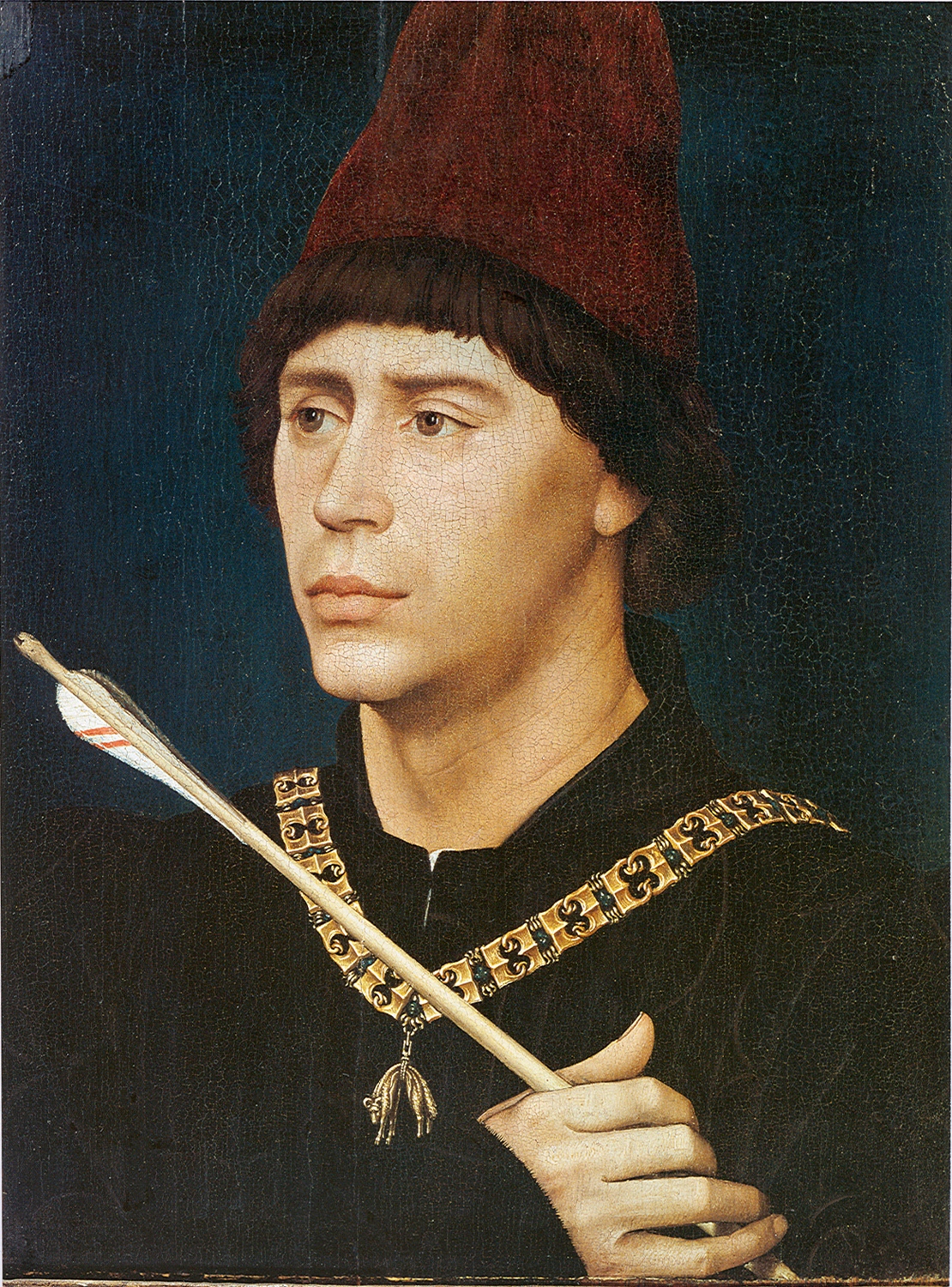
JOURNAL: Special Issue of the Revue du Nord on Bastardy and Illegitimate Offspring

(image: Antony, the "Bastard of Burgundy", source: Wikimedia Commons)

Nomôdos reports the publication of a special issue of the respected journal Revue du Nord, dedicated to bastardy and illegitimate offspring, an initiative of the CRHIDI (centre for Legal and Institutional History at the Saint-Louis University (Brussels)

Summary and table of contents:
Présentation
Dans un article fameux paru en 1975, le regretté Michael Harsgor, a forgé le concept de «bâtardocratie» pour désigner un phénomène qu’il observa dans la France de la fin du Moyen Âge et qu’il décrivit comme «un puissant essor social et politique des enfants naturels engendrés par des pères appartenant à la noblesse». Il mettait ainsi l’accent sur les rapports entre bâtardise et pouvoir et sur le rôle, souvent important, que les enfants illégitimes, liés non pas seulement à la noblesse mais aux élites en général, ont pu jouer au cœur des institutions ecclésiastiques, politiques, militaires et administratives, dans un contexte – tant moral que démographique – qui leur était momentanément favorable.
Cette réalité, d’autres chercheurs, avant M. Harsgor et après lui, l’ont également étudiée et mise en lumière, mais elle n’avait jamais encore fait l’objet d’un travail collectif permettant la confrontation de sources, de cas – individuels ou non – et de situations provenant d’aires géo- graphiques diverses et fournissant les matériaux à une approche comparative. C’est cette lacune historiographique que les concepteurs et les auteurs du présent volume ont voulu contribuer à combler.
Les dix-neuf études contenues dans ce recueil couvrent un champ chronologique allant du 13e au 16e siècle et un espace géopolitique englobant les royaumes de France, de Navarre, d’Angleterre et d’Écosse, les principautés des anciens Pays-Bas, le duché de Lorraine, les sei- gneuries de la Maison de Savoie et le marquisat de Ferrare. Dans ce cadre, la relation entre naissance illégitime et exercice du pouvoir est envisagée sous différents aspects et selon les grands thèmes que sont le statut politique et juridique, la quête de la légitimation, les destins, les carrières, le mécénat, la bibliophilie, l’héraldique. Grâce à cet apport à la fois riche et varié se dessine une image plus nette d’un phénomène historique qui a sans doute atteint son apogée au xVe siècle pour s’affaiblir au seuil de l’Époque moderne, quand se modifièrent la situation démographique, les conditions sociales et les exigences de la morale.
Table des matières
  • Bertrand Schnerb, Introduction. Bâtards et pouvoir: un thème de recherche
  • Monique Maillard-Luypaert, Jean de Bourgogne, bâtard de Jean sans Peur, évêque de Cambrai de 1439 à 1480
  • Alain Marchandisse, Corneille, bâtard de Bourgogne (ca 1426-1452)
  • Bertrand Schnerb, Des bâtards nobles au service du prince: l’exemple de la cour de Bourgogne (fin 14e-début 15e siècle)
  • Jean-Baptiste Santamaria, Les bâtards à la Chambre des comptes de Lille: autour du cas de Denis de Pacy
  • Alice Duda, Les lettres de légitimation des ducs de Bourgogne (1384-1477)
  • Céline Berry, La bâtardise au sein du lignage de Luxembourg
  • Godfried Croenen, Bâtards et pouvoir dans le duché de Brabant (12e-14e siècles)
  • Michel Nassiet, Les bâtards dans l’Ouest au 15e et au début du 16e siècle
  • Christophe Rivière, Les bâtards en Lorraine: emblèmes d’une culture politique ou trublions d’une société nobiliaire?
  • Emmanuel Johans, Les bâtards d’Argmanac (14e-16e siècles)
  • Claire Dechamps, Un couple de bibliophiles dans le milieu royal: Louis, bâtard de Bourbon, et son épouse, Jeanne, bâtarde de France
  • Philippe Contamine, Jean, comte de Dunois et de Longueville (1403?-1468), ou l’honneur d’être bâtard
  • Alexander Grant, Royal and Magnate Bastards in the Later Middle Ages: The View from Scotland
  • Michael Hicks, The Royal Bastards of Late Medieval England
  • Luisa Clotilde Gentile, Les bâtards princiers piémontais et savoyards
  • Giovanni Ricci, Les dangers de la bâtardise. Les péripéties de l’Etat seigneurial des Este entre 15e et 16e siècles
  • María Narbona Cárceles, Les bâtards royaux et la nouvelle noblesse de sang en Navarre (fin 14e siècle-début 15e siècle)
  • Laurent Hablot, L’emblématique des bâtards princiers au 15e siècle. Outil d’un nouveau pouvoir?
  • Simona Slanicka, L’art d’être bâtard. La bâtardise et la legitimation artistique à la Renaissance (Maisons de Bourgogne et d’Este, vers 1450)
  • Eric Bousmar, Les bâtards et l’exercice du pouvoir: modalités spécifiques ou fenêtre étroite d’opportunité? 

26 October 2014

BOOK: "Cohabitation and Non-Marital Births in England and Wales" (1600-2012), edited by Rebecca Probert (June 2014)


Cohabitation and Non-Marital Births in England and Wales (1600-2012), edited by Rebecca Probert, (University of Warwick) 

June 2014
All information here 

From the press:

Today, almost half of all children are born outside marriage, with cohabiting relationships accounting for the majority of such births. But what was the situation in earlier centuries? Bringing together leading historians, demographers and lawyers, this interdisciplinary collection examines the changing context of non-marital child-bearing in England and Wales since 1600. Drawing on Private Acts of Parliament, ecclesiastical court records, reported cases, sessions files, coronial records, poor law records, petitions to the London Foundling Hospital, the registers of the London Bridewell, the records of charitable institutions, surveys and modern demographic data, it not only shows the relative rarity of cohabitation in earlier periods but also discovers the nature of individual relationships. It also explores how differences in the extent of both non-marital child-bearing and cohabitation emerge depending on definition, source material, interpretation and location, building up a more nuanced picture of past practices.