Search

Showing posts with label Christianity. Show all posts

09 October 2023

SEMINAR SERIES: Chrétienté latine et société féodale (Xe-XIIIe siècles) (Paris: Sorbonne Université, 2023-2024)


Chrétienté latine et société féodale (Xe-XIIIe siècles)

Séminaire dirigé par Florian MAZEL

Mercredi de 15h00 à 17h00, Sorbonne, salle Perroy, galerie Dumas, escalier R, 2e étage


I – Actualité de la recherche

  • 8 novembre : Solal ABELES (Université du Luxembourg) et Fanny MADELINE (Université Paris 1) : autour du livre Retour à l’horizon : historiographie du féodalisme. La Société d’étude du féodalime – 1975-1982, L’atelier du CRH, 27, 2023 (éd. électronique : https://doi.org/10.4000/acrh.23229)
  • 15 novembre : Pierre CHASTANG (Université Paris-Saclay), Fabrice DELIVRE (Université Paris 1), Catherine KÖNIG-PRALONG (EHESS) et Valérie THEIS (ENS Paris) : Le pouvoir des listes au Moyen Âge. Un bilan du projet POLIMA
  • 22 novembre : Marie DEJOUX (Université Paris 1) : Sainteté, genre, milieu curial et gouvernement. Autour du livre de S. Field, Sainteté de cour. Les Capétiens et leurs saintes femmes, Paris, 2022.
  • 6 décembre : Isabelle ROSE (Université Rennes 2). Autour de son livre Le mariage des prêtres, une hérésie ? Genèse du nicolaïsme, Ier-XIe siècle, Paris, 2023.


II – Repenser l’Ecclesia. Église, société, économie, domination : perspectives historiographiques

  • 13 décembre : Dominique IOGNA-PRAT (EHESS) : Ecclesia et espace : du lieu de culte à la cité
  • 20 décembre : Pierre CHASTANG (Université Paris-Saclay) : Retour sur la spatialisation de l’ecclesia
  • 7 février : Jacques DALARUN (Institut de France) : Ecclesia et gouvernement
  • 28 février [séance commune avec le séminaire « Église, société, culture » de Cécile Caby] : Cécile CABY (Université Paris-Sorbonne) : retour sur Ecclesia et gouvernement
  • 6 mars : Giacomo TODESCHINI (Université de Trieste) : Ecclesia et lexiques de l’économie
  • 13 mars : Jacques CHIFFOLEAU (EHESS) : L’économie de l’institution ecclésiale
  • 20 mars : Clément LENOBLE (CNRS) : Retour sur l’économie de l’institution ecclésiale
  • 27 mars : Valentina TONEATTO (Université Lyon 2) : Retour sur Ecclesia et lexiques de l’économie
  • 3 avril : Michel LAUWERS (Université de Nice Côte d’Azur) : Le dominium ecclésial
  • 17 avril : Nicolas PERREAUX (CNRS) : Retour sur le dominium ecclésial


More information can be found here.

26 October 2021

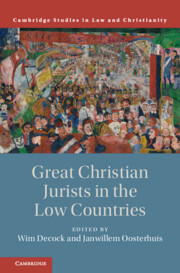
BOOK: Wim DECOCK, Janwillem OOSTERHUIS (eds.), Great Christian Jurists in the Low Countries (Cambridge: Cambridge University Press, 2021), pp. 380, ISBN 9781108555388


(Source: Cambridge University Press)


ABOUT THE BOOK

What impact has Christianity had on law and policies in the Lowlands from the eleventh century through the end of the twentieth century? Taking the gradual 'secularization' of European legal culture as a framework, this volume explores the lives and times of twenty legal scholars and professionals to study the historical impact of the Christian faith on legal and political life in the Low Countries. The process whereby Christian belief systems gradually lost their impact on the regulation of secular affairs passed through several stages, not in the least the Protestant Reformation, which led to the separation of the Low Countries in a Protestant North and a Catholic South in the first place. The contributions take up general issues such as the relationship between justice and mercy, Christianity and politics as well as more technical topics of state-church law, criminal law and social policy.


More information is available with the publisher.

The table of contents is available here.


20 September 2021

COLLOQUIUM: Theologians and Contract Law (11 October, Oxford)


The Pusey Centre for Theology, Law and Culture is hosting its inaugural colloquium on Monday 11 October. 


09 March 2021

BOOK: M.C. MIROW & Rafael DOMINGO (Eds.), Law and Christianity in Latin America - The Work of Great Jurists (Abingdon: Routledge, 2021). ISBN 9780367896416, 120.00 GBP


(Source: Routledge)

Routledge is publishing a new edited collection on law and Christianity in Latin America.

ABOUT THE BOOK

This volume examines the lives of more than thirty-five key personalities in Latin American law with a focus on how their Christian faith was a factor in molding the evolution of law in their countries and the region.

The book is a significant contribution to our ability to understand the work and perspectives of jurists and their effect on legal development in Latin America. The individuals selected for study exhibit wide-ranging areas of expertise from private law and codification, through national public law and constitutional law, to international developments that left their mark on the region and the world. The chapters discuss the jurists within their historical, intellectual, and political context. The editors selected jurists after extensive consultation with legal historians in various countries of the region looking at the jurist’s particular merits, contributions to law in general, religious perspective, and importance within the specific country and period under consideration. Giving the work a diversity of international and methodological perspectives, the chapters have been written by distinguished legal scholars and historians from Latin America and around the world.

The collection will appeal to scholars, lawyers, and students interested in the interplay between law and religion. Political, social, legal, and religious historians among other readers will find, for the first time in English, authoritative treatments of the region’s essential legal thinkers and authors. Students and other who may not read Spanish will appreciate these clear, accessible, and engaging English studies of the region’s great jurists.

ABOUT THE EDITORS

M. C. Mirow, Professor of Law, Florida International University, Miami, Florida, USA.

Rafael Domingo, Spruill Family Professor of Law and Religion, Emory University, Atlanta, Georgia, USA; Álvaro d’Ors Professor of Law, University of Navarra, Pamplona, Spain.

TABLE OF CONTENTS

Foreword
John Witte, Jr.

Introduction
M. C. Mirow

Nineteenth-Century Jurists

1 Juan Germán Roscio (Venezuela, 1763 –1821)
Rogelio Pérez-Perdomo

2 Andrés Bello (Venezuela and Chile, 1781–1865)
Alejandro Guzmán

3 Félix Varela y Morales (Cuba, 1788–1853)
M. C. Mirow

4 Mariano Egaña (Chile, 1793–1846)
Javier Francisco Infante Martin

5 Justo Donoso Vivanco (Chile, 1800–1868)
Cristóbal García-Huidobro Becerra

6 Dalmacio Vélez Sarsfield (Argentina, 1800–1875)

Abelardo Levaggi

7 José Bernardo Couto y Pérez (Mexico, 1803–1862)
Óscar Cruz Barney

8 Teodosio Lares (Mexico, 1806–1870)
Brian Hamnett

9 Bartolomé Herrera Vélez (Peru, 1808–1864)
Fernán Altuve-Febres Lores

10 Juan Nepomuceno Rodríguez de San Miguel (Mexico, 1808–1877)
Juan Pablo Salazar Andreu

11 Juan Bautista Alberdi (Argentina, 1810–1884)
Ezequiel Abásolo

12 Clemente de Jesús Munguía Núñez (Mexico, 1810–1868)
Jorge Adame Goddard

13 Eduardo Acevedo Maturana (Uruguay, 1815–1863)
Juan Carlos Frontera

14 Augusto Teixeira de Freitas (Brazil, 1816–1883)
Alfredo de J. Flores

15 Justo Arosemena Quesada (Panama and Colombia, 1817–1896)
Hernán Alejandro Olano García and M. C. Mirow

16 Tristán Narvaja (Argentina and Uruguay, 1819–1877)
Viviana Kluger

17 Gabriel García Moreno (Ecuador, 1821–1875)
Peter V. N. Henderson

18 Julián Viso (Venezuela, 1822–1900)
Gustavo Adolfo Vaamonde

19 Rafael Fernández Concha (Chile, 1833–1883)
Raúl Madrid

20 Tobias Barreto de Meneses (Brazil, 1839–1889)
Marcio Ricardo Staffen

21 José Manuel Estrada (Argentina, 1842–1894)
Agustín Parise

22 Miguel Antonio Caro Tobar (Colombia, 1845–1909)
Eduardo Herrera and M. C. Mirow

23 Fernando Vélez Barrientos (Colombia, 1847–1935)
Victor M. Uribe-Uran

Twentieth-Century Jurists

24 Antonio Sánchez de Bustamante y Sirvén (Cuba, 1855–1961)
Juan Bosco Amores Carredano

25 Víctor Andrés Belaúnde Diez Canseco (Peru, 1883–1966)
Martín Santiváñez Vivanco

26 José de la Riva-Agüero y Osma (Peru, 1885–1944)
José de la Puente Brunke

27 Manuel Herrera y Lasso (Mexico, 1890–1967)
Kif Augustine-Adams

28 Heráclito Fontoura Sobral Pinto (Brazil, 1893–1991)
Ernesto Pimentel and Paul Sekscenski

29 Julio Tobar Donoso (Ecuador, 1894–1981)
Álvaro Mejía-Salazar

30 Tomás Darío Casares (Argentina, 1895–1977)
Juan Cianciardo and Marcelo Fernández Peralta

31 Pedro Lira Urquieta (Chile, 1900–1981)
Cristián Villalonga Torrijo

32. Arturo Enrique Sampay (Argentina, 1911–1977)
Susana Ramella

33 Rafael Antonio Caldera Rodríguez (Venezuela, 1916–2009)
Carlos García Soto

34 Óscar Arnulfo Romero y Galdámez (El Salvador, 1917–1980)
Rafael Domingo

35 Germán Bidart Campos (Argentina, 1927–2004)
Santiago Legarre

36 Juan Larrea Holguín (Ecuador, 1927–2006)
Juan Carlos Riofrío Martínez-Villalba

37 Carlos Alberto Menezes Direito (Brazil, 1942–2009)
Robert J. Cottrol


More info here

19 January 2021

BOOK: Orazio CONDORELLI & Rafael DOMINGO (Eds.), Law and the Christian Tradition in Italy: The Legacy of the Great Jurists (New York: Routledge, 2020). ISBN: 978-0-367-85710-3, pp. 468,


(Source: Routledge)


ABOUT THE BOOK

Firmly rooted on Roman and canon law, Italian legal culture has had an impressive influence on the civil law tradition from the Middle Ages to present day, and it is rightly regarded as "the cradle of the European legal culture." Along with Justinian’s compilation, the US Constitution, and the French Civil Code, the Decretum of Master Gratian or the so-called Glossa ordinaria of Accursius are one of the few legal sources that have influenced the entire world for centuries. This volume explores a millennium-long story of law and religion in Italy through a series of twenty-six biographical chapters written by distinguished legal scholars and historians from Italy and around the world. The chapters range from the first Italian civilians and canonists, Irnerius and Gratian in the early twelfth century, to the leading architect of the Second Vatican Council, Pope Paul VI. Between these two bookends, this volume offers notable case studies of familiar civilians like Bartolo, Baldo, and Gentili and familiar canonists like Hostiensis, Panormitanus, and Gasparri but also a number of other jurists in the broadest sense who deserve much more attention especially outside of Italy. This diversity of international and methodological perspectives gives the volume its unique character. The book will be essential reading for academics working in the areas of Legal History, Law and Religion, and Constitutional Law and will appeal to scholars, lawyers, and students interested in the interplay between religion and law in the era of globalization.


ABOUT THE EDITORS

Orazio Condorelli is Professor of Ecclesiastical and Canon Law in the University of Catania, Italy.
Rafael Domingo is the Spruill Family Professor of Law and Religion at Emory University in Atlanta, USA, and Alvaro d’Ors Professor of Law at the University of Navarra, Spain.


TABLE OF CONTENTS

Foreword: John Witte, Jr.;

Introduction: Orazio Condorelli and Rafael Domingo.;

Irnerius (ca. 1055 to ca. 1125);
Andrea Padovani;
Gratian (late eleventh century to ca. 1145);
Atria A. Larson;
Azo (ca. 1165 to ca. 1120) and Accursius (1182/5 to ca. 1263);
Emanuele Conte;
Sinibaldo Fieschi (Pope Innocent IV) (1180/90–1254);
Kathleen G. Cushing;
Enrico da Susa (Cardinal Hostiensis) (ca. 1200–1271);
Kenneth Pennington;
Thomas Aquinas (1225–1274);
Charles J. Reid Jr;
Cino Sinibuldi da Pistoia (ca. 1265–1336);
Giuseppe Speciale;
Giovanni d’Andrea (1270–1348);
Peter D. Clarke;
Bartolo da Sassoferrato (1313/14–1357);
Orazio Condorelli;
Baldo degli Ubaldi da Perugia (1327–1400);
Julius Kirshner;
Paolo di Castro (1360/62–1441);
Susanne Lepsius;
Niccolò Tedeschi (Panormitanus) (1386–1445);
R. H. Helmholz;
Thomas Cajetan (1469–1534);
Wim Decock;
Andrea Alciato (1492–1550);
Alain Wijffels;
Robert Bellarmine (1542–1621);
Lorenzo Sinisi;
Alberico Gentili (1552–1608);
Giovanni Minnucci;
Giovanni Battista De Luca (1613–1683);
Italo Birocchi;
Giambattista Vico (1668–1744)
Marco Nicola Miletti
Cesare Beccaria (1738–1794);
Maria Gigliola di Renzo Villata;
Pietro Gasparri (1852–1934);
Alberto Lupano;
Contardo Ferrini (1859–1902);
Rafael Domingo;
Luigi Sturzo (1871–1959);
Romeo Astorri;
Francesco Carnelutti (1879–1965);
Giovanni Chiodi;
Alcide De Gasperi (1881–1954);
Olivier Descamps;
Arturo Carlo Jemolo (1891–1981);
Carlo Fantappiè;
Giovanni Battista Montini, Pope Paul VI (1897–1978);
Jean-Pierre Schouppe;


More information with the publisher.

18 November 2020

BOOK: R. COCHRAN and Michael P. MORELAND, eds., Christianity and Private Law (London: Routledge, 2020). ISBN 9780367893460, 120.00 GBP


(Source: Routledge)

Routledge is publishing a new book on Christianity and private law.

ABOUT THE BOOK

This volume examines the relationship between Christian legal theory and the fields of private law.
Recent years have seen a resurgence of interest in private law theory, and this book contributes to that discussion by drawing on the historical, theological, and philosophical resources of the Christian tradition. The book begins with an introduction from the editors that lays out the understanding of “private law” and what distinguishes private law topics from other fields of law. This section includes two survey chapters on natural law and biblical sources. The remaining sections of the book move sequentially through the fields of property, contracts, and torts. Several chapters focus on historical sources and show the ways in which the evolution of legal doctrine in areas of private law has been heavily influenced by Christian thinkers. Other essays draw out more contemporary and public policy-related implications for private law.

While this book is focused on the relationship of Christianity to private law, it will be of broad interest to those who might not share that faith perspective. In particular, legal historians and philosophers of law will find much of interest in the original scholarship in this volume. The book will be attractive to teachers of law, political science, and theology. It will be of special interest to the many law faculty in property, contracts, and torts, as it provides a set of often overlooked historical and theoretical perspectives on these fields.

ABOUT THE EDITORS

Robert F. Cochran Jr. is Louis D. Brandeis Professor of Law, Caruso School of Law, Pepperdine University, USA, and Senior Fellow, Center for Advanced Studies in Culture, University of Virginia, USA.    

Michael P. Moreland is University Professor of Law and Religion and Director of the Eleanor H. McCullen Center for Law, Religion and Public Policy, Villanova University, USA.

TABLE OF CONTENTS

1. Introduction
a. John Witte, Jr. (Emory) - Foreword
b. The Editors - Introduction
c. James R. Gordley (Tulane) - Christian Origins of Private Law
d. Brent A. Strawn (Duke) - Biblical Understandings of Private Law
2. Property
a. David W. Opderbeck (Seton Hall) - Christian Thought and Property Law
b. William S. Brewbaker III (Alabama) - Augustinian Property
c. Richard H. Helmholz (Chicago) - Religion and English Property Law: 1500-1700
d. Adam J. MacLeod (Faulkner) – Property and Practical Reason
e. Paula A. Franzese and Angela C. Carmella (Seton Hall) – Catholic Social Teaching, Property Law, and Public Housing
3. Contracts
a. Wim Decock (KU Leuven, Belgium) - Contract Law in Early Modern Scholasticism
b. David S. Caudill (Villanova) - Private Law in Christian Perspective: The Example of Dooyeweerd on Contracts
c. C. Scott Pryor (Campbell) - Destabilizing Contract: A Christian Argument For Revitalizing Unconscionability
d. Val D. Ricks (South Texas) – Christianity, Freedom, and the Doctrine of Consideration
e. Michael A. Helfand (Pepperdine) - Privatization and Pluralism in Dispute Resolution: Promoting Religious Values through Contract
4. Torts
a. Michael P. Moreland (Villanova) and Jeffrey A. Pojanowski (Notre Dame) – The Moral of Torts
b. David F. Partlett (Emory) – Christianity and Tort Duties
c. Nathan B. Oman (William and Mary) – Christianity’s Quarrel with Civil Recourse Theory
d. Robert F. Cochran, Jr. (Pepperdine) - Tort Law and Intermediate Communities: Catholic and Calvinist Theories


More info here

09 October 2020

BOOK: MODEER, K. and Vogt, H., Eds. Law and The Christian Tradition in Scandinavia - The Writings of Great Nordic Jurists (London: Routledge, 2021). ISBN 9780367858247, 120.00 GBP


(Source: Routledge)

Routledge is publishing a new book on great Nordic jurists and Christianity.

ABOUT THE BOOK

This book presents a comprehensive history of law and religion in the Nordic context.

The entwinement of law and religion in Scandinavia encompasses an unusual history, not widely known, yet important for its impact on contemporary political and international relations in the region. The volume provides a holistic picture from the first written legal sources of the twelfth century to the law of the present secular welfare states. It recounts this history through biographical case studies. Taking the point of view of major influential figures in church, politics, university, and law, it thus presents the principal actors who served as catalysts in ecclesiastical and secular law through the centuries. This refreshing approach to legal history contributes to a new trend in historiography, particularly articulated by a younger generation of experienced Nordic scholars whose work is featured prominently in this volume.

The collection will be a valuable resource for academics and researchers working in the areas of Legal History and Law and Religion.

ABOUT THE EDITORS

Kjell Å Modéer is Professor Emeritus of Legal History at Lund University, Sweden.
Helle Vogt holds the Chair in Legal History at the Faculty of Law, University of Copenhagen, Denmark.

TABLE OF CONTENTS

Foreword by John Witte, Jr.;
  1. Introduction: Kjell Å Modéer & Helle Vogt;
  2. The Middle Ages;
    1. Introduction: Bertil Nilsson & Helle Vogt;
    2. Per Andersen & Helle Vogt: Archbishops Absalon and Anders Sunesen: Legal reforms in around 1200 in Denmark;
    3. Bertil Nilsson & Stina Sundmark: Anders Andersson And, Brynolf Algotsson & Laurentius of Vaksala, Swedish church law around 1300;
  3. Reformation and Early Modern Times;
    1. Introduction: Mia Korpiola & Heikki Pihlajamäki;
    2. Morten Kjær & Mattias Skat Sommer: Johannes Bugenhagen: The architect of the Danish Reformation;
    3. Heikki Pihlajamäki: Olaus Petri: The architect of the Swedish Reformation;
    4. Mia Korpiola: Archbishop Laurentius Petri: The Respected Authority of the Swedish Reformation;
    5. Morten Kjær and Mattias Skat Sommer: The Christian jurisprudence of Niels Hemmingsen;
  4. The Enlightenment – Secular Law in Christian Societies;
    1. Introduction: Søren Koch and Kristian Mejrup;
    2. Søren Koch: Ludvig Holberg: Natural Law and the Struggle with Pietism in Eighteenth-Century Denmark-Norway: Ludvig Holberg (1684–1751);
    3. Kristian Mejrup: Andreas Hojer: the standard-bearer of Danish-Norwegian Pietism;
  5. National Romanticism and Constitutionalism;
    1. Introduction: Anders Jarlert & Kjell Å Modéer;
    2. Lisbet Christoffersen and Niels Henrik Gregersen: Shaping the Danish People’s Church in the Context of Freedom of Religion. A.S. Ørsted (1778–1860) and N.F.S. Grundtvig (1783–1872);
    3. Kjell Å Modéer: Christian Legal Historian and Intermediary of Henric Schartau’s Religious Heritage: Carl Johan Schlyter 1795 – 1888;
    4. Alexander Maurits: The Theological Battle for Freedom of Religion in Sweden: the Case of Henrik Reuterdahl and Johan Henrik Thomander;
    5. Jussi Sallila: Karl Gustav Ehrström: Humanity, the Christian Spirit, and Criminal Law in Finland in the nineteenth century;
  6. Modernity: Secularism and Positivism/Legal Realism;
    1. Introduction: Anders Jarlert & Kjell Å Modéer;
    2. Egil Morland and Torgeir Landro, Absalon Taranger: Legal history and church politic in Norway around 1900;
    3. Anders Jarlert: Swedish Modernity in Transition within Law and Theology: Halvar G F Sundberg and Gustaf Aulén;
    4. Egil Morland: Church Leader in Times of Trouble: Eivind Josef Berggrav (1884 - 1959);
    5. Kjell Å Modéer, Frede Castberg 1893 – 1977: A Counterpoint in Modern Nordic Legal Culture;
    6. Kjell Å Modéer: A Late-Modern Catalyst in Swedish Ecclesiastical Law: Göran Göransson (1925–1998);

More info here

02 July 2020

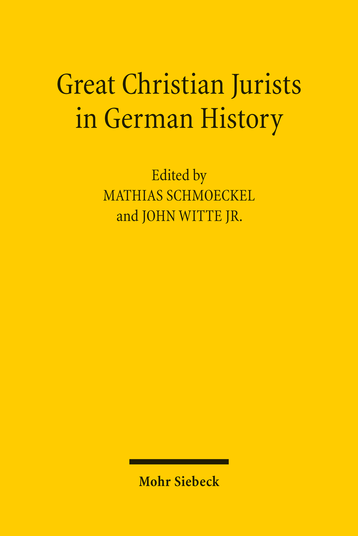
BOOK: Mathias SCHMOECKEL and John WITTE, eds., Great Christian Jurists in German History (Tübingen: Mohr Siebeck, 2020). ISBN 978-3-16-158346-9, 74.00 EUR


(Source: Mohr Siebeck)

Mohr Siebeck is publishing an edited collection on “Great Christian Jurists in German History”.

ABOUT THE BOOK

This volume is part of a 50-volume series on »Great Christian Jurists,« presenting the interaction of law and Christianity through the biographies of 1000 legal figures of the past two millennia. This volume presents 26 major German legal scholars from Albert the Great and Eike von Repgow in the Middle Ages to Konrad Adenauer and Stephan Kuttner in the twentieth century. Each chapter analyzes the influence of Christianity on their lives and legal work and sketches their enduring influence on the laws of church and state. Featuring freshly written chapters, this is the first overview in English of the relationship of Christianity and German law in the second millennium. Included are studies of both famous and long forgotten Catholics and Protestants, and both martyrs and collaborators with Nazism and earlier forms of state autocracy. Authoritative, accessible, and engaging, this study is a vital scholarly resource and classroom text.

ABOUT THE AUTHOR

Mathias Schmoeckel Professor of German and Rhenish Legal History and Executive Director of the Institute of German and Rhenish Legal History and Civil Law at the University of Bonn.

John Witte Robert W. Woodruff Professor of Law, McDonald Distinguished Professor of Religion, and Director of the Center for the Study of Law and Religion at Emory University School in Atlanta.

TABLE OF CONTENTS

Survey of contents
Ken Pennington: Johannes Teutonicus (ca. 1170/75–1245) – Tilman Repgen: Eike von Repgow (ca. 1180–1235) and the Christian Character of his Sachsenspiegel – Sven Lichtmann/Hannes Möhle: Albertus Magnus (before 1200–1280) Natural Law as Law of Reason and its Significance for the Political Order – Mathias Schmoeckel: Johann von Buch (1290–1356) and the First Gloss of the Mirror of the Saxons – Gero Fuchs: Conrad Peutinger (1465–1547) – John Witte Jr.: The Good Lutheran Jurist Johann Oldendorp (ca. 1486–1567) – Wolfgang Forster: Andreas Gail (1526–1587) – Heiner Lück: Matthew Wesenbeck (1531–1586): Professor of Jurisprudence in Wittenberg – Cornel Zwierlein: Johannes Althusius (1563–1638) – Pascal Förster: Dominicus Arumäus (1579–1637) – Mathias Schmoeckel: Benedict Carpzov the Younger (1595–1666) – Robert von Friedeburg: Samuel von Pufendorf (1632–1694) – Steffen Schlinker: Gottfried Wilhelm Leibniz (1646–1716) – Christoph Strohm: Christian Thomasius (1655–1728) – Sebastian Michels: Carl Gottlieb Svarez (1746–1798) – Joachim Rückert: Friedrich Carl von Savigny (1779–1861) – Steffen Schlinker: Karl Friedrich Eichhorn (1781–1854) – Hans-Georg Hermann: »Rescued from Scylla, to be thrown to Charybdis”: Religious Conviction and the Separation of Church and State in the Works of Sylvester Jordan (1792–1861) – Hans-Peter Haferkamp: Moritz August von Bethmann-Hollweg (1795–1877) – Heinrich de Wall: Friedrich Julius Stahl (1802–1861) – Malte Becker: Max von Seydel (1846–1901) – Andreas Thier: Rudolph Sohm (1841–1917) – Konrad Adenauer: Konrad Adenauer (1876–1967) – Werner Schubert: Hans Nawiasky (1880–1961) – Joachim Rückert: Eugen Bolz (1881–1945) Jurisprudence, Dictatorship, and the Responsibilities of a Jurist and Christian* – Ken Pennington: Stephan Georg Kuttner (1907–1996)

More info here

25 June 2020

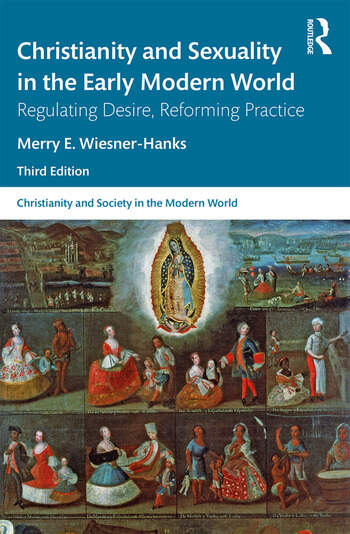
BOOK: Merry E. WIESNER-HANKS, Christianity and Sexuality in the Early Modern World Regulating Desire, Reforming Practice, 3rd ed. (London: Routledge, 2020). ISBN 9780367201791, 32.99 GBP


(Source: Routledge)

Routledge is publishing a new edition of Christianity and Sexuality in the Early Modern World.

ABOUT THE BOOK

Christianity and Sexuality in the Early Modern World surveys the ways in which people from the time of Luther and Columbus to that of Thomas Jefferson used Christian ideas and institutions to regulate and shape sexual norms and conduct, and examines the impact of their efforts.

Global in scope and geographic in organization, the book contains chapters on Protestant, Catholic, and Orthodox Europe, Latin America and the Caribbean, Africa and Asia, and North America. It explores key topics, including marriage and divorce, fornication and illegitimacy, clerical sexuality, same-sex relations, witchcraft and love magic, moral crimes, and interracial relationships. The book sets its findings within the context of many historical fields, including the history of gender and sexuality, and of colonialism and race.

Each chapter in this third edition has been updated to reflect new scholarship, particularly on the actual lived experience of people around the world. This has resulted in expanded coverage of nearly every issue, including notions of the body and of honor, gendered religious symbols, religious and racial intermarriage, sexual and gender fluidity, the process of conversion, the interweaving of racial identity and religious ideologies, and the role of Indigenous and enslaved people in shaping Christian traditions and practices. It is ideal for students of the history of sexuality, early modern Christianity, and early modern gender.

ABOUT THE AUTHOR

Merry E. Wiesner-Hanks is Distinguished Professor of History Emerita at the University of Wisconsin-Milwaukee, USA. The senior editor of the Sixteenth Century Journal, she is author or editor of thirty books and many articles that have appeared in English, German, French, Italian, Spanish, Portuguese, Greek, Chinese, Turkish, and Korean.

TABLE OF CONTENTS

Introduction; 1. Christianity to 1500; 2. Protestant Europe; 3. Catholic and Orthodox Europe; 4. Latin America and the Caribbean; 5. Africa and Asia; 6. North America; 7. Conclusions

More info here

04 June 2020

BOOK: Adriano PROSPERI, Crime and Forgiveness. Christianizing Execution in Medieval Europe (Transl. Jeremy Carden) (Cambridge: Harvard University Press, 2020). ISBN 9780674659841, €36.00


(Source: HUP)

Harvard University Press has published a new book (translated from Italian) on Christianity’s role in legitimizing the death penalty in Early Modern Europe.

ABOUT THE BOOK

A provocative analysis of how Christianity helped legitimize the death penalty in early modern Europe, then throughout the Christian world, by turning execution into a great cathartic public ritual and the condemned into a Christ-like figure who accepts death to save humanity.

The public execution of criminals has been a common practice ever since ancient times. In this wide-ranging investigation of the death penalty in Europe from the fourteenth to the eighteenth century, noted Italian historian Adriano Prosperi identifies a crucial period when legal concepts of vengeance and justice merged with Christian beliefs in repentance and forgiveness.

Crime and Forgiveness begins with late antiquity but comes into sharp focus in fourteenth-century Italy, with the work of the Confraternities of Mercy, which offered Christian comfort to the condemned and were for centuries responsible for burying the dead. Under the brotherhoods’ influence, the ritual of public execution became Christianized, and the doomed person became a symbol of the fallen human condition. Because the time of death was known, this “ideal” sinner could be comforted and prepared for the next life through confession and repentance. In return, the community bearing witness to the execution offered forgiveness and a Christian burial. No longer facing eternal condemnation, the criminal in turn publicly forgave the executioner, and the death provided a moral lesson to the community.

Over time, as the practice of Christian comfort spread across Europe, it offered political authorities an opportunity to legitimize the death penalty and encode into law the right to kill and exact vengeance. But the contradictions created by Christianity’s central role in executions did not dissipate, and squaring the emotions and values surrounding state-sanctioned executions was not simple, then or now.

ABOUT THE AUTHOR

Adriano Prosperi is Professor of Modern History, Emeritus, at the Scuola Normale Superiore di Pisa and the author of more than fifteen books that address the intersection of law and religion in early modern Europe.

More info here

10 December 2019

BOOK: Pamela BARMASH, The Oxford Handbook of Biblical Law (Oxford: Oxford University Press, 2019). ISBN 9780199392667, £97.00


(Source: OUP)

Oxford University Press is publishing a handbook on biblical law.

ABOUT THE BOOK

Major innovations have occurred in the study of biblical law in recent decades. The legal material of the Pentateuch has received new interest with detailed studies of specific biblical passages. The comparison of biblical practice to ancient Near Eastern customs has received a new impetus with the concentration on texts from actual ancient legal transactions.

The Oxford Handbook of Biblical Law provides a state of the art analysis of the major questions, principles, and texts pertinent to biblical law. The thirty-three chapters, written by an international team of experts, deal with the concepts, significant texts, institutions, and procedures of biblical law; the intersection of law with religion, socio-economic circumstances, and politics; and the reinterpretation of biblical law in the emerging Jewish and Christian communities. The volume is intended to introduce non-specialists to the field as well as to stimulate new thinking among scholars working in biblical law.

ABOUT THE EDITOR

Edited by Pamela Barmash, Associate Professor of Hebrew Bible and Biblical Hebrew, Washington University in St. Louis

Pamela Barmash is a professor of Hebrew Bible at Washington University in St. Louis and has served as director of Jewish, Islamic and Near Eastern Studies there. She has been a fellow at the Hebrew University, Jerusalem, and at the Institute for Advanced Study, Princeton. She is the author of Homicide in the Biblical World, and she is the co-editor of Exodus in the Jewish Experience: Echoes and Reverberations.

TABLE OF CONTENTS

Introduction
Legal Institutions and Fundamental Concepts
Covenant
Social Justice
Offences Against Human Beings in Public and Private Law
Litigation: Trial Procedure, Jurisdiction, Evidence, Testimony
Women, Children, Slaves, and Foreigners
Ritual Law: Sacrifice and Holy Days
Ritual Law: Priests, Purity, and the Sanctuary
"An Eye for an Eye and Capital Punishment
Legal Texts of the Bible
The Decalogue
The Book of the Covenant
The Priestly Law
The Holiness Legislation
The Deuteronomic Reform
Law and Narratives
Determining the Date of the Legal Texts of the Hebrew Bible
Law in the Canon of the Hebrew Bible
The Role of Law in the Formation of the Pentateuch and the Canon
The Law and the Prophets
Law and the Wisdom Tradition
The Legacy of the Ancient Near East Context of Biblical Law
Law Collections and Legal Forms and Institutions
Ancient Near Eastern Treaties and Biblical Law
The Pre-Exilic Monarchy and the Law
Law in the Persian Period
The Late Second Temple Period and Beyond — Reflections on Biblical Law Within Emerging Jewish Communities
Law in the Late Second Temple Period in the Dead Sea Scrolls, and in Intertestamental and Diaspora Sources
Judaism and Christianity: Diverging Paths in the Centuries after the Destruction of the Second Temple
The Bible and the Sources of Rabbinic Law
The Law and the Gospels, with Attention to the Relationship Between the Decalogue and the Sermon on the Mount/Plain
Ethics and Moral Duties in Jewish Law
Paul and the Covenant
Rabbinic Law
Ritual Law in Rabbinic Judaism
Women, Children, and Slaves in Jewish Law
Women, Children, Slaves, and the Law in the New Testament Period
Social Justice in Early Christianity
Social Justice in Rabbinic Judaism

More info here

03 July 2019

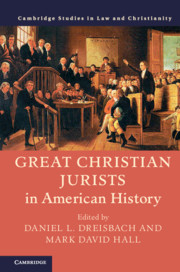
BOOK: Daniel L. DREISBACH and Mark David HALL, eds., Great Christian Jurists in American History [Law and Christianity] (Cambridge: Cambridge University Press, 2019). ISBN 9781108475358, £ 99.99


(Source: CUP)

Cambridge University Press has just published a new book on great Christian jurists in American history.  

ABOUT THE BOOK

From the early days of European settlement in North America, Christianity has had a profound impact on American law and culture. This volume profiles nineteen of America's most influential Christian jurists from the early colonial era to the present day. Anyone interested in American legal history and jurisprudence, the role Christianity has played throughout the nation's history, and the relationship between faith and law will enjoy this worthy and unique study. The jurists covered in this collection were pious men and women, but that does not mean they agreed on how faith should inform law. From Roger Williams and John Cotton to Antonin Scalia and Mary Ann Glendon, America's great Christian jurists have brought their faith to bear on the practice of law in different ways and to different effects.

ABOUT THE EDITORS

Daniel L. DreisbachAmerican University, Washington DC
Daniel L. Dreisbach is a professor in the School of Public Affairs at the American University in Washington, DC. His research interests include the intersection of religion, law, and politics in American public life. He has authored or edited ten books, including Thomas Jefferson and the Wall of Separation between Church and State (2002) and Reading the Bible with the Founding Fathers (2017). He has published numerous book chapters, reviews, and articles in scholarly journals, including American Journal of Legal History, the Journal of Church and State, Politics and Religion, and William and Mary Quarterly.

Mark David HallGeorge Fox University
Mark David Hall is Herbert Hoover Distinguished Professor of Politics and Faculty Fellow in the William Penn Honors Program at George Fox University. Mark has written, edited, or co-edited a dozen books, including Did America Have a Christian Founding?: Separating Modern Myth from Historical Truth (forthcoming); Roger Sherman and the Creation of the American Republic (2013); and The Sacred Rights of Conscience: Selected Readings on Religious Liberty and Church-State Relations in the American Founding (2009).

TABLE OF CONTENTS

Introduction Christianity and American law Daniel L. Dreisbach
1. Roger Williams and John Cotton Glenn A. Moots
2. John Winthrop and the covenantal ideal Darren Staloff
3. Friendly laws: William Penn's Christian jurisprudence Andrew R. Murphy
4. The friendly jurisprudence and early feminism of John Dickinson Jane E. Calvert
5. Roger Sherman, Oliver Ellsworth, and the formation of America's constitutional order Mark David Hall
6. John Jay: the first Chief Justice Wendell Bird
7. James Wilson Donald L. Drakeman
8. Was Justice Joseph Story a Christian constitutionalist? James Stoner
9. Harvard's evangelist of evidence: Simon Greenleaf's Christian common sense Daniel David Blinka
10. John Marshall Harlan the Elder, Christian Jurist Linda Przybyszewski
11. Judicial conservatism and Protestant faith: the case of Justice David J. Brewer Linda Przybyszewski
12. John T. Noonan, Jr: Catholic Jurist and Judge Charles J. Reid, Jr
13. The integrative Christian jurisprudence of Harold J. Berman John Witte
14. Antonin Scalia: devout Christian
worldly judge Thomas C. Berg
15. The insights and transitions of Mary Ann Glendon Paolo G. Carozza
16. A reformed liberalism: Michael McConnell's contributions to Christian jurisprudence Nathan S. Chapman
17. The jurisprudence of Robert P. George Gerard V. Bradley.

More info here

05 June 2019

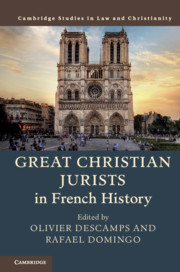
BOOK: Olivier DESCAMPS and Rafael DOMINGO, eds., Great Christian Jurists in French History [Law and Christianity] (Cambridge: Cambridge University Press, 2019). ISBN 9781108484084, £ 94.99


(Source: CUP)

Cambridge University Press has just published a new book on great Christian jurists in French history.

ABOUT THE BOOK

French legal culture, from the Middle Ages to the present day, has had an impressive influence on legal norms and institutions that have emerged in Europe and the Americas, as well as in Asian and African countries. This volume examines the lives of twenty-seven key legal thinkers in French history, with a focus on how their Christian faith and ideals were a factor in framing the evolution of French jurisprudence. Professors Olivier Descamps and Rafael Domingo bring together this diverse group of distinguished legal scholars and historians to provide a unique comparative study of law and religion that will be of value to scholars, lawyers, and students. The collaboration among French and non-French scholars, and the diversity of international and methodological perspectives, gives this volume its own unique character and value to add to this fascinating series.

ABOUT THE EDITORS

Olivier DescampsPantheon-Assas University, Paris

Olivier Descamps is Professor of law and legal history at the Panthéon-Assas University in Paris, France, and Managing Director of the Institute of Legal History of the French National Center for Scientific Research (CNRS) in Paris. A specialist in legal history, canon law, and comparative law, he has authored or edited five books, including Les sources du droit à l'aune de la pratique (2018) and Le statut du magistrat (forthcoming). Professor Descamps is coeditor of the Revue historique de droit français et étranger, one of the leading journals in legal history worldwide.
Rafael DomingoUniversidad de Navarra, Spain

Rafael Domingo is the Spruill Family Research Professor at Emory University, Atlanta, and ICS Professor of Law at the Universidad de Navarra, Spain. A specialist in legal history, legal theory, ancient Roman law, and comparative law, he has authored or edited more than twenty books, including The New Global Law (Cambridge, 2010), God and the Secular Legal System (Cambridge, 2016), Roman Law: An Introduction (2018), and Great Christian Jurists in Spanish History (Cambridge, 2018).

TABLE OF CONTENTS

Introduction Olivier Descamps and Rafael Domingo
1.
Ivo de Chartres (Yves de Chartres) Christof Rolker
2. Stephen of Tournai (Étienne de Tournai) Ken Pennington
3. Guillaume Durand Orazio Condorelli
4. Jacques de Revigny Paul J. du Plessis
5. Pierre de Belleperche Yves Mausen
6. Charles Dumoulin Wim Decock
7. John Calvin (Jean Calvin) John Witte, Jr
8. Jacques Cujas Xavier Prevost
9. Francois Hotman Mathias Schmoeckel
10. Hugues Doneau Christian Hattenhauer
11. Jean Bodin Daniel Lee
12. Jean Domat David Gilles
13. Henri François d'Aguesseau Isabelle Brancourt
14. Robert-Joseph Pothier Olivier Descamps
15. Jean-Etienne-Marie Portalis Nicolas Laurent-Bonne
16. Alexis de Tocqueville Mary Ann Glendon
17. Paul Viollet Anne-Sophie Chambost
18. Paul Fournier Brigitte Basdevant-Gaudemet and Rafael Domingo
19. Raymond Saleilles Marco Sabbioneti
20. Maurice Hauriou Julien Barroche
21. Léon Duguit M. C. Mirow
22.
Georges Ripert Frédéric Audren
23. Jacques Maritain William Sweet
24. Robert Schuman Rafael Domingo
25.
Gabriel Le Bras Kathleen Cushing
26. Jean Carbonnier Laetitia Guerlain
27. Michel Villey Luisa Brunori
Index.

More info here

08 February 2019

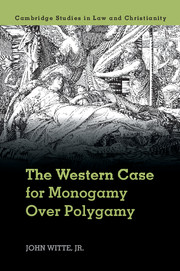
BOOK: John WITTE, The Western Case for Monogamy over Polygamy [Law and Christianity] (Cambridge: Cambridge University Press, 2015). ISBN 9781107499171, £ 37.99


(Source: CUP)

We did not yet report on this publication on monogamy in the Western tradition in Cambridge’s Law and Christianity series, which was published in 2015.

ABOUT THE BOOK

For more than 2,500 years, the Western tradition has embraced monogamous marriage as an essential institution for the flourishing of men and women, parents and children, society and the state. At the same time, polygamy has been considered a serious crime that harms wives and children, correlates with sundry other crimes and abuses, and threatens good citizenship and political stability. The West has thus long punished all manner of plural marriages and denounced the polygamous teachings of selected Jews, Muslims, Anabaptists, Mormons, and others. John Witte, Jr carefully documents the Western case for monogamy over polygamy from antiquity until today. He analyzes the historical claims that polygamy is biblical, natural, and useful alongside modern claims that anti-polygamy laws violate personal and religious freedom. While giving the pro and con arguments a full hearing, Witte concludes that the Western historical case against polygamy remains compelling and urges Western nations to hold the line on monogamy:

·         The first comprehensive history of attitudes toward polygamy in the West, from biblical times until today
·         Includes detailed case studies of polygamist prosecutions in early modern Europe and nineteenth-century America
·         Provides valuable tools for the study of polygamy including definitions of plural marital unions and a detailed background on Biblical, Talmudic, Greek and Roman law

ABOUT THE AUTHOR

John Witte, Jr, Emory University, Atlanta
John Witte, Jr is Robert W. Woodruff University Professor and Director of the Center for the Study of Law and Religion at Emory University, Atlanta. A world authority in legal history, he has directed twelve major international projects on democracy, human rights, religious liberty, marriage, family, and children. He has lectured throughout the world and published twenty-seven books, including, recently, Christianity and Human Rights: An Introduction (Cambridge, 2010) and The Sins of the Fathers: The Law and Theology of Illegitimacy Reconsidered (Cambridge, 2009).

TABLE OF CONTENTS

1. From polygamy to monogamy in ancient Judaism
2. Monogamy versus polygamy in the early church
3. Polygamy in the laws of state and church in the first millennium
4. The medieval case for monogamy over polygamy
5. Polygamous experiments in early Protestantism
6. The Calvinist case against polygamy and its civil law impact
7. The English case against polygamy: theology, politics, and the early modern common law
8. The early modern liberal case for polygamy
9. The Enlightenment liberal case against polygamy
10. The American case against polygamy.

More information here

08 November 2018

BOOK: Augusto ZIMMERMANN, Christian Foundations of the Common Law, Volume 3: Australia (Brisbane: Connor Court Publishing, 2018). ISBN 9781925826159, $29.95


(Source: Pellowe Talk)

Connor Court Publishing has just published the 3rd volume of a 3 volume-work by Professor Augusto Zimmermann on Christian Foundations of the Common Law. Volume I (on England) can be found here, Volume II (on the United States) can be found here. The current volume deals with Australia.

APPRAISAL

“In his latest tome, ‘Christian Foundations of the Common Law’, Dr Augusto Zimmermann rediscovers the Christian roots of the English, American and Australian legal systems. With scholarly acuity, this work skilfully uncovers how great thinkers in Western Civilization understood the cultural importance of these self-evident truths to society and good governance under the rule of law. At a time when perhaps we need it most, Zimmermann shows how Christian ideas like ‘natural law’, ‘natural rights’ and ‘natural justice’, contributed to the development of the common law. In doing so, Dr Zimmermann’s work convincingly confirms for us that ideas informed by the Bible influenced in important ways the development of the Common Law, and indeed, the preservation of freedom and justice. Woven through the very readable chapters of this book is a profound understanding of an ancient sacred premise: God revealed moral absolutes in His Word, and placed these truths on the human heart”.–William Wagner, Distinguished Professor Emeritus of Law, Western Michigan University, U.S.A., Former U.S. Federal Judge & U.S. Diplomat, President, Salt & Light Global

“Professor Zimmermann’s book is striking in its depth and breadth.  Not since Harold Berman’s volumes on Law and Revolution has such a mammoth task been undertaken.  Berman’s positive influence is clear in the way Zimmermann systematically and incontrovertibly demonstrates the Christian roots of the common law in Australia, England and the US.  Yet Zimmermann goes further than Berman in at least two respects.  First, he delves deeply into three particular jurisdictions and focuses on influential political figures in an enlightening way.  Second, Zimmermann skilfully takes into account recent developments in Western politics and culture and a broad range of contemporary scholarship in theology, legal theory and history, philosophy and constitutional law.  This book is therefore informative for scholars and laity alike, and essential reading for a legal community which seems content to drift ever further from its Christian origins.  I highly recommend it.” — Dr Alex Deagon FHEA, Senior Lecturer in Law, Queensland University of Technology, Author of ‘From Violence to Peace: Theology, Law and Community’

“Professor Augusto Zimmermann has produced an extremely helpful book in which he carefully demonstrates the indissociable Christian origins of the common law. This is a most timely publication, particularly in the context of contemporary discourse that attempts to relativise religious influence. Professor Zimmermann traces how many of our current freedoms within a broad, plural, public square can be attributed to a rich seam of Christian philosophical influence that has evidently infused the development of the common law in different jurisdictions. In my view, this is essential reading for students and scholars alike who seek a fuller appreciation as to the origins of the common law.” — Simon McCrossan LL.M, Barrister, UK, Head of Public Policy, Evangelical Alliance UK

“If we forget our history we are destined to repeat mistakes of the past. If we are not truthful about our history we cannot understand our present. It is popular today to attempt to whitewash the positive influence of religion not only from the present but also from the past. The idea that law is morally neutral and that religion generally and Christianity, in particular, is a force of evil and not good has become popular in Australia’s mainstream press and embraced by politicians and academics. In this excellent book, Dr Zimmermann carefully lays out for the reader an easily digestible and highly readable account of the Christian roots of the common law in England, the United States and Australia. His book is a very valuable addition to Australian works on legal history and will assist not only lawyers and law students but all interested readers to better understand why our legal system is as it is. The work also provides an understanding of the dangers of forgetting the common laws roots in Christianity and in particular in the use of reason grounded in faith. It demands publication”. — Michael Quinlan, Dean & Professor of Law, The University of Notre Dame Australia, (Sydney)

“I very much enjoyed reading this book by Dr Augusto Zimmermann. I think the book has the great potential to have a timeless impact and its historical overview of the Christian foundations of the common law and the laws of the U.S. and Australia is thorough, important and timely. In sum, this is an excellent and timely work, for which I deeply commend its author”. — Michael V. Hernandez, Dean & Professor of Law, Regent University School of Law, U.S.A.

“Awareness of history is the most serious casualty of our age. If it is taught at all, it is too often restricted to topical issues and current events in isolation from their larger context. In the legal profession, for example, few practitioners fully appreciate the huge dependence of the Common Law on Christian principles; Christian moral theology and philosophy lie at the very heart of western jurisprudence.  Professor Zimmermann’s wonderful book outlines these connections, confidently ranging over an enormous and ambitious body of material and setting them out with lucidity and grace.  Such a book is a treasure, much needed and long overdue”. — David Daintree AM, Director, The Christopher Dawson Centre for Cultural Studies (Tasmania), Author of ‘Soul of the West: Christianity and the Great Tradition’

“This is an eminently readable book which should be read by law students, legal academics, practising lawyers and the judiciary. I also recommend the book to those who, although they may not have been trained in the rigorous discussion of legal and moral issues, are nevertheless interested in understanding the legal, philosophical and Christian roots of our legal system. Hence, it is with pleasure that I recommend this book to the widest possible readership. This book is erudite, informative, well-written and researched and most importantly, it is a timely reminder of the Christian heritage of the Common Law that has served us so well for many centuries”. — Gabriël A. Moens, Emeritus Professor of Law, The University of Queensland, Former Pro-Vice-Chancellor and Law Dean, Murdoch University

“Attempts to limit the scope of public discourse to the strictly secular are pushing Christianity and its conception of the “good life” to the margins of society. At a time when religious belief is increasingly cast as a matter of private opinion that can have no bearing on the shaping of policy, Augusto Zimmermann issues a timely reminder that one of our foundational institutions – the Common Law – is deeply rooted in Christianity. This important book is both a scholarly account of those roots and a warning of the threats the Common Law tradition will face if Western civilisation slips its Christian moorings”. — Peter Kurti, Research Fellow, Religion and Civil Society Program, The Centre for Independent Studies (Sydney)

“In an age of cynicism, apathy and despair Professor Zimmermann’s book comes as a fresh and timely reminder to not neglect the legal and parliamentary Christian foundations of our nation. With well researched material, this book documents how the history of Common Law is intrinsically intertwined with the Christian faith. It is a very enlightening, inspiring and encouraging contribution, documenting this important aspect of Australia’s Christian heritage. Every Australian needs to read it to appreciate our heritage of freedom, which one hundred thousand Australians sacrificed their lives to defend in two world wars”. — Dr Graham McLennan, Chairman, National Alliance of Christian Leaders (NACL), Joint Founder, Christian History Research website (www.chr.org.au)

“From the perspective of a practitioner whose daily routine is arguing in court, Augusto Zimmermann’s Christian Foundations of the Common Law, with its encyclopaedic English, American and Australian perspective, is an elegant commentary on the relation between the law and ideas, both theological and philosophical. The part devoted to the United States is particularly significant for the rest of the common law world whose law is so much influenced by that country. This is a must read book for anyone who wishes to understand where we are and where we came from.” — Michael McAuley, President, St Thomas More Society (Australia), Barrister, Selborne Chambers (Sydney)

“We are indebted to Augusto Zimmermann for his magnificent account of the role played by Christian philosophy in the development of the legal systems of England, the U.S. and Australia. This is a highly significant and original work, written with great clarity and directness yet displaying profound historical and theological scholarship. It is especially relevant in our times when scant attention is paid to the contribution of Christian values and beliefs to human life. This book will enrich the understanding of many, but it will also challenge and irritate that realm of secularist thought that sees Christianity as a dark and sinister presence on the human condition” — Michael Mc Mahon OMI, Department of Religious Education and English, Mazenod College, Perth

“Professor Zimmermann’s book is outstanding in its breadth and depth. The Christian influence on the legal institutions that have come to define the West is proven beyond doubt in this work. Zimmermann’s study brings together not just the best historical, legal, and philosophical analyses on the question of the origins and evolution of the West’s legal traditions, but also offers original insights of its own. More and more, in spite of the declarations of secularist triumphalists, we are discovering that the institutions that have brought so much freedom and stability to the West are indeed a result of a complex set of historical traditions and practices evolving in dialogue with Christian institutions and ideas. If it is perilous for a civilisation to forget the traditions that have nourished and animated its most successful and valuable institutions, then Zimmermann’s book is not merely a fascinating read but also indispensable for the task of preserving modern liberties against various creeping totalitarianisms, secularist and religious.” — Dr Stephen Chavura B.A. (Hons. I), Ph.D. (UNE), Senior Research Associate, Department of Modern History and Politics, Macquarie University, Sydney.

“At a time when Christianity is being pushed out of the public square, Dr Zimmermann’s latest book is a timely and important antidote to the modern myth that our common law rights emerged from thin air or was a gift from international bodies like the United Nations. In fact, as Dr Zimmermann’s historical analysis reveals, the reason we have a public square is that of early English legal developments driven by theologians and Christian jurists. Dr Zimmermann has yet again made an important contribution to the legal literature which should be required reading by all first year law students (as well as the lecturers!)”. –Morgan Begg, Research Fellow, Institute of Public Affairs (Melbourne)

“Christianity, history and law all get a bad rap nowadays. They are ignored, denounced or misrepresented. Yet all three are vital to modern democracies, and all three are closely related as Dr Zimmerman so brilliantly demonstrates in this important volume. This exceedingly thorough, well-researched, and well-written book is essential reading for those who would see faith and freedom retain their much-needed role in Western society”. — Bill Muehlenberg, CultureWatch, Author of ‘Modern Conservative Thought’

More information here