Search

Showing posts with label Gender and History. Show all posts

02 July 2024

CALL FOR PAPERS: Gender, Identity, and Authority in Late Antiquity (Tulsa, 20-23 MAR 2025; DEADLINE 1 OCT 2024)

(Image source: WikimediaCommons)


The Society for Late Antiquity is pleased to announce the sixteenth biennial meeting of Shifting Frontiers in Late Antiquity, which will be held at The University of Tulsa, in Tulsa, Oklahoma. We encourage papers that investigate issues and aspects of gender, identity, and/or authority within the broader late antique world, either in relation to one another or on their own. This thematic scope is intentionally broad, allowing for many different approaches and from a host of disciplines and methodologies. Gender, for example, might include the impact of religion or other factors on ideas of the family, sex, and sexuality, understandings of the nature of gender differences, or conceptions of identity and authority in relationship to the gendered or genderless self or other. Likewise, identity might focus on its self-perception or ascription by others, its potential to be malleable, situational, or contested, or its various components, like ethnicity, political allegiance, religious affiliation, or class. Finally, authority might interrogate its attribution to or expectation for a particular person (e.g., an empress or saint), place (e.g., Rome), or thing (e.g., a text or creed), the mechanisms for its attainment or rejection, such as tradition, merit, or force, or its realization of lack thereof, either as an actual fact or ideal.

Abstracts (no more than 500 words) for papers presenting original scholarship should be submitted for consideration no later than October 1, 2024.


More information can be found here.

08 March 2024

OPEN ACCESS: Christina BARD, Frédéric CHAUVAUD, Michelle PERROT & Jacques-Guy PETIT (dir.), Femmes et justice pénale, XIXe-XXe siècles (Rennes: Presses universitaires de Rennes, 2002), 382 p. ISBN 9782868477514


Abstract:

Ensemble articulé d'une trentaine d'études sur les femmes et la justice, cet ouvrage constitue la première synthèse sur ce sujet peu connu qui s'intercale entre le domaine du droit en amont, et celui de la peine – et notamment de la prison – en aval. Il se concentre sur l'histoire contemporaine de quelques pays occidentaux, particulièrement la France et le Canada. Femmes et justice : ce thème dessine d'abord les contours d'une histoire spécifique, celle des illégalismes féminins (vol domestique, infanticide, avortement, prostitution) du XIXe et du début du XXe siècle... Le fonctionnement judiciaire, marqué par la différenciation des sexes, est aussi mis en lumière. Cette asymétrie qui produit tantôt de l'indulgence, tantôt un surcroit de sévérité à rencontre des femmes jugées s'explique en partie par les représentations collectives qui érigent en modèle la femme-mère, douce et soumise. Toute déviance paraît dès lors monstrueuse : la criminelle occupe une place de choix dans l'imaginaire misogyne. Autre facette, la femme victime des violences masculines, privée du droit de se défendre, suspectée dans ses dires. Un long combat sera nécessaire pour que sa parole soit reconnue. La féminisation toute récente des métiers de justice n'est pas étrangère à cette révolution impulsée par les féministes.

Read the book here: DOI 10.4000/books.pur.16148.


28 February 2022

BOOK: Stephen HEWER, Beyond Exclusion in Medieval Ireland: Intersections of Ethnicity, Sex, and Society under English Law (Turnhout: Brepols, 2021). ISBN: 978-2-503-59457-6, pp.338, EUR 100,00


(Source: Brepols)

ABOUT THE BOOK

The notion that, upon the advent of the English in 1167, all Gaelic peoples in Ireland were immediately and ipso facto denied access to the English royal courts has become so widely accepted in popular culture that it is often treated as fact. In this ground-breaking monograph, however, the narrative of absolute ethnic discrimination in thirteenth- and early fourteenth-century English Ireland is for the first time tackled head-on through a thorough re-examination of the Irish plea rolls. Through a forensic study of these records, the author demonstrates not only that there was a great deal of variation in how members of various ethnic groups and women who came before the English royal courts in Ireland were treated, but also that there was a large — and hitherto scarcely noticed — population of Gaels with regular and unimpeded access to English law, and that the intersections between gender/sex and ethnicity have too often been deeply misunderstood or disregarded. A close comparison between the treatment of Gaelic women and men and that of the English of Ireland, together with an in-depth examination of other ethnicities from around the Irish Sea, provide a new understanding of English Ireland in which it is clear that there was not a simple dichotomy between the English and the unfree, but rather that people lived an altogether more complex and nuanced existence.

ABOUT THE AUTHOR

Stephen Hewer is a Leverhulme Early Career Fellow at the University of Liverpool.

TABLE OF CONTENTS

Table of Contents
Acknowledgements   p. 9
Abbreviations   p. 11
Introduction   p. 15
Chapter 1: Legal Bondage and ‘betaghs’    p. 37
Chapter 2: Free Gaelic Men in English Ireland    p. 53
Chapter 3: Te Legal Status of Women    p. 93
Chapter 4: Legal Discrimination, Disseisins, and Land Transfers    p. 137
Chapter 5: Irish Sea Region Ethnicities    p. 161
Chapter 6: Te Efects of Ethnicity in Criminal Cases    p. 195
Chapter 7: Te Role of Ethnicity in the Legal Status of Clerics    p. 259
Conclusion    p. 289
Bibliography    p. 299
Index   p.  319


More information with the publisher.

21 December 2021

CONFERENCE VIDEOS: Le statut des femmes. Domination et constructions identitaires (approches juridique, historique, philosophique et anthropologique) [Journées doctorales du CHAD] (Université Paris Nanterre: Centre d'Histoire et d'Anthropologie du Droit, 3-4 JUNE 2021)


The center for Legal History and Anthropology of the Université de Nanterre (Paris) organised a doctoral seminar on the status of women from an interdisciplinary perspective. The various contributions can be watched on Youtube, as shown above.

A full list of interventions can be found here.

16 July 2021

BOOK: Margareth LANZINGER et al. (Eds.), Negotiations of Gender and Property through Legal Regimes (14th-19th Century) - Stipulating, Litigating, Mediating (Leiden/New York: Brill, 2021). ISBN 978-90-04-45418-7, 130.00 EUR


(Source: Brill)

Brill has published “Negotiations of Gender and Property through Legal Regimes (14th-19th Century) - Stipulating, Litigating, Mediating”.

ABOUT THE BOOK

This volume explores familial wealth arrangements and gendered property from the fourteenth to the nineteenth centuries in Italian, German and Austrian territories (including Florence, Trento, Tyrol, and Vienna), Nordic countries, Western Pyrenees, and England. Family property as capital in the form of houses, land, movables, financial assets, and rights were of great importance in the past. Arrangements of such property were characterised by a high degree of negotiating competence but likewise they entailed competition between the parties involved and were highly conflict prone. Fifteen contributors from Austria, Finland, France, Germany, Italy, and the UK address different marital property regimes in relation to the practices and legal regulations of inheritance patterns with consideration to inter-familial negotiation, conflict, and resolution. 

ABOUT THE EDITORS

Margareth Lanzinger, Ph.D. (1999), is Professor of Economic and Social History at the University of Vienna. She has published monographs, edited volumes, and many articles on kinship and property, including The Routledge History of the Domestic Sphere (16th to 19th Century) (2020), co-edited with Joachim Eibach. 

Janine Maegraith, Ph.D. (2005), is Research Associate at the University of Vienna. She has published widely on topics in social history of early modern central Europe, including “Landlessness”. Reviewing the Early Modern Property Structure in Southern Tyrol, in Zeitschrift für Agrargeschichte und Agrarsoziologie 68, 1 (2020). 

Siglinde Clementi, Ph.D. (2016), is Vice Director of the Competence Centre for Regional History at the Free University of Bozen-Bolzano. She has published widely on early modern Tyrol, gender and women’s history. Körper, Selbst und Melancholie. Die Selbstzeugnisse des Landadeligen Osvaldo Ercole Trapp (1634–1710) (2017). 

Ellinor Forster, Ph.D. (2008), is Assistant Professor at the Institute for History and European Ethnology at the University of Innsbruck. She has published widely on spatial concepts, political and symbolic communication, legal and gender history, including Demarkationslinie Eherecht. Geschlechtsspezifische Nachwirkungen der Rechtspluralität von Tiroler Landesordnung versus Trienter Statut und österreichischem versus französischem Recht (1815–1856), in Vormärz. Eine geteilte Geschichte Trentino-Tirols / Vormärz. Una Storia Condivisa Trento-Tirolese (2017). 

Christian Hagen, Ph.D. (2013), is Research Associate at the University of Kiel. He published on Medieval economic, social, urban, regional, and cultural history, including Fürstliche Herrschaft und kommunale Teilhabe. Die Städte der Grafschaft Tirol im Spätmittelalter (2015).


More info here

07 December 2020

BOOK: Sanne MUURLING, Everyday Crime, Criminal Justice and Gender in Early Modern Bologna (Leiden: Brill, 2020). ISBN: 9789004440586, € 121.00

(Source: Brill)

ABOUT THE BOOK

Series: Crime and City in History, Volume: 5

Female protagonists are commonly overlooked in the history of crime; especially in early modern Italy, where women’s scope of action is often portrayed as heavily restricted. This book redresses the notion of Italian women’s passivity, arguing that women’s crimes were far too common to be viewed as an anomaly. Based on over two thousand criminal complaints and investigation dossiers, Sanne Muurling charts the multifaceted impact of gender on patterns of recorded crime in early modern Bologna. While various socioeconomic and legal mechanisms withdrew women from the criminal justice process, the casebooks also reveal that women – as criminal offenders and savvy litigants – had an active hand in keeping the wheels of the court spinning.

ABOUT THE AUTHOR

Sanne Muurling, Ph.D. (2019), Leiden University, is a postdoctoral researcher at Radboud University. She has published on the social history of daily life, crime and deviance, gender, disease, poverty and welfare arrangements.


More information with the publisher.

15 October 2020

BOOK: Annette Caroline CREMER, ed., Gender, Law and Material Culture Immobile Property and Mobile Goods in Early Modern Europe (London: Routledge, 2020). ISBN 9780367371777, £34.99


(Source: Routledge)

Routledge is publishing a new book on immobile property and mobile goods in Early Modern Europe.

ABOUT THE BOOK

This interdisciplinary volume discusses the division of the early modern material world into the important legal, economic and personal categories of mobile and immobile property, possession and the rights to usufruct.

The essays describe and compare different modes of acquisition and inter-generational transfer via law and custom. The varying perspectives, including cultural history, legal history, social and economic history, philosophy and law, allows for a more nuanced understanding of the links between the movability of an object and the gender of the person who owned, possessed or used it. Case studies and examples come from a wide geographical range including Norway, Scotland, Italy, Tyrol, Greece, Romania, Brazil, Jamaica and the English colonies. By covering both urban and rural areas and exploring all social groups, from ruling elites to the lower strata of society, the essays offer fresh insight into the division of mobile and immobile property that socially and economically posed disadvantages for women.

By exploring a broad scope of topics including landownership, marriage contracts, slaveholding and the dowry, this book is an essential resource for both researchers and students of women’s history, social and economic history and material culture.

ABOUT THE AUTHOR

Annette Caroline Cremer is an Assistant Professor at the History Faculty at Giessen University, Germany. She has published several books in the field of material culture research, European cultural history in the seventeenth-eighteenth centuries, court culture and gender history.

TABLE OF CONTENTS

1. Gender, Law and Material Culture
Annette Caroline Cremer
2. Early modern political philosophy on rights of ownership
Amelie Stuart
Part 1: Gifts, Symbolic values and Strategies
3. Real Estates as Marital Gifts. Women and Landownership in 15th century Norway
Susann Anett Pedersen
4. Married Women's Testaments: Division and Distribution of Moveable Property in Seventeenth-Century Glasgow
Rebecca Mason
5. Hybrid legal Cultures among the Early Modern Tyrolean Nobility. Marriage Contracts and the symbolic Value of Assets
Siglinde Clementi
Part 2: Women's Access to immobile Property
6. Fenced in or out? Women and Landownserhip in early modern southern Tyrol
Janine Maegraith
7. Women, Land and Usufruct in the 18th-century Ottoman Empire: A Caste Study of Vidin and Antakya
Fatma Gül Karagöz
Part 3: Women, Law and Property in colonial contexts
8. In Her Own Right. Gender, Slaveholding, and Moveable Goods in Colonial Jamaica
Christine Walker
9. Land, Slaves and Honour - Women's Ownership and Possession in Colonial Brazil (Paraíba) 
Luisa Stella de Oliveira Coutinho Silva
Part 4: Women and Property in transitory Zones
10. Women and Movable Goods in Maritime Border Economy in 19th century Sicily (Aeolian Islands)
Ida Fazio
11. Stamp duty and the transformation of the dowry in 19th century Greece
Evdoxios Doxiadis
12. Starting a Married Life. Women and Goods in the Mid-Nineteenth-Century Romanian Towns of Piteși and Câmpulung
Nicoleta Roman
Part 5: Synthesis
13. Movable Goods and Immovable Property - Interrelated Perspectives
Margareth Lanzinger


More info here

12 October 2020

BOOK: Amanda MCVITTY, Treason and Masculinity in Medieval England: Gender, Law and Political Culture (Woodbridge: Boydell & Brewer, 2020). ISBN 9781783275557, 70.00 GBP


Boydell & Brewer is publishing a new book on the role played by gender in Medieval English conflicts over treason.

ABOUT THE BOOK

Conflicts over treason tormented English political society in the later Middle Ages. As legal and political historians have shown, treason was always a constitutional matter as well as a legal one because it was pivotal in mediating the relationship between English kings, their political subjects and the abstraction of the crown. However, despite renewed interest in constitutional history, there has been no extended examination of treason in medieval England since the 1970s.
This pioneering study presents a new interpretation of treason, not only as a legal construct, a political weapon and a tool for constitutional thinking, but also as a cultural category, aligning it with questions of gender, vernacularity and national identity. It examines cases from the 1380s to the 1420s, revealing how kings defended their claims to sovereign authority by using the laws of treason to bind their mortal male bodies to the enduring body politic of the realm, and explains how that body politic was masculinised through its entanglement in contests over manly honour and homosocial loyalties. Drawing on evidence from trial records, legislation and chronicles, it illuminates the ways in which cultural ideals of manhood reinforced or subverted government responses to crises of legitimacy, and demonstrates that gender conditioned understandings of treason in the political arena as well as the definitions embedded in statutes and case law. At the same time, it explores the varied ways men defended themselves from accusations of treason by invoking, and in the process helping to transform, shared beliefs about what it meant to be a man in medieval England.

ABOUT THE AUTHOR

E. AMANDA MCVITTY is a Lecturer in History in the School of Humanities, Massey University, Aotearoa New Zealand.

TABLE OF CONTENTS

Introduction

True men and traitors at the court of Richard II, 1386-88

Tyranny, revenge and manly honour, 1397-98

The Lancastrian succession and the masculine body politic

From public speech to treasonous deed

Civic manhood and political dissent

Chivalry, homosociality and the English nation

Conclusion

Bibliography

Index


More info here

12 August 2020

BOOK: Julie HARDWICK, Sex in an Old Regime City - Young People, Production, and Reproduction in France, 1660-1789 (Oxford: Oxford University Press, 2020). ISBN 9780190945183, $35.00


(Source: OUP)

OUP is publishing a book on the history of young people's intimacy, based on legal records from the city of Lyon during the Ancien Régime.

ABOUT THE BOOK

Our ideas about the long histories of young couples' relationships and women's efforts to manage their reproductive health are often premised on the notion of a powerful sexual double standard.

In Sex in an Old Regime City, Julie Hardwick offers a major reframing of the history of young people's intimacy. Based on legal records from the city of Lyon, Hardwick uncovers the relationships of young workers before marriage and after pregnancy occurred, even if marriage did not follow, and finds that communities treated these occurrences without stigmatizing or moralizing. She finds a hidden world of strategies young couples enacted when they faced an untimely pregnancy. If they could not or would not marry, they sometimes tried to terminate pregnancies, to make the newborn go away by a variety of measures, or to charge the infant to local welfare institutions. Far from being isolated, couples drew on the resources of local communities and networks. Clerics, midwives, wet nurses, landladies, lawyers, parents, and male partners in and outside the city offered pragmatic, sympathetic ways to help young, unmarried pregnant women deal with their situations and hold young men responsible for the reproductive consequences of their sexual activity. This was not merely emotional work; those involved were financially compensated. These support systems ensured that the women could resume their jobs and usually marry later, without long-term costs. In doing so, communities managed and minimized the disruptions and consequences even of cases of abandonment and unprosecuted infanticide.

This richly textured study re-thinks the ways in which fundamental issues of intimacy and gendered power were entwined with families, communities, and religious and secular institutions at all levels from households to neighborhoods to the state.

ABOUT THE AUTHOR

Julie Hardwick is the John E. Green Professor of History at the University of Texas at Austin. She is the author of Family Business: Litigation and the Political Economies of Daily Life in Seventeenth-Century France (OUP, 2009) and The Practice of Patriarchy: Gender and the Politics of Household Authority in Early Modern France.

TABLE OF CONTENTS

Acknowledgments
Introduction A Foundling's Garter and the World of Young People's Intimacy
Ch.. 1. Sourcing Intimate Histories: The Social World of Young Workers
Ch. 2. Peril Stories: Licit Intimacy, Space, and Community Safeguarding
Ch. 3. Holding Men Responsible: Fertility, Community, and Court
Ch. 4. "Remedies" and Remedies: Managing Out-of-Wedlock Pregnancy
Ch. 5. Intimate Labor: Paid Work and an Intimate Economy of Reproduction
Ch. 6. Foundlings and Makeshift Coffins: Community Complicity and Dead Babies
Conclusion: The End of the Old Regime?
Notes
Bibliography
Index

More info here

07 May 2020

INTERVIEW: "Quelle liberté pour les femmes à la fin du Moyen Âge ?" (Julie Pilorget, retronews.fr)

(image source: retronews/BnF)
First paragraph:
Dans sa thèse Des femmes dans la ville : Amiens (1380-1520), Julie Pilorget étudie la place des femmes en milieu urbain au Moyen Âge tardif. L’historienne démontre comment une somme de facteurs a permis à ces citadines – et parfois, travailleuses – d’obtenir certaines libertés. Dans les derniers siècles du Moyen Âge, les sociétés urbaines du nord de l’Europe ont offert aux femmes de multiples possibilités d’exercer divers rôles sociaux, économiques et religieux de certaine importance. Depuis le début des années 1980, de nombreuses études ont été réalisées sur le sujet, pour l’essentiel à partir d’exemples anglais, bourguignons ou allemands. Julie Pilorget a quant à elle choisi de centrer sa thèse sur une ville du nord de la France, Amiens, en Picardie, se situant aux confins de ces diverses influences. Propos rapportés par Mazarine Vertanessian.
Read more on retronews.

23 April 2020

BOOK: Ariadne SCHMIDT, Prosecuting Women A Comparative Perspective on Crime and Gender Before the Dutch Criminal Courts, c.1600-1810 (Leiden-New York: Brill, 2020). ISBN 978-90-04-42490-6, €105.00


(Source: Brill)

Brill is publishing a new book on crime and gender before the Dutch criminal courts (1600-1800).

ABOUT THE BOOK

In the early modern period women played a prominent role in crime. At times they even made up half of all defendants. Female criminality was a typically urban phenomenon. Why do we find so many women before the Dutch criminal courts? 

In Prosecuting Women Ariadne Schmidt analyses the relation between female crime and the urban context by comparing prosecution patterns in various Dutch cities. Prosecuting Women looks beyond the bare figures, examines the personal circumstances of criminal women and shows how women's illegal activities were linked to the socio-economic context of the locality and varied over time. The local interplay between actual crime and the responses of the authorities gave every city a location-specific dynamic in its pattern of prosecuted crime.

ABOUT THE AUTHOR

Ariadne Schmidt, Ph.D. (2001), is the professor by special appointment of the history of urban culture, in particular of Leiden, and lecturer in social and economic history at Leiden University. She has published widely on early modern urban history, gender history, family history and the history of women's work.

More info here

06 March 2020

VICTORIA KENT PRIZE

The Victoria Kent Prize of the University of Malaga for studies on women, gender or feminism was awarded to Maria Sol Calandria for her PhD thesis "Matar a la madre. Infanticidios, honor y género en la Provincia de Buenos Aires (1886-1921)".

Source: https://laplata.conicet.gov.ar/una-becaria-del-conicet-fue-galardonada-internacionalmente-por-una-tesis-sobre-genero-y-feminismo/?fbclid=IwAR3nD3AjQjCcQDcZAIFcCwFTfYRLXpCiOA0oYwRBrRmQOSSmQN4Hl6vscx4

12 February 2020

BOOK: Caroline DERRY, Lesbianism and the Criminal Law - Three Centuries of Legal Regulation in England and Wales (London: Palgrave Macmillan, 2020). ISBN 978-3-030-35300-1, 92,64 €


(Source: Routledge)

Routledge is publishing a new book on lesbianism and criminal law in English and Welsh legal history.

ABOUT THE BOOK

This book offers a comprehensive examination of the ways in which the criminal justice system of England and Wales has regulated, and failed or refused to regulate, lesbianism. It identifies the overarching approach as one of silencing: lesbianism has not only been ignored or regarded as unimaginable, but was deliberately excluded from legal discourses. A series of case studies ranging from 1746 to 2013 from parliamentary debates to individual prosecutions shed light on the complex process of regulation through silencing. They illuminate its evolution over three centuries and explore when and why it has been breached. The answers Derry uncovers can be fully understood only in the context of surrounding social and legal developments which are also considered. Lesbianism and the Criminal Law makes an important contribution to the growing bodies of literature on feminism, sexuality and the law and the legal history of sexual offences.

ABOUT THE AUTHOR

Caroline Derry is Lecturer in Law at the Open University, UK. She taught for fifteen years at London Metropolitan University where she was a senior lecturer in Criminal and Evidence Law and Gender and Law, and LLB course leader. She has been a visiting lecturer in Criminal Law at SOAS and at Paris Descartes. She is a co-author of Complete Criminal Law (OUP, 2018) and Gender and Law (Routledge, 2018).

TABLE OF CONTENTS

Introduction
Mary/Charles Hamilton: Eighteenth-Century Female Husband Prosecutions
Louise Mourey and the ‘Maiden Tribute of Modern Babylon’
‘Gross Indecency Between Females’: The 1921 Parliamentary Debates
Victor/Valerie Barker: Sexology and Challenges to Silencing
The Wolfenden Report: A Shift in Silencing
Allen: Sexual Offences Prosecutions in the Late Twentieth Century
McNally: After the Sexual Offences Act 2003
Conclusion

More info here

06 January 2020

CALL FOR PAPERS: Interactions, Exchanges, and Transformations: European Legal Traditions and their impact on the Construction of Gender in a Global Context (Vancouver, 20-23 February 2021) (DEADLINE: 31 January 2020)


(Source: SFU)

We learned of a call for papers for a conference of the international research network “Gender differences in European legal cultures”. Here the call:

We are pleased to announce a call for papers for a conference titled Interactions, Exchanges, and Transformations: European Legal Traditions and their impact on the Construction of Gender in a Global Context to be held in Vancouver, Canada, in 20 - 23 February 2021. The conference is the 11th conference of the international research network Gender Differences in European Legal Cultures  with the collaboration of Simon Fraser University, the University of British Columbia, and the University of Northern British Columbia.

The conference seeks to examine the interactions between varied European legal cultures and their impact on gender dynamics, in both local and global contexts. It will explore how legal traditions overlapped and collided, shaped and displaced each other within Europe and how European legal cultures were exported around the world. Some of the themes that our conference seeks to cover are the codifications experienced in Europe and beyond that included the borrowing of elements from diverse legal traditions, the imposition of European legal regimes onto colonized societies, or the voluntary wholesale adoption of certain codes often during “modernization” drives in such diverse states as the Ottoman Empire, Japan, Egypt, and Latin America. Our goal is to explore these interactions in Europe and the broader world and their impact on the development and transformation of law and gender constructions.

The organizers hope to be able to cover travel and accommodation expenses for all participants dependent upon available funding. In case that is not possible scholars from outside North America and in the early stages of their careers (graduate students, recent PhDs) will receive priority.

We welcome contributions from all geographic areas and from comparative perspectives, as well as contributions reflecting on methodological and theoretical issues. Proposals should include:

1. the title of the presentation and a 150-word abstract;
2. a short (max 150 word) academic bio containing contact information for the presenter.

Proposals should be emailed in Word format to the following conference address:


Deadline for submission: 31 January 2020

For questions please contact the organizing team:

Dana Wessell Lightfoot, Assistant Professor, University of Northern British Columbia (Dana.WessellLightfoot@unbc.ca)

Evdoxios Doxiadis, Associate Professor, Simon Fraser University

John Christopoulos, Assistant Professor, University of British Columbia (john.christopoulos@ubc.ca)

04 October 2019

BOOK: Ilan PELED, Law and Gender in the Ancient Near East and the Hebrew Bible (London: Routledge, 2019). ISBN 9780367371494, £92.00


(Source: Routledge)

Routledge is publishing a new book on the regulation of gender relations in the ancient Near East and biblical law.

ABOUT THE BOOK

This volume examines how gender relations were regulated in ancient Near Eastern and biblical law. The textual corpus examined includes the various pertinent law collections, royal decrees and instructions from Mesopotamia and Hatti, and the three biblical legal collections.

Peled explores issues beginning with the wide societal perspective of gender equality and inequality, continues to the institutional perspective of economy, palace and temple, the family, and lastly, sex crimes. All the texts mentioned or referred to in the book are given in an appendix, both in the original languages and in English translation, allowing scholars to access the primary sources for themselves.

Law and Gender in the Ancient Near East and the Hebrew Bible offers an invaluable resource for anyone working on Near Eastern society and culture, and gender in the ancient world more broadly.

ABOUT THE AUTHOR

Ilan Peled is an Assyriologist working at the University of Amsterdam, author of Masculinities and Third Gender: The Origins and Nature of an Institutionalized Gender Otherness in the Ancient Near East, and editor of Structures of Power: Law and Gender Across the Ancient Near East and Beyond.

TABLE OF CONTENTS

Introduction
1. The Societal Perspective: Social Status and Gender (In)equality
2. The Institutional Perspective: Bureaucracy and Economy: The Palace, Temple, and Beyond
3. The Familial Perspective: Regulation of Family Life
4. The Individual Perspective: Morality and Sex Crimes
5. Summary, Analysis and Conclusions
Part II
6. Texts: The Primary Sources Mentioned and Discussed in the Book

All info here

01 July 2019

CONFERENCE: Open Kinship? Social and Legal Practices from Gender Perspectives (1450–1900) (Vienna, 26-28 September 2019)


(Source: Univie)

Open  Kinship?  Social  and  Legal  Practices  from  Gender  Perspectives  (1450–1900)10th Conference of the international research network “Gender Differences in the History of European Legal Cultures

”University of Vienna, 26-28 September 2019| Hauptgebäude(Main Building), Seminarraum Geschichte 1 (first floor) Conveners: Margareth Lanzinger, Julia Heinemann, Johannes Kaska and Janine Maegraithin cooperation with the FWF research project “The Role of Wealth in Defining and Constitut-ing Kinship Spaces from 16th to the 18th Century”,the research area “Economy and Society from a Perspective of Historical and Cultural Studies”and the Department of Economic and Social History

Thursday, 26September 2019

13.30|Reception &Registration14.00|Welcome & GreetingsIntroduction|Margareth Lanzinger(Vienna) and Janine Maegraith(Cambridge/Vienna)14.30-18.00|Session 1: Labelling and KinningChair: Grethe Jakobsen (Copenhagen)14:30-15:15 | Jasmin Hauck(Eichstätt-Ingolstadt/Rome), Personae coniunctae: The limits of kinship in doctrine and practice of legal representation in the Later Middle Ages15:15-16:00| Sophie  Ruppel (Basel), I  offered  him  brotherhood,  but  he  would  only  accept me as a father.“Kinning” in seventeenthcentury high aristocracy16:00-16:30: Coffee Break16:30-17:15  | Regina  Schäfer (Mainz),  Who  is  kin?  Labelling  family  in  court  records  of  the fifteenthand sixteenth century17:15-18:00| Andrea  Griesebner (Wien),  Kinning  and  de-kinning  in  the  context  of  marital conflicts and separation from bedand board19:30| Dinner

Friday, 27September 2019
9:00-12.30 |Session 2: Rearranging KinChair: Johannes Kaska (Vienna)9:00-9:45| Siglinde  Clementi (Bozen/Brixen), Remarriage  arrangements  and  inheritance practices in stepfamilies of the Tyrolean nobility in the early modern period9:45-10:30  |Christine  Walker (Singapore),  Baptisms  and  the re-formation  of  the  family  in colonial Jamaica10:30-11:00 Coffee Break/ 11:00-11:45 | Luisa Stella de Oliveira Coutinho Silva (Frankfurt), Illegitimate children in the Captaincy of Paraíba: kinship and family relations inthe colonisation of Brazil11:45-12:30| Rebecca Mason (Glasgow), Women on the margins: blended families and legal practices in the courts of seventeenth-century Glasgow12:30-14:00 Lunch14:00-18:00 |Session 3: Family and Household ConfigurationsChair: Janine Maegraith (Cambridge/Vienna)14:00-14:45  | Marina  Garbellotti (Verona), Whatmade a man a ‘father’ or a woman a ‘mother’? Adoption and fosterage practices in early modern Italy14:45-15:30 | Adina Eckart (Bamberg), Lucrezia de’Medici Salviati –a case study concerning the role of mothers in familial capital accumulation15:30-16:00 Coffee Break16:00-16:45 |Evdoxios Doxiadis (Burnaby), Fathers and married daughters16:45-17:30  |Benedetta  Borello(Cassino), Brotherhood  and  brothers  in  seventeenth-century Rome: the casesof merchants, artisans, inn-keepers and painters17:30-18:00 Coffee Break18:00-19:00  | Keynote| Michaela  Hohkamp(Hanover), Favourites,  sweethearts  and  dar-lings–akaleidoscopic  survey  of  early  modern  modes  of  kinship  and  their  epistemological settings from a historical-anthropological perspective –and beyond19:30 Dinner

Saturday, 28September 2019

9:00-11:15|Session 4: Law and Conflict. Chair: Julia Heinemann (Vienna)9:00-9:45| Marie Malherbe (Vienna/Rouen), Gender perspectives on civil trials in Venetian aristocratic families (1710-1820)9:45-10:30 | Nicoleta Roman (Bucharest), Law, women and family. Dowry and inheritance in mid-nineteenth century Wallachia10:30-11:15| Isabelle Chabot (Padova), A fraternity without blood ties? Relations between brothers-and sisters-in-laws in Florence in the fourteenth and fifteenth centuries11:15-11:45 Coffee Break11:45-13:15 |Session 5:Inclusion –Exclusion11:45-12:30| Nathalie  Büsser (Zurich), The  patrimonialisationof  the  communal  offices  in the Old Swiss Confederation (fifteenth to eighteenth century)12:30-13:15 | Dmitry Mukhin (Vologda), Setting the boundaries of familiesinnorthern Rus-sian villagesatthe end of the nineteenth century13-15-13:45 |Final comment| Anna Bellavitis(Rouen)13.45 Lunch

All conference info can be found here

06 June 2018

BOOK REVIEW: Wolfgang BURGDORF on Gary FERGUSON, Same-Sex Marriage in Renaissance Rome (Ithaca: Cornell UP, 2016) in Sehepunkte XVIII (2018), Nr. 5

(image source: Cornell UP)

Wolfgang Burgdorf (LMU München) reviewed Same-Sex Marriage in Renaissance Rome by Gary Ferguson (Cornell UP).

First paragraph:
Die Ehe für zwei Menschen gleichen Geschlechts ist keineswegs erst ein Phänomen der jüngeren Geschichte. 2015 hat Guiseppe Marcocci in den Historical Reflections einen Aufsatz veröffentlicht: "'Is This Love?' Same-Sex Marriage in Renaissance Rome". Es geht dabei um die Hintergründe der Hinrichtung von acht Sodomiten in Rom 1578. Einer war Portugiese, einer Albaner, sechs Spanier. Insgesamt waren elf Mitglieder einer Gruppe von 27 oder mehr verhaftet worden. Die übrigen waren geflohen (25). Mindestens zwei Mitglieder der Gruppe hatten geplant in der Kirche des Heiligen Johannes am lateinischen Tor eine Ehe zu schließen. Die Beteiligten hatten sich eine Geheimsprache zugelegt, so dass sie in Gegenwart von Dritten über ihre sexuellen Aktivitäten sprechen konnten, ohne sich zu verraten (115). Aus den Verhören ergibt sich, dass die Mitglieder der Gruppe viele gleichgeschlechtliche sexuelle Kontakte hatten. Es handelt sich also bei den Verhafteten nur um die Spitze eines Eisberges (164).

Read the rest on recensio.net.

23 May 2018

CALL FOR PAPERS: Migration and Gender : relationships, economic resources and institutions in historical perspective (15th-20th centuries) (DEADLINE 15 JUL 2018)


CFP: Migration and Gender : relationships, economic resources and institutions in historical perspective (15th-20th centuries)

University of Cambridge (UK) 
8-9-10 November 2018 (tbc)

 Migration and mobility were common experiences among individuals of the past. If for a long while the young male has epitomised “the migrant”, since the 1980s, a new wave of studies pointed out the relevance of women. In addition, the notion of gender has  called into question traditional female and male roles. Nevertheless, many key issues of the history of migration have not been considered according to a gendered perspective, and in turn, many crucial topics for gender history have been overlooked when studying migrants and mobile people. 
 This workshop aims to bring together researchers working on migration according to a gendered perspective and to a micro-historical perspective from the late Middle Ages to the early nineteenth century. Its purpose is to encourage a more incisive dialogue between migration studies and gender studies, taking into account the fact that female and male roles were, and are, the result of social, cultural and economic construction. Together with gender, proposals might consider how marital status, age and ethnicity shaped migration and settlement patterns in specific economic, cultural and political contexts.

 In this workshop, migration is not exclusively understood as a lineal process, but also as result of multiple intermediary steps. At the same time, the achievement of permanent settlement was not necessarily the (first) aim of the movement. For all these historiographical questions, a gendered approach has not yet been sufficiently developed: we invite therefore papers taking into account all kinds of mobility and migration, i.e. temporary or seasonal mobility, economic, political or religious migration, domestic/international migration and mobility between the town and its outskirts.

A first group of questions concerns the material and economic resources mobilised by migrants. Proposals might investigate what means women and men used to move and settle down or might study how they manage to maintain – or abandon – assets and/or relationships in their birth community. From another point of view  we need to know more about places where newcomers met other people and/or were able to find useful information  (i.e. inns, taverns, lodging in private houses etc.). 

 A second bundle of questions concerns the nature and the extension of social resources newcomers were able to mobilise, to build and to use in migration and/or settlement paths or, at least, during their temporarily stay in the town. Research might investigate how these ties – made up by professional intermediaries, individuals or institutions -  influenced, successfully or not, the daily life, the research for a job or a house, the access to credit networks, to poor relief or to other urban resources etc... 

 A third bundle of questions concerns laws and customs, and more generally authorities and institutions (guilds, charity institutions, citizenship etc…) monitoring and regulating the presence of newcomers. Proposals might consider whether these norms existed, whether they had a gendered impact on the behaviour of migrants, and what where the factors at stake (marital status, age, specific economic sectors etc...). 

               Please submit an abstract in English (500 words maximum) to bz268@cam.ac.uk  by 15th July 2018 with MIGRATION AND GENDER WORKSHOP 2018 in the subject line.

The selected authors will be required to present their research in a 20 minutes presentation. The language of the workshop is English. 
After the workshop a selection of papers will be considered for publication. Some funds will be available for the translation in English of the selected articles.

Accommodation in Cambridge, a dinner and refreshments will be provided by the organisation. Limited funds for travels will be available.

This workshop benefits of funds from the Horizon European Union's research and innovation programme under the Marie Sklodowska-Curie grant agreement N. 703737.

For further enquires please do not hesitate to write to Beatrice Zucca :  bz268@cam.ac.uk.

24 March 2018

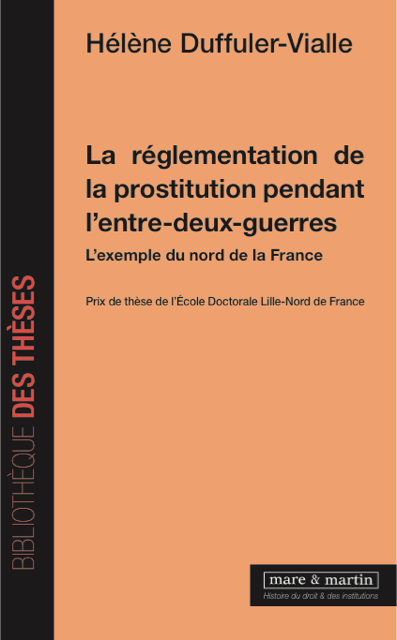
BOOK: Hélène DUFFULER-VIALLE, La réglementation de la prostitution pendant l’entre-deux-guerres L’exemple du nord de la France (Paris: Mare & Martin, 2018), 656 p. ISBN 978-2-84934-314-2, €56

(image source: Mare&Martin)


Book abstract:
Annoncé comme moribond à la fin du XIXe siècle et au début du XXe siècle, le système de réglementation de la prostitution reprend avec vigueur à la sortie de la première guerre mondiale. Le réglementarisme connait alors son « chant du cygne » pendant l’entre-deux-guerres avant d’être « aboli » en 1946. Violemment critiqué avant la seconde guerre mondiale, il s’adapte et se renforce dans une logique hygiéniste et sanitariste, tout en prétendant composer avec les libertés fondamentales des personnes concernées. Entre l’étude des débats juridiques, théoriques et idéologiques, l’analyse des rapports de pouvoir des autorités de régulation, la mise en œuvre concrète de cette réglementation ainsi que sa transgression, et le prisme du genre dans l’analyse des archives juridiques et judiciaires, cette thèse en histoire du droit, forte d’une approche interdisciplinaire, montre que l’enjeu du contrôle dépasse le cadre de la « prostitution » pour viser la sexualité en général avec, comme levier, la peur.

 Prix de thèse de l’École Doctorale Lille-Nord de France

(more information here)

20 February 2018

BOOK: Anna BELLAVITIS & Beatrice ZUCCA MICHELETTO (eds.), Gender, Law and Economic Well-Being in Europe from the Fifteenth to the Nineteenth Century [Gender and Well-Being] (New York: Routledge, 2018), 336 p. ISBN 9781138571518, £ 115

(image source: Routledge)


Book abstract:


This book offers a comparative perspective on Northern and Southern Europe laws and customs concerning women’s property and economic rights. By focusing on both Northern and Southern European societies, these studies analyse the consequences of different juridical frameworks and norms on the development of the economic roles of men and women This volume is divided into three sections. The first, Laws, presents general outlines related to some European regions; the second, Family strategies or marital economies? questions the potential conflict between the economic interests of the married couple and those of the lineage within the nobility. Finally the third part of the book, Inside the urban economy, focuses on economic and work activities of middle and lower classes in the urban environment. The assorted and rich panorama offered by the history of the legislation on women’s economic rights shows that similarities and differences run through Europe in such a way that the North/South model looks very stereotyped. While this approach calls into question classical geographical and cultural maps and well-established chronologies, it encourages reconsidering the European history according to a cross-boundaries perspective. By drawing on a wide range of social, economic and cultural European contexts, from the late Medieval Age-Early Modern Age to the nineteenth century including the middle and lower classes (especially artisans, merchants and traders) as well as the economic practices and norms of the upper middle class and aristocracy, this book will be of interest to economic and social historians, sociologists of health, gender, sexuality and economists.

Table of contents:


List of Figures; List of Tables; List of contributors; Acknowledgements; 

INTRODUCTION: North vs South: gender, law and economic well-being in Europe (15th-19th centuries),; Anna Bellavitis, Beatrice Zucca Micheletto; 

SECTION 1/ LAWS;
Chapter 1. Community of goods, coverture and capability in Britain: Scotland v. England, Deborah Simonton;
Chapter 2. Between parental power and marital authority. How merchant women stood the test of the customary laws in Brittany (16th- 17th centuries), Nicole Dufournaud;
Chapter 3. Exceptional women. Female merchants and working women in Italy in the early modern period, Simona Feci;
Chapter 4. Married women’s property rights in the nineteenth century in France and Spain: a North-South case study, Marion Röwekamp; Chapter 5. From legal diversity to centralization: marriage and wealth in nineteenth-century Greece, Doxiadis Evdoxios; 

SECTION 2 / FAMILY STRATEGIES OR MARITAL ECONOMY?;
Chapter 6. Marriage, law and property – Married noblewomen’s role in property management in fifteenth-century Norway, Susann Anett Pedersen;
Chapter 7. Class privileges and the public good. The Monti dei Maritaggi in Early Modern Naples, Vittoria Fiorelli;
Chapter 8. Women of high and medium-ranking officers in the Ile-de-France between the seventeenth and eighteenth centuries: what economic agency?, Claire Chatelain;
Chapter 9. Undivided brothers – renouncing sisters. Family strategies of low nobility in sixteenth and seventeenth century Tirol, Siglinde Clementi; 

SECTION 3/ INSIDE THE URBAN ECONOMY;
Chapter 10. The ‘egalitarian trend’ in practice. Female participation in capital markets in late medieval Leuven, Andrea Bardyn;
Chapter 11. Women and credit in eighteenth– century Venice: a preliminary analysis, Matteo Pompermaier;
Chapter 12. Married women, property and paraphernalia in Early Modern Scotland, Rebecca Mason;
Chapter 13. Women at work in a Southern European town: women, guilds and commercial partnerships in Venice in the sixteenth century, Emilie Fiorucci;
Chapter 14. Law, wives and the marital economy in sixteenth-century Antwerp. Bridging the gap between theory and practice, Kaat Cappelle;
Chapter 15. Women, law, and business formation in Early Modern Paris, Janine M. Lanza;
Chapter 16. Bankruptcies, a gateway to gender history. The example of women book traders in Paris in the nineteenth century, Viera Rebolledo-Dhuin; Index

On the editors:


Anna Bellavitis is Professor of Early Modern History at the University of Rouen-Normandy, director of the Groupe de Recherche d’Histoire (GRHis EA3831) and Senior Member of the Institut Universitaire de France. Beatrice Zucca Micheletto is Marie Sklodowska-Curie Fellow at The Cambridge Group for the History of Population and Social Structure, University of Cambridge and associated researcher at the Groupe de Recherche d’Histoire, University of Rouen-Normandy.


More information here.