Search

Showing posts with label Property Law. Show all posts

26 January 2026

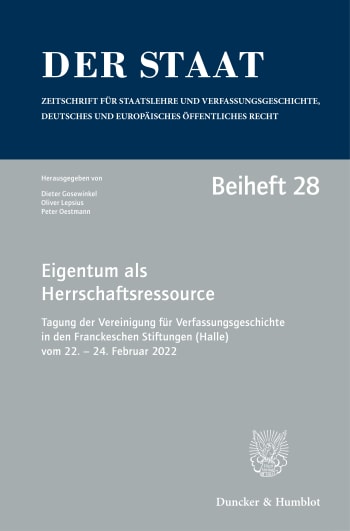
JOURNAL: Dieter GOSEWINKEL, Oliver LEPSIUS, Peter OESTMANN (eds.), Eigentum als Herrschaftsressource. Tagung der Vereinigung für Verfassungsgeschichte in den Franckeschen Stiftungen (Halle) vom 22.–24. Februar 2022 [Beihefte zu "Der Staat"; 28] (Berlin: Duncker & Humblot, 2025), 292 p., ISBN 978-3-428-19212-0

Cover: Eigentum als Herrschaftsressource

ABOUT THE JOURNAL:
 
Das Beiheft dokumentiert eine Tagung der Vereinigung für Verfassungsgeschichte. Eigentum als Herrschaftsressource scheint auf den ersten Blick einen zivilrechtlichen und einen öffentlichrechtlichen Aspekt zu verknüpfen. Aber in der Tat stützten sich frühmittelalterliche Könige auf eigene Ländereien und Domänen, um ihre Macht zu finanzieren und damit zu festigen. Später erschien dominium als Inbegriff von Herrschaft und Eigentum zugleich, sehr handfest auch in der Geschichte des Kolonialismus. Erst das 19. Jahrhundert versuchte, Amt und Privatperson wieder zu trennen. Bis in die Zeitgeschichte mit ihren neuen Nationalstaaten, totalitären Regimen, der Daseinsvorsorge und dem geistigen Eigentum erstreckt sich die thematische Spannweite der Beiträge. Die Plenumsdiskussionen sind umfassend dokumentiert und zeigen, wie Rechtshistoriker, Öffentlichrechtler und Archivare über eine Grundfrage der Verfassungsgeschichte epochenübergreifend ins Gespräch kommen. 
 
OVERVIEW OF CONTRIBUTIONS:
 
David Bachrach
Allodium und Eigentum im frühen Mittelalter. Die Basis der königlichen Macht?

Stefan Hammer
Eigentum, Vertrag und politische Herrschaft im Vernunftrecht

Benedikt Stuchtey
Mit John Locke argumentieren. Eigentumsfragen als Herrschaftsressource in der Geschichte des Kolonialismus

Reinhard Mußgnug
Das Eigentum des Monarchen im Wandel der Verfassungen

Dirk van Laak
Experimentierfelder des Gemeinwohls? Infrastrukturen und die Logik des Eigentums

Margrit Seckelmann
Die Internationalisierung »geistiger Eigentumsrechte«

Marju Luts-Sootak und Karin Visnapuu
Eigentum im Nationalstaat und Sozialismus – der Fall Estland als unabhängige Republik 1918−1940 und unter der Sowjetherrschaft

Thorsten Keiser
Eigentum als Herrschaftsressource in totalitären Regimen

Simon Kempny
Die Konstruktion des Eigentumsrechts durch Gesetzgebung
 
Find more here

19 September 2025

BOOK REVIEW: Joshua GETZLER, on The making of modern property: reinventing Roman law in Europe and its peripheries 1789–1950 by Anna di Robilant (Comparative Legal History, XIII (2025), nr. 1, June, pp. 138-145)

(Image source: Taylor&Francis)


In this ambitious monograph Anna di Robilant describes how European jurists of the eighteenth and nineteenth centuries drew from the doctrines of Roman classical law and ius commune traditions in order to craft a new ‘Romanist-bourgeois’ form of property. She shows how a succession of gifted scholars steeped in Roman legal tradition produced a concept of property as dominium or absolute command, designed to secure the widest possible control of resources by individual owners. The hallmark of this dominium was the power to assign and dispose of assets as expressions of subjective right grounded in the free will of the autonomous owner. This juridical project of Romanist-bourgeois property joined to an ideological inheritance drawn from idealist philosophy (Kant, Hegel) and political economy (Smith, the Physiocrats), according to which a person’s interests were best expressed by choice of conduct in relation to external things and persons, yielding property and obligations as the basic legal building blocks of society. Each of these streams of liberal thought – the legal, the philosophical, and the economic – emphasized the benign operation and interaction of the wills of autonomous actors who could, within the guidance of a modernised legal order, constitute a cooperative society based on voluntary relations between equals. On di Robilant’s account, Romanist-bourgeois property as individualised dominium was not only projected as a positive contribution to freedom in a well-ordered society; it was also an act of creative destruction, aiming to clear away illiberal obstacles left over from the past. Romanist-bourgeois property would dissolve or displace the older feudal forms of holding that were associated with hierarchy, inequality, domination, and inefficiency, and permit the forces of capital and labour to interact with utmost freedom and rationality. Like modern economic analysts of the law today, Roman-bourgeois theory appealed to a lofty sense of autonomy, allied to a yen for efficiency and prosperity.


To read the full review, please click here. Online access is free for members of the European Society for Comparative Legal History. 

DOI: 10.1080/2049677X.2025.2500208


10 March 2025

BOOK: Aleksander GREBIENIOW, Estate Planning by Agreement in the Sources of Roman Law [Warschauer Schriften zum römischen Recht und zur europäischen Rechtstradition, eds. Tomasz GIARO, Jakob FORTUNAT STAGL, Maria NOWAK, and Aleksander GREBENIOW; 2] (Boston/Paderborn: Brill/Schöningh, 2025), XX + 459 p. ISBN 978-3-506-79508-3 [OPEN ACCESS]


(image source: Brill/Schöningh)


Abstract:

The present book encompasses various legal phenomena pertaining to wealth transfer mortis causa in the world of Roman law. It demonstrates that succession in property rights could be realised by agreements of various kinds, which – though not building a coherent legal concept and being much different from the modern understanding of contractual succession – served as will-substitutes, i.e. functional equivalents to the Roman testament. The study goes back to the ancient sources in order to select and examine any testimonies of agreements aimed at regulating patrimonial relationships after death: agreements having immediate effect between the living, those enforceable only at the death of the deceased, and finally, settlements altering the order of succession mortis causa long after his passing away. It uncovers a series of societal patterns of behaviour staying behind legal institutions. The extent of the already ancient phenomenon of estate planning by agreement and the diversity of the dogmatic issues involved provides a notable starting point for discussions on the contemporary inheritance law dogmas.

Table of Contents:

Preface................................................................................................ 3

CONTENTS....................................................................................... 4

Abbreviations...................................................................................... 7

Introduction....................................................................................... 11

1 The Methodological Framework...................................................... 15

1.1 Objective, Objects of Research and Thesis................................. 15

1.1.1 The Notion of Estate Planning............................................. 15

1.1.2 Correspondent Concepts in Ancient Roman Law.................. 17

1.1.3 Additio: The Notion of Contractual Succession.................... 27

1.1.4 Thesis................................................................................ 30

1.2 The State of the Field................................................................ 31

1.2.1 Romanistic Scholarship on Contracts of Succession Mortis Causa........................................................................................ 31

1.2.2 Roman Law and Social Realities......................................... 37

1.3 Sources, Methods, and Research Plan........................................ 52

1.3.1 Sources.............................................................................. 52

1.3.2 Method.............................................................................. 56

1.3.3 Research Plan.................................................................... 60

2 The Institutions of Estate Planning................................................... 62

2.1 Successio anticipata: Juridical Acts Concluded and Executed During Life............................................................................................... 62

2.1.1 Divisio ab intestato............................................................ 66

2.1.2 Donationes...................................................................... 127

2.1.3 Dowries........................................................................... 180

2.1.4 Peculia............................................................................ 185

2.1.5 Specific Cases of Anticipated Succession........................... 192

2.1.6 Conclusions Concerning Anticipated Succession................ 197

2.2 Juridical Acts Mortis Causa Enforced at Death......................... 200

2.2.1 Mancipatio familiae.......................................................... 200

2.2.2 Stipulationes.................................................................... 209

2.2.3 Pacta............................................................................... 237

2.2.4. Pacta Dotalia Mortis Causa............................................. 259

2.2.5 Mandatum Post Mortem and Related Institutions................ 295

2.2.6 Conclusions on Wealth Transfers Enforced at Death........... 318

2.3 Agreements Concerning Succession Mortis Causa Concluded Post Mortem........................................................................................ 324

2.3.1 Venditio hereditatis.......................................................... 324

2.3.2 Postmortal Pacts and Transactiones................................... 327

2.3.3. Conclusions regarding Postmortal Arrangements............... 335

3 Conclusions.................................................................................. 337

3.1 General Observations.............................................................. 337

3.2 Specific Observations............................................................. 340

3.3 Final Observations.................................................................. 350

4 Bibliography................................................................................. 354

5 Index of Sources........................................................................... 389

Read more here (DOI 10.30965/9783657795086). 

13 January 2025

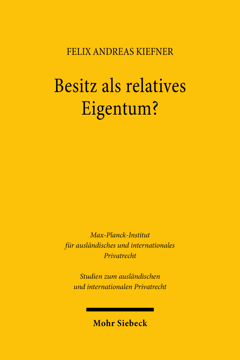
BOOK: Felix Andreas KIEFNER, Besitz als relatives Eigentum? - Geschichte und Dogmatik des Besitzschutzes als Relativschutz im common law und im civil law [Studien zum ausländischen und internationalen Privatrecht; 531] (Tübingen: Mohr Siebeck, 2024), 372 p., ISBN 978-3-16-163872-5

 Cover von 'undefined'
ABOUT THE BOOK:
 
In der Tradition des civil law betont man unter Verweis auf den possessorischen Besitzschutz regelmäßig, dass Eigentum und Besitz grundverschieden seien. Nach common law hingegenerwirbt jeder Besitzer zum Zeitpunkt der Besitzerlangung zugleich ein relatives Eigentum, welches gegen alle »schlechter berechtigten« Dritten wirkt und entsprechenden Rechtsschutz vermittelt. Finder, Diebe, Grundstücksbesetzer, Mieter, gescheiterte redliche Erwerber - sie alle sind relative Eigentümer. Doch auch im römischen und römisch-gemeinen Recht existierte für bestimmte Besitzertypen die Vorstellung eines relativen Eigentums, wovon sich in heutigen kontinentaleuropäischen Rechtsordnungen aber nur noch minimale Spuren finden. Wie hat sich die Vorstellung des Besitzes als relatives Eigentum in den Traditionen des common law und des civil law entwickelt? Welche Wertungen und Funktionen lagen und liegen ihr zugrunde? In welchen Fallgruppen des Besitzes kann sie überzeugen? Felix Kiefner untersucht diese Fragen in historisch-vergleichender Perspektive am Beispiel des englischen und des deutschen Rechts.
 
TABLE OF CONTENTS:
 
Einführung
Teil 1: England und die Tradition des
common law
Kapitel 1: Grundlagen
Kapitel 2: Besitzschutz im heutigen englischen Recht
Kapitel 3: Historische Grundlagen des Besitzschutzes im englischen Recht
Kapitel 4: Wertungen des Besitzschutzes im heutigen englischen Recht
Teil 2: Deutschland und die Tradition des civil law
Kapitel 5: Grundlagen
Kapitel 6: Der petitorische Besitzschutz (§ 1007 BGB)
Kapitel 7: Besitzschutz im Übrigen
Teil 3: Essenz und vergleichende Schlussbetrachtung
Kapitel 8: Dogmatische Ergebnisse
Kapitel 9: Modelle zur Erklärung des Relativschutzes
Kapitel 10: Überzeugungskraft des Relativschutzes – Fallgruppen und Wertungen
 
Find more here.

04 November 2024

BOOK: Julian SCHWARZE, Westeigentum in der DDR [Jenaer Schriften zum DDR Recht; 2] (Köln: Böhlau, 2024), 388 p., ISBN 978-3-412-52990-1


ABOUT THE BOOK:

Die Gründung der DDR zerriss nicht nur zahllose Familien, in hunderttausenden Fällen trennte sie auch Grundstücke auf unabsehbare Zeit von ihren Eigentümern. Insbesondere das Vermögen von Republikflüchtlingen, Ausreisenden, BRD-Bürgern und Ausländern befand sich für die Eigentümer durch die deutsche Teilung unerreichbar jenseits des „Eisernen Vorhangs“. In der DDR wurde dieses Westeigentum Gegenstand einer streng geheimen staatlichen Enteignungsmaschinerie. Unbemerkt von der Öffentlichkeit wurden unzählige Vermögenswerte westlicher Eigentümer systematisch erfasst, überschuldet und anschließend in Volkseigentum überführt. Auf der Grundlage umfangreicher Archivbestände schildert Julian Schwarze den Umgang mit dem Westvermögen in der DDR von 1949 bis 1990. Die Darstellung verortet das Westvermögen in einem Spannungsfeld zwischen Ideologie, Politik und Recht. Hierdurch wird deutlich, dass das Westvermögen schon in der DDR längst nicht nur ein juristisches Problem war. Erstmalig liegt damit eine umfassende Untersuchung jener Vermögensschädigungen vor, deren Rückabwicklung unter dem Schlagwort der offenen Vermögensfragen zu den umstrittensten Fragen der Wiedervereinigung zählte.  

ABOUT THE AUTHOR:

Julian Schwarze ist derzeit Rechtsreferendar am Landgericht Heidelberg. Nach seinem Studium der Rechtswissenschaft in Heidelberg, Lille (Frankreich) und Leipzig promovierte er an der Universität Jena im Bereich der DDR-Rechtsgeschichte. 
 
Read more here.

08 July 2024

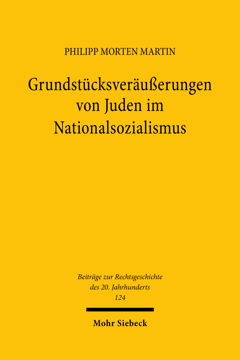
BOOK: Philipp Morten MARTIN, Grundstücksveräußerungen von Juden im Nationalsozialismus [Beiträge zur Rechtsgeschichte des 20. Jahrhunderts; 124] (Tübingen: Mohr Siebeck, 2024), 219 p., ISBN 978-3-16-163684-4

Cover von 'undefined'

ABOUT THE BOOK:

Philipp Morten Martin beschäftigt sich mit Grundstücksveräußerungen von Juden im Nationalsozialismus in den Jahren 1938 und 1939. Dazu hat er über 40.000 Notarurkunden aus den Landgerichtsbezirken Düsseldorf, Köln und Wuppertal untersucht. Ziel war es, die in der historischen Forschung bisher wenig berücksichtigte Frage nach der Wirksamkeit dieser Veräußerungen zu erfassen. Der Autor arbeitet heraus, an welchen vertraglichen Regelungen und Umständen des Vertragsschlusses sich der Einfluss der nationalsozialistischen Verfolgung darstellen lässt. Dies betrifft etwa die erzwungenen Veräußerungen von Grundstücken oder solche Veräußerungen, die unter Drohungen gegen die Veräußerer zustande kamen. Auch wird untersucht, wie die jüdischen Eigentümer an den Veräußerungen beteiligt wurden, wenn sie selbst nicht mehr bei der Beurkundung erscheinen konnten, weil sie geflohen waren.

Find more here.

13 May 2024

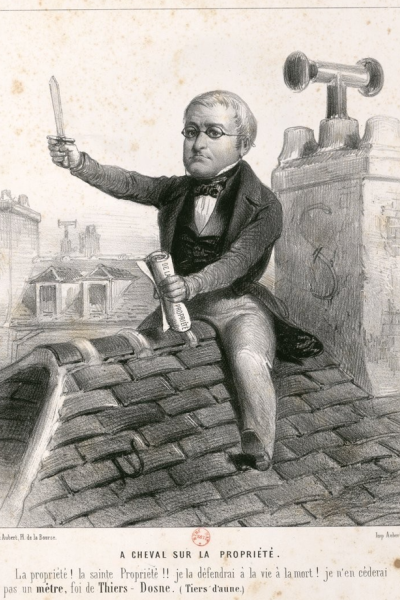
CONFERENCE: Penser le droit des biens hors la propriété (Paris: Ecole Nationale des Chartes/PSL, 11 JUN 2024)

(image source: PSL)


Abstract

Avec la crise du néo-libéralisme, l’exclusivité du droit de propriété connaît aujourd’hui un nouveau moment de déstabilisation : fonction sociale de la propriété et réglementation (par exemple encadrement des loyers, interdiction des locations saisonnières dans certaines zones etc.), remise en cause d’un domaine public « coffre-fort » (par exemple restitution des biens mal acquis, etc.), insuffisance de la propriété pour assurer la protection (par exemple théorie des communs, subjectivisation, etc.).

Le projet naît ainsi du constat que les instruments juridiques inédits imaginés pour pallier la déstabilisation que connaît aujourd'hui le droit de propriété exclusif apparaissent souvent comme des échos, plus ou moins lointains, à des formules employées, sous l'Ancien régime, avant l'émergence d'une propriété exclusive, mais aussi, aux XIXe et XXe siècles, pour en limiter les effets. C'est pourquoi nous avons souhaité rassembler, à l'occasion de cette journée d'études, des travaux menés sur diverses périodes, avec une approche privatiste ou publiciste, juriste ou historienne, mais qui ont en commun de mettre au jour de tels agencements.


Programme


9h30 : accueil des participants

  • 9h50 : mot d’ouverture par Christophe Gauthier, directeur du Centre Jean-Mabillon
  • 10h : propos introductifs par Katia Weidenfeld et Patrick Arabeyre

Penser les droits sur les choses

Président de séance : Laurent Pfister (U. Paris 2).

  • 10h15 : Clément Tisserant (Bibliothèque de l’U. Caen-Normandie), « Fief et emphytéose dans la doctrine méridionale »
  • 10h35 : Eva Becquet (U. Paris 2), « Une forme d’organisation foncière dans la longue durée : le bail emphytéotique sous l’Ancien Régime »
  • 11h30 : Viviana Persi (U. Lille 2), « Les res nullius par l’image (manuscrits médiévaux du Corpus juris civilis) »
  • 11h50 : Xavier Prevost (U. Bordeaux), « Penser le droit des biens par l’amour selon le Cupido iurisperitus d’Étienne Forcadel (1553) »

Interroger la propriété exclusive

Président de séance : Jean-Louis Halpérin (ENS)

  • 14h : Aurelle Levasseur (U. Sorbonne Paris-Nord) : « Les concessions d'eau courante dans les immeubles parisiens jusqu'au début du premier Empire : de la propriété à l'abonnement »
  • 14h20 : Guillaume Richard (U. Paris-Cité) : « La propriété collective des groupements : petits arrangements avec le droit (XIXe siècle) »
  • 14h40 : Anne-Sophie Chambost (Sciences Po Lyon) : « Proudhon, un précurseur des communs ? »
  • 15h30 : Rémi Faivre-Faucompré (U. Picardie Jules Verne) : « Les divisions horizontales de l’immeuble à l'épreuve de la conception exclusive de la propriété (XIXe-XXe siècles) »
  • 15h50 : Christian Hottin (CY Cergy-Pontoise Paris Université) et Lily Martinet (Ministère de la Culture) : « Le droit de propriété, une catégorie pertinente pour le patrimoine immatériel ? »
  • 16h30 : propos conclusifs par Katia Weidenfeld et Patrick Arabeyre

Location: 

More information here.

03 July 2023

BOOK: H. B. CALLAWAY, The House in the Rue Saint-Fiacre: A Social History of Property in Revolutionary Paris (Cambridge, MA: Harvard University Press, 2023), 304 pp, ISBN 9780674279346, $45


(image courtesy: Harvard University Press)

Book description: 

Property reform was at the heart of the French Revolution. As lawmakers proclaimed at the time, and as historians have long echoed, the Revolution created modern property rights. Under the new regime, property was redefined as an individual right to which all citizens were entitled. Yet as the state seized assets and prepared them for sale, administrators quickly found that realizing the dream of democratic property rights was far more complicated than simply rewriting laws.

H. B. Callaway sifts through records on Parisian émigrés who fled the country during the Revolution, leaving behind property that the state tried to confiscate. Immediately, officials faced difficult questions about what constituted property, how to prove ownership, and how to navigate the complexities of credit arrangements and family lineage. Mothers fought to protect the inheritances of their children, tenants angled to avoid rent payments, and creditors sought their dues. In attempting to execute policy, administrators regularly exercised their own judgment on the validity of claims. Their records reveal far more continuity between the Old Regime and revolutionary practices than the law proclaimed. Property ownership continued to depend on webs of connections beyond the citizen–state relationship, reinforced by customary law and inheritance traditions. The resulting property system was a product of contingent, on-the-ground negotiations as much as revolutionary law.

The House in the Rue Saint-Fiacre takes stock of the contradictions on which modern property rights were founded. As Callaway shows, the property confiscations of Parisian émigrés are a powerful, clarifying lens on the idea of ownership even as it exists today.

Table of contents: 

  • Map of Paris Showing Approximate Locations of Key Addresses in the Text
  • Introduction
  • 1. Property Law in Revolutionary Society
  • 2. The Émigrés and the Politics of Property
  • 3. The Hands of the Nation
  • 4. Césarine’s Inheritance
  • 5. Property, Family, and Patrimony
  • 6. By Iron or Nail
  • Conclusion
  • Notes
  • Acknowledgments
  • Index

About the author: 
H. B. Callaway is Research Associate at the Centre Roland Mousnier of the Université Paris-Sorbonne.
More information can be found here