Search

Showing posts with label 18th Century Legal History. Show all posts

12 May 2026

BOOK: Bianca PREMO, La Ilustración a juicio. Litigantes y colonialismo en el imperio español [Historia del Derecho en América Latina, 1ª Edición] (México: Tirant lo Blanch, 2026), 514 p., ISBN 9788491198727

(image source: Tirant)

Abstract:
Este libro examina cómo las ideas ilustradas se pusieron a prueba en el mundo cotidiano de la justicia iberoamericana entre las personas esclavizadas e indígenas, y entre las mujeres del siglo XVIII. Se centra en los tribunales civiles, tanto en América como en España, como espacios clave de debate sobre los derechos naturales, la expansión de la esfera secular, el historicismo y la libertad.  El libro enseña cómo leer el archivo judicial para sacar a la luz las ideas de personas no letradas, y redibuja la geografía de la modernidad para replantear el origen de nociones habitualmente atribuidas a Europa del Norte.  Al entablar un diálogo con la historia del derecho, la historia intelectual y la historia social, subraya cómo la práctica legal transformó filosofías abstractas en herramientas prácticas. En conjunto, ofrece una reinterpretación poderosa de la Ilustración como un fenómeno forjado en el derecho colonial.
On the author:
Bianca Premo es Profesora Distinguida Universitaria de Historia en la Florida International University, en Miami, Estados Unidos.
Table of contents:

Introducción ¿Por qué es Ilustración?       

Ilustración sin el siglo XVIII        

Escritura, historia y escritura de la historia del Imperio español       

La república de los iletrados        

Una definición        

Verificable y refutable: Un panorama del libro       

Método comparativo        

Regiones       

Periodo de tiempo        

Casos y litigantes         

PARTE I: LIMONES Y LIMONADA: DEMANDAR EN EL IMPERIO ESPAÑOL

1. Agentes y poderes. Litigantes y escritores en los tribunales        

Poderes: Papel y protocolo        

Agentes: autoría y opciones de los litigantes        

“Dios no paga”        

Conclusión         

2. Derecho y Ley: Ilustración jurídica en la filosofía y las políticas      

El árbol de limones: Ilustración jurídica ecléctica        

Limones: Derecho moderno temprano en el Imperio español        

El árbol: Pensamiento jurídico de la ilustración        

Jurisprudencia colonial        

Bravo de Lagunas y la jurisdicción secular        

Bravo de Lagunas y la esclavitud        

Leyes sobre leyes        

“Desembarazados y libres”: Leyes sobre eficiencia judicial        

Jueces de bronce        

El crecimiento de la jurisdicción secular   

Agentes y poderes revisados        

Conclusión         

3. Números y valores: Conteo de casos en el imperio español        

Números        

Conteo de casos        

Conteo de causas        

Valores        

La cultura orientada a la justicia de los Montes de Toledo        

Umbrales y puertas: Las demandas de los subordinados coloniales 

Conclusión        

PARTE II: LUCES A PARTIR DE LITIGANTES 

4. Pleitos y demandas. Conflictos conyugales en tribunales civiles    

Justicia        

Derechos        

Una breve historia sobre los alimentos     

Secularización e individualidad: Jurisdicción y disputas maritales      

Derechos naturales y otras fuentes de derecho        

Los casos civiles de las mujeres como Ilustración        

Conclusión         

5. Ayer y hoy. Estatus y costumbres indígenas        

Ayer            

Armonía y justicia        

La lengua de la ley: Disputas legales en lengua zapoteca        

Hoy                

El mérito o la nueva ciencia del estatus    

Costumbre hoy        

Casos civiles indígenas como Ilustración   

Conclusión         

6. Ser y devenir: Libertad y demandas de esclavos        

El comienzo de la libertad: Periodización e historiografía        

Fines de las demandas por esclavitud       

Jurisprudencia        

Los esclavos en los tribunales eclesiásticos y civiles        

Del amparo a los papeles        

Autoconservación y sevicia        

La personalidad jurídica de los esclavos   

“La libertad que requieran los juicios”       

La etapa de libertad         

Conclusión: Los litigios de esclavos como Ilustración        

Conclusión. ¿Por qué no Ilustración?

Find more on: Tirant.

08 May 2026

ADVANCE ARTICLE: Julia RUDOLPH, "William Blackstone, Family Man: New Contexts in Gender, Jurisprudence, and Jamaica" (Law & History Review) [OPEN ACCESS]


(image source: Cambridge Core)

Abstract:

While much has been written about William Blackstone, the jurist, politician, and legal writer, this article provides a critical new understanding of Blackstone, the husband, friend, and investor. It considers Blackstone’s legal and economic actions as well as ideas, analyzing his strategies for managing family wealth and comparing them to the strategies employed by a member of his extended family who was a Jamaican planter. Here, the article contributes to recent scholarship on the global dimensions of English and British legal history. It offers a fuller account of Blackstone’s proximity to the colonial plantation economy by investigating how economic change and imperial controversies impacted his personal and professional life. It also exposes Blackstone’s conventionally masculine bias by detailing the different ways in which he privileged male interests when making personal investment choices and when coming to judicial decisions about women’s property claims. A gendered ideology, which positioned male authority as central to the success of the household, state, and empire, furnished the framework within which Blackstone justified the operation of law and directed his own actions as head of his family. Placing Blackstone’s jurisprudence and experience within the contexts of patriarchy and colonialism, the article sheds new light on this influential figure, showing how he embodied the core features of an eighteenth-century family man and shaped modern ideas about male authority, property, and power.

The full article can be read here in open access: DOI 10.1017/S0738248026101618.

(Source: Legal History Blog)

30 April 2026

WORKSHOP: Saskia LETTMAIER, "Marriage and Madness: The Origins of the Marriage of Lunatics Act of 1742" [Stanford Center for Law and History Workshop] (Stanford: Stanford University, 5 MAY 2026) (9:45 PM - 10:45 PM CET) [HYBRID]


Saskia Lettmaier, Professor of Law and Global Legal History at the University of Hamburg, will present her paper, "Marriage and Madness: The Origins of the Marriage of Lunatics Act of 1742"

Abstract:

In 2021, the Parliament of the Irish Republic—as the last legislature in Great Britain and Ireland—abolished an Act to Prevent the Marriage of Lunatics. This Act had its origins in a British statute of 1742, which was subsequently extended to Ireland and was in force in all parts of the British isles from 1811 until 1959, when it was abolished for England and Wales. The Act has been almost completely ignored by (legal) history. Quite undeservedly so, for it may claim to be the first English general act since the Elizabethan settlement to interfere with the traditional canon law of marriage, predating the much more famous Hardwicke Marriage Act by more than a decade. It rendered absolutely void the marriages of persons who had been found lunatic by commission under the Great Seal or whose persons and estates had been placed under trustees by Act of Parliament. Such persons could no longer contract a valid marriage after 24 June 1742, not even during a lucid interval, unless they had first been declared of sound mind by the Lord Chancellor or other competent authority. Yet there is little evidence to suggest that unsuitable marriages by lunatics constituted a widespread social problem in mid-eighteenth-century England. Given the English reluctance to pass general acts in this period, why was the esoteric topic of lunatics’ marriage singled out for general legislative treatment, rather than being dealt with—like the thorny issue of divorce—through private acts on a case-by-case basis? This paper seeks to answer that puzzle. In doing so, it explores the intersection of marriage law, property protection, elite family strategy, and parliamentary power, taking us into the worlds of high society and high politics in eighteenth-century Britain.

 Pratical information:

                             Tuesday, May 5
                         12:45-1:45 PM (PT)
          Room 320D, Stanford Law School
                              and via Zoom 

To RSVP, click here. 

13 April 2026

SEMINAR: La construcción del Estado en España (s. XVIII) (Barcelona: Universitat Pompeu Fabra, 8 APR 2026)


(image source: UPF Barcelona)

On 8 April, a seminar was held at Pompeu Fabra University (Barcelona) on state formation in 18th century Spain. The program can be found below:

La Càtedra Josep Fontana de la Universitat Pompeu Fabra organitza la jornada “La construcción del Estado en España (s. XVIII)”, una sessió dedicada a analitzar els processos polítics, institucionals i administratius que van marcar la configuració de l’Estat a l’Espanya del segle XVIII.

La trobada comptarà amb la participació de destacats especialistes en història moderna:


§   Sergio Solbes, de la Universidad de Las Palmas de Gran Canaria: “Gobernar a través del suministro militar: el Contractor State y la provisión de uniformes para el ejército”

§   Francisco Andújar, de la Universitat d'Almeria: “Fisuras del Estado borbónico: venalidad y corrupción”

§   Joaquim Albareda, de la Universitat Pompeu Fabra: “Política y reformas del absolutismo borbónico”


La jornada vol oferir un espai de debat acadèmic sobre les reformes borbòniques, la centralització administrativa i les dinàmiques de poder que van contribuir a la construcció de l’Estat modern.


L’activitat es realitza amb la col·laboració de la Diputació de Barcelona.

L’activitat està oberta a la comunitat universitària i al públic interessat en la història política i institucional de l’Espanya moderna.

Data: 8 d’abril de 2026

Hora: 10.30 h

Lloc: Sala de graus A. Calsamiglia, Edifici Roger de Llúria, Campus de la Ciutadella (UPF)


💻 Les jornades es podran seguir en directe per streaming a través d’aquest enllaç:

👉 https://www.upf.edu/web/humanitats/streaming


23 February 2026

BOOK: Amedeo ARENA (ed.), Cittadino di tutti i luoghi, contemporaneo di tutte le età: l’universalità del pensiero di Gaetano Filangieri (Napoli: Editoriale Scientifica, 2024). ISBN 979-12-235-0082-8, 387 p. [OPEN ACCESS]


(Source: ES)

Abstract:

Il presente volume, rientrante nella Collana del Dipartimento di Giurisprudenza dell’Università degli Studi di Napoli Federico II e pubblicato in occasione degli 800 anni dalla fondazione dell’Ateneo napoletano, si divide in due parti. La prima, denominata Cittadino di tutti i luoghi, raccoglie dei saggi che esaminano la rilevanza che il pensiero filangieriano ha assunto, già alla fine del Settecento, in una pluralità di ambiti geografici: da Napoli a Milano, dalla Francia alla Prussia, dalla Gran Bretagna agli Stati Uniti d’America. La seconda parte, intitolata Contemporaneo di tutte l’età, comprende dei contributi che si soffermano sulla valenza delle riflessioni di Filangieri in diverse epoche storiche, dall’Ottocento ai giorni nostri. L’opera intende evidenziare l’universalità del pensiero di Filangieri, nella convinzione che le sue idee possano ancora offrire utili spunti per «conciliare in un codice la libertà, la pace, e la ragione» e per «compire l’opera» della «felicità de’ popoli».

About the author:

Amedeo Arena è professore ordinario di Diritto dell’Unione Europea presso il Dipartimento di Giurisprudenza dell’Università degli Studi di Napoli Federico II e Senior Fellow presso l’Institute of European Studies della University of California, Berkeley. È referente scientifico dell’Accademia Filangieri di Partenope, nell’ambito della quale ha promosso l’istituzione del Premio Filangieri per giovani giuristi. Ha tenuto diverse lezioni e relazioni a convegni, presso università italiane e statunitensi, sulla corrispondenza tra Gaetano Filangieri e Benjamin Franklin ed è stato curatore della mostra pannellare che ha riunito per la prima volta le lettere dei due illuministi, esposta presso il Consolato generale d’Italia a Filadelfia e presso l’Istituto italiano di cultura a San Francisco. Le sue ricerche d’archivio hanno condotto al riconoscimento di Domenico Cirillo come primo socio italiano della American Philosophical Society di Filadelfia, attraverso la correzione di un errore avvenuto nel 1768. È stato, inoltre, nominato membro del comitato istituito dalla American Philosophical Society per le celebrazioni del 250º anniversario della Dichiarazione di indipendenza.


More information with the publisher.

09 February 2026

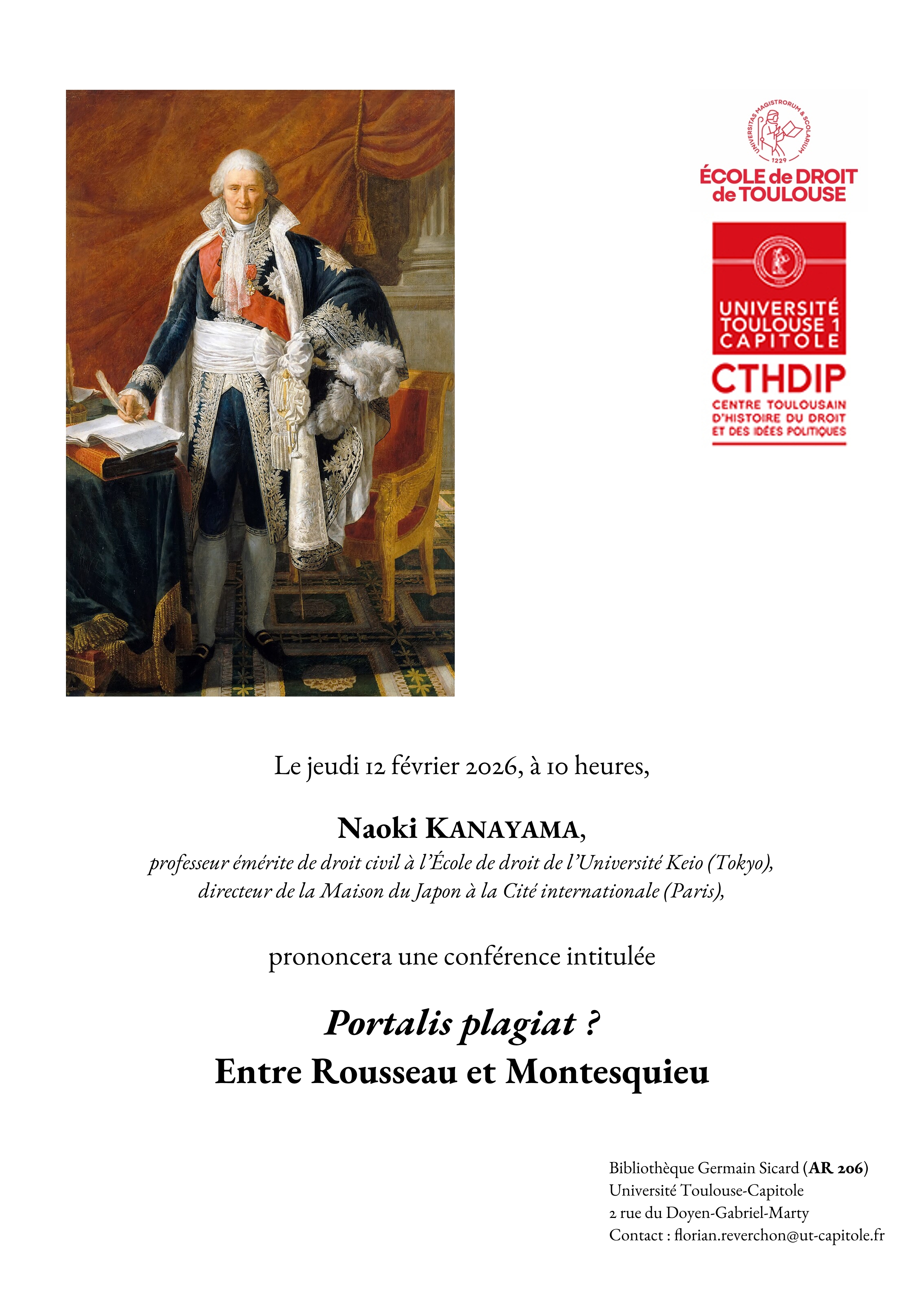
LECTURE: Naoki KANAYAMA, "Portalis plagiat ? Entre Rousseau et Montesquieu" (Toulouse: Université Toulouse 1 Capitole/CTHDIP, 12 FEB 2026)


On the speaker:

Naoki Kanayama est professeur émérite de droit civil à l’École de droit de l’Université Keio (Tokyo) et directeur de la Maison du Japon à la Cité internationale (Paris).

Convened by prof. Florian Reverchon (Toulouse).

Click here for more information

16 April 2025

SYMPOSIUM: Constitutional Meaning in the Shadow of the Articles of Confederation (Philadephia: Brennan Center for Justice/National Constitution Center, 12 MAY 2025) [HYBRID]

(image source: Swogo)

Abstract:
The Roberts Court has increasingly relied on history to resolve some of the most important constitutional questions of our time. Embracing a form of interpretation called “originalism,” the Court’s conservative majority argues that the original public understanding of the Constitution is what really counts. But discerning the goals and assumptions of those who ratified the Constitution requires an understanding of the document they were replacing: the Articles of Confederation. Today, the Articles are ignored as a false start. That’s a mistake. The Constitution was an explicit attempt to form a union “more perfect” than that of the Articles of Confederation, and they provide vital context to the framers’ choices. Join us in Philadelphia on Monday, May 12, at 11 a.m. ET as historians, journalists, law professors, and political scientists explore how the nation’s first experiment in self-governance paved the way for the Constitution we have today. Participants will examine the legacy of the Articles of Confederation, the founding debates over federal power, and the lasting influence of these debates on modern-day constitutional interpretation.
Program:
11-11:15 a.m. | Introductory Remarks


Jeffrey Rosen, president and CEO, National Constitution Center
Michael Waldman, president and CEO, Brennan Center for Justice

11:15 a.m.–12:30 p.m. | Panel 1: The Articles of Confederation

Explore the origins of the Articles of Confederation—examining the political, practical, and ideological reasons behind the states' sovereignty—and how the “firm league of friendship” among the 13 states ultimately became unworkable.

Aditya Bamzai, Martha Lubin Karsh and Bruce A. Karsh Bicentennial Professor of Law, University of Virginia School of Law
Johann Neem, professor of history, Western Washington University
Farah Peterson, professor of law, University of Chicago Law School
Jack Rakove, Coe Professor of History and American Studies, professor of political science emeritus, Stanford University
Moderator: Alicia Bannon, director of the Brennan Center Judiciary Program

12:30–1:15 p.m. | Lunchtime Keynote

1:15–2:30 p.m. | Panel 2: Debating the Constitution 

Examine the reasons for the Constitution’s plan of government, how it was understood at the time, and how concerns over its failings were addressed through ideological debates at the Constitutional Convention.

Jay Cost, Gerald R. Ford Nonresident Senior Fellow, American Enterprise Institute
Jonathan Gienapp, associate professor of history, associate professor of law, Stanford University
Kermit Roosevelt, David Berger Professor for the Administration of Justice, University of Pennsylvania Carey Law School

2:45–4 p.m. | Panel 3: The War Over the Constitution’s Meaning

Explore governance under the new Constitution and the Articles’ long shadow, from the early republic to the post–New Deal modern era, and how competing narratives of the Constitution’s origin story evolved.

Ilya Somin, professor of law, Antonin Scalia Law School at George Mason University
Alan Trammell, associate professor of law, Washington and Lee University School of Law
Moderator: Wilfred U. Codrington III, Walter Floersheimer Professor of Constitutional Law, Benjamin N. Cardozo School of Law; fellow, Brennan Center

4–4:15 p.m. | Closing Reflections

Registration information: online - in-person.

(source: Legal History Blog)

15 October 2024

LECTURE: Isabelle BRANCOURT, Henri-François d'Aguesseau, magistrat, chancelier et législateur (Paris: Cour de Cassation, 7 OCT 2024) [RECORDED]

(image source: Wikimedia Commons)

Programme:

Pascal PLAS professeur d’histoire contemporaine à l’Université de Limoges, directeur de l’Institut international de recherches sur la conflictualité (IRCO) Isabelle BRANCOURT chargée de recherche au CNRS (Institut d’histoire du droit Jean GAUDEMET ; UMR 7184-Université Paris II)

The lecture has been livestreamed on 7 October and recorded. More information here

19 May 2024

ONLINE LECTURE: Prof. Michael G. MÜLLER, 'The partitions of Poland in the light of the 18th century concepts of international law' - Czasopismo Prawno-Historyczne (CPH; Legal History Journal) (21 MAY 2024 , 4:00 pm CEST, online)


(Source: wikimedia)


The oldest Polish journal of legal history, Czasopismo Prawno-Historyczne (CPH; Legal History Journal), published by the Faculty of Law and Administration at AMU since 1948, is organizing a series of online lectures. The editor-in-chief of CPH, Dr. Hab. Maksymilian Stanulewicz, a professor at AMU, warmly invites all interested scholars and students to participate in our online lectures and to submit papers to CPH. The series is organized by the Editorial Secretary of CPH, Dr. Piotr Alexandrowicz (piotr.alexandrowicz@amu.edu.pl). For more information on the series, please visit the website.


SECOND LECTURE

Title: The partitions of Poland in the light of the 18th century concepts of international law

Speaker: Prof. Michael G. Müller

Date: May 21 st , 4:00 pm CEST

Link to the online meeting: https://bit.ly/legalhistory2

Abstract: Recent research has delivered substantially new insight into the diplomatic history of the partitions of Poland in the 18th Century. We are now able to thoroughly reconstruct the strategies by which the partitioning powers tried to justify their action, and to follow Western responses to that. The lecture will examine the respective diplomatic and public discourse in the light of contemporary concepts of international law.

CV: Born 1950. M. A. in History and Slavonic Languages at the University of Frankfurt/Main 1974, PhD in East European History 1977. Worked as researcher in East European History at the universities of Frankfurt/Main and Giessen as well as at the Berlin Historical Commission (Historische Kommission zu Berlin). Between 1990 and 1992 research grants awarded by the German Research Foundation (Deutsche Forschungsgemeinschaft) and the “Immanuel Kant”-programme. Habilitation in Modern and East European History at the Freie Universität Berlin 1993. From 1992 to 1996 professor for East Central European History at the European University Institute in Florence (Italy). 1996-2019 chair for East European History in Halle. Co-editor of Kwartalnik Historyczny; 2003-2014 German chairman of the Joint Polish-German Commission for the Revision of School Textbooks; 2012 Doctor honoris causa, University of Warsaw.

Website: https://www.geschichte.uni-halle.de/mitarbeiter/mueller/

30 November 2023

BOOK: Henri-Pierre MOTTIRONI, Commerce et République en France au XVIIIe siècle ; quand l'entreprise inventa le citoyen (Lormont, Le Bord de l’eau, 2023), 180 p. ISBN 9782356879769, € 24


(image source: Le Bord de l'Eau)

Abstract:
À une époque où les firmes multinationales sont perçues comme une menace pour la démocratie et où nombreux sont ceux qui appellent à une réforme de leur gouvernance pour les rendre socialement et écologiquement responsables, revenir sur les liens entre le monde des affaires et l’émergence de la démocratie représentative moderne se révèle nécessaire. En dépit d’expressions et métaphores explicites comme l’idée d’un gouvernement « en trust » dans la pensée anglo-saxonne ou la métaphore du citoyen-actionnaire chez le grand constitutionnaliste de la Révolution française, Emmanuel Sieyès, l’historiographie politique et constitutionnelle a jusqu’alors trop souvent négligé ce lien. En croisant histoire des idées, études des transferts culturels et histoire du droit commercial et de l’entreprise, l’auteur comble cette lacune en mettant en lumière l’importance des idées et pratiques commerciales et financières dans la pensée politique des fondateurs de nos républiques modernes de la fin du XVIIe siècle à la Révolution française. Loin de l’opposition contemporaine entre démocratie et grande entreprise, cette étude montre que nos conceptions modernes du constitutionnalisme et du gouvernement représentatif doivent beaucoup à la gouvernance d’entreprise et au droit commercial du siècle des révolutions.

On the author:

Docteur en science politique de l’IEP de Paris et de l’Université de Lausanne, Henri-Pierre Mottironi est chercheur à l’Université de Neuchâtel à l’Institut d’histoire. Ses travaux croisent histoire de la pensée politique, de la gouvernance d’entreprise et du droit commercial, aux XVIIIe et XIXe siècles.

(source: Le Bord de l'Eau

27 November 2023

CONFERENCE: Conférence et cycle '1709, l'année où la révolution n'a pas éclaté' (Rennes, 28 November 2023)


(Source: Univdroit)

Présentation


En 1709, la France est au bord du chaos. En cette fin de règne de Louis XIV, les malheurs s'abattent sur le plus grand royaume d'Europe. En décembre précédent, c'est l'orgueilleuse citadelle de Lille qui est tombée aux mains des Anglais et de leurs alliés. En janvier, une vague de froid sans précédent a envahi le pays : à Marseille, le Vieux-Port est pris par les glaces, tandis que les charrettes traversent la Garonne gelée. La quasi-totalité des récoltes sont détruites. Au printemps 1709, la France s'embrase : partout des révoltes éclatent tandis que certains crient au complot de famine. On parle même d'assassiner le roi « Louis le Tyran » et de convoquer les états généraux. A l'été, une émeute parisienne menace la Bastille. Et pourtant la révolution n'éclate pas.

Pourquoi et comment les institutions ont-elles tenu ? C'est ce que tente de comprendre ce livre novateur qui, non seulement analyse pour la première fois cette crise qui fit vaciller le trône soixante ans après la Fronde et quatre-vingt ans avant la Révolution française, mais imagine même, dans un exceptionnel exercice d'uchronie, les scénarios de ce qui aurait pu se passer.


Programme


18h30 : Intervention de Gauthier Aubert, Professeur d'histoire moderne à l'Université Rennes 2 et membre de Tempora (EA 7468)

20h00 : Fin


Cette rencontre se déroulera en présentiel et en distanciel via Zoom
Participation en distanciel - Conférence du 28/11/23 : https://univ-rennes1-fr.zoom.us/meeting/register/tJIsdOutqT0tHtN1UfqufsLJG3eLM1A0TY3u#/registration


Conférence organisée par l'Association rennaise des historiens du droit (ARHD), avec le soutien de l'IODE, Université de Rennes / CNRS, dans le cadre des "Rencontres d'histoire du droit"


Faculté de droit
Amphi III
9 rue Jean Macé
35700 Rennes

18 August 2023

ARTICLE: Vincent GUFFROY, An account of the negotiations inside the Parlement de Paris: Claude Guillaume Lambert’s diary (French History XXXVII (2023), Nr. 2, 111-125)


(image source: OUP)

Abstract:
The Parlement de Paris is well known to historians. However, if its role as a recorder of edicts and royal declarations is clear, less is known of the debates that informed its judgments and remonstrances. The official records compiled by court clerks have tended to be the only source used by historians. Yet some magistrates created a more personal memory of the discussions that took place within the secret council. The diary kept by Claude Guillaume II Lambert, a young councillor at the Chambre des Enquêtes, is a good example of this. It uncovers the parlementaires’ connections, power plays and strategic postures from May 1749 to June 1751, brings to life the negotiations that took place within the assembly and abounds in anecdotes. After having been a privileged source of information for the pamphleteering journalists of the eighteenth century, Lambert’s diary offers the historian a window into the very soul of the parlement.

Read more with OUP (DOI 10.1093/fh/crac056)


19 July 2022

ARTICLE: Felix WALDMANN, "Natural Law and the Chair of Ethics in the University of Naples, 1703-1769" (Modern Intellectual History XIX (2022), No. 1, 54-80) (OPEN ACCESS)


(image source: Cambridge Core)
Abstract:
This articles focuses on a significant change to the curriculum in “ethics” (moral philosophy) in the University of Naples, superintended by Celestino Galiani, the rector of the university (1732–53), and Antonio Genovesi, Galiani's protégé and the university's professor of ethics (1746–54). The article contends that Galiani's and Genovesi's sympathies lay with the form of “modern natural law” pioneered by Hugo Grotius and his followers in Northern Europe. The transformation of curricular ethics in Protestant contexts had stemmed from an anxiety about its relevance in the face of moral skepticism. The article shows how this anxiety affected a Catholic context, and it responds to John Robertson's contention that Giambattista Vico's use of “sacred history” in his Scienza nuova (1725, revised 1730, 1744) typified a search among Catholics for an alternative to “scholastic natural law,” when the latter was found insufficiently to explain the sources of human sociability.

Read the article here: DOI  10.1017/S1479244320000360.

12 January 2022

BOOK: Charles FLETCHER, Justice and Society in the Highlands of Scotland. Strathspey and the Regality of Grant (c. 1690-1748) (Leiden: Brill, 2021). ISBN: 978-90-04-47251-8, €112.00

(Source: Brill)

ABOUT THE BOOK

Series: Legal History Library, Volume: 53

This book fills a significant gap in our current understanding of early modern Scottish history. It is the first systematic consideration of the workings of seigneurial courts of feudal lords in 18th century Scotland. For several hundred years, these courts were one of the main forums for justice across Europe. Until 1748, Scottish courts of barony and regality handled both criminal complaints and civil disputes; they made by-laws and levied taxes; they set wages and enforced morality. The 18th century was a time of epoch-defining events in Scotland, such as the Jacobite rebellions, and union with England. The amount of literature on this period of Scottish history is extensive; it is therefore remarkable that the story of these courts has been left untouched. 

ABOUT THE AUTHOR

Charles Fletcher, Ph.D. (2019), University of Edinburgh. His main fields of interest are the culture and history of the highlands of Scotland and Scottish legal history.

TABLE OF CONTENTS

Preface 
Acknowledgements 
List of Illustrations 
Conventions and Abbreviations 
Glossary 

1 Introduction 
 1.1 Heritable Justice in Scotland 
 1.2 Seigneurial Justice: Scotland in European Context 
 1.3 The Regality of Grant 

2 The Clan Grant and the Regality Court 
 2.1 Strathspey in the Early Eighteenth Century 
 2.2 The Lairds of Grant, the Fine and the Regality Court of Grant 
  2.2.1  The Lairds of Grant 
  2.2.2  Bailies of the Regality of Grant 
  2.2.3  The Fine of Clan Grant: John Grant of Dalrachney 
 2.3 Conclusion 

3 The Regality Court and Its Procedures 
 3.1 Court Officials 
  3.1.1  Clerks of the Court 
  3.1.2  Procurators Fiscal 
  3.1.3  Officers 
  3.1.4  Birlawmen 
 3.2 How, Why and When Were Courts Convened? 
  3.2.1  When? 
  3.2.2  Where? 
 3.3 The Court Day 

4 Actions for Debt 
 4.1 Debt and Credit in Strathspey 
 4.2 The Collection of Rents 
 4.3 Poinding 
 4.4 Debt and Divisions in the Grant Family: Unwarranted Poinding 1710–1711 
  4.4.1  Rental Crisis 
  4.4.2  Case Study: Ludovick Grant of that Ilk v. Mungo Grant of Mullochard and Others 
 4.5 Conclusion 

5 Criminal Jurisdiction 
 5.1 Violent Crime and the Regality Court of Grant 
  5.1.1  Trends in Violent Crime 
  5.1.2  Gendered Differences in Violence 
  5.1.3  Types of Violence 
   a) Violent Threats and Caution 
   b) Violent Disputes 
 5.1.4  Process 
 5.1.5  Punishment 
 5.2 Serious Crime and the Regality Court of Grant 
 5.3 The Northern Circuit of the Justiciary Court and the Regality of Grant 
  5.3.1  1708–1710 
  5.3.2  1711–1747 
  5.3.3  After Abolition, 1748–1753 
 5.4 Conclusion 

6 Economic and Social Control 
 6.1 Economic Control 
  6.1.1  Food Supplies 
  6.1.2  Regulation of Employment 
   a) The Problem of ‘Loose’ Servants 
   b) Wages 
   c) Other Trades 
  6.1.3  The Relationship between the Regality Court and the Justices of the Peace 
 6.2 Religious and Social Control 
  6.2.1  People 
  6.2.2  Kirk Session Business and the Regality Court of Grant 
  6.2.3  Slander 
  6.2.4  Funding the Kirk 
 6.3 Local Governance, Conclusions 

7 The Regality Court and the Landed Estate 
  Woodlands, Game, Farming and Improvement 
 7.1 Protecting the Laird’s Woodlands and Game 
  7.1.1  Woodlands and Their Management in Eighteenth-century Strathspey 
  7.1.2  The Regality Court and the Woods 
   a) Continuity and Change 
   b) The York Buildings Company 
 7.2 Game 
  7.2.1  Hunting, Fishing and Game in the Regality of Grant 
  7.2.2  Poaching Cases in the Regality Court 
 7.3 Improvement and Farming 
  7.3.1  Pastoral Farming 
 7.4 Conclusion 

8 Land Tenure 
 8.1 Tacks and Tenure 
 8.2 Vassal’s Labour Services 
 8.3 Conclusion 

9 Conclusion 
 9.1 Justice, Society, and Heritable Jurisdictions 
 9.2 Jurisdiction 
 9.3 Heritable Justice after 1748 

Bibliography 
Index 


More information with the publisher.