Search

Showing posts with label 18th Century History. Show all posts

30 March 2026

CONFERENCE: ISECS Conference ‘Reframing the Enlightenment’ [ISECS/SIEDS] (Paris: DHI/Collège de France/Maison de la Recherche, 10-12 June 2026)


(image source: ISECS-SIEDS)

Abstract:

Both ISECS and most of its member societies were founded when the Enlightenment movement of the 18th century enjoyed the highest reputation among scholars and perhaps even more so in society: as fighters for freedom of thought and self-determination, as advocates of progress and as pioneers of a democratic society. This of course was a view that experts always knew to be idealising, but it suited the mood of the democratisation push in Western societies and beyond in the last third of the 20th century. Since around the turn of the millennium, the winds of scholars’s and society’s favour towards the Enlightenment have changed. Today, it seems that the society that the Enlightenment thinkers envisioned has not been realized. We are still facing fundamental inequalities: namely a power imbalance between the sexes, between elites and the people, between Europeans and the ‘rest’ of the world. Some exponents of the post-colonial agenda see the Enlightenment, not only in its racial doctrines but also in its standards of rationality, primarily as a justification of European colonial domination and exploitation. On the other side of the political spectrum, the Enlightenment is also criticised by those who see it as an arbitrary destruction of traditions or the self-serving empowerment of a small group of the intellectual elite. The current situation can be summarised in a variation of Jonathan Israel’s well-known book title: “Enlightenment contested again”. Anyone studying the 18th century is doubly challenged by this development. Firstly, the research in the 18th century is not unaffected by the respective social conditions. Secondly, the experts of the 18th century are able to substantially contribute to current debates on the role of the Enlightenment in the history of humanity. Organizing a conference, titled “Reframing the Enlightenment / Le défi des Lumières”, ISECS is consciously taking on these challenges. This conference reflects the contemporary context in which we conduct our research and takes a well-founded position on the assessment of the Enlightenment in today’s debates based on our research. The focus of the contributions should therefore be both on the historical subjects and on the assessment of the Enlightenment in our present day. The aim of the conference is to overcome the too simple positioning oneself either for or against the Enlightenment and to emphasise the complexity of both the Enlightenment as a historical phenomenon and its legacy for the present and the future.

Discover the program here

(source: Werkgroep de 18de eeuw)

23 February 2026

BOOK: Amedeo ARENA (ed.), Cittadino di tutti i luoghi, contemporaneo di tutte le età: l’universalità del pensiero di Gaetano Filangieri (Napoli: Editoriale Scientifica, 2024). ISBN 979-12-235-0082-8, 387 p. [OPEN ACCESS]


(Source: ES)

Abstract:

Il presente volume, rientrante nella Collana del Dipartimento di Giurisprudenza dell’Università degli Studi di Napoli Federico II e pubblicato in occasione degli 800 anni dalla fondazione dell’Ateneo napoletano, si divide in due parti. La prima, denominata Cittadino di tutti i luoghi, raccoglie dei saggi che esaminano la rilevanza che il pensiero filangieriano ha assunto, già alla fine del Settecento, in una pluralità di ambiti geografici: da Napoli a Milano, dalla Francia alla Prussia, dalla Gran Bretagna agli Stati Uniti d’America. La seconda parte, intitolata Contemporaneo di tutte l’età, comprende dei contributi che si soffermano sulla valenza delle riflessioni di Filangieri in diverse epoche storiche, dall’Ottocento ai giorni nostri. L’opera intende evidenziare l’universalità del pensiero di Filangieri, nella convinzione che le sue idee possano ancora offrire utili spunti per «conciliare in un codice la libertà, la pace, e la ragione» e per «compire l’opera» della «felicità de’ popoli».

About the author:

Amedeo Arena è professore ordinario di Diritto dell’Unione Europea presso il Dipartimento di Giurisprudenza dell’Università degli Studi di Napoli Federico II e Senior Fellow presso l’Institute of European Studies della University of California, Berkeley. È referente scientifico dell’Accademia Filangieri di Partenope, nell’ambito della quale ha promosso l’istituzione del Premio Filangieri per giovani giuristi. Ha tenuto diverse lezioni e relazioni a convegni, presso università italiane e statunitensi, sulla corrispondenza tra Gaetano Filangieri e Benjamin Franklin ed è stato curatore della mostra pannellare che ha riunito per la prima volta le lettere dei due illuministi, esposta presso il Consolato generale d’Italia a Filadelfia e presso l’Istituto italiano di cultura a San Francisco. Le sue ricerche d’archivio hanno condotto al riconoscimento di Domenico Cirillo come primo socio italiano della American Philosophical Society di Filadelfia, attraverso la correzione di un errore avvenuto nel 1768. È stato, inoltre, nominato membro del comitato istituito dalla American Philosophical Society per le celebrazioni del 250º anniversario della Dichiarazione di indipendenza.


More information with the publisher.

10 December 2025

PRIZE: American Society for Legal History Article Prize to Grace MALLON (co-winner), "Negotiated Federalism: Intergovernmental Relations on the Maritime Frontier, 1789-1815"


(image source: Rothermere American Institute, Oxford)

On the article:

Grace Mallon’s “Negotiated Federalism” examines the federal government’s efforts to enforce its new authority after the Founding. Federal officials quickly realized that they required the participation and consent of state governments, as federal laws could not take effect without the legislation, investment, and manpower of state governments. The piece showcases how Atlantic port cities presented a crucial test case for negotiated federalism, where the federal government sought to exercise power in spaces where states had already entrenched their authority. As early federal officials set up customs and lighthouse services, rebuilt coastal fortifications, and enforced regulations, they had to negotiate with states to determine “which powers each level of government could exercise.” As a result, federal power depended on a state’s willingness to negotiate its authority. The crisply written article tackles big questions of federalism through granular details of practical problems and personality conflicts. Based in impressive primary source research in state and federal official records and correspondence, Mallon brings multiple areas of scholarship together to describe how power was worked out ‘in the course of ordinary government administration instead of in high theory. “Negotiated Federalism” takes something that we feel is well-understood (federalism at the founding) and through a creative path through the archive mines new and provocative ways of seeing the past that help us see the present more clearly.

Link to the article here: 10.1353/wmq.2024.a941486 

(source: RAI - Oxford University

06 May 2025

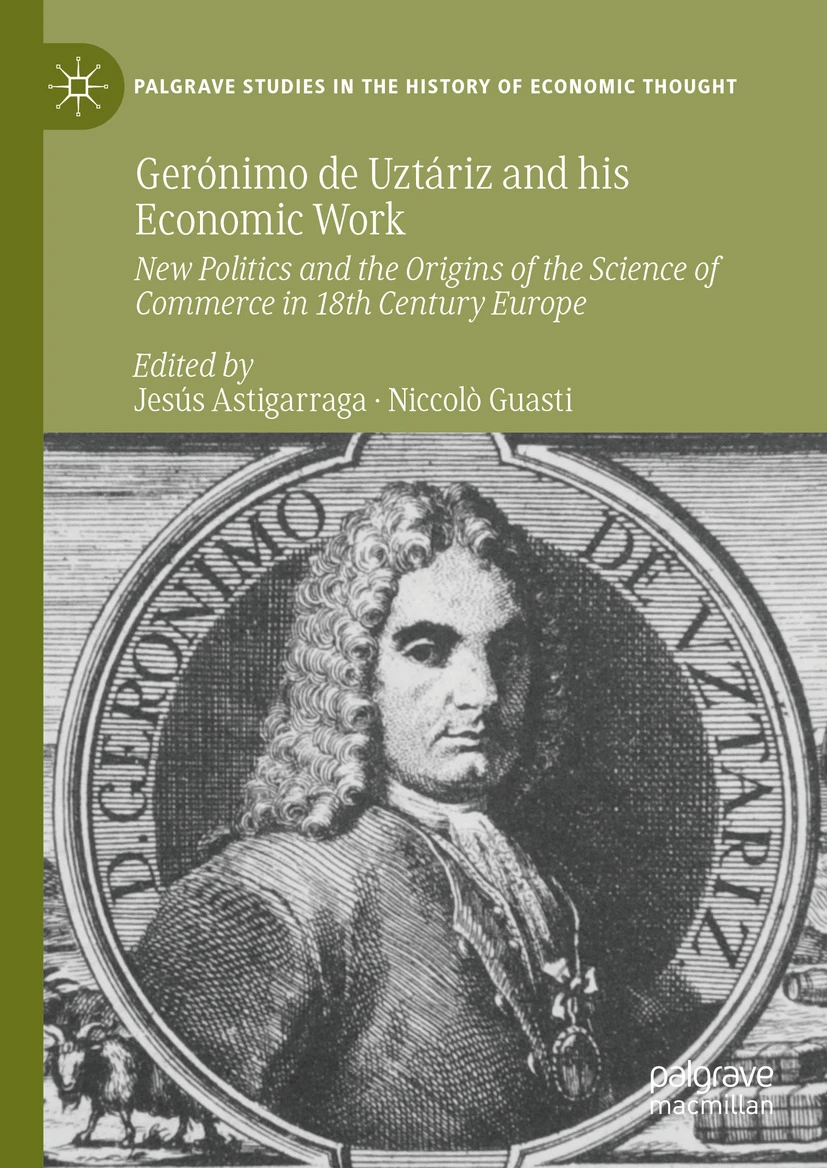
BOOK: Jesús ASTIGARRAGA & Niccolò GUASTI (eds.), Gerónimo de Uztáriz and his Economic Work. New Politics and the Origins of the Science of Commerce in 18th Century Europe [Palgrave Studies in the History of Economic Thought, eds. Peter KIESLER, Jan TOPOROWSKI & Maria Cristina MARCUZZO] (Cham: Palgrave Macmillan, 2025), XVII + 364 p. ISBN 9783031758560


Abstract:

This book provides a detailed and compelling guide to the life and economic work of Gerónimo de Uztáriz. It contextualises his work within the economic and political trends of the time, including the Enlightenment, Spanish liberalism, and colonial empires. Particular attention is given to de Uztáriz’s seminal work Theórica y Práctica de comercio y de marina and how it achieved international circulation and recognition. Its influence on 18th century Spain is examined, alongside a detailed analysis of the trade systems of the day. The translation and reception of Theórica in France, Great Britain, Italy, Ireland, and Germany is also discussed. This book aims to shed new light upon the economic work of Gerónimo de Uztáriz and highlights why his ideas remain relevant and important. It will be of interest to students and researchers working within modern history and the history of economic thought.

Table of contents:

Uztáriz and the Origins of the “Science of Commerce” in Europe (Jesús Astigarraga, Niccolò Guasti)
Abstract:

This chapter aims to introduce the figure of Uztáriz and to underline the importance of his Theórica (1724) in both the Hispanic and European contexts. The state of the art on these issues is discussed in detail, and the book’s main objectives are set out. The chapter highlights Uztariz’s book as an attempt to establish a “new politics” for the Spanish Monarchy and concludes by emphasising its international dimension: to speak of the Theórica is to speak of the origins of the “science of commerce” in the European Enlightenment.

Gerónimo de Uztáriz: Biographical Note (Reyes Fernández Durán)
Abstract:

This chapter aims to reconstruct Uztáriz’s personal and intellectual history. It highlights, among other aspects, his relationship with the influential group from Navarre who had settled in Madrid, his long sojourn in Belgium and the Netherlands, his informative travels around Europe, his posting to the Viceroyalty of Sicily as Treasury advisor, and his return to Spain at the height of the War of the Spanish Succession to serve the Crown in diplomatic affairs and on different councils. These stages are related with the vicissitudes of the 1724 first edition of the Theórica and the 1742 and 1757 re-editions, as well as the range of measures to tackle the country’s economic crisis set out in the work. The importance of examining the reports that Uztáriz wrote at the authorities’ request and other unpublished writings is also stressed.

The Man and His Circumstances: The Historical Context of Writing the Theórica (Sergio Solbes Ferri)
Abstract:

The years following the end of the War of the Spanish Succession were particularly frenzied in several aspects. The revision of the situation in the international and military policy sphere brought about by the Treaties of Utrecht has been emphasized, and this period is also understood to have formed part of a restructuring process for the Spanish economy. However, until recently, the idea of a simultaneous reorganization of an institutional framework affecting Spain as a whole has been blurred. The Nueva Planta reform phase was not limited to its implementation in the Crown of Aragon kingdoms, but was a key moment in the development of the modern state throughout Spain. Jean Orry’s reforms at the end of the conflict did not achieve a stable structure for several decades. Consequently, the context in which Uztáriz’s Theórica (1724) was published needs to be studied as a particularly delicate and significant moment in the halting overhaul of the Bourbon administration.

Europe in the Time of Gerónimo de Uztáriz’s Theórica: Between the Peace of Utrecht (1713) and the Peace of Vienna (1725) (Virginia León Sanz)
Abstract:

Uztáriz finished the Theórica at the end of 1724, a troubled year in Philip V’s reign, characterised by the monarch’s abdication and return to the throne. Bourbon diplomacy was about to undertake a U-turn in terms of its alliances, with a rapprochement with Austria and the signing of the Peace of Vienna in 1725. For almost a decade, Philip V had been endeavouring to reverse the Treaties of Utrecht, mainly those signed with England, but also others relating to the Mediterranean which had meant the loss of Sardinia, Milan, Naples and Sicily and which translated into a dynastic policy that conditioned Atlantic policy. Spain’s joining of the Quadruple Alliance in February 1720 and the slow pace of work at the Congress of Cambrai, the conflicts with England over the implementing of the Trade Treaty and the Treaty of Asiento, and the deterioration of relations with France all culminated in a change in Spain’s attitude and a rethinking of its positions at political and trade level arising from the Europe of Utrecht. In this European context, Uztáriz’s international career and the range of posts he held in Philip V’s service equipped him with a unique perspective on the trade policies of France, England and Holland. Shortly after the work was published, in 1725, Spain signed a Trade Treaty with Austria.

Uztáriz and His Sources: The Public Good Beyond the Reason of State (Niccolò Guasti)
Abstract:

Uztáriz’s treatise advocated a new economic policy for the Spanish Bourbon monarchy: since commerce, at the beginning of the eighteenth century, had come to underpin the balance of power in the international system, he lobbied for strong state intervention to develop national industry and trade with the colonies. Combining his training as a military engineer and a strong expertise in the administrative field with the heuristic tools taken from French Colbertism, Spanish arbitrismo and maybe English Political Arithmetic, Uztáriz featured some possible countermeasures against the re-export Dutch trade and the aggressive economic policy carried out by England since the second half of the seventeenth century. However, he never considered the political solutions or economic data gained from his sources (Vauban, Dubos, Huet, Savary, Moncada, Fernández de Navarrete, etc.) as a theoretical knowledge, but rather a practical know-how, useful to devise an economic policy able to restore Spain as a new model commercial empire.

Taxes and Tariffs in the Fiscal Debate in Spain at the Time of Uztáriz’s Theórica (1724–1757) (Niccolò Guasti, Jesús Astigarraga)
Abstract:

Uztáriz’s Theórica was the most influential Spanish economics text throughout the country and its colonies as a whole in the eighteenth century. It soon became the object of well-honed critical analyses. Although this controversial reception touched on many of the arguments put forward in the work, taxation was undoubtedly a major focus of the interpretations. This chapter aims to define the outlines of the long shadow cast by the Theórica over the three decades after its publication. It is divided basically into three sections. The first analyses Uztáriz’s core proposal for taxation, the second deals with tariffs and the customs system. and the third examines the controversial reception of both, particularly the former, among political economists and reformers of the day. The chapter underlines that Uztáriz conceived taxation (taxes and tariffs) as a linchpin for establishing a “new policy” that would bring Spain into line with Europe’s leading countries and promote the recovery of comercio útil, especially domestic manufacturing.

The Organisation of the Armadas of War and Commerce in the Writings of Gerónimo de Uztáriz (1717–1725): Polemics During the Transfer of the Casa de la Contratación (Ana Crespo-Solana)
Abstract:

The relationship between timber provision for navy shipyards and the naval reforms carried out during the eighteenth century has been the subject of recent analysis. The aforementioned issues, namely those pertaining to naval models and the supply of timber, were prominent in the political and economic discourses that shaped the decision to transfer the trade and navigation tribunals from Seville to Cadiz. This aspect was a point of contention between Gerónimo de Uztáriz and those who advocated for the centralisation of the navy, particularly the minister José Patiño. This chapter puts forward an analysis of the reciprocal relationship between forests, resources for the navy (dealt with in Chapter LXIII of the Theórica), and the organisation of fleets and navies from the perspective of Uztáriz's comparative critique. The author’s analysis is focused on the political and economic debate that took place within the Bourbonic Court concerning the defence of interests surrounding the creation of new shipyards and naval centres in eighteenth-century Spain.

The Colonial Balance of Trade: Uztáriz and the Carrera de Indias (Fidel J. Tavárez)
Abstract:

That Uztáriz’s Theórica had enormous influence in the Hispanic world, especially concerning commercial matters, is a well-known fact. Be that as it may, it remains surprising that an economic treatise centrally concerned with commercial matters had very little to say about the Spanish Empire’s port-restricted and convoy system of trade, the infamous fleets and galleons. Why did Uztáriz almost entirely eschew this topic, even though the reform of the fleets and galleons would later become one of the most important economic concerns among ministers in the court? After describing Uztáriz’s economic thought in relation to various arbitristas (projectors) of the seventeenth century, this chapter proposes that, to answer this question, it is first necessary to reconstruct a related debate about whether a modern commercial nation had to imitate the Dutch in erecting privileged commercial companies. Arguing against the need to imitate the Dutch model, Uztáriz suggested that the most important factor of a successful commercial state was a well-organised system of tariffs and economic incentives that privileged national goods. Whether this occurred via the fleets and galleons or commercial companies was of secondary importance. Instead, the crown had to focus on trading with national goods and achieving a favorable balance of trade.

The Theórica: Publishing History and Economic Lexicon (Elena Carpi)
Abstract:

This chapter deals with the Theórica from the point of view of publishing history and the comparison between the first two editions, with special attention to the paratexts and to the handwritten notes in the margins of the first edition. In addition, it proposes the study of the most relevant neological formations, from a lexicogenetic point of view.

Uztáriz in Britain (Richard van den Berg)
Abstract:

The publication of the English translation of Uztáriz’s Theórica in 1751 signalled the beginning of the reception of this work in Britain. Over the next decades there were frequent, but often somewhat isolated, references to Uztáriz in works dealing with commercial, colonial or naval matters. However, by far the most extensive use was made of this Spanish treatise by Malachy Postlethwayt in his Universal Dictionary of Trade and Commerce. This chapter examines the selections Postlethwayt made and the ways in which he used these substantial borrowings in support of his own positions.

The French Translation of the Theórica: From Political Arithmetic to Political Economy (Antonella Alimento)
Abstract:

This chapter considers the identity of the person who drove forward the 1753 French translation of Uztáriz’s Theórica y práctica de comercio y de marina. Evidence supports the hypothesis that it was Véron de Forbonnais who proposed the translation as part of a broader editorial initiative, which also included the translation of The British Merchant (1753) and was aimed at employing political arithmetic to prevent the renewal of the commercial treaty binding France to the United Provinces and the implementation of the treaty signed with England in Utrecht in 1713. Forbonnais, who admired Uztáriz’s text for its methodological approach, used his notes not only to correct the factual errors made by Uztáriz but also to replace the natural law approach adopted by the Navarrese official with an economic anthropology based on self-interest and “progressive consumptionism”, which he embraced having read and appreciated David Hume.

Uztáriz in the German-Speaking World: Karl Zinzendorf’s Commercial Travels to Spain in 1767 (Simon Adler)
Abstract:

The contribution will examine the reception of Uztáriz’s Theórica in the Habsburg monarchy. It will discuss how Karl Zinzendorf, a leading enlightened Minister in Maria Teresa’s government and specialist in trade affairs, used Uztáriz’s ideas for his commercial travels to Spain in 1767, and it will show how the cameralist writer Joseph von Sonnenfels included the Théorica in his writings. It attempts to highlight the influence of Uztáriz´ ideas amongst economic writers and government ministers in German states.

The Circulation and Translation of Uztáriz’s Theórica in Italy (Niccolò Guasti)
Abstract:

Uztáriz can be considered one of the most frequently quoted foreign economists in eighteenth-century Italy; in some Italian contexts (the Kingdom of Naples, Habsburg Lombardy, the Republic of Venice, the Duchy of Modena and the Papal State), he was regarded among the founding fathers of the new political economy as an academic and scientific discipline. His Theórica was read by Italian reformers and Enlightenment thinkers (Genovesi, Verri, Beccaria, Pagnini, Paradisi, Fracastoro, Vergani, Zanon, etc.) especially through the French translation by Forbonnais (1753), although in 1793 a Spanish expelled Jesuit, Gonzalo Adorno Hinojosa, released a new translation, this time directly from Spanish into Italian. Although it was a partial version (since Adorno translated almost half of original Uztáriz’s treatise), this latest version of the Theórica confirms that at the end of the eighteenth century Uztáriz’s economic ideas and political suggestions were still effective and attractive in several Italian states. The chapter examines the spread of Uztáriz’s Theórica in eighteenth-century Italy through its translations and the reasons for this enduring success.

Uztáriz’s Theórica and Strategies for Spain’s Economic Development (1740–1795) (Jesús Astigarraga, Javier Usoz, Juan Zabalza)
Abstract:

The Theórica’s commercial and industrial goal was hegemonic in Spain during the first half of the eighteenth century, in tune with prevailing ideas in the rest of Europe. During this time the book marked ways of thinking about how the structural problem faced by Spain due to its “lack of trade” could be solved, and from 1740 onwards it became a key text, thanks to the two re-editions in 1742 and in 1757. The work was especially influential in the three areas of taxation, trade and development strategies. However, after around 1760 its influence waned due to the prevalence of doctrines in favour of prioritising agriculture. In spite of this, its proposals for taxation, support for the role of trade, which was partially open to free trade initiatives, and criticism of companies with state privileges meant that the work retained its relevance in this predominantly agrarian context. Its pro-manufacturing stance, which was largely detached from Ancien Regime rigidity and privileges, also survived among major authors and in specific fields. This chapter therefore underlines the argument that there was not just one interpretation of the Theórica but many, and that they were wide-ranging and even contradictory.

Read more here: DOI 10.1007/978-3-031-75857-7.

23 April 2025

LECTURE: Barbara STOLLBERG-RILINGER on the Logic of Autocracy [The 2025 George Rousseau Lecture] (Oxford: Magdalen College, 30 APR 2025)


(image source: Ticketmaster)


Abstract:
What happens if a person who rejects all rules and conventions finds himself in the position of the ruler? The Prussian ‘Soldier King’ Frederick William I (1688-1740), father of Frederick the Great, is a legendary figure of German history. He is known for state reforms, the vast expansion of his army, and for almost sentencing his son to death. Frederick William I demonstratively challenged almost all political, legal, moral, and aesthetic norms of the time: he humiliated the elites, distrusted his officials, avoided the company of women, and traumatized his son. Contemporaries such as Montesquieu regarded him as a ridiculous outsider and a pathological despot. Later historians, however, transformed him into the ‘educator of the German people.’ This bizarre case can serve as an example of the social logic of autocracy and the power of retrospective rationalization.

On the speaker:
Barbara Stollberg-Rilinger (Wissenschaftskolleg zu Berlin / Institute of Advanced Study). Se was, from 1997 to 2021, Professor of Early Modern History at the University of Münster, where she led collaborative research groups on ‘Symbolic Communication and Social Value Systems’ and ‘Religion and Politics.’ Since 2018 she is Rector of the Wissenschaftskolleg zu Berlin / Institute of Advanced Study. She is a member of various academies and a Fellow of the British Academy. Her field of research is the constitutional, political and cultural history of Europe from the 16th century to the 18th, especially the Holy Roman Empire. Her main research focus is on political rituals and procedures, metaphors and symbols.

(source: Ticketmaster


26 February 2025

BOOK: Francesco SERPICO, Il corsaro e le philosophe: Il regno di Napoli e le reggenze barbaresche nel settecento. Pratiche, linguaggi, rappresentazioni giuridiche (Napoli: Edizioni scientifiche italiane, 2023). ISBN: 9788849553413, pp. 228, 33,00 €


(Source: Esi)

ABOUT THE BOOK

Gli assalti compiuti nel Settecento dalle ciurme di Tunisi, Tripoli, Algeri, Salé nel Mediterraneo furono considerati dai contemporanei come atti di pirateria o, all’opposto, l’esplicazione di una condotta bellica non dissimile da quella praticata dagli Stati europei sugli spazi marini. La questione costituisce la chiave di lettura per esaminare i problemi aperti, per la cultura giuridica, dal nuovo quadro politico delineato dalla dinastia borbonica che segnò una svolta nei rapporti tra il Mezzogiorno e il tradizionale nemico musulmano. Si trattò di una storia fatta di scontri e incomprensioni, ma anche di collaborazioni inedite e legami inaspettati. Un rapporto destinato fatalmente ad interrompersi all’indomani della Grande Rivoluzione e delle campagne napoleoniche. Nel nuovo ordine della “civilizzazione” e del “progresso”, le reggenze barbaresche sarebbero divenute l’emblema di una umanità barbara e selvaggia, portatrice di valori radicalmente antitetici a quelli occidentali. Da quel momento in avanti, il modello discorsivo del pirata come combattente senza legge e nemico universale avrebbe contribuito a nutrire una nuova retorica: quella coloniale.


ABOUT THE AUTHOR

Francesco Serpico è professore associato di Storia del diritto medievale e moderno nel Corso di laurea magistrale in Giurisprudenza presso il Dipartimento Giuridico dell’Università degli Studi del Molise.


TABLE OF CONTENTS

Introduzione

Il pirata e la costruzione giuridica dell’alterità

1. Hostis communis omnium

2. A tu per tu con il Leviatano: nel laboratorio politico di Carl Schmitt

3. Una «coincidenza degli opposti»: la prospettiva mediterranea

4. La corsa nel Mare Interno in Età moderna. Incontri, scontri, ibridazioni

5. Der unheimliche Feind

Prologo

I Lumi ed il Maghreb. Ambivalenze e chiaroscuri

Capitolo I

A Sud del Mezzogiorno

1. Una storia di frontiera

2. «I turchi non sono più quelli di una volta»

3. Diplomazia e scambi consolari: la scoperta dell’alterità

4. Un État faible

Capitolo II

Il mercantilismo ed il piccolo principe

1. Riprendere la via del mare

2. Jealousy of trade

3. Un mare di carte

4. Ascesa e declino di un riformatore. La politica marittima di Bernardo Tanucci

5. La svolta degli anni Ottanta 101

Capitolo III

La parola alla cultura giuridica: De Jorio vs. Galiani?

1. Riannodando i fili dell’inimicizia

2. La statualizzazione della guerra di corsa

3. Il riconoscimento giuridico delle reggenze nordafricane

4. Dal Baltico al Mediterraneo. La lezione di Martin Hübner

5. Un «obbligo forzoso di divenir ausiliare»

6. Galiani, Vattel e la condanna dei Pirates States

Capitolo IV

Sipario sulla corsa barbaresca

1. Il problema mediterraneo alla vigilia della Rivoluzione francese

2. «O più pace o più guerra»

3. Rough waters. Gli americani nel Mare nostrum

4. Il Mezzogiorno napoleonico e la corsa barbaresca

5. I destini della «civilizzazione»

Epilogo

Orientalismi giuridici

Indice dei nomi


More information with the publisher.

08 April 2024

BOOK: Anna BRINKMAN, Balancing Strategy Sea Power, Neutrality, and Prize Law in the Seven Years' War (Cambridge: University press, 2024). ISBN: 9781009425599, £ 85.00

(Source: CUP)

ABOUT THE BOOK

What is the relationship between seapower, law, and strategy? Anna Brinkman uses in-depth analysis of cases brought before the Court of Prize Appeal during the Seven Years' War to explore how Britain worked to shape maritime international law to its strategic advantage. Within the court, government officials and naval and legal minds came together to shape legal decisions from the perspectives of both legal philosophy and maritime strategic aims. As a result, neutrality and the negotiation of rights became critical to maritime warfare. Balancing Strategy unpicks a complex web of competing priorities: deals struck with the Dutch Republic and Spain; imperial rivalry; mercantilism; colonial trade; and the relationships between metropoles and colonies, trade, and the navy. Ultimately, influencing and shaping international law of the sea allows a nation to create the norms and rules that constrain or enable the use of seapower during war.


ABOUT THE AUTHOR

Dr. Anna Brinkman is a Lecturer in the Defence Studies Department at King's College London and co-director of the Corbett Centre for Maritime Policy Studies. She is a historian of eighteenth- and nineteenth-century maritime strategy and international law.

20 March 2024

BOOK: Julie DOULEY, La grâce au féminin. Les femmes face au pardon princier dans les Pays-Bas Autrichiens (1762-1794) [Histoire, Justice, Sociétés] (Louvain: PUL, 2024), 136 p. ISBN 9782390614241, € 14,9


(iamge source: PUL)

Book abstract:

Au cours des dernières décennies, les lettres de rémission ont bénéficié d'une aura importante parmi les historiens de la justice, donnant lieu à de nombreux projets de recherche et études.  Au cours des dernières décennies, les lettres de rémission ont bénéfi cié d'une aura importante parmi les historiens de la justice, donnant lieu à de nombreux projets de recherche et études. Pourtant, malgré le fl ot de publications qui en découle, force est de constater l’absence de travaux portant sur une catégorie de population spécifi que : les femmes. En effet, si l’étude de la pratique miséricordieuse fait intuitivement penser aux lettres de rémission, il n’est pas étonnant d’associer le pardon à une fi gure masculine se présentant « aux pieds de Sa Majesté ». Cette déduction s’explique par le fait qu’historiquement, les lettres de rémission se concentrent sur l’homicide, crime de sang, dont les femmes semblent être traditionnellement éloignées. Bien trop souvent jugées absentes ou quantitativement peu importantes, ces dernières semblent avoir été le plus souvent mises de côté, voire oubliées. C’est donc dans une profonde volonté de pallier le manque d’études portant sur les femmes face au pardon princier que s’inscrit cette présente recherche. En travaillant essentiellement sur les dossiers de grâce ordinaires issus du fonds du Conseil privé sous le régime autrichien, cette étude se concentre spécifi quement sur les femmes candidates à la grâce dans la seconde moitié du XVIIIe siècle : identifier, incriminer, pardonner, tels sont les trois temps de cette réflexion.


Table of contents:

Remerciements 7
Préface 9
Introduction 13
Première partie
Liminaires 17
Chapitre I
Les sources 19
1. Présentation des sources 22
2. Critique 26
3. Aperçu quantitatif 26
4. Conclusion 31
Chapitre II
Droit de grâce et réformes pénales dans les Pays-bas autrichiens 33
1. Le droit de grâce au XVIIIe siècle : entre continuité et évolution 33
2. Torture et prison à la croisée des réformes pénales 35
2.1. De la torture... 38
2.2. ... À l'établissement de maisons de correction 42

Deuxième partie
Les femmes face au pardon princier dans les Pays-Bas autrichiens 45
Chapitre III
Identifier 47
1. Cadre général : les femmes sous l’Ancien Régime 49
1.1. Un être juridiquement incapable 49
1.2. Faible par nature 51
1.3. Ange ou démon ? 55
2. Au cœur des lettres 57
2.1. De la déclinaison de l’identité... 57
2.2. À la description au fil du récit 62
2.3. Un nombre important de détenues 66
3. Conclusion 66
Chapitre IV
Incriminer 69
1. Les motifs de la déviance 71
2. Les faits incriminés 75
2.1. Délits contre les biens 80
2.2. Délits contre l’autorité 81
2.3. Délits contre les personnes 82
2.4. Délits contre les mœurs et la religion 83
3. Les peines 85
4. Conclusion 89
Chapitre V
Pardonner 91
1. Solliciter 93
1.1. Seule ou accompagnée dans la démarche ? 95

1.2. La supplique : une préparation minutieuse ? 99
2. Apprécier 100
2.1. Les circonstances atténuantes 101
2.2. Les divergences d’avis 105
3. Conclure 106
3.1. « ... moyennant qu’elle paye les frais et mises de justice » 107
3.2. Bilan 107
3.3. Un après ? 109
4. Conclusion 111
Conclusion générale 113
Table des figures 117
Sources et bibliographie 119
1. Sources 119
1.1. Sources inédites 119
1.2. Sources éditées 122
2. Bibliographie 122
Index 131
Table des matières 133

Read more with the publisher

12 February 2024

BOOK: Eric SCHNAKENBOURG, La quasi-guerre. Le conflit entre la France et les États-Unis. 1796-1800 (Paris: Tallandier, 2024), 320 p. ISBN 9791021051300, € 22,5

(image source: Tallandier)

Abstract:

Qui sait que la France et les États-Unis se sont affrontés ? Dans la seconde moitié des années 1790, ces deux puissances pourtant alliées entrent ouvertement en conflit. Bien que la guerre ne soit jamais officiellement déclarée, Français et Américains s’opposent lors de combats navals de part et d’autre de l’Atlantique et multiplient les captures de bâtiments, provoquant plusieurs milliers de morts et de blessés. Cet épisode, passé à la postérité sous le nom de Quasi-Guerre, naît de contentieux commerciaux et diplomatiques entre les deux pays. Il vient aussi, et peut-être surtout, d’un sentiment de trahison ressenti par la France quand les États-Unis semblent se rapprocher de leur ancien ennemi commun : la Grande-Bretagne. Les historiens américains ont accordé une grande attention à ce moment singulier car il s’agit du premier conflit de leur pays depuis son indépendance avec une grande puissance européenne. Éric Schnakenbourg propose une histoire totale de cette guerre en français, en s’appuyant sur des archives inédites. Ses recherches nous permettent de découvrir cet épisode méconnu de la France révolutionnaire.

On the author:

Éric Schnakenbourg est professeur d’histoire moderne à Nantes Université et directeur du Centre de recherche en histoire internationale et atlantique (CRHIA). Il a notamment publié Entre la guerre et la paix. Neutralité et relations internationales, XVIIe-XVIIIe siècles (2013) et Le Monde atlantique. Un espace en mouvement, XVe-XVIIIe siècle (2021).

More information here


11 January 2024

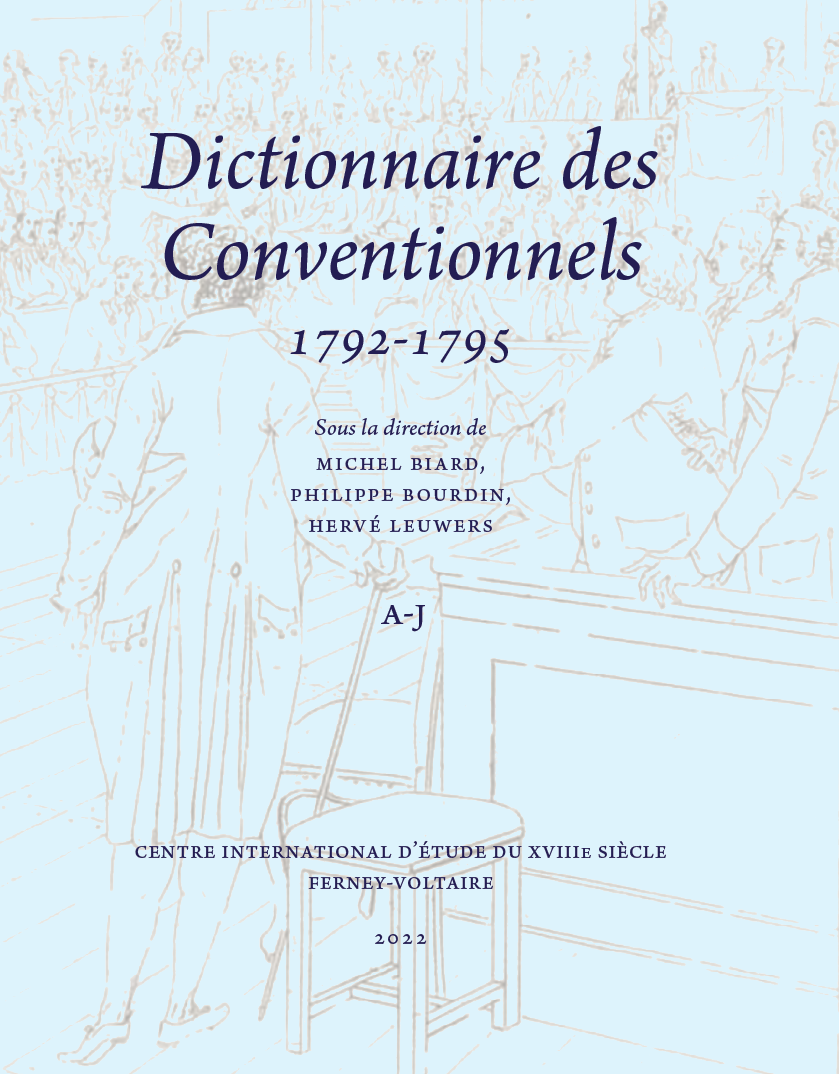
BOOK: Michel BIARD, Philippe BOURDIN & Hervé LEUWERS (dir.), Dictionnaire des Conventionnels 1792-1795 (Ferney-Voltaire: Centre international d'étude du XVIIIe siècle), XXXIV + 1310 p. ISBN 978-2-84559-153-0, 2022, €220


(image source: Etudes Robespierristes)

Abstract:
De l’entrée en république, le 21 septembre 1792, jusqu’à l’amnistie qui espérait une nouvelle fois clore la Révolution, le 4 brumaire an IV (26 octobre 1795), quelque neuf cents hommes ont siégé sur les bancs de la Convention nationale. Ensemble, non sans de profondes divisions, ils ont élaboré les bases d’une constitution démocratique mort-née (juin 1793), établi un «gouvernement révolutionnaire» destiné à «fonder» la république en période de guerre extérieure et intérieure (octobre 1793), puis inventé une république des «meilleurs», celle du Directoire, par la Constitution de l’an III (août 1795). Les hommes qui ont écrit l’histoire de ces trois années majeures demeuraient pour une partie d’entre eux méconnus. Depuis le Dictionnaire des Conventionnels de Kuscinski (1916), œuvre remarquable, mais inachevée et posthume, aucun travail d’ampleur n’avait permis d’examiner leurs parcours. Ces dernières années, les publications du Dictionnaire des Constituants (1991), puis du Dictionnaire des Législateurs (2007), sous la direction d’Edna Lemay, rendaient cette lacune plus visible encore. C’est pour la combler que ce Dictionnaire des Conventionnels, élaboré par une cinquantaine d’auteurs, a été conçu dans le cadre d’un projet financé par l’Agence nationale de la recherche; il retrace le parcours politique de ces fondateurs de la Première République, leurs missions dans les départements ou auprès des armées, leur travail dans les comités, leurs prises de position, leurs conflits et parfois leurs décès tragiques, en mettant les années 1792-1795 en perspective, par la présentation de leur cheminement, avant et après la Convention.
Table of contents:

Tome I

   Auteurs

   Principales abréviations

   Introduction

   Repères chronologiques

   Conventionnels Alard-Izoard

Tome II

   Principales abréviations

   Conventionnels Jac-Zangiacomi

   Cartes

– 1. Les départements à l’époque de la Convention (Michel Biard et François Delisle)

– 2. Nombre de représentants attribués aux départements (Michel Biard et François Delisle)

– 3. Nombre de représentants ayant siégé (Michel Biard et François Delisle)

– 4. Conventionnels présents aux appels nominaux du 20 septembre 1792 (Hervé Leuwers et François Delisle)

– 5. Conventionnels arrivés au 30 septembre 1792 (Hervé Leuwers et François Delisle)

– 6. Conventionnels arrivés au 31 octobre 1792 (Hervé Leuwers et François Delisle)

– 7. Adresses parisiennes des Conventionnels, carte 1 (Michel Biard et François Delisle)

– 8. Adresses parisiennes des Conventionnels, carte 2 (Michel Biard et François Delisle)

– 9. Nombre d’interventions par Conventionnel (Philippe Bourdin et François Delisle)

– 10. Conventionnels ayant déclaré leur fortune (Philippe Bourdin et François Delisle)

– 11. Nombre de missions par département (Michel Biard et François Delisle)

– 12. Représentants en mission aux armées (Michel Biard et François Delisle)

– 13. Les Conventionnels décédés de mort non naturelle (Michel Biard et François Delisle)

   Annexes

– 1. Les Conventionnels ayant siégé (Michel Biard)

– 2. Les présidents de la Convention nationale (Hervé Leuwers)

– 3. Les comités de la Convention nationale (Philippe Bourdin)

– 4. Girondins et Montagnards (Hervé Leuwers)

– 5. Les 426 représentants du peuple en mission (mars 1793-brumaire an IV) (Michel Biard)

– 6. Assemblées dans lesquelles ont siégé les Conventionnels (1789-1815) (Philippe Bourdin)

– 7. Âge des Conventionnels en 1793 (Philippe Bourdin)

– 8. Professions et fonctions des Conventionnels en 1789 et en 1800 (Philippe Bourdin)

– 9. Adresses parisiennes des Conventionnels (Michel Biard)

– 10. Les principaux orateurs (Philippe Bourdin)

– 11. Les 96 Conventionnels décédés de mort non naturelle (1793-1799) (Michel Biard)

– 12. Réintégrer au sein de la Convention les proscrits encore vivants (Michel Biard)

– 13. Le devenir des Conventionnels atteints par l’ordonnance du 24 juillet 1815 et la loi du 12 janvier 1816 (Hervé Leuwers)

– 14. Dates de décès des Conventionnels (Michel Biard)

Contributors:

Serge Aberdam, chercheur retraité au Département des sciences sociales de l’INRA Nathalie Alzas, docteure de l’université de Provence Gaid Andro, maîtresse de conférences à INSPE, université de Nantes Jean Bart, professeur émérite d’histoire du droit, université de Bourgogne Cyril Belmonte, docteur de l’université de Provence Mathias Berton, docteur de l’université Paris 1 Panthéon-Sorbonne Serge Bianchi, professeur émérite d’histoire moderne, université Rennes II Michel Biard, professeur d’histoire moderne, université de Rouen Normandie Bernard Bodinier, professeur honoraire d’histoire moderne, université de Rouen Justine Bodnar, master 2, université de Rouen Normandie Alexiane Boudaut, master 2, université de Rouen Normandie Philippe Bourdin, professeur d’histoire moderne, université Clermont-Auvergne, IUF Laurent Brassart, maître de conférences, université de Lille Patrice Bret, chercheur honoraire au Centre Alexandre Koyré, Paris Emilie Cadio, master 2, université Paris 1 Panthéon-Sorbonne Matthieu Carlot, professeur certifié Jean-Luc Chappey, professeur d’histoire des sciences, université Paris 1 Panthéon-Sorbonne Paul Chopelin, maître de conférences, université Jean Moulin Lyon 3 Guillaume Colot, docteur de l’université de Clermont-Ferrand Michel Combet, maître de conférences, université de Bordeaux Annie Crépin, maîtresse de conférences honoraire, université d’Artois Lorenzo Cuccoli, docteur des universités de Paris 1 et de Bologne Vincent Cuvilliers, docteur de l’université d’Artois Bernard Dailly, professeur certifié Hubert Delpont, docteur de l’université Bordeaux Montaigne Robert Demeude, docteur de l’université Paris 1 Panthéon-Sorbonne Jean-Étienne Dubois, docteur de l’université Clermont-Auvergne Anne-Marie Duport, docteure de l’université Paris 1 Panthéon-Sorbonne Annie Duprat, professeure honoraire d’histoire moderne, université de Cergy-Pontoise Pascal Dupuy, maître de conférences, université de Rouen Normandie Alain Duran, docteur de l’université Paris 1 Panthéon-Sorbonne Matthieu Fontaine, docteur de l’université d’Artois Bernard Gainot, maître de conférences honoraire HDR, université Paris 1 Panthéon-Sorbonne Daniel Galloyer, professeur agrégé Charlotte Goetz-Nothomb, chercheuse de l’équipe Pôlenordgroup, Bruxelles André Goudeau, docteur de l’université de Rouen René Grevet, professeur honoraire d’histoire moderne, université de Lille Samuel Guicheteau, formateur à l’INSPE, université de Nantes Jean-Pierre Harbulot, docteur de l’université de Lorraine Philippe Jarnoux, professeur d’histoire moderne, université de Bretagne occidentale, Brest Jean-Pierre Jessenne, professeur honoraire d’histoire moderne, université de Lille Anne Jollet, maîtresse de conférences, université de Poitiers Daniel Jouteux, président de la Société des Amis de la Révolution française – Club René Levasseur de la Sarthe Maxime Kaci, maître de conférences, université de Franche-Comté Isabelle Laboulais, professeure d’histoire moderne, université de Strasbourg Christine Lamarre, professeur honoraire d’histoire moderne, université de Bourgogne-Franche-Comté Christine Le Bozec, maîtresse de conférences honoraire, université de Rouen Normandie Jean-Baptiste Legoff, archiviste-paléographe, archives départementales d’Indre-et-Loire Éric Lem, ambassadeur Stefan Lemny, Bibliothèque nationale de France Hervé Leuwers, professeur d’histoire moderne, université de Lille Guillaume Lévêque, professeur agrégé Suzanne Levin, docteure de l’université Paris Nanterre Aurélien Lignereux, professeur d’histoire contemporaine, Sciences Po Grenoble – université Grenoble Alpes, IUF Nicolas Lumbroso, magistrat, doctorant à l’université de Lille Hugues Marquis, docteur en histoire, professeur agrégé à l’INSPE, université de Poitiers Jean-Claude Martin, attaché de conservation du patrimoine, Archives départementales de l’Orne Alain Massalsky, docteur de l’université Paris 1 Panthéon-Sorbonne Anne de Mathan, professeure d’histoire moderne, université de Caen Normandie Guillaume Mazeau, maître de conférences, université Paris 1 Panthéon-Sorbonne Raymonde Monnier, ingénieur de recherche honoraire au CNRS Philippe Moulis, docteur de l’université d’Artois Matthieu de Oliveira, maître de conférences, université de Lille Danièle Pingué, maîtresse de conférences honoraire, université de Franche-Comté Frédérique Pitou, professeure honoraire d’histoire moderne, université du Maine au Mans Anne Quennedey, docteure de l’université Paris-Sorbonne Anne Rolland-Boulestreau, professeure d’histoire moderne, université catholique de l’Ouest, Angers Jean-Paul Rothiot, maître de conférences honoraire, université de Nancy Catherine Schmidt, docteure de l’université Paris 1 Panthéon-Sorbonne Côme Simien, maître de conférences, université Paris 1 Panthéon-Sorbonne Cyril Triolaire, maître de conférences, université Clermont-Auvergne Bernard Vinot, docteur d’Etat de l’université Paris 1 Panthéon Sorbonne Dominique Waquet, chercheur associé, EHESS Emmanuel de Waresquiel, HDR, École pratique des hautes études

Read more here


13 December 2023

BOOK: Naïma GHERMANI, Le droit des exilés, Généalogie du droit d'asile au XVIIIe siècle (Paris: PUF, 2023), 368 p. ISBN 97821308-33321, 25 €


(image source: PUF)

Abstract:
Le xvııe siècle est frappé par une « crise des réfugiés » sans précédent. Fuyant les persécutions et les politiques coercitives, des centaines de milliers de personnes prennent la route de l’exil : judéo-ibériques, vaudois, protestants français, wallons ou tchèques, cherchent une protection matérielle et juridique dans plusieurs pays d’Europe. Or, le droit d’asile était jusqu'alors seulement conçu comme une immunité accordée à des délinquants ou à des criminels. Comment en faire un droit pour les personnes innocentes ? S’appuyant sur des sources en partie inédites, cet ouvrage, à la croisée de l’histoire du droit et de l’histoire des émotions, s’interroge sur cette mutation profonde du droit d’asile. Les fugitifs dispersés dans plusieurs pays d’Europe forgent un langage de l’exil et élaborent la figure compassionnelle du réfugié. C’est sur elle que les juristes s’appuient pour penser un « droit des exilés ». Ce droit de recevoir des personnes vulnérables, qui s’ébauche dans l’Allemagne protestante, ouvre un chapitre inédit et transnational du droit des gens.

On the author:

Naïma Ghermani est professeure d’histoire moderne à l’université de Grenoble-Alpes. Elle est l'auteure, avec Caroline Michel d’Annoville, d'Image et Droit. Du ius imaginis au droit à l’image (Éditions de l’École française de Rome, 2022). 

Read more here