Search

Showing posts with label global history. Show all posts

18 June 2026

BOOK: Daniel ALLEMANN, Empires of Slavery: Rights and Power in the Early Modern Iberian World [Max Planck Studies in Global Legal History of the Iberian Worlds, ed. Thomas DUVE; 7] (Leiden/Boston: Martinus Nijhoff/Brill, 2026), [OPEN ACCESS]


(image source: Brill)

Abstract:
Enslavement was central to the early modern Iberian empires. No one at the time seriously questioned its legality, yet widespread reports of violent practices of captivity and human trafficking contrasted sharply with the Christian ideal of charity. This volume explores how Spanish and Portuguese theologians, jurists, and missionaries grappled with this moral dilemma. These thinkers developed ideological tools to protect the souls of those who appeared to be in a state of mortal damnation. Slavery prompted Iberian intellectuals to rethink the boundaries between property and person, law and religion, and household and commonwealth. By reconstructing these debates, this volume offers a new narrative about the relationship between individual rights and political power in the early modern Iberian world.

On the author:

Daniel Allemann, Ph.D. (2020), University of Cambridge, is Scientific Collaborator at the University of Geneva. A historian of the late medieval and early modern periods, he studies how intellectual traditions shaped ideas of empire, rights, and religion. He co-edited Conceptions of Space in Intellectual History (2018). 

Read more here: DOI  10.1163/9789004760592.


10 March 2026

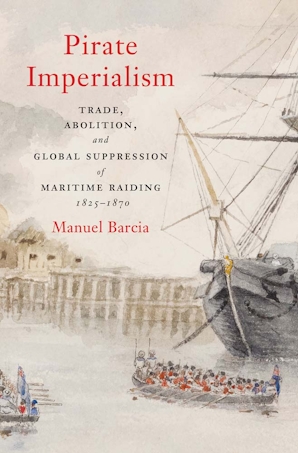
BOOK: Manuel BARCIA, Pirate Imperialism. Trade, Abolition, and Global Suppression of Maritime Raiding, 1825-1870 (London: Yale University Press, 2026)

(image source: Yale)

Abstract:
This first truly global history of the suppression of piracy links maritime raiding to empire building in the nineteenth century In the middle decades of the nineteenth century, imperial powers around the world came into direct confrontation with local resistance in the form of maritime raiding. From the Atlantic basin to the western Mediterranean Sea, the Persian Gulf and the east coast of Africa, and Southeast Asia and China, imperial powers claimed that progress was being held back by the barbarity and greed of pirates, who repeatedly attacked imperial vessels. The suppression of piracy, justified under the banner of spreading civilization and free trade and abolishing slavery and the slave trade, provided both western and non-western powers with a back door for territorial expansion and the enforcement of imperialist agendas. Historian Manuel Barcia tells the story of these conflicts, showing how imperialist powers frequently used anti–maritime raiding efforts as excuses to cement western supremacy in various parts of the world, while simultaneously resorting to violent means that were indistinguishable from the methods of those they accused of being pirates.

Author:

Manuel Barcia is pro-vice-chancellor for global engagement at the University of Bath. He has published five books, the most recent of which, The Yellow Demon of Fever, won the Paul E. Lovejoy Prize.

Read more here


13 February 2026

SYMPOSIUM: The Meanings of Independence: The American Declaration in Global Context, 1776-1826 (Oxford: Rothermere American Institute, 19 MAR 2026)

(image source: Oxford)
 

Abstract:

The Declaration of Independence, whose 250th anniversary Americans will observe in 2026, is the United States’ founding text, but it was also a transformational international text. Although Congress’s main purpose was to declare thirteen of Britain’s American colonies to be free and independent states, the Declaration’s words and example spoke to audiences well beyond the new union’s borders. Convened by Eliga Gould and Patrick Griffin, Harmsworth Professors, respectively, for 2025-26 and 2022-23, this conference will explore some of the implications of that wider message. In addition to the response to the Declaration in Britain, Ireland, and Europe, we anticipate presentations that focus on North America’s Indian country, Haiti and the Caribbean, Sierra Leone and West Africa, and China and British India. Participants will approach their topic from the broadest possible social and cultural contexts, paying particular attention to how categories of race and class, as well as gender and sexuality, mediated what independence meant. As the choice of 1826 as the conference’s endpoints, we hope to include presentations on the Spanish American Revolutions that extended the quest for independence throughout the Western Hemisphere. 1826 was also the year that two of the main architects of American independence, John Adams and Thomas Jefferson, died, both on July 4.

See here for program and registration

15 December 2025

BLOG SYMPOSIUM: Imperialism, Sovereignty and the Making of International Law at 20 (National University of Singapore)


(image source: NUS)

The Centre for International Law Dialogues of the National University of Singapore hosts a blog series on Anthony Anghie's seminal monograph Imperialism, Sovereignty and the Making of International Law (CUP, series Cambridge Studies in International and Comaprative Law, eds. James Crawford and John Bell).

Read more here.

05 June 2025

VACANCY: Five 4-year doctoral scholarships available a.y. 2025-2026 (Napoli: Scuola Superiore Meridionale; DEADLINE 27 AUG 2025)


(image source: SSM)

Ph.D. Program in Global History and Governance

Five 4-year doctoral scholarships available at the Scuola Superiore Meridionale, Napoli (Italy), a.y. 2025-2026

The Scuola Superiore Meridionale (SSM) in Naples, in partnership with the Università di Napoli Federico II, invites applications for five fully funded scholarships in the PhD program in Global History and Governance for the academic year 2025-2026.

The Program: The PhD in Global History and Governance program consists of an advanced course of study and research at the end of which the student defends a dissertation based on original and independent scientific work. The course offers an educational program based on a multidisciplinary approach centered on history and law, but it is open to contributions from other disciplines.

The Ph.D. program in Global History and Governance is aimed at highly motivated students with a solid personal background and multiple language skills.

The program focuses on the comparisons, connections, and processes of globalization that have characterized different areas of the planet between the 16th and 20th centuries. It does so by concentrating on the relational dimension of historical processes, legal regimes, and the organization of power; on the interconnections between economic, political, legal, cultural, and social factors; and on the circulation, exchange, and interconnection of ideas, persons, institutions, legal cultures, political models, concepts, rights, and goods on a global scale.

Program coordinator: Prof. Daniela Luigia Caglioti

Funding amount: Annual stipend of € 19,000.00; 50% increase of the scholarship for research abroad for up to 12 months; up to 20% of the scholarship in research funds per year; no tuition fees.

Starting date: November 2, 2025

Admission requirements: Candidates must possess an MA/MS degree, an excellent command of English, and possibly a second language other than their mother tongue. They must present a personal statement, a research proposal on a subject relevant to the PhD program, and a review/discussion of a text that particularly inspired applicants in the choice to pursue their studies and in the conception and writing of the proposal itself.

Application deadline: August 27, 2025, 2:00 pm (CET), only via the online system.

Deadline for the submission of recommendation letters: August 29, 2025, 2:00 pm (CET)


Please visit the SSM website for full details of the funding of the award, eligibility, and how to apply: https://www.ssmeridionale.it/avcp/bando-di-concorso-xli-ciclo-dottorato-di-ricerca-della-scuola-superiore-meridionale/.

For further information, please write to ghg@ssmeridionale.it

06 May 2025

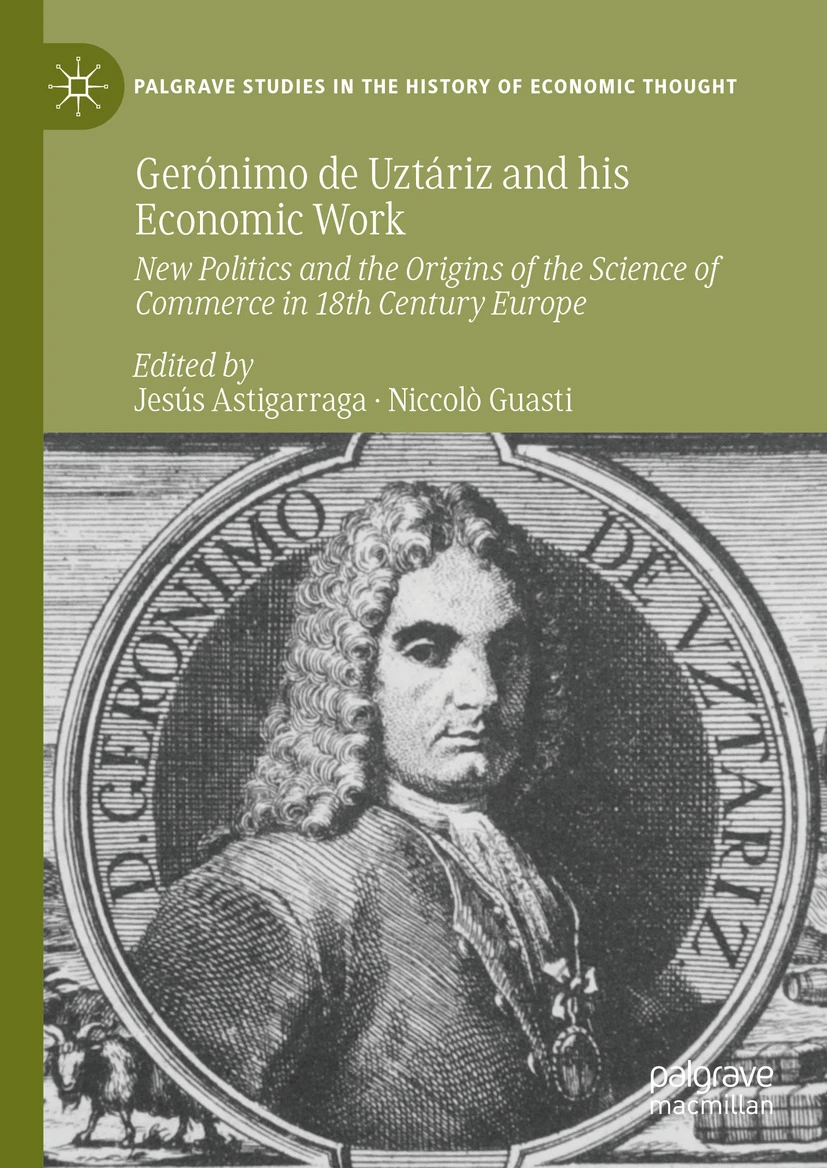
BOOK: Jesús ASTIGARRAGA & Niccolò GUASTI (eds.), Gerónimo de Uztáriz and his Economic Work. New Politics and the Origins of the Science of Commerce in 18th Century Europe [Palgrave Studies in the History of Economic Thought, eds. Peter KIESLER, Jan TOPOROWSKI & Maria Cristina MARCUZZO] (Cham: Palgrave Macmillan, 2025), XVII + 364 p. ISBN 9783031758560


Abstract:

This book provides a detailed and compelling guide to the life and economic work of Gerónimo de Uztáriz. It contextualises his work within the economic and political trends of the time, including the Enlightenment, Spanish liberalism, and colonial empires. Particular attention is given to de Uztáriz’s seminal work Theórica y Práctica de comercio y de marina and how it achieved international circulation and recognition. Its influence on 18th century Spain is examined, alongside a detailed analysis of the trade systems of the day. The translation and reception of Theórica in France, Great Britain, Italy, Ireland, and Germany is also discussed. This book aims to shed new light upon the economic work of Gerónimo de Uztáriz and highlights why his ideas remain relevant and important. It will be of interest to students and researchers working within modern history and the history of economic thought.

Table of contents:

Uztáriz and the Origins of the “Science of Commerce” in Europe (Jesús Astigarraga, Niccolò Guasti)
Abstract:

This chapter aims to introduce the figure of Uztáriz and to underline the importance of his Theórica (1724) in both the Hispanic and European contexts. The state of the art on these issues is discussed in detail, and the book’s main objectives are set out. The chapter highlights Uztariz’s book as an attempt to establish a “new politics” for the Spanish Monarchy and concludes by emphasising its international dimension: to speak of the Theórica is to speak of the origins of the “science of commerce” in the European Enlightenment.

Gerónimo de Uztáriz: Biographical Note (Reyes Fernández Durán)
Abstract:

This chapter aims to reconstruct Uztáriz’s personal and intellectual history. It highlights, among other aspects, his relationship with the influential group from Navarre who had settled in Madrid, his long sojourn in Belgium and the Netherlands, his informative travels around Europe, his posting to the Viceroyalty of Sicily as Treasury advisor, and his return to Spain at the height of the War of the Spanish Succession to serve the Crown in diplomatic affairs and on different councils. These stages are related with the vicissitudes of the 1724 first edition of the Theórica and the 1742 and 1757 re-editions, as well as the range of measures to tackle the country’s economic crisis set out in the work. The importance of examining the reports that Uztáriz wrote at the authorities’ request and other unpublished writings is also stressed.

The Man and His Circumstances: The Historical Context of Writing the Theórica (Sergio Solbes Ferri)
Abstract:

The years following the end of the War of the Spanish Succession were particularly frenzied in several aspects. The revision of the situation in the international and military policy sphere brought about by the Treaties of Utrecht has been emphasized, and this period is also understood to have formed part of a restructuring process for the Spanish economy. However, until recently, the idea of a simultaneous reorganization of an institutional framework affecting Spain as a whole has been blurred. The Nueva Planta reform phase was not limited to its implementation in the Crown of Aragon kingdoms, but was a key moment in the development of the modern state throughout Spain. Jean Orry’s reforms at the end of the conflict did not achieve a stable structure for several decades. Consequently, the context in which Uztáriz’s Theórica (1724) was published needs to be studied as a particularly delicate and significant moment in the halting overhaul of the Bourbon administration.

Europe in the Time of Gerónimo de Uztáriz’s Theórica: Between the Peace of Utrecht (1713) and the Peace of Vienna (1725) (Virginia León Sanz)
Abstract:

Uztáriz finished the Theórica at the end of 1724, a troubled year in Philip V’s reign, characterised by the monarch’s abdication and return to the throne. Bourbon diplomacy was about to undertake a U-turn in terms of its alliances, with a rapprochement with Austria and the signing of the Peace of Vienna in 1725. For almost a decade, Philip V had been endeavouring to reverse the Treaties of Utrecht, mainly those signed with England, but also others relating to the Mediterranean which had meant the loss of Sardinia, Milan, Naples and Sicily and which translated into a dynastic policy that conditioned Atlantic policy. Spain’s joining of the Quadruple Alliance in February 1720 and the slow pace of work at the Congress of Cambrai, the conflicts with England over the implementing of the Trade Treaty and the Treaty of Asiento, and the deterioration of relations with France all culminated in a change in Spain’s attitude and a rethinking of its positions at political and trade level arising from the Europe of Utrecht. In this European context, Uztáriz’s international career and the range of posts he held in Philip V’s service equipped him with a unique perspective on the trade policies of France, England and Holland. Shortly after the work was published, in 1725, Spain signed a Trade Treaty with Austria.

Uztáriz and His Sources: The Public Good Beyond the Reason of State (Niccolò Guasti)
Abstract:

Uztáriz’s treatise advocated a new economic policy for the Spanish Bourbon monarchy: since commerce, at the beginning of the eighteenth century, had come to underpin the balance of power in the international system, he lobbied for strong state intervention to develop national industry and trade with the colonies. Combining his training as a military engineer and a strong expertise in the administrative field with the heuristic tools taken from French Colbertism, Spanish arbitrismo and maybe English Political Arithmetic, Uztáriz featured some possible countermeasures against the re-export Dutch trade and the aggressive economic policy carried out by England since the second half of the seventeenth century. However, he never considered the political solutions or economic data gained from his sources (Vauban, Dubos, Huet, Savary, Moncada, Fernández de Navarrete, etc.) as a theoretical knowledge, but rather a practical know-how, useful to devise an economic policy able to restore Spain as a new model commercial empire.

Taxes and Tariffs in the Fiscal Debate in Spain at the Time of Uztáriz’s Theórica (1724–1757) (Niccolò Guasti, Jesús Astigarraga)
Abstract:

Uztáriz’s Theórica was the most influential Spanish economics text throughout the country and its colonies as a whole in the eighteenth century. It soon became the object of well-honed critical analyses. Although this controversial reception touched on many of the arguments put forward in the work, taxation was undoubtedly a major focus of the interpretations. This chapter aims to define the outlines of the long shadow cast by the Theórica over the three decades after its publication. It is divided basically into three sections. The first analyses Uztáriz’s core proposal for taxation, the second deals with tariffs and the customs system. and the third examines the controversial reception of both, particularly the former, among political economists and reformers of the day. The chapter underlines that Uztáriz conceived taxation (taxes and tariffs) as a linchpin for establishing a “new policy” that would bring Spain into line with Europe’s leading countries and promote the recovery of comercio útil, especially domestic manufacturing.

The Organisation of the Armadas of War and Commerce in the Writings of Gerónimo de Uztáriz (1717–1725): Polemics During the Transfer of the Casa de la Contratación (Ana Crespo-Solana)
Abstract:

The relationship between timber provision for navy shipyards and the naval reforms carried out during the eighteenth century has been the subject of recent analysis. The aforementioned issues, namely those pertaining to naval models and the supply of timber, were prominent in the political and economic discourses that shaped the decision to transfer the trade and navigation tribunals from Seville to Cadiz. This aspect was a point of contention between Gerónimo de Uztáriz and those who advocated for the centralisation of the navy, particularly the minister José Patiño. This chapter puts forward an analysis of the reciprocal relationship between forests, resources for the navy (dealt with in Chapter LXIII of the Theórica), and the organisation of fleets and navies from the perspective of Uztáriz's comparative critique. The author’s analysis is focused on the political and economic debate that took place within the Bourbonic Court concerning the defence of interests surrounding the creation of new shipyards and naval centres in eighteenth-century Spain.

The Colonial Balance of Trade: Uztáriz and the Carrera de Indias (Fidel J. Tavárez)
Abstract:

That Uztáriz’s Theórica had enormous influence in the Hispanic world, especially concerning commercial matters, is a well-known fact. Be that as it may, it remains surprising that an economic treatise centrally concerned with commercial matters had very little to say about the Spanish Empire’s port-restricted and convoy system of trade, the infamous fleets and galleons. Why did Uztáriz almost entirely eschew this topic, even though the reform of the fleets and galleons would later become one of the most important economic concerns among ministers in the court? After describing Uztáriz’s economic thought in relation to various arbitristas (projectors) of the seventeenth century, this chapter proposes that, to answer this question, it is first necessary to reconstruct a related debate about whether a modern commercial nation had to imitate the Dutch in erecting privileged commercial companies. Arguing against the need to imitate the Dutch model, Uztáriz suggested that the most important factor of a successful commercial state was a well-organised system of tariffs and economic incentives that privileged national goods. Whether this occurred via the fleets and galleons or commercial companies was of secondary importance. Instead, the crown had to focus on trading with national goods and achieving a favorable balance of trade.

The Theórica: Publishing History and Economic Lexicon (Elena Carpi)
Abstract:

This chapter deals with the Theórica from the point of view of publishing history and the comparison between the first two editions, with special attention to the paratexts and to the handwritten notes in the margins of the first edition. In addition, it proposes the study of the most relevant neological formations, from a lexicogenetic point of view.

Uztáriz in Britain (Richard van den Berg)
Abstract:

The publication of the English translation of Uztáriz’s Theórica in 1751 signalled the beginning of the reception of this work in Britain. Over the next decades there were frequent, but often somewhat isolated, references to Uztáriz in works dealing with commercial, colonial or naval matters. However, by far the most extensive use was made of this Spanish treatise by Malachy Postlethwayt in his Universal Dictionary of Trade and Commerce. This chapter examines the selections Postlethwayt made and the ways in which he used these substantial borrowings in support of his own positions.

The French Translation of the Theórica: From Political Arithmetic to Political Economy (Antonella Alimento)
Abstract:

This chapter considers the identity of the person who drove forward the 1753 French translation of Uztáriz’s Theórica y práctica de comercio y de marina. Evidence supports the hypothesis that it was Véron de Forbonnais who proposed the translation as part of a broader editorial initiative, which also included the translation of The British Merchant (1753) and was aimed at employing political arithmetic to prevent the renewal of the commercial treaty binding France to the United Provinces and the implementation of the treaty signed with England in Utrecht in 1713. Forbonnais, who admired Uztáriz’s text for its methodological approach, used his notes not only to correct the factual errors made by Uztáriz but also to replace the natural law approach adopted by the Navarrese official with an economic anthropology based on self-interest and “progressive consumptionism”, which he embraced having read and appreciated David Hume.

Uztáriz in the German-Speaking World: Karl Zinzendorf’s Commercial Travels to Spain in 1767 (Simon Adler)
Abstract:

The contribution will examine the reception of Uztáriz’s Theórica in the Habsburg monarchy. It will discuss how Karl Zinzendorf, a leading enlightened Minister in Maria Teresa’s government and specialist in trade affairs, used Uztáriz’s ideas for his commercial travels to Spain in 1767, and it will show how the cameralist writer Joseph von Sonnenfels included the Théorica in his writings. It attempts to highlight the influence of Uztáriz´ ideas amongst economic writers and government ministers in German states.

The Circulation and Translation of Uztáriz’s Theórica in Italy (Niccolò Guasti)
Abstract:

Uztáriz can be considered one of the most frequently quoted foreign economists in eighteenth-century Italy; in some Italian contexts (the Kingdom of Naples, Habsburg Lombardy, the Republic of Venice, the Duchy of Modena and the Papal State), he was regarded among the founding fathers of the new political economy as an academic and scientific discipline. His Theórica was read by Italian reformers and Enlightenment thinkers (Genovesi, Verri, Beccaria, Pagnini, Paradisi, Fracastoro, Vergani, Zanon, etc.) especially through the French translation by Forbonnais (1753), although in 1793 a Spanish expelled Jesuit, Gonzalo Adorno Hinojosa, released a new translation, this time directly from Spanish into Italian. Although it was a partial version (since Adorno translated almost half of original Uztáriz’s treatise), this latest version of the Theórica confirms that at the end of the eighteenth century Uztáriz’s economic ideas and political suggestions were still effective and attractive in several Italian states. The chapter examines the spread of Uztáriz’s Theórica in eighteenth-century Italy through its translations and the reasons for this enduring success.

Uztáriz’s Theórica and Strategies for Spain’s Economic Development (1740–1795) (Jesús Astigarraga, Javier Usoz, Juan Zabalza)
Abstract:

The Theórica’s commercial and industrial goal was hegemonic in Spain during the first half of the eighteenth century, in tune with prevailing ideas in the rest of Europe. During this time the book marked ways of thinking about how the structural problem faced by Spain due to its “lack of trade” could be solved, and from 1740 onwards it became a key text, thanks to the two re-editions in 1742 and in 1757. The work was especially influential in the three areas of taxation, trade and development strategies. However, after around 1760 its influence waned due to the prevalence of doctrines in favour of prioritising agriculture. In spite of this, its proposals for taxation, support for the role of trade, which was partially open to free trade initiatives, and criticism of companies with state privileges meant that the work retained its relevance in this predominantly agrarian context. Its pro-manufacturing stance, which was largely detached from Ancien Regime rigidity and privileges, also survived among major authors and in specific fields. This chapter therefore underlines the argument that there was not just one interpretation of the Theórica but many, and that they were wide-ranging and even contradictory.

Read more here: DOI 10.1007/978-3-031-75857-7.

21 April 2025

BOOK: David MOTADEL (ed.), Globalizing Europe. A History (Cambridge: Cambridge University Press, 2025), ISBN 9781009262873, € 31,5


Abstract:
Globalizing Europe explores modern Europe's myriad entanglements with the wider world, considering the continent not only as an engine but also as a product of global transformations. It looks at the ways in which the global movements of peoples and ideas, goods and raw materials, flora and fauna have impacted life on the continent over the centuries. Bringing together a group of leading historians, the book shows how the history of Europe can be integrated into global history. Taken together, its chapters will help reshape our understanding of the boundaries of Europe – and the field of modern European history.

Table of contents:

1. Global Europe David Motadel
2. Global Conjunctures and the Remaking of European Political History Sebastian Conrad
3. Global Origins of the Old World Economy Sven Beckert
4. European Intellectual History after the Global Turn Samuel Moyn
5. Religion and the Global History of Europe Abigal Green
6. European Social History and the Global Turn Richard Drayton
7. Europe's Place in Global Environmental History J. R. McNeill
8. Global Turns in European History and the History of Consumption Maxine Berg
9. Global Material Culture in Early Modern and Modern Europe Anne Gerritsen
10. Migration and European History's Global Turn Elizabeth Buettner
11. 'Race' in the Global History of Europe Priya Satia
12. Globalising European Gender History Lucy Delap
13. Globalizing Europe's Musical Past Kira Thurman
14. Global Histories of European Art Caroline van Eck
15. Globalizing European Military History Michelle Moyd
16. Deglobalizing the Global History of Europe Stephen W. Sawyer
Afterword: Global Histories of Modern Europe Richard J. Evans.

On the editor:

David Motadel is Associate Professor of International History at the London School of Economics and Political Science. He is the author of Islam and Nazi Germany's War (2014), which was awarded the Ernst Fraenkel Prize, and, as editor, Islam and the European Empires (2014). In 2018, he received the Philip Leverhulme Prize for History.

Read more here (DOI  10.1017/9781009262873).


18 March 2025

BOOK: Randal LESAFFER (ed.), The Cambridge History of International Law. Volume 6. International Law in Early Modern Europe [Part of The Cambridge History of International Law] (Cambridge: Cambridge University Press, 2025), 800 p., ISBN 9781108485616; £120


 (image source: Cambridge University Press)

Abstract:

Volume VI of The Cambridge History of International Law offers a survey of the law of nations in early modern Europe through a balanced treatment of legal theory and diplomatic practice. Bringing together a wide range of scholars, this volume builds on recent historiographical insights from different disciplines, including legal history, diplomatic history, and the history of political thought. It considers all major themes ranging from the allocation of jurisdiction over land and sea, war- and peace- making, trade and navigation to diplomacy and dispute settlement. A unique overall synthesis of early modern law across nations in Europe.


Table of contents:

Part I. International Law in Renaissance Europe (1492–1660)

1. The law of nations in Renaissance Europe Randall Lesaffer

2. Territory and jurisdiction in Renaissance Europe Tamar Herzog

3. Beyond the free sea. The law of the sea in Renaissance Europe Louis Sicking

4. War and the use of force in Renaissance Europe Anuschka Tischer

5. Warfare on land in Renaissance Europe Valentina Vadi

6. The law of maritime warfare during the transition between medieval and early modern Europe Alain Wijffels

7. Peace-making in Renaissance Europe Randall Lesaffer

8. Trade and navigation in Renaissance Europe Dave De Ruysscher

9. Diplomacy in Renaissance Europe Dante Fedele

10. Dispute settlement in Renaissance Europe Guido Braun

11. The Ottoman encounter and the law of nations in the Renaissance Maurits H. van den Boogert

Part II. International Law in Old Regime Europe (1660–1775) 12. The law of nations in Old Regime Europe Randall Lesaffer

13. Territory and jurisdiction in Old Regime Europe Frederik Dhondt

14. The law of the sea in Old Regime Europe Kinji Akashi

15. War and the use of force in Old Regime Europe Randall Lesaffer

16. Warfare on land in Old Regime Europe Stefano Cattelan and Raymond Kubben

17. Maritime warfare in Old Regime Europe Stefano Cattelan

18. Peace-making in Old Regime Europe Randall Lesaffer

19. Trade in Old Regime Europe Dave De Ruysscher

20. Diplomacy in Old Regime Europe Linda S. Frey and Marsha Frey

21. Dispute settlement in Old Regime Europe Christoph Kampmann

22. The Ottoman encounter and the law of nations in the Old Regime Maurits H. van den Boogert.

Read more here.

10 February 2025

BOOK: H.E. CHEHABI & David MOTADEL (eds.), Unconquered States: Non-European Powers in the Imperial Age (Oxford: Oxford University Press, 2024), ISBN 9780198863298


(image source: twitter)


Abstract:
In the heyday of empire, most of the world was ruled, directly or indirectly, by the European powers. Unconquered States explores the struggles for sovereignty of the few nominally independent non-Western states in the imperial age. It examines the ways in which countries such as China, Ethiopia, Japan, the Ottoman Empire, Persia (Iran), and Siam (Thailand) managed to keep European imperialism at bay, whereas others, such as Hawai‘i, Korea, Madagascar, Morocco, and Tonga, long struggled, but ultimately failed, to maintain their sovereignty. Its chapters address four major aspects of the relations these countries had with the Western imperial powers: armed conflict and military reform, unequal treaties and capitulations, diplomatic encounters, and royal diplomacy. Bringing together scholars from five continents, the book provides the first comprehensive global history of the engagement of the independent non-European states with the European empires, reshaping our understanding of sovereignty, territoriality, and hierarchy in the modern world order.

Read more here: DOI 10.1093/oso/9780198863298.001.0001.


23 January 2025

BOOK: Moritz MIHATSCH & Michael MULLIGAN (eds.), Shifting Sovereignties. A Global History of a Concept in Practice (Berlin: DeGruyter Oldenbourg, 2025), ISBN 9783111447117, €129

(image source: DeGruyter Oldenbourg

Abstract:

Shifting Sovereignties explores practical manifestations of sovereignty from antiquity to the Anthropocene. Taking a global-history perspective and centring Africa, the Middle East, and Asia, it destabilises overly neat theoretical notions of the concept. Shifting Sovereignties shows that, in practice, sovereignty is far from absolute, perpetual, indivisible, or supreme; rather it is fuzzy, compromised, fragmented, and layered. From these observations, the authors derive a historical conceptualisation which makes change and contingency core aspects of the understanding of sovereignty. Rather than understanding sovereignty as a characteristic of individual states, Mihatsch and Mulligan propose the notion of “sovereignty regimes”: frameworks of legitimation enforced through mutual recognition. These regimes are created and managed by more or less institutionalised structures which embody what the authors call “system sovereignty.” Sovereignty regimes and system sovereignty are, like sovereignty itself, continuously changing and contingent. This process of change forms the core of the book. Shifting Sovereignties thus contributes a practical, historical perspective on a concept which is foundational in political science, international relations, and international law.

On the editors:

Moritz A. Mihatsch, University of Cambridge, UK; Michael R. Mulligan, Euro University of Bahrain.

Read more here

20 August 2024

BOOK: Indravati FÉLICITÉ, Le Saint-Empire face au monde. Contestations et redéfinitions de l'impérialité XVIe-XIXe siècle (Paris: CNRS Éditions, 2024), 456 p. ISBN 9782271146311, € 27


(image source: CNRS)

Abstract:
Le monde germanique a-t-il pris part au tournant global de l’époque moderne et au processus de conquête et de colonisation qui l’a caractérisée ? Le Saint-Empire romain germanique, perçu alors comme l’une des formations politiques les plus importantes, est aujourd’hui largement absent des travaux consacrés aux empires. Ce fut pourtant un acteur majeur des relations internationales du XVe au début du XIXe siècle. Indravati Félicité montre comment cette entité s’est confrontée au monde, la débarrassant ainsi de l’image de « vieil empire » qu’on lui a souvent prêtée. Marqué par une dimension continentale forte, le Saint-Empire n’en a pas moins été intégré au commerce mondial et inséré dans des réseaux internationaux. Ses habitants ont contribué par leurs voyages et leurs publications à la connaissance de contrées méconnues, ils ont noué des contacts politiques avec diverses nations extraeuropéennes, ont pensé leur place dans un monde en interdépendance croissante. Indravati Félicité nous fait redécouvrir cet empire connecté, et propose, ce faisant, une réflexion sur les notions d’empire et d’impérialité.

On the author:

Indravati Félicité est historienne. Elle est notamment l’auteure de Négocier pour exister. Les villes et duchés du nord de l’Empire face à la France, 1650-1730 (2016) et a dirigé L’Identité du diplomate (Moyen Âge-XIXe siècle). Métier ou noble loisir ? (2020).

Read more here

21 May 2024

BOOK: Franck BILLÉ, Sanjyot MEHENDALE & James LANKTON (eds.), The Maritime Silk Road. Global Connectivities, Regional Nodes, Localities (Amsterdam: University Press, 2022). ISBN 9789048552429, pp. 284 (open access)


(Source: AUP)


ABOUT THE BOOK

The Maritime Silk Road foregrounds the numerous networks that have been woven across oceanic geographies, tying world regions together often far more extensively than land-based routes. On the strength of the new data which has emerged in the last two decades in the form of archaeological findings, as well as new techniques such as GIS modelling, the authors collectively demonstrate the existence of a very early global maritime trade. From architecture to cuisine, and language to clothing, evidence points to early connections both within Asia and between Asia and other continents—well before European explorations of the Global South. The human stories presented here offer insights into both the extent and limits of this global exchange, showing how goods and people travelled vast distances, how they were embedded in regional networks, and how local cultures were shaped as a result.

ABOUT THE EDITORS

Franck Billé is a cultural anthropologist based at the University of California, Berkeley, where he is program director for the Tang Center for Silk Road Studies. He is the author of Sinophobia (Hawaii, 2015), coauthor of On the Edge (Harvard, 2021), editor of Voluminous States (Duke, 2020), and coeditor of Yellow Perils (Hawaii, 2019) and Frontier Encounters (Open Book, 2012). He is currently finalizing his latest book, Somatic States: On Cartography, Geobodies, Bodily Integrity (Duke University Press). More information about his current research is available on his website: www.franckbille.com.

Sanjyot Mehendale is Chair of the P.Y. and Kinmay W. Tang Center for Silk Road Studies and Vice Chair of the Center for Buddhist Studies at UC Berkeley. Her main research concerns is a focus on the Kushan period, in particular on trade and cultural exchange and the relationship between Kushan kingship and Buddhist institutions. A recipient of a National Endowment for the Humanities Fellowship, she has developed, in collaboration with the Electronic Cultural Atlas Initiative, a digital archive of the Begram ivory and bone carvings, which were once housed in the National Museum in Kabul, Afghanistan (www.ecai.org/begramweb=). The author of several articles on Silk Roads art and archaeology, she is the co-editor of Central Asia and the Caucasus: Transnationalism and Diaspora (Routledge, 2005).

James W. Lankton is currently a Senior Research Associate at UCL Institute of Archaeology in London and has been a Visiting Scholar at the Tang Center for Silk Road Studies, UC Berkeley. For the past twenty years James has focused on the interpretation of chemical analyses of early glass found both East and West, with recent projects on glass from South and Southeast Asia and Korea in the late 1st c. BCE to the 6th c. CE, and Egypt and the Mediterranean basin from the Late Bronze Age.


TABLE OF CONTENTS

Illustrations

Acknowledgments

(Franck Billé, Sanjyot Mehendale, and James W. Lankton) Introduction

Globalities

1. (Eivind Heldaas Seland) Spaces, Places and Things: The Spatial Dimension of Early Indian Ocean Exchange

2. (Hyunhee Park) Open Space and Flexible Borders: Theorizing Maritime Space through Premodern Sino-Islamic Connections

3. (James W. Lankton) From Regional to Global: Early Glass and the Development of the Maritime Silk Road

Regional Nodes

4. (Jun Kimura) Archaeological evidence of shipping and shipbuilding along the Maritime Silk Road

5. (Ariane De Saxcé) Networks and cultural mapping of South Asian maritime trade

6. (Shadreck Chirikure) Southern Africa and the Indian Ocean World: Relocating Agency From “Center” to “Periphery,” From the Maritime Silk Road to the Maritime Ivory Route

Localities

7. (John N. Miksic) Chinese Ceramics on the Maritime Silk Road The Importance of Context

8. (Derek Heng) Urban Demographics along the Maritime Asian Silk Road: Archaeological Small Finds and Settlement Patterns at Pre-Modern Port-Settlements of the Malay Region

9. (Osmund Bopearachchi) Indian Ocean Trade through Buddhist Iconographies

Contributors

Index


More information with the publisher.

23 June 2023

SCHOLARSHIPS: Ph.D. Program in Global History and Governance at the Scuola Superiore Meridionale (SSM) in Naples (Italy) Nov 2023-2027 (DEADLINE: 25 AUG 2023)


(Image source: https://www.ssmeridionale.it/it-it/home)
 

Ph.D. Program in Global History and Governance
Eight 4-year doctoral scholarships are available
at the Scuola Superiore Meridionale, Napoli (Italy)
a.y. 2023-2024


The Scuola Superiore Meridionale (SSM) in Naples invites applications for 8 fully-funded scholarships (of which 7 are funded by the EU via the PNRR and one is on ) in the PhD program in Global History and Governance for the academic year 2023-2024.


The Program: The PhD in Global History and Governance consists of an advanced course of study and research at the end of which the student defends a thesis based on original and independent scientific work. The course offers an educational program based on a multi-disciplinary approach centered on history and law and opened to contributions of other disciplines. The Ph.D. program in Global History and Governance is aimed at highly motivated students with a solid personal background and diverse language skills. The program focuses on the comparisons, connections, and processes of globalization that have characterized different areas of the planet between the 16th and the 20th century. It does so by concentrating on the relational dimension of historical processes, legal regimes, and the organization of power; on the interconnections between economic, political, legal, cultural, and social factors; and circulation, exchange, and interconnection of ideas, persons, institutions, legal cultures, political models, concepts, rights and goods on a global scale.

Program coordinator: Prof. Daniela Luigia Caglioti

Program webpage: https://www.ssmeridionale.it/en-us/dottorato/rubriche/global-history-and-governanceghg-3118-1-b6644db167ea2f37aa7d1ac31340ca7a

Funding amount: Annual stipend of € 19,000.00; 50% increase of the scholarship for research abroad for up to 12 months; up to 20% of the scholarship in research funds per year; no tuition fees.

Starting date: November 2, 2023

Admission requirements: Candidates must possess an MA/MS degree, an excellent command of English, and possibly a second language other than their mother tongue. They must present a personal statement, a research proposal on a subject relevant to the PhD program, and the review/discussion of a text that particularly inspired applicants in the choice to pursue their studies as well as in the conception and writing of the proposal itself.

Application deadline: August 25, 2023 (only via the online system at https://pica.cineca.it/ssm/dottorato39-ssm/domande

 Deadline for recommendation letters: August 29, 2023

 Please visit the SSM website for full details of the funding of the award, eligibility, and how to apply: https://www.ssmeridionale.it/it-it/la-scuola/bandi-di-concorso/dottorati/2023/bando-di-concorso-39-ciclodottorato-ssm-35884-1-a857e5c233e38ebb663eb33415292987

 For further information, please write to ghg@ssmeridionale.it.