Search

Showing posts with label European history. Show all posts

14 April 2026

BOOK: David ART, The Resilience of the Old Regime. Paths Around Democracy in Europe, 1832–1919 (Cambridge: Cambridge University Press, 2026), ISBN 9781009710718


(image source: CUP)

Abstract:
In The Resilience of the Old Regime, David Art reevaluates the so-called first wave of democratization in Western Europe through the lens of authoritarian resilience. He argues that non-democrats succeeded to a very large degree in managing, diverting, disrupting, and repressing democratic movements until the end of the First World War. This was true both in states political scientists have long considered either full democracies or democratic vanguards (such as the UK and Sweden), as well as in others (such as Germany and Italy) that appeared to be democratizing. He challenges both the Whiggish view that democracy in the West moved progressively forward, and the influential theory that threats of revolution explain democratization. Drawing on extensive historical sources and data, Art recasts European political development from 1832–1919 as a period in which competitive oligarchies and competitive authoritarian regimes predominated. Explores the core arguments of key theorists like Robert Dahl and Barrington Moore as they engage with European political history during the rise of mass politics Explains how archaic practices like plural voting and male-only voting were justified by liberals in supposedly democratizing regimes Provides a revision of this critical period of European political development through the frame of authoritarian persistence rather than the conventional-and sometimes misleading--- one of democratic triumph

On the author:
David Ar is Professor of Political Science at Tufts University. He is the author of The Politics of the Nazi Past in Germany and Austria (Cambridge, 2006) and Inside the Radical Right (Cambridge, 2011) and is a faculty affiliate at the Minda de Gunzburg Center for European Studies at Harvard University.

More information here


02 March 2026

VACANCY: Eugen and Jacqueline Weber Postdoctoral Scholar in European History (Los Angeles: UCLA; DEADLINE 31 MAR 2026)


(image: Eugen Weber; source: UCLA)

Position overview

Position title: EUGEN AND JACQUELINE WEBER POSTDOCTORAL SCHOLAR IN EUROPEAN HISTORY

Salary range: A reasonable salary estimate is from $69,073 to $ 74,281 based on experience level. See full salary range at Table 23
Review timeline: initial review April 1, 2026

Application Window

Open date: February 24, 2026

Next review date: Wednesday, Apr 1, 2026 at 11:59pm (Pacific Time)
Apply by this date to ensure full consideration by the committee.

Final date: Sunday, May 31, 2026 at 11:59pm (Pacific Time)
Applications will continue to be accepted until this date, but those received after the review date will only be considered if the position has not yet been filled.

Position description

The UCLA Meyer and Renee Luskin Department of History seeks applicants for a two-year Postdoctoral Scholar. The candidate must hold a Ph.D. in History or related field, awarded between September 1, 2022 and June 10, 2026.

The Weber Postdoctoral Scholar position is made possible by a bequest from Jacqueline and Eugen Weber to the Department of History, to support the work of a recent Ph.D. We seek a historian of exceptional promise who will contribute to the excellence of our department’s teaching and research program. Candidates working in any area of European history are encouraged to apply.

The successful applicant will contribute intellectually to the department as well as to its mission by teaching an undergraduate course during each academic year if needed, in a topic close to their area of research. The course selection may include History 187 (Variable Topic Research Seminar) and/or another course on European history to be determined by the department. The incumbent will also work with a faculty mentor on research and professional development.

We are especially eager to interview candidates with a demonstrable commitment to the success and mentorship of students from underrepresented and underserved populations and with an enthusiasm for building ties across fields within the department or the university.

The appointment (which includes benefits) will be for an initial 24 month period, with the possibility of renewal for an additional 12 months subject to available funding and satisfactory performance.

Salary will follow standards for post-doctoral scholars and will reflect the applicant’s experience. Salary range: The posted UC salary scales set the minimum pay determined by postdoc experience level. The starting salary range for this position is currently $69,073.

To apply, candidates must submit (a) a curriculum vitae, (b) cover letter, (c) statement of research describing their interests and plans for the postdoctoral period, and (d) statement of teaching philosophy and discussion of possible seminar topics. Applicants should also have three referees submit letters of reference.

Review of applications will begin April 1, 2026 and will continue until the position is filled. The preferred start date is July 1, 2026.

Qualifications

Basic qualifications

Ph.D. in History or related field, awarded between September 1, 2022 and June 10, 2026.

Additional qualifications

We seek a historian of exceptional promise who will contribute to the excellence of our department’s teaching and research program. Candidates working in any area of European history are encouraged to apply.

Preferred qualifications

A demonstrable commitment to the success and mentorship of students from underrepresented and underserved populations and an enthusiasm for building ties across fields within the department or the university.

Application Requirements

Document requirements
  • Curriculum Vitae - Your most recently updated C.V.

  • Cover Letter

  • Statement of Research - Please describe your interests and plans for the postdoctoral period,

  • Reference check authorization release form - Complete and upload the reference check authorization release form

  • UCLA Mission Statement - As the nation's premier public research university, UC's mission is the creation, dissemination, preservation and application of knowledge for the betterment of our global society. We have a particular responsibility to the people of California which we express in the excellence of the education we provide, the impact of the research we do, the comprehensive, life-saving medical services we provide, and the public service mission we are devoted to. The University of California promotes the social mobility of its students, equips them with the tools and experience that furthers their ambitions, and regards their accomplishments across the life span as evidence of the profoundly positive impact of higher education.

    The UCLA campus has expressed these goals in its strategic plan as follows:

    Deepen our engagement with Los Angeles
    Expand our reach as a global university
    Enhance our research and creative activities
    Elevate how we teach
    Become a more effective institution

    Prompt for candidates for recruitment:

    Reflecting on your personal and professional experiences, highlight your past contributions and future commitments to advancing UCLA's mission as embodied in the 2023-28 strategic plan. These accomplishments and ambitions may be discussed in the context of describing your teaching, scholarship, and service

  • Statement of Teaching - Please describe your teaching philosophy and possible seminar topics.

Reference requirements
  • 3-5 letters of reference required

3 letters of reference required

Apply link: https://recruit.apo.ucla.edu/JPF10862

Help contact: ann@history.ucla.edu

About UCLA

As a University employee, you will be required to comply with all applicable University policies and/or collective bargaining agreements, as may be amended from time to time. Federal, state, or local government directives may impose additional requirements.

The University of California is an Equal Opportunity Employer. All qualified applicants will receive consideration for employment without regard to race, color, religion, sex, sexual orientation, gender identity, national origin, disability, age, protected veteran status, or other protected status under state or federal law.

As a condition of employment, the finalist will be required to disclose if they are subject to any final administrative or judicial decisions within the last seven years determining that they committed any misconduct.

Read more here.

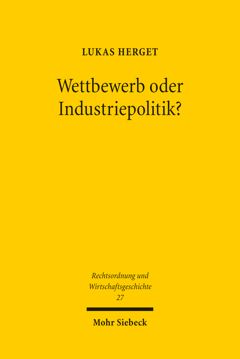
BOOK: Lukas HERGET, Wettbewerb oder Industriepolitik? Die Europäische Fusionskontrolle als Spielball nationaler Wirtschaftspolitiken (1958-1989) [Rechtsordnung und Wirtschaftsgeschichte; 27] (Tübingen: Mohr Siebeck, 2025), 260 p. ISBN 978-3-16-164390-3


Cover von 'undefined' 
 
ABOUT THE BOOK:
 
Lukas Herget untersucht die Entstehung der Europäischen Fusionskontrolle von den 1950er Jahren bis zum Erlass der Fusionskontrollverordnung 1989 und analysiert dabei die Rolle zentraler Akteure auf supranationaler, intergouvernementaler und nationaler Ebene. Im Fokus stehen zwei übergeordnete Fragen: Wie wirkten sich Pfadabhängigkeiten gegenüber nationalen Ordnungsvorstellungen auf die Verhandlungspositionen zur Ausgestaltung der Fusionskontrolle aus? Welche Strategien verfolgten die beteiligten Akteure, um ihre jeweiligen Interessen durchzusetzen? Der Autor stützt sich auf Archivmaterial aus deutschen und europäischen Archiven und verfolgt einen akteurszentrierten Ansatz, der personelle und rechtliche Kontinuitäten sowie Brüche offenlegt. Interdisziplinär werden dabei rechtsgeschichtliche, wettbewerbstheoretische sowie integrations- und politikgeschichtliche Perspektiven verbunden.
 
TABLE OF CONTENT:
 
I. Die Europäische Fusionskontrolle im Kontext des europäischen Wettbewerbsrechts - II. Forschungsstand - III. Fragestellung, Erkenntnisinteresse, Quellen
I. Die Aushandlung des gemeinsamen Wettbewerbsrechts des EWG-Vertrags - II. Die Durchsetzung der Kommission als Wettbewerbsbehörde - III. Zusammenfassung
I. Das Problem der Unternehmenskonzentration auf dem Gemeinsamen Markt - II. Der Paradigmenwechsel der Kommission - III. Zusammenfassung
I. Die Entscheidung der Kommission - II. Das Auseinanderfallen von wettbewerbspolitischem Anspruch und wettbewerbsrechtlichen Möglichkeiten. Das gerichtliche Verfahren im Fall Continental Can - III. Das EuGH-Urteil als Auslöser für den Rechtsetzungsprozess - IV. Zusammenfassung
I. Der »Ur-Vorschlag« der Kommission von 1973 - II. Die Resonanz auf den Verordnungsvorschlag - III. Zusammenfassung
I. Die ersten Verhandlungen auf Gemeinschaftsebene - II. Der Verordnungsvorschlag und die Entwicklungen in der zweiten Hälfte der 1970er Jahre - III. Zusammenfassung
I. Resignation und Neubeginn. Der Verordnungsvorschlag Anfang der 1980er Jahre - II. Das »Philip-Morris-Urteil« des EuGH als Wendepunkt für die Verhandlungen - III. Das finale Aushandeln und der Erlass der Fusionskontrollverordnung - IV. Zusammenfassung
 
Find more here

23 February 2026

VACANCY: Assistant Professor in Early Modern British History (fulltime, tenure) (Warwick: University of Warwick, DEADLINE 8 MAR 2026)

(image source: Warwick)
 

Description:

Informal Queries For informal queries about the role, please contact Professor Tim Lockley at T.J.Lockley@warwick.ac.uk The Department of History seeks to appoint an Assistant Professor in Early Modern British History on a full-time and indefinite basis from 1 September 2026. You will be part of one of the largest History departments in the UK with a thriving community of teachers and researchers covering a range of disciplines and geographical areas.

Read more here

08 December 2025

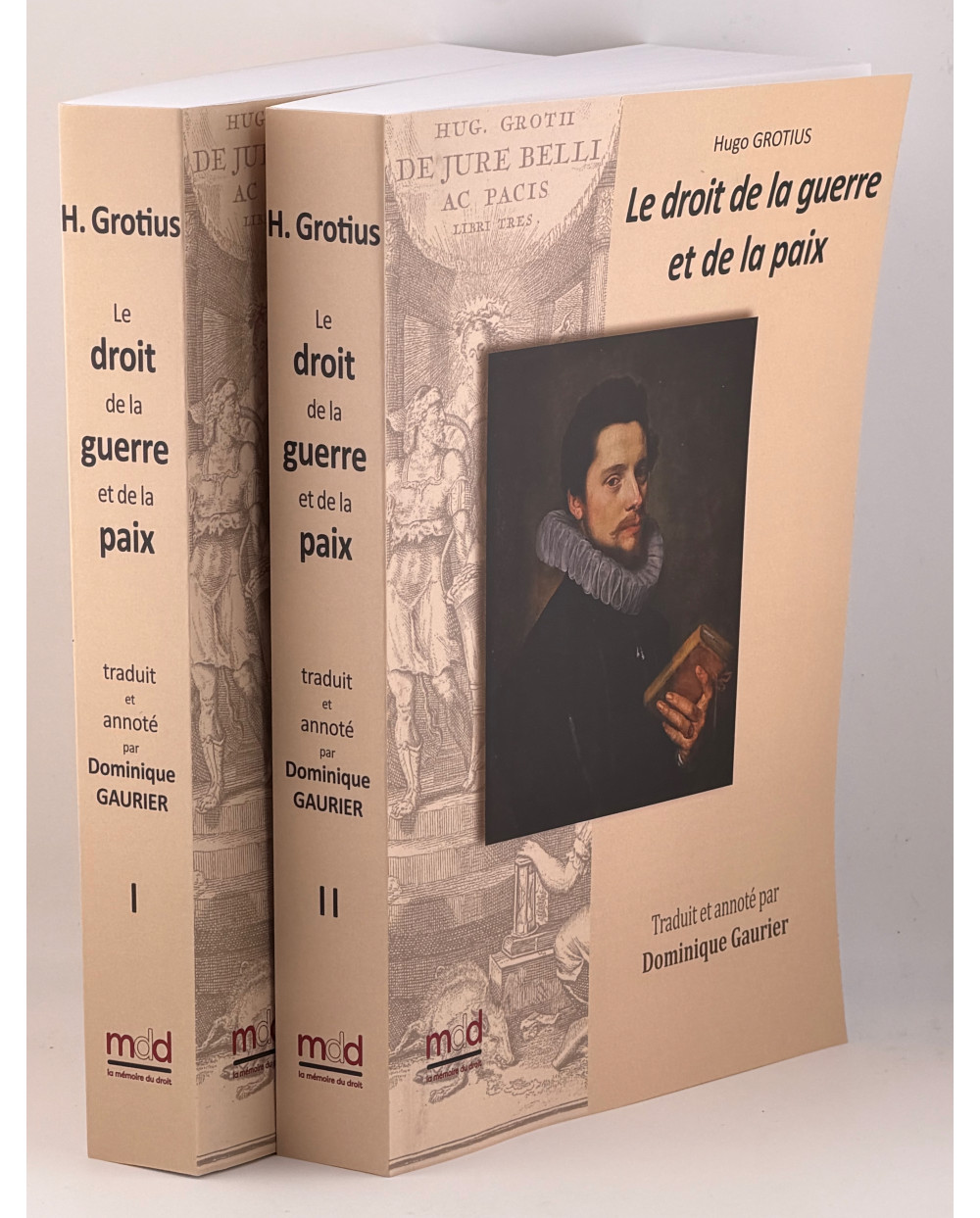
PRE-ORDER: Hugo GROTIUS, De Jure Belli Ac Pacis Libri Tres. Avec les notes de Grotius, de Gronovius, de Barbeyrac et du traducteur (transl. Dominique GAURIER) (Paris: La Mémoire du Droit, 2026), 2 vol., 1350 p. € 480


(image source: MDD)

Abstract:
En 1625, paraissaient à Paris, dédiés à Louis XIII, les De jure belli ac pacis Libri tres d’Hugo Grotius. Pour ce quatrième centenaire, après les trois précédentes traditions en langue française de cet ouvrage, Dominique Gaurier a jugé bon de le retraduire totalement pour permettre aux personnes intéressées d'avoir enfin accès au contenu même de l’ouvrage sans le réécrire ou lui faire dire ce qu'il ne disait pas. De fait, les précédents traducteurs semblent avoir plus fait passer leurs propres idées dans leurs traductions que celles de l’auteur, notamment en modernisant trop le texte et ses concepts.Ce dernier traducteur, qui a beaucoup traduit tant du latin que du néerlandais d'autres ouvrages de Grotius, espère ainsi avoir contribué à une connaissance plus exacte de la place tenue par Grotius qui est loin d’être l'auteur moderne, trop souvent présenté comme le fondateur du droit international moderne, que l’on croit et qui reste très ancré dans la tradition des écrivains de la seconde moitié du XVIe siècle.Le lecteur percevra mieux à travers cette dernière et quatrième traduction, on l’espère, la véracité de cette affirmation.
Read more here.

11 September 2025

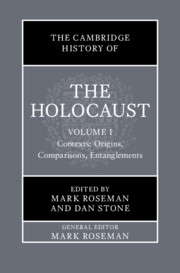
BOOK: Mark ROSEMAN & Dan STONE (eds.), Contexts: Origins, Comparisons, Entanglements [The Cambridge History of the Holocaust, ed. Mark ROSEMAN; vol. 1] (Cambridge: Cambridge University Press, 2025), ISBN 9781108913614


(image source: Cambridge)


Abstract:
The Cambridge History of the Holocaust offers a comprehensive and innovative overview of the complex field of Holocaust history from a variety of interpretive perspectives. The first volume begins with essays outlining the evolution of Holocaust historiography and the central conceptual and methodological questions facing historians. Further chapters provide insights into the longer-term causes and contexts of the Holocaust, before focusing on its immediate pre-history. The volume examines Holocaust archives, race-thinking and eugenics, violence in Weimar Germany, Hitler and Nazi ideology, and the implementation of antisemitic policies in the run up to the Second World War. Its ambitious coverage provides an unparalleled overview of the development of the policies that created the conditions necessary for the Holocaust to take place.

Table of contents:

  • General Editor's Introduction Mark Roseman
    • Introduction to volume I Mark Roseman and Dan Stone
    • 1. Historiography of the holocaust: early developments Boaz Cohen
    • 2. The historiography of the holocaust: the years of diversification and integration Dan Stone
    • 3. From 'final solution' to 'holocaust'. Autobiographical reflections Jane Caplan
    • 4. The holocaust, genocide, and the origins of the commensurability problem A. Dirk Moses
    • 5. Fascism and holocaust Aristotle Kallis
    • 6. The holocaust and modernity Mark Roseman
    • 7. Integrated approaches and boundaries in holocaust scholarship Dan Stone
    • 8. Mapping the holocaust Tim Cole
    • 9. Archiving the holocaust Jan Lambertz
    • 10. Antisemitism in interwar Europe Ulrich Wyrwa
    • 11. Race-thinking, Völkisch-nationalism, and eugenics Eric Kurlander
    • 12. Inter-ethnic violence in Europe before the holocaust Robert Gerwarth
    • 13. Communism and anti-Communism Andreas Wirsching
    • 14. Weimar Germany's vanishing point: politics, violence and the rise of the nazis, 1918–1933 Annemarie Sammartino
    • 15. Hitler and the Nazi party Thomas Weber
    • 16. Hitler, state and party Helmut Walser Smith
    • 17. Anti-semitic policy in the early years of the third Reich Hans Christian Jasch
    • 18. Popular participation in anti-Jewish policy up to 1938 Michael Wildt
    • 19. Nazi biopolitics: eugenics, racial policy, and the persecution of 'Asoziale,' 1933–1939 Richard F. Wetzell
    • 20. 'Judenforschung' –Nazi Jewish studies Dirk Rupnow
    • 21. Belonging and belongings: the dispossession of German Jews Christoph Kreutzmüller and Jonathan Zatlin
    • 22. Kristallnacht Alan E. Steinweis
    • 23. Lebensraum, autarky and a new imperial order Richard Overy
    • 24. International responses to nazi race and Jewish policy, 1933–1939 Jonathan Wiesen.

     Read more here.


    03 July 2025

    ARTICLE: Jens T. THEILEN, "Civilizational Hierarchies and the Notion of ‘Europe’ in the European Convention on Human Rights" (EJIL XXXVI (2025), nr. 1, 113-142)


    (image source: OUP)

    Abstract:

    When the European Convention on Human Rights was adopted, several states parties were major colonial powers forcefully engaged in retaining that position. This article aims to demonstrate the continued importance of this constellation for European human rights law. Using the convention’s travaux préparatoires as a starting point, it identifies civilizational hierarchies between Europe and other regions as foundational to the European project of human rights. The article then traces how the notion of ‘Europe’ has served as a conduit for these hierarchies to persist in less explicitly racialized form, using two examples: first, that of territorial and extraterritorial applicability and, second, the interpretation of the convention by the European Court of Human Rights based on the margin of appreciation and European consensus. Colonial continuities in the form of civilizational hierarchies, as this article thus aims to show, are not only relevant for specific topics like post-colonial migration but also continue to shape the project of European human rights as a whole.

    Read more here: DOI 10.1093/ejil/chaf018

    06 June 2025

    BOOK: Stefano CATTELAN & Frederik DHONDT (eds.), Small Power Neutrality and the Law of The Sea in the Long Eighteenth Century (ca. 1650–1800): Law as Argument in the Pelagic Arena [History of European Political and Constitutional Thought eds. Mark SOMOS, Erica BENNER & László KONTLER; 14] (Leiden/Boston: Brill, 2025), ISBN: 9789004728974 , € 126,00


    (Image source: Brill)

    Abstract: 

    This volume by both younger and more established specialists of legal, maritime, diplomatic, and political history covers the nuanced interplay of neutrality and the law of the sea within Western, Central, and Eastern Europe, emphasising the opening up of the world in the early modern period (i.e. Africa, North America, and the Caribbean). The various faces of neutrality, both in law and politics, appear through commercial, administrative, and geopolitical practical cases and in the writings of famous legal writers. By linking up different sets of knowledge, a kaleidoscope of power configurations and arguments guides the reader through the labyrinth of trade, sea power, and negotiations.

    Contributors: 

    Stefano Cattelan, Frederik Dhondt, John Freeman, Nora Naguib Leerberg, Christian Pfister-Langanay, Leos Müller, Stephen C. Neff, and Victor Wilson.

    On the editors: 

    Stefano Cattelan is Postdoctoral Researcher at the Faculty of Law and Criminology of the Vrije Universiteit Brussel (Research Group CORE) and Adjunct Professor at the Brussels School of Governance. His research focuses on the history of international law and the law of the sea between the 16th and 18th centuries and has been funded by the Carlsberg Foundation and the Research Foundation Flanders (FWO).

    Frederik Dhondt is Associate Professor at the Faculty of Law and Criminology of the Vrije Universiteit Brussel (Research Group CORE) and Voluntary Collaborator at the Ghent Legal History Institute and the Gustave Rolin Jaequemyns Institute of International Law (GRILI). His publications focus on the history of legal argumentation and diplomacy from the 18th century onwards, such as Balance of Power and Norm Hierarchy: Franco-British Diplomacy after the Peace of Utrecht (Brill, 2015).

    21 May 2025

    CALL FOR PAPERS: XVI Coloquio Internacional de historiografía europea y XII Jornadas de estudios sobre la modernidad clásica (Mar del Plata: Universidad Nacional de Mar del Plata, 26-28 NOV 2025) [DEADLINE 30 JUN 2025]

    Universidad Nacional de Mar del Plata

    Facultad de Humanidades

    Departamento de Historia – CEHIS


    XVI COLOQUIO INTERNACIONAL DE HISTORIOGRAFÍA EUROPEA Y

    XIII JORNADAS DE ESTUDIOS SOBRE LA MODERNIDAD CLÁSICA


    Mar del Plata, 26, 27 y 28 de noviembre de 2025


    El Coloquio es organizado por el Grupo de Investigación en Historia de Europa Moderna dirigido por la Dra. María Luz González Mezquita y da continuidad a los realizados en anteriores oportunidades sobre temáticas relacionadas con la Modernidad clásica, con especial incidencia en el área hispana. Es importante destacar que se trata del único evento científico que se realiza centrado en este período en el país y que su relevancia se ha puesto de manifiesto en las quince reuniones anteriores, tanto por el elevado número de asistentes promedio (300) en cada una de ellas, procedentes de todo el país y del exterior, como por las disertaciones de reconocidos especialistas nacionales y extranjeros que han sido incluidas en la edición de las Actas de los Coloquios realizados.


    Modalidad:                                                                           

    Panel inaugural.

    Conferencias magistrales.
    Presentación de la edición de los resultados del Coloquio 2023.

    Presentación de libros editados durante 2024 y 2025.


    Las sesiones se realizarán en forma presencial y se admitirán eventuales exposiciones virtuales.


    CONVOCATORIA


    1-    1-MESAS GENERALES (para lectura de propuestas, avances y debates de investigaciones cada participante tendrá 20 minutos de lectura)

    ·       Poderes, conflictos y consensos

    ·       Religión, actores y procesos

    ·       Historias conectadas

    ·       Problemas de Historia Cultural

    ·       Historiografía: debates y perspectivas

    ·       Economía y sociedad


    2- Se aceptarán propuestas de mesas sobre temas específicos: los coordinadores deberán enviar el tema, integrantes (hasta 6 con 15 minutos de exposición cada uno) y fundamentación.


    3-    3- Presentación de Publicaciones recientes (2024-2025): consignar título completo de la obra a presentar y los investigadores propuestos para la actividad.


    Este Coloquio tiene como objetivos principales:

    -Poner al alcance la comunidad universitaria y no universitaria, distintos temas relacionados con las investigaciones y tendencias de la historiografía europea moderna en la actualidad.

    -Transmitir a la comunidad algunos resultados de la tarea llevada a cabo por el Grupo de Investigaciones en Historia de Europa Moderna cuyo proyecto de investigación ha sido subsidiado por la Secretaría de Investigación y Posgrado de nuestra Universidad, poniendo de manifiesto los aspectos que se han trabajado en función de algunos de los fines propuestos: a-programa de investigadores visitantes; b-programa de enlace con Universidades y centros de universidades nacionales y extranjeros; c-programa de extensión promoviendo la articulación con distintos niveles de la enseñanza y difusión de las tareas desarrolladas; d-programa de desarrollo de proyectos de trabajo individuales y su articulación en torno al proyecto de investigación vigente: “La Monarquía de España (XVI-XVIII): Construcción de saberes políticos, mecanismos de poder e interacciones en un mundo global”, y; e- mostrar una parte de los resultados obtenidos en las investigaciones que el grupo viene desarrollando desde su creación.


    Coordinación general: María Luz González Mezquita (UNMdP)


    ______________________________________________________________________________


    CRITERIOS DE PRESENTACIÓN DE TRABAJOS


    LOS ABSTRACTS se reciben hasta el 30 de Junio de 2025. Para ello, debe enviarse un resumen de 250 palabras, en formato Word 2003, con letra Times New Roman tamaño 12, a: coloquiohistoriamoderna2025@gmail.com El texto irá encabezado por los siguientes datos: título de la ponencia, nombre y apellido del autor, cargo e institución a la cual pertenece, mesa temática, E-mail, teléfono y dirección postal.

    En el caso de la presentación por parte de estudiantes avanzados, deberán acompañar su abstract con el aval de un docente.

    Importante: sólo se aceptará 1 (un) trabajo de autoría por participante.

    Junto con la propuesta debe remitirse un CV del autor/a de un máximo de 5 (cinco) líneas.


    LAS PONENCIAS: Quienes deseen publicar sus ponencias en las Actas del Congreso deberán presentarlas en la fecha estimada del 31 de Octubre de 2025. Los trabajos no podrán exceder las 9 páginas (con notas a pie de página). Los mismos deberán redactarse en Word, letra Times New Roman, tamaño 12, a un espacio y medio, con márgenes normales (superior e inferior a 2,5 cm y derecho e izquierdo a 3 cm). SIN VERSALITAS Los textos se recibirán en la dirección coloquiohistoriamoderna2025@gmail.com


    CONSULTAS:     coloquiohistoriamoderna2025@gmail.com


    ARANCELES:


    Expositores nacionales:         $10.000,00 (diez mil pesos).  

    Ponentes desde el exterior:    consultar.

    Asistentes con certificado:     $5000,00 (cinco mil pesos).

    Estudiantes de grado (asistentes): sin cargo.


    21 April 2025

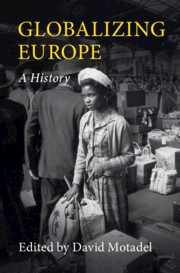
    BOOK: David MOTADEL (ed.), Globalizing Europe. A History (Cambridge: Cambridge University Press, 2025), ISBN 9781009262873, € 31,5


    Abstract:
    Globalizing Europe explores modern Europe's myriad entanglements with the wider world, considering the continent not only as an engine but also as a product of global transformations. It looks at the ways in which the global movements of peoples and ideas, goods and raw materials, flora and fauna have impacted life on the continent over the centuries. Bringing together a group of leading historians, the book shows how the history of Europe can be integrated into global history. Taken together, its chapters will help reshape our understanding of the boundaries of Europe – and the field of modern European history.

    Table of contents:

    1. Global Europe David Motadel
    2. Global Conjunctures and the Remaking of European Political History Sebastian Conrad
    3. Global Origins of the Old World Economy Sven Beckert
    4. European Intellectual History after the Global Turn Samuel Moyn
    5. Religion and the Global History of Europe Abigal Green
    6. European Social History and the Global Turn Richard Drayton
    7. Europe's Place in Global Environmental History J. R. McNeill
    8. Global Turns in European History and the History of Consumption Maxine Berg
    9. Global Material Culture in Early Modern and Modern Europe Anne Gerritsen
    10. Migration and European History's Global Turn Elizabeth Buettner
    11. 'Race' in the Global History of Europe Priya Satia
    12. Globalising European Gender History Lucy Delap
    13. Globalizing Europe's Musical Past Kira Thurman
    14. Global Histories of European Art Caroline van Eck
    15. Globalizing European Military History Michelle Moyd
    16. Deglobalizing the Global History of Europe Stephen W. Sawyer
    Afterword: Global Histories of Modern Europe Richard J. Evans.

    On the editor:

    David Motadel is Associate Professor of International History at the London School of Economics and Political Science. He is the author of Islam and Nazi Germany's War (2014), which was awarded the Ernst Fraenkel Prize, and, as editor, Islam and the European Empires (2014). In 2018, he received the Philip Leverhulme Prize for History.

    Read more here (DOI  10.1017/9781009262873).


    10 June 2024

    BOOK: Antonio ANTONETTI, Riccardo BERARDI (eds.), The Various Models of Lordship in Europe between the Ninth and Fifteenth Centuries (Cambridge: Cambridge Scholars Publishing, 2023). ISBN: 9781527529083


    ABOUT THE BOOK

    The status of lord represented one of the most original solutions to the political and social transitions of the Medieval period. Questions still remain unanswered and require further investigation, thus many scholars have collaborated to produce this collection which offers a synthesis of the most recent scholarship. This book relates the workings of seigneurial systems in different areas of Europe, from the Baltic to the Mediterranean, from Castile to Pontus. In this way, the perspective remains the same, institutional and material. This book emphasises both the institutional and informal forms of lordship identified and crystallised by social and political actors (for example, communities, sovereigns, nobles, bishops, and abbots). It offers a general framework for those approaching the subject for the first time and a useful in-depth tool with numerous regional cases for long-term scholars.


    ABOUT THE EDITORS

    Antonio Antonetti (1989) is a post-PhD fellow at the University of San Marino. His main research interest is the Church in late-medieval southern Italy, particularly the evolution of the ecclesiastical institutions (dioceses) and the role of the bishops in the Italian society.

    Riccardo Berardi (1988) is a post-PhD fellow at the University of Calabria, Italy, and a research fellow at the École française de Rome and the Deutsche Historische Institut in Rom. His research interests concern the history of the lordships of southern Italy, with particular attention to Calabria during the 11th-16th centuries.


    More information can be found here.

    28 May 2024

    BOOK: Isabelle MATHIEU, Isabelle ORTEGA (eds.), L’ingouvernabilité en questions. Europe chrétienne méridionale et orientale, XIIe-première moitié du XVIe siècle (Rennes: Presses universitaires de Rennes, 2024). ISBN: 9782753594401


    ABOUT THE BOOK

    Qu’advient-il quand « gouverner devient difficile » ? Si le gouvernement et l’acte de gouverner ont déjà bien été étudiés, il n’en va pas de même de l’ingouvernabilité. Le but de cet ouvrage est dès lors de se pencher sur les limites, les oppositions et les dysfonctionnements en matière de gouvernement entendu dans un sens large. Il est de comprendre les acteurs qui en sont responsables, les causes qui les expliquent, les aspects sous lesquels ces anomalies se manifestent. Il permet d’entrevoir de quelle façon les appareils de gouvernement tentent de répondre à leurs difficultés avec plus ou moins de succès. La zone géographique retenue est composée certes de territoires variés, tant du point de vue de la géographie que des populations qui y vivent, pour autant cette diversité garantit le comparatisme dans un espace où la question institutionnelle et gouvernementale est centrale et les freins, les limites ou les difficultés sont légitimement des pistes de réflexion qu’il fallait explorer. À la lumière de dossiers documentaires riches et variés, ce livre a pour ambition de questionner très largement le sens de l’acte de gouverner avec l’objectif de proposer des clés de lecture qui pourraient être transposées à d’autres périodes.


    More information can be found here

    15 December 2023

    FELLOWSHIPS: IEG Fellowships for Doctoral Students (m/f/div) (Mainz: IEG, deadline 15 FEB 2024)

    (Image source: Wikimedia Commons)


     IEG Fellowships for Doctoral Students (m/f/div)

    The Leibniz Institute of European History (IEG) awards 8–10 fellowships for doctoral students in European history, the history of religion and other historical disciplines.

    The IEG funds PhD projects in European history from early modern to contemporary history. We are particularly interested in projects

    • with a comparative or cross-border approach
    • on European history in its relation to the wider world
    • on topics of intellectual and religious history
    • that make use of digital tools and methods.

    What we offer
    IEG Fellowships provide a unique opportunity to pursue and finalise individual PhD projects while living and working at the Institute in Mainz for 6–12 months. The monthly stipend is € 1,350. Additionally, it is possible to apply for family or child allowance.

    Requirements
    Successful candidates are required to reside at the Institute in Mainz throughout the duration of their fellowship. They are expected to be active members on the IEG’s research community and to participate in the weekly colloquia and scholarly activities. Moreover, they will present their work in progress at least once during their stay. The IEG supports the writing up of dissertations and does not provide funding for preliminary research, language courses or the revision of book manuscripts. At the time of the application deadline, candidates should have pursued their PhD for a maximum of three years. PhD theses continue to be supervised under the auspices of the fellows' home universities. We expect proficiency in English. The IEG encourages applications from women.

    Application 
    Please combine all application materials, except for the application form, into a single PDF and send it to: application@ieg-mainz.de

    Applications may be submitted in either English or German; we recommend that candidates use the language in which they are most proficient.

    Application forms can be downloaded here: https://buff.ly/3Tl47ZG

    The IEG has two deadlines each year for IEG Fellowships: February 15 and August 15.

    The next deadline for applications is February 15, 2024.

    Please direct any questions concerning the IEG Fellowship Programme to Ms. Joke Kabbert: fellowship@ieg-mainz.de

    Contact Information

    Leibniz Institute of European History (IEG)
    Head of Research Fellowship Programme
    Joke Kabbert, M. A.
    Alte Universitaetsstrasse 19
    55116 Mainz
    Germany

    04 May 2022

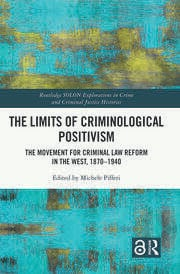
    BOOK: Michele PIFFERI (Ed.), The Limits of Criminological Positivism. The Movement for Criminal Law Reform in the West, 1870-1940 (London: Routledge, 2022). ISBN: 9780367340599, pp. 202, £96.00

    ABOUT THE BOOK

    The Limits of Criminological Positivism: The Movement for Criminal Law Reform in the West, 1870-1940 presents the first major study of the limits of criminological positivism in the West and establishes the subject as a field of interest.

    The volume will explore those limits and bring to life the resulting doctrinal, procedural, and institutional compromises of the early twentieth century that might be said to have defined modern criminal justice administration. The book examines the topic not only in North America and western Europe, with essays on Italy, Germany, France, Spain, the United Kingdom, Belgium, and Finland but also the reception and implementation of positivist ideas in Brazil. In doing so, it explores three comparative elements: (1) the differing national experiences within the civil law world; (2) differences and similarities between civil law and common law regimes; and (3) some differences between the two leading common-law countries. It interrogates many key aspects of current penal systems, such as the impact of extra-legal scientific knowledge on criminal law, preventive detention, the ‘dual-track’ system with both traditional punishment and novel measures of security, the assessment of offenders’ dangerousness, juvenile justice, and the indeterminate sentence. As a result, this study contributes to a critical understanding of some inherent contradictions characterizing criminal justice in contemporary western societies. Written in a straight-forward and direct manner, this volume will be of great interest to academics and students researching historical criminology, philosophy, political science, and legal history.

    ABOUT THE EDITOR

    Michele Pifferi is Professor of Legal History at the University of Ferrara, Law Department. He has been Visiting Researcher at the Max-Planck-Institute for Legal History and Legal Theory in Frankfurt am Main; Emil Noël Fellow at NYU School of Law; Robbins Fellow at Berkeley UC—School of Law; Academic Visitor at the Oxford Centre for Criminology; and Alexander von Humboldt Research Fellow at the University of Hamburg, Faculty of Law. He is currently Alexander von Humboldt Research Fellow at the Humboldt Universität zu Berlin, Faculty of Law as well Principal Investigator of a research project on Legal History and Mass Migration: Integration, Exclusion, and Criminalization of Migrants in the 19th and 20th Century. Member of the Editorial Board of the series Rechtsgeschichte und Rechtsgeschehen —Italien (LIT Verlag), and of Quaderni fiorentini per la storia del pensiero giuridico moderno. His research interests focus on history of late medieval to late modern criminal justice, history of criminology, and history of migration law.

    TABLE OF CONTENTS

    Introduction. An Historiographical Reassessment of Criminological Positivism

    Michele Pifferi


    Scientist Utopia and Reactionary Nostalgia: Criminal Procedure and the Early Positivist School

    Marco Nicola Miletti


    Penal Reform in Imperial Germany: Conflict and Compromise

    Richard F. Wetzell


    The French Judicial and Political Origins of Raymond Saleilles’ Individualization of Punishment

    James M. Donovan


    The Influence of Positivism in Belgium: An Eclectic Compromise Between Adhesion and Resistance

    Yves Cartuyvels


    The Limits of Positivism: Finnish Criminal Law Scholarship and the European Context at the Turn of the Twentieth Century

    Heikki Pihlajamäki


    From the Sacred Springtime of Criminal Law to the Limits of Criminological Positivism in Spain

    Enrique Roldán Cañizares


    Fascist Italy’s Juvenile Courts in Their Infancy: First Impressions

    Paul Garfinkel


    Responding to the Problem of Crime: English Criminal Law and the Limits of Positivism, 1870-1940

    Lindsay Farmer


    Positivism’s Humbugs: Criminology and its Cranks in Progressive America

    Susanna Blumenthal


    Limits and displacements in the adoption of criminological positivism in Brazil (1890-1940)

    Ana Lucia Sabadell and Dimitri Dimoulis


    From Responsibility to Dangerousness? The Failed Promise of Penal Positivism

    Michele Pifferi


    Index


    More information with the publisher.

    21 February 2022

    BOOK: Christophe CHARLE & Daniel ROCHE (dir.), L'Europe. Encyclopédie historique (Paris: Actes Sud, 2018), 2400 p., € 59, ISBN 9782330106430


    De la fin de l’Antiquité à nos jours circulent les cultures, se métissent les peuples, se transforment les sociétés, s’étendent les pouvoirs au sein d’une Europe aux dimensions variables selon les époques et ses rapports changeants avec le reste du monde.

    «L’Europe» livre tous les éléments indispensables pour comprendre la multiplicité des strates, des conflits ou des échanges qui ont fait naître, déployé ou remodelé ce continent. Celui-ci cumule paradoxes et contradictions historiques : à la fois fort et faible, temporairement réuni ou profondément divisé ; y alternent phases d’expansion et de repli, périodes de certitude et de supériorité proclamée et moments de dépression ou de décadence réelle ou supposée.

    En ressort un portrait polyphonique et dynamique, raisonné et critique, d’une civilisation, une et plurielle, à bien des égards plus unie qu’on ne le croit, dont l’histoire tour à tour exalte, instruit ou désespère.

    Ce faisant, «L’Europe» offre le guide d’exploration nécessaire au moment crucial que nous traversons :

    – une organisation des savoirs à la fois chronologique et thématique ;

    – une présentation des cultures matérielles et immatérielles ;

    – la diversité spatiale et temporelle des Europes ;

    – la pluralité productive des approches historiques : intellectuelle, politique, économique, sociale, technique, religieuse, culturelle, symbolique ;

    – la contribution multinationale de plus de 430 spécialistes.

    With contributions by Emanuele Conte, Bruno Dumézil, Emmanuel Le Roy Ladurie, Christine Lebeau, Renaud Morieux, Michel Porret, Mathieu Da Vinha, Gilles Lecuppre, Pascal Ory, Jonathan Sheehan, Barbara Stollberg-Rilinger, Françoise Waquet, Xavier Hélary, Philippe Contamine, Philippe Levillain, Nicolas Offenstadt, Willem Frijhoff, Eric Schnakenbourg, Isabelle Dasque, Michel Troper, Antonella Alimento, Yannick Bosc, Géraud Poumarède, Martin Wrede, Hervé Drévillon, Fanny Cosandey, Lucien Bély, Denis Crouzet, Antonio Trampus, John Shovlin, Roger Chartier, Silvia Marzagalli, Jean-Louis Halpérin, Georges-Henri Soutou, Sylvie Aprile, Michel Vovelle, Jürgen Osterhammel... and many others. 

    (read more with Actes Sud)