Search

Showing posts with label 19th Century History. Show all posts

14 April 2026

BOOK: David ART, The Resilience of the Old Regime. Paths Around Democracy in Europe, 1832–1919 (Cambridge: Cambridge University Press, 2026), ISBN 9781009710718


(image source: CUP)

Abstract:
In The Resilience of the Old Regime, David Art reevaluates the so-called first wave of democratization in Western Europe through the lens of authoritarian resilience. He argues that non-democrats succeeded to a very large degree in managing, diverting, disrupting, and repressing democratic movements until the end of the First World War. This was true both in states political scientists have long considered either full democracies or democratic vanguards (such as the UK and Sweden), as well as in others (such as Germany and Italy) that appeared to be democratizing. He challenges both the Whiggish view that democracy in the West moved progressively forward, and the influential theory that threats of revolution explain democratization. Drawing on extensive historical sources and data, Art recasts European political development from 1832–1919 as a period in which competitive oligarchies and competitive authoritarian regimes predominated. Explores the core arguments of key theorists like Robert Dahl and Barrington Moore as they engage with European political history during the rise of mass politics Explains how archaic practices like plural voting and male-only voting were justified by liberals in supposedly democratizing regimes Provides a revision of this critical period of European political development through the frame of authoritarian persistence rather than the conventional-and sometimes misleading--- one of democratic triumph

On the author:
David Ar is Professor of Political Science at Tufts University. He is the author of The Politics of the Nazi Past in Germany and Austria (Cambridge, 2006) and Inside the Radical Right (Cambridge, 2011) and is a faculty affiliate at the Minda de Gunzburg Center for European Studies at Harvard University.

More information here


18 March 2026

PROJECT: CONDUIT, comparing French and Italian colonial law (Institut Universitaire de France, Prof. Monica CARDILLO/Nantes Université)


(image source: IUF)

Project abstract:

Ce projet porte sur l’analyse et la comparaison des administrations coloniales françaises et italiennes, à partir des ressources archivistiques, afin de comprendre comment s’est construit le droit colonial en Afrique. Plus précisément, à travers l’étude de l’activité de terrain des administrateurs des cercles, ce projet s’attache à comprendre l’évolution des normes traditionnelles du fait du contact colonial, et du processus de « disqualification » et « requalification » de la logique juridique locale. Conduit suivant une approche interdisciplinaire, il vise à mettre en œuvre une méthodologie critique de l’archive coloniale. Inscrit dans les sciences juridiques émergentes, ce projet cible la concrétisation d’actions pédagogiques, scientifiques, de sauvegarde d’archives par la numérisation.

(read more here

10 December 2025

PRIZE: American Society for Legal History Article Prize to Grace MALLON (co-winner), "Negotiated Federalism: Intergovernmental Relations on the Maritime Frontier, 1789-1815"


(image source: Rothermere American Institute, Oxford)

On the article:

Grace Mallon’s “Negotiated Federalism” examines the federal government’s efforts to enforce its new authority after the Founding. Federal officials quickly realized that they required the participation and consent of state governments, as federal laws could not take effect without the legislation, investment, and manpower of state governments. The piece showcases how Atlantic port cities presented a crucial test case for negotiated federalism, where the federal government sought to exercise power in spaces where states had already entrenched their authority. As early federal officials set up customs and lighthouse services, rebuilt coastal fortifications, and enforced regulations, they had to negotiate with states to determine “which powers each level of government could exercise.” As a result, federal power depended on a state’s willingness to negotiate its authority. The crisply written article tackles big questions of federalism through granular details of practical problems and personality conflicts. Based in impressive primary source research in state and federal official records and correspondence, Mallon brings multiple areas of scholarship together to describe how power was worked out ‘in the course of ordinary government administration instead of in high theory. “Negotiated Federalism” takes something that we feel is well-understood (federalism at the founding) and through a creative path through the archive mines new and provocative ways of seeing the past that help us see the present more clearly.

Link to the article here: 10.1353/wmq.2024.a941486 

(source: RAI - Oxford University

05 December 2025

BOOK: Aniceto MASFERRER DOMINGO (ed.), The Making of Criminal Law. The Role of Case Law in the 19th and 20th Centuries (London: Routledge, 2025), 380 p. ISBN 9781003633082

(image source: Taylor & Francis)

Abstract:
The separation of powers produced by the Enlightenment period reinforced the myth of the “perfection of the law”, with criminal law being dependent on the principle of legality. Demonstrating that this principle has not fundamentally altered judges' methods of interpretation and decision-making, this collective volume explores the role of case law in the making of modern criminal law from the late 19th century to the end of the 20th century. It enables us to gauge the influence of case law developed and to assess the extent to which it contributed to major criminal law decisions and the emergence of model criminal codes. The book takes a comparative view across various European and American jurisdictions and offers an overview of European civil law traditions along with comparisons from the Americas. The focus is on Western legal historiography, which has hitherto been notably under-researched. The chronological point of departure is marked by the creation of the Supreme Court and the cassation in each jurisdiction. Each chapter contains a short introduction to the role of jurisprudence in the making of criminal law from the 19th century onwards in that jurisdiction, followed by an exploration of the contribution of the legal doctrine of the Supreme Court in the making or development of a particular criminal offence or institution. The book will be of interest to scholars and historians working or teaching in the areas of legal history, comparative legal history, criminal law and comparative law. It will also be of use to scholars interested in the study of law in different socio-cultural contexts.

Table of contents

The contribution of case law to the making of Western criminal law (Aniceto Masferrer)
Abstract:

Criminal case law has been scarcely studied for various reasons. In fact, until a few years ago, no legal historian had set out to study it as an element shaping the criminal-legal system. However, in the last decade some of them began this task and have achieved surprising results, both in terms of the volume and quality of their scientific production. In Spain, for example, scholars have practically completed the study of the entire doctrine of the Supreme Court with respect to the Special Part of criminal codes and are now working on the General Part. This chapter analyzes the importance of case law as a source of law and as an object of legal and historical-legal study and includes an exhaustive description of the results obtained in recent years. In addition, it gives – as an introductory chapter of the whole collective book – a brief overview of the the role of case law in the making of modern criminal law in some European and American countries (France, Spain, Portugal, Holland, Austria, Hungary, Denmark, Sweden, Finland, Russia, Georgia-USA, and Chile), all belonging to the civil law tradition.

Case law in the court of cassation. Interpreting codification, production, and physiology of judgments (1811–1863) (Claire Bouglé-Le Roux)
Abstract:

The criminal case law of the first half of the French 19th century offers a particularly rich field of observation for those wishing to measure the role of the judge, and particularly the judge of cassation. This was a strategic period: it saw the introduction of the codification of criminal law by judges, whose interpretation was in principle constrained by the principle of the legality of offences and penalties. However, in cassation, the judges developed interpretation techniques and a method for giving reasons for their decisions, which enabled them to free themselves from the text where necessary, but also to acquire full authority over the trial judges, who were in principle the sole holders of the sovereignty of the trial judges. This study highlights the dual power of the judges of cassation in both legal and jurisdictional terms.

French case law about the age of minority. A historical study about the relationships between jurisprudence and juvenile delinquency (Jean-Louis Halpérin)
Abstract:

France is reputed to be one of the first countries in the world to have adopted a penal code, first in 1791 and then in 1810 with the Napoleonic Code, which remained in force until 1992. However, these codes should not overshadow the role of case law, which developed in parallel with the creation of the Tribunal (later the Court) of cassation in 1790. This chapter deals with criminal minority and the application of articles of the Penal Code providing for two distinct regimes depending on the discernment of minors under the age of 16. In doing so, it shows how the Court of cassation ensured that this question of discernment was always asked and has gradually taken an interest in the choice of reformatories. It gives evidence that, after the 1912 law and a 1945 ordinance closing the houses of correction, the Court of cassation reintroduced the criterion of discernment, and demonstrates that, in the longue durée, French higher judges first acted in the interest of the law, then in the interest of children, with a relative influence of social and doctrinal movements in favor of a more lenient treatment of juvenile delinquency.

The burden of proof in the crime of adultery in Spain. The contribution of the Supreme Court (1870–1978) (Aniceto Masferrer)
Abstract:

This chapter shows that, although the criminal provisions contained in the Codes regulating adultery and de facto union established the essential elements of the criminal type, case law complemented the legal regime by applying these precepts ad mentem legislatorem in specific cases, some of which were difficult – if not impossible – for the criminal legislator to foresee. In this sense, the Supreme Court’s magistrates highly contributed to the legal configuration of a crime, the application of which required going beyond what was established by the legal precept. “Going beyond” does not mean contravening or ignoring the precept, but clarifying, developing, and completing certain aspects that required a correct application of the criminal offense described in the legal precept. Although adultery is a crime that has been in force for centuries, the legislator was never fully aware of the complexity involved in proving it. The evidentiary complexity of the expression “yacimiento” (lying/having sexual relations) used in the legal precept to succinctly describe the type of crime (“A married woman who lies with a man who is not her husband commits adultery”) provoked numerous appeals and a large body of legal doctrine on the different ways of proving the existence or not of sexual intercourse, of its imperfect forms, or of sexual relations outside the scope of this particular type of crime or even of criminal law in general. In short, the chapter gives evidence of the relevance of the Supreme Court, whose doctrine greatly contributed to the adultery’s normative configuration.

Diving into Spanish legal dissonance. Honour as a 19th-century two-sided normative reality (José Franco-Chasán)
Abstract:

Law encompasses society’s values, morals, and ways of acting. Those unwritten values can explain why the legal orders of so many countries enormously differ. The rather wide value of ‘honour’ leads us to a manifold outcome. Particularly, caselaw played a very important role in the configuration of honour due to the main contradiction that characterised the duel: a de iure condemnation (through Criminal Codes), and a de facto promotion (through the Code of Honour and social conceptions). Far from acting in a very dogmatic manner, the judges understood the reality of the moment and knew how to read between the lines of what was happening.

Neither one nor the other. Gender, sex, and marriage on trial in Portugal during the 19th and 20th centuries (Maria Clara Calheiros)
Abstract:

This article uses the legal treatment of adultery in Portugal under the 1886 Penal Code (in force until 1982) as a lens to explore broader European shifts in family law, gender norms, and the relationship between law and religion. Despite early 20th-century legislative reforms aiming for gender equality, Portuguese courts continued to punish female adultery more harshly, reflecting persistent traditional and religious influences. Drawing on legal texts, case law, and scholarly literature, the study reveals the tension between progressive legal ideals and conservative judicial practices. It contributes to wider debates on how legal systems mediate social change, gender relations, and secularization processes in modern Europe.

The Dutch Supreme Court on rape and sexual assault between 1886 and 1991 (Janwillem Oosterhuis)
Abstract:

In the Netherlands, sexual morality changed profoundly between the end of the 19th century and the 1970s. To a considerable degree, this changing morality is reflected in criminal legislation, particularly when it comes to adultery, homosexuality, and pornography. In the same period, however, certain articles on sexual morality stayed the same. Between 1886 and 1991, the articles on rape and sexual assault remained unchanged. Only in 1991, when a revision of the Wetboek van van Strafregt (Criminal Code) took place, were these articles revised. This chapter investigates whether the changing public morality is reflected in the decisions of the Hoge Raad, the Dutch Supreme Court, on sexual morality, focussing on rape and sexual assault. Decisions of the Hoge Raad on adultery are almost completely absent, due to the de facto decriminalisation of adultery by the Hoge Raad through a civil law decision of 1883. Apart from this early decriminalisation of adultery via civil law, it appears that the Hoge Raad did not take the lead in adapting the content of criminal law concepts to changing views on sexual morals and marital relations. In view of its function as court of cassation, that is maybe for the better.

Homosexuality in Austrian penal law and the role of the Supreme Court (Martin P. Schennach)
Abstract:

The contribution explores the impact of the Austrian Supreme Court on the interpretation and application of § 129 (1) lit. b of the Criminal Code of 1852. The law criminalized homosexual relations from the latter half of the 19th century until 1971, when it was repealed during the “minor reform of criminal law.” Pivotal judicial rulings of the Supreme Court were forged in the decades around 1900, intricately intertwined with medical and psychiatric discussions. Renowned psychiatrist Krafft-Ebing emerged as a key figure, actively contributing to debates in the field of legal policy. Despite Krafft-Ebing’s influence and that of other medical experts, the Supreme Court diverged from their views. Instead, it adopted an expansive interpretation of prohibited acts, extending beyond mere male-male intercourse or similar acts. The Supreme court stipulated that criminal liability encompassed all interactions between individuals of the same sex aimed at arousing or fulfilling sexual desires. Moreover, the Supreme Court dismissed defense strategies proposed by psychiatric experts, contending that offenders’ mental health conditions did not absolve them of criminal responsibility. Even if the Supreme Court thus deviated from the line of psychiatric science, the Supreme Court aligned itself with the prevailing consensus of the legal academic community. The landmark rulings of around 1900 retained significant influence for subsequent decades. Even as late as 1969, just two years prior to the repeal of criminal liability, the Supreme Court remained steadfast in its established approach, adhering to its prior decisions despite evolving social dynamics and ongoing discussions.

Judicial decisions shaping criminal law. Eight decades of sedition cases in Hungary (Emőd Veress, Bence Zsolt Kovács)
Abstract:

Sedition typically involves actions or speech that incite rebellion against the authority of a state or monarch, or that seek to undermine the lawful authority of the government. This chapter examines the evolution and implications of judicial decision-making on the consistency of criminal law, with a focus on Hungary’s legal history, through significant political changes from the 19th to the 20th centuries. The research highlights the foundational role of Hungary’s highest courts in maintaining legal consistency amidst these transformations, especially in the interpretation of the sedition offence. By delving into Hungary’s transition to a codified criminal framework, exemplified by the Csemegi Code of 1878, to a more politicized judicial approach influenced by Soviet doctrines post-1948, the analysis demonstrates how judicial practices adapted to shifting political landscapes, impacting the uniform application of criminal law. This evolution underscores the difficult interplay between law and changing societal contexts. Through detailed examinations of precedent and the role of high courts, the study provides insights into the broader implications of judicial decisions in shaping legal and societal norms.

Dolus Eventualis in Danish criminal law The introduction of a legal concept by the Supreme Court (Per Andersen)
Abstract:

In 1918, the Danish Supreme Court confirmed a sentence passed by a lower court in  criminal case. Through its arguments for the confirmation, the Supreme Court introduced the concept of dolus eventualis, a form of intent, for the first time in Danish law. The chapter argues that the Supreme Court judges in 1918 were likely inspired by jurisprudential considerations of the period within the small Danish jurisprudential milieu, which again was particularly inspired by German jurisprudence. By introducing the not explicitly declared idea of dolus eventualis, the Supreme Court foresaw a change to forms of intent that would be made in the coming Criminal Act of 1930. The concept may very well have been known during the following decades, but it was nevertheless debated within jurisprudence and among criminal law experts and not used again before the late 1970s. What makes the concept of dolus eventualis in the 1918 judgment remarkable is the fact that this concept is the only criminal concept introduced by the Danish Supreme Court in recent times. The chapter explains why this may be the case, due to a Danish legal tradition characterized by a very cautious and conservative court in terms of introducing new concepts or legal ideas in order not to act as a legislative power.

Case law between the adoption of two criminal codes, Sweden 1864–1962 The definition of rape and aspects of criminal intent (Martin Sunnqvist)
Abstract:

This chapter discusses the development of criminal law through case law during the time of the Swedish 1864 Criminal Code. The main example is how rules relating to rape were interpreted by the Supreme Court. The first fully reported Supreme Court case about rape is from 1925. In this case and another from 1927, a heavy burden was placed on a woman to clearly resist the perpetrator, otherwise the crime would not be defined as rape. In 1937, the types of violence relevant for rape were widened. There was at first a hesitation within the courts how to draw the line between more or less lenient violence, but in two cases in 1937 and 1942, the Supreme Court marked a stricter view on rape than had dominated before. The chapter also discusses some types of cases where Supreme Court decisions from the 19th and early 20th centuries are still important.

Supreme Court of Finland's theft rulings in the context of crises and modernization (Esko Häkkinen)
Abstract:

The chapter examines the evolution of the Supreme Court of Finland’s approach to theft cases from the end of the 19th century to the 1970s, a period of rapid economic modernization and significant social change in Finland. General development of criminal justice and penal policy and the special role of theft in it as well as the history of the supreme administration of justice in Finland and previous research on its criminal justice role is depicted. An analysis of Supreme Court theft cases shows that the court actively updated and expanded the definition of theft in response to emerging forms of property crime. This was facilitated by the absence of a clear statutory definition of theft in the Finnish Criminal Code. In contrast to its activity in modernizing the interpretation of the meaning of theft, the court was passive in responding to the major shifts Finnish penal policy went through during the period. Despite the penal policy’s importance of theft as a high-volume crime treated severely by the Criminal Code, the court’s approach to theft cases remained largely unaffected by broader changes in penal policy.

Evolution of slander and libel in the Russian Empire and Soviet Russia (1870–1970) (Tatiana Alekseeva)
Abstract:

This chapter is devoted to the general problem of judicial influence on criminal law modification. The lack of legislative changes may not be directly related to the application of law. From a historical perspective, in Russia, it can be exemplified with slander and libel ("kleveta"). High courts interpreted all elements of this crime, specified details, and even changed their positions on the same matters. Although actus reus was not very far from the legislative wording of kleveta, the interpretation of mens rea finally became imprecise and unclear without bearing high courts’ decisions in mind.

Infidelity, legality, and Southern jurisprudence Title The newly established Georgia state Supreme Court and its contribution to adultery as a criminal offense (Julie Rocheton)
Abstract:

This chapter examines the jurisprudence of the Georgia Supreme Court regarding adultery as a criminal offense during its formative years (1846–1900). It explores how the court navigated societal values, legal codification, and the enforcement of morality while utilizing cases to assert its authority and legitimacy within Georgia’s evolving judicial landscape. Through an analysis of rulings, legislative developments, and contemporary newspapers, it highlights the tensions between codified law and community standards in defining personal behavior as a matter of public concern. By situating adultery laws within broader concerns of public order, gender norms, and racial dynamics, the chapter emphasizes the interplay between legality and cultural values. It reveals how the court’s reasoning aligned with legislative frameworks to crystallize adultery as a distinct criminal offense while negotiating the boundaries between legality and morality. This analysis positions the newly established Georgia Supreme Court as a vital site for reinforcing societal norms and shaping its institutional identity. This chapter provides new insights into Southern legal history, the intersection of private and public spheres, and the enduring influence of moral regulation on the development of American criminal law and jurisprudence.

Deterrence and criminal law. A first panorama on the application of Article 483 of the criminal law in Chilean Courts (1878–1887) (Macarena Cordero Fernández, Loris De Nardi)
Abstract:

The investigation explores the application of Article 483 of the Chilean Criminal Code between 1878 and 1887 that presupposed the guilt of a merchant if his premises were destroyed by fire. The historic context that motivated the inclusion of this regulation is examined, enhancing its deterrent function on frauds in fire insurances. In this regard, the expansion of the insurance industry and the increase in intentional fires at the time made it necessary to introduce a measure that would discourage the fraudulent practices. It should be added that the detection of fires, provoked or intentional, was complex mainly due to the lack of adequate appraisals. Despite the presumption of guilt established by the article, the analysis of the jurisprudence reveals that in practice the presumption of innocence prevailed. The judges only applied this article in very exceptional cases, which makes its ineffectiveness evident. The regulation, instead of being an effective punitive instrument, served to dissuade the merchants from using fire as a solution to their economic issues, demanding that they prove their innocence instead of the authorities proving their guilt. The study offers a vision that on one side reflects that this ruling constituted a legal innovation at the time and on the other, that its introduction in the XIX century codes reinforced the interests of the bourgeoisie, adapting the laws to new liberal ideas, in this case by means of a legal fiction to facilitate the resolution of difficult cases.

Read more here: DOI 10.4324/9781003633082.


24 November 2025

BOOK: Georgios GIANNAKOPOULOS, The interpreters. British internationalism and empire in southeastern Europe, 1870-1930 (Manchester: Manchester University Press, 2025), ISBN 9781526160133, 85 GBP


Abstract:
The book offers a new interpretation of the cultural and intellectual exchanges between Britain and southeastern Europe in an age of imperial transformation. It considers systematically the question of the management of ethnic difference in multinational imperial states as diverse as Britain, Austria-Hungary and the Ottoman Empire. It traces the regional experiences and impact of British scholars and public intellectuals steering through competing nationalisms and translating regional national questions to British and international audiences. The emphasis on past attempts to reconcile liberal democracy and nationalism with imperial rule continues to resonate in our day as intellectuals confront the challenges presented the rise of ethno-nationalist politics and shifting place of Britain in Europe.

On the author:

Georgios Giannakopoulos is Senior Lecturer in Modern History at City St George's, University of London.

Read more here


22 September 2025

BOOK: Jean-Baptiste BUSAAL & Nathalie CLARENC (dir.), Règlement des différends frontaliers en Amérique Latine. Approches croisées d'Histoire et de Droit sur l'arbitrage [Histoire du droit et des institutions] (Paris: Mare & Martin, 2025), 212 p. ISBN 978-2-38600-061-4, € 27


(image source: Mare & Martin)

Abstract:
Aujourd’hui, le tracé des frontières litigieuses de l’Amérique latine se dessine à La Haye devant la Cour internationale de justice. Il occupe une grande partie de son activité judiciaire : 14 affaires furent introduites seulement depuis le début des années 2000. Mais la question est ancienne et la plupart des différends avaient déjà donné lieu à des procédures d’arbitrage entre le xixe et le début du xxe siècle. Cet ouvrage propose un recueil d’analyses de cas historiques et contemporains d’arbitrages de frontières dans l’espace des anciennes colonies ibériques de l’Époque moderne. L’approche est pluridisciplinaire, car elle allie histoire du droit et droit international. Les contributions des historiens du droit s’inscrivent dans le prolongement d’une historiographie récente qui a montré en quoi l’enjeu de l’intégrité territoriale est l’une des conséquences du double phénomène de construction institutionnelle des États et de la forge d’un discours national, voire nationaliste, au xixe siècle. Les auteurs internationalistes proposent une réflexion sur les modalités juridiques de règlement des disputes territoriales entre États, depuis les arbitrages du xixe siècle jusqu’aux procédures judiciaires du xxie siècle. L’analyse de cette évolution fournit des éclairages utiles sur le droit du contentieux international, et alimente la réflexion lancinante sur l’efficacité de la justice internationale : le règlement judiciaire pourra-t-il réussir là où les tentatives d’arbitrage ont échoué ?

On the editors:

Jean-Baptiste Busaall est Maître de conférences en histoire du droit à l’université Paris Cité. Nathalie Clarenc est Maître de conférences en droit public à l’université Paris Cité.

Read more here.

28 April 2025

CONFERENCE: Henri Saint-Simon (1760-1825), le fondateur des fondateurs. Colloque du bicentenaire de la mort du philosophe (Paris: Bibliothèque de l'Arsenal, Maison Auguste Comte, Société des Etudes saint-simoniennes, 16-17 MAY 2025)

(image source: Wikimedia Commons)

Abstract:

À l'occasion du bicentenaire de la mort du philosophe Henri Saint-Simon (1760-1825), ce colloque international et pluridisciplinaire, traitera de l’œuvre de Saint-Simon dans son contexte historique et aussi ses multiples interprétations. Il abordera les héritages nombreux de son œuvre dont le saint-simonisme, le positivisme, les socialismes et l’industrialisme.

 Program:

Vendredi 16 mai 

  • Philippe RÉGNIER, CNRS histoire littéraire, IHRIM Saint-Simon à l’heure de sa mort : qu’incarne-t-il pour la jeunesse de 1825 ? 
  • Jean DHOMBRES, EHESS, histoire des sciences  Dynamiques des sciences du temps « scientifique » de Saint-Simon  
  • Sayuri SHIRASE, docteure en philosophie, JSPS Research Fellow  Saint-Simon et le Japon. Réception de la doctrine de l’ère Meiji à nos jours 
  • Diane MORGAN, université de Leeds UK, cultural studies,  La figure du dernier homme et la fin du monde chez Saint-Simon 
  • Dominique IOGNA-PRAT, EHESS, histoire  Saint-Simon en quête d’un « christianisme définitif » 
  • Pierre MUSSO, université de Rennes et Télécom Paris  L’énigme Saint-Simon et la religion industrielle 

Table ronde « Saint-Simon, saint-simonisme et industrie »  à l’Arsenal 17h 30- 19h

animée par Pierre Musso, avec

  • Isabelle BERREBI-HOFFMANN, Directrice de recherche  CNRS au CNAM    - Pascal DALOZ, DG de Dassault Systèmes
  • Nicolas DUFOURCQ, DG de la Banque Publique d’Investissement 
  • Jean-Dominique SENARD, Président de Renault 

Samedi 17 mai 

  • Michel BOURDEAU, CNRS  Auguste Comte, saint-simonien? 
  • Jan E.M. HOUBEN, Ecole Pratique des Hautes Etudes Saint-Simon et la paix
  • Laurent FEDI, université de Strasbourg, philosophie Le temps des prophètes : le dernier Comte et les saint-simoniens 
  • Marie JANIN doctorante et Thérence CARVALHO, université de Nantes, droit et pensée politique Le Droit comme instrument du « Nouveau Christianisme » : la pensée juridique de Saint-Simon et sa diffusion en Europe par l’école saint-simonienne
  • Antoine PICON, histoire, Harvard Graduate School of Design.  Régénérer la connaissance : Saint-Simon, les Saint-simoniens et la Science 
  • Mary PICKERING, histoire, San Jose State University L'idée du « peuple » dans les œuvres de Saint-Simon et Auguste Comte 
Practicalities:

Le vendredi 16 mai il se tiendra à partir de 9 heures à la Bibliothèque de l'Arsenal, 1 rue de Sully à Paris 4e arr. Métro Sully-Morland Le samedi 17 mai, le colloque se déroulera à la Chapelle de l'Humanité, 5 rue Payenne, Paris 3e arr. à partir de 9h 30. Métro Saint-Paul. En parallèle au collooque se tiendront deux expositions autour de Saint-Simon : l'une à la Bibliothèque de l'Arsenal et l'autre à la Maison Auguste Comte, 10 rue Monsieur le Prince, Paris 6e.  Visites en groupe sur rendez-vous.

 Read more here.

17 March 2025

BOOK: Sarina LANDEFELD, Individuals in International Humanitarian Law. A Historical Analysis [Studies in International Law] (London: Bloomsbury, 2025), 352 p. ISBN 9781509968220


(image source: Bloomsbury)

Abstract:
This book offers a new, more critical perspective on the regulation and protection of individuals under international humanitarian law. Providing a historical account of the changing conceptualisation of individuals since 1864, the study draws on social constructivism. This approach casts light on the struggle of making sense of, and agreeing on, the position of individuals in armed conflicts during the law-making process, often hidden by international humanitarian law's conventional narratives. This intriguing study grapples with a difficult and disputed area of the law of armed conflict, making a singular and significant contribution which will be welcomed by all scholars in the field.

 Table of contents:

1. Introduction
2. Constructing Individuals for International Humanitarian Law
3. The Early Written Laws of War
4. The Inter-War Years and the 1949 Geneva Conventions
5. From the 1949 Geneva Conventions to the 1977 Additional Protocols
6. The Post-1977 Era
7. Conclusion

On the author:

Sarina Landefeld is Lecturer in Law at the University of Leicester, UK.

Read more here

(source: ILReporter)

10 January 2025

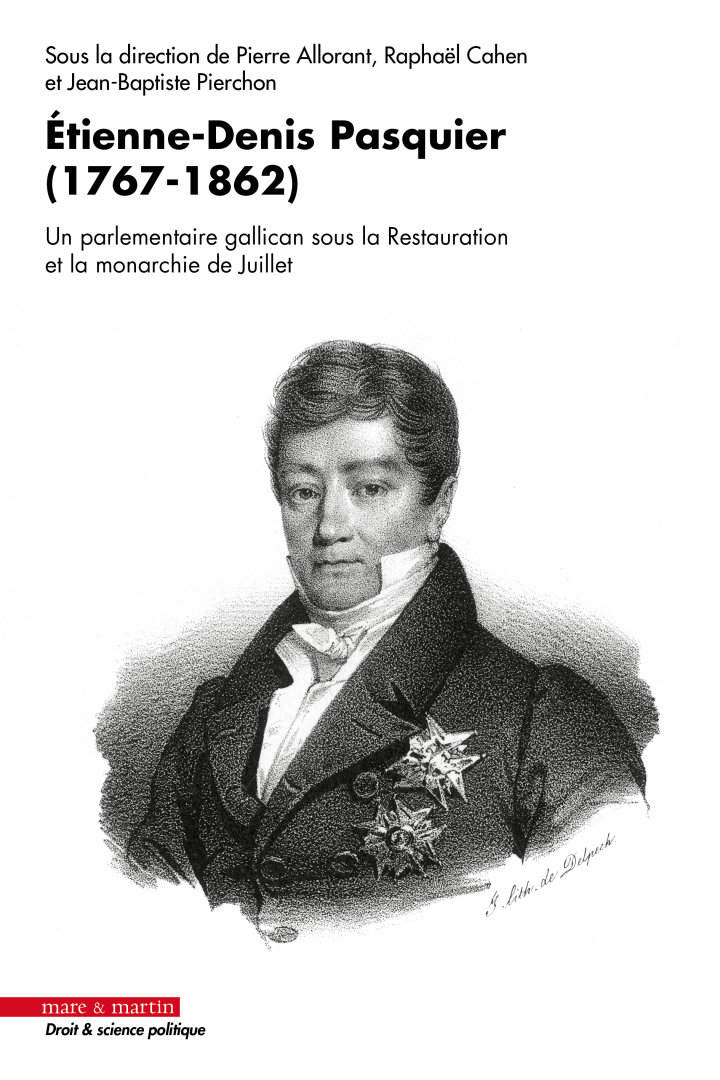
BOOK: Jean-Baptiste PIERCHON , Pierre ALLORANT & Raphaël CAHEN (dir.), Étienne-Denis Pasquier (1767-1862). Un parlementaire gallican sous la Restauration et la monarchie de Juillet [Droit & science politique] (Paris: Mare & Martin, 2024), 228 p. ISBN 978-2-38600-079-9, 28 €


(image source: Mare & Martin)

Abstract: 

Étienne-Denis Pasquier fut l’un des hommes politiques les plus importants de la première moitié du xixe siècle.
Ancien préfet de police de Paris (1810-1814), il fut député de la Seine puis pair de France sous la Restauration, tout en effectuant une riche carrière ministérielle (il fut garde des Sceaux à deux reprises puis ministre des Affaires étrangères, sous le règne de Louis XVIII). Pasquier se rallia ensuite à Louis-Philippe qui le nomma président de la Chambre des pairs (au mois d’août 1830) puis chancelier de France (en 1837). Contraint de quitter la vie politique à la suite de la Révolution de 1848, Étienne-Denis Pasquier consacra sa retraite à la rédaction de ses Mémoires (commencés en 1822) et à l’écriture de nombreux articles historiques et politiques (demeurés inédits).
L’ambition de cet ouvrage est de revenir sur les aspects méconnus de la carrière de Pasquier, tout en apportant un éclairage nouveau sur son oeuvre institutionnelle, juridique et diplomatique.

Read more here

13 December 2024

BOOK: Martin LÖHNIG & Stephan WAGNER (Hrsg.), Deutscher Bund und nationale Rechtseinheit [Mitteleuropäisches Zivilrecht; 3] (Tübingen: Mohr Siebeck, 2024), ISBN 9783161640995, € 89


(image source: Mohr Siebeck)

Abstract:

In its last years, the German Federation (Deutscher Bund) laid the foundations for national legal unity. There were ambitious plans to establish a »uniform law« by codifying commercial law, the law of obligations, the law of civil procedure, bankruptcy law, copyright law and patent law, safeguarded by the promise of mutual legal assistance.

Table of contents:

Martin Löhnig: Einführung - Jürgen Müller: Deutscher Bund und nationale Rechtsvereinheitlichung - Stephan Wagner: Allgemeines Deutsches Handelsgesetzbuch von 1861 - Nürnberger Entwurf - Stefan Vogenauer/Christoph Schmetterer: Entwurf eines allgemeinen deutschen Gesetzes über Schuldverhältnisse von 1866 - Dresdner Entwurf - Christian Hattenhauer: Privatrechtsvereinheitlichung »von unten« - Die Gesetzgebung des Bürgerlichen Gesetzbuchs für das Königreich Sachsen von 1863/65 - Martin Löhnig: Entwurf einer allgemeinen Civilprozeßordnung für die deutschen Bundesstaaten von 1866 - Hannoverscher Entwurf - Christoph Becker: Bestrebungen zur Vereinheitlichung des Konkursrechts im Deutschen Bund - Rainer Nomine: Entwurf eines Gesetzes zum Schutze der Urheberrechte an literarischen Erzeugnissen und Werken der Kunst von 1864 - Frankfurter Entwurf - Louis Pahlow: Wettbewerb um Innovationen statt Harmonisierung des Rechts - Zum Patentrecht im Deutschen Bund - Ignacio Czeguhn: Entwurf eines Gesetzes über die gegenseitige Rechtshilfe von 1861 - Nikolaus Linder: Die Rolle des Deutschen Juristentags bei der Herstellung nationaler Rechtseinheit auf dem Gebiet des Privatrechts 

On the editors:

Martin Löhnig ist Inhaber des Lehrstuhls für Bürgerliches Recht, Deutsche und Europäische Rechtsgeschichte sowie Kirchenrecht an der Universität Regensburg. https://orcid.org/0000-0002-4616-1905 - Stephan Wagner ist Inhaber des Lehrstuhls für Bürgerliches Recht, Europäische, Deutsche und Sächsische Rechtsgeschichte an der Martin-Luther-Universität Halle-Wittenberg. https://orcid.org/0000-0002-2476-9557

Read more here (DOI 10.1628/978-3-16-164099-5). 


14 February 2024

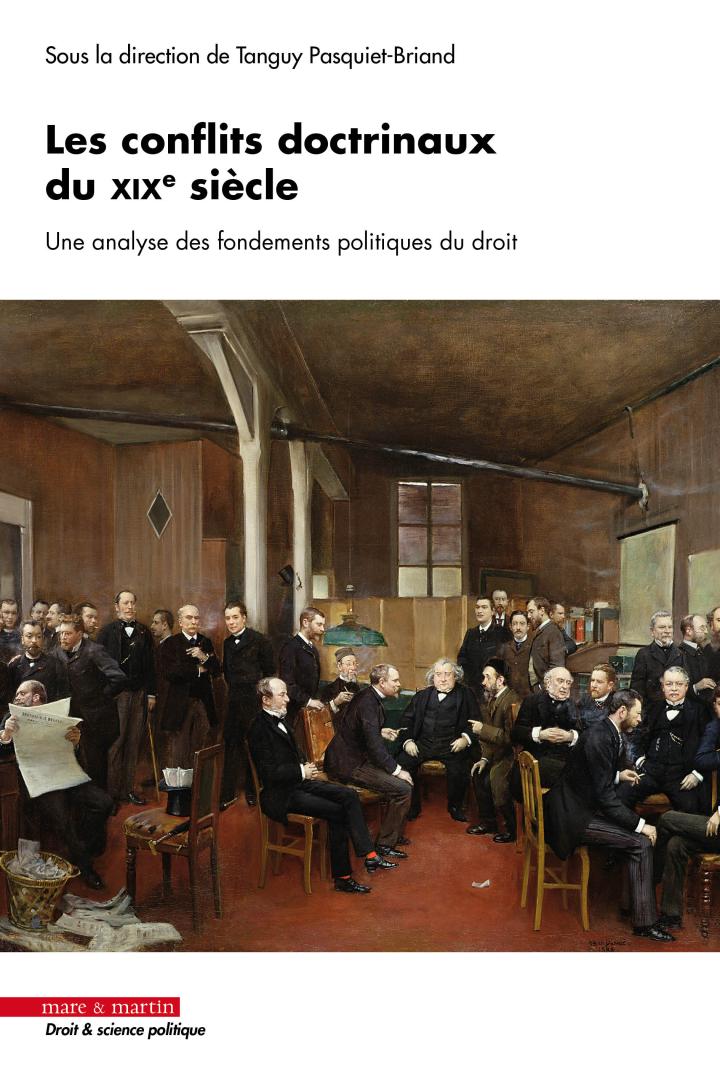
BOOK: Tanguy PASQUIET-BRIAND (dir.), Les conflits doctrinaux du XIXe siècle. Une analyse des fondements politiques du droit [Droit et sciences politiques] (Paris: Mare & Martin, 2023), 262 p. ISBN 9782849347096, € 30


(image source: Mare et Martin)

Abstract:
Rassemblant des contributions denses, diversifiées et ne se limitant pas à l’historiographie française, cet ouvrage se conçoit comme une ouverture sur quelques grands conflits doctrinaux qui ont jalonné le « long xixe siècle ». À la faveur d’une démarche volontairement pluridisciplinaire, il espère susciter l’intérêt pour une redécouverte des oppositions marquantes de ce siècle, caractérisées par une instrumentalisation historiciste et dogmatique du droit, mais également par la recherche d’une fondation scientifique et rétrospectivement pré-positiviste de la matière. Ce livre entend, grâce aux réflexions de chercheurs d’horizons variés, participer à un mouvement de valorisation de la culture juridique.

Read more here


05 September 2023

SYMPOSIUM: 'Imagining Peace in the Long Nineteenth Century (1789-1914). In Search of New Actors and Vocabularies' (Brussels: Vrije Universiteit Brussel, 15 SEPT 2023) [Hybrid]


Imagining Peace in the Long Nineteenth Century (1789-1914)  
In Search of New Actors and Vocabularies  


Programme

15 September 2023

Room I.0.02

9:30 – 9:45
Opening remarks and introduction by Wouter De Rycke & Raphaël Cahen (Vrije Universiteit Brussel)

9:45 – 10:30
Public keynote by Martti Koskenniemi (University of Helsinki)

The Law of an International Civil Society: The Road not Taken.

10:30 – 11:00
Discussion and audience questions

Room PL.5.5.61

11:30 – 12:00
Stella Ghervas (University of California – Los Angeles)

From Projects to Pacts: The Peace Plan as Genre in the Age of Revolutions.

12:00 – 13:00

Lunch break

13:00 – 13:30
Hendrik Simon (Peace Research Institute Frankfurt)

Imagining Perpetual Peace - A Forgotten Kantian Debate in Early 19th Century.

13:30 – 14:00

Jakob Zollmann (Berlin Social Science Center)

Eduard Loewenthal and the Future of Peace in Imperial Germany. Considerations of a would-be Nobel Peace Prize Winner.

14:00 – 14:30
Miroslav Šedivý (University of Pardubice)

The Search for New International Law and Lasting Peace in Mid-19th Century Geopolitical Debates. German and Italian Nationalist Responses to Insecurity.

14:30 – 15:00
Wouter De Rycke (Vrije Universiteit Brussel)

Justifying Utopia. The Mid-Nineteenth Century International Peace Movement and International Law.

15:00 – 15:30

Coffee break

15:30 – 16:00
Eliana Augusti (University of Salento)

The Imagined Peace and the Lost Words in the European Long Nineteenth Century.

16:00 – 16:30
Miloš Vec (University of Vienna)

Neither War nor Peace? Armed Reprisals in 19th-Century International Legal Doctrine.

16:30 – 17:00
Thomas Hippler (University de Caen Normandie)

17:00 – 17: 30

Concluding remarks

PHOTO EXHIBITION: "Il volto del crimine. La tirannia dell'organismo secondo l'antropologia criminale del XIX secolo" - Università di Verona, Settembre-Dicembre 2023


27 January 2022

BOOK: Felice BATLAN & Marianne VASARA-AALTONEN (Eds.), Histories of Legal Aid. A Comparative and International Perspective (London: Palgrave Macmillan, 2021). ISBN: 978-3-030-80270-7, pp. 330


ABOUT THE BOOK

This book focuses on the history of the provision of legal aid and legal assistance to the poor in the nineteenth and twentieth centuries in eight different countries. It is the first such book to bring together historical work on legal aid in a comparative perspective, and allows readers to analogise and contrast historical narratives about free legal aid across countries. Legal aid developed as a result of industrialisation, urbanization, immigration, the rise of philanthropy, and what were viewed as new legal problems. Closely related, was the growing professionalisation of lawyers and the question of what duties lawyers owed society to perform free work. Yet, legal aid providers in many countries included lay women and men, leading at times to tensions with the bar. Furthermore, legal aid often became deeply politicized, creating dramatic conflicts concerning the rights of the poor to have equal access to justice.

ABOUT THE EDITORS

Felice Batlan is Professor of Law and affiliated Professor of the Humanities at IIT Chicago-Kent, USA.  She is the author of the award-winning Women and Justice for the Poor: A History of Legal Aid, 1863-1945 (2015). Her research focuses on the legal history of women and gender in the U.S. and internationally.

Marianne Vasara-Aaltonen is University Lecturer in Legal History at the University of Helsinki, Finland. She is the author of Learning Law and Travelling Europe: Study Journeys and the Developing Swedish Legal Profession (2020), and several articles on the history of legal education, the legal profession, and the courts.

TABLE OF CONTENTS

Available here.

17 November 2021

BOOK: Miroslav ŠEDIVÝ, Si vis pacem, para bellum. The Italian Response to International Insecurity 1830-1848 [International History - Internationale Geschichte; 7] (Wien: ÖAW Verlag, 2021), 346 p. ISBN 978-3-7001-8705-9, € 79


(image source: OEAW)

Book description:
It was not after 1848 but actually before this revolutionary year that Europe witnessed the abusive proceedings perpetrated by the great powers which undermined the functionality of the post-Napoleonic international order. Even worse, their abuse of power in European and overseas affairs provoked a feeling of mistrust, pessimism and fear and led to discussions about the disappearing justice from the world among a considerable number of Europeans. By the 1840s, under the influence of various crises and conflicts members of the educated middle and upper middle classes in particular changed the way they judged and approached issues of international politics, justice, security and nation building. This process was all the more important in Italy since the search for greater security against external threats became the driving force in the spread of the idea to unite her politically from the Alps to Sicily. This unity, along with well defensible frontiers, a strong army and navy and good material resources including colonial ones, was to ensure a more secure position within the system of European politics and thereby better prospects for a peaceful future according to the phrase Si vis pacem, para bellum. However, this power-oriented response to insecurity had devastating consequences for the generally shared desire to live in peace with other nations, represented by another aspiration deeply rooted in the national movement: to establish a better international order. To reveal this important process of pan-European dimension is the principal aim of this book, and the Italian arena of politics in 1830–1848 has been chosen to clarify this sea change in political behaviour.

On the author:

Is professor at the Institute of Historical Sciences at the Faculty of Arts and Philosophy at the University Pardubice.

(DOI 10.1553/978OEAW87059)

(source: ESIL IGHL Blog)

05 November 2021

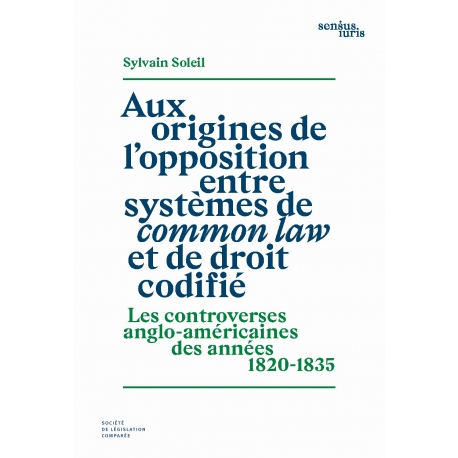
BOOK: Sylvain SOLEIL, Aux origines de l'opposition entre systèmes de common law et de droit codifié [Sensus Iuris] (Paris: Société de législation comparée, 2021), 371 p. ISBN 978236517113, € 36

(image source: SLC)


Book description:

Le common law et le droit codifié forment deux systèmes juridiques différents. Ceci est bien connu. Toutefois, de part et d’autre de la Manche et de l’Atlantique, les universitaires et les praticiens ne se contentent pas de les différencier. Ils ont pris l’habitude de les opposer l’un à l’autre. Cet ouvrage cherche à saisir l’origine de cet antagonisme doctrinal. Il explore les controverses anglo-américaines des années 1820-1835, lorsque le common law a été furieusement attaqué dans les cercles réformateurs et que sa codification a été prônée dans les discours, les ouvrages, les revues. Certes, sur le plan législatif, la plupart des projets ont échoué. Mais, sur le plan doctrinal, la controverse a produit une opposition profonde entre deux conceptions du droit parce que les deux systèmes ont été opposés l’un à l’autre. Les débats ont été violents aux États-Unis comme au Royaume-Uni. Ils ont structuré l’identité des deux systèmes. Ils ont mobilisé beaucoup de textes et d’auteurs européens (Institutes de Justinien, Code Napoléon, Portalis, Savigny, Dupin, Meyer, etc.). Ils ont donné lieu à des interprétations sommaires de la part des auteurs français. De sorte que cette controverse anglo-américaine et son interprétation française ont convaincu les juristes engagés dans cette bataille, ainsi que leurs auditeurs et leurs lecteurs, qu’il existait bel et bien deux systèmes non seulement différents mais également antagonistes.

More information here

28 October 2021

BOOK: Jenny Paola VALENCIA, El proceso de adopción del Código Civil en Colombia. Vientos de cambios en la cultura política y jurídica en el siglo XIX (México: Tirant lo Blanch, 2021). ISBN: 9788413785325, pp. 308, $ 449.00 MXN

(Source: Tirant lo Blanch)

ABOUT THE BOOK

Series: Historia del Derecho en América Latina

Este libro analiza la forma en la que el Código Civil se insertó en la cultura jurídica y política colombiana en el siglo XIX. No se ocupa tanto del estudio de su contenido, sino, más bien, del largo proceso de su adopción, desde los primeros intentos codificadores, a comienzos de la República, hasta el año 1887. En el texto se entiende la codificación como parte esencial de la configuración del Estado y se hace alusión a una multiplicidad de actores, escenarios y discusiones, así como a diferentes miradas a partir de las cuales se intentó estructurar una nueva sociedad con principios y valores propios. Finalmente, el lector encontrará en esta obra una referencia a las formas de publicación y circulación de la codificación, atendiendo a la materialidad y a los formatos en los que ésta viajó por la sociedad decimonónica colombiana.

ABOUT THE AUTHOR

Jenny Paola Valencia es historiadora de la Universidad del Valle, magister y doctora de historia de la Universidad de los Andes. En la actualidad es docente universitaria e investigadora posdoctoral adscrita al Grupo de Estudios de Literatura y Cultura Intelectual Latinoamericana (GELCIL) de la Universidad de Antioquia.

TABLE OF CONTENTS

Índice

Agradecimientos       17

Prólogo       19

Introducción       21

Capítulo 1 - Del Antiguo Régimen jurídico a la codificación

1.    Características del entramado jurídico de la monarquía hispánica      47

2.    Cuerpos normativos de la monarquía hispánica      54

3.    El régimen borbónico y los inicios del desmantelamiento del antiguo orden jurídico      60

Capítulo 2 - El proceso de codificación y la organización del Estado en clave liberal

1.    Previo a la codificación: escenario político y de cultura legal entre 1810-1845      74

2.    Los primeros intentos codificadores y la crítica al régimen jurídico anterior      79

3.    La búsqueda de una vuelta a la monarquía constitucional: el periodo de la recopilación 

       de leyes de la Nueva Granada, 1843-1845     90

4.    La era codificadora en el siglo XIX: una historia conectada en Europa 

       e Hispanoamérica      97

5.    La adopción del Código Civil 1857-1887: del federalismo a la Regeneración      103

Capítulo 3 - El Código Civil en la contienda Iglesia-Estado

1.    Cambios jurídicos que iniciaron la separación entre la Iglesia y el Estado      121

2.    La adopción del matrimonio civil      142

3.    Inicios de un consenso frente a las relaciones con la Iglesia previo al Concordato      151

4.    La Suprema Corte y la Procuraduría: resolución de conflictos entre la I

       glesia y el Estado      159

Capítulo 4 - Difusión y circulación de una cultura legal y política de respeto y apego a la ley

1.    Circulación de autores y textos jurídicos en los primeros años de la República      171

2.    Bentham: utilitarismo y codificación      174

3.    La filosofía moral como forma de circulación de una cultura jurídica      184

4.    Rituales y prescripciones: la lectura de la Constitución y el Código Penal en 

       la plaza pública      201

Capítulo 5 - ¿Y cómo viaja el código?

El Código Civil como objeto textual y su circuito de difusión

1.    La prensa oficial como tribuna parlamentaria      210

2.    El Código por entregas: publicación en las Gacetas oficiales      215

3.    El Código Civil como texto impreso      227

4.    Formato, precio, imprentas y estructura de publicación del Código      234

Fuentes y bibliografía

Fuentes primarias      261

Bibliografía general      265

Anexo - “Modificaciones introducidas al Código de Bello por el Estado de Santander”

Sobre el matrimonio

Diferencias en el matrimonio y la filiación en los otros códigos      279

Índice de tablas e imágenes

Tabla 1.    Sometimiento de eclesiásticos a la legislación      139

Tabla 2.    Disposiciones sobre el matrimonio civil por Estados soberanos      146

Tabla 3.    Publicación códigos de los Estados federales      236

Tabla 4.    Estructura de publicación Doce Códigos de Cundinamarca      238

Imagen 1.    Portada de los Doce Códigos del Estado de Cundinamarca      239

Imagen 2.    Código Civil. Asamblea Magdalena      242

Imagen 3.    Portada del Código Civil de Santander      242

Imagen 4.    Portada del Código Civil de Panamá      243

Imagen 5.    Portada del Código Civil de Bolívar      243


More information with the publisher.

30 August 2021

BOOK: Philippe RYGIEL, L’ordre des circulations ? L’Institut de Droit international et la régulation des migrations (1870-1920) [Coll. « Histoire contemporaine »] (Paris: Éditions de la Sorbonne, 2021), ISBN 9791035106348


(image source: CNRS Histoire Sociale)

Description:
Le contrôle des migrations affectant le territoire d’un État est souvent conçu comme relevant de la seule compétence de celui-ci : tout passage de frontière, tout séjour d’un étranger, pourtant, mettent en contact plusieurs souverainetés et instaurent entre elles des échanges, des négociations, ou suscitent des conflits. Les fondateurs du droit international moderne, réunis à la fin du XIXe siècle par l’Institut de droit international, en étaient bien conscients. Fins observateurs du monde de leur temps, qu’ils entendaient ordonner selon le droit, ils consacrent alors aux implications des mobilités humaines des milliers de pages, et au meilleur moyen de les régler de nombreux débats, soucieux qu’ils étaient d’instaurer un ordre des circulations libéral, condition à leurs yeux de la prospérité de chacun et de la paix entre les nations occidentales. Ils entreprennent ainsi, non sans connaître de véritables succès, d’assurer un statut juridique aux étrangers résidant en Occident, de protéger les réfugiés de la vindicte des États, de dénoncer enfin les entraves trop manifestes à la liberté de circulation. Les guerres brutales que connut l’Europe, sa division en aires d’influence rivales, l’affaissement de la civilisation européenne consécutif à la Première Guerre mondiale ont fait tomber dans l’oubli ces travaux fondateurs autant que leurs réalisations effectives, dont beaucoup ne survécurent toutefois pas à l’effondrement du monde qui les avait vu naître. Ce livre retrace leur histoire et leurs combats, en un temps que marque à nouveau autant la nécessité d’un ordre mondial des mobilités humaines que l’apparente impossibilité de le faire advenir.

(read more here

(source: ESILHIL Blog)


27 August 2021

JOURNAL: Outre-Mers. Revue d'histoire 410-411 [Numéro Spécial: L'impérialisme informel de la France et de l'Espagne au XIXe siècle] (JUN 2021)


(image source: SFHOM)

Description:

"La Société Française d’Histoire des Outre-mers publie dans ce numéro de sa revue un travail novateur d’Arnaud Bartolomei, de Xavier Huetz De Lemps et de Martín Rodrigo Y Alharilla sur l’impérialisme informel de la France et de l’Espagne au XIXe siècle. Si la notion d’impérialisme informel a été mobilisée par les historiens britanniques pour comprendre la puissance coloniale hégémonique d’outre-manche, cette notion a été plus rarement sollicitée pour analyser les trajectoires impériales d’autres puissances européennes. Les auteurs pallient cette carence pour les empires français et espagnol dont l’historiographie s’est trop longtemps attachée à la seule conquête territoriale afin d’évaluer leur puissance impériale. Toute proportion gardée avec le modèle britannique, les auteurs interrogent la puissance heuristique d’une telle perspective et les modalités de domination informelle envisagées par la France et l’Espagne au XIXe siècle. David Todd focalise son attention sur les agents français et les collaborateurs autochtones des outre-mers, sur les promoteurs et les bénéficiaires de ces nouvelles formes d’influence en France métropolitaine. Ce cadre établi, Arnaud Bartolomei, Manuel Talamante et Xavier Daumalin ouvrent respectivement des perspectives sur l’expansion commerciale de la France au Mexique, à Montevideo mais aussi en Afrique. Pour l’Espagne, les contributions d’Eloy Martín Corrales et de Juan Inarejos Muñoz portent sur l’analyse des motivations des politiques d’expansion espagnole qui vont à l’encontre de la seule lecture de la « matrice » du désastre de 1898. D’autres acteurs et d’autres intentions ont pu générer de nouvelles formes d’impérialisme. Martín Rodrigo y Alharilla et Lizbeth Chaviano Pérez montrent ainsi que la question de l’esclavage et de la traite a constitué le principal moteur de l’implantation de l’Espagne en Afrique sub-saharienne. De même, L. Chaviano Pérez met clairement en évidence des formes de sous-impérialisme informel en montrant que le sort des établissements espagnols en Guinée a été intimement lié aux intérêts cubains et aux pressions de ses planteurs. En focalisant leur attention sur la fin de l’époque moderne et le début de la reprise de l’expansion européenne dans le dernier tiers du XIXe siècle, l’ensemble de ces contributions invite le lecteur à appréhender les « conditions d’une domination économique » qui se voulait « si possible exclusive ou privilégiée, sur le reste du monde »."

(read more: SFHOM

(source: ESILHIL Blog)