Search

Showing posts with label Colonial Law. Show all posts

12 June 2026

BOOK: Thomas DUVE & Tamar HERZOG (eds.), Historia del Derecho de América Latina en Perspectiva Global [Historia del Derecho en América Latina, 1ª Edición] (México: Tirant lo Blanch, 2026), 680 p., ISBN 9788410959361

(image source: Tirant)

Abstract:

Este libro es el resultado de un esfuerzo colectivo de investigadores de América Latina, Europa y los Estados Unidos que se propusieron escribir una historia del Derecho centrada en las experiencias compartidas de las sociedades latinoamericanas a lo largo de un extenso período histórico, iniciado antes de la invasión europea del continente y que se prolonga hasta nuestros días. Su propósito era construir un relato capaz de identificar tendencias comunes, dar cuenta de las profundas transformaciones ocurridas a lo largo de este recorrido e integrar dichos procesos en una perspectiva más amplia. Esta historia «pan-latinoamericana», abordada desde una perspectiva global, muestra cómo América Latina se enfrentó a desafíos similares a los de otras regiones del mundo y cómo los debates surgidos en la región estuvieron con frecuencia vinculados a discusiones que tenían lugar en otros contextos. Los actores latinoamericanos contribuyeron activamente a estas discusiones y de ellas recibieron influencias, inspiración y nuevos marcos de reflexión.

Desde el punto de vista metodológico, los autores privilegian las preguntas sobre las respuestas, los procesos sobre los resultados y los contextos sobre las meras descripciones de soluciones jurídicas. La obra explora dónde, cómo y por qué se materializa el Derecho, quiénes son sus protagonistas y cuáles son los principales escenarios en los que actúa. Asimismo, pone de relieve los múltiples niveles en que opera el fenómeno jurídico y su profunda interrelación con los procesos sociales, políticos, culturales y económicos.

On the author:

Thomas Duve es director del Instituto Max Planck de Historia y Teoría del Derecho, y catedrático en la Facultad de Derecho de la Universidad Goethe de Fráncfort. Es especialista en historia del derecho y sus relaciones con la religión en los imperios ibérico.

Tamar Herzog ocupa la cátedra Monroe Gutman en la Universidad de Harvard. Su principal área de interés es la historia jurídica y social de la península ibérica y sus territorios de ultramar.

Table of contents:

Introducción       
Thomas Duve
Tamar Herzog
1. ¿En qué consiste la Historia del Derecho de América Latina en perspectiva global?
1.1. ¿Cómo se escribió y se escribe la Historia del Derecho de América Latina?        
Carlos Petit
1.2 ¿Qué es la Historia del Derecho y cómo se relaciona con otras Historias?       
Tamar Herzog
1.3. ¿Cómo se produce el Derecho?        
Thomas Duve
1.4. ¿Qué es la Historia del Derecho global y cómo puede llevarse a cabo?        
Mariana Dias Paes
2. ¿Cómo aproximarse al Derecho indígena?
2. ¿Cómo aproximarse al Derecho indígena?        
Caroline Cunill
3. ¿Cómo abordar el Derecho colonial?
3.1. Un Derecho civil para una sociedad religiosa        
Tamar Herzog
3.2. Normatividad religiosa para imperios coloniales        
Thomas Duve
3.3. La esfera doméstica        
Romina Zamora
4. Independencia(s): ¿Qué es un Derecho revolucionario?
4. Independencia(s): ¿Qué es un Derecho revolucionario?        
Tamar Herzog
5. ¿El advenimiento de los Estados? El siglo XIX
5.1. Constituciones        
José María Portillo
5.2. Codificaciones        
Agustín Parise
5.3. Contestaciones y exclusiones        
Monica Dantas
Roberto Saba
6. ¿La omnipresencia del Estado? El siglo XX
6.1. Hacia el Estado Administrativo        
Eduardo Zimmermann
6.2. Dictaduras       
Cristiano Paixão
6.3. Justicia transicional y derechos humanos        
Ruti Teitel
Valeria Vegh Weis
7. Más allá del Estado: ¿Puede sobrevivir el Derecho estatal en el siglo XXI?
7. Más allá del Estado: ¿Puede sobrevivir el Derecho estatal en el siglo XXI?        
Daniel Bonilla Maldonado

Find more on: Tirant

18 March 2026

PROJECT: CONDUIT, comparing French and Italian colonial law (Institut Universitaire de France, Prof. Monica CARDILLO/Nantes Université)


(image source: IUF)

Project abstract:

Ce projet porte sur l’analyse et la comparaison des administrations coloniales françaises et italiennes, à partir des ressources archivistiques, afin de comprendre comment s’est construit le droit colonial en Afrique. Plus précisément, à travers l’étude de l’activité de terrain des administrateurs des cercles, ce projet s’attache à comprendre l’évolution des normes traditionnelles du fait du contact colonial, et du processus de « disqualification » et « requalification » de la logique juridique locale. Conduit suivant une approche interdisciplinaire, il vise à mettre en œuvre une méthodologie critique de l’archive coloniale. Inscrit dans les sciences juridiques émergentes, ce projet cible la concrétisation d’actions pédagogiques, scientifiques, de sauvegarde d’archives par la numérisation.

(read more here

03 October 2025

BOOK REVIEW: Lyndsay CAMPBELL on English law, the legal profession, and colonialism: histories, parallels, and influences edited by Cerian Griffiths and Łukasz Jan Korporowicz (Comparative Legal History, XIII (2025), nr. 1, June, pp. 150-153)

(Image source: Taylor&Francis)

Originating in and building on a 2021 conference, this collection contributes to the growing literature on the histories of empire, focusing on the movement of English law and the history of the legal profession in the colonial context. It features chapters from scholars around the world at a whole range of career stages. The conclusion, by Cerian Griffiths and Łukasz Jan Korporowicz, indicates that the project is an attempt to tug British Empire history into the theoretical orbit of European-style Global Legal History, to shed light on a field that ‘has traditionally been the poor relation to its civil law cousin’ (258) and to present research on the ‘early modern and modern eras which often receive less interest than medieval historical studies’ (259). I had to chew on these statements for a bit, and also the omission, in the same paragraph, of the forty-six-year-old Osgoode Society for Canadian Legal History from the editors’ list of academic associations that have contributed to the development of the history of the common law world over the past 40 years (Canada is mostly absent from the book, which perhaps explains this omission). In any case, although at least in theory Global Legal History seems to purport to do everything, a single collection cannot. More importantly, I take it that the editors’ point is to underline the focus on the mobility of law and people, to look beyond the nation and the local in our questions and approaches.
English Law, the Legal Profession, and Colonialism opens with a helpful introduction by Michael Lobban, who describes the book's major thematic preoccupations, including how legal ideas travelled within the British Empire (between the ‘centre’ and the ‘periphery’ and also among colonies), the tension between authoritarianism and liberalism, and how that tension wove through conceptions of the nature and purpose of the rule of law, given that the law and legal principles that travelled around the empire landed in places that were unlike England, to varying degrees and in various ways. The chapters that follow, although somewhat uneven in readability, direct our attention not only to public law and notable juridical personalities but also to the network of personal and commercial relationships – structured through legal rights and principles – that were so crucial to the decisions individual people made in shaping legality in the British Empire.

To read the full review, please click here. Online access is free for members of the European Society for Comparative Legal History. For further information about the volume on our blog, please visit here
DOI: 10.1080/2049677X.2025.2500210


02 October 2025

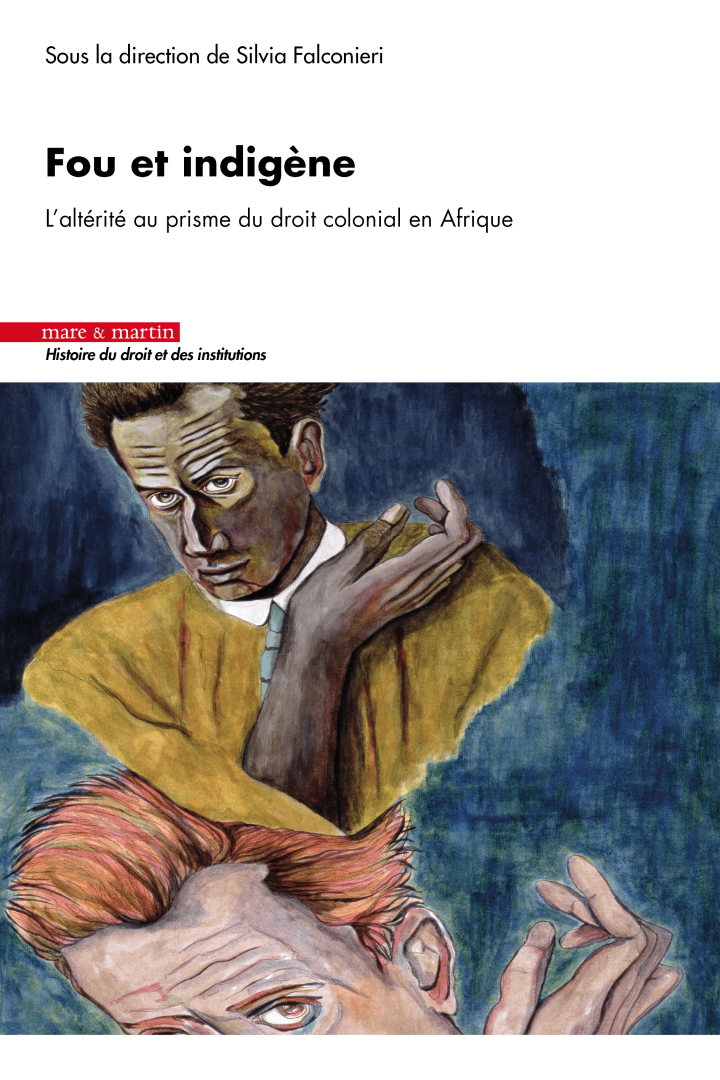
BOOK: Silvia FALCONIERI (dir.), Fou et indigène. L'altérité au prisme du droit colonial en Afrique [Histoire du droit et des institutions] (Paris: Mare & Martin, 2025), 274 p. ISBN 9782386001284, € 31


Abstract:
Issu d’une recherche collective financée par l’Agence nationale de la recherche, le présent ouvrage propose une histoire juridique de la folie dans les territoires africains colonisés par la France entre la fin du XIXe siècle et les années 1960. Que se passe-t-il lorsque la condition juridique spécifique à l’« indigène » se double d’une différence supplémentaire qui touche à la sphère de la pathologie mentale ? Qu’en est-il du traitement juridique de la folie des populations colonisées ? Voyageant à travers les différents territoires africains occupés par la France, cet ouvrage interroge l’intersection de deux formes d’altérité, celles de « fou » et d’« indigène ». Les chapitres qui le composent montrent comment la prise en charge juridique et administrative, mais aussi médicale, de la « folie » de l’« Autre » se fait dans une variété de contextes et suivant des procédures, souvent atypiques, qui peuvent s’écarter du droit commun.

Read more here


19 November 2024

VIRTUAL LIBRARY: Ouvrages, Éditions numériques du CHJ (Lille: UMR 8025 CNRS-Université de Lille, 1982-2023) [OPEN ACCESS]


The Centre d'histoire judiciaire (Université de Lille/CNRS, UMR 8025) has published 62 volumes in open access from its previous print runs, from 1982 to 2023, with the licence "Creative Commons Attribution Non Commercial Share Alike 4.0 International (CC-BY-NC-SA-4.0)" on Nakala.

The "virtual library" contains edited volumes (e.g. acta of the Société d'histoire du droit et des institutions des pays flamands, picards et wallons, other conferences organised by the CHJ), but also monographs (e.g. Véronique Demars-Sion, Femmes séduites et abandonnées au 18e siècle, 1991). 

The various themes treated range from criminal justice, colonial law, labour law, diplomacy and law, the absolutist state, conflict resolution, governance to gender and judicial organisation.

Examples:

X (dir.), Justice populaire. Actes des journées de la société d'histoire du droit, tenues à Lille, 25-28 mai 1989 [L'Espace Juridique] (Lille: CHJ, 1992), ISBN 290851009X
DOI 10.34847/nkl.8ec543dw

Jacques LORGNIER (dir.), Justice & République(s) [L'Espace juridique] (Lille: CHJ, 1993), ISBN 290851012X
DOI 10.34847/nkl.c98b56z2

X (dir.), Justice et institutions françaises en Belgique (1795-1815). Actes du colloque tenu à l'Université de Lille II les 1, 2 et 3 juin 1995 [L'espace juridique] (Lille: CHJ, 1996)
DOI 10.34847/nkl.ead23yj5

Serge DAUCHY, Sylvie HUMBERT & Jean-Pierre ROYER (dir.), Le juge de paix. Nouvelles contributions européennes (Lille: CHJ, 1995), ISBN 2910114023
DOI 10.34847/nkl.ce71rc2n

Véronique DEMARS-SION, Femmes séduites et abandonnées au 18e siècle. L'exemple du Cambrésis [L'espace juridique] (Lille: CHJ, 1991), ISBN 2908510081
DOI 10.34847/nkl.8f34v6kq

Serge DACHY & Catherine LECOMTE (dir.), L'absolutisme éclairé [Société d'Histoire du Droit et des Institutions des Pays Flamands, Picards et Wallons] (Lille: CHJ, 2002), ISBN 29101140508
DOI 10.34847/nkl.5a81wr71

Bernard DURAND & Leah OTIS-COUR (dir.), La torture judiciaire. Approches historiques et juridiques (Lille: CHJ, 2002), ISBN 2910114-066
DOI 10.34847/nkl.dae9q2t1

Bernard DURAND & Maité LESNÉ-FERRET (dir.), Justice pénale et droit des clercs en Europe, XVIe-XVIIIe siècles [Histoire de la Justice] (Lille: CHJ, 2005), ISBN 2910114112
DOI 10.34847/nkl.a80cdny7

Sylvie HUMBERT & Jean-Pierre ROYER (dir.), Auteurs et Acteurs de la Séparation des Eglises et de l'Etat. Actes du colloque tenu à Lille les 29 et 30 septembre 2005 (Lille: CHJ, 2007), ISBN 2910114171
DOI 10.34847/nkl.6b686yp4

Bernard DURAND & Martine FABRE (dir.), Continuités ou ruptures ? Cour de cassation en France - Cour Suprême au Maroc [Histoire de la Justice] (Lille: CHJ, 2010), ISBN 2910114228
DOI 10.34847/nkl.4afab6cn

Véronique DEMARS-SION & Renée MARTINAGE (dir.), Diplomates et diplomatie. Actes des Journées internationales tenues à Péronne du 22 au 23 mai 2009 [Société d'Histoire du Droit et des Institutions des Pays Flamands, Picards et Wallons] (Lille: CHJ, 2013), ISBN 290114309
DOI 10.34847/nkl.2bcbx6tf

Sandra GÉRARD-LOISEAU & Florence RENUCCI (dir.), Les normes au Maghreb (XIXe-XXe siècle) (Lille: CHJ, 2016), ISBN 2910114325
DOI 10.34847/nkl.a60a6wg3

Sebastiaan VANDENBOGAERDE, Iris LELLOUCHE, Hélène DUFFULER-VIALLE, Sébastian DHALLUIN & Bruno DEBAENST (dir.), (Wo)Men in Legal History (Lille: CHJ, 2016), ISBN 2910114333 
DOI 10.34847/nkl.ec5bwvb5

Luisa BRUNORI, Farid LEKÉAL & Alain WIJFFELS (dir.), Gouvernance, justice et santé (Lille: CHJ, 2020), ISBN 2910114368
DOI 10.34847/nkl.11fez952

Pascal HEPNER, Tanguy LE MARC'HADOUR & Christian PFISTER-LANGANAY, Construire et Déconstruire les territoires. Actes des Journées internationales tenues à Arras les 11 et 12 mai 2018 [Société d'Histoire du Droit et des Institutions des Pays Flamands, Picards et Wallons] (Lille: CHJ, 2023).
DOI 10.34847/nkl.8cde5896

The full list of 62 volumes can be read or downloaded here.

02 October 2024

BOOK: Robin Leon GOGOL, Kolonialrecht und Provenzienzforschung [Beiträge zu den Grundfragen des Rechts; 41] (Göttingen: V&R unipress, 2023), 217 p., ISBN 978-3-8471-1630-1

 
ABOUT THE BOOK:
 
Für die juristische Untersuchung der kolonialrechtlichen Erwerbsprozesse sind die dem deutschen Zivilrecht immanenten Gerechtigkeitsideale und Billigkeitsgrundsätze maßgeblich. Robin Leon Gogol gibt durch eine rechtshistorische Quellenauswertung einen Überblick über das Kolonialrecht und stellt mittels der Untersuchung des rechtlichen Rahmens der deutschen Kolonialisierungsgeschichte die Auswirkungen des Rechts auf die Provenienzforschung fest, um dann abschließend Kategorien rechtlicher Legitimität für den konkreten Einzelfall einer historischen Provenienzprüfung zu erarbeiten. Dabei behandelt er neben abstrakten juristischen Fragestellungen auch die spannende Herkunftsgeschichte der »Federkrone aus Kamerun«, die mutmaßlich vom Besitz des Manga Ndumbe Bell in die Hände des deutschen Missionars Theodor Christaller gelangt ist.
 
ABOUT THE AUTHOR:
 
Dr. Robin Leon Gogol arbeitete als Jurist an der Leibniz Universität Hannover am Lehrstuhl für öffentliches Medienrecht, am Lehrstuhl für Zivilrecht und Rechtsgeschichte sowie am CELLS-Institut für Medizin- und Ethikrecht. Während seiner Promotion am Lehrstuhl für Zivilrecht und Rechtsgeschichte war er zudem Researcher and Legal Counsel beim internationalen PAESE-Projekt des Landes Niedersachsen.  
 
Read more here.

21 March 2022

SEMINAR: Project Comparing Early Modern Colonial Law Launch Seminar


(Source: https://twitter.com/MancillaOrdenes/status/1494372509256495106/photo/1)

Developed at the university of Helsinki by the coordination of prof. Heikki Pihlajamäki, the project CoCoLaw (Comparing Early Modern Colonial Laws) aims to provide a comparative analysis of how early modern colonial laws of England, the Netherlands, Spain, and Portugal were structured. 


Our first event will happen on the 22nd of march, with Annemieke Romein and Mariana Armond Dias Paes as keynote speakers. 


Here is the registering form link:  https://www.lyyti.in/CoCoLaw_Launch_Seminar_Registration


22 December 2021

WORKSHOP: Decolonization by Codification: The Making of the 1958 Penal Code in Late Colonial Nigeria, 4 January 2022

(Source: mpilhlt)

MPI-TAU Transnational Legal History Workshop

DATE: Jan 4, 2022 TIME: 19:00 - 20:30
SPEAKER: Rabiat Akande (Osgoode)
CONVENORS: Thomas Duve, David Schorr (TAU), Stefan Vogenauer
LOCATION: video conference
ROOM: For further information please contact mpitauwkshp@gmail.com


30 September 2021

CALL FOR PAPERS: Ownership Regimes in the Iberian World, 1500-1850


(Source: https://www.google.com/search?q=max+planck+institute+for+legal+history+and+legal+theory&sxsrf=AOaemvKtGNA6eqPAwVVCiHGTqiz2iOIFLw:1631720230292&source=lnms&tbm=isch&sa=X&ved=2ahUKEwiFysvFp4HzAhXVgf0HHcg3Cm8Q_AUoAXoECAEQAw&biw=1366&bih=625#imgrc=jWXl5ITlOufXgM)

For a Workshop and Publication, we are calling for contributions that deal with questions of land tenure in any region of the former Portuguese and Spanish empires in Asia, Africa, Europe (incl. Italy and the Netherlands), and the Americas during the early modern period. The contributions may explore the role of families, marriage, kinship, corporations (the Church, cabildos/concelhos, pueblos, etc.), and other kinds of institutions in the regulation of land. Case studies, comparisons, as well as methodological and analytical approaches are particularly welcome. A selection of the papers presented at the workshop will be published as a volume of the Brill series Max Planck Studies in Global Legal History of the Iberian Worlds.

Submission:

Please send your book chapter proposals in Spanish, English, or Portuguese to Dr. Manuel Bastias Saavedra (bastias@...) until October 31, 2021. A full manuscript will be required before the conference.


More information: https://www.lhlt.mpg.de/2660181/cfp_-_ownership_regimes_in_the_iberian_world.pdf 

14 September 2021

BOOK: Gustavo César Machado CABRAL; Delmiro Ximenes de FARIAS; Sarah Kelly Limão PAPA (Orgs.). Fontes do direito na América Portuguesa: estudos sobre o fenômeno jurídico no Período Colonial (Séculos XVI-XVIII). (Editora Fi: 2021). ISBN: 978-65-5917-176-7. OPEN ACCESS.


(Source: https://www.editorafi.com/176america?fbclid=IwAR2luZHA23Ix-3oR8knVTtGbRyjCva0FtQwyOUNdImzQjHN8YY34e9IEYKY)

O livro é composto de diversos capítulos escritos pelos membros do NEDAP. Resultado de diferentes níveis de formação educacional, os artigos variam também no grau de profundidade, entretanto, sem comprometer a qualidade da obra. Percebe-se, no livro, um amadurecimento no trato com as fontes históricas, tão caras aos historiadores de formação, assim como também do uso de uma bibliografia recente do Brasil colonial. As filiações historiográficas e a corrente teórica utilizada pelo conjunto dos autores, tanto no processo de pesquisas, como na escrita dos capítulos, fica demonstrado e fundamentado. As escolhas do grupo confirmam o uso corrente de uma dada historiografia que muito tem influenciado a produção historiográfica colonial do Brasil nos últimos anos. Com esta obra, é possível perceber a complexidade do direito no período colonial, uma vez que existia uma pluralidade jurídica que englobava desde o direito do reino (ius patrium), o direito canônico, o direito local, entre outros até o direito comum europeu (ius commune). São abordados casos de jurisdição, envolvendo diversas autoridades coloniais, aplicação da justiça, eleições municipais, planejamento urbano, controle sobre a produção de aguardente, natureza jurídica dos ofícios, direito das viúvas, mas também análises sobre uma teoria do direito colonial brasileiro. Percebe-se uma variedade na inclusão de agentes distintos, embora indígenas e negros não tenham sido contemplados neste conjunto de trabalhos. Mas certamente é um excelente exercício de diálogo entre o Direito e a História, do qual profissionais de ambas as áreas se beneficiarão, mas principalmente os historiadores do direito, que se tem expandido na última década, resultado do maior diálogo entre estes profissionais. O campo científico da História do Direito ganha muito com essa obra que se tornará referência obrigatória para os estudiosos da história do Brasil no período colonial.


Índice


Apresentação  - Gustavo César Machado Cabral

Prefácio - Carmen Alveal


Parte 1 - Perspectivas conceituais

Uma teoria do direito para a América Portuguesa (Séculos XVI-XVIII) - Gustavo César Machado Cabral

Ordens normativas e América Portuguesa: o caso do direito colonial brasileiro (Séculos XVI a XVIII) - Victor Hugo Siqueira de Assis - Kauan Duarte Gondim dos Santos


Parte 2 Jurisdição, competência e conflitos

A atuação do Governador-Geral na Capitania do Rio de Janeiro entre 1650 e 1656: uma análise de casos com base nos conceitos de pluralismo jurídico e monarquia pluricontinental - João Victor Oliveira Freire

A iniciativa processual penal dos governadores-gerais do Brasil: As cartas do Conde de Castelo Melhor e do Conde de Atouguia e determinações de instauração de devassas (1650-1657) - Delmiro Ximenes de Farias

A administração colonial na América Portuguesa: Conflitos de jurisdição entre o Governo-Geral do Brasil, o Governo de Pernambuco e a Câmara de Olinda (1663 - 1668) - Sarah Kelly Limão Papa


Parte 3 - Experiências locais

Eleições no Brasil colonial: entre a imposição da norma régia e a manifestação do direito local - Lucas Igor Cavalcante Rodrigues

Fontes do direito e planejamento urbano na capitania do Ceará: os casos das vilas de Icó e Aracati - Gustavo César Machado Cabral - Ana Carolina Farias Almeida da Costa - Matheus Silva de Sá


Parte 4 - Administração e direitos em disputa

As reiteradas provisões para “não se fazer aguardente” e o uso de ordens e portarias como meio de efetivação de normas (1636 - 1664) - Joana Aymée Nogueira de Freitas - João Victor Diniz Ribeiro - Stéfano Gonçalves Lima

Legitimidade para pedir das viúvas no Século XVIII: a autonomia das mulheres na -América Portuguesa -Ana Luiza Barroso Caracas de Castro

A dupla natureza dos ofícios públicos intermédios na América Portuguesa da primeira metade do Século XVIII: entre a honra e o bem patrimonial -Wirdley Bernardino Pinheiro - Victor Alves Magalhães


Free E-book: https://drive.google.com/file/d/158hp73oYSAKddmrn8kL_sjV1ICLfUt7E/view 

25 June 2021

BOOK: Michelle MCKINLEY, Libertades fraccionadas. Esclavitud, intimidad y movilización jurídica en la Lima colonial, 1600-1700 (Valencia: Tirant lo Blanch, 2021). ISBN: 9788413365565, pp. 372, $ 449.00 MXN


ABOUT THE BOOK

‘Libertades fraccionadas’ explora el modo como miles de esclavas en el Perú colonial aprovecharon los instrumentos jurídicos a su disposición para asegurar su libertad, mantener intactas sus familias, negociar precios bajos para auto-comprarse y planificar transferencias de propiedad. Mediante una extensa investigación en archivos, Michelle McKinley explora las experiencias de mujeres esclavizadas cuya huella histórica es apenas visible en los registros oficiales y demuestra hasta qué punto los esclavos podían actuar por voluntad propia, a pesar de estar atrapados en las redes del tráfico de seres humanos del mundo Atlántico. La autora presenta a las mujeres esclavizadas como actores legales con identidades superpuestas: esposas, madres, amantes, nodrizas y sirvientas que recibían un jornal, y muestra cómo esas experiencias en el ambiente laboral urbano condicionaron su identidad como esclavas. Si bien los procesos judiciales no siempre eran exitosos para las esclavas, en ‘Libertades fraccionadas’ se demuestra la forma en que estas mujeres utilizaron los canales del afecto y la intimidad para presionar y obtener su libertad, y evitar así la transmisión generacional de la esclavitud a sus hijos.

ABOUT THE AUTHOR

Michelle A. McKinley es catedrática en la Escuela de Derecho de la Universidad de Oregon. Ha publicado numerosos trabajos sobre legislación internacional, globalización e historia jurídica, y en el año 2011 fue galardonada con el Surrency Prize de la American Society for Legal History. 

TABLE OF CONTENTS

Contenido

Agradecimientos        9

Prólogo        13

Bianca Premo

Introducción        17

1    Litigando por la libertad        49

2    Cadenas conyugales        109

3    Dependencias peligrosas        153

4    Libertad en la pila bautismal        195

5    Hasta que la muerte nos separe        237

6    Comprador, cuidado        271

Conclusión        313

Nota sobre las referencias y la bibliografía        327

Índice        353


More information with the publisher.

29 May 2021

BOOK : Marc BONINCHI (dir) , Jean-Pierre LE CROM (dir) , La chicotte et le pécule, les travailleurs à l’épreuve du droit colonial français (XIXe-XXe siècles), (Presses universitaires de Rennes, 2021). ISBN : 978-2-7535-8066-4, pp. 336, € 25,00.


About the book : 

Collection : Histoire 

Résumé de l'éditeur : Entre l'abolition de l'esclavage et les indépendances, une réglementation du travail s'est progressivement et très diversement implantée dans les colonies. Ce sujet méconnu a fait l'objet d'une recherche collective de plusieurs années ayant mobilisé de nombreux chercheurs et dont ce livre est issu. Il repose sur l'exploitation de milliers de documents d'archives, en très grande partie inédits. Du Maroc à l'Indochine, du Cameroun aux Antilles, ce livre apporte une pierre inédite à l'histoire du colonialisme et à celle du droit social et il lève un coin de voile sur le « mauvais sort » fait aux travailleurs de l'outre-mer qui n'et pas sans lien avec l'aspiration des peuples à l'indépendance. 


Editor's summary : Between the abolition of slavery and independence, labor regulations gradually and very differently took hold in the colonies. This little-known subject has been the subject of collective research over several years that has mobilized many researchers and from which this book is based. It is based on the exploitation of thousands of archival documents most of them unpublished. From Morocco to Indochina; from Cameroon to the West Indies, this book brings an unprecedented stone to the history of colonialism and of social law. It lifts a corner of the veil on the "wrongdoings" done on the workers of the other side-sea which is not unrelated to the peoples' aspiration for independance. 


Les contributeurs sont : Farid LEKEAL, Bruno DUBOIS, Philippe AUVERGNON, Delphine CONNES, Dominique TAURISSON-MOURET, Stéphanie COUDERC-MORANDEAU, Dominique BLONZ-COLOMBO, Florence RENUCCI, Katia BARRAGAN. 


The contributors are :  Farid LEKEAL, Bruno DUBOIS, Philippe AUVERGNON, Delphine CONNES, Dominique TAURISSON-MOURET, Stéphanie COUDERC-MORANDEAU, Dominique BLONZ-COLOMBO, Florence RENUCCI, Katia BARRAGAN. 


A propos des directeurs de l'ouvrage :  


Marc Boninchi, est actuellement maître de conférence en histoire du droit à l'université de Lyon. Marc Boninchi a soutenu en 2005 la thèse suivante : " La répression des infractions à l'ordre moral sous le régime de Vichy, 1940-1944.


Jean-Pierre Le Crom, est actuellement directeur de recherche au CNRS au sein de l'université de Nantes. Jean-pierre Le Crom a soutenu en 1992 la thèse suivante : "L'organisation des relations professionnelles en France (1940-1944) : corporatisme et charte du travail. " 


Concerning the directors of the book :  


Marc Boninchiis currently a lecturer in the history of law at the University of Lyon. Marc Boninchi defended in 2005 the following thesis: "The repression of offenses against the moral order under the Vichy regime, 1940-1944."


Jean-Pierre Le Crom, is currently a research director at the CNRS at the University of Nantes. Jean-pierre Le Crom defended the following thesis in 1992: "The organization of industrial relations in France (1940-1944): corporatism and the labor charter."


Table des matières : 


Sommaire : 


Jean-Pierre LE CROM, Introduction, p. 7-20


Marc BONINCHI, La genèse des règles de protection. Les dynamiques de la réforme sociale aux colonies. p. 21-70

Farid LEKEAL, Indemniser les accidents du travail survenus aux colonies ? Quelques questions posées sur l’application de la loi du 9 avril 1898 concernant les responsabilités des accidents dont les ouvriers sont victimes dans leur travail . p. 71-90

Bruno DUBOIS, Entre conflit de souveraineté, crispations coloniales et antagonismes professionnels, la difficile implantation des conseils de prud’hommes en Tunisie (1897-1957). p. 91-124

Philippe AUVERGNON, Delphine CONNES, L’encadrement juridique du travail dans les « vieilles colonies » au XIXe siècle ou comment sortir de l’esclavagisme. p. 125-146


Dominique TAURISSON-MOURETLe recrutement colonial en Indochine. Hyperréglementation et dérèglement durable. p. 147-174


Marc BONINCHI, Un Code pour l’Inde. Le travail indigène et sa protection durant l’entre-deux-guerres. p. 175-204


Stéphanie COUDERC-MORANDEAU, La législation du travail des pays sous mandat français. Syrie-Liban (1920-1941). p. 205-226


Jean-Pierre LE CROM, Travail libre, travail forcé. Les catégories du travail « indigène » au Cameroun sous le mandat français de la Société des Nations (1922-1945). p. 227-254


Dominique BLONZ-COLOMBOLe droit syndical au Maroc au temps du Protectorat (1912-1956). p. 255-274


Florence RENUCCI, Les voltigeurs d’outre-mer. L’inspection générale du travail de la Seconde Guerre mondiale aux Indépendances. p. 275-296


Katia BARRAGANLe droit du travail des Européens dans les colonies françaises d’exploitation, entre différenciation et assimilation. p. 297-316


Marc BONINCHI, Conclusion – Le sort des travailleurs dans les colonies françaises. Une révolution à refaire ? p. 317-328


Les auteurs. p. 329


21 May 2021

PODCAST: Às vésperas do leviathan


(Source: https://www.politico.eu/wp-content/uploads/2020/04/GettyImages-1152427249-1160x926.jpg)

We have learned of a legal history podcast. Episodes already published:

Cap 2 - Os Jesuítas e Construção da Ordem Jurídica

Cap 3 - A religião como meio de inclusão e de exclusão nas corporações de ofício

Cap 4 - John Locke e as prerrogativas ministeriais: um problema clássico do liberalismo político


More information: https://www.asvesperasdoleviathan.com/

Spotfy page: https://open.spotify.com/show/2B9Jp7a23OigFctdqzfj76 


04 May 2021

BOOK: Deana HEATH, Colonial Terror. Torture and State Violence in Colonial India (Oxford: University Press, 2021). ISBN: 9780192893932, pp. 240, £ 80.00


(Source: OUP )

ABOUT THE BOOK

Focusing on India between the early nineteenth century and the First World War, Colonial Terror explores the centrality of the torture of Indian bodies to the law-preserving violence of colonial rule and some of the ways in which extraordinary violence was embedded in the ordinary operation of colonial states. Although enacted largely by Indians on Indian bodies, particularly by subaltern members of the police, the book argues that torture was facilitated, systematized, and ultimately sanctioned by first the East India Company and then the Raj because it benefitted the colonial regime, since rendering the police a source of terror played a key role in the construction and maintenance of state sovereignty. Drawing upon the work of both Giorgio Agamben and Michel Foucault, Colonial Terror contends, furthermore, that it is only possible to understand the terrorizing nature of the colonial police in India by viewing colonial India as a 'regime of exception' in which two different forms of exceptionality were in operation - one wrought through the exclusion of particular groups or segments of the Indian population from the law and the other by petty sovereigns in their enactment of illegal violence in the operation of the law. It was in such fertile ground, in which colonial subjects were both included within the domain of colonial law while also being abandoned by it, that torture was able to flourish. in which two different forms of exceptionality were in operation - one wrought through the exclusion of particular groups or segments of the Indian population from the law and the other by petty sovereigns in their enactment of illegal violence in the operation of the law. It was in such fertile ground, in which colonial subjects were both included within the domain of colonial law while also being abandoned by it, that torture was able to flourish. in which two different forms of exceptionality were in operation - one wrought through the exclusion of particular groups or segments of the Indian population from the law and the other by petty sovereigns in their enactment of illegal violence in the operation of the law. It was in such fertile ground, in which colonial subjects were both included within the domain of colonial law while also being abandoned by it, that torture was able to flourish.

ABOUT THE AUTHOR

Deana Heath is Reader in Indian and Colonial History at the University of Liverpool. She received her PhD from the University of California, Berkeley and has since held academic posts in four countries: the United States, Ireland, Canada, and the United Kingdom. she has been the beneficiary of grants from numerous national and international funding bodies, including the Independent Social Research Foundation, The Indian Council for Cultural Relations, The Irish Research Council for the Humanities and Social Sciences, The American Institute of Indian Studies, and the Fulbright Scholar programs. She is currently Reader in Indian and Colonial History at the University of Liverpool.

TABLE OF CONTENTS

Introduction: Torture, Empire, and the Exception

1: Violence, the Exception and Bare Life

2: The Facilitators I: Policing

3: The Facilitators II: Law and 'Justice'

4: The Perpetrators

Conclusion: Torture in a State of Exception


More information with the publisher.

19 March 2021

JOB OFFER: 3 PhD Students (m/f/d) (Dr. Inge VAN HULLE, Legal Connectivities and Colonial Cultures in Africa; Frankfurt: MPILHLT, DEADLINE 1 MAY 2021)


Project description:

The legal history of colonialism has for a long time been embedded in the paradigm of the nation state, where the focus lies on investigating the history of individual colonies within a single colonial or national legal tradition. State-centrism in colonial legal history means that the colonies and metropole are often separated from developments that took place on a regional or international level. However, insights from global history, histoire croisée and entangled history, have illustrated the impact on historical developments of the movement and the spatial interconnectedness of people, goods and ideas. This project starts from the premise that the same may be said for the movement of legal concepts and ideas in and about Africa during the colonial period of the late nineteenth- and twentieth centuries. The project maps the connectivities of legal developments in colonial Africa across the local, regional and international level by identifying normative exchanges, for example, between international treaty- and diplomatic negotiations, lobby groups, colonial governments and local actors. Here, the actions of and networks between historical actors who often held plural and conflicting allegiances take centre-stage.

Duties and responsibilities:

 Your key responsibility is to develop and complete a doctoral dissertation within the confines of the research group in one of the three themes described above. Doctoral students are expected to publish and disseminate their research findings in close co-operation with the other members of the research group.

Your profile:

A university degree in law, humanities or social sciences that has been completed with above-average success is required. You have an excellent command of English, both spoken and written and are proficient in either French or German. Knowledge of African languages is not a requirement but will be considered as an asset. Your curriculum vitae shows the potential to conduct research at an internationally high level. You work meticulously and are able to handle deadlines. You work independently and have a strong interest in interdisciplinary, archival and comparative work. You have the ability to play an active collaborative role in the research group.

Job: 

The PhD positions (39 hours per week) are paid the equivalent of 65% of the German Civil Service Collective Agreement (TVöD Bund), level E13, and are primarily intended to enable the preparation of a doctoral thesis. The positions are fixed-term appointments for three years; in exceptional cases, a position can be extended for one additional year. The Max Planck Society is committed to increasing the number of individuals with disabilities in its workforce and therefore encourages applications from such individuals. Furthermore, the Max Planck Society seeks to increase the number of women in those areas where they are underrepresented and therefore explicitly encourages women to apply. The Max Planck Society strives for gender equality and diversity. We welcome applications from all backgrounds.

 Application process:

 Your application must be submitted online via the link below by the closing date of May 1, 2021. Please forward your application documents to your indicated reviewers. If you are shortlisted, we will request a review. If your application is convincing, we will invite you to a selection interview.

The application should be in English or German and should contain the following documents:

  • Names and addresses (by post and electronically) of three researchers who have agreed to issue you with a letter of reference
  • Detailed CV containing a list of any publications you might have
  • Copies of your school leaver’s certificate and degree certificate
  • Preliminary research project (up to five pages) fitting within one of the three themes; Cover letter naming your research project and explaining to what extent your profile meets the selection criteria
  • Written sample of approx. 20 printed pages (e.g. master thesis sample, journal articles, book chapters, etc.)

Contact:

Informal enquiries may be directed to Dr. I. Van Hulle (vanhulle@rg.mpg.de). For questions as to the terms and conditions of employment please contact Ms. Anna Heym (jobs@rg.mpg.de).

Link to application here

(source: ESILHIL)

04 November 2020

SYMPOSIUM : "Abroger, conserver ou trier. Que faire du faire du droit privé dans un territoire libéré ?", Université de Bretagne Sud (And Online), 6-7 NOVEMBER 2020

PROGRAMME: 

 6 NOVEMBRE: 

9h15 : Accueil des congressistes 

9h45 : Ouverture du Congrès - Allocutions d’ouverture Anne-Sophie Lamblin-Goudin, Doyen de la Faculté de Droit, des Sciences Économiques et de Gestion de l’Université Bretagne Sud Raphaël Reneau, Directeur du Département Droit, Faculté de Droit, des Sciences Économiques et de Gestion de l’Université Bretagne Sud 1er Panel - L’Europe post-napoléonienne Présidence : Sylvain Soleil, Université de Rennes 1 Entre rejet et séduction : le droit privé étranger dans le Royaume de Piémont-Sardaigne sous la Restauration Marc Ortolani, Université de Nice Sophia-Antipolis Abroger, Conserver ou Trier : le droit privé à l’épreuve du feu dans l’Italie du Nord après la chute de Napoléon Gigliola Di Renzo Vilata (en visioconférence), Università Cattolica Milano What to do with the foreign legal codes ? Incomplete elements of French legal culture and their perception in Polish territories Anna Klimaszewska, Uniwersytet Gdański La persistance territoriale partielle du Code Napoléon en Lituanie (1808-2000) Thierry Hamon, Université de Rennes 1 

11h15 : Pause 2ème Panel - L’Amérique des indépendances Présidence : Romain Bareau, Université Bretagne Sud 11h30 : Maintenir ou rejeter la common law d’origine anglaise ? La controverse nord-américaine des années 1820 Sylvain Soleil, Université de Rennes 1 Le Code civil en Amérique espagnole au XIXème siècle : droit privé et les nouvelles républiques Javier Barrientos Grandon, Université de Madrid Maintenir ou rejeter le droit privé portugais au Brésil Mariane Tenório Alves Nunes, Université de Lille 2 

Après-Midi 14h30 : Reprise des travaux La liberté... dans les chaines ? Le tri du droit privé français dans les mains de la common law David Gilles, Université de Sherbrooke  3ème Panel - L’Europe des nations et des nationalismes Présidence : Eric Gasparini, Université d’Aix-Marseille La Belgique des années 1830 Dirk Heirbaut, Universiteit Gent La Roumanie des années 1860 Manuel Gutan, Universitatea Lucian Blaga din Sibiu Maintenir le droit privé applicable en Alsace- Lorraine recouvrée, un enjeu juridique et politique Elodie Coutant, Université de Bordeaux 

16h00 : Pause 4ème Panel - Le monde de la décolonisation Présidence : Eric Gasparini, Université d’Aix-Marseille 

16h15 : L’Indochine Alexandre Deroche, Université de Tours L’Afrique française (1) Eric Gasparini, Université d’Aix-Marseille L’Afrique française (2) Séraphin Nene Bi Boti, Université Alassane Ouattara de Bouaké Le Commonwealth Gwenaël Guyon, Écoles de Saint-Cyr Coëtquidan 

17h45 : Fin de la 1ère journée 

7 Novembre 2020 Matinée 9h00 : Accueil des congressistes 4ème Panel (Suite) -

 Le monde de la décolonisation 9h15 : De la Syrie ottomane à l’indépendance. Conflits de droits dans les mandats français Olivier Hanne, Écoles militaires de Saint-Cyr Coëtquidan 5ème Panel - La question traitée par la doctrine La doctrine de droit privé (1813-1830) Catherine Touche, Université de Rennes 1 La doctrine de droit international public et la question des Pays-Bas septentrionaux Dominique Gaurier, Université de Nantes La doctrine de droit international privé Baudouin Ancel, Université de Paris II 

11h00 : Pause Table Ronde - La synthèse comparative Présidence : Patrice Davost, magistrat 

11h15 : Synthèse et problématiques Hugo Beuvant, Université de Rennes 1 Débats en vue d’aboutir à une synthèse collective 

12h30 : Clôture des travaux : Droit privé japonais au Laos et réformes des années 2000. Retour d’expérience Patrice Davost, Magistrat, Ancien Directeur des Services judiciaires du Ministère de la Justice 

CONTACT AND REGISTRATION:  marie.paulin@univ-ubs.fr You can also attend this symposium online.

24 June 2020

JOURNAL: Special Issue "Le concept de civilisation en droit colonial belge" (Revue interdisciplinaire d'études juridiques LXXXIII (2019), no. 2

(image source: CAIRN)

De l’épistémologie de la théorie du droit (Pierre Moor)
Abstract:
We cannot approach legal theory without first answering two questions : First, what do we mean by « law ». And second, what, in light of this understanding, are the appropriate theoretical instruments for its analysis ? As regards the first question, the legal phenomenon should be understood as it operates in reality : that is to say, as a system constituted by a set of texts, the most important being normative, which are produced by a set of actors – those being lawyers and people who work with them. It is the functioning of this complex system that legal theory must explain. The answer to the second question - the appropriate theoretical instruments-derives from this analysis. The instruments will be drawn, on the one hand, from semiology, insofar as the law is unthinkable without considering its textual and therefore linguistic dimension : defining the semiotic status of the signs that form the normative texts is therefore necessary to understand the relationship between the norms and their object. On the other hand, the contemporary theory of systems allows us to grasp the texture of internal relations between the legal actors, a differentiated texture that gives law its autoreferential character, while also bringing to light the modalities of its relation with its social environment. In sum, the point of view could be said to be external, since it does not use legal concepts, but, to the contrary, treats such concepts as the object of analysis ; and legal theory, not being a legal discipline, is an element of the sociology of law.
 Introduction. Nations civilisées, mission civilisatrice, droit de civilisation (Pierre-Olivier de Broux)
First paragraph:
Le concept de civilisation est au cœur du présent dossier, consacré au concept de civilisation en droit colonial belge. Ce concept est à la fois particulièrement ancien mais aussi très déprécié aujourd’hui, précisément à cause des usages qui en ont été faits aux XIXe et XXe siècles. Sa présence dans le droit colonial belge ne doit rien au hasard : la mission civilisatrice dont s’est prévalu Léopold II s’inscrit dans un contexte historique et juridique qui balise pour une bonne part la référence au concept de civilisation. C’est ce contexte – surtout issu de la sphère internationale – qui est brièvement brossé dans la présente introduction, synthétisant la littérature critique abondante récemment parue à ce sujet.
 « Le Congo était fondé dans l’intérêt de la civilisation et de la Belgique ». La notion de civilisation dans la Charte coloniale (Pierre-Olivier de Broux & Bérengère Piret)
Abstract:
Belgium’s “civilizing mission” in its African colonial territories is at the heart of colonial rhetoric. The leitmotif of overseas action since the foundation of the Congo Free State in 1885 and a prelude to most European colonization efforts in Africa in the 19th century. The Belgian colonial vocabulary did not hesitate to use it. However, its legal and administrative translation still seems to be poorly studied. The main ambition of this contribution is therefore to question this “civilizing mission” on the basis of the colonial charter. More precisely, this article aims to identify the meaning of the notion of civilization as used by the colonial authorities when the Congo was taken over by Belgium and to identify the legal instruments by which the “civilizing mission” must be implemented there.
 Civiliser les « indigènes » par le droit. Antoine Sohier et les revues juridiques coloniales (1925-1960) (Romain Landmeters & Nathalie Tousignant)
Abstract:
The idea of civilizing the population of Congo is concomitant with the Belgian colonial enterprise from the very beginning. This conception has been inherent in the imperial imagination since the end of the 19th century. With the takeover of Congo by Belgium in 1908, the civilization effort of the Congo Free State (CFS) became the common denominator of the Belgian government, of the world of industry and commerce as well as missionaries. At the crossroads of these three pillars of Belgian-style colonialism, the colonial judiciary also contributes to the civilizing mission. Through the analysis of textual data of three colonial legal journals, this contribution explores the uses of the terms civilize/civilization/civilized by contributors, including the main one, magistrate Antoine Sohier. This analysis highlights the construction of a consensus around a single Civilization, an objective to be achieved by the Congolese populations adhering to the values promoted by the civilizing mission/action claimed by the Belgian colonial project.
 La notion de civilisation en droit colonial belge postérieur à la Seconde Guerre mondiale et en droit congolais postérieur à l’indépendance (Wenceslas Busane Ruhana Mirindi)
Abstract:
Belgian colonial law has organised institutions and forged rules for the implementation of the civilizing mission, the main objective of the colonial enterprise. This contribution focuses on the evolution of the notion of civilization in the post-World War II period, during which the end of colonization took place. During this period, colonial law was characterised by a conception of civilization that was clearly European-centred and inherited from the 19th century. Nevertheless, there is a decrease in the intensity of the affirmation of the civilizing mission. Congolese post-independence law, on the other hand, shows the quest for an authentic civilization. It reflects a tension between the instrumentalization of autocratic power and the opening towards the values of universal civilization.
Lancement du nouveau thème du SIEJ (Jérémie Van Meerbeeck)

L’homme augmenté : quelle dignité humaine pour encadrer les progrès de la génétique ? (Jean-Aymeric Marot)
Abstract:
The notion of « human dignity » is ambivalent, susceptible to be brought up both to uphold the highest principles of protection of our species as a whole or to support the growing affirmation of the power of individuals’ self-determination over their own bodies. Today, at a time when the mysteries of the human genome are slowly unveiled, the use of human enhancement technologies comes in the wake of this autonomist trend but raises new fears as to the preservation of genetic heritage, the determination of the best interests of the child or the right to privacy. In these respects, involvement of public authorities will be required to ensure the safeguarding of the most fundamental values on which our society is built.
Book reviews:

  • J. Gaakeer, Judging from experience. Law, praxis, humanities, Edinburgh, Edinburgh University Press, 2019, 307 p. (François Ost)
  • A. Somek, The Legal Relation : Legal Theory after Legal Positivism, Cambridge, Cambridge University Press, 2017, 220 p. (Aristel Skrbic)
  • Th. Berns et J. Lafosse (dir.), Guerre juste et droit des gens moderne, Bruxelles, Éditions de l’Université de Bruxelles, 2017, 208 p. (Louis Triaille)
  • F. Ost, Si le droit m’était conté…, Paris, Dalloz, 2019, 214 p. (Xavier Dijon)
  • A. Flückiger, (Re)faire la loi. Traité de légistique à l’ère du droit souple, Berne, Stämpfli, 2019, 761 p. (Norman Vander Putten)
Read more on Cairn.