Search

Showing posts with label Comparative law. Show all posts

17 August 2026

BOOK: Mathias SIEMS, Legal Transplants. An Interdisciplinary Approach (Oxford: Oxford university Press, 2026), 320 p., ISBN 9780198884125, 105 GBP


(image source: OUP)


Abstract:

Fifty years after Alan Watson's Legal Transplants: An Approach to Comparative Law, the concept of legal transplants remains central to comparative legal scholarship. Over time, the literature has expanded to explore how laws are drafted, interpreted, and understood across jurisdictions-revealing legal transplants as a complex and multifaceted phenomenon. This book offers a nuanced and balanced analysis of the evolution of legal transplants, engaging with both foundational texts and recent developments. It goes beyond traditional legal discourse to incorporate insights from other disciplines, including policy studies, cultural transfer, entangled history, and the diffusion of ideas. By doing so, it broadens the scope of the debate and encourages a more interdisciplinary approach to understanding how legal norms travel and take root. Importantly, the book makes a strong case for the continued relevance and effectiveness of legal transplants in modern lawmaking. While acknowledging valid criticisms, it challenges the notion that such concerns should lead to legal isolationism. Instead, it argues that legal transplants are not only common but often successful-and should remain a key tool for lawmakers seeking to innovate and reform.
Table of contents:
Chapter 1:Introduction
Chapter 2:A Bibliometric Assessment of the Use of the Term 'Legal Transplants'
Chapter 3:An Anatomy of Legal Transplants
Chapter 4:Why Do Legal Transplants Take Place?
Chapter 5:Do Legal Transplants 'Work'?
Chapter 6:Is it Desirable to Use Legal Transplants?
Chapter 7:How Should the Design of Transplants be Pursued?
Chapter 8:Conclusion

 On the author:

Mathias Siems is Professor of Private Law and Market Regulation at the European University Institute (EUI) in Florence, Italy. He previously taught at Durham University, the University of East Anglia, the University of Edinburgh and the Riga Graduate School of Law. He was also a Fulbright Scholar at Harvard Law School and a Jean Monnet Fellow at the EUI. He is a graduate of the universities of Munich, London, and Edinburgh.

 Read more with OUP.


19 June 2026

CLH ARTICLE: Ralf MICHAELS, Comparative law today – tomes, themes, trends (Comparative Legal History, XIV (2026), nr. 1: June) [OPEN ACCESS]

(Image source: Taylor&Francis)

Abstract: 
This essay surveys recent themes and trends in comparative law scholarship, with a particular eye towards the connections between comparative law and legal history. The author observes a significant movement towards encyclopaedisation, marked by a proliferation of handbooks and encyclopaedias that attempt to systematise knowledge, though these works often struggle with comprehensiveness and persistent Eurocentrism. While traditional treatises continue to show fealty to established functionalist models, there is an observable shift away from the historical dominance of private law towards holistic, post-doctrinal, and interdisciplinary approaches. A primary concern raised is the ‘turn to method’, where the discipline has become increasingly self-absorbed with methodological pluralism and theory, sometimes resulting in ‘method without comparison’. Furthermore, the survey highlights the vital emergence of decolonial and postcolonial scholarship originating from the Global South, facilitating South-South comparison and challenging the field's colonial and Eurocentric foundations. Finally, the author examines the uneasy relationship between comparative law and legal history, questioning whether the discipline can move beyond viewing legal systems as separate entities towards a more integrated world law approach.
Of particular interest to readers of this blog is the essay's final section, "The Place of History", in which Michaels critically examines the uneasy relationship between comparative law and legal history – and the extent to which the latter remains underutilized in the former. Central to this discussion is Heikki Pihlajamäki's proposal to merge the two disciplines, which Michaels engages with directly and which will be further explored at the journal's online Dialogues event this October.
The piece has already sparked an online debate, with Jaakko Husa commenting on his social media (@husajaakko.bsky.social) that «Ralf Michaels has written an interesting, highly learned, and slightly provocative overall take on comparative law. He offers lots of food for thought even if one would disagree. Personally I admit enjoying greatly to be characterised as "the ironic pragmatist"».

To read the article in open access, please click here.

DOI: 10.1080/2049677X.2026.2671591


29 January 2026

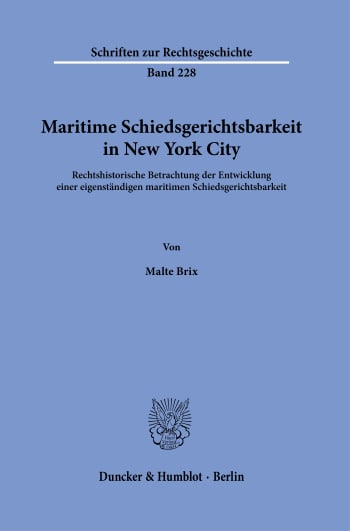
BOOK: Malte BRIX, Maritime Schiedsgerichtsbarkeit in New York City. Rechtshistorische Betrachtung der Entwicklung einer eigenständigen maritimen Schiedsgerichtsbarkeit [Schriften zur Rechtsgeschichte; 228] (Berlin: Duncker & Humblot, 2025), 223 p., ISBN 978-3-428-19344-8

 Cover: Maritime Schiedsgerichtsbarkeit in New York City 

ABOUT THE BOOK:
 
Die private Seehandelsschiedsgerichtsbarkeit hat eine enorme praktische Bedeutung im internationalen Seehandel. Die 1963 gegründete Society of Maritime Arbitrators (SMA) mit Sitz in New York City ist eine bedeutsame Institution in diesem Bereich. Die Arbeit untersucht die Entstehung der eigenständigen maritimen Schiedsgerichtsbarkeit in New York City seit der Kolonialzeit bis heute anhand von bislang noch nicht erforschten Originalquellen und ausgewählten Schiedssprüchen verschiedener Institutionen. Durch die Auswertung des hauptsächlich in den Archiven der New York Historical Society und des New Netherland Institute in Albany aufgefundenen Materials gelingt es, die Zusammenschlüsse von Kaufleuten und die vielfältigen maritimen Handelsbräuche als Ausgangspunkt dieser Entwicklung zu identifizieren. So waren die Arbitration Committees der New York Chamber of Commerce und der New York Produce Exchange die Wegbereiter der Gründung der SMA als eigenständiger Seehandelsschiedsgerichtsbarkeit in New York City.
 
TABLE OF CONTENTS:
 
A. Einführung
Einleitung und Forschungsgegenstand – Quellenlage

B. Die Geschichte des Seehandelsrechts
Erste Überlieferungen des Seerechts und des Seehandels – Das Seehandelsrecht im antiken Griechenland – Das Seehandelsrecht im antiken Rom – Das Seehandelsrecht im Frühmittelalter – Das Seehandelsrecht nach dem Zerfall des Römischen Reiches

C. Die Geschichte der Schiedsgerichtsbarkeit
Das Schiedsgericht im antiken Griechenland – Die Schiedsgerichtsbarkeit und der Zivilprozess im römischen Recht – Die Entwicklung der Schiedsgerichtsbarkeit seit dem Mittelalter

D. Die Entwicklung einer maritimen Schiedsgerichtsbarkeit in New York City
Die niederländische Kolonialzeit – Die englische Kolonialzeit – Die New York Chamber of Commerce – Die New York Produce Exchange – Die Society of Maritime Arbitrators

E. Die gegenwärtige Bedeutung der maritimen Schiedsgerichtsbarkeit
Die gegenwärtige Bedeutung der Schiedsgerichtsbarkeit für den internationalen Seehandel – Die gegenwärtige Bedeutung der SMA im Seehandel

F. Gesamtergebnis
Die Entstehung einer maritimen Schiedsgerichtsbarkeit in New York City – Die Handelsplätze als Ausgangspunkt – Die Bedeutung der Handelsbräuche und die lex mercatoria – Ausblick
 
Find more here

22 January 2026

BOOK: Robert SCHÜTZE & Mathias SIEMS (eds.) Comparative International Law. Foundations and Critique (London: Bloomsbury, 2026), 360 p. ISBN 9781509972395, 95 GBP


(image source: Bloomsbury)

Abstract:

The modern field of comparative international law emerged in the last century, but it still suffers from a lack of intellectual and methodological foundations. This ambitious collection fills that gap. It examines the key concepts of comparative international law, including its historical and critical perspectives. Contributors from a wide geographical range present their diverse and thought-provoking views on international and comparative law. This is a much-needed and cutting-edge book on an undervalued yet topical field of research.

Table of contents:

 Part I: Setting the Scene

1. Comparative International Law: State of the Art, Mathias Siems (European University Institute, Italy)
2. Comparative International Law: A Historical Re-Construction, 3. 'African' International Law, 4. 'American' International Law, 5. China's Contemporary Approach to International Law, 6. 'European' International Law: European Exceptionalism and Universalism in the Nineteenth-Century, 7. The Islamic Conception of International Law, 8. Is Comparative International Law Really Comparative Law? A Methodological Critique, 9. Comparative International Law: What's Next? 10. Decolonising the Comparative Metrics of (Private) International Law,11. Science in Comparative International Law, 12. Quantitative International Comparisons: A Tale of Missed Encounters, 13. Global Law and Comparative International Law,

Read more here

15 December 2025

CALL FOR PAPERS: Global Law and Particular Legalities: Essays in Honour of William Twining (special issue in "The Journal of Comparative Law"; DEADLINE 9 JAN 2026)


(Image source: Lawbook Exchange)

When William Twining passed away on 9 October 2025, the global legal academy lost one of its most original and eclectic thinkers. Twining was a scholar of extraordinary range, leading debates not only within comparative law and comparative legal studies, but also within general jurisprudence, legal history, socio-legal studies, and the law of evidence. He argued passionately for legal scholarship as an open and inclusive enterprise, frequently magnifying voices from the Global South and fiercely critiquing what he saw as an over-reliance upon Anglo-American assumptions and perspectives within the academic writing of his peers. Twining can be credited not only with the meteoric rise of the ‘Law in context’ movement, but also with the expansion of general jurisprudence and the philosophy of law into fields such as legal pluralism and law and globalisation. For Twining, law was both everywhere and always from somewhere in particular. 

This special issue is dedicated to these, and other aspects, of Twining’s towering legacy. The guest editors invite the submission of abstracts of no more than 250 words by 9 January 2026, with an expectation that, if initially accepted, complete papers will be delivered no later than 30 June 2026, for final review and publication within the Journal of Comparative Law. Completed papers should be no more than 10,000 words, including footnotes. Submissions may concern any aspect of Twining’s intellectual or pedagogical legacy, however, the guest editors would particularly welcome abstracts and papers engaging with the following, either alone or in combination:

  • Comparative law and comparative legal studies as intellectual disciplines.
  • General jurisprudence, understood as both a descriptive and an inclusive enterprise.
  • Law both about, and within, the Global South.
  • Law, empire, and imperialism.
  • Law as a global and transnational phenomenon.
  • ‘Law in context’ as method and methodology.
  • Legal and normative pluralism.
  • Legal pedagogy and law teaching from a comparative perspective.
  • Legal realism in historical and comparative perspective(s).
  • Socio-legal studies and its connection(s) to comparative law.
  • The law of evidence in comparative perspective(s).

Abstracts are particularly welcome from scholars from the Global South, as well as from early career academics and colleagues with backgrounds otherwise under-represented within the academy. Initial submissions should be sent, together with a short biography of no more than 150 words, to Prof. Alex Green at aggreen@cuhk.edu.hk.


Guest Editors:

  • Prof. Alex Green (文浩航), Associate Professor, Chinese University of Hong Kong; Academic Associate, 23ES Chambers (London and Manchester)
  • Prof. Jennifer Hendry (文林言), Professor, Chinese University of Hong Kong; Academic Associate, 23ES Chambers (London and Manchester)

05 December 2025

BOOK REVIEW: William BARBEY on Elgar encyclopedia of comparative law edited by Jan M. Smits, Jaakko Husa, Catherine Valcke and Madalena Narciso (Comparative Legal History, XIII (2025), nr. 2)

(Image source: Taylor&Francis)

Reviewing a collective work, an encyclopaedia no less, is not an easy task. How do you start your reading? Is one supposed to read it from cover to cover, from the first to the last entry in the order of print? Or is one to focus on the most important entries (and in that case how does one select them)? Put in another way: how can a single reviewer do justice to the work of more than 200 eminent scholars?
I once read that in order to criticise a book, you do not have to read all of it: like the cooking of a steak, one bite is all it takes to tell if the chef was off his game. Nonetheless if the dish is properly made, and if you enjoy even your greens, you will probably be more than tempted to order a pudding.
Not entirely sure of the merit of such a method, I narrowed down a few entries (as if selecting from a menu) according to my own fields of interests (eg ‘comparative jurisprudence’, ‘legal families’, ‘legal history and comparative law’, ‘codification’, ‘estoppel’, ‘trust law’, ‘subjective right(s)’) and out of curiosity (eg ‘Islamic law’, ‘gift’, ‘Iceland’). And so, I dived right into it – just to see if it would satisfy my appetite.
After a while, the many cross-references guided me towards more and more new entries I had at first neglected. And being in the habit to look up words in a (printed) dictionary only to forget the one word I was looking for in the first place (having encountered numerous more interesting definitions in the meantime), I ended being quite astray from my original path, transported to other times and other places: ‘Constitutional Court (Germany)’, ‘lex mercatoria’, ‘Europe small jurisdictions (Andorra, Liechtenstein, Monaco)’, ‘supervening events and force majeure’.
For a scholar, to be lost in the material is not a curse but a gift. It is the very essence of comparative research: discovering and revealing connections between per se unrelated themes or jurisdictions. One has to be curious and willing to confront oneself to unknown territories (‘it is simply impossible to master all methods that are needed in order to explore all the law at all times and places’, writes Agustín Parise, vol 1, 359). Above all it demands to go beyond one’s comfort zone.

To read the full review, please click here. Online access is free for members of the European Society for Comparative Legal History.

DOI: 10.1080/2049677X.2025.2580119


07 October 2025

ADVANCE ARTICLE: Kevin BYRNE KELLER, "From Legal Transplants to Policy Irritants: Chinese Economic Expansion and Global Legal Change " (The American Journal of Comparative Law 2025)


(image source: OUP)

Abstract:


Since the 1970s, comparative law scholars have studied “legal transplants”: legal institutions that emerged in one location and then were moved to (or forced upon) another. This research agenda offers little traction on one of today’s most pressing questions of global legal change. For several decades, Chinese leaders have encouraged Chinese enterprises to increase their international engagement. Those leaders insist that they have no desire to alter the legal systems of their economic partners, but China’s growing global economic presence does seem to affect legal systems elsewhere. To make sense of this pattern, this Article draws on and extends Gunther Teubner’s concept of a “legal irritant.” It introduces the idea of a “policy irritant”: a policy that a country implements, inspired by policies elsewhere, that places pressure on and potentially reshapes the country’s legal regime. To demonstrate how the concept of a policy irritant improves our understanding of theoretical questions about legal change and concrete questions about current global conflicts, this Article offers a case study of the Madaraka Express, a China-funded railroad project in Kenya. From a theoretical perspective, the Article makes two contributions to the literature on legal transplants. First, it reveals that policy emulation can catalyze legal change. Second, it observes that policy emulation can result in changes both to the recipient legal system and to the policy being emulated. At a more concrete level, the Article offers two insights into China’s engagement with the Global South. First, the introduction of China-inspired policies caused controversy in Kenya not because those policies were inherently insidious, but because they rubbed roughly against features of Kenya’s legal system that many Kenyans value highly. Second, Kenya’s legal system has shown strength in the face of pressures introduced by China-inspired policies, and has in some instances forced changes in those policies.

Read more here: DOI  10.1093/ajcl/avaf021.

(source: Legal History Blog)

26 February 2025

BOOK: Andrew J. BELL & Joanna MCCUNN, Uncertainty in Comparative Law and Legal History. Known Unknowns [Transforming Legal Histories, eds. Lydia HAYES, Katie RICHARDS, Russell SANBERG & Sharon THOMPSON] (London: Routledge, 2024), 346 p. ISBN 9781032873756, 116 GBP


Abstract:

Laws are imposed on facts. But what is the law to do when its rules for establishing facts do not—because they cannot—produce a satisfactory answer? Scenarios that raise this intractable uncertainty problem have been treated as isolated concerns, but are in fact endemic across legal systems. They can cross jurisdictional and doctrinal boundaries, have recurred throughout history, and demand creative thinking from those faced with them. This book explores the law’s understandings of and responses to such situations from a comparative historical perspective. It investigates how the law has framed these most difficult problems of uncertainty; dealt with uncertainty’s often unclear boundaries; and developed a broad range of different responses to solve or avoid it, across doctrine, time, and jurisdiction. The work examines a selection of key uncertainty problems across private law as elements of a singular uncertainty issue endemic in legal systems. This analysis will be of interest to historians and comparatists, but also to doctrinal, theoretical, and other scholars and practitioners. The analysis leaves us better informed and better equipped for dealing with future scenarios where uncertainty arises, including insights beyond national and doctrinal confines.
Table of contents:

. Known unknowns: uncharted waters

Andrew J. Bell and Joanna McCunn

PART 1: Life and death

2. ‘In the beginning’: dealing with ‘unknowns’ at the start of life

Gwen Seabourne

3. Commorientes: deaths, disasters, disappearances

Andrew J. Bell

4. The subtle conclusion: epistemic uncertainty and law at the end of life

C.P. McGrath 

PART 2: Causation and loss

5. Causal uncertainty in tort law: the special case of mesothelioma

Ken Oliphant

6. Known unknowns: loss of a chance and intractable connections

Samantha Schnobel and Judith Skillen

7. Quantifying or avoiding the unknown? Damages for future lost earnings in tortious personal injury cases

David Messner-Kreuzbauer

PART 3: Meanings and intentions

8. Contractual interpretation and ad hominem rules of construction

Joanna McCunn

9. Unmixing intangible assets

Benjamin Douglas and Lorenzo Maniscalco

PART 4: Broader perspectives on law and uncertainty

10. A spectrum of uncertainty

Matthew Dyson

11. Known unknowns in Roman law: the second chapter of the lex Aquilia

David Ibbetson

PART 5: Conclusions

12. Known unknowns: tracing a map

Andrew J. Bell and Joanna McCunn


Editors:
Andrew J. Bell is a Lecturer in Law at the University of Bristol, UK, and a Fellow of the European Centre of Tort and Insurance Law. Joanna McCunn is a Senior Lecturer in Law at the University of Bristol, UK.
Read more here.

29 January 2025

RESEARCH MASTER CLASS: Oxford IECL Research Masterclass for Graduate Students (SEP 2025; DEADLINE 21 MAR 2025)


(image source: IECL)

September 2025

The Institute of European and Comparative Law at the Faculty of Law, University of Oxford, is running the second year of its Research Masterclass for graduate research students working in the Institute’s fields of European Law, Comparative Law and Competition Law in September 2025.
 

What the course offers:

  1. 12 small group seminars with leading academics from Oxford and beyond discussing the methodology of research in European, Comparative and Competition Law;
  2. Desk-space in the IECL from 1 September to 26 September;
  3. Research opportunities using the University of Oxford’s library and online resources: online from 1 August to 31 October;
  4. Accommodation available from Corpus Christi College (Lampl Building) at preferential rates for 30 August to 28 September (approx. £48 pppn);
  5. Dinner in an Oxford College and lunches normally accompanying seminars;
  6. Networking opportunities with current Oxford Graduate students: you will be paired with an Oxford student in a similar or related field as well as being able to work with the whole cohort;
  7. A certificate of completion.

Cost

The course costs £800, with accommodation to be paid separately (College accommodation at a
reduced rate is offered but not required) and most meals are paid separately. We have kept costs down
as far as possible and are not in a position to offer fee waivers or other discounts.

Eligibility

To be eligible you must be a graduate research student in law working on European Law, Comparative
Law and/or Competition Law. Places are limited.

How to apply

Please send a single document, describing your research project in no more than 200 words, and a CV, in total not more than 4 sides of A4 (font size 12) addressed to the IECL Administrator, on administrator@iecl.ox.ac.uk as soon as possible and no later than 4pm BST 21 March 2025. Decisions will be taken soon after that. An offer to take part is conditional on paying the course fee. 

Note

The IECL will issue an invitation letter. However, we cannot assist with immigration requirements or travel arrangements; those are the responsibility of the attending student.

Further details of the structure of the course are below. We look forward to welcoming you to Oxford!

Matthew Dyson
Professor of Civil and Criminal Law
Director of the IECL

Course Structure

The Research Masterclass is designed to give you space to work on your own research collaboratively and develop your methods further through structured sessions with leading academics. Those sessions happen three times a week over the four weeks. Each session will involve the academic picking a piece of work, set in advance, which the students will have access to (or a part of it), and discussing the methods used, the decisions made, and the impact evident, from conception to completion. While all four weeks have that basic patter, each week has an emphasis. Outside of the seminars, participants are free to work at their desk in the seminar room, in one of Oxford’s world-leading libraries or elsewhere.

Week 1. Research Choices: seminars focus on methodology needed before research begins.

Week 2. Research Execution: seminars focus on case studies of academics’ work.

Week 3. Research Challenges: seminars focus on problems researchers have faced.

Week 4. Research Outputs: seminars focus on writing, and presenting, research.

Academics involved so far (subject to change)

Prof Matthew Dyson (Comparative Law)
Prof Ariel Ezrachi (Competition Law)
Prof Liz Fisher (Comparative Public Law)
Prof Son Bui (Asian Law)
Dr Johannes Ungerer (Conflicts of Laws)
Prof Iyiola Solanke (EU Law)
Prof Angus Johnston (EU Law)
Prof Sanja Bogojevic (EU Law)
Prof Birke Haecker, Bonn (Comparative legal history)
Prof Laura Carlson, Stockholm (Comparative law and equality law)

Learning Outcomes

  • Make progress analysing and clarifying an abstract question, grasping and critically comparing different approaches to answering it, and developing an approach of your own;
  • Increase skills in building and taking apart complex arguments for and against a position;
  • where necessary, be able to put difficult historical texts produced within a historical context;
  • improve on constructing significant pieces of writing that provide a clear overview of a subject and a sustained independent argument about it, presented in a lucid, objective and scholarly manner
  • advance towards excellent oral presentation;
  • develop time management skills; and
  • make more effective use of libraries, information technology and other sources of information.
Read more here.

13 December 2024

ADVANCE ARTICLE: Fernanda PIRIE, "Global Comparative Law?" (Oxford Journal of Legal Studies, 2024) [OPEN ACCESS]

(image source: OUP)


Abstract:

The Cambridge Handbook of Comparative Law, edited by Matthias Siems and Po Jen Yap, continues recent calls to expand the field of comparative law. By including authors drawn from all parts of the world, it presents ‘new perspectives’ on the field. This wide geographic remit proves successful as a way of moving beyond traditional ‘families’ and doctrinal topics. The contributors raise new themes for comparison, many related to public law and processes of change. But this, in turn, raises questions about the purposes of expanding the field. The volume largely concerns the laws and legal issues of modern states, and the authors do not venture far into history. Nor do they consider the alternatives offered by religious and traditional legal systems or forms of non-state ordering. I suggest that these subjects could productively expand the field even further, raising more theoretical questions about what law is and does.

Read more here

17 June 2024

BOOK: William E. BUTLER & Oleksiy KRESIN (eds.), The World Picture of Comparative Law (Clark, NJ: Talbot Publishing, 2024). ISBN: 9781616196905, pp. 694, $185.


ABOUT THE BOOK

A title in the JCL Studies in Comparative Law, Second Series. 

Every discipline perceives and constructs the world in its own way, structuring an aspect of reality and developing a research program and methodology with a specific vision that forms a special world picture of the discipline. The essays in this volume address the dialectics of the individual, national or other legal systems, the particular/common, and the (non)existence of the general/global, as the basis of a comparative law world picture, presenting for the first time its complex philosophical and historical vision. The view of law as a "national" discipline disregarded the law of nations and non-Western realities and the interaction of state legal orders with other normative orders. As shown here, a paradigmatic change is underway as awareness of this larger picture takes root. 

ABOUT THE EDITORS

William E. Butler is the John Edward Fowler Distinguished Professor of Law, Dickinson School of Law, Pennsylvania State University; Emeritus Professor of Comparative Law, University of London (University College London); Foreign Member, National Academy of Sciences of Ukraine and National Academy of Legal Sciences of Ukraine. 

Oleksiy Kresin is a leading Ukrainian comparative lawyer; Head, Center of Comparative Jurisprudence, Koretsky Institute of State and Law, National Academy of Sciences of Ukraine; Secretary-General, Ukrainian Association of Comparative Jurisprudence; President, Ukrainian National Committee, International Association of Legal Sciences; Associate, International Academy of Comparative Law.


More information with the publisher.

16 January 2024

CALL FOR BLOGPOSTS: Cross-Jurisdictional Dialogues in the Interwar Period (British Association of Comparative Law)

(image source: BACL)


Call:

The British Association of Comparative Law (BACL) is pleased to announce a call for the 2023-2024 cycle of its “Cross-jurisdictional dialogues in the Interwar period” series, which shines a light on less-known legal transfers in the Interwar period which have played an important role in the advancement of the law.

BACL ran the first season of the series during the 2022-2023 academic year – the pieces, which belong to it, can either be accessed by clicking on the hashtag “#Series_Interwar_Dialogue” or by selecting the “Interwar Dialogue” category on the BACL Blog.

BACL is interested to consider for publication stories of legal transfers from all over the world. The call is not limited to a single legal discipline either. During the first season of the series, BACL published contributions concerning the laws of Australia, Austria, China, Greece, Ibero-America, Italy, Poland, and Yugoslavia. Moreover, these blog pieces encompass Interwar dialogues in private law, administrative law, constitutional law, criminal law, and human rights law.

The inspiration behind the series and the requirements for submission can be found below.

The period between World War I and World War II was characterised by vigorous debates and legal innovation in response to extreme social and economic challenges. This was a time of disillusionment with well-established paradigms and legislative models, but also a time of hope in which comparative dialogue and exchange of ideas between jurisdictions thrived. Some of these exchanges have had a long-lasting impact both on doctrinal and legislative development, but not all stories are well-known. For more details about the background of our series, please read R. Vassileva’s piece on “Interwar Dialogues and the Patterns of Legal Change”. 

Some of the questions we are interested to hear about in the 2023-2024 season of the series include:

  • Do you know of intellectual giants of their time who have served as bridges between different legal cultures, ultimately becoming key agents of legal change, and whose legacy deserves more attention?
  • Are there intellectual hubs that have channeled pivotal comparative dialogue, but whose significance has been underestimated?
  • What factors gather scholars together? To what extent do academic friendships play a role in law development? Do formal or informal networks have a decisive impact on comparative dialogues?
  • For legal ideas to travel during the Interwar period, jurists needed to physically travel, too. However, jurists may have different motivations to cross borders – these personal choices make all the difference and may provide insights on the conditions that trigger legal change. What do such episodes tell us about the mobility, relatability, and translatability of legal ideas? Is the notion of “travel”, which encompasses both time and space, rather than “transfer” more helpful in understanding the complexity of the exchanges between jurisdictions?
  • What factors shape legal identity and, respectively, determine the type of legal transfers that a given legal system embraces and/or rejects?
  • Many of the pieces, which BACL published in the 2022-2023 cycle of the series, seem to indicate that legal transfers are facilitated by windows of opportunity conditioned by the unique concurrence of diverse factors. The concomitance of the (geo)political context, the socio-economic challenges, the backgrounds and aspirations of the individuals involved who could make a difference, etc. create fleeting opportunities for lasting legal change to take place. If that is indeed the case, what do unique windows of opportunity that facilitated legal transfers tell us about the bigger picture of law development? Can they inform the important theoretical work on legal development which has already been carried out?
  • Overall, do you know of fascinating stories of how cross-jurisdictional dialogues between World War I and World War II that have impacted law development? You can focus on one legal principle, the work of a scholar or a group of scholars, or provide a general overview of how cross-jurisdictional dialogue has impacted a legal system that you research.   

Please note that BACL is interested in receiving submissions discussing legal transfers in different fields – private law, public law, constitutional law, criminal law, etc.

 Submission requirements

  • Deadline for the 2023-2024 seasonBACL will accept pieces for consideration until 10 November 2023.   
  • BACL encourages early submissions.
  • Please send blog piece to Dr Vassileva r.vassileva[at]mdx.ac.uk, copying Prof Marique ymarique[at]essex.ac.uk (co-editors of the series).
  • The blog piece should be ca 2,000 words and in excellent English. By exception, longer pieces may be accepted.
  • Please provide a title and focus for your blog piece, and your affiliation.  
  • Please use hyperlinks instead of footnotes or include references in the text itself.
  • Please use headings for the different parts of your blogpost.
  • Pictures to illustrate the text are welcome. Please provide their credits.  
  • BACL encourages prospective authors to take a look at the pieces which have already been published in this series by clicking on the hashtag “#Series_Interwar_Dialogue” or by selecting the “Interwar Dialogue” category on the BACL Blog in order to gain a better idea of what is expected.
  • Please feel free to contact the editors informally to test your ideas prior to submission.
  • BACL reserves the right to demand corrections and to reject submissions which do not address the call or which do not meet its publication standards.

Further information here

12 December 2023

SYMPOSIUM: Les relations entre le droit comparé, l’identité nationale et le colonialisme (Brussels: University Foundation (and online), 13 DEC 2023)


On Wednesday, 13 December 2023, the comité de redaction of the Revue de droit international et de droit comparé will be hosting a hybrid event to celebrate the 100th issue of the journal. It will be dedicated to Les relations entre le droit comparé, l’identité nationale et le colonialisme.

Program:

17h30 : Accueil, par Guy Keutgen, directeur de la Revue 

    17h40 : Présentation du numéro spécial et des orateurs, par Wim Decock et Henri Culot, coordinateurs du numéro spécial
      17h50 :  « Pour un droit comparé décolonial », par Lena Salaymeh, professeure, University of Oxford et École Pratique des Hautes Études (Paris Sciences et Lettres)
        18h10 : « L’ethnoconstitutionnalisme : signification et limites », par Éric M. Ngango Youmbi, professeur, Université de Garoua (Cameroun)
          18h30 : Conclusion, par Henri Culot, rédacteur en chef de la Revue

          Physical venue:

          Mercredi 13 décembre 2023 à 17h30 Fondation Universitaire - 11, Rue d’Egmont - 1000 Bruxelles Parking : Deux portes Métro : Porte de Namur / Trône – Gare SNCB de Bruxelles-Luxembourg.


          Registration here

          09 June 2023

          RESEARCH MASTER CLASS: Oxford IECL Research Masterclass for Graduate Students (4-29 SEP 2023; DEADLINE 26 JUN 2023)


          (image: Corpus Christi College, Oxford; Source: Wikimedia Commons)

          Oxford IECL Research Masterclass for Graduate Students


          The Institute for European and Comparative Law at the Faculty of Law, University of Oxford, is introducing a Research Masterclass to support graduate research students working in the Institute’s fields of European Law, Comparative Law and Competition Law in September 2023 in Oxford.


          What the course offers:


          1.      12 small group seminars with leading academics from Oxford and beyond discussing the methodology of research in European, Comparative and Competition Law;

          2.      Desk-space in the IECL from 4 September to 29 September;

          3.      Research opportunities using the University of Oxford’s library and online resources: online from 1 August to 31 October;

          4.      Accommodation available from Corpus Christi College at preferential rates for 4 to 30 September (£45 pppn);

          5.      Dinner in an Oxford College and lunches accompanying some seminars;

          6.      Networking opportunities with current Oxford Graduate students: you will be paired with an Oxford student in a similar or related field as well as being able to work with the whole cohort;

          7.      A certificate of completion.


          Cost

          The course costs £750, with accommodation to be paid separately (College accommodation at a reduced rate is offered but not required) and most meals are paid separately. We have kept costs down as far as possible and are not in a position to offer fee waivers or other discounts.


          Eligibility

          To be eligible you must be a graduate research student in law working on European Law, Comparative Law and/or Competition Law. Places are limited.


          How to apply

          Please send a single document, describing your research project in no more than 200 words, and a CV, in total not more than 4 sides of A4 long (font size 12) to Kat Hayward, IECL Administrator, on administrator@iecl.ox.ac.uk as soon as possible and no later than 4pm BST on 26 June 2023. Decisions will be taken soon after that. An offer to take part is be conditional on paying the course fee.


          Note

          The IECL will issue an invitation letter, but cannot assist with immigration requirements or travel arrangements. Those are the responsibility of the attending student.


          Further details of the structure of the course are below.


          We look forward to welcoming you to Oxford!


          Matthew Dyson

          Professor of Civil and Criminal Law

          Director of the IECL

          The Research Masterclass is designed to give you space to work on your own research collaboratively and develop your methods further through structured sessions with leading academics. Those sessions happen three times a week over the four weeks. Each session will involve the academic picking a piece of work, set in advance, which the students will have access to (or a part of it), and discussing the methods used, the decisions made, and the impact evident, from conception to completion. While all four weeks have that basic patter, each week has an emphasis. Outside of the seminars, participants are free to work at their desk in the seminar room, in one of Oxford’s world-leading libraries or elsewhere.


          Week 1. Research Choices: seminars focus on methodology needed before research begins.


          Week 2. Research Execution: seminars focus on case studies of academics’ work.


          Week 3. Research Challenges: seminars focus on problems researchers have faced.


          Week 4. Research Outputs: seminars focus on writing, and presenting, research.


          Academics involved so far (subject to change)

          Prof Matthew Dyson (Comparative Law)

          Prof Ariel Ezrachi (Competition Law)

          Prof Liz Fisher (Comparative Public Law)

          Prof Son Bui (Asian Law)

          Dr Johannes Ungerer (Conflicts of Laws)

          Dr Florian Griesl (Socio-legal studies)

          Prof Iyiola Solanke (EU Law)

          Prof Stefan Enchelmaier (EU Law)

          Prof Angus Johnston (EU Law)

          Prof Sanja Bogojevic (EU Law)

          Prof Birke Haecker, Bonn (Comparative legal history)

          Prof Laura Carlson, Stockholm (Comparative law and equality law)

          Dr Maria Salah, Chile (Comparative law)

          Prof Alec Walen, Rutgers (Legal theory)


          The learning outcomes are aimed to support graduate research students complete their theses:


          • Make progress analysing and clarifying an abstract question, grasping and critically comparing different approaches to answering it, and developing an approach of your own;
          • Increase skills in building and taking apart complex arguments for and against a position;
          • where necessary, be able to put difficult historical texts produced within a historical context;
          • improve on constructing significant pieces of writing that provide a clear overview of a subject and a sustained independent argument about it, presented in a lucid, objective and scholarly manner
          • advance towards excellent oral presentation;
          • develop time management skills; and
          • make more effective use of libraries, information technology and other sources of information.


          02 May 2022

          CFP: Call for Papers for Volume 3, Issue 2 - Central European Journal of Comparative Law (Deadline 31 August 2022)

          (Source: CEJCL)

          CALL FOR PAPERS FOR VOLUME 3, ISSUE 2

          The Editorial Team of Central European Journal of Comparative Law kindly invites researchers, scholars, and university lecturers to submit their scholarly writings to the forthcoming issue (Volume 3, Issue 2) of our journal in the following sections: 1. Issues related to cultural rights, in particular UNESCO and the protection of cultural landscapes, the impact of the pandemic on culture and cultural rights, cultural rights and diaspora communities, food as cultural right; 2. Cultural property: protection regime, current problems of looted or nationalized art.

          These topics are not exclusive. The Editorial Team gladly welcomes manuscripts from all fields of law which are in connection with the journal’s mission. The Central European Journal of Comparative Law (CEJCL) aims at establishing itself as a comparative legal research forum that analyses both private and public law of primarily, but not exclusively, European countries. Manuscripts from the field of political science (e.g. comparative politics) and international relations are also accepted. Both the CEJCL research topics and adopted approach are relevant to the Central European and East Central European region, and hence, it also intends to build its reputation as a major publication within this region. CEJCL prefers thematic issues to advance more straightforward comparability. Ensuring the ‘best practises’ and making different legal solutions available and interpretable to the relevant group of countries is of utmost importance to CEJCL.

          Language: CEJCL exclusively accepts manuscripts that are written in English. The manuscripts submitted that are accepted for publication are proofread by English-language experts, the costs of which are covered by the publisher.

          Length requirements: CEJCL publishes articles that do not exceed 60.000 characters, including spaces. Generally, the manuscripts should be between 40.000 and 60.000 characters.

          Guide for authors, including reference style and citation; peer-review: Please find the detailed guide for authors on the following website: https://ojs3.mtak.hu/index.php/cejcl/guideforauthors. The authors may find more information about the process of peer-review on the following website: https://ojs3.mtak.hu/index.php/cejcl/peerreview.

          Deadline: We ask the authors to be so kind as to submit their manuscripts by 31 August 2022 at the latest. The submission should be sent via e-mail to the following address: comparativelaw@mfi.gov.hu. It should also include the author’s personal data (affiliation, academic degree, position, e-mail address, ORCID number), a brief abstract and 5-7 keywords in a separate document.

          Publication date: The Editorial Team aims to publish the new issue in the second half of 2022.

          16 March 2022

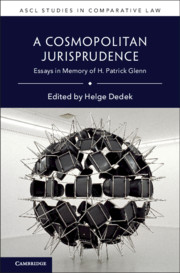
          BOOK: Helge DEDEK (ed.), A Cosmopolitan Jurisprudence. Essays in Memory of H. Patrick Glenn (Cambridge, Cambridge University Press, 2021), ISBN: 978-1108-8-4172-6


          ABOUT THE BOOK

          H. Patrick Glenn (1940–2014), Professor of Law and former Director of the Institute of Comparative Law at McGill University, was a key figure in the global discourse on comparative law. This collection is intended to honor Professor Glenn's intellectual legacy by engaging critically with his ideas, especially focusing on his visions of a 'cosmopolitan state' and of law conceptualized as 'tradition'. The book explores the intellectual history of comparative law as a discipline, its attempts to push the objects of its study beyond the positive law of the nation-state, and both its potential and the challenges it must confront in the face of the complex phenomena of globalization and the internationalization of law. An international group of leading scholars in comparative law, legal philosophy, legal sociology, and legal history takes stock of the field of comparative law and where it is headed.


          ABOUT THE EDITOR

          Helge Dedek is Professor of Law at McGill University and former Director of the McGill Institute of Comparative Law. Since 2014, he serves as Co-Editor-in-Chief of the American Journal of Comparative Law.


          TABLE OF CONTENTS

          • Introduction
            • Where the ‘Real Action’ Is: From Comparative Law to Cosmopolitan Jurisprudence, by Helge Dedek
          • Part I - The Tradition of Comparative Law
            • 1 - How to Do Comparative Law: Some Lessons to Be Learned, by Mauro Bussani
            • 2 - The ‘Comparative Method’ at the Roots of Comparative Law, by Giorgio Resta
            • 3 - The Value of Micro-Comparison, by John Bell
            • 4 - Sociocultural Challenges for Comparative Legal Studies in Mixed Legal Systems, by Esin Örücü
            • 5 - Breaking Barriers in Comparative Law, by Michele Graziadei
          • Part II - The Concept of Tradition
            • 6 - Too Much Information, by Martin Krygier
            • 7 - Legal Systems as Legal Traditions, by Catherine Valcke
            • 8 - Learning from Patrick Glenn: Tradition, Change, and Innovation, by David Nelken
            • 9 - The Sunni Legal Tradition: An Overview of Pluralism, Formalism, and Reform, by Ahmed Fekry Ibrahim
            • 10 - Commensurability, Comparative Law, and Confucian Legal Tradition, by Marie Seong-Hak Kim
          • Part III - Crossing Boundaries
            • 11 - The School of Salamanca: A Common Law?, by Thomas Duve
            • 12 - The Un-Common Law, by Vivian Grosswald Curran
            • 13 - The Fabric of Normative Translation in Law, by Ko Hasegawa
            • 14 - Statehood as Process: The Modern State Between Closure and Openness, by Gunnar Folke Schuppert
            • 15 - Cosmopolitan Attachments, by Neil Walker
          • H Patrick Glenn Publications

          More information can be found here.

          10 March 2022

          CALL FOR PAPERS: Enseigner le droit hors des frontières nationales (XIXe-XXe siècles) (Aix-Marseille, SEPT 2022); DEADLINE 15 MARCH 2022


           3e  journée d’étude : APPEL À COMMUNICATIONS  

          Acteurs et actrices de l’enseignement juridique hors de la métropole 

          Aix-Marseille - septembre 2022 


          Argumentaire 


          Depuis quelques décennies, l’histoire de l’enseignement du droit à l’époque contemporaine est, en France, un chantier en plein essor. En témoigne la création de la Société pour l’histoire des facultés de droit en 1983, qui a permis la coordination et le développement d’un champ de recherches jusqu’alors délaissé. Cependant, cette histoire des facultés de droit est longtemps restée une histoire des doctrines qui y étaient enseignées et des écoles qui s’y affrontaient. Il a fallu attendre une période plus récente pour que l’historiographie se saisisse des lieux de l’enseignement du droit en eux-mêmes, dans le cadre d’une socio-histoire attentive au fonctionnement de l’institution, à son personnel, ses étudiants, ou encore ses ressources budgétaires. Alors que de telles études fleurissaient déjà dans d’autres disciplines (v. par exemple les travaux de Charles, 2004 ; Picard, 2007 ; Singaravelou, 2009 ; Ferté et Barrera, 2010), les initiatives se sont multipliées ces dernières années chez les juristes, parfois en lien avec les débats actuels liés à l’autonomie des universités ou la rénovation de l’enseignement du droit dans un contexte de globalisation (Ancel et Heuschling, 2016 ; Jamin et Van Caeneghem, 2016).  


          Ce renouvellement des approches s’est fréquemment adossé à la question des disciplines juridiques. Il a également emprunté le chemin d’un intérêt pour le collectif enseignant. Siprojuris, la base de données bio-bibliographique des professeurs de droit français entre 1804 et 1950, rassemblant 600 individus, a vu le jour, fruit d’un travail collectif coordonné par Catherine Fillon. Ouvrant de nouvelles perspectives pour l’histoire sociale des élites juridiques, cet important déport prosopographique s’est doublé d’un renouvellement de la biographie intellectuelle des professeurs de droit, désormais moins préoccupée de décréter l’existence de « grands juristes » que de décrypter les mécanismes concrets d’accession à la « grandeur intellectuelle ». Enfin, cette nouvelle histoire des facultés de droit s’est souvent concentrée sur des aires géographiques particulières, ce qui a donné lieu à la création, en 2008, du Réseau européen pour l’histoire de l’enseignement du droit 


          Le progrès de l’histoire de l’enseignement du droit est par conséquent substantiel pour ce qui concerne la période contemporaine. Ce cycle de journées d’études profite de ces nouveaux acquis pour poursuivre le travail déjà accompli en interrogeant un phénomène peu investi jusqu’alors : l’histoire de l’enseignement du droit hors des frontières nationales aux xixe et xxe siècles. Certes, l’époque contemporaine est marquée, par rapport au Moyen Âge, notamment, par une incontestable nationalisation du droit et de son enseignement, amorcée à l’époque moderne. A priori, l’on pourrait penser que le temps des pérégrinations académiques est révolu. À y regarder de plus près, toutefois, rien n’est moins sûr. Empruntant des formes variées, une dilatation certaine de l’espace académique français peut également être observée à l’époque contemporaine (Audren et Halpérin, 2013).  


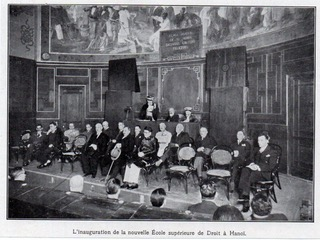
          - Dans le cadre de l’expansion militaire ou coloniale tout d’abord, la métropole entend plaquer son modèle d’enseignement du droit dans le cadre d’institutions dédiées (facultés de droit dans les départements annexés par l’Empire napoléonien ; École de droit d’Alger, expansion universitaire vers le Levant avec les Écoles de droit du Caire ou de Beyrouth, École de droit d’Hanoï, etc.).  


          - En dehors du cadre « autoritaire » des régions militairement occupées ou colonisées ensuite, nombreux sont les professeurs de droit, surtout à partir de l’entre-deux-guerres, à promouvoir le droit français à l’étranger, dans le cadre d’une diplomatie culturelle bien comprise (conférences, cours au sein d’instituts culturels, etc.).  


          Cette appréhension transnationale de l’enseignement du droit se situe par conséquent à l’articulation d’un triple questionnement : la réflexion similaire venue des historiens d’autres disciplines, qui se sont également saisis de cette question ; le tournant historiographique vers l’histoire globale ou connectée, ainsi que vers la question des circulations, qui entend interroger, voire dépasser les cadres nationaux habituellement retenus pour écrire l’histoire ; la problématique actuelle de la dénationalisation/ globalisation de l’enseignement du droit, qui agite la doctrine. 


          Il nous a semblé qu’un tel questionnement relatif à l’enseignement du droit hors des frontières nationales était de nature à combler un vide historiographique important, tout en éclairant certains enjeux actuels de la globalisation de l’enseignement du droit. Par ailleurs, les contributions de collègues étrangers pouvant offrir un éclairage similaire dans leurs pays seront particulièrement appréciées. Ces trois journées d’études ont été divisées thématiquement : 


          1) Lyon, 22 novembre 2018 - « Les lieux et les formes de l’enseignement juridique hors de la métropole » 


          La première journée d’études a été consacrée aux diverses modalités structurelles de l’enseignement du droit en dehors du cadre métropolitain. Si, dans ses colonies, un État peut finir par envisager de créer des facultés calquées sur le modèle de la métropole, il lui faut généralement faire preuve de davantage d’inventivité dans les territoires étrangers demeurés maîtres de leur souveraineté où, par surcroît, il peut être en concurrence avec d’autres États tout aussi désireux de promouvoir leur influence politique et juridique. L’éventail des multiples formes retenues, ponctuelles ou plus pérennes (des tournées de conférences, à la main-mise sur des écoles locales, en passant par la création d’instituts culturels…) méritait d’être précisé, mais aussi cartographié. Où ? Suivant quelles formes ? Selon quels partenariats et avec quels financements ? Ce sont autant de questions auxquelles cette première journée a pu apporter des réponses plus précises.  


          2) Bordeaux, mars 2020 - « Contenu et objectifs de l’enseignement juridique hors de la métropole » 


          La deuxième journée d’études s’est concentrée sur la question des cours de droit dispensés hors de la métropole. Quels sont les objectifs de tels enseignements (former des élites locales ; apporter une connaissance du droit local aux étudiants français ; acculturer les populations conquises au droit français ; promouvoir la « grandeur » du droit français à l’étranger, etc.) ? En fonction des différents desseins de ces cours, leur contenu diffère-t-il ? Enseigne-t-on de la même manière, par exemple, le droit civil français dans les colonies, dans les pays militairement conquis ou encore dans les instituts culturels à l’étranger ? Autrement dit, les professeurs de droit opèrent-ils une adaptation du contenu de leurs cours en fonction du contexte et/ ou du public auquel ils s’adressent ? C’est, par conséquent, la question des modalités intellectuelles de l’enseignement juridique hors de la métropole qui a été abordée.  


          3) Aix-Marseille, septembre 2022 - « Acteurs et actrices de l’enseignement juridique hors de la métropole » 


          Enfin, cette troisième journée d’études s’intéressera aux acteurs et actrices, qu’ils soient enseignant.e.s ou étudiant.e.s. Du côté des professeur.e.s, les questionnements concernent, comme souvent dans les problématiques de l’exil durable ou temporaire, la question des profils, des parcours et des raisons, lorsqu’elles existent, qui encouragent à partir. Quelles sont les motivations de ces enseignant.e.s ? Matérielles ? Personnelles ? Idéologiques ? Qu’est-ce que l’expérience étrangère nous raconte de ces hommes et de ces femmes : est-elle la preuve d’une plus grande ouverture d’esprit ? A-t-elle des incidences sur leur façon de concevoir et d’enseigner le droit ? Peut-elle avoir un sens politique ?... En parallèle, des interrogations similaires se posent pour les étudiant.e.s, en tant qu’individus, mais également en tant que groupes. Les migrations estudiantines peuvent notamment avoir des conséquences sur les équilibres sociaux et culturels des États ou encore sur la circulation des savoirs. Afin de ne pas enfermer ces acteurs du droit dans des spécificités qui pourraient s’avérer trompeuses, nous encourageons fortement leur remise en perspective dans le monde plus global de l’enseignement supérieur, ainsi que les approches comparées.  


          Bibliographie indicative 


          Ancel (P.) et Heuschling (L.) (dir.), La transnationalisation de l’enseignement du droit, Bruxelles, Larcier, 2016. 


          Audren (F.) et Halpérin (J.-L.), La culture juridique française entre mythes et réalités, xixe-xxe siècles, Paris, CNRS éd., 2013. 


          Audren (F.), « Alma Mater sous le regard de l’historien du droit. Cultures académiques, formation des élites et identités professionnelles », dans Krynen (J.) et d’Alteroche (B.) (dir.), L’histoire du droit en France. Nouvelles tendances, nouveaux territoires, Paris, Classiques Garnier, 2014, p. 145-172. 


          Bastier (J.), « L’enseignement du droit à Alger de 1879 à 1914 », dans Nélidoff (Ph.) (dir.), Les facultés de droit de province au xixe siècle, tome 1, Bilan et perspectives de la recherche, Toulouse, Presses de l’Université Toulouse 1 Capitole, 2009, p. 519-542. 


          Charle (Ch.), « Enseignement supérieur et expansion internationale (1870-1930). Des instituts pour un nouvel empire ? », dans Heilbron (J.), Lenoir (R.) et Sapiro (G.) (dir.), Pour une histoire des sciences sociales. Hommage à Pierre Bourdieu, Paris, Fayard, 2004, p. 323-347. 


          Charle (Ch.), Schriewer (J.) et Wagner (P.) (dir.), Transnational Intellectual Networks. Forms of Academic Knowledge and the Search for Cultural Identities, Francfort, New York, Campus, 2004.  


          Falconieri (S.), « Le « droit de la race ». Apprendre l’antisémitisme à la Faculté de droit de Paris (1940-1944) », Clio@themis. Revue électronique d’histoire du droit, n° 7, 2014 (en ligne). 


          Ferté (P.) et Barerra (C.) (dir.), Étudiants de l’exil. Migrations internationales et universités refuges (xvie-xxe s.), Toulouse, Presses universitaires du Mirail, 2010. 


          Fillon (C.), « L’enseignement du droit, instrument et enjeu de la diplomatie culturelle française. L’exemple de l’Égypte au début du xxe siècle », Mil neuf cent. Revue d’histoire intellectuelle, n° 29 [La Belle Époque des juristes. Enseigner le droit dans la République], 2011/1, p. 123-144. 


          Fillon (C.), « Le Jésuite, l’Universitaire et le Politique : stratégies de recrutement du corps enseignant de l’École Française de droit de Beyrouth (1913-1939) », dans Gaven (J.-C.) et Audren (F.) (dir.), Les facultés de droit de province aux xixe et xxe siècles, tome 3, Les conquêtes universitaires, Toulouse, Presses Universitaires de Toulouse 1 Capitole, 2011, p. 115-138. 


          Gaillard (A.-M.) et (J.), Les enjeux des migrations scientifiques internationales. De la quête du savoir à la circulation des compétences, Paris, L’Harmattan, 1999. 


          Gonzalez (C.), « Education and Empire : Colonial Universities in Mexico, India and the United States », Research and Occasional Paper Series, CSHE-Berkeley, 2014 (en ligne). 


          Guerlain L., Juristes voyageurs et fabrique des savoirs. L’exemple des missions du ministère de l’Instruction publique (1843-1934), HDR, vol. inédit, Bordeaux, 2019. 


          Halary (Ch.), Les exilés du savoir. Les migrations scientifiques internationales et leurs mobiles, Paris, L’Harmattan, 1994. 


          Halpérin (J.-L.) (dir.), Paris, capitale juridique (1804-1950). Études de socio-histoire sur la Faculté de droit de Paris, Paris, Éditions rue d’Ulm, 2011. 


          Jamin (Ch.) et Van Caenegem (W.) (dir.), The Internationalisation of Legal Education, Switzerland, Springer, 2016. 


          Outre-Mers. Revue d’histoire, t. 105, n° 394-395 [Enseignement supérieur et universités dans les espaces coloniaux : histoire, comparaisons (du xixe siècle aux indépendances)], 2017, coordonné par Hélène Charton et Marc Michel. 


          Picard (E.), « Étudiants et enseignants : du dossier individuel à la prosopographie », Revue administrative, 2007, p. 55-58 (en ligne). 


          Ponthoreau (M.-Cl.) (dir.), La dénationalisation de l’enseignement juridique. Comparaisons des pratiques, Paris, Institut Universitaire Varenne, coll. « Colloques & Essais », 2016. 


          Renucci (F.), « La doctrine coloniale en République. L’exemple de deux jurisconsultes algériens : Marcel Morand et Emile Larcher », dans J.-L. Halpérin et A. Stora-Lamarre (dir.), La République et son droit (1870-1930), Besançon, Presses Universitaires de Franche Comté, 2011, p. 461-478 (en ligne). 


          Renucci (F.), « Écrire autrement la rencontre entre droit et sociologie. L’apport du terrain colonial », dans A.-S. Chambost (dir.), Approches culturelles des savoirs juridiques, Paris, Lextenso, 2020, p. 47-72 (en ligne). 


          Renucci (F.) (dir.), Dictionnaire des juristes. Colonies et Outre-mer ultramarins (xviiie-xxe siècles), Rennes, PUR, 2022. 


          Singaravelou (P.), « L’enseignement supérieur colonial. Un état des lieux », Histoire de l’éducation, 122/2009, p. 71-92 


          Tronchet (G.), Savoirs en diplomatie. Une histoire sociale et transnationale de la politique universitaire internationale de la France (années 1870-années 1930), thèse de doctorat en histoire contemporaine, Université Paris 1 Panthéon-Sorbonne, 2014. 


          Pour dernière journée d’Aix-Marseille, les propositions de communication, accompagnées d’un bref CV, sont à envoyer aux quatre organisatrices pour le 15 mars 2022 


          Comité d’organisation 


          Silvia Falconieri (chargée de recherches CNRS, IMAF) : silviafalconieri@gmail.com  

          Catherine Fillon (professeur, Université Jean Moulin Lyon III) : catherine.fillon@univ-lyon3.fr 

          Laetitia Guerlain (professeur, Université de Bordeaux) : laetitia.guerlain@u-bordeaux.fr 

          Florence Renucci (directrice de recherches CNRS, IMAF) : florence.renucci@univ-amu.fr 


          Comité scientifique 


          Frédéric Audren (directeur de recherches CNRS, École de droit de Sciences Po) 

          Isabelle Giraudou (professeur associée, Université de Tokyo) 

          Jean-Louis Halpérin (professeur, ENS) 

          Béatrice Jaluzot (maître de conférences, Sciences Po Lyon) 

          Emmanuelle Picard (maître de conférences, ENS Lyon) 

          Guillaume Tronchet (chercheur affilié à l’IHMC, ENS-Paris 1)