Search

Showing posts with label history of arbitration. Show all posts

29 January 2026

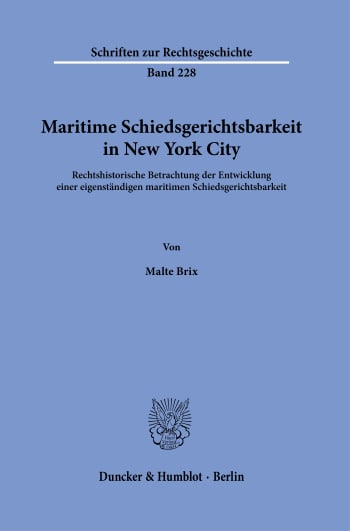
BOOK: Malte BRIX, Maritime Schiedsgerichtsbarkeit in New York City. Rechtshistorische Betrachtung der Entwicklung einer eigenständigen maritimen Schiedsgerichtsbarkeit [Schriften zur Rechtsgeschichte; 228] (Berlin: Duncker & Humblot, 2025), 223 p., ISBN 978-3-428-19344-8

 Cover: Maritime Schiedsgerichtsbarkeit in New York City 

ABOUT THE BOOK:
 
Die private Seehandelsschiedsgerichtsbarkeit hat eine enorme praktische Bedeutung im internationalen Seehandel. Die 1963 gegründete Society of Maritime Arbitrators (SMA) mit Sitz in New York City ist eine bedeutsame Institution in diesem Bereich. Die Arbeit untersucht die Entstehung der eigenständigen maritimen Schiedsgerichtsbarkeit in New York City seit der Kolonialzeit bis heute anhand von bislang noch nicht erforschten Originalquellen und ausgewählten Schiedssprüchen verschiedener Institutionen. Durch die Auswertung des hauptsächlich in den Archiven der New York Historical Society und des New Netherland Institute in Albany aufgefundenen Materials gelingt es, die Zusammenschlüsse von Kaufleuten und die vielfältigen maritimen Handelsbräuche als Ausgangspunkt dieser Entwicklung zu identifizieren. So waren die Arbitration Committees der New York Chamber of Commerce und der New York Produce Exchange die Wegbereiter der Gründung der SMA als eigenständiger Seehandelsschiedsgerichtsbarkeit in New York City.
 
TABLE OF CONTENTS:
 
A. Einführung
Einleitung und Forschungsgegenstand – Quellenlage

B. Die Geschichte des Seehandelsrechts
Erste Überlieferungen des Seerechts und des Seehandels – Das Seehandelsrecht im antiken Griechenland – Das Seehandelsrecht im antiken Rom – Das Seehandelsrecht im Frühmittelalter – Das Seehandelsrecht nach dem Zerfall des Römischen Reiches

C. Die Geschichte der Schiedsgerichtsbarkeit
Das Schiedsgericht im antiken Griechenland – Die Schiedsgerichtsbarkeit und der Zivilprozess im römischen Recht – Die Entwicklung der Schiedsgerichtsbarkeit seit dem Mittelalter

D. Die Entwicklung einer maritimen Schiedsgerichtsbarkeit in New York City
Die niederländische Kolonialzeit – Die englische Kolonialzeit – Die New York Chamber of Commerce – Die New York Produce Exchange – Die Society of Maritime Arbitrators

E. Die gegenwärtige Bedeutung der maritimen Schiedsgerichtsbarkeit
Die gegenwärtige Bedeutung der Schiedsgerichtsbarkeit für den internationalen Seehandel – Die gegenwärtige Bedeutung der SMA im Seehandel

F. Gesamtergebnis
Die Entstehung einer maritimen Schiedsgerichtsbarkeit in New York City – Die Handelsplätze als Ausgangspunkt – Die Bedeutung der Handelsbräuche und die lex mercatoria – Ausblick
 
Find more here

22 September 2021

COLLOQUIUM: Why Arbitration? - History, Theory & Practice (Oxford, 1 October 2021)


The Centre for Theology, Law, and Culture is hosting a colloquium on the history of arbitration next week. The event can be attended digitally by sending an e-mail to Jonathan.Price@stx.ox.ac.uk

03 February 2021

BOOK: Art HINSHAW, Andrea KUPFER SCHNEIDER & Sarah R. COLE, Discussions in Dispute Resolution : The Foundational Articles (Oxford: OUP, 2021). ISBN 9780197513248, 74.27 EUR


(Source: Bookdepository)

OUP is publishing an edited collection on foundational articles in alternative dispute resolution.

ABOUT THE BOOK

While arbitration was robust in colonial and early America, dispute resolution lost its footing to the court system as the United States grew into a bustling and burgeoning country. And while dispute resolution processes emerged briefly from time to time, they were dormant until the enactment of the Federal Arbitration Act and collective bargaining grew out of the labor movement. But it wasn't until 1976, when Frank Sander delivered his famous remarks at the Pound Conference, that the modern dispute resolution movement was born. By the year 2000, alternative dispute resolution had transformed from a populist rebellion against the judicial system to mainstream legal practice. Today, lawyers and retiring judges look to arbitration and mediation for a career pivot, and law schools train law students in the finer arts of dispute resolution practice as both providers and advocates. Discussions in Dispute Resolution brings together the modern dispute resolution field's most influential commentaries in its first few decades and reflects on what makes these pieces so important. This book collects 16 foundational writings, four pieces from each of the field's primary subfields--negotiation, mediation, arbitration, and public policy. Each piece has four commenters who answer the question: why is this work a foundational piece in the dispute resolution field? The purpose in asking this simple question is fourfold: to hail the field's foundational generation and their work, to bring a fresh look at these articles, to engage the articles' original authors where possible, and to challenge the articles with the benefit of hindsight. Where possible, the book gives the authors of the original pieces the opportunity either to reflect on the piece itself or to respond to the other commenters.


ABOUT THE EDITORS

Art Hinshaw is the John J. Bouma Fellow, the Founding Director of the Lodestar Dispute Resolution Center, and a Clinical Professor of Law at the Sandra Day O'Connor College of Law at Arizona State University. Professor Hinshaw's scholarship focuses on mediation and negotiation theory and practice, and he is a co-author on the 6th edition of the classic textbook Dispute Resolution & Lawyers: A Contemporary Approach and author of numerous articles and book chapters. Currently he is a member of the ABA's Standing Committee on Mediator Ethical Guidance and a regular contributor to Indisputably: the ADR Prof Blog. He is a former member of the Arizona Commission on Judicial Conduct.

Andrea Kupfer Schneider is a Professor of Law, the inaugural director of the Institute for Women's Leadership at Marquette University and the Director of the law school's nationally ranked dispute resolution program. She frequently publishes law review articles and book chapters on negotiation, gender, and international conflict and has co-authored several leading legal textbooks on ADR, Negotiation, Mediation and Plea Bargaining. Andrea is a founding editor of Indisputably, the blog for ADR law faculty and started the Dispute Resolution Works-in-Progress Annual Conference in 2007. She was named 2009 Woman of the Year by the Wisconsin Law Journal and, in 2016, gave her first TEDx talk entitled Women Don't Negotiate and Other Similar Nonsense. She was named the 2017 recipient of the ABA Section of Dispute Resolution Award for Outstanding Scholarly Work.

Sarah Rudolph Cole is the Michael E. Moritz Chair in Alternative Dispute Resolution, Moritz College of Law, Ohio State University; Professor Cole clerked on the Ninth Circuit for Eugene A. Wright. She practiced labor and employment law and was on the faculty at Creighton University School of Law before joining the Moritz faculty in 1998. She is co-author, with Nancy Rogers, James Coben, Peter Thompson and Craig McEwen of Mediation: Law, Policy and Practice and Dispute Resolution: Negotiation, Mediation and Other Processes with Nancy Rogers, Stephen Goldberg and Frank Sander. She is the director of the Program on Dispute Resolution at Moritz. In 2013, Ohio State awarded her the Alumni Award for Distinguished Teaching. She serves on arbitration and mediation panels for AAA and the State of Ohio and visited at Harvard Law School in Fall 2019.

More info here

03 August 2020

BOOK: Wolfram BUCHWITZ, Schiedsverfahrensrecht in Antike Und Mittelalter - Eine Historische Grundlegung (Göttingen: Vandenhoeck & Ruprecht, 2020). ISBN 978-3-412-51933-9, 60,00 EUR


Vandenhoeck & Ruprecht is publishing a new book on arbitration during Antiquity and the Middle Ages.

ABOUT THE BOOK

Schiedsverfahren waren auch in Antike und Mittelalter verbreitete Mittel der außergerichtlichen Konfliktlösung. Das römische Recht hat viele konzeptionelle Grundlagen gelegt, auf denen spätere Epochen aufgebaut haben. Aus dem Mittelalter stammt die Einbettung in das Verfahrensrecht. Auf diesen historischen Vorläufern beruhen selbst noch einige Grundsätze des modernen Schiedsverfahrensrechts. In diesem Buch wird ein weiter Bogen geschlagen, der erstmalig die entsprechenden Unterschiede, Gemeinsamkeiten und Entwicklungslinien aufzeigt. Dabei werden die wichtigsten epochenübergreifenden dogmatischen Fragen des Schiedsverfahrensrechts thematisiert, aber auch die in der Praxis entwickelten Vertragsformulare in die Deutung mit einbezogen. Zeitlich umfasst die Darstellung die Periode vom 1. Jahrhundert v.Chr. bis zum 13. Jahrhundert n.Chr.

ABOUT THE AUTHOR

Wolfram Buchwitz ist Ordinarius für Bürgerliches Recht, Römisches Recht, Historische Rechtsvergleichung und Zivilprozessrecht an der Julius-Maximilians-Universität Würzburg und Richter am Oberlandesgericht Frankfurt.

More info here

25 May 2020

CONFERENCE: Mixed Arbitral Tribunals 1919-1930: An Experiment in the International Adjudication of Private Rights (22-23 October 2020, Luxembourg)


(Source: MPI Luxembourg)

The Max Planck Institute in Luxembourg is organizing a conference on mixed arbitral tribunals.

The creation of a system of Mixed Arbitral Tribunals (MATs) was a major contribution of the post-WWI peace treaties to the development of international adjudication. Numerically speaking, the 36 MATs were undoubtedly the busiest international courts of the interwar period. Taken together, they decided on more than 70,000 cases, mostly covering private rights. This caseload is even more impressive if one considers that their existence generally did not exceed 10 years, as most of the MATs were discontinued pursuant to the 1930 Young Plan. The MATs are similarly remarkable from a procedural point of view. First, their respective rules of procedure were so detailed that contemporaries described them as 'miniature civil procedure codes'. Second, in a departure from most other international courts and tribunals, they also allowed individuals whose rights were at stake to become involved in the proceedings before them. Although the MATs failed to produce a universally consistent body of case-law, their collection of published decisions was a major source for legal doctrine in the 1920s and 1930s and remains of interest for international lawyers today. The MATs themselves served as a source of inspiration for other international and supranational courts and tribunals, including the European Court of Justice. Their example might similarly inspire potential future negotiations over institutionalized investment tribunals.

And yet, like many other international 'experiments' of the interwar period, the MATs are often barely mentioned in post-WWII accounts of international law. Despite (or perhaps because of) the amount of cases they handled and the vastness of archival records they generated, they have not given rise to a single major monograph after 1945.

By organizing a conference specifically dedicated to the MATs and their impact on international adjudication of private rights, the Max Planck Planck Institute Luxembourg for Procedural Law would like to shed new light on this often overlooked chapter in the history of international law.

Thursday, 22 October 2020
14:00     Welcome coffee
14:30     Welcome Address: Prof. Hélène Ruiz Fabri & Dr Michel Erpelding (MPI Luxembourg)
14:45     Session 1: A New Form of International Adjudication: The MATs in Context
Introductory Speaker: Dr Jakob Zollmann (WBZ Berlin Social Science Center)
Speakers:           
Dr José Gustavo Prieto Munoz (University of Turin)
Mexican Claims Commissions and Caudillos in the 20th Century: The Legitimacy for International Adjudication in Latin America
Mr Willem Theus (Catholic University of Leuven - KUL)
There and Back Again: From Consular Courts Through Mixed Arbitral Tribunals to International Commercial Courts
Chair:    Dr Jakob Zollmann (WBZ Berlin Social Center)
16:15     Coffee break
16:45     Session 2: Identifying the Claimants: The MATs and the Nationality of Private Persons
Speakers:           
Dr Jakob Zollmann (WBZ Berlin Social Science Center)
The Mixed Arbitral Tribunals and Citizenship. Histories of Nations, Autonomy and Anger, 1919 to 1930
Mr Momchil L. Milanov (University of Geneva)
Splitting the Atom of Nationality: The Mixed Arbitral Tribunal for Upper Silesia and the Emergence of Citizenship in International Law
Prof. Emanuel Castellarin (University of Strasbourg) *
The Mixed Arbitral Tribunals and the Nationality of Legal Persons
Chair:    AG Maciej Szpunar (Court of Justice of the European Union) TBC
18:00     Reception

Friday, 23 Octoer 2020
Morning session              
09:00     Welcome coffee
09:30     Session 3: Arbitrators as Peacemakers: The Case of Prof. Paul Moriaud (1865-1924)
Speakers:           
Dr Pascal Plas (University of Limoges)
Paul Moriaud, la paix par l'arbitrage, L'homme, les réseaux, les idées (FR)
Prof. Jacques Péricard (University of Limoges)
Paul Moriaud et la mise en oeuvre des Tribunaux arbitraux mixtes (FR)
Dr Michel Erpelding (MPI Luxembourg)
Paul Moriaud, the German-Belgian MAT, and the Case of the Belgian Deportees
Chair:    Prof. Emmanuel Decaux (OSCE Court of Conciliation and Arbitration)

11:15     Coffee break
11:45     Session 4: Arbitral Awards as Sources of International Law: Assessing the Impact of the MATs' Case-Law
Speakers:           
Mr Guillaume Guez (University of Geneva; Sorbonne Law School)
The Contribution of the MATs to the Law of Treaties
Dr Mateusz Piatkowski (University of Lodz)
The MATs and the Law of Air Warfare: The Tragic Impact of the Awards in Coenca Brothers and Kiriadolou
Chair:    Prof. Hélène Ruiz Fabri (MPI Luxembourg)
13:00     Lunch break
Afternoon session          
14:00     Session 5: The MATs and the Protection of Private Property: From the Interwar Period to Present-Day Debates on Investor-State Arbitration
Speakers:           
Dr Marilena Papadaki (University of Athens)
The Romanian-Hungarian MAT: Protection of Enemy Private Property, Questions of Jurisdiction, and the Council of the League of Nations
Prof. Maja Stanivukovic & Dr Sanja Djajic (University of Novi Sad)
Something Old, Something New: The 1930 Reform of the Trianon MATs and the Contemporary Discussion of the Appeal Mechanism in Investment Arbitration
Dr Jarrod Hepburn (University of Melbourne)
Investment Treaty Arbitration and the Nascent Legacy of the MATs
Chair:    Porf. Hans Van Houtte (Catholic University of Leuven (KUL) / Iran-United States Claims Tribunal)
15:45     Concluding Remarks: Prof. Burkhard Hess (MPI Luxembourg)

More info here