Search

Showing posts with label Colloquium. Show all posts

30 October 2023

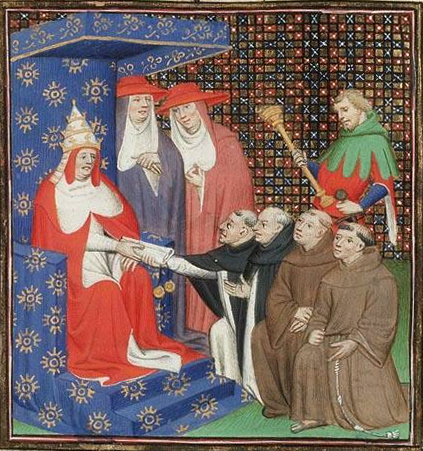
COLLOQUE: Des fonctions judiciaires des consuls aux tribunaux consulaires (XIIe – XXe siècle) (Hamburg: Warburg-Haus, 2-4 NOV 2023) [ONLINE]

(Image source: UnivDroit)


PROGRAMME


Jeudi 2 Novembre 2023


8h30 : Accueil des participants

9h00 : Introduction - Arnaud Bartolomei, Univ. Côte d'Azur; Lars Regula, Univ. Hamburg; Jörg Ulbert, Univ. Bretagne Sud


Session 1 - Les origines médiévales des tribunaux consulaires / Présidence de séance : Dominique Valérian, Université Paris I – Panthéon Sorbonne


9h30 : Les fonctions des consuls de la communauté de Lucque à Bruges (1377-1404) - Laura Galoppini, Università di Pisa; 

10h00 : Les fonctions judiciaires des consuls florentins (XIIIe-XVe siècle) : éléments d'approche globale - Cédric Quertier, CNRS, Paris


11h00 : Qué jurisdicción para el cónsul de catalanes ? Extensión, funciones y agentes de su configuración - Daniel Duran Duelt, Archivo de la Catedral de Barcelona

11h30 : The role of consuls of foreign nations in commercial conflict resolution in sixteenth-century Valencia - Ana Fernández Castro, Scuola Superiore Meridionale, Naples

12h00 : Discussion


Session 2 - En pays de Chrétienté / Présidence de séance : Victor Simon, Université de Lille


14h00 : Théorie et pratique des fonctions judiciaires des consuls de France en pays de Chrétienté à l'époque de Louis XIV - Jörg Ulbert, Université Bretagne Sud

14h30 : La jurisdicción consular entre disimulación, excepción y conflicto. El caso de los cónsules de extranjeros en Livorno (s. XVIII) - Marcella Aglietti, Università di Pisa


15h30 : Juridiction contentieuse et fonctions judiciaires des consuls français dans les mondes hispaniques (XVIIIe-XIXe siècle) - Arnaud Bartolomei, Université Côte d'Azur

16h00 : Les uffici legali : des bureaux au service des fonctions judiciaires des consuls d'Italie aux Etats-Unis (années 1900 – années 1910) - Thibault Bechini, Ecole française de Rome

16h30 : Discussion

17h00 : Session poster - Paul-Emmanuel Babin, Université de Lille; Paul Duvivier, Université Champagne-Ardennes; Marvin Gonzalez, Université Côte d'Azur; Jean-Charles Pelao, Aix-Marseille Université


Vendredi 3 Novembre 2023

Session 3a - Dans l'Empire Ottoman et en Afrique du Nord / Présidence de séance : Jessica Marglin, University of Southern California


9h00 : Les juridictions consulaires des nations latines dans les ports musulmans (XIIIe-XVe siècle) : droit musulman, traités bilatéraux et forum shopping - Dominique Valerian, Université Paris I – Panthéon Sorbonne

9h30 : Juridiction ou police ? Les ambiguïtés de la distinction entre compétence juridictionnelle et pouvoirs de police dans les échelles du Levant et de Barbarie (XVIe-XVIIIe siècle) - Victor Simon, Université de Lille

10h00 : Discussion


11h00 : Italian consular jurisdiction in Cairo : structures, procedures, and consumers (late 19th - early 20th century) - Eleonora Angella, Università della Tuscia, Viterbo

11h30 : Protecting the Swiss. The jurisdictional struggle for the protection of the Swiss citizens in the Ottoman Empire after the Franco-Prussian War - Giorgio Ennas, Franklin University Lugano

12h00 : Discussion


Session 3b - Dans l'Empire Ottoman et en Afrique du Nord /Présidence de séance : Mathieu Grenet, INU Champollion, Albi


14h00 : The Ottoman 1879 reforms and the waning of capitulations - Berna Kamay, Sabancı University, Istanbul

14h30 : “An anomaly” : Consular jurisdiction in 19th century legal thinking - Lars Regula, Universität Hamburg

15h00 : National consular legal inputs in the making of international law - Will Hanley, Florida State University


16h00 : Nationalizing consular jurisdiction in the nineteenth-century Middle East and North Africa - Jessica Marglin, University of Southern California

16h30 : The Austrian Consular Court System between 1923/29 and 1938 : “Completely Useless ?” - Bernhard Gollob, Universität Graz

17h00 : The legal system of the Tangier International Zone (1923-1956) - Willem Theus, Université Catholique Louvain

17h30 : Discussion


Samedi 4 Novembre 2023

Session 4 - Asie et Afrique / Présidence de séance : Klaus Weber, Europa Universität Viadrina, Frankfurt an der Oder


9h00 : Le consulat français de Canton dans la seconde moitié du XVIIIe siècle : donner au libre négoce la protection qui lui est nécessaire - Juliette Françoise, Université de Genève / Université Paris 1 Panthéon-Sorbonne

9h30 : A consulate or a colony ? The curious case of the French territories in India in the 18th century - Gauri Parasher, Universität Trier


10h30 : La justice consulaire dans les concessions étrangères de Tianjin (1900-1943) - Sacha Gauthier-Olssy, Université Côte d'Azur

11h00 : La justice consulaire dans les traités franco-africains au XIXe siècle - Gnienefreretien Silue, Université de San Pedro, Côte d'Ivoire

11h30 : Negotiating the end of extraterritoriality, 1919-1946 - Thomas Pierre Gidney, European University Institute, San Domenico di Fiesole

12h00 : Discussion finale


Pour assister au colloque à distance ou tout autre renseignement, écrire à : arnaud.bartolomei@univ-cotedazur.fr - jorg.ulbert@univ-ubs.fr ou/or lars.regula@uni-hamburg.de


More information can be found here.

05 July 2023

CONFERENCE: The Papacy and the Mongolian reigns in the 13th and 14th Centuries (18, 19, 20 July 2023, Wuppertal-Beijing-ONLINE)


The international conference "The Papacy and the Mongolian Reigns in the 13th and 14th Centuries" intends to investigate the phase of relations between Rome and the Far East which is to be places in the first half of the 14th century, a phase that went beyond the first evangelization of the Mongols and times at the institutionalisation of these relations.

The international conference will take place simultaneously in Wuppertal for the European participants and in Beijing for the participants from China, connected via zoom and will be held, due to time difference, on the mornings of 18, 19 and 20 July 2023.

Information and zoom access: cappuccio@uni-wuppertal.de.


***

PROGRAMME


18.07.2023 - Sources

09.00 Johrendt Jochen / Li Wendan: Introduction

09.15 Johrendt Jochen (Bergische Universität Wuppertal): Letters concerning the Mongols in the papal registers

10.15 Alberzoni Maria Pia (Università Cattolica del Sacro Cuore, Milano): The travelogues of the Franciscans in the East

10.45 Andreose Alvise (Università di Udine): Odoric of Pordenone, the Franciscan order and the Papacy

11.45 Li Wendan (Peking University): Historical commentaries on the papal letters concerning the Mongols in the 14th century

12.15 Hautala Roman (Oulu University): Catholic missionary work in the Golden Horde: Factors that contributed to its development

12.45 Discussion


19.07.2023 - Themes and actors of the interaction

09.00 Cappuccio Caterina / Massetti Francesco (Bergische Universität Wuppertal): The Papacy and the Church of Zaytun. Formation and institutionalisation of a Latin diocese in Yuan China

09.45 Concina Chiara Maria (Università di Verona): "aperiatur via... apta nunciis sepe mittendis". The corrispondence between the pope Benedict XII and the Alans in the context of the East-West relations

11.00 Bueno Irene (Università di Bologna): “De societate Christianorum ac Tatarum”: Armenian and Mongols in the diplomatic schemes of the Avignon popes.

11.30 Chen Chunxiao (Chinese Academy of Social Sciences): Byzantine wives of the Mongol Khans

12.00 Musarra Antonio (Sapienza, Università di Roma): Genöse and Venetian merchants in the Far East

12.30 Discussion


20.07.2023 - Perception in the Far East

09.00 Dang Bahoai (Peking University): Two problems related with China mission of Pope Clement V

09.30 Ma Xiaolin (Nankai University): Chinese sources concerning the letters of Toghon Temür and the Alans to Pope Benedict XII

11.00 Qiu Zhirong (Renmin University of China): Some Mongolian terms in Odorico da Pordenone's Relations

11.30 Qiu Yihao (Fudan University): An unknown papal mission in 1312?

12.00 Fujisaki Mamoru (University of Tokyo): Explaining the Christian faith in the papal letters to the Mongols

12.30 Discussion and concluding remarks


More information can be found here.
12 May 2023

BOOK: Marie BASSANO, Luisa BRUNORI, Cristina CANCIO & Floren GARNIER (dir.), La Volonté. Italie-France allers-retours (Toulouse: Presses de l'Université Toulouse Capitole, 2022), ISBN 9782379281174, 525 p. [OPEN ACCESS]


(image source: openedition)

Abstract:
La volonté. Voilà une notion qui est la croce e delizia de tout juriste. Elle n’a pas manqué de nourrir la réflexion depuis plusieurs siècles d’histoire juridique et suscite toujours des questionnements contemporains. La dimension diachronique, l’approche comparative et la réflexion collective sont au cœur des rencontres « France-Italie » depuis 2018. Par leur format original et l’ambition d’identifier et d’analyser la circulation des idées juridiques entre les deux pays et leurs juristes, les journées toulousaines de 2021 proposent d’interroger à nouveaux frais un thème déjà fécond. Les contributions réunies dans le présent volume ont permis de croiser les réflexions d’historiens du droit français et italiens pour saisir une notion qui n’est pas univoque ni un principe universel. Ils se sont également interrogés sur les moyens et les éléments qui ont façonné cette variabilité notionnelle en relation avec leur contexte d’élaboration et d’utilisation. Volonté individuelle et volonté  collective, volonté juridique et volonté réelle sont quelques-unes des multiples facettes de la notion. Elles ont retenu l’attention d’une vingtaines de juristes historiens pour lesquels « l’une des tâches fondamentales de l’histoire du droit consiste à rappeler aux juristes que les principes et concepts généraux n’ont pas une signification absolue ou intemporelle ».

Contributions by Luisa Brunori, Alain Wijffels, Elena Giannozzi, Giovanni Rossi, Lorenzo Sinisi, Marie Bassano, Orazio Condorelli, David Deroussin, Giovanni Chiodi, Olivier Descamps, Alarico Barbagli, Victor Simon, Ferdinando Mazzarella, Paolo Alvazzi Del Frate, Guillaume Richard, Francesco Mastroberti, Katia Weidenfeld, Florent Garnier, Cristina Ciancio, Nicolas Derasse, Marco Cavina, Tanguy Le Marc'hadour and Damigela Hoxha.

Open access (DOI 10.4000/books.putc.15871).


22 September 2021

COLLOQUIUM: Why Arbitration? - History, Theory & Practice (Oxford, 1 October 2021)


The Centre for Theology, Law, and Culture is hosting a colloquium on the history of arbitration next week. The event can be attended digitally by sending an e-mail to Jonathan.Price@stx.ox.ac.uk

06 September 2021

CONFERENCE: Giustizia, istituzioni e notai tra i secoli XII e XVII in una prospettiva europea (Genoa-online, 8-10 SEP 2021)


We learned of a colloquium organized by the research group Notariorium Itinera on "Justice, institutions and notaries between the XII and the XVII centuries. A European perspective".

The event is free and open to the public, and it will take place via Zoom. Registration is required by sending an email to giustizia.genova2021@gmail.com


***

Mercoledì 8 settembre, ore 10.00

Sessione 1 - La giustizia e i suoi strumenti 

10.20 «Hec est quedam inquisitio». Formule e formulari della giustizia penale tra XIII e XV secolo  - ETTORE DEZZA (Università degli Studi di Pavia) 

10.40 «Omnia mea mecum porto»: Bartolomeo de Iordanis notaio e giudice alla fine del Duecento e i suoi ferri del mestiere - FRANCESCA SANTONI, CRISTINA MANTEGNA (Università degli Studi di Roma La Sapienza) 

11.20 Notai italiani al servizio dell’impero durante il regno di Federico I Barbarossa ed Enrico VI - ALBERTO SPATARO (Istituto Storico Italiano per il Medioevo) 

11.40 Fildesmido da Mogliano e i signori di Sant’Angelo: un caso di giustizia signorile nella Marca della prima metà del XIII secolo - STEFANO DEGLI ESPOSTI (Archivio di Stato di Fermo) 


Mercoledì 8 settembre, ore 14.00

Sessione 2 - La giustizia e i suoi linguaggi  

14.00 Notaio mediatore: la distanza fra la vita e la pergamena  - ALESSANDRA BASSANI (Università degli Studi di Milano) 

14.20 Scrivere ciò che è detto. Modi e forme di verbalizzazione - VALENTINA RUZZIN (Università degli Studi di Genova) 

14.40 La voce dei testimoni e la scrittura dei notai nelle inchieste giudiziarie della Marca anconetana (sec. XIII) - FRANCESCO PIRANI (Università degli Studi di Macerata) 

15.20 La giustizia e i suoi linguaggi nelle illustrazioni dei manoscritti giuridici e dei documenti notarili - MARIA ALESSANDRA BILOTTA (IEM-FCSH/Universidade Nova de Lisboa) 

15.40 Notai a giudizio: parole, immagini e azioni nella Milano del Tardo Medioevo - MARTA L. MANGINI (Università degli Studi di Milano) 

16.00 L’altra giustizia. Le sentenze arbitrali a Genova (secc. XIIXIII): arbitri, notai, documenti - MARTA CALLERI (Università degli Studi di Milano) 

16.20 Il sistema di composizione negoziale ed extra-giudiziario dei conflitti a Spalato nel XV secolo - ERMANNO ORLANDO (Università per stranieri di Siena)


Giovedì 9 settembre, ore 9.00

Sessione 3 - La giustizia in Europa 

9.00 Giustizia, istituzioni e notai nelle città della Provenza bassomedievale nei secoli XII - XIV - SIMONE BALOSSINO (Université d’Avignon et des Pays de Vaucluse) 

9.20 Un tabellionage original: éncadrement de l’activité des passeurs d’actes dans le duché de Bretagne - THOMAS DELANNOY (Université de Nantes) 

9.40 A cavallo fra giustizia mercantile e relazioni internazionali: Joan Fogassot notaio del Consolato del Mare di Barcellona e ambasciatore del sovrano nel Quattrocento - ELENA MACCIONI (Università di Cagliari) 

10.00 La actividad notarial de Sevilla en el ámbito judicial durante el siglo XIV - PILAR OSTOS SALCEDO (Universidad de Sevilla) 

10.40 Los escribanos del concejo ante la justicia: un pleito por el acceso al oficio - MARIA LUISA DOMINGUEZ FERRERO (Universidad de Sevilla) 

11.00 Administración de la justicia en Sevilla - ROCÍO POSTIGO RUIZ (Universidad de Sevilla) 

11.20 Práctica judicial y producción de documentos en la Corona de Castilla (1150-1250 ca.) - MIGUEL CALLEJA PUERTA (Universidad de Oviedo) 

11.40 The Portrait of a Notary Public in Late Medieval Transylvania, Urbanus Petri de Stynawia († ca. 1471). Social, legal and paleographical implications - ADINEL CIPRIAN DINC Ă (Babeş-Bolyai University, ClujNapoca) 


Giovedì 9 settembre, ore 14.00

Sessione 4 - La giustizia della Chiesa  

14.00 La giustizia nell’estremo ponente ligure: Siro, arcivescovo di Genova, notai e documenti (1143-1156) - SANDRA MACCHIAVELLO (Università degli Studi di Genova) 

14.20 Carte, instrumenta e testamenti impugnati in un processo piacentino del XIII secolo - EMANUELA FUGAZZA (Università degli Studi di Pavia) 

14.40 Il primo tribunale dei vescovi di Cortona (XIV sec.): carriere e uffici - SIMONE ALLEGRIA (Università degli Studi di Siena); ALARICO BARBAGLI (Università degli Studi di Pisa)

15.20 Il tribunale dell’abate: notariato e documentazione a Susa nel XIV secolo - LIVIA ORLA (Università degli Studi di Torino) 

15.40 Notai pubblici e notai della curia nelle udienze ecclesiastiche di Braga e Porto (secoli XIII e XIV) - MARIA CRISTINA CUNHA; MARIA JOÃO OLIVEIRA E SILVA (Universidade do Porto) 

16.00 I procedimenti documentari dell’Inquisizione spagnola. Secreto e secretarios del Tribunale di Sassari (XVII secolo) - MARIANGELA RAPETTI (Università degli Studi di Cagliari) 


Venerdì 10 settembre, ore 9.00

Sessione 5 - La giustizia nell’Italia centro-meridionale 

9.00 L’eredità di Federico II nella documentazione giudiziaria del Regno di Sicilia degli ultimi Svevi - MARIA GALANTE (Università degli Studi di Salerno) 

9.20 Tra Napoli e Amalfi: persistenze e innovazioni nella documentazione giudiziaria del XIII secolo - GIULIANA CAPRIOLO (Università degli Studi di Salerno) 

9.40 Corti di giustizia locali: la situazione pugliese affiorante dalle carte dei secoli XII-XV - CORINNA DRAGO (Università degli Studi di Bari) 

10.00 Notai e documentazione nella Sardegna dei giudici - BIANCA FADDA; CECILIA TASCA (Università degli Studi di Cagliari) 

10.40 La giustizia dei vincitori, le cautele dei vinti. Gli atti della guerra del 1290 tra Roma e Viterbo - CRISTINA CARBONETTI (Università degli Studi di Roma Tor Vergata)

11.00 Les pouvoirs de juridiction des notaires toscans : autour du titre de notarius et iudex ordinarius et du précepte de guarentigia (XI e-XIVe siècle) - MATTHIEU ALLINGRI (Université d’Aix-Marseille-CNRS) 

11.20 Notai e uomini di legge a Pisa nel XII secolo: riflessioni sul profilo culturale di un «ceto» emergente - MARIA CRISTINA ROSSI (Università degli Studi di Pisa) 

11.40 Scritture, notai e giustizia criminale a Bologna attraverso le Carte di corredo del podestà (prima metà del XIV secolo) - MADDALENA MODESTI (Università degli Studi di Bologna) 


Venerdì 10 settembre, ore 14.00

Sessione 6 - La giustizia nell’Italia settentrionale  

14.00 Il vertice della giustizia podestarile a Genova: pronunciamenti e sentenze in un frammento notarile di metà Duecento - GIOVANNA ORLANDI (Università degli Studi di Genova) 

14.20 Tra attività istituzionale e network personali: un sondaggio sui giudici a Genova nella prima metà del Trecento - PAOLA GUGLIELMOTTI (Università degli Studi di Genova) 

14.40 Notai e giudici nel cartolare di Leonardo Osbergerio (1341- 1344) - DENISE BEZZINA (Marie Skłodowska Curie Fellow, CNRS - Centre Roland Mousnier, Université Paris-Sorbonne) 

15.00 Procedure e modalità redazionali dell’amministrazione della giustizia civile a Savona agli inizi del XIII secolo: il cartolare di “Saono” - ANTONELLA ROVERE (Università degli Studi di Genova) 

15.40 Giustizia e finanza nel tardo medioevo: esempi dall’Italia nord-occidentale - ANTONIO OLIVIERI (Università degli Studi di Torino) 

16.00 Notai e organi giudiziari nell’arco alpino occidentale: autonomie locali e centralismo sabaudo nei secoli XIII-XV - PAOLO BUFFO (Università degli Studi di Bergamo) 

16.20 Una disputa giurisdizionale al tempo di Enrico VII. Spunti a partire da alcune fonti pavesi del XIV secolo - FERDINANDO NICOSIA (Università degli Studi di Pavia) 

16.40 «Hanc sententiam dixi et hanc breve scripsi». Notai e amministrazione della giustizia nella Marca Veronese tra XII e XIII secolo - GIUSEPPE GARDONI (Accademia Nazionale Virgiliana) 

17.00 I notai e la “buona giustizia” la società dei Protettori dei Carcerati di Milano (XV secolo) - GIULIANA ALBINI (Università degli Studi di Milano) 

17.20 Sociabilità intellettuale e religiosa di giudici e notai nell’età di Albertano da Brescia - MARINA GAZZINI (Università degli Studi di Milano) 

17.40 Notai e giustizia nella Terraferma veneziana in età moderna. Produzione, conservazione e tradizione degli atti civili - STEFANO TALAMINI (Università degli Studi di Trento) 

18.00 Saluti di chiusura


Detailed information can be found here


10 March 2021

ONLINE COLLOQUIUM: Krausisme juridique et politique en Europe. Droit et politique au service de l'idéal de l'Humanité (Dijon, 11-12 MAR 2021)

(image source: VUB-CORE)

Abstract:

Méconnu en France, le philosophe du droit Karl Christian Friedrich Krause (1781-1832) eut une descendance intellectuelle riche. Cultivée autant par des politiques libéraux soucieux de résoudre la « question sociale », que par des juristes intéressés par ses thèses organicistes et tutélaires, sa pensée connut un réel essor en Europe grâce aux travaux de vulgarisation de ses élèves, dont plusieurs deviendront professeurs : Heinrich Ahrens, Karl Röder, Théodore Schliephake et Hermann Karl von Leonardi. En quelques mots, la philosophie krausiste se présente comme un spiritualisme rationaliste et humaniste, articulé autour de deux postulats de départ. Le « panenthéisme », d’une part, sorte de conciliation entre panthéisme et théisme, c’est-à-dire entre conceptions transcendante et immanente de Dieu, ce dernier contenant le monde sans se confondre avec lui. La vision d’une humanité formant un grand organisme vivant, d’autre part, qui comprend diverses unités sociales reliées entre elles de façon harmonique, dans l’idée de développer l’homme en lui permettant d’atteindre ses buts (vertu, beauté, droit, religion, science, art et éducation). Afin de permettre à l’homme d’accéder à sa « pure et complète humanité », le versant politique du krausisme porta un vaste programme éducatif et progressiste (quoique profondément hostile au positivisme et au matérialisme), inséré au sein d’un libéralisme solidaire et d’une démocratie organique. Cette dernière est bâtie sur un système représentatif dualiste offrant une chambre spécifique à la représentation des intérêts sociaux, que d’aucuns pourraient voir comme une préfiguration des chambres corporatives. Le propos vise à rassembler les hommes autour de leurs objectifs communs via un ensemble harmonieux d’associations générales et spéciales, faisant ainsi cesser toute concurrence inutile et nuisible entre eux. La synergie associative autorisera ainsi la formation d’une « Alliance de l’Humanité », fédération ultime couronnant toutes les associations ; elle initiera, du même coup, le troisième âge de l’histoire humaine dégagé par Krause : celui de l’harmonie. Dans l’optique de garantir le triomphe de ce troisième âge, le versant juridique du krausisme opta pour une refonte de la théorie de l’État, vu comme une association destinée à promouvoir et à réaliser le droit. Le droit étant le principe qui régit tous les rapports entre les sphères sociales dans lesquelles vit l’humanité, son régulateur autrement dit, l’État s’érige ainsi en un vaste pouvoir régulateur et conservateur de l’ordre social : il promeut et diffuse le droit et les valeurs culturelles qu’il porte en lui, toujours dans l’idée de mener chaque être humain vers son plein épanouissement. Les applications en furent nombreuses ; et si l’on retient surtout l’abolition de la peine de mort en 1867 par les Portugais convertis au krausisme, il convient aussi de mentionner l’avant-gardisme des krausistes sur des thèmes comme l’écologie et les droits de la femme. Ce colloque cherche à combler une lacune en France, où aucune synthèse n’existe. Nous proposerons ainsi un panorama des krausismes juridique et politique, limité à son berceau européen, mais ayant toutefois pour ambition de dévoiler et d'explorer les pistes de recherches en France.

Programme:

Day 1
Aux origines du krausisme : philosophie du droit et droit naturel 
1 - La philosophie du droit de Karl Christian Friedrich Krause et de Heinrich Ahrens Delia Manzanero (Université Rey Juan Carlos)/Antolín Sánchez Cuervo (IFS-CSIC) 
2 - Une réception du droit naturel krausiste en France  : Edouard Laboulaye Tristan Pouthier (CRJ Pothier - Université d’Orléans) 
3 - Le droit naturel de Vicente Ferrer Neto Paiva et la réception portugaise du krausisme Maria Clara Calheiros (JusGov - Université du Minho)

Utilisations et mésusages de la pensée de Krause et d’Ahrens en droits public et civil 
4 -À propos de la méconnaissance, du dédain voire du rejet du krausisme par les juristes allemands du XIXe siècle Olivier Jouanjan (Institut Villey- Univ. Paris II) 
5 - La réforme de l’Etat par les krausistes espagnols au second XIXe siècle Paul Aubert (TELEMME – Université d’Aix-Marseille) 
6 -Krausisme et kantisme dans l’œuvre juridique du Doyen dijonnais Claude-Joseph Tissot Jean-Jacques Clère (CREDESPO – Université de Bourgogne)

Droit pénal et droit social krausistes 
7 - Le droit pénal de Karl Röder Jean-Louis Halpérin (CTAD – Ecole Normale Supérieure) 
8 - Le rôle des krausistes dans l’institution des sciences sociales et la critique du droit libéral (Espagne, 1880-1910) Élodie Richard (EHESS, LIER- FYT)

Concept et réalisations du krausisme politique 
9 - Krausist politics ? Heinrich Ahrens in the Frankfurt Parlement (1848/1849) Wolfgang Forster (Université de Tübingen) 
10 -L’actualité de l’idéal krausiste : le programme politique de Ciudadanos dans l’Espagne du XXIe siècle Mathieu Petithomme (CRJFC – Université de Franche-Comté)

Day 2
Diffusions d’un message d’espoir 
11 -Scruter et répandre « l’époque nouvelle » depuis Prague : la revue Die neue Zeit de Hermann Karl von Leonhardi Caroula Argyriadis-Kervégan (CPJP – Université de Cergy-Pontoise) 
12 -Le projet européen krausiste Raphaël Cahen (CORE – Vrije Universiteit de Bruxelles)

Réceptions contrastées 
13 -Proudhon, lecteur de Krause ? Anne-Sophie Chambost (CERCRID - Sciences Po Lyon) 
14 -La réception manquée des krausistes par les proudhoniens et les utopistes français Aurélie Lahaie (CREDESPO – Université de Bourgogne) 
15 -Krause plus Proudhon ? La synthèse belge de la représentation du travail Edward Castleton (Logiques de l’Agir, Université de Bourgogne-Franche-Comté) 
16 -Utopies organicistes et régulations corporatistes dans les dissertations doctorales portugaises du second XIXe siècle : les rêveries krausistes des ministres Mártens Ferrão et Costa Lobo Oscar Ferreira (CREDESPO – Université de Bourgogne)

Full programme (including hours) here

Registration details on the CREDESPO website.

23 June 2020

CONFERENCE REPORT: Online Symposium on the Society's Journal Comparative Legal history (10 June 2020)

(image: the School of Athens, Rafael; source: Wikimedia Commons)

On 10 June 2020, the first Zoom symposium of Comparative Legal History, the society's peer reviewed journal (Routledge) was held from 10:00 to 12:00 CET. This symposium was attended by 50 scholars from various continents and legal traditions. 

Outgoing editor-in-chief Heikki Pihlajamäki introduced Agustín Parise (Maastricht) as his successor, and presented the other members of the editorial team: articles editor Jacqueline Bemmer, book review editor Marianne Vasara-Aaltonen, copy editor Emmanuel Van Dongen and copy-editor Emilia Mattaix Ferrándiz. The new editorial team had the opportunity to present their background and vision for the future of the journal. 

Two keynote interventions of 15 minutes were presented. The speakers have been so kind as to share a summary:

Prof. Shaunnaugh Dorsett (University of Technology, Sydney):
What is the remit of comparative legal history? What ought it to be? What might this mean for the Society’s Journal? In recent years comparative legal history has sought to shrug off the shackles of paradigmatic comparative legal history – history where the comparative unit is nation state (or a region of it). Over the last 25 years, in response to an increased global consciousness and to post-colonial critique and to the limits of national-based histories that these have revealed, how we think about doing history has changed, in some ways profoundly. We have seen the rise of transnational history and global history in part as a response to these forces. And it seems clear comparative legal history needs to respond to these as well. This raises the question of how does comparative legal history do so without falling into transnational or global history (assuming we want it to retain an identity separate from these)? This is the clear risk of an expansive approach that addresses these concerns. There is now I think a continuum between comparative, transnational and global history. The boundaries are somewhat porous and many pieces that can be described as comparative are also transnational. I think it inevitable that if we look at an expanded view of comparative legal history which is open to the global and to connectedness then it may also be fall into the broad remits of transnational and even global history. But the reverse is not necessarily true – global or transnational history may not always be comparative (although it often will be). It is after all the compare at the heart of comparative legal history that makes it distinctive and allows it, if we want this, to retain an identity.
 What might compare mean and include then? So here I take compare somewhat literally: to compare is to think of one thing in relation to another. But it is not necessarily to set two (possibly similar, possibly not) things side by side. Thus ‘compare’ could (and should) be broad an inclusive. A list might include: an examination of a legal form or development in a single site, but where that examination is seated in a broad context of the intellectual and practical forces arriving from outside which, along with local forces, shape its development and evolution; local developments or legal forms which in part mimic broader Empire or transnational forms (slavery is an obvious example) but which show the political or economic or other contingency of their local development; work focusing on local forms as a result of legal hybridisation; mapping the ways in which legal forms move around a region or Empire, finding new form in new locales; legal personnel and laws which move between centre and periphery (or better still across the globe rather than linearly, missing out the centre entirely). Such work would de-centre Europe (or any Imperial power, located in Europe or not) and re-write movement and comparison from the perspective of the periphery; engagements with plurality. This is broad; but it is all comparative. It is both internal and external. And it all has at its heart ‘compare’. For the Journal my wish list is that this should mean a greater engagement with work from the Global South; work which engages comparisons between Empires; comparisons written from the periphery and which speak back to Europe; better conversation between those working in civil and common law traditions.
Prof. Matt Dyson (Oxford, President of our Society):
Our reflection on what we are trying to do as comparative legal historians is an important part of doing it well. There is room for a great variety of approaches and subject matters, so long as scholarly rigour and care are foremost. For me personally, I have been drawn to the power of explaining why particular legal events have happened, constructs selected and ideas spread. That “micro-purpose” is particularly challenging, but offers insight that can be valuable for a very wide set of audiences.


Doing comparative legal history well involves difficult choices of priority, or “macro-purpose”, of the vast amount of interesting and difficult questions that merit attention, and the joy of intellectual enquiry. Part of that involves an interrogation first as individuals, and then as groups of scholars, over what merit our work has, and what purposes we are going to purpose. That involves challenging questions that, in the tradition of scholarship we aspire to uphold, we must not shy from asking, seeking wisdom to understand, and then trying to over time to improve our answers.


Greater means of collaboration and co-operation seem essential for doing work that can, at a reasonable pace, shed light on important questions not isolated instances unsewn together. We have opportunities across disciplines, as well as across universities and countries. We need to think about what we are publishing, its value and whether it could be better if it was wider, deeper and with more insight. Part of that will involve helping funding and administrative bodies to understand the longer term gains, rather than counting publications. I have seen great generosity from colleagues all over the world, in supporting each other, harnessing that to produce work that is valuable for all over the long term outcomes for all must be one of our goals.


It is also particularly important to make sure our work is accessible, visible, trackable and in effect, promulgated carefully. The risk of not doing so, and of sources overwhelming a legal system’s ability to address them is well known. We can see examples from the /ius commune/ to the more recent digitisation and neutral reporting of case decisions which in the last two years has covered both common law and civil law jurisdictions. It is so easy for sources to overwhelm in number and the best work to be lost. As the excellent work of the journal, and the blog, shows, there is an incredible standard being reached; so much worth sharing.
In the discussion which followed, a number of topics were addressed, including the following:
  • the impact of Digital Humanities, and the suggestion to devote a thematic issue to this methodological innovation (Emmanuel Van Dongen, Florenz Volkaert, Mia Korpiola)
  • the role of philosophy in the discipline of comparative legal history (Adolfo Giuliani)
  • the role of technology, symbolism and the role of law as science (Katharina Isabel Schmidt)
  • the persistence of national legal histories (Helle Vogt)
Each of the the editors on the then added their thoughts and reflections on the role of the discipline and the journal

Prof. Dyson and Prof. Philajamäki thanked the ESCLH Blog team (Frederik Dhondt, Arthur Barretto, Filip Batselé, Stefano Cattelan, Antoni Lahondes and Christel Annemieke Romein), for its relentless efforts in keeping our Society's daily stream of news running.

09 June 2020

REMINDER: COLLOQUIUM: Comparative Legal History: the Journal and the Discipline (Zoom, 10 JUN 2020, 10:00-12:00 CET)


Colloquium on Comparative Legal History: the Journal and the Discipline

(image: Rafael's The School of Athens; source: Wikimedia Commons)

Comparative Legal History, the journal of the European Society for Comparative Legal History (ESCLH) and a leading publication of its kind, offers an online colloquium on the present and future of this discipline. The following questions will be addressed, amongst others,

·         What is comparative legal history and what should it be?
·         Should it exist at all, or is all legal history now transnational and global?
·         What does it mean to compare?
·         How should we further develop the Journal?
·         What can we do to enhance the global scope of the Journal?


Shaunnagh Dorsett (Editorial Board of CLH, University of Technology Sydney) and Matthew Dyson (President of the ESCLH, University of Oxford), together with the journal staff, will be discussing these and other exciting questions.

The event is free and open to the public, and it will take place via Zoom, on Wednesday, 10 June 2020, from 10:00-12:00hs (CEST). Registration is required by sending an email to CLHColloquium@gmail.com. (By registering, you will receive the link to the meeting.)

We warmly welcome everyone to take part in the discussions!

Heikki Pihlajamäki (Editor, CLH), Agustín Parise (Articles Editor, and incoming Editor), Jaqueline Bemmer (incoming Articles Editor), Marianne Vasara-Aaltonen (Reviews Editor), Emmanuel van Dongen (Copy Editor), and Emilia Mataix Ferrándiz (Copy Editor)


22 May 2020

COLLOQUIUM: The Legal History of Epidemics – ONLINE (25 May 2020)


Via the Environment, Law, and History blogspot, we learned of a colloquium on the legal history of epidemics.

Next Monday, 25 May, the David Berg Foundation Institute for Law and History at Tel Aviv University will host an online colloquium on the legal history of epidemics. 

The program:

Session 1 (15:00 GMT/11:00 EDT):

Mario Ascheri (Rome 3): Treatises on Plague Law in the Italian Renaissance
Tamara Morsel-Eisenberg (Harvard): Early Modern Jewish Legal Sources on Epidemics
Noga Morag-Levine (Michigan State): Pestilence and Governance in Early Modern England
Alex Chase-Levenson (Penn): Lazaretto Law in the Early Nineteenth-Century Mediterranean
Felice Batlan (Chicago-Kent): Rights, Quarantines, and Inequality in U.S. History
John Witt (Yale): American Contagions: A Short History of Law and Democracy in Crisis

Session 2 (16:15 GMT/12:15 EDT):

Roundtable discussion: Issues and challenges in the legal history of epidemics
Moderator: David Schorr (Tel Aviv)


15 May 2020

COLLOQUIUM: Comparative Legal History: the Journal and the Discipline (Zoom, 10 JUN 2020, 10:00-12:00 CET)


Colloquium on Comparative Legal History: the Journal and the Discipline

(image: Rafael's The School of Athens; source: Wikimedia Commons)

Comparative Legal History, the journal of the European Society for Comparative Legal History (ESCLH) and a leading publication of its kind, offers an online colloquium on the present and future of this discipline. The following questions will be addressed, amongst others,

·         What is comparative legal history and what should it be?
·         Should it exist at all, or is all legal history now transnational and global?
·         What does it mean to compare?
·         How should we further develop the Journal?
·         What can we do to enhance the global scope of the Journal?


Shaunnagh Dorsett (Editorial Board of CLH, University of Technology Sydney) and Matthew Dyson (President of the ESCLH, University of Oxford), together with the journal staff, will be discussing these and other exciting questions.

The event is free and open to the public, and it will take place via Zoom, on Wednesday, 10 June 2020, from 10:00-12:00hs (CEST). Registration is required by sending an email to CLHColloquium@gmail.com. (By registering, you will receive the link to the meeting.)

We warmly welcome everyone to take part in the discussions!

Heikki Pihlajamäki (Editor, CLH), Agustín Parise (Articles Editor, and incoming Editor), Jaqueline Bemmer (incoming Articles Editor), Marianne Vasara-Aaltonen (Reviews Editor), Emmanuel van Dongen (Copy Editor), and Emilia Mataix Ferrándiz (Copy Editor)


30 January 2020

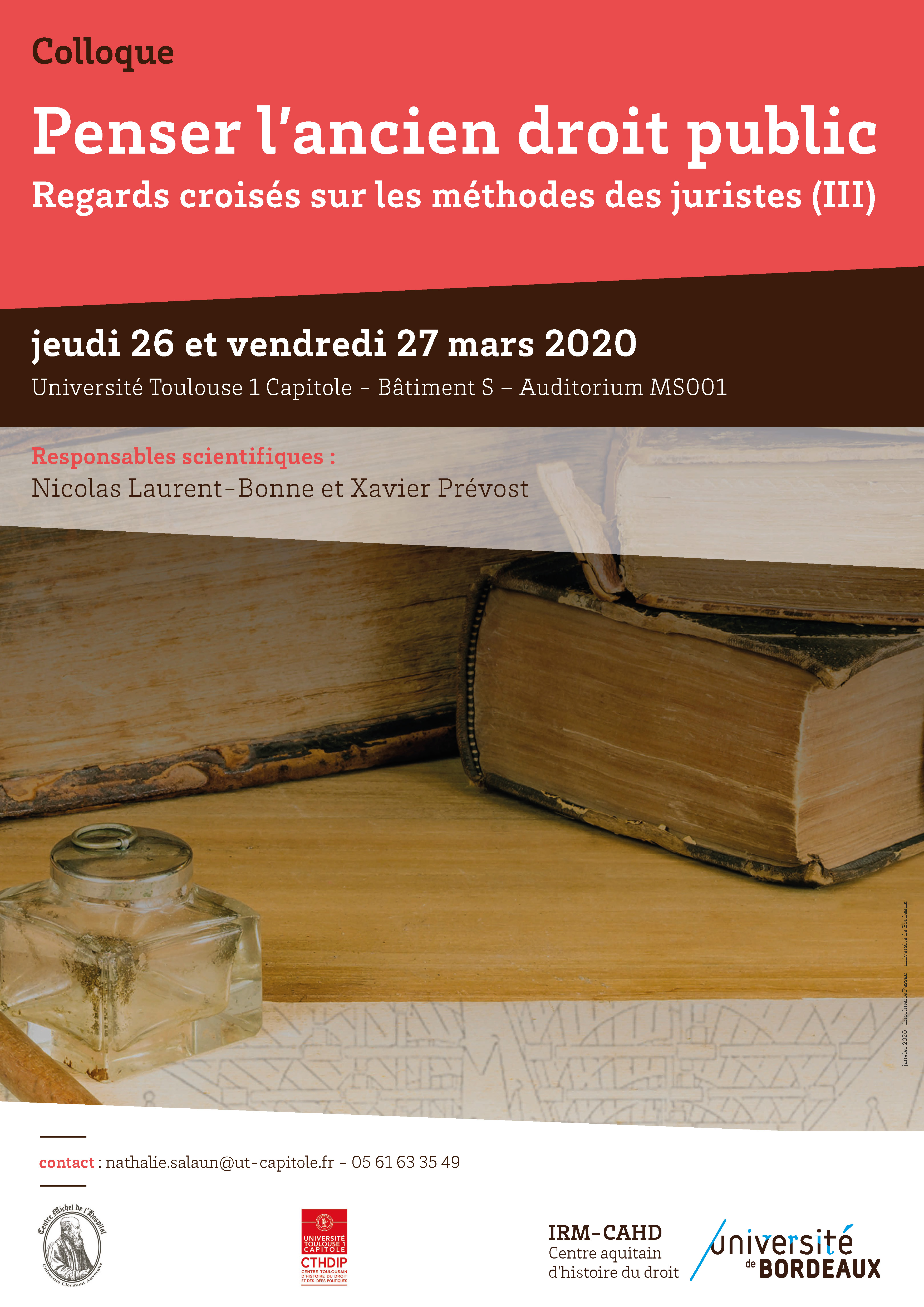
COLLOQUIUM: "Penser l'ancien droit public : regards croisés sur les méthodes des juristes (III) " (Toulouse, 26-27 March 2020)


We learned of a colloquium at the University of Toulouse with the title “Penser l'ancien droit public : regards croisés sur les méthodes des juristes (III)”.

Colloque organisé par Nicolas Laurent-Bonne, professeur à l’université Clermont Auvergne (Centre Michel de L’Hospital, EA 4232) Xavier Prévost, professeur à l’université de Bordeaux (Institut de recherche Montesquieu-CAHD, EA 7434) avec le soutien du Centre toulousain d’histoire du droit et des idées politiques (UR 789)

 Comité scientifique :

  • ANNE ROUSSELET-PIMONT, professeur à l’École de droit de la Sorbonne (université Paris I)
  • NADER HAKIM, professeur à l’université de Bordeaux
  • JEAN-LOUIS HALPERIN, professeur à l’École normale supérieure (en attente)
  • JACQUES KRYNEN, professeur à l’université Toulouse I Capitole
  • NICOLAS LAURENT-BONNE, professeur à l’université Clermont Auvergne
  • XAVIER PRÉVOST, professeur à l’université de Bordeaux

The full programme can be found here

28 November 2019

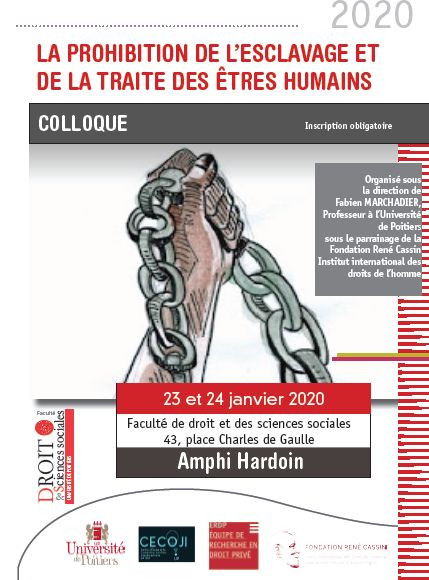
COLLOQUIUM: La prohibition de l’esclavage et de la traite des êtres humains (23-24 January 2020, Paris)


We learned of an international colloquium on the abolition of slavery and the slave trade in Paris coming January.

Particulièrement attentatoire à la dignité de l’homme, au même titre que la torture, l’esclavage fait l’objet d’une prohibition relativement ancienne et d’une grande fermeté. Énoncée dans la convention de Genève relative à l’esclavage du 25 septembre 1926, la prohibition absolue de l’esclavage, quelles que soient les circonstances, est reprise dans l’ensemble des déclarations et conventions protectrices des droits de l’homme. Au sein des États, l’abolition est progressive.

Le Pakistan clôt, en 1992, un processus engagé deux siècles auparavant en 1777 (abolition de l’esclavage dans le Vermont). La réduction en esclavage, autrefois rouage de l’économie (traite négrière), est devenue un crime contre l’humanité (art. 7 Statut CPI).

L’esclavage institutionnel n’existe plus, mais il doit désormais être saisi dans sa réalité factuelle afin de lutter efficacement contre tous les trafics et toutes les formes d’exploitation ayant pour objet des êtres humains, hommes, femmes et enfants. Il perdure dans toutes les régions du monde y compris dans ses manifestations les plus archaïques comme en attestent les marchés aux esclaves en Libye et le traitement réservé aux femmes Yézidies par l’État islamique.

L’esclavage est non seulement une réalité contemporaine, mais il est également un amer souvenir de la conquête du monde et de la colonisation par les européens.

Quelles réponses juridiques, quels recours offrir aux victimes de cette pratique odieuse ? Quelle signification revêt ou devrait revêtir l’esclavage sans pour autant diluer la notion en l’appliquant à des situations licites dans certains États (notamment la gestation pour autrui) ? Quelle distinction opérer entre esclavage, servitude, travail forcé et traite ? Quelle valeur possède le consentement de la victime à son exploitation ? Comment affronter l’esclavage dans ses multiples modalités ainsi que dans ses dimensions spatiales et temporelles ?

L’esclavage est une pratique d’hier et d’aujourd’hui. Les plaies du passé peinent à cicatriser ; le ressentiment des descendants d’esclaves demeure vivace. Entre devoir de mémoire et réparation, comment assumer le passé ? Au présent, la lutte contre l’esclavage associe tant les États que les opérateurs privés, en particulier à travers le devoir de vigilance imposé à certaines entreprises multinationales afin d’éviter qu’elles n’entretiennent indirectement le phénomène par leurs filiales ou sous-traitants établis à l’étranger. Le colloque a pour ambition de réfléchir à ces différentes questions et aux réponses qu’elles sont susceptibles de recevoir.

The full conference program can be found here

31 October 2019

COLLOQUIUM: Blasphemy and Violence. Interdependencies since 1760 (Ghent, 4-5 March 2020)


We learned of a colloquium on the interdependency between blasphemy and violence in Ghent. Here the programme:

Venue
The conference takes place in the large conference room of Liberas in the centre of Ghent - Kramersplein 23, 9000 Ghent.
Wednesday 4 March 2020
18:00 - 19:30      Alain Cabantous (Paris, FR): Violence et Sacré ou le Blasphème en Révolution
Thursday 5 March 2020
9:00 - 9:30: Welcome and Opening
9:00 - 9:10           Peter Laroy / Christoph de Spiegeleer (Ghent, BE): Welcome to Liberas
9:10 - 9:30           Eveline Bouwers (Mainz, DE) & David Nash (Oxford, GB): Introduction
9:30 - 11:00: Section 1: Blasphemy as a Companion to Political Transition
9:30 - 9:50           Laura Thompson (Boston, US / Tunis, TN): Protecting Muslims’ Feelings, Protecting Public Order: Tunisian Blasphemy Cases from the 19th Century through the Arab Spring
9:50 - 10:10        Nadezhda Beliakova (Moscow, RU): On Blasphemy and Violence during the Revolution and the Construction of Socialism in the Soviet Union
10:10 - 10:30      Julio de la Cueva (Toledo, ES): Blasphemy, War and Revolution: Spain, 1936
10:30 - 11:00      Comments and Discussion
11:00 - 11:30      Coffee Break
11:30 - 13:00: Section 2: Blasphemy as a Tool for Emancipation
11:30 - 11:50      Emilia Musumeci (Teramo, IT): David Lazzaretti: Martyr, Rebel, or Heretic? A Puzzling Case in Post-Unification Italy
11:50 - 12:10      Matthew Kerry (Stirling, GB): Blasphemy in Early Twentieth-Century Spain: Vulgarity, Violence and the Crowd
12:10 - 12:30      Marcin Skladanowski (Lublin, PL): Pokémon in the Church: The Case of Ruslan Sokolovskiy and the Limits of Religious Performance in Contemporary Russia
12:30 - 13:00      Comments and Discussion
13:00 - 14:00      Lunch Break
14:00 - 15:30: Section 3: Blasphemy as an Instrument to Confront the Secular
14:00 - 14:20      Marco Omes (Pisa, IT): Blasphemy, Religious Adherence and Political Loyalty in the Roman States during the French Occupations (1789 - 1799 and 1808 - 1814)
14:20 - 14:40      Dirk Johannsen (Oslo, NO): Blasphemy as a Cultural Strategy. The Case of the Nordic Modern Breakthrough, 1871 - 1890
14:40 - 15:00      Hussien Soliman (Alexandria,EG): Blasphemy as a Justification for Violence against Freethinkers in Modern Egypt
15:00 - 15:30      Comments and Discussion
15:30 - 16:00      Coffee Break
16:00 - 17:00: Section 4: Blasphemy as a Strategy for Suppressing the Religious Other
16:00 - 16:20      Christoffer Leber (Munich, DE): The New Martyr. The Jatho Affair in Imperial Germany between Blasphemy, Freethought, and Religious Reform (c. 1910 - 1915)
16:20 - 16:40      Yvonne Sherwood (Kent, GB): Blasphemy, Violence, and the Production of Minorities
16:40 - 17:00      Comments and Discussion
17:00 - 18:00: Concluding remarks

More info about the conference can be found here

15 October 2019

COLLOQUIUM: Imperialiter. L'eschatologie impériale du souverain (Paris, 16-18 October 2019)


We learned of a colloqium at the Collège de France on “l'eschatologie impériale du souverain”.

L’histoire des Empires connaît un engouement récent qui a fait émerger un champ spécifique, « l’impériologie ». En revanche, la question de l’« impérialité », c’est-à-dire de l’Empire comme horizon des possibles, n’a pas bénéficié d’une approche complète. Or, comme l’ont montré de récentes études, le succès de l’idéologie impériale se mesure aussi à sa marque dans des monarchies non impériales (France, Sicile, Angleterre, Castille, États pontificaux...). Le programme Imperialiter (2017-2021) vise ainsi à mener de manière exhaustive l’analyse des réappropriations de l’Empire au Moyen Âge et à l’époque moderne par le biais de rencontres scientifiques régulières. 

Quatre d'entre elles se sont tenues successivement à Rome (deux rencontres, en octobre 2017), Oxford (juin 2018), Madrid (octobre 2019). Le colloque accueilli au Collège de France est donc le cinquième de la série. Le thème de « l'eschatologie impériale du souverain » que ce colloque explore s'est dégagé lors des précédentes journées, qui ont mis en lumière dans les discours, les représentations, les modèles associés aux rois impérialisants, l’importance du thème de l’eschatologie et de ses diverses manifestations (le messianisme, le prophétisme, la croisade et la libération des villes saintes, l'Antéchrist, le « roi des trois religions »), lesquelles permettent au souverain d’amplifier les manifestations de sa souveraineté par l’association de traits qui le lient à la seconde Parousie, celle, définitive, du retour du Christ (modèle royal par excellence) qui abrogera toute souveraineté terrestre et impériale.

More info, including the full program, can be found here

04 October 2019

COLLOQUIUM: Legacies of War and Empire - New Work in the History of International Law (University of Edinburgh, 10 October 2019)


We learned of a colloquium at the University of Edinburgh, focusing on the theme of legacies of empire and war. Here the programme:

The Edinburgh Centre for International and Global Law presents

Legacies of War and Empire - New Work in the History of International Law Part 2

This roundtable will bring together scholars working in the history of international law, with a particular focus on the legacies of empires and of war for the structure of international law and for contemporary international legal norms.

Dr Boyd van Dijk, Lecturer in Modern European History, University of Amsterdam
Making Common Article 3 in Southeast Asia: A Third World Approach to the 1949 Geneva Conventions
Most scholars agree that modern empires framed their colonial wars as ‘emergencies’ in order to escape international scrutiny. After 1945, however, those same imperial powers invited the International Committee of the Red Cross (ICRC) to intervene in their wars of decolonization, despite resisting an official state of war. This article seeks to solve this puzzle by drawing attention to the ICRC’s critical part in reshaping the international legal system for colonial war in the critical years before the Algerian War and the Bandung Conference. In this formative period, the organization played, together with anti-colonial activists, a transformative role in contesting accepted ideas of global governance and international law while providing a new stage for anticolonial resistance, with far-reaching consequences not just for the ICRC’s own institutional future, but also for the legitimization of postcolonial sovereignty in the twentieth century.

Dr Megan Donaldson, Lecturer in International Law, University College London
The Afterlife of François de Callières: Secrecy, Espionage and the Ethos of Diplomacy
The paper examines a crucial turning point in the evolving relationship between espionage and diplomacy: interwar efforts to rehabilitate diplomacy from widespread critiques of its imbrication with secrecy and deception. It shows that writings by and for diplomats in the 1920s and 30s sought to shift moral concern from the secrecy of diplomacy as such to deceptive dealings; and then to distance diplomacy from deception. These interwar writings on diplomacy had surprising longevity, remaining leading references well after WWII. Moreover, they illustrate an enduring pattern in which the practice of espionage is rhetorically excluded from diplomacy, while the boundary between diplomacy and espionage remains undefined. Diplomacy can thus be presented as a practice of peace and conciliation, or as liberal bargaining, softening the sharper edges of hierarchy. Yet in instances like Australia’s recording of the East Timorese cabinet during crucial treaty negotiations, it becomes clear how closely espionage and diplomacy are intertwined—and how profoundly this complex of activities, once seen outside a Cold War contest of superpowers—accentuates rather than palliates inequality.

Dr Rotem Giladi, Teaching Fellow in International Law, Edinburgh Law School
Approaching Colonial War: Law, Culture, and the Case of Human Heads
The paper starts with the observation that while there can be little doubt about the existence of an international law category of ‘colonial war’ in the late nineteenth century, establishing its content, contours, boundaries, and intellectual foundations proves highly elusive. The resulting indeterminacy of the category operates, then, both doctrinally and epistemologically. Historiographically, in addition, it leaves us with a highly impoverished, even distorted, account of the origins and politics of the modern laws of war. While we know that the codification of the laws of war was central to the modern international law project of the late 1800s, we know little on how the development of the laws of war was linked to the legal structuring of empire and colonialism, another central concerns of that generation’s international lawyers. The paper suggests next that the very elusiveness of colonial war, rather than an obstacle to be overcome, may itself serve as a source of meaning. Here I propose, tentatively, approaching colonial war not as a set of indeterminate, uncertain, unstable, or contradictory norms but, instead, as a register of cultural practices that together may furnish an alternative historical account of the laws of war its operation, function, and preoccupation. To illustrate the utility of this approach, I last reflect on a series of anecdotes involving the fate of human heads— cultural artefacts present in colonial battlefields, diplomatic conferences, private homes, popular culture, and public debates—and explore their potential meanings.

Dr Inge van Hulle, Assistant Professor, Tilburg Law School
Benevolent Aggression and Exemplary Violence in West Africa (1807-1885)
This paper represents one of the first attempts to elaborate on the international legal framework that surrounded the practice of imperial use of force in an African context during the early and mid-nineteenth century, prior to the Scramble for Africa. I first discuss the context in which violence was used as an imperial strategy and highlight the particular environmental conditions in which military campaigns took place in West Africa. I then elaborate on the justifications that British imperial personnel resorted to in their use of force and that became accepted practice in British imperial international law. Violence, though inherently part of a policy of aggression, was often styled as ‘benevolent’: as a form of racialised necessity; as an extension of Britain’s humanitarian agenda or as a supposedly legitimate answer to a perceived African wrong-doing. Apart from forced interventions, Britain actively pursued the acquisition of a monopoly over the exercise of violence in frontier regions by pursuing a policy of mediation in inter-African disputes, imprisonment of so-called African ‘rebels’ and disarmament of neighbouring African states in order to safeguard trade. As British presence in West Africa increased during the second half of the nineteenth century so did imperial agents’ resort to violence. Force thus became a method through which British strategic objectives could be fulfilled by coercing African rulers into accepting the premises of British imperial international law.

Dr Cait Storr, Lecturer in Law, University of Glasgow Law School
International Status, Imperial Form: Nauru and the Histories of International Law
This chapter is the introduction to a forthcoming monograph, International Status, Imperial
Form: Nauru and the Histories of International Law. The book draws on theories of jurisdiction and bureaucracy to construct a detailed sociolegal account of the relationship between international status and administraive form in the Nauruan case, as a frame through which to examine how the twentieth century international order developed in continuaion of European imperial administrative practices of the late nineteenth century. It argues that as the international status of Nauru shifted from protectorate, to mandate, to trust territory, to sovereign state, what occurred at the level of local administration was an accretive process of internal bureaucratisation and external restatement according to the prevailing concepts of the period. It concludes that shiftss in international status toward political independence are better understood as marking not the end, but the beginning of the process of decolonisation.

More info with the University of Edinburgh


25 September 2019

COLLOQIUM: La mémoire du droit dans la lutte contre les formes d’esclavage (Paris, 11 October 2019)


We learned of a colloquium organized by the Association française pour l’histoire de la justice on the theme of “La justice et la mémoire de l’esclavage ancient et moderne”.

Cette journée d’étude représente le 3e temps d’un colloque plurisite organisé sous l’égide de l’Association française pour l’histoire de la justice (AFHJ), sur le thème : La justice et la mémoire de l’esclavage ancien et moderne.

Les deux premiers actes se sont déroulés aux Antilles de la manière suivante :
I. Mémoire passée et réparations, Laboratoire CREDDI (Faculté des Sciences juridiques et économiques de la Guadeloupe, Université des Antilles), 7 novembre 2018 ;
II. Mémoire à travers la littérature et regard sur l’esclavage moderne, Cour d’appel de la Martinique, 9 novembre 2018.

L’esclavage stricto sensu et les autres formes d’exploitation des êtres humains qui lui sont associées (servitude, servage, travail forcé, traite,…) constituent un phénomène présent dans la grande majorité des sociétés à travers le monde depuis l’Antiquité. Or, si les phases des « sociétés esclavagistes », jusqu’au XVe siècle environ, et des « traites légales », jusqu’au XIXe siècle, ont laissé place, au niveau international et à celui d’une partie des États, à celles d’abolitionnisme puis de répression des formes d’esclavage officielles ou généralisées, ce fléau a échoué à être éradiqué. Prenant un aspect souvent plus diffus, d’anciennes formes se sont maintenues et de nouvelles sont apparues, la fondation australienne Walk Free faisant état de 40 millions de victimes à l’échelle de la planète dans la dernière édition de son Global Slavery Index (GSI 2018).

La France, progressivement présentée comme le pays du « sol franc » à partir de la fin de l’époque médiévale, n’est pas demeurée en marge de cette histoire mondiale. Notamment restée une terre de servage jusqu’à la fin de l’Ancien Régime et devenue entre le XVIIe et le XIXe siècle un acteur majeur de la traite négrière en vue du recours à une main d’œuvre d’esclaves dans les « anciennes » colonies, elle enregistrait, cent-soixante-cinq ans après la seconde abolition de l’esclavage en 1848, 8 500 victimes de l’esclavage moderne (GSI 2013)…, 129 000 cinq ans plus tard (GSI 2018).
Comme l’a souligné avec raison l’actuelle présidente du Comité contre l’esclavage moderne (CCEM), association à l’origine de la première condamnation de la France par la Cour européenne des droits de l’homme en raison de l’insuffisance de son dispositif de lutte contre ce phénomène en 2005, cette situation appelle à « lutter contre l’indifférence [des gens] ». Tel est l’un des objectifs poursuivi par le Comité national pour la mémoire et l’histoire de l’esclavage (CNMHE) depuis 2004 et par le projet de Fondation pour la mémoire de l’esclavage, à partir d’un travail d’éclairage sur le passé. Or, parce qu’il se construit dans le temps et laisse une trace tangible, le droit constitue également un utile instrument de la mémoire des formes d’esclavage et de leur évolution, ainsi qu’un important vecteur du « Plus jamais ça ! »

L’objet de la présente journée d’étude est ainsi de rendre compte de ce rôle de mémoire du droit tourné vers l’action contre les formes d’esclavage depuis le début du XIXe siècle, même si son effectivité et son amélioration se heurtent encore (ou surtout) aujourd’hui à une difficile « prise de conscience » de la réalité et de l’ampleur du phénomène.

More info, as well as the full programme, can be found here

15 August 2019

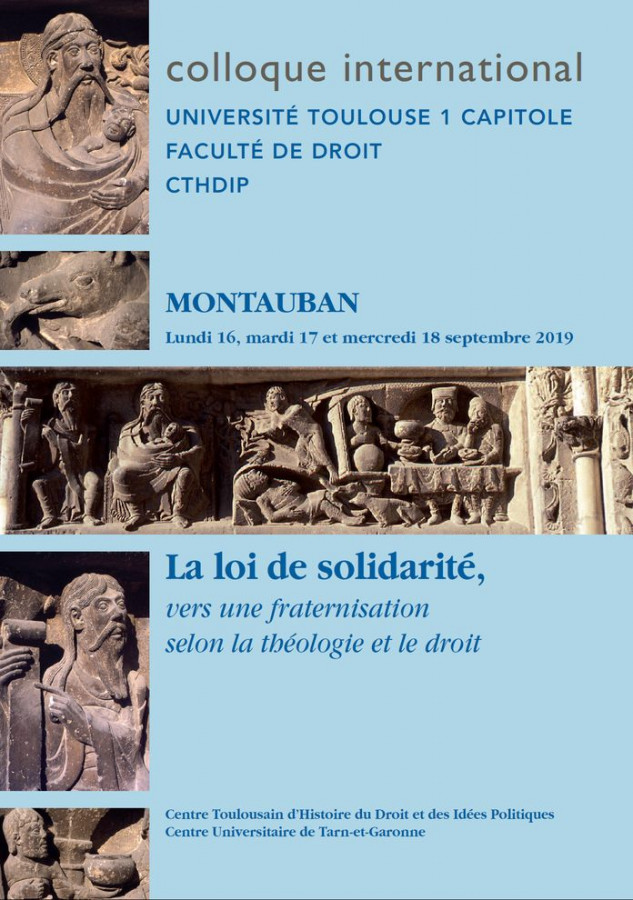
COLLOQUIUM: La loi de solidarité - Vers une fraternisation selon la théologie et le droit (Montauban, 16-18 September 2019)


Via the Portail Universitaire du droit, we learned of a colloquium organized by the Centre Toulousain d’histoire du droit et des idées politiques.

Après avoir interrogé la réciprocité, les prochaines rencontres montalbanaises proposent d’étudier la loi de solidarité. Lors des journées de l’été 2017, les théologiens ont rappelé aux juristes combien la formule « Tout ce que vous voulez que les hommes fassent pour vous, faites-le de même pour eux » emporte la mutua benevolentia qui veut le bien de l’autre comme l’on souhaite le sien propre. Rechercher la loi de solidarité, c’est aller plus loin vers un principe de juste partage – établir la part de chacun – qui devient une nécessité de bien commun. Dans la tradition judéo-chrétienne, la communauté d'origine donne le socle de la solidarité, on y perçoit – à travers la profusion d’une riche diversité – l'égalité première des hommes qui pouvaient fraterniser. Au XIXe siècle, la doctrine sociale assemble la solidarité à la responsabilité de tous et pour tous, ailleurs l’orthodoxie livre le terme de sobornost qui s’élargira. C’est faire accorder liberté et unité, pour la communion : « Ils n’avaient qu’un cœur et mettaient tout en commun ». En islam, on trouve une notion proche, avec une solidarité entre fidèles qui les rend frères. Toutefois la solidarité matérielle et spirituelle peut apparaître plus vaste, elle est magnifiée dans l’hexameron. Et l’on saisit cette solidarité étendue, illustrée par le Cantico di frate sol qui entraîne vers le respect des lois de la création. Jaillissent ici les relations entre l’humanité et « les autres créatures ». Les juristes montrent pareillement ce double mouvement des liens juridiques lorsqu’ils définissent la solidarité comme « l’union des personnes par une obligation », et parfois comme « un rapport d’interdépendance entre les choses ». La solidarité apparaît ainsi relationnelle jusqu’à devenir amicale. À la suite d’Aristote que reprend le droit romain dans l’amitié civique, puis la doctrine médiévale, on y voit l’amicus amico amicus. Mais là peuvent surgir des crises qui perturbent les relations jusqu’à les abîmer tant la confiance est atteinte, et diriger vers le bellum omnium contra omnes, ou le « chacun contre tous » et le « tous contre chacun ». Liées aux désordres particularistes, ces ruptures doivent alerter, car elles déforment la solidarité – surtout en temps d’insécurité – jusqu’à en faire récemment un délit, ou parfois engager vers des réflexes de complaisance qu’entraînent les fausses ressemblances. Heureusement, les embarras des temps peuvent toujours redevenir lieux d’harmonie qui « rendent au droit sa fonction de rectifier les faits ». C’est exhorter aux devoirs envers les autres, dans une solidarité reliée à la subsidiarité que théologiens et juristes tentent de fonder sur le principe de fraternité, contre les tendances parfois individualistes ou trop impersonnelles des normes. Face aux définitions de la solidarité et à leurs dégradations, s’ouvrent des interrogations pour en comprendre les fondements à situer entre générosité ou obligation, les moyens, les finalités et les limites, appliqués à la variété des échanges, avec une question qui revient sans cesse : peut-on être solidaire de tout, ou simplement de tous ? Y a-t-il des solidarités impossibles, selon la fin posée ? Sur ces aspects marqués par un passé souvent troublé, ce colloque réunira des dignitaires religieux et des universitaires pour toujours conserver un dialogue.

Christine Mengès-Le Pape, Professeur à l’Université Toulouse 1 Capitole, CTHDIP