Search

Showing posts with label theology. Show all posts

05 May 2026

PODCAST: Wim DECOCK, "Le marché du mérite: la morale du capitalisme" (France Culture: Entendez-vous l'éco, 6 APR 2026)


(image: Illustration du jésuite allemand Athanasius Kircher (1601/1602–1680) datant de 1667. ©Getty; source: France Culture)

Abstract:

Justifier les profits à l'heure où le commerce fait la richesse des nations a constitué, à la fin du XVIème siècle, une petite révolution juridique et théologique. A la tête de ce renversement intellectuel, on trouve le théologien jésuite Leonardus Lessius (1554-1623). S'il n'est pas économiste à proprement parler, la tâche principale de Lessius "en tant que théologien et en tant que prêtre" est finalement d'"accompagner les individus, d'accompagner les âmes. Il va essayer de donner des conseils à des individus par rapport à des transactions, des contrats particuliers", explique Wim Decock. Ainsi, "il va régulièrement faire le lien entre son approbation de certains contrats et le bien-être général de l'économie, le bien commun, l'utilité publique de certaines pratiques individuelles. Donc même s'il ne résonne pas comme un Antoine de Montchrestien ou autres premiers protoéconomistes qui pensent vraiment à développer et accroître la richesse nationale, (..) il va indirectement essayer de penser la prospérité à l'échelle de la société dans son entièreté". Historien du droit, Wim Decock nous emmène au cœur des Pays-Bas, à une époque où marchands, hommes d'affaires et jésuites posent les bases mêmes de notre économie actuelle.

 Listen to the conversation here.

30 April 2026

BOOK: Violet SOEN, Wouter DRUWÉ, Wim FRANCOIS & Ralph DECONINCK (eds.), Innovationes Lovanienses: Arts, Law and Theology at the University of Louvain (1425–1797) [Lectio; 18] (Turnhout: Brepols, 2026)


(image source: TRN)

Abstract:

Throughout the first centuries of its existence, the University of Louvain functioned as a crossroads for the transmission of texts, ideas, and even images from Antiquity, across the Middle Ages, and through the Renaissance. From its foundational bulls between 1425 and 1432, the university was established as a prototypical studium generale, drawing inspiration from earlier institutions in Paris and Cologne and adopting elements from contemporary universities like Rostock and Geneva. Situated at the heart of Europe, the University of Louvain quickly became a pivotal center for the reception and dissemination of both ancient and contemporary knowledge across the continent, and later, the Habsburg Empire. This volume examines how teachers and students examined old and innovative ideas across various constituent bodies of the university, including the Faculty of Arts or the College of the Three Tongues, or neighboring institutions, like the Jesuit College. Contributions span the Faculties of Law, adopting insights on the newly promulgated Tridentine decrees or novel moral economies, to the Faculty of Theology, a hotbed of the controversies surrounding grace, free will, and salvation in post-Tridentine Catholicism. Of the many scholars that were active in Louvain, special attention is devoted to the philologist Petrus Nannius, the theologians Michael Baius and Jacobus Janssonius, the lawyers Petrus Peckius and Johannes Wamesius, and the Jesuits Robertus Bellarminus and Leonardus Lessius, along with the lectures they gave at the Louvain house of their Order.

Table of contents: 

Introduction
Innovationes Lovanienses: What Is New about the ‘Old’ University of Louvain (1425–1797)? (Violet Soen)
Part I. The Faculty of Arts and the Collegium Trilingue
The Old and the New: Scholastic Elements in the Works of Petrus Nannius (1496–1557), Professor of the Collegium Trilingue in the First Half of the Sixteenth Century (Aline Smeesters)
Diagrammatic Innovations in Louvain Logic Notebooks (Seventeenth-Eighteenth Centuries) (Lorenz Demey)
Part II. The Faculties of Canon and Civil Law
The Role of Legal Practice in Louvain’s Legal Education (c. 1550–1650) (Wouter Druwé)
What Makes a Legal Commentary? Louvain Professors on Liber extra and Liber sextus (Sixteenth-Eighteenth Centuries) (Piotr Alexandrowicz)
Teaching Canon Law after Trent: Mapping Juridical Sources in the Lectures of Petrus Peckius (1529–1589) (Ana Luiza Ferreira Gomes Silva)
When the Sun Stopped Setting: Louvain Lawyers and Theologians on Issues of Monopolies and Competition (1500–1670) (Wout Vandermeulen)
Part III. The Faculty of Theology and the Jesuit College
Knowledge of Nature and Scripture at the Threshold of Modernity: Michael Baius’s (1513–1589) Louvain Lecture on Romans 1 (Jarrik Van Der Biest)
The Internal Act of Faith in the Commentaries on the Summa theologiae Produced in Sixteenth- and Seventeenth-century Louvain (with a Comparison with Previous Iberian Commentators) (Lidia Lanza)
The Jesuit College and Knowledge Transmission: Robert Bellarmine’s Lectiones Lovanienses (1570–1576) and the Spanish Scholastic Legal-Economic Thought (Shiri Roelofs)
Ex nudo Dei beneplacito: On Concord and Discord between Luis de Molina’s Concordia (1588) and Leonardus Lessius’ De gratia efficaci (1610) (C. J. (Niels) de Bruijn)
Vision, Love, and Joy: The Louvain Jesuit Leonard Lessius (1554–1623) on Beatitude (Patrícia Calvário)
Index

(source: Theology Research News)

24 February 2026

SEMINAR CYCLE: "La escuela de Salamanca: Actualidad, vigencia y legado" (Madrid: Real Academia de la Historia, FEB 2026)


(image source: RAH)


Abstract:

La Real Academia de la Historia organiza, junto a la Fundación Tatiana, la quinta edición del ciclo de conferencias “El Valor de la Historia”. Carmen Sanz Ayán, académica de número de la institución, es una vez más la coordinadora de este ciclo de conferencias, que se desarrollará en dos partes. La primera parte tendrá lugar en febrero de 2026 y la segunda se celebrará en los meses de octubre y noviembre de 2026. La Escuela de Salamanca es un movimiento intelectual y cultural desarrollado en los siglos XVI y XVII que, liderado por el teólogo, filósofo y jurista Francisco de Vitoria (1485-1546), tuvo una amplia proyección no solo en Europa sino en toda la extensión de la global Monarquía Hispánica. Su influencia interdisciplinar en universidades y pensadores coetáneos y posteriores fue tan amplia que con frecuencia sus miembros suelen ser considerados padres de la Modernidad. La transversalidad del enfoque humanista de sus presupuestos teológico-jurídicos manifestado en su revalorización del derecho natural y de gentes, en la defensa de la libertad individual frente a los posibles excesos del poder político y en su preocupación por el comercio justo o la ética económica, priorizó la defensa de la dignidad humana y la aplicación de la razón a la hora de dar respuesta a los problemas sociales y morales que surgieron en su tiempo y merece ser conocido por los ciudadanos y ciudadanas del siglo XXI que a pesar de los 500 años transcurridos desde su aparición, se enfrentan con desafíos de parecida naturaleza. La Fundación Tatiana y la Real Academia de la Historia, comprometidas desde 2019 en una alianza estratégica para visibilizar nuestra relación con el pasado de un modo dinámico y crítico, han promovido para 2026 dos ciclos de conferencias y mesas redondas centradas en la difusión del legado intelectual de la Escuela de Salamanca que en 2026 celebra su V Centenario al recordar la llegada de Francisco de Vitoria a la Universidad salmantina en 1526. Los dos ciclos de conferencias programados durante los meses de febrero, octubre y noviembre de 2026 en las sedes de la RAH y de la Fundación Tatiana, se ocuparán de analizar la naturaleza y el legado de este universal e influyente movimiento intelectual.

Program:

6 de febrero de 2026

Inauguración y presentación de los ciclos

La Escuela de Salamanca: Concepto y Evolución

Carmen Sanz Ayán

Académica de número de la Real Academia de la Historia y catedrática de Historia Moderna (UCM).

19:00h. Sede Real Academia de la HistoriaCalle Amor de Dios, 2, Madrid, 28014 Madrid

13 de febrero de 2026

Las ideas económicas de la Escuela de Salamanca y su praxis política
(Siglos XVI-XVII)

Agustín González Enciso

Académico correspondiente de la Real Academia de la Historia y catedrático emérito Universidad de Navarra.

19:00h. Sede Real Academia de la HistoriaCalle Amor de Dios, 2, Madrid, 28014 Madrid

25 de febrero de 2026

Mesa Redonda

La Escuela de Salamanca en clave humanística: Soberanía y legitimidad del poder

Con la participación

Sergio Bravo Sánchez

Universidad Complutense de Madrid (UCM)

Lorena Velasco Guerrero

Universidad Francisco de Vitoria (UFV)

Jaime Elipe Soriano

Universidad Autónoma de Madrid (UAM)

19:30h. Sede Fundación Tatiana en Madrid. Paseo del General Martínez Campos 25, Madrid


Read more here.

19 February 2026

BOOK: Luigi TAPARELLI d'AZEGLIO, Saggio teoretico di diritto naturale appoggiato sul fatto. Naturrechtslehre. Eine theoretische Abhandlung über das natürliche Recht auf objektiver Grundlage (ed. Marco SCHRAGE) [Politische Philosophie und Rechtstheorie des Mittelalters und der Neuzeit; ,Abt. I. Texte] (Stuttgart-Bad Cannstatt: Frommann & Holzboog) 7 vol. ISBN 978-3-7728-2980-2


(image source: F-H)

Abstract:
Das Hauptwerk des Luigi Taparelli d’Azeglio SJ (1793–1862), ›Saggio teoretico di diritto naturale appoggiato sul fatto‹, ist die Blaupause für die moderne, von Papst Leo XIII. initiierte katholische Soziallehre. Die in diesem 1855 in vierter – der letzten von Taparelli ergänzten und überarbeiteten – Auflage erschienenen Werk ausgeführten prinzipiellen Erwägungen und Grundzüge sind auch für gegenwärtige theologisch-ethische Positionierungen in der katholischen Kirche relevant. Im deutschsprachigen Raum gibt es jedoch nur eine Übersetzung von seiner ersten, in den Jahren 1840–1843 sukzessive veröffentlichten Auflage; sie stammt bereits aus dem Jahr 1845. Dem Desiderat einer modernen Übersetzung der vierten Auflage wird nun durch eine zweisprachige Ausgabe entsprochen und eine jede der sieben Abhandlungen des ›Saggio teoretico‹ in einem separaten Band herausgegeben.

Read more here


26 August 2025

BOOK: Justin M. ANDERSON and Atria A. LARSON (eds.), Thomas Aquinas and Medieval Canon Law (Washington D.C.: Catholic University of America Press, 2025), 402 p. ISBN: 9780813239347

Abstract: 

Thomas Aquinas and Medieval Canon Law bridges, for the first time, two worlds of scholarship that have never been explored in book-length form and investigates an under-researched area in Thomistic studies, namely the question of how Thomas Aquinas engaged the ecclesiastical law and jurisprudence of his day.

Neither historians of medieval canon law nor experts on Thomas’s thought have previously paid much attention to the canon law tradition as a source for Thomas’s work and an influence on his thought. But, as this volume shows, his consideration of mendicant life, law, justice, oaths, penance, clerical orders, the Eucharist, baptism, property, commerce, marriage and more reveal engagement with key canon law texts and concepts and with the jurisprudence of major canonists. The book uncovers how Aquinas encountered canonical regulations and jurisprudence as a Dominican, an educator in both theology and pastoral care, and a participant in the secular-mendicant controversy. In his life, education, community, and his way of thought, Thomas Aquinas could not avoid and necessarily encountered and dealt with the canonical tradition. He did so in a distinctive way, working as he did with his theological and philosophical source material to craft his own great synthesis. What this volume shows, if nothing else, is that the canon law tradition should be taken into consideration when assessing Thomas’s synthetic thought.

Following the editors’ introduction, thirteen scholarly contributions and an epilogue explore Aquinas’s interaction with medieval canon law through four major themes: Dominican Matters; Foundations Matters of Faith, Truth, and Law; Moral Matters; and Sacramental Matters. Approximately half the contributors are specialists from the field of medieval canon law, and half are grounded in Thomistic tradition. The result is a unique and scholarly contribution to two major research areas that may open avenues for similar studies of other key figures in the scholastic tradition.

About the editors:
Justin M. Anderson is professor and Chair of Moral Theology at Immaculate Conception Seminary School of Theology at Seton Hall University. 
Atria A. Larson is associate professor of medieval christianity at Saint Louis University, and the author of Gratian's Tractatus de penitentia: A New Latin Edition with English Translation and Master of Penance: Gratian and the Development of Penitential Thought and Law in the Twelfth Century.


More information can be found here.

25 August 2025

BOOK: Ernst KANTOROWICZ, Radiances. Unpublished Essays on Gods, Kingship, and Images of the State (Ithaca: Cornell University Press, 2025), 258 p. ISBN 9781501782534

(Image source: Cornell University Press)

Abstract:
Radiances gathers previously unpublished essays by one of the greatest historians of the twentieth century. Although best known for The King's Two Bodies (1957), Ernst Kantorowicz's scholarly expertise ranged from classical antiquity to early modernity and from political pageantry to numismatics. These essays traverse the breadth of his expertise, exploring "radiations" of the themes that were central to his published work: sovereignty, theology, law, and iconography.
The radiations in these engaging essays include the imagery of throne-sharing from the Hellenistic era and Pharaonic Egypt to early Christianity, coronation ceremonies in Byzantium and the West, the Carolingian and Burgundian Renaissances, the relationship between Rome and Christianity, the importance of history as a humanistic pursuit, and the significance of postage stamps in political myth-building. Robert E. Lerner discusses each essay's composition, themes, and place in Kantorowicz's oeuvre. Combining vast knowledge with intellectual delight, Radiances teems with the profound historical insights that distinguished Kantorowicz's scholarship.

On the author:
Ernst Kantorowicz (1895–1963) taught at the University of Frankfurt and University of California, Berkeley, and was a member of the Institute for Advanced Study in Princeton.

More information can be found here.

13 May 2025

CONFERENCE RECORDING: Thomisme et Droit (Toulouse: Université Toulouse Capitole/Le Mans Université/IRJS-Paris 1 Panthéon-Sorbonne, 25-26 JAN 2024)

The recordings of the conference Thomisme et droit, huit siècles d'histoire are available through CanalU-tv. Click on the video above for the opening (other sessions here)

Description:

Colloque organisé par le Centre Toulousain d'Histoire du Droit et des Idées Politiques (CTHDIP, Université Toulouse Capitole), le Themis-Um (Le Mans Université) et l’IRJS (Université Paris 1 Panthéon-Sorbonne), sous la direction de Cyrille Dounot (UT Capitole) et Pierre-Louis Boyer (Le Mans Université).

More information here

14 April 2025

CONFERENCE: Lectures de… n° 18 : Jean-Rémi Lanavère, Loi naturelle et politique chez saint Thomas d’Aquin (Vrin, 2024) (Paris: Sorbonne, 30 APR 2025)

 Lectures de… n° 18 :
Jean-Rémi Lanavère, Loi naturelle et politique chez saint Thomas d’Aquin
(Vrin, 2024)


(image source: J. Vrin)

En Sorbonne, salle à la fresque (ancienne ENC, D 306, 17 rue de la Sorbonne, 75005 Paris)

Mercredi 30 avril 2025 à 14 h
Sous la présidence de Michel Troper, professeur émérite de droit public, Université Paris Nanterre
Pierre Manent, directeur de recherche émérite de l’Ecole des hautes études en sciences sociales, La loi naturelle est-elle une loi de perfection ?
Thierry Sol, professeur extraordinaire d’histoire du droit canonique, doyen de la faculté de droit canonique, Pontificia Università della Santa Croce (Rome), La loi naturelle – loi civile et loi ecclésiastique : Gratien et saint Thomas
Francesco Biuso, doctorant en philosophie, Université Paris 1 Panthéon-Sorbonne, La loi à la lumière du paradigme d’ordre théocentrique chez saint Thomas d’Aquin
Nicolas Warembourg, professeur d’histoire du droit, Université Paris 1 Panthéon-Sorbonne, La loi comme concept analogique
Bernard Bourdin, o.p., professeur de philosophie politique, Institut catholique de Paris, Le bien commun au défi du positivisme juridique
Marta Peguera Poch, professeur d’histoire du droit, Université Paris 1 Panthéon-Sorbonne, Loi et politique, dialogue entre saint Thomas et d’Aguesseau
Et en présence de don Jean-Rémi Lanavère, directeur adjoint de l’Ecole supérieure de philosophie et de théologie de la Communauté Saint-Martin


More on the book here.
(source: Prof. P. Bonin/SHFD)

28 March 2025

BOOK: Melodie H. EICHBAUER, Law in a Culture of Theology. The Use of Canon Law by Parisian Theologians, ca. 1120–ca. 1220 (London: Routledge, 2025), 278 p., ISBN: 9781032736082

(Image source: Routledge)


About the book

Law in a Culture of Theology: The Use of Canon Law by Parisian Theologians, ca. 1120–ca. 1220 considers the study of law within its intellectual environment. It demonstrates that theologians associated with the schools of Paris in the twelfth century, particularly Peter the Chanter and his circle, had a working knowledge of Romano-canonical tradition and thought about the human context of the law, which, in turn, reflected the environment in which each master worked. It begins by showing the extent to which law was woven into the fabric of the schools of Paris, and follows with individual case studies.

These case studies—marriage in Hugh of St. Victor’s De Sacramentis and Peter Lombard’s Sententiae, excommunication in Peter the Chanter’s Summa de sacramentis et animae consiliis, crusade activity and heresy in Robert of Couçon’s Summa penitentiae, homicide in Robert of Flamborough’s Liber poenitentialis, and the faces of greed in Thomas of Chobham’s Summa confessorum—demonstrate how each theologian drew upon legal thought, for what end he was using it, and how his use of law fit into contemporary legal thinking. A competency in law proved valuable to, and was tailored for, different types of ecclesiastical  roles: teachers showing students how to analytically navigate complex questions of pastoral care, papal judge-delegate on the cusp of full-time administration on behalf of the papacy, penitentiarius of St. Victor and the students at the University of Paris, or diocesan management.

This book will be a useful resource for all students and researchers interested in medieval canon law, medieval theology and pre-modern law.


About the author

Melodie H. Eichbauer is Professor of Medieval History at Florida Gulf Coast University, U.S.A. Her research focuses on the dissemination of legal knowledge; the interpretation of law; and the ways in which social, political, and intellectual developments and trends shaped both between c.1000 and c.1500. She authored the second edition of Medieval Canon Law, an expanded and revised version of the first edition by James A. Brundage (2023). She is the editor of A Cultural History of Genocide, Vol. 2: The Middle Ages (2021), the co-editor with Danica Summerlin of The Use of Canon Law in Ecclesiastical Administration, 1000–1250 (2018); and the co-editor with Kenneth Pennington of Law as Profession and Practice in Medieval Europe: Essays in Honor of James A. Brundage (2011).


Table of Contents

Introduction
1. Setting the Stage: Sharing and Producing Legal Collections in Northern France, ca. 1050–ca. 1130
2. Twelfth-Century Paris Theologians and their Engagement with Legal Knowledge
3. Hugh of St. Victor, Peter Lombard, and Northern French Canonical Collections: Intellectual Interplay on Marriage at the Dawn of the University of Paris
4. Peter the Chanter: Using Excommunication to Teach the Pragmatics of Pastoral Care
5. Robert of Courçon: Administering Crusading Activity and the Fight Against Heresy
6. Robert of Flamborough: Penitentiarius to the Students of Paris and Homicide
7. Thomas of Chobham: The Deadly Sin of Greed
Conclusion


More information can be found here.

19 September 2024

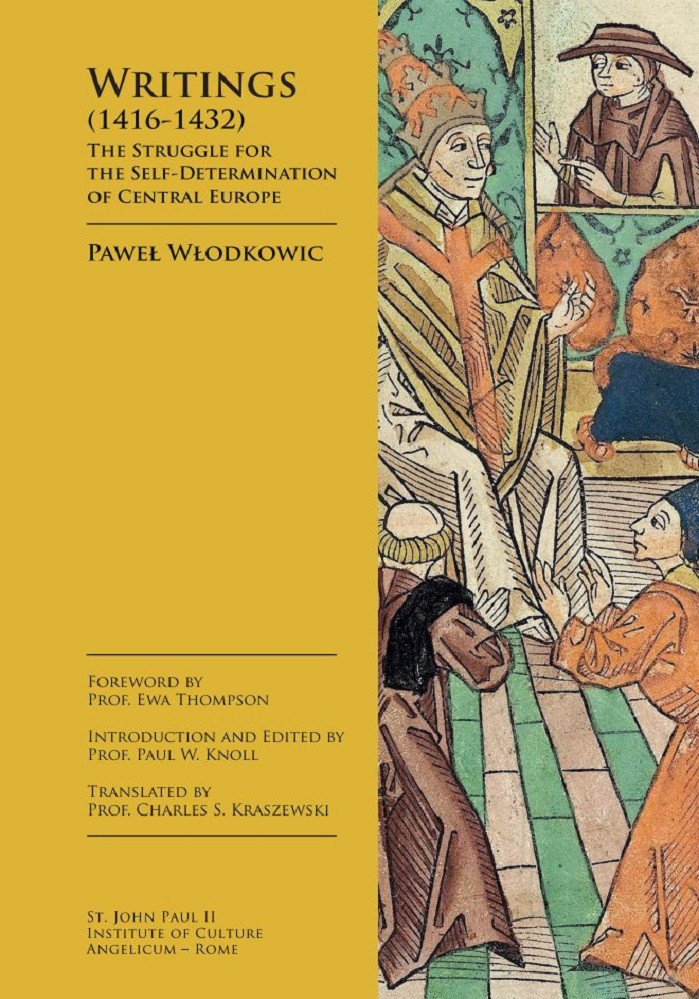
BOOK: Paweł WLODKOWIC, Writings (1416-1432). The Struggle for the Self-Determination of Central Europe (transl. Charles S. KRASZEWSKI, ed. Paul W. KNOLL) (Rome: St. John Paul II Institute of Culture/Evangelicum: 2023), 664 p. ISBN 978-83-67065-44-3 150 Zl.


(image source: Teologiapolityczna)

Abstract:

Paweł Włodkowic and his Tractatus de potestae papae et imperatoris respectu infidelium (Treatise on the Power of the Pope and Emperor Respecting Infidels) presented during the Council of Constance (1414-1418) are the symbols of fundamental for shaping Polish political and social thought focused on the rights of people, their natural inclinations to forming communities subjected to natural law and the law of nations. At the same time, the context of the announcement of his dissertation evokes the greatest diplomatic victory of Poland in Europe at the turn of the Middle Ages and the Renaissance, connected with the pivotal for the peaceful functioning of Central Europe conflict of the Polish-Lithuanian union with the Teutonic Order, whose representatives sought to convert the gentiles by force, and in practice often exterminate them. In the linguistic and substantive manner proper for that period, the scholastic treatise considers questions fundamental and universal for political and religious communities, which boil down to the following issues: Where is the boundary between the just and unjust use of force? What is the significance of the national right to freedom, existence and self-determination for the international peace? Today, we can consider Paweł Włodkowic’s thought from the perspective that allows us to appreciate that this way of thinking eventually created conditions for the emergence of the modern concept of human rights and religious tolerance. Reinforcing the pragmatic and specific political goals that Włodkowic has faced with the original, humanist-Christian approach supported by the highest, in that historical period, scientific and intellectual standards has resulted in presenting the whole of Europe with such ideas that today can be appraised as Polish contribution to development European thought in the fifteenth century and that preceded Francis of Vittoria, one of the fathers of international law, by one century.

Read more here

14 December 2023

BOOK: Sepúlveda on the Spanish Invasion of the Americas (ed./tr. Luke GLANVILLE, David LUPHER & Maya Feile TOMES) [The History and Theory of International Law, eds. Nehal BHUTA, Anthony PAGDEN & Benjamin STRAUMANN] (Oxford: OUP, 2023), 448 p. ISBN 9780198863823, 110 GBP


(image source: OUP)

Abstract:

This volume presents the first full English translation of four key texts from the dispute between Juan Ginés de Sepúlveda and Bartolomé de las Casas regarding the justice of Spain's invasion of the Americas, culminating in their famous debate in Valladolid in 1550-51. An impassioned defence of the invasion, Sepúlveda's Democrates secundus (composed around 1544) amplified the controversy within Spain about the justice of its activities in the Americas. When Las Casas schemed to block publication of Sepúlveda's manuscript, Sepúlveda wrote an Apologia (1550) in its defence. Tensions were so high that Emperor Charles V called a temporary halt to undertakings in the Americas and convoked a meeting of theologians and jurists in Valladolid to address the matter. Here, Sepúlveda and Las Casas debated bitterly. Las Casas subsequently printed a composite record of the Valladolid deliberations (Aquí se contiene una disputa o controversia, 1552). Sepúlveda retaliated by penning a furious response (Proposiciones temerarias y de mala doctrina, around 1553-54) and strove to have Las Casas' text banned by the Inquisition. The debate between Sepúlveda and Las Casas was a pivotal moment in the history of international legal thought. They argued over fundamental matters of empire and colonial rule; natural law and cultural difference; the jurisdiction of the Church, responsibilities of Christian rulers, and rights of infidel peoples; the just reasons for war and grounds for resistance; and the right to punish idolatry, protect innocents from tyranny, and subjugate unbelievers for the purpose of spreading the Christian faith. With a detailed scholarly introduction that elucidates the complex story of these four controversial texts and reflects on the impacts of Sepúlveda's ideas, which continue to be felt in the theories and practices of war today, this book is a must-read for all those interested in the fields of history, political science, international relations, and colonial studies.

On the editors/translators:

Edited and translated by Luke Glanville, Associate Professor, The Australian National University, David Lupher, Professor of Classics, University of Pudget Sound, and Maya Feile Tomes, Lorna Close Lecturer in Spanish, University of Cambridge Luke Glanville is Associate Professor of International Relations at the Australian National University. His research spans past and present thought and practice regarding international protection against atrocities, refugee exclusion, and colonial conquest, and he has most recently authored Sharing Responsibility: The History and Future of Protection from Atrocities. David Lupher is Professor of Classics, Emeritus, at the University of Puget Sound. His main area of research is classical receptions in early modern colonial America. He is the author of books including Romans in a New World: Classical Models in Sixteenth-Century Spanish America (2003), as well as a translation of Alberico Gentili's Wars of the Romans (2011). Maya Feile Tomes is Lorna Close Lecturer in Spanish at Murray Edwards College, Cambridge, Bye-Fellow in Modern Languages at Peterhouse, and Affiliated Lecturer in the Faculty of Classics, Cambridge. She has most recently co-edited Brill's Companion to Classics in the Early Americas (2021). This is her second book. 

Read more here

SEMINAR SERIES: Sécularités, dialogue entre théologiens et juristes (Paris: Institut de recherche juridique de la Sorbonne, JAN-MAR 2024)


« Sécularités, dialogue entre théologiens et juristes » réunit depuis cinq ans à l’Institut de Recherches Juridiques de la Sorbonne, en partenariat avec le Centre d’études du Saulchoir, des représentants des deux disciplines, en prenant acte de l'achèvement de la sécularisation de notre société. Les séances ont lieu (avec quelques exceptions…) le deuxième vendredi de chaque mois, de 16 h 30 à 19 h 30, afin d’entendre un théologien et un juriste sur un thème commun, de leur permettre de dialoguer, puis de discuter avec eux. Elles se tiennent dans la salle des séminaires de l’IRJS (au deuxième étage du 4 rue Valette, 75005 Paris).

Animé par Bernard Bourdin, dominicain, professeur d'histoire des idées et de philosophie politique, Institut catholique de Paris, directeur du Centre d'étude du Saulchoir ; Pierre Bonin, professeur d'histoire du droit, Ecole de droit de la Sorbonne ; François-Guy Trébulle, professeur de droit privé, Ecole de droit de la Sorbonne


Programme:

  • Vendredi 12 janvier : La légitimité, avec Bernard Bourdin, dominicain, professeur d'histoire des idées et de philosophie politique, Institut catholique de Paris, directeur du Centre d'étude du Saulchoir, et Aïda Manouguian, docteur en droit public, université Lyon 3 Jean Moulin
  • Jeudi 8 février : L'obéissance, avec Bruno Cadoré, ancien maître de l'Ordre des Dominicains, et Nicolas Sild, professeur de droit public, université de Toulouse Capitole
  • Vendredi 8 mars : Loi et bien commun, avec don Jean-Rémi Lanavère, directeur adjoint de l'Ecole Supérieure de Philosophie et de Théologie de la Communauté Saint-Martin, et Jimmy Meersman, maître de conférences en droit public, université de Lorraine


More information can be found here.


07 December 2023

Workshop: The Writings of Francisco Rodrigues SJ (1515-1573): Mission, theology, politics, and religious normativities in Iberian Asia (Max Planck Institute for Legal History and Legal Theory, 1 & 15 December 2023) [online]

Arquivo da Universidade de Coimbra (Colégio de Jesus de Coimbra, Pergaminhos de Cartas e Ordens, AUC-IV-3a-Gav. 28, n. 40). University of Coimbra


 Workshop: The Writings of Francisco Rodrigues SJ (1515-1573): Mission,

theology, politics, and religious normativities in Iberian Asia


Organization: Rômulo Ehalt (mpilhlt)

Contact: ehalt@lhlt.mpg.de


1 December 2023 


Rômulo Ehalt (mpilhlt)

10:00-10:30 - The World that Theology and Canon Law Created: Iberian Asia, 1550s-1570s


Coffee break 10:30-10:45


Ines G. Županov (Centre national de la recherche scientifique)

10:45-12:00 - The Crooked Line: Accommodation as pragmatic universal in Portuguese India (16th-

17th c.)


James Fujitani (University of Nottingham, Ningbo)

10:45-12:00 - Rodrigues as a witness to Portuguese smuggling in East Asia


Lunch 12:00-13:00


Gustavo Cabral (Universidade Federal do Ceará)

13:00-14:30 - Francisco Rodrigues and the cases of conscience regarding the captains of fortresses

and voyages in the Estado da Índia (16th c.)


Bradley Blankemeyer (University of Oxford)

13:00-14:30 - By the favor of Our Lord and his prince: Francisco Rodrigues and the politics of Christian uniformity in the Estado da Índia


15 December 2023


Stuart M. McManus (Chinese University of Hong Kong)

10:00-12:00 - Text and Intertext in Francisco Rodrigues' Resolução de algumas dúvidas


Roger Lee de Jesus (Leibniz Universität Hannover)

10:00-12:00 - From percalços to fazenda: Francisco Rodrigues and the economy of the Estado da

Índia


Lunch 12:00-13:00


Antonio Vasconcelos de Saldanha (University of Macau-Universidade de Lisboa)

13:00-14:30 - Finding, defining, and serving a cause: Fr. Francisco Rodrigues and the Jesuit enterprise of mass conversion and idolatry eradication in India


Stefano Cattelan (Vrije Universiteit Brussel)

13:00-14:30 - Serafim de Freitas and Francisco Rodrigues: defending the Portuguese Empire in Asia


Rômulo Ehalt (mpilhlt)

14:30-15:00 - Closing remarks and deadlines

19 August 2022

JOB OFFER: Postdoctoral Scholar for a project on "Divine grace, human agency, and economic entrepreneurship in Luis de Molina" (supervisors: Wim François [KU Leuven] – Wim Decock [UC Louvain]) {DEADLINE SEPTEMBER 15, 2022}


(Source: Wikimedia Commons)


Job offer

Postdoctoral Scholar for a project on

Divine grace, human agency, and economic entrepreneurship in Luis de Molina

(supervisors: Wim François [KU Leuven] – Wim Decock [UC Louvain])


Subsequent to the awarding of a grant from the FWO-Research Foundation Flanders in 2020 we invite applications for a full-time position as postdoctoral scholar on a project entitled Divine grace, human agency, and economic entrepreneurship in Luis de Molina.

The project is the second part of a broader project entitled Knocking on Heaven’s Doors’. Free will, Money, and Emotions in the Theological Systems of Leonard Lessius and Luis de Molina (late 1500s-early 1600s). The position is tenable for two years. The first part, on Lessius, has been elaborated in 2021-2022, the second part, on Molina, will be covered in the years 2023-2024.

Project description

Jesuit theologians such as Luis de Molina (1535-1600) and Leonard Lessius (1554-1623) tended to accept that postlapsarian humans, although affected by original sin and in huge need of divine grace, preserved their positive capacities to know the good, to long for it, and to be able to perform good works that contribute to their own salvation. Whereas the first part of the project, elaborated by Dr. Eleonora Rai, focused upon Lessius, the second part will especially deal with Molina’s theology of grace, free will, and eternal predestination.

Molina’s (contested) theological position – not the least his scientia media  doctrine -- have elaborately been studied not only in his basic work the Concordia (1588), but also in the context of the Congregations De Auxiliis Divinae Gratiae  (1597-1606). Little research has been done, however, on the subtle differences between Molina’s theology and the (more radical) positions of Lessius. Although contemporaries and co-religionists, such as Bellarmino, were aware of these theological subtleties, they have astonishingly been overlooked in contemporary research where Lessius’s position is often simply considered as a variant of Molinism. Therefore, this project has the ambition to engage in a more systematic study of subtle variants, clear-cut differences, and reciprocal influences between the theological and moral systems of Lessius and Molina. The epistolary exchange between the protagonists will also be studied to that purpose.

The Jesuits’ emphasis on man’s deliberation and freedom of action, vis-à-vis God’s initiative, even extended to the realms of economy and finance, which according to the traditional moral system were especially liable to sinful deeds, such as lending at interest. Where the connection between Lessius’s views on grace and free will, on the one hand, and his liberal economic ethics, on the other, has been studied before, this is less the case for Molina and will therefore be subject of research in the second part of the project. Theologically educated confessors and moralists like Lessius had even to consider pressing concerns about the fate of the biblical-juridical category of the “miserabiles personae,” the poor, the orphans and the widows and how the well-to-do citizens should take responsibility here. Molina’s positions in this regard still wait for further research. 

This project will further innovatively study how the theologies under consideration also promoted the major role of human agency- authorship alongside God’s inspiration in the coming into being of the biblical texts. These theories opposed Lessius and like-minded theologians to doctrines of the divine dictation of the Scriptures, as defended by the Dominican Bañez. Molina’s viewpoint on this matter, however, has never been thoroughly explored, an enterprise which may allow a fuller comparison of the two Jesuits’ theological systems.

An important question is whether the differences between Lessius’s and Molina’s theology of justification  – including their consequences in the moral field –, as well as their viewpoints regarding the inspiration of the Scriptures were so crucial, that they “justified” different reactions among the leaders within the Society of Jesus, pre-eminently Bellarmino. Such a strategy led to the eventual censoring of Lessius’ s works, more than Molina’s, who was saved from being condemned as an outcome of the Congregations De Auxiliis. Hence, this project will also unavoidably look at these intra-Jesuit controversies and consider the religious-political strategies promoted by the Society of Jesus at the turn of the 17th century. 

By comparison, the views of the prominent Protestant theologian Jacob Arminius, charged by strict Calvinists as being ‘crypto-Jesuit’, will be further analysed for any possible reciprocal influences. Though the reception of Molina’s doctrine by Arminius and like-minded theologians has been studied, it should not be excluded that more progress is possible in this field.

Job description

With a view to the aforementioned research, the project will involve a postdoctoral scholar. In collaboration with the supervisors, the researcher will develop abovementioned program, share his/her insights at (international) conferences, and record the research results in scholarly articles and/or a monograph. Further, the postdoctoral scholar will be involved in the organization of the Twelfth Annual REFORC Conference on Early Modern Christianity devoted to Early Modern Christianity, Economic Entrepreneurship, and Social Welfare which will take place in Leuven in May 11-13, 2023: https://reforc.com/events/twelfth-annual-reforc-conference-on-early-modern-christianity/

Job requirements

- The candidate has a doctor’s degree in the humanities, viz. in theology and religious studies, philosophy, history of law, neo-Latin, or early modern history, with a seniority between 1 and 5 years.

- The successful candidate has a very competent, solid knowledge of Latin.

- He or she has a good proficiency in the history of early modern Christianity in general and is willing to pursue and capable of acquiring specialized knowledge of the often sophisticated Catholic theology of the period.

- As full-time employee, the candidate is required to reside and work in Leuven (Belgium) during the entire tenure of the scholarship.

Job offer

- The postdoctoral scholarship will start on 1 January 2023 with a one year-contract, which after a positive evaluation will be extended with another year until 31 December 2024.

 - The net salary will follow the KU Leuven standards for postdoctoral scholars, taking into account life conditions and family situation if needed. Social benefits and health insurance are also provided for.

- The KU Leuven Faculty of Theology and Religious Studies offers the opportunity to work in an enthusiast team on an exciting, ambitious project, for which the post-doctoral scholar will also be able to rely on expertise at KU Leuven’s partner institutions, especially at UC Louvain in Louvain-la-Neuve. 

- The accepted candidate will enjoy the opportunity of working in the historic University town of Leuven, in the context of a dynamic, internationally-oriented theological faculty  – Position 4 in QS World University Rankings -- with library-resources that are second to none.


Application procedure

- Applications should be submitted electronically to the following address:wim.francois@kuleuven.be -

 - They should include a letter of motivation (in English or French, maximum 2 pages in all)containing an exposition of the reasons why the applicant believes she or he has the appropriate qualifications for conducting this particular research and for completing it in the allocated time.-

- An up-to-date CV, including work experience, publications, and study results, amongst others.-

 - The name and address (including email) of two scholars of international reputation who may be contacted as referee.

- Application deadline: 15 September 2022


Schedule

- Receipt of each fully completed application will be acknowledged as soon as possible. 

- Candidates who fulfil the requirements will be invited for an online talk, most probably in the second week of October, and may be asked to translate and analyse a short extract form Molina’s work. 

- Final decision and notification of the results are expected by the end of October.


14 March 2022

SEMINAR SERIES: Diritto - Storia - Antropologia. Incontri seminariali (March-April 2022; Università degli Studi di Brescia - ONLINE)

(Image source: Academia.edu)
 

We learned of a seminar series organized by the University of Brescia regarding the relations of legal knowledge with Theology, Philosophy, Historiography and Neuroethics by the perspective of legal history.

All the seminar will be held on-line, in the virtual rooms linked at the end of the post.

***

18 MARZO 2022 ORE 12:00 - Incontro con la Teologia 
GIANFRANCO MAGLIO (Facoltà Teologica del Triveneto)

La consuetudine nella coscienza giuridica medievale e il giurista di domani

Discussant: ANDREA PADOVANI (Facoltà di Diritto Canonico s. Pio X - Venezia)

*

25 MARZO 2022 ORE 12:00 - Incontro con la Filosofia
STEFANO SIMONETTA (Università di Milano)

Natura e consenso nella teoria della legge di John Fortescue

Discussant: ALAN  SANDONÀ (Università degli Studi di Brescia)

*

1 APRILE  2022 ORE 12:00 - Incontro con la Storiografia
VINCENZO LAVENIA (Università di Bologna)

Storia dell'Inquisizione e Storia del diritto: alcune questioni

Discussant: ALDO ANDREA CASSI (Università degli Studi di Brescia)

*

22 APRILE 2022 ORE 12:00 - Incontro con la Neuroetica
ANDREA LAVAZZA (Centro Universitario Internazionale)

Neuroetica come nuova antropologia e i fondamenti del diritto

Discussant: ALBERTO SCIUMÈ (C.R.E.AF. - Università degli Studi di Brescia)


The links at the conferences are the following
  • La consuetudine nella coscienza giuridica medievale e il giurista di domani (here)
  • Natura e consenso nella teoria della legge di John Fortescue (here)
  • Storia dell'Inquisizione e Storia del diritto: alcune questioni (here)
  • Neuroetica come nuova antropologia e i fondamenti del diritto (here)

More information can be found here.


19 January 2022

BOOK: Harald E. BRAUN, Erik DE BOM & Paolo ASTORRI (eds.), A Companion to The Spanish Scholastics [Brill's Companions to the Christian Tradition; 102, ed. Christopher M. BELLITTO] (Leiden/Boston: Martinus Nijhoff/Brill, 2022), 614 p. ISBN 978-90-04-29441-7, € 229


(image source: Brill)

Book abstract:

The Companion to the Spanish Scholastics offers a much-needed survey of the entire field of early modern Spanish scholastic thought. The volume introduces main themes and contexts of scholastics inquiry (Theology, Philosophy, Ethics, Politics, Economics, Law, Science and the Senses) through close examination of a wide range of texts, debates, methods, and authors, as well as in-depth discussion of the relevant literature. Chapters include a useful bibliography and serve as point of departure for future research. The volume not only draws the sum of existing research, but challenges established notions and breaks new ground. Contributors are Fernanda Alfieri, Harald Braun, Paolo Broggio, Alejandro Chafuen, Wim Decock, Fernando Domínguez Reboiras, Thomas Duve, Petr Dvořák, Giovanni Gellera, Juan Manuel Gómez Paris, Christophe Grellard, Miroslav Hanke, Ruth Hill, Harro Höpfl, Nils Jansen, Vincenzo Lavenia, Thomas Marschler, Fabio Monsalve, Thomas Pink, Rudolf Schüssler, Daniel Schwartz, Leen Spruit, Toon Van Houdt, María José Vega, and Andreas Wagner.

 On the editors:

Harald Ernst Braun, D.Phil. Oxon. (2001), is Reader in European History (1300-1700) at the University of Liverpool. He has published widely on early modern Catholic, especially Spanish political thought and culture. Erik De Bom, Ph.D. (2009), KU Leuven, is Research Fellow at that university. He has published on the history of political thought in the sixteenth and seventeenth centuries, early-modern intellectual history and Renaissance humanism. Paolo Astorri, Ph.D. (2018), KU Leuven, is Postdoctoral Researcher in Legal History at the University of Copenhagen, Centre for Privacy Studies. His book Lutheran Theology and Contract Law in Early Modern Germany (ca. 1520-1720), published in Brill’s new series Law and Religion in Early Modern Period, won the RefoRc book award in 2020.

Table of contents:


List of Figures and Tables


Notes on Contributors

part 1

 Introduction
   Harald E. Braun

part 2
Contexts
1 Theology
   Christophe Grellard

2 Managing Dissent
   María José Vega

3 Law
   Thomas Duve

part 3
Theology
4 Grace
   Paolo Broggio

5 Divine Attributes
   Thomas Marschler

6 Biblical Criticism
   Fernando Domínguez Reboiras

part 4
Philosophy
7 Logic
   Petr Dvořák and Miroslav Hanke

8 Natural Philosophy
   Giovanni Gellera

9 Psychology
   Leen Spruit

part 5
Ethics
10 Final Causation in Jesuit Thought Finality and Nature and Normative Power
   Thomas Pink

11 Love, Marriage, and Sexuality in Spanish Scholastic Thought
   Fernanda Alfieri

12 Probabilism and Casuistry
   Rudolf Schüssler

part 6
Politics
13 Church and State
   Harro Höpfl

14  Jus Post Bellum in the Spanish Scholastics Statism and Individualism
   Daniel Schwartz

part 7
Economics
15 Usury and Interest
   Toon van Houdt and Fabio Monsalve

16 Just Pricing
   Alejandro Chafuen

17 Taxation
   Vincenzo Lavenia

part 8
Law
18 Between Cosmopolitan Citizens and Sovereign Nations International Law According to the Spanish Scholastics
   Andreas Wagner

19 Contract Law in Early Modern Scholasticism
   Wim Decock

20 The Doctrine of Restitution ( Restitutio)
   Nils Jansen

part 9
Science and the Senses
21 Scholastics and Novatores
   Juan Manuel Gómez Paris

22 The New World and the Problem of Race
   Ruth Hill

Read more on the publisher's website (DOI  10.1163/9789004296961).