Search

Showing posts with label Conference and Call for papers. Show all posts

25 March 2026

CONFERENCE: 12e Congrès de l’Association des Cercles francophones d’histoire et d’archéologie de Belgique/59e Congrès de la Fédération des Cercles d’archéologie et d’histoire de Belgique (Brussels: Académie Royale de Belgique, 20-23 AUG 2026) [DEADLINE 15 APR]


12e Congrès de l’Association des Cercles francophones d’histoire et d’archéologie de Belgique
59e Congrès de la Fédération des Cercles d’archéologie et d’histoire de Belgique

Programme
Le Congrès de Bruxelles 2026 se déroulera du jeudi 20 au dimanche 23 août 2026, à l’Académie royale de Belgique. La séance inaugurale aura lieu dans la grande salle Albert II du palais des Académies.
Les journées d’étude se tiendront dans le bâtiment des anciennes écuries. Les salles des conférences sont disposées autour d’un patio où seront installés l’accueil aux participants, la pause café et la vente des publications patrimoniales. Les journées d’étude sont réparties en quatre tranches horaires : 9h00 – 10h30 et 11h00 – 12h30 / 14h00 – 15h30 et 16h00 – 17h30. Trois communications par tranche horaire totaliseront six communications par demi-journée, avec des pauses-cafés de trente minutes entre elles. Après chaque communication d’une durée de vingt minutes, les participants pourront échanger pendant dix minutes. Le programme des communications sera établi vers la mi-mai.
Des activités culturelles gratuites et/ou payantes seront proposées en parallèle des séances d’études, l’après-midi du vendredi 21 et du samedi 22 août. D’autres animeront la soirée du jeudi et du vendredi ainsi que le dimanche 23 août. Le programme et les modalités d’inscription seront précisés ultérieurement.
Sections
  1. Archéologie
  2. Histoire politique, militaire et relations internationales
  3. Histoire économique et sociale (+ numismatique, démographie, vie quotidienne)
  4. Histoire des institutions et du droit (+ sigillographie)
  5. Histoire des religions et des mouvements philosophiques
  6. Histoire des sciences, des techniques et des savoirs anciens
  7. Histoire de l’environnement et de l’aménagement du territoire
  8. Généalogie et histoire des familles (+ héraldique)
  9. Histoire des arts
  10. Patrimoine oral et immatériel, folklore
  11. Archives et bibliothèques
  12. Patrimoine mobilier et musées

Modalités d'Inscription

Les personnes qui souhaitent assister ou participer comme orateurs au Congrès sont invitées à se faire connaitre dès à présent, en remplissant le formulaire dans la langue de leur choix (FR, NL, D) : soit en ligne, soit en le renvoyant par courriel à srab@acfhab.be ou par courrier postal à

c/o Société Royale d’Archéologie de Bruxelles (SRAB)
Congrès de Bruxelles 2026
Université libre de Bruxelles – C.P. 133/01
Avenue Franklin Roosevelt 50
B-1050 Bruxelles

Chaque congressiste recevra, à l’ouverture du Congrès, le tome 1 des Actes contenant les textes de présentation générale et les résumés de l’ensemble des communications. Une documentation culturelle et touristique relative aux différentes manifestations du Congrès y sera jointe.
Les congressistes auront la possibilité de souscrire aux volumes des Actes qui contiendront les textes des communications présentées. Le montant de la souscription aux Actes ainsi que celui du banquet de clôture du samedi 22 août seront fixés ultérieurement.
Les congressistes désireux de présenter une ou plusieurs communications sont invités à en aviser l’organisateur en renvoyant le formulaire accompagné d’un résumé de leur intervention en Word (de 15 à 20 lignes) avant le 15 avril 2026.
Tout engagement non confirmé à cette date par l’envoi d’un résumé, ne sera pas pris en compte. Les travaux de chaque section sont organisés par un bureau composé d’un président, d’un ou deux vice-président(s) et d’un secrétaire. Toute précision d’ordre scientifique pourra être obtenue auprès des responsables des sections.
Les candidatures seront étudiées par le comité scientifique qui fera connaître sa décision au plus tard le vendredi 15 mai.
Les résumés des communications retenues seront publiés dans le tome I des Actes, offert à tous les congressistes. Si le conférencier désire accompagner son résumé d’une illustration, il veillera à le faire savoir et à fournir une image de qualité suffisante, avec les références de l’œuvre respectant les mentions obligatoires et les droits d’édition éventuels.
Les communications auront une durée maximum de 20 minutes et seront suivies de dix minutes de discussion. Le choix de la langue est libre (français, néerlandais, allemand). Cependant, nous souhaitons souligner que tout (ou presque) se déroulera en français, la langue officielle du Congrès, et que le public sera, dans sa grande majorité, francophone.

You find more information here.

11 October 2022

CALL FOR PAPERS: Conference "A History of Constant Reform: Crime and Punishment in the Twentieth Century" - University of Fribourg, 8 - 9 June 2023 [DEADLINE 15 January 2023]


A History of Constant Reform: Crime and Punishment in the Twentieth Century

8 - 9 June 2023, Fribourg (Switzerland)

Deadline for applications: 15 January 2023


Although closely related, the histories of criminal justice and prisons are often studied apart. This workshop seeks to bring together historians and scholars from neighbouring disciplines working on various aspects of the history of crime, criminal justice, and incarceration in the twentieth century.

In the twentieth century, laws, legal institutions, and prison facilities seemed to be characterized by a constant process of reform. Though there were occasional accelerations and downturns, the reform movement never entirely stopped. Thus, the discourses and practices of criminality and of legal sanctions and their execution evolved substantially, while the individuals involved in the legal and penal systems – the accused, accusers, lawyers, judges, prison inmates, prison workers, and criminologists – became more diverse in terms of gender, social and geographic origin, professionalization, etc.

The goal of this workshop is to start a discussion of how reforms and changes in different steps of the criminal and penal system related to and influenced each other. Although closely related, the histories of criminal justice and prisons are often studied apart. This workshop seeks to bring together historians and scholars from neighbouring disciplines working on various aspects of the history of crime, criminal justice, and incarceration in the twentieth century, when phases of relative stability seemed to be followed by periods of rapid change. The 1970s in particular, though less well studied than previous periods of reform, seem to have been an especially intense time of debate about the criminal justice and prison systems.

We propose to follow four broad tracks to identify how different forces converged to generate moments of change in the twentieth century:

1. Visible Justice/Invisible Prisons?
In line with the dictum, “Ignorance of the law is no excuse,” making the legislative process public is one of the fundamental principles of democracy. Even before a law is adopted, every step in its creation must be publicly discussed, and after its adoption, it is supposed to be publicly available. The execution of penal sanctions on the other hand is almost entirely a black box. It takes place in areas separated from society and remains invisible to most people. In the twentieth century, making the living conditions in prisons known to the outside world was challenging, since the media paid little attention and few people cared about the inmate population, who were thought to deserve their fate. This situation was contested throughout the twentieth century by individuals and organizations both inside and outside prisons, but they were most successful in the 1970s, when anti-prison groups and other critics of the carceral system seemed to become more numerous.

What triggered the wider contestation? Were critics simply more efficient? Finding answers to such questions will lead us to examine the conditions that made the critique of the prison system possible. Prison living conditions are closely related to issues of funding. How did debates about the importance of self-financing of prisons change in the political sphere? Furthermore, has the tension between the public nature of legislative processes and the hidden nature of the penal system evolved over time? Did the democratization of politics that occurred during the twentieth century lead to a wider public involvement in the law-making process? How has this affected subordinate social groups? What were the relationships between the democratization of political life and the prison reform movement based on human rights principles?

2. Criminalization and Decriminalization
What was counted as criminal behaviour changed over the course of the twentieth century. Criminalization and decriminalization were complex processes that were related to changes in society, culture, politics, and the economy. The most famous example of criminalization of previously legal behaviour is the prohibition of alcohol consumption in the United States in the first half of the twentieth century; another is the criminalization and decriminalization of abortion. While changes in criminal laws were the most obvious expression of criminalization or decriminalization, there were also more subtle forms. For instance, increased reporting of sexual crimes in the early twentieth century led to increased visibility of behaviour that had previously gone mostly unreported. Intensified policing of public and private spaces could have a similar effect; the same is true for harsher or more lenient sentences by the courts. Moreover, the spread of new patterns of behaviour, such as ostentatious drug use by members of the counterculture, may have led to increased police activity and subsequent criminalization. In turn, the incarceration of drug addicts also posed significant problems for prisons.

What were the social, cultural, economic, and political driving forces and contexts of various forms of criminalization and decriminalization in the twentieth century? Which social groups were targeted, and which benefited? Which (political) activists lobbied for criminalization or decriminalization? And how did criminalization and decriminalization relate to historical shifts taking place in the second half of the twentieth century, such as the rise of the counterculture and the subsequent decline of middle-class mores, the increase of global migration, and the emergence of neoliberalism and right-wing populism?

3. Reform and Scientific Knowledge
Throughout the twentieth century, crime and criminal justice and punishment were subjects of scientific knowledge production. The late nineteenth and early twentieth centuries witnessed the rise of a well-documented naturalization and medicalization of crime and criminal justice. While sociological explanations on the social causes of crime had existed since at least the nineteenth century, medical experts began to individualize criminal behaviour by interpreting it as a sign of psychiatric illness or ‘abnormality.’ Especially in Nazi Germany, but also elsewhere, crime was racialized. Individuals who were racially classified as ‘Jews,’ ‘Gypsies,’ or ‘Slavs’ were seen as ‘naturally’ prone to criminal behaviour. Criminals – female criminals in particular– were seen as a threat to the fabric of society. In this regard, we would like to question the way women were viewed as a specific class of criminal subjects and how prisons were conceived differently for men and women over time. How was this differentiation challenged?

Starting in the 1960s, the medicalized, racist, and sexist view on crime and criminal justice came under scrutiny by proponents of the New Left. Related to this criticism, new sociological approaches started to gain influence, such as the labelling theory and the differential association theory, which focused on the interplay of crime, criminalization, and socialization in subcultures. Nevertheless, psychiatrists and their expertise still remain an important pillar in criminal procedures.

In the closing decades of the twentieth century, neoliberal theories of crime and punishment started to evolve. Following the rational choice theorem, neoliberals conceptualized criminals as rational and profit-seeking actors who freely and deliberately chose to commit crimes (as opposed to being forced by social circumstances or mental conditions) and were thus seen as fully responsible for their actions. What were the political implications of these and other developments in the knowledge production on crime, criminal justice, and punishment? How did scientific theories relate to and react to the rise of human rights and anti-racism? Did the role of psychiatrists, both as knowledge producers and as scientific experts in trials, evolve after the critique directed against them in the 1970s? How has knowledge production been influenced by the rise of neoliberalism and right-wing populism? We would also like to question the way psychiatry and psychiatric theories affected the carceral system. Did they trigger reforms of the prisons? Did they influence new conceptions of prison facilities?

4. Human Rights and Social Movement Advocacy as Driving Forces for Change?
The emergence of human rights in public discourse after the Second World War, promoted by the United Nations and the European Council, has been the driving force behind the push for minimum standards of respect for human rights in the management of prison facilities. However, historians have paid little attention to the impact of these standards on legal and prison reforms. How were these minimum standards, which entailed new obligations and a reduction of state autonomy, implemented in law and in prison facilities?

Supranational organizations were not the only ones calling for reform. In the wake of the 1968 movements, subordinate social groups demanded more attention and pushed for various forms of social discrimination such as racism and sexism in penal institutions to be addressed. In addition, legal reformers and scholars developed critiques of the law as an instrument used by the ruling classes to secure their domination. What effects did such critiques lead to in the penal system? What were the major improvements? How did social movements appeal to human rights in order to demand greater social rights? How did these movements influence the law and the execution of punishment? How did the social movement denounce injustice when it was part of the law? How were prisoners involved in the process of denunciation and reform? And finally, how do these developments relate to the increasing individualization of societies during the second half of the twentieth century?

Proposals of 300–500 words, accompanied by a short biographical note, should be sent by January 15, 2023 to the following addresses: maurice.cottier@unifr.ch and alix.heiniger@unifr.ch.

Decisions will be announced no later than February 1, 2023.

The conference will take place at the University of Fribourg, June 8 and 9 2023.

Organizers: Maurice Cottier and Alix Heiniger (Department of Contemporary History, University of Fribourg).

Kontakt

E-Mail: maurice.cottier@unifr.ch

Source: A History of Constant Reform: Crime and Punishment in the Twentieth Century. In: H-Soz-Kult, 05.10.2022, <www.hsozkult.de/event/id/event-130079>.

17 March 2022

EXTENDED DEADLINE: Liability and Responsibility in Legal History, 26th Annual Forum of Young Legal Historians (Istanbul, 12-14 October 2022)

(Image source: Association for Young Legal Historians)


We learned about the extended deadline for submitting papers at the Annual Forum of Young Legal Historians 2020/2022.

Applications including an abstract of not more than 250 words and your CV can be sent to istanbul2022@aylh.org before 22nd of April. Presentations have to be in English and should not exceed 20 minutes each. 

The conference fee will be € 150, – and does not include travel and accommodation. After 2nd of May accepted papers will be informed and will be contacted further to complete the registration by paying the conference fee. Registration link could be found in the website. For the completion of the registration fees a further e-mail will be sent to all the partipants on 9th of May.

Registration is limited to a number of people, therefore, early registration is strongly recommended!


Previous posts:

  • Call for papers (here)
  • Postponement (here)

More information can be found here.

22 December 2021

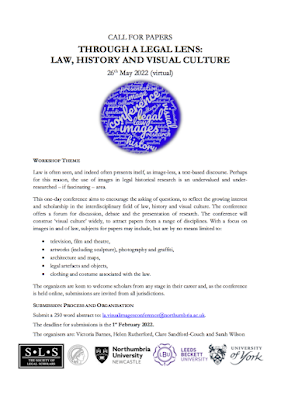
CALL FOR PAPERS: Through A Legal Lens: Law, History and Visual Culture - Online 26th May 2022 - deadline 1st February 2022


WORKSHOP THEME

Law is often seen, and indeed often presents itself, as image-less, a text-based discourse. Perhaps

for this reason, the use of images in legal historical research is an undervalued and under-researched – if fascinating – area.

This one-day conference aims to encourage the asking of questions, to reflect the growing interest
and scholarship in the interdisciplinary field of law, history and visual culture. The conference
offers a forum for discussion, debate and the presentation of research. The conference will
construe ‘visual culture’ widely, to attract papers from a range of disciplines. With a focus on
images in and of law, subjects for papers may include, but are by no means limited to:
 television, film and theatre,
 artworks (including sculpture), photography and graffiti,
 architecture and maps,
 legal artefacts and objects,
 clothing and costume associated with the law.

The organizers are keen to welcome scholars from any stage in their career and, as the conference
is held online, submissions are invited from all jurisdictions.

SUBMISSION PROCESS AND ORGANISATION

Submit a 250 word abstract to: la.visualimagesconference@northumbria.ac.uk.

The deadline for submissions is the 1st February 2022.

The organisers are: Victoria Barnes, Helen Rutherford, Clare Sandford-Couch and Sarah Wilson

23 April 2021

CALL FOR PAPERS: Monarchy in turmoil: princes, courts, and politics in revolution and restoration 1780-1830 (Leiden, 18-20 May 2022) (DEADLINE: 31 May 2021)


We learned of a call for papers for a conference on monarchies between 1780-1830.

For every period, it is a challenge to unearth the details of political trafficking; yet the effort needs to include all relevant persons, groups, and institutions – not only those wielding formal responsibilities. We hope to reinvigorate this effort by inviting specialists to present their research on the institutional, social, and political aspects of the court between 1780 and 1830.

Conference layout

We invite papers outlining change and continuity in household institutions; on the careers of court dignitaries moving between household, central government, representative assemblies, the army, and regional administration; on decision-making and political contestation around the prince.

Papers can be proposed for the following sections:

Institutions. Household staffs and their connections in ministries, councils, army command, representative assemblies; connections among these institutions and with regional administrations. Who may be seen as the key political players and brokers on the basis of these connections?

Activities. Routines of these office holders and institutions; points of contact and sociability. Was there a central meeting point, or do we rather see a series of competing foci of sociability? [ceremony and representation can be addressed if related to these themes, but do not form part of our core conference themes].

Politics and decision-making. How did key policy choices take shape? Who were involved, formally and informally? Examples of household—government—parliament—army interaction around princes. Change over time; comparison of processes in various countries.

Europe will be our prime focus; excursions are possible if they show a direct connection to the European-Atlantic-Global wave of revolution as well as to the themes cited here (e.g. the Braganza court in Brazil; Ottoman responses in terms of court organisation and decision-making.)

The organisers have approached a number of institutions and researchers directly. In addition  this announcement will be placed on internet and can be circulated freely: it is intended to attract the attention of researchers in the field.

Paper proposals

We ask those interested to present a paper to send a mail message with a mini-bio (100 words) plus a title and abstract (250 words) to: monarchyinturmoil@hum.leidenuniv.nl before 31 May 2021.

Applicants will receive a response in early July.

Travel and accommodation of speakers will be covered  by the organisers.

Organisation

This conference is organised by the Leiden University Institute for History and Huygens Institute for Dutch History and Culture on 18-20 May 2022 in Leiden, Gravensteen building, in the framework of the research project Monarchy in Turmoil. Rulers, Courts and Politics in The Netherlands and Germany, C.1780 – C.1820, funded by the Dutch Research Council.


The full call can be found here

22 March 2021

CALL FOR PAPERS: 25th British Legal History Conference (6-9 July 2022, Belfast) (DEADLINE: 30 August 2021)


(Source: QUB)

We learned of the call for papers for the British Legal History Conference 2022

 LAW AND CONSTITUTIONAL CHANGE


Abstracts are invited for the 25th BRITISH LEGAL HISTORY CONFERENCE which is being run jointly with the Irish Legal History Society and hosted by Queen’s University Belfast, on Wednesday 6 July – Saturday 9 July 2022. 


The conference was originally scheduled for 2021. Queen’s, Belfast, was given the honour of hosting the BLHC in 2021, because it is a significant year in the “Decade of Centenaries”[1] in Ireland, north and south, marking both the centenary of the opening in June 1921 of the Parliament of Northern Ireland, established under the Government of Ireland Act 1920, and the centenary of the signing of articles of agreement for the Anglo-Irish Treaty in December 1921, leading to the establishment of the Irish Free State.   The conference theme, “Law and Constitutional Change”, was chosen against this background.  The Covid-19 pandemic intervened, making postponement unavoidable. 


Organising the conference in 2022 will, however, allow us to celebrate the half-centenary of the British Legal History Conference, first held in Aberystwyth in 1972.  Our hope is that attendance at the conference can be in person, but this will be kept under review and, if necessary, the option of online attendance/participation will be considered.


Conference papers can examine from any historical perspective the relationship between law and constitutional change. The difficulty of defining constitutional change was noted by the Select Committee on the Constitution in their report, The Process of Constitutional Change (HL Paper 177, 2011, para. 10), but they identified several examples, without being exhaustive: parliamentary sovereignty; the rule of law and the rights and liberties of the individual; the union state; representative government; and state membership of international organisations, such as (then) the EU and the Commonwealth.  These are, of course, only examples and the conference theme will be interpreted in all its breadth.


In the context of present-day analysis of the political and constitutional upheavals in British-Irish relations in the early 1920s, the President of Ireland, Michael D. Higgins, has adopted the Irish word, Machnamh, meaning reflection, contemplation, meditation and thought, for a series of online reflections – https://president.ie/en/diary/details/president-hosts-machnamh-100-event  In the spirit of Machnamh, we invite you to join the conversation on law and constitutional change in Queen’s, Belfast, in July 2022.


--------------


Please note the following rules:

-          If you submitted an abstract in 2020, you must make a fresh submission.

-          Abstracts must be for individual papers only, not for panels. Co-authored papers are acceptable.

-          Only one abstract should be submitted per person.

-          Abstracts must be submitted as Microsoft Word documents using the online portal on the Call for Papers page of the conference website.  Please do not submit by email.

-          Abstracts must not exceed 500 words.

-          Please indicate if your proposal is contingent on the availability of an option of online participation.

-          The deadline for submission of abstracts is Monday 30 August 2021.

-          Queries can be emailed to BLHC-2022-info@qub.ac.uk    

-          At the conference, individual oral presentations will last 15-20 minutes.


We hope to publish the programme on the conference website in October 2021.  Details of plenary speakers will also appear there in due course.


Proposals from postgraduate and early career researchers are welcome.


Further information about travel to Belfast, accommodation, and so on, will be added to the conference website during 2021-2022:  https://www.qub.ac.uk/sites/BLH-Conference-2022/


Poster competition


This, the second joint BLHC - ILHS conference, was proposed by Sir Anthony Hart, retired High Court judge, former president of ILHS and enthusiastic supporter of BLHCs, who died suddenly in July 2019.  A poster competition is planned during the 2022 conference as a tribute to Tony.  There will be two prizes, including one for the PGR/early career category. The prizes are generously funded by the Journal of Legal History and by the Irish Legal History Society.  Details of the competition will be posted on the conference website. 


[1] See https://www.decadeofcentenaries.com, a website sponsored by the Irish Department of Culture, Heritage and the Gaeltacht, and other websites linked to it.

22 February 2021

CALL FOR PAPERS: Slavery Past, Present & Future (7-9 July 2021, ONLINE) (DEADLINE: 15 March 2021)


(Source: McKinneylaw)

We learned of a Call for Papers for the 5th global meeting of “Slavery Past, Present & Future”. Here the Call:

Slavery (the treatment of humans as chattel) and enslavement through conquest, birth, gender, race, ethnicity, kinship, and exploitation of indebtedness have been an intrinsic part of human societies.

Slavery and a variety of other forms of exploitation existed in ancient societies across the world, and in many other states and territories.  The Transatlantic Slave Trade furnished at least 10 million Africans for slavery throughout the Americas. 

Controversial and contested estimates indicate that up to 40 million people worldwide are enslaved today.  This modern re-emergence of slavery into public view, following legal abolition of the trans-Atlantic slave trade over two hundred years ago, is said to be linked to the deepening interconnectedness of countries in the global economy, overpopulation, and the economic and other vulnerabilities of individual victims and communities.

But should we think of these people as enslaved? And if so, is slavery an inevitable part of the human condition? Like ‘consumers’ of past eras, such as early industrialization, are we dependent on the exploitation of others? What does the persistence and mutations of different forms of exploitation mean in the context of abolition and recognition of universal individual and collective human rights? 

The varieties of contemporary forms of exploitation appear to be endless. This interdisciplinary conference will facilitate a multidisciplinary exploration of slavery in all its dimensions. 

In keeping with previous meetings, the format of the Slavery Past, Present and Future Conference this year will be plenary. We intend to hold the meetings for part of the day only [EST] to avoid Zoom fatigue and expect those who register to attend all the sessions in order to facilitate a genuine cross-fertilization of ideas across identities, disciplines, and subject areas.

Submissions are sought from people from all walks of life and identities, including:

  • Academics: from all disciplines, such as art, film, anthropology, sociology, history, ethnic studies, politics, social work, economics, and any field that touches the study of exploitation
  • Civil society members: human rights activists, leaders in non-governmental organizations, and others in the NGO or social advocacy fields
  • Professionals: social workers, corporate social responsibility and business ethics professionals, business leaders, and health care professionals
  • Government actors: representatives, policymakers, lobbyists, and analysts
  • Global citizens with personal connections to slavery or exploitation: former enslaved persons or indentured laborers, members of at-risk populations, migrant or guest workers, non-regularized immigrants, and refugees

We particularly encourage submissions from the Global South.

Potential themes and sub-themes include but are not limited to:

  1. Defining Slavery
  2. Slaveries of the Past
  3. Human Trafficking and other Forms of Contemporary Exploitation
  4. Systems and Structures of Enslavement and Subordination (historic and contemporary)
  5. Voices of the Enslaved
  6. Legacies of Slavery
  7. Anti-slavery Initiatives and Movements
  8. Covid-19 and slavery


More information can be found here

11 February 2021

REMINDER: Second Student Conference on Legal History – The Iustoria 2021 (Belgrade, 25-26 March 2021) (DEADLINE: 15 February 2021)

(Source: Iustoria)

We received notice from the team of the Iustoria conference at the University of Belgrade that it still possible to send in applications until 15 February 2021. The original post and all info about the conference can be found here

21 January 2021

CALL FOR PAPERS: International Military Justice Forum (Paris, 18-19 November 2021) (DEADLINE: 15 April 2021)

We received news of a call for papers for the first international military justice forum, which also considers papers on the History of Military Justice and Comparative Military Justice.

International Military Justice Forum

Military justice as it is, as it was, as it was compared and as it could be.

Paris, Cour de Cassation, November 18 and 19, 2021

Argument. The International Military Justice Forum (IMJF) is a place of debate, meeting and exchange that proposes to explore a variety of military justice issues. Its first objective is to highlight the diversity of military justice systems, to expose their salient features, to explore their history and to underline their actual evolution. In a comparative way, the IMJF also aims to emphasize links and similarities that may have existed - or still exist - between national military laws, which may be consequences of circulations of legal models, codes, doctrines and people or the existence geopolitical influences. This scientific event must finally allow us to imagine together what the future of military law could be, as our armed forces are transformed by new technologies. Its originality is to mix disciplines. History, law, ethics, philosophy and new technologies will be at the heart of our debates and discussions. The IMJF, which is a continuation of the work carried out by lawyers at the Research Centre of the French Military Academy Saint-Cyr Coëtquidan (CREC) from 2010, was created to bring together academics, professionals, armed forces officers, engineers and all those who share an interest for this exciting discipline. The CREC, in collaboration with the Parquet Général of the French Cour de Cassation, will host the first edition of the International Military Justice Forum in Paris on November 18 and 19, 2021.

Objectives: • To highlight contemporary military justice systems and to compare them (Military Justice as it is). This first part should be used to deepen knowledge on military justice systems that exist in the world and to identify points of comparison. Many issues are to be considered: What are the legal foundations of military justice? What is military courts’ jurisdiction? How are courts organized? How are they hierarchized? How do they work? Are they special and different from the civilian courts? Are they civilian specialized courts? Or are they organized in a mixed way? Who is the judge? What is the procedure? What are the offences? What are the penalties? What is the officer's role in military justice? All these questions could also be used to provide a critical look at a national military justice system, in terms of structure or training: how to improve military justice? • To recount the history of military justice in the world (Military Justice as it was).

This second part aims to highlight the main historical developments of military justice, from Antiquity to the contemporary period: 1/ The evolution of the sources of military justice: Military justice systems are known to have been largely built by major legislations. As, among others, the first Articles of War in England (1385), the Mandement de Montdidier (1347) and legislations of 1796 in France or the Swedish code of 1621. At the origins of these founding texts, famous legislators have left their mark on the history of military justice. However, the latter has also developed in practice, thanks to courts decisions and to political debates. In other words, what have been sources of military justice? Who are those who contributed to its history? 2/ The institutional aspect: Gradually, military justice has been structured and institutionalized, before being integrated into State administration. How has military justice been transformed in the context of the construction of states and the establishment of permanent and professional armies? This question implies others: how did new bodies of specialized lawyers appear? Broadly speaking, what have been the major structural and institutional transformations of military justice? 3/ The theoretical foundations of military justice: Christianity, Humanism or Enlightenment, for example, may have influenced development and evolution of military justice (Belli, Ayala, Grotius, Vettel, etc.). The French revolutionaries were also not insensitive to the fate of the soldier before a court. Who are the main authors and intellectuals who used their pen to call for reform? What were their arguments? Have they been influential? 4 / Military justice in its military context: Establishing a modern system of military justice is one thing. Being able to make it work properly is another. Has military justice always been effective in times of war and especially in times of debacle or defeat? 5/ Military justice in practice: The history of military justice is also that of trials and cases. Some are famous, others have been forgotten. Some have made military justice grow, others have turned public opinion against it. What are great military affairs in history? Which less well-known ones deserve to be known better?  

The circulation of military justice models in the world (Military Justice as it was compared) Comparative studies can answer two sets of questions. 1/ Why compare national military law? It seems that many authors, lawyer or not, military or not, have compared in the past and still compare military national laws or military justice systems today. And there is a variety of reasons: criticizing a system, promoting or rejecting reform, categorizing or classifying laws or procedures, or simply exposing diversity. It also seems that several national military laws have been models used to build other national legal systems. The aim is to look at the circulation of military law models around the world, and to expose methods and motives of legal comparison. 2/ Are there "families" of military law? French comparatist René David identified several "families" of legal systems in the world (Common Law, Civil Law, Religious Law, etc.)? But could it be possible to identify families of military laws? In other words, have colonization, international treaties of all kinds (e.g. NATO), intergovernmental organizations (Ex: Commonwealth), political unions (Ex: USSR), political and economic associations (Ex: EU) or simply interstate cultural or diplomatic bounds, contributed to the emergence of "families" of military justice systems, whose members share common features and similarities?  

Imagine tomorrow’s military law and military justice (Military Justice as it it could be). Battlefield robotization, augmented soldier, artificial intelligence; technological developments present and to come and their use by armed forces will necessarily be controlled and regulated by law. Stakes are numerous: responsibility, consent, courts’ jurisdiction, etc. Which future for military law and military justice?

Papers will be given in English or in French (interpreters will translate from English to French and from French to English). Organization committee: Stéphane Baudens (CREC Saint-Cyr) Eric Gherardi (CREC Saint-Cyr) Gwenaël Guyon (CREC Saint-Cyr) Gérard de Boisboissel (CREC Saint-Cyr) Proposals for communication (400 words maximum), should be sent to the forum’s organizers, specifying in which section papers would be included: militaryjusticeforum@gmail.com The deadline to submit a proposal is April 15, 2021.

23 November 2020

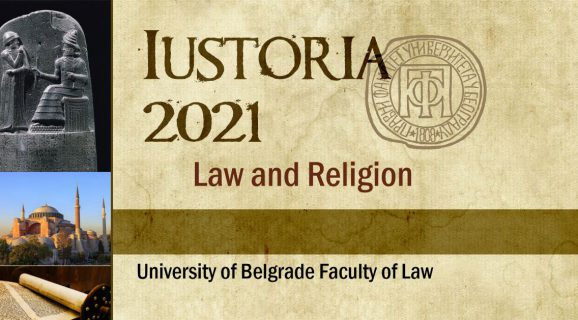
CALL FOR PAPERS: Second Student Conference on Legal History – The Iustoria 2021 (Belgrade, 25-26 March 2021) (DEADLINE: 14 January 2021)


We received notice of a call for papers for the 2nd edition of the Iustoria conference at the University of Belgrade. Here the call:

The University of Belgrade Faculty of Law is now receiving paper proposals for the Second student conference on legal history – the Iustoria 2021, to be held on the 25th and 26th of March, 2021, its topic being “Law and Religion”

The reason for the topic is the fact that this year marks the 100th anniversary of the adoption of the Vidovdan (St. Vitus’ Day) Constitution of the Kingdom of Serbs, Croats and Slovenes (1921), which, among many other changes, was the first in this region to introduce multi-confessionalism instead of one state religion. The question of the relationship between the state and the church and the position of different religious denominations in the modern state is certainly still relevant today; however, the connection between law and religion has lasted since time immemorial. The emergence of the first norms of primitive law is predominantly related to religious commandments and taboos. Most legal systems of the Antiquity have noticeable connections with religion – from irrational means of proof such as ordeals and oaths, through contractualformalism in the old ius civile, to special regulations on the position of the clergy. Monotheistic religions bring with them a different view of society and law, and many new topics, such as the relationship between secular and religious regulations, the influence of religious norms on everyday social relations (especially marital and family relations) or the punishment of crimes against religion. In all societies, one can speak to a greater or lesser extent about the issue of the legal position of members of other religions, but it is monotheism, together with numerous religious conflicts and schisms, that intensifies this issue. The colonial expansion of the Western powers also raises the question of the attitude of (Christian) colonizers towards the religions of the conquered population. And the modern age also brings states that separate themselves from religion – whether it is a matter of distancing in the form of secularism, or a conflict characteristic of communist states. We’re looking forward to applications on all of these and many other issues related to the main topic!

All students of graduate and post-graduate studies pertaining to law or other humanities are eligible to apply for the conference. The applications should contain basic personal information (name and surname, faculty, department, level and year of study), along with an extended abstract containing anywhere between 500 and 1000 words. Applications are accepted in either Serbian or English.

The applications should be e-mailed to iustoria@ius.bg.ac.rs before the 15th of January, 2021. The students will be informed by the 25th of January whether or not their application has been accepted. A provisional programme for the conference will be announced by the 1st of February. Drafts of the chosen papers need to be sent by the 15th of March. For any additional information you may enquire at the same e-mail address, or consult the official Facebook page of the conference – https://www.facebook.com/iustoria/

Just like on last year’s conference, apart from the presentations given by their colleagues, the students at the conference will have an opportunity to attend several lectures given by renowned experts – more details on this will be available in the final version of the programme.

Given the fact that the situation with the COVID-19 pandemic is still uncertain, we will make a decision by the 25th of February whether the conference will be held live or online. If it is held live, we’ll do our best to secure accomodations either in student dorms or with student host families for those participants who don’t reside in Belgrade. These arrangements will depend on the number of available spots.

The final versions of the papers presented at the conference, with final changes and corrections submitted within a reasonable time after the conference, will be submitted for publication in the journal „Vesnik pravne istorije / Herald of Legal History“.Herald of Legal History”.


More info here

04 November 2020

CALL FOR PAPERS: Race, Law and Group Identity in Medieval Europe (Torun – Poland, 6-7 September 2021) (DEADLINE: 2 April 2021)


We received word of a call for papers for a conference on “Race, Law and Group Identity in Medieval Europe” organized by Nicolaus Copernicus University (Torun) and Swansea University. Here the call:

This will be an interdisciplinary conference welcoming historians, art historians, archaeologists, literary scholars and sociologists. It will discuss the complex relationships that existed between any of the following elements: (1.) medieval ‘race’ –here problematized as constructed variously in relation to biological, ethnic, linguistic or even proto-national elements–; (2.) laws directly or indirectly governing perceived ‘racial’ or other identity groups; and (3.) the formation and perpetuation of ‘racial’ or other group identities. 

The later medieval processes of colonization at the European ‘peripheries’ (e.g. Wales, Ireland, Prussia, Livonia, reconquest Spain, the Levant, etc.), of increasing legal consciousness and litigiousness, and of growing self-awareness among literary and political communities transformed the social and political landscape of medieval Europe.  These changes were reflected in both core and peripheral areas. This conference shall cast the widest possible net to bring together exciting new perspectives on these processes and their outcomes, broadly conceived.

Indicative approaches to ‘race’, law and group identity include:

  • colonization; urbanization; urban and spiritual space; integration/assimilation; rebellion; minority suppression; self-expression; material culture; contemporary group characterizations. 

Proposals: We invite proposals for 20 minute student papers and 30 minute academic papers (abstracts of 250 words)

keynote speakers: Monday 6 September, Professor Deborah Youngs (Swansea University) and, Tuesday 7 September, Professor Andrzej Janeczek (Polish Academy of Sciences, Warsaw).

Languages: English and German (with English translation).

Venue:  Nicolaus Copernicus University, Toruń, Poland. It is envisaged that this will be an in-person event. Should widespread covid-19 travel restrictions remain in October 2021, the event will be moved online. 

Costs: Funding is currently being organized, but speakers should expect it to cover only travel and accommodation within Poland. Non-presenting delegates should expect to pay a modest conference fee, with a reduction or waver for PhD Students.  


This conference is to be held in connection with Polish National Agency for Academic Exchange (Narodowa Agencja Wymiany Akademickiej) grant no. PPN/ULM/2019/1/00033/U/00001, ‘Ethnicity, law, urban development and identity: a comparative study of medieval Wales and Prussia’.

20 October 2020

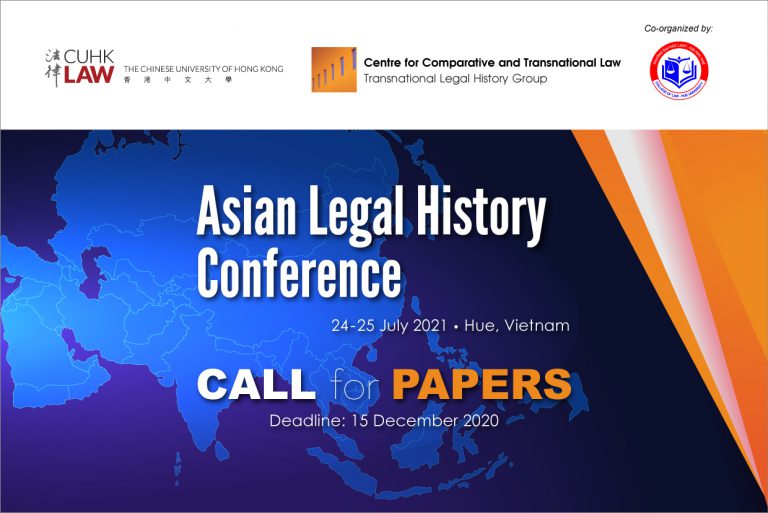
CALL FOR PAPERS : Asian Legal History Conference (24-25 July 2021, Hue – Vietnam) (DEADLINE: 15 December 2020)

(Source: Law.cuhk)


We received news of the call for papers for the Asian Legal History Conference 2021.

The CCTL Transnational Legal History Group of the CUHK LAW and the University of Law – Hue University will be jointly organizing a conference on the theme of Asian Legal History at the University of Law – Hue University, Hue, Vietnam, on 24-25 July 2021. Convened by Bui Ngoc Son and Christopher Roberts, Assistant Professors at CUHK LAW, the conference aims to bring together a diverse and interdisciplinary group of scholars, researchers, and graduate students to share their research findings on topics relating to legal history in Asia.

Confirmed Keynote Speakers:

1. Andrew Harding, Visiting Research Professor, National University of Singapore, Faculty of Law
2. Pip Nicholson, Dean, William Hearn Professor of Law, Melbourne Law School
3. Radhika Singha, Professor of Modern Indian History, Jawaharlal Nehru University
4. Lutz-Christian Wolff, Dean, Wei Lun Professor of Law, CUHK LAW

Call for Papers:

The organizers invite proposals for individual papers and panels. Submissions on any subject, providing it pertains to legal history in Asia, will be considered. General topics may include:

The historical evolution of common law, civil law, and socialist law traditions in Asia;
Legal pluralism and jurisdictional clashes;
Dynastic law;
Colonial law;
Customary law and village law;
Buddhist Law, Confucian Law, Hindu Law, and Islamic Law;
The history of a particular area of law (constitutional law, property law, criminal law, etc);
Theoretical and methodological issues involved in studying Asian legal history.

The conference organizers are particularly interested in papers addressing the following subjects:

  • Asian approaches to and impacts upon the historical development of international law;
  • Transnational legal history;
  • The relationship between metropolitan and colonial approaches to law;
  • The history of law, gender and sexuality;
  • The evolution of, and contestations around, legal positivism;
  • The history of law schools and of the formation of the judiciary and of members of the legal profession;
  • The history of public order law;
  • The history of law and violence.

Individual paper proposals should include a 300-word abstract and the author’s contact information.

Panel proposals should include a 300-word description of the panel, 300-word abstracts of three to four individual papers, contact information for each person on the panel, and contact information for the chairs of the panel.

Registration Fee: HK$ 200 per participant

Conference organizers will provide two lunches, one dinner, and refreshments. Participants are responsible for their own travel and accommodation costs.

Important dates:

  • 5 October 2020: Online abstract submission opens
  • 15 December 2020: Abstract submission deadline
  • 15 February 2021: Notification of acceptance
  • 15 March 2021: Registration opens
  • 30 April 2021: Early registration and payment closes
  • 25 June 2021: Regular registration and payment closes
  • 24-25 July 2021: The conference takes place

Please submit the abstracts via online form by 15 December 2020.


More info here

04 August 2020

CALL FOR PAPERS: Political and administrative elites in Europe – Theory and Practice in Historical Perspective (Online, 9-11 November 2020) (DEADLINE: 15 August 2020)


(Source: H-Announce)

Via H-Announce, we learned of a call for papers for an online conference on “Political and administrative elites in Europe – Theory and Practice in Historical Perspective.

The conference focus will lie mainly on the transformations underwent by elites during the second half of the 19th century and the first half of the twentieth century, and the deriving social mobility. While political and administrative upper layers form the main cohort of interest, papers on other social and professional elite categories (economic elite, church representatives, intellectuals, etc.) are equally welcome. Within the framework of the conference, we aim at addressing three essential aspects: defining (and self-defining of) elites, the changes, shifts and transitions which delineate the process of social mobility, and the methods and tools by means of which the latter can be traced and researched for the 19th and 20th centuries upper social layers. Hence, we welcome contributions focusing on one of the following topics:”

The full call can be found on H-Announce.

23 July 2020

CALL FOR PAPERS: Global Inequality – An Intellectual History (Aarhus, 10-11 June 2021) (DEADLINE: 31 August 2020)


We learned of a call for papers for a symposium on the intellectual history of global inequality since 1945. Here the call:

This two-day symposium is designed to investigate the global intellectual history of inequality. It will do so through a double global lens: How have intellectuals from around the world thought about inequality in the world? The aim of the symposium is to contribute with a new transnational intellectual history of inequality in different geographical and cultural contexts. The symposium will investigate links, differences and similarities between different intellectual traditions, as well as the circulation of inequality concepts and knowledge across countries. It aspires to facilitate a unique transcultural and multi-linguistic knowledge about inequality concepts, contributing to the fields of global conceptual and intellectual history. The symposium will aim at a special journal issue on the global intellectual history of inequality, exploring relationships between geographical anchoring (place) and thinking on inequality in history. We are delighted that the journal Global Intellectual History has kindly agreed to be the host of this special issue. Critics of global intellectual history have rightfully pointed out that few connections are actually truly global (planetary), but can much more adequately be described as transnational or transcultural (or ‘transcolonial’ or ‘transimperial’) connections. Taking this criticism into account, we are interested both in learning more about the intellectual histories of inequality in non-western countries, including in non-English, indigenous languages. Secondly, we are interested in learning more about intellectual and conceptual histories of transnational connections between various parts of the world, such as North-South and South-South connections and intellectual biographies of key thinkers on inequality whose histories are linked to several countries and continents. How did intellectuals across the globe address inequalities in a post-world war II age of ‘development’, promises of universal human rights, new data on inequalities, and of the crucial historical dynamics of the Cold War and decolonization?

The full call for papers can be found here

21 July 2020

CALL FOR PAPERS: The Independence of Peru and the Americas in Global Perspective (London, 11-12 March 2021) (DEADLINE: 1 November 2020)


(Source: SOAS)

We learned of a call for papers for a symposium on 200 years of Peruvian, Mexican, Central American and Brazilian independence at SOAS London. Here the call:

In 2021-22 Peru, Mexico, Central America and Brazil will celebrate 200 years of independence. The Independence of Peru in particular and of the Americas as a whole was a global event. A key battleground of the Age of Revolutions and the birthplace of the First Wave of Decolonization, Latin American independence produced a new world order.

In this hybrid symposium, leading historians from around the world will present and debate new research on the global significance and legacy of these events.

Participants may join us in London or via Zoom. All paper proposals and perspectives will be considered. We particularly seek papers that engage the following approaches:

• Connected histories of independence
• Conceptual and intellectual histories of independence
• Economic histories of independence
• New political histories of independence
• Atlantic and global histories of independence and decolonisation
• Historical anthropologies of independence
• Cultural histories of the symbols and materiality of independence
• Histories of the historiography of independence
• Histories of knowledge and independence
• Histories of centennial and bicentennial commemorations
Please send your paper abstract and 2-page cv to Professor Mark Thurner, mark.thurner@sas.ac.uk by November 1, 2020. Please note that we intend to publish an edited volume of original work based on the conference proceedings.

More info here