Search

Showing posts with label germany. Show all posts

31 October 2024

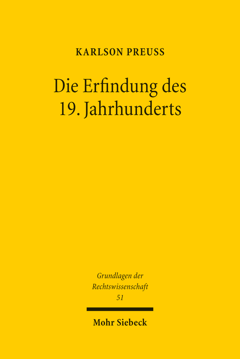
BOOK: Karlson PREUSS, Die Erfindung des 19. Jahrhunderts. Ein wissens- und professionssoziologischer Beitrag zur Historiographie des westlichen Rechtsdenkens [Grundlagen der Rechtswissenschaft, 51] (Tübingen: Mohr Siebeck, 2024), 342 p., ISBN 978-3-16-163256-3

 Cover von 'undefined'
ABOUT THE BOOK:
 
Die Rechtsepoche des 19. Jahrhunderts leidet unter einem schlechten Ruf. In der westlichen Rechtsgeschichtsschreibung behauptet sich hartnäckig die Auffassung, dass das Rechtsdenken im 19. Jahrhundert einer formalistischen Ideologie verfallen war und erst mit der Wende zum 20. Jahrhundert einen Sinn für die »soziale« Realität des Rechts entwickelt hat. Karlson Preuß führt dieses Narrativ auf geschichtspolitische Professionsstreite um 1900 zurück. Er zeichnet nach, dass juristische Reformdiskurse in Deutschland, Frankreich und den USA im frühen 20. Jahrhundert Zerrbilder der vorangegangenen Rechtsepoche in die Welt gesetzt und mit dieser Sicht einen immensen Einfluss auf die westliche Rechtshistoriographie ausgeübt haben. Dabei will er sowohl der Transnationalität des Untersuchungsgegenstandes gerecht werden und damit der Tatsache, dass ein höchst fragwürdiges Narrativ einen bedeutenden Einfluss auf die nationalen Rechtsdiskurse verschiedener Rechtsfamilien ausgeübt hat, als auch eine soziologische Erklärung für den Erfolg dieses Narratives anbieten.
 
Read more here.

30 October 2024

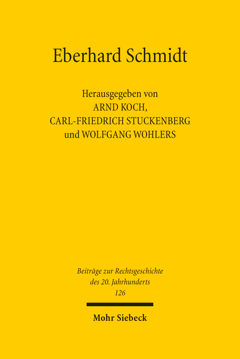
BOOK: Arnd KOCH, Carl-Friedrich STUCKENBERG & Wolfgang WOHLERS (eds.), Eberhard Schmidt. Strafrechtshistoriker, Strafprozessualist und Strafrechtler [Beiträge zur Rechtsgeschichte des 20. Jahrhunderts; 126] (Tübingen: Mohr Siebeck, 2024), 279 p., ISBN 978-3-16-162153-6

 Cover von 'undefined'
ABOUT THE BOOK:
 
Eberhard Schmidt (1891-1977) war als Jurist im Kaiserreich, in der Weimarer Republik, im NS-Staat und in der Bundesrepublik tätig, sein wissenschaftliches Werk umfasst neben dem materiellen Strafrecht die Strafrechtsgeschichte und das Strafprozessrecht. Schmidt gilt als Stammvater des Arztstrafrechts und war Schüler Franz von Liszts, dessen Lehrbuch er fortführte und dessen Ideen er in die Beratungen der Großen Strafrechtskommission der 1950er Jahre einbrachte. Als Rechtshistoriker prägte Schmidt die strafrechtsgeschichtlichen Vorstellungen mehrerer Juristengenerationen. Im Strafprozessrecht, dem er sich nach 1945 zuwandte, gilt sein »Lehrkommentar« als epochale wissenschaftliche Leistung. Die Beiträge des Bandes nehmen eine wissenschaftshistorische Verortung des Schmidt´schen Werkes vor und gehen der Frage nach, welche seiner Arbeiten auch aus heutiger Sicht von bleibendem Wert sind.
 
TABLE OF CONTENTS:
 
Klaus-Peter Schroeder: Eberhard Schmidt (1891-1977) - Die »peregrinatio academica« eines deutschen Strafrechtslehrers - Arnd Koch: Eberhard Schmidt und das Dritte Reich - Milan Kuhli: Eberhard Schmidt als Rechtshistoriker - Mathias Schmoeckel: Der Inquisitionsprozess und seine Geschichten - Sven Großmann: Eberhard Schmidt und die Entwicklung des reformierten Strafverfahrens - Carl-Friedrich Stuckenberg: Die wissenschaftliche Behandlung des Strafprozessrechts - Wolfgang Wohlers: Die Rechtsstaatlichkeit des Strafverfahrens: Justizförmigkeit vs. Zweckmäßigkeit - Martin Löhnig: Das Richterbild bei Eberhard Schmidt - Heike Jung: Eberhard Schmidt und das Arztrecht - Thomas Weigend: Eberhard Schmidt und Franz von Liszts »Lehrbuch des Deutschen Strafrechts« - Sascha Ziemann: Eberhard Schmidt und das Erbe der Liszt-Schule nach 1945 - Wolfgang Frisch: Eberhard Schmidt als Kriminalpolitiker, insbesondere in der Strafrechtsreform der 1950er Jahre - Franz Streng: Eberhard Schmidt und der Strafvollzug
 
Read more here.

28 October 2024

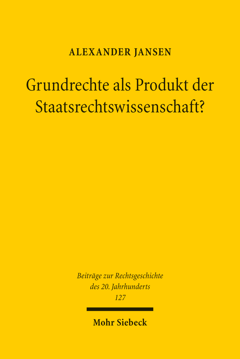
BOOK: Alexander JANSEN, Grundrechte als Produkt der Staatsrechtswissenschaft? [Beiträge zur Rechtsgeschichte des 20. Jahrhunderts; 127] (Tübingen: Mohr Siebeck, 2024), 193 p., ISBN 978-3-16-163845-9


 Cover von 'undefined'
ABOUT THE BOOK:
 
Die Grundrechte des Grundgesetzes werden oft als Ergebnis eines Kompromisses verstanden. Dennoch postuliert das Bundesverfassungsgericht, dass sie »eine verfassungsrechtliche Grundentscheidung« enthalten und als solche »für alle Bereiche des Rechts« gelten. Der Aussage liegt damit der Gedanke einer bewussten Entscheidung des Verfassungsgebers zugrunde. Die Grundlage für die Entscheidung des Verfassungsgebers sucht Alexander Jansen in der Staatsrechtslehre. Er untersucht, ob die Lehren der Staatsrechtler Rudolf Smend, Carl Schmitt und Richard Thoma die Entstehung der Grundrechte des Grundgesetzes beeinflusst haben. Im Mittelpunkt stehen die Beratungen des Parlamentarischen Rates über die Grundrechte, die Aufschluss über die Vorstellungen dieser Wissenschaftler geben.
 
TABLE OF CONTENTS:
 
Einleitung
A. Hinführung
B. Untersuchungsgegenstand
C. Fragestellung
D. Thesen
E. Forschungsstand
F. Gang der Untersuchung
G. Methodenfragen: Wissenschafts- und Dogmengeschichte

Kapitel 1: Integration durch Grundrechte (Rudolf Smend)
A. Vorbemerkung: Die Integrationslehre als Grundlage der Grundrechtskonzeption?
B. Wissenschaftliche Kurzbiographie
C. Die Integrationslehre als Ausgangspunkt der Grundrechtslehre
D. Die Integrationslehre im Parlamentarischen Rat
E. Fazit: Wider die integrative Grundrechtstheorie

Kapitel 2: Dezision und Grundrechte (Carl Schmitt)
A. Vorbemerkung: Der Mythos Carl Schmitt
B. Wissenschaftliche Kurzbiographie
C. Die Grundrechtslehre Carl Schmitts im Parlamentarischen Rat
D. Fazit: Der, dessen Name nicht genannt werden darf

Kapitel 3: Rechtsstaat und Grundrechte (Richard Thoma
A. Vorbemerkung: Thoma als Transporteur liberaler Grundrechtslehren?
B. Wissenschaftliche Kurzbiographie
C. Grundrechtstheorie: Grundrechte als individuelle Abwehrrechte
D. Rolle im Parlamentarischen Rat
E. Die Vorbehaltslehre Thomas im Parlamentarischen Rat
F. Fazit: Lösungsdivergenz trotz Systemkonvergenz

Schluss
A. Kenner der Grundrechtslehren
B. Grundrechte ohne Staatsrechtswissenschaft
C. Grundrechte als Vergangenheitsbewältigung
D. Verwaiste Verfassungsväter
 
Read more here

10 December 2021

BOOK: Petra SCHÖNEMANN-BERHENS, Alfred Hermann Fried: Peace Activist and Nobel Prize Laureate (Leiden: Brill, 2021). ISBN: 978-90-04-47037-8, € 116.00

(Source: Brill)

ABOUT THE BOOK

Petra Schönemann-Behrens provides an informative review of the life and times of Alfred H. Fried (1864-1921), a significant if underappreciated German pacifist of the late nineteenth century and early twentieth century. In response to the militarism and international anarchy of the European states, Fried developed his unique notion of “revolutionary” or “scientific” pacifism, differentiating it from reform pacifism, in order to address the material causes of war. As theorist, practitioner, and journalist, Fried advanced radical ideas at the time: the formation of a pan-European union, the establishment of an effective international court of arbitration, the elimination of a secretive diplomatic class, and the expansion of international economic and cultural cooperation. 

This book is a translation of the German biography Alfred H. Fried: Friedensaktivist–Nobelpreisträger, published by Römerhof Verlag in 2011, and commemorates the 100th anniversary of Fried’s death. 

ABOUT THE AUTHOR AND TRANSLATORS

Petra Schönemann-Behrens, Dr. phil. (2004), is a teacher of history, ethics and German at Gymnasium Wildeshausen near Oldenburg, Germany. She has published articles on historical peace research, mainly on A. H. Fried, and contributed to various radio and TV programs on this topic. 

Edward T. Larkin, Ph.D. (1986), is Professor Emeritus of German at the University of New Hampshire (USA). In addition to having published numerous articles on major German and Austrian authors, he has also published six book-length translations. 

Thomas B. Ahrens, Ph.D. (1998), is Director of Convocations at Berea College (USA). A long-time college educator and academic author, he has published translations of Austrian authors in the refereed online journal No Man’s Land as well as two novels.

TABLE OF CONTENTS

Foreword 
Preface 
Acknowledgments 

1 Childhood and Youth 
 1 The Early Years 
 2 Apprenticeship with a Bookseller and Fried’s First Experiences of Pacifism 

2 The Berlin Years 1884–1903 
 1 From Apprentice Bookseller to Publisher 
 2 Alfred H. Fried and Company 
 3 The Path to the Peace Movement 
 4 Experiments 
  4.1 Fried’s Hygienic Trash Collection and Removal Apparatus 
  4.2 The Self-Dating Envelope 
  4.3 An Election Atlas 
  4.4 Supplemental Encyclopedia 
 5 The Conference at The Hague 1899 
  5.1 The Founding of the Friedens-Warte in 1899 
 6 Consolidation Attempts around 1900 
  6.1 Esperanto 
 7 Flight from Berlin (1903) 

3 The Vienna Years, 1903–1915 
 1 A Reluctant Return Home 
 2 Fried, von Suttner, and the Austrian Peace Society 
 3 Work as a Journalist to 1907 
 4 Impulses from the Hague 
 5 The Foundations of Revolutionary Pacifism, 1908 
 6 Integration and Recognition 
 7 The Association of International Understanding 
 8 Nobel Peace Prize in 1911 and Honorary Doctorate in 1913 
 9 Before the Great War 

4 In Swiss Exile 1914/15–1919 
 1 The Move to Berne 
 2 1916: In the Crossfire of the Critics 
 3 Swiss Exile from 1917 to the End of the War 
 4 After the War – the Final Months in Switzerland 

5 Everywhere a Foreigner 
 1 Back to Vienna, via Munich 
 2 Final Works and Plans 
 3 Obituaries and Testimonials 

6 Survivors and Successors 
 1 Therese Fried 
 2 Fried and German Pacifism after 1921 

Die Friedens-Warte 
 1 The First Years 1899–1904 
 2 Consolidation Phase 1904–1909 
 3 Period of Growth, 1910–1914 
 4 War Censorship and the Path into Exile 
 5 Die Friedens-Warte in Swiss Exile 
 6 The Friedens-Warte after the War, 1918–1919 
 7 The Conflict over Succession, 1921–1924 
 8 The Friedens-Warte under Hans Wehberg, 1924 – 1962 
 9 A New Beginning in 1974 

Epilogue 
Appendix 1: To my beloved wife 
Appendix 2: Program of Revolutionary Pacifism, 1908 
Bibliography 
Index 


More information with the publisher.

16 March 2020

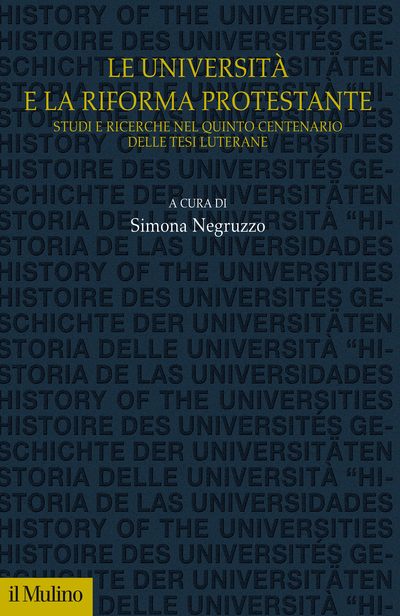
BOOK: Simona NEGRUZZO (a cura di), Le università e la riforma protestante. Studi e ricerche nel quinto centenario delle tesi luterane (Bologna: Il Mulino, 2018). ISBN: 9788815279835, pp. 532, € 29,00

Cover L'università e la Riforma protestante
(Source: Il Mulino)

ABOUT THE BOOK

Nel quinto centenario delle tesi luterane, il Centro interuniversitario per la storia delle università italiane - CISUI ha promosso un'aggiornata riflessione sul rapporto tra Riforma e università, approfondendo, attraverso alcuni esempi indicativi, il significato e le ricadute che i movimenti riformatori ebbero sul sistema d'insegnamento superiore tra medioevo ed età moderna. Come la proposta religiosa di Lutero s'innestò in un clima umanistico-rinascimentale già attraversato da fermenti di rinnovamento, così le riforme provocarono e/o accelerarono un processo di trasformazione dei luoghi d'insegnamento e dei metodi educativi, in parte già in atto. «Universitas semper reformanda»: se fin dalle sue origini, l'istituzione accademica aveva accolto e accompagnato i cambiamenti storici, dal XVI secolo le nuove proposte universitarie s'inserirono nel solco delle riforme religiose e in un contesto culturale, politico, sociale ed economico ormai confessionale. Eredità della Riforma fu la gemmazione, intorno a università «stricto sensu», di istituzioni più o meno deputate a erogare i gradi accademici, ma provviste di insegnamenti «superiori», con finalità esclusivamente professionali non soddisfatte in pieno dagli atenei: le accademie calviniste svizzere e francesi per la formazione dei pastori, i seminari cattolici post-tridentini per la preparazione dei sacerdoti, fino ai «seminaria nobilium» o alle scuole d'ingegneria civile o militare. La Riforma protestante, avviata con Lutero, Zwingli e Calvino, provocò un'autentica rivoluzione dell'ambito educativo che scosse le fondamenta delle comunità accademiche e l'epistemologia di alcune discipline, come l'astronomia o la medicina.

ABOUT THE EDITOR

Simona Negruzzo è professoressa associata presso il Dipartimento di Storia Culture Civiltà dell' Università di Bologna; Settore scientifico disciplinare: M-STO/02 STORIA MODERNA.

TABLE OF CONTENTS

Introduzione, di Simona Negruzzo

Paolo Prodi: dalle «riforme» religiose alle radici del moderno, di Umberto Mazzone

Heidelberg and the Holy See. From the Late Medieval reform councils to the Reformation in the Electoral Palatinate, di Heike Hawicks e Ingo Runde

La réforme des enseignements à l’Université de Wittenberg (1508-1536): une relecture, di Jean-Luc Le Cam Universale Studium Marpurgense. La prima fondazione universitaria della Riforma, di Hans Schneider

Educare la città. Martin Butzer nella Strasburgo d’inizio Cinquecento, di Simona Negruzzo

Between integration and independence: cultural development in 16th century Zurich higher education, di Anja-Silvia Goeing

L’Académie de Calvin à Genève: «Instruire nos enfants afin de les préparer tant au ministère qu’au gouvernement civil», di Béatrice Nicollier

The Lausanne Academy and the origin of the reformed academy model, di Karine Crousaz

Les «petites» académies réformées françaises aux XVIe-XVIIe siècles, di Yves Krumenacker

La lotta dell’università luterana contro spinozismo e pietismo, di Valerio Marchetti

Astronomia e matematica nei primi decenni delle riforme protestante e cattolica, di Luigi Pepe

L’emigrazione religionis causa dall’Italia e gli studi nella Penisola: il caso di uno studente protestante in incognito all’Università di Padova, di Federico Zuliani

La enseñanza del derecho y los Índices de libros prohibidos. Notas para un panorama ibérico, 1583-1640, di Laura Beck Varela

«Un’anatomia dell’anima come esigenza del nuovo individuo». La Scuola di Salamanca e il dibattito teologicogiuridico scaturito dalla Riforma protestante fra XVI e XVII secolo, di Gian Luca D’Errico

A Catholic university fathered by Protestantism? The Jesuits of Vilnius and the Counter-Reformation in the late sixteenth century, di Liudas Jovaiša

More information here

05 September 2018

CONFERENCE: After Pufendorf: Natural Law and the Passions in Germany and Scotland (24-27 October 2018, St. Andrews)


(Source: Wiki)

Via intellectualhistory.net, we learned of a conference on late natural law thinkers in Germany and Scotland.

By the middle of the eighteenth century, a number of authors who taught and wrote about natural law saw themselves as being engaged in a very different intellectual and academic activity than that of the natural lawyers of earlier generations. While staying within the mode of natural law, the deep-going revision that they understood themselves to be undertaking – each in their separate way – was to shift the idea of natural law as something that human nature needed somehow to have imposed upon it to the idea of natural law as in some sense inherent in human nature itself. Furthermore, they saw the relevant aspects of human nature to be the emotions or passions that drove people in their active lives. This development in natural law thinking has been referred to as an anthropological approach, as a turn from law to moral philosophy, as the formulation of a ‘Recht des Gefühls’, as a sentimental natural law, etc.

It was a line of argument that took several different forms and was articulated in quite different contexts, yet it is recognizable in thinkers as different as Johann Jacob Schmauss in Göttingen and Adam Smith in Glasgow. It was, however, a development that had started much earlier as part of the intense debates at the turn of the century about the nature and validity of Samuel Pufendorf’s natural law. Philosophers, legal theorists and theologians associated with the new university in Halle were the leading disputants, and a particularly important turning point in the debates about Pufendorf was Christian Thomasius’ abnegation during the early years of the new century of the deeply Pufendorfian ideas of natural law that he had been propagating with great impact previously.

Only a few years later, we see a reaction against Pufendorf in Scotland that has a number of strikingly similar features to that in Germany. Here the leading figure was Francis Hutcheson who had a broad influence on the intellectual culture that we now refer to as the Scottish Enlightenment and among whose students was Adam Smith. Across deep differences in philosophical, theological, legal and political contexts in Germany and Scotland the similarities in thoughts about natural law are striking, not only because of the idea of the passionate foundations for natural law, but also because these ideas in both cultural spheres led to some of the sharpest formulations of rights theories and to a historicisation of morality and law that pointed towards the dissolution of the natural law language. While acknowledging the many differences between the German and the Scottish thinkers, similarities such as these are so intriguing that they warrant joint consideration in a conference.

Programme organisers: Frank Grunert (Halle); Knud Haakonssen (St. Andrews/Erfurt)
Local organisers: James Harris and Richard Whatmore (St. Andrews)

For more information or to attend the conference, please contact Elsie Johnstone.


20 December 2016

JOB: Research Assistant /PhD Candidate/Post-Doc in Research Training Group "Metropolität in der Vormoderne" (University of Regensburg, Germany, 2017)


The DFG (Deutsche Forschungsgemeinschaft) Research Training Group 2337/1 "Metropolität in der Vormoderne" (University of Regensburg, Germany) offers  10 x 0,65 Research Assistant / PhD Candidate and 1 x Post-Doc position.

all information here (only in German)


14 April 2015

BOOK: Michael STOLLEIS, Public Law in Germany: an Introduction into its History, 16th-21st Century [Beck'sche Reihe, 6135] (Munich: C.H. Beck, 2014), 228 p. ISBN 9783406659430. € 16,95


Prof. em. dr. dr. h.c. mult. Michael Stolleis, honorary director of the Max Planck Institute for European Legal History, has published an introduction to the history of public law (in German).

Presentation:
Die „Geschichte des öffentlichen Rechts in Deutschland“ in vier Bänden von Michael Stolleis gehört zu den herausragenden Gesamtdarstellungen unserer Zeit. Auf mehr als 2000 Druckseiten entfaltet ihr Autor darin weit über den wissenschaftsgeschichtlichen Rahmen hinaus ein rechtshistorisches Panorama Deutschlands von der Frühen Neuzeit bis an die Schwelle der Gegenwart. Nun fasst Stolleis kaum weniger eindrucksvoll den gewaltigen Stoff noch einmal auf rund 240 Seiten zusammen. Der Leser dieser glänzenden Einführung gewinnt ein grundlegendes Wissen über das deutsche öffentliche Recht im Wandel der Zeiten. 

04 February 2015

LIBRARY: Free on-demand digitizing at the Berlin State Library (books published between 1701 and 1920)

 
Forum Historiae Iuris reports the possibility for researchers to have legally relevant material digitized, thanks to a fund created for the next three years.

Full entry (in German):

Insbesondere die zu rechtshistorischen Themen Forschenden möchte der Fachinformationsdienst für internationale und interdisziplinäre Rechtsforschung exklusiv einladen, sein kostenfreies Serviceangebot zur On-Demand-Digitalisierung von rechtswissenschaftlich relevanten Texten aus dem gemeinfreien Bestand der Staatsbibliothek zu Berlin zu erproben.
Zentrale Aufgabe des von der Deutschen Forschungsgemeinschaft an der Staatsbibliothek zu Berlin eingerichteten Fachinformationsdiensts für internationale und interdisziplinäre Rechtsforschung ist es, die wissenschaftlichen Aktivitäten der juristischen Fachcommunity an universitären wie außeruniversitären Forschungseinrichtungen in Deutschland mit nachfrageorientierten Informationsdienstleistungen zu unterstützen.
Insbesondere die zu rechtshistorischen Themen Forschenden möchte der Fachinformationsdienst daher exklusiv einladen, ²DoD zu erproben – sein kostenfreies Serviceangebot zur On-Demand-Digitalisierung von rechtswissenschaftlich relevanten Texten aus dem gemeinfreien Bestand der Staatsbibliothek zu Berlin.
Sollten Sie im Rahmen der Durchführung oder Beantragung eines historisch orientierten Forschungsvorhabens Zugriff auf Quellenwerke aus dem – gerade im Bereich der europäischen Rechtsgeschichte außerordentlich dichten – Bestand der Staatsbibliothek zu Berlin benötigen, so steht Ihnen in den kommenden drei Jahren ein Fonds zur Verfügung, aus dessen Mitteln die Umsetzung Ihrer Digitalisierungswünsche ermöglicht wird.
Bitte beachten Sie, dass dieses Angebot mit Blick auf die umfänglichen Digitalisierungskampagnen der Deutschen Forschungsgemeinschaft im Bereich der im deutschen Sprachraum des 16. und 17. Jahrhunderts erschienenen Drucke vorläufig nur für zwischen 1701 und 1920 erschienene Werke gilt und zudem weiteren Restriktionen unterworfen ist.
Nähere Informationen zu den Nutzungsbedingungen dieses kostenfreien Serviceangebots sowie einen Direktlink zum Antragsformular finden Sie bitte unter: http://vifa-recht.de/intr2dod
Über das allgemeine Profil des Fachinformationsdiensts für internationale und interdisziplinäre Rechtsforschung orientiert Sie das entsprechende Webangebot der Staatsbibliothek zu Berlin: http://staatsbibliothek-berlin.de/recherche/fachgebiete/rechtswissenschaft/

More information on

14 August 2014

ARTICLE: Thomas Duve on "National Traditions and Transnational Perspectives"

Thomas Duve on "National Traditions and Transnational Perspectives", now available on SSRN.  
The article will be published in the upcoming issue of our journal Rechtsgeschichte-Legal History

click here to read the abstract and download the article

19 June 2014

JOURNAL (open access): Jus Politicum 12: History of German Public Law


Jus Politicum published its twelfth issue, centred on the history of German Public Law, featuring among others the podcast of a Parisian debate around the French version of Michael Stolleis' classic, as well as written contributions on the same topic, and a review of Halperin & Audren's recent co-authored book on French Legal Culture in the 19th and 20th Centuries.
Contents:

Histoire du droit public allemand
Frédéric Audren, Olivier Beaud, Nader Hakim, Pascale Gonod, Olivier Jouanjan, Jean-Louis Mestre, Michael Stolleis : "Podcast : Autour de l’ « histoire du droit public en Allemagne (1800-1914) » de Michael Stolleis"
Michael Stolleis : "Préface de Michael Stolleis, Histoire du droit public en Allemagne (1800-1914), Dalloz, 2014, 700 p."
Olivier Beaud : "Quelques remarques de lecture autour du livre de Michael Stolleis : Histoire du droit public en Allemagne (1800-1914), Dalloz, 2014, 700 p."
Nader Hakim : "Intervention autour du livre de Michael Stolleis : Histoire du droit public en Allemagne (1800-1914), Dalloz, 2014, 700 p."
Olivier Jouanjan : "Remarques sur l’Histoire du droit public en Allemagne (1800-1914) : pourquoi lire Michael Stolleis en France ?"
Nationalité et citoyenneté
Dieter Gosewinkel : "Naturaliser ou exclure ? La nationalité en France et en Allemagne aux XIXe et XXe siècles. Une comparaison historique"
Olivier Beaud : "Une question négligée dans le droit de la nationalité : la question de la nationalité dans une Fédération"

Varia

Marc Lahmer : "Le Moment 1789 et la séparation des pouvoirs"
Jean Leclair : "Michael Oakeshott ou la recherche d’une politique dépourvue d’abstractions"
Jean-François Giacuzzo : "Un regard sur les publicistes français montés au « front intellectuel » de 1914-1918"

Actualité

Denis Baranger, Camille Broyelle, Bertrand Seiller : "L’affaire Dieudonné et les libertés"

Notes de lecture

David Mongoin : "Apostolos Vlachogiannis, La Living Constitution. Les juges de la Cour suprême des Etats-Unis et la Constitution, préface d’Olivier Beaud, Paris, Classiques Garnier, coll. « Bibliothèque de la pensée juridique », n° 4, 2014, 643 p."
Alexandre Viala : "Jean-Jacques Sueur, Pour un droit politique. Contribution à un débat Presses de l’Université Laval, collection Dikè, 2011, 331 p."
Jean-Paul Andrieux : "Frédéric Audren, Jean-Louis Halpérin, La culture juridique française, Entre mythes et réalités XIXe-XXe siècles, Paris, CNRS éditions, 2013, 330 p."

Archives
Olivier Beaud : "Le Président peut-il témoigner en justice ?"
Benjamin Fargeaud : "Présentation des archives Raymond Janot"