Search

Showing posts with label fundamental rights. Show all posts

25 May 2026

BOOK: Clifford ANDO, Mirko CANEVARO & Benjamin STRAUMANN (eds.), The Cambridge History of Rights, vol.I: The Ancient World [The Cambridge History of Rights, eds. Nehal BHUTA, Anthony PAGDEN & Mira L. SIEGELBERG] (Cambridge: Cambridge University Press, 2026), ISBN 9781108837354, 120 GBP


(image source: CUP)

Abstract:
The ancient world existed before the modern conceptual and linguistic apparatus of rights, and any attempts to understand its place in history must be undertaken with care. This volume covers not only Greco-Roman antiquity, but ranges from the ancient Near East to early Confucian China; Deuteronomic Judaism to Ptolemaic Egypt; and rabbinic Judaism to Sasanian law. It describes ancient normative conceptions of personhood and practices of law in a way that respects their historical and linguistic particularity, appreciating the distinctiveness of the cultures under study whilst clarifying their salience for comparative study. Through thirteen expertly researched essays, volume one of The Cambridge History of Rights is a comprehensive and authoritative reference for the history of rights in the global ancient world and highlights societies that the field has long neglected.

Table of contents:

  • Introduction Clifford Ando, Mirko Canevaro and Benjamin Straumann
    • 1. To claim to protect claims: the generative discourse of Mesopotamian legal rights Seth Richardson
    • 2. The individual and the communal: early Confucian resources for human rights May Sim
    • 3. human rights in the Hebrew Bible? Sandra Jacobs
    • 4. Greek subjective rights? Justice, legal discourse, and legal institutions Mirko Canevaro and Linda Rocchi
    • 5. Aristotle on subjective rights Pia Campeggiani
    • 6. Do rights exist in Hellenistic philosophy? Jon Miller
    • 7. Rights in Ptolemaic Egypt Nadine Grotkamp
    • 8. Rights in Roman Republican thought Valentina Arena
    • 9. Ius in the subjective sense in classical Roman law Charles Donahue, Jr
    • 10. Rights and dignity in late ancient thought Kyle Harper
    • 11. Rights in late ancient law? Noel Lenski
    • 12. Rabbinic Judaism Alyssa M. Gray
    • 13. Sasanian law Maria Macuch.

    Read more here: DOI 10.1017/9781108938938


    28 April 2026

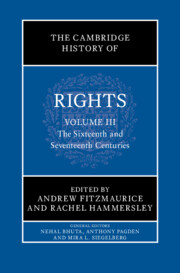
    BOOK: Andrew FITZMAURICE & Rachel HAMMERSLEY (eds.), The Cambridge HIstory of Rights, vol. III: The Sixteenth and Seventeenth Centuries [The Cambridge History of Rights, ed. Nehal BHUTA, Anthony PAGDEN & Mira L. SIEGELBERG] (Cambridge: Cambridge University Press, 2026), ISBN 9781108938853, 120 GBP


    (image source: CUP)

    Abstract:
    In the sixteenth and seventeenth centuries, contemporary authors explored the myriad ways in which the concept of rights could be understood but almost always arrived at the same conclusion: It was vital that rights should never be conflated with power. Through twenty-six expertly written essays, Volume III of The Cambridge History of Rights focuses on the language of rights, exploring its use in contexts as diverse as the English family, trading relations, and Asian powers. This was a period in which rights came to the forefront of political discourse, making it crucial to the longer history of rights reflected in this series. By foregrounding the idea of rights in action, the volume considers the relationship between the ways in which rights were articulated – by individuals, institutions, and states – and how they were enacted in practice. In doing so, it uncovers the complexities inherent in the development of the language of rights during this formative period.
    Table of contents:
    • Introduction Andrew Fitzmaurice and Rachel Hammersley
    • 1. Roman law: the science of right Daniel Lee
    • 2. Natural rights Mads Langballe Jensen
    • 3. Historic rights in sixteenth-century France Sophie Nicholls
    • 4. Common law rights Alan Cromartie
    • 5. The rights of states to self-preservation Simone Zurbuchen
    • 6. The Right of natural persons to self-preservation Rosemarie Wagner
    • 7. Divine right in early modern political thought Cesare Cuttica
    • 8. The right to punish Signey Gutnick Allen
    • 9. The rights of war and peace Peter Schröder
    • 10. The right of navigation: claiming and challenging the free sea in theory and practice Arthur Westeijn
    • 11. The right to trade, 1500 –1700 Mark Somos
    • 12. The right to property Andrew Fitzmaurice
    • 13. Fair trials in law: imagining the rights of the accused Paul D. Halliday
    • 14. Freedom of religion Stefania Tutino
    • 15. The right of resistance Kajo Kubala
    • 16. The Right to Political participation and representation Markku Peltonen
    • 17. Rights and power in early modern feminism Hannah Dawson
    • 18. Gender and rights Anna Becker
    • 19. The rights of women Sharon Achinstein
    • 20. The rights of the insane Angus Gowland
    • 21. The rights of asylum Gaby Mahlberg
    • 22. The rights of peoples in Spain and its empire Tamar Herzog
    • 23. The rights of people in the English empire Ken Macmillan
    • 24. Rights in the seventeenth-century French empire Saliha Belmessous
    • 25. Rights, authority, and autonomy: the VOC in seventeenth century Southeast Asia Peter Borschberg.

    Read more here: DOI 10.1017/9781108938853

    07 January 2026

    JOURNAL: Fundamental rights. Rivista di studi giuridici, storici e antropologici - 2025/2 [open access]


    Abstract: This contribution means to focus on some fundamental points of the modern international law’s formation, considering the elaboration made by both the catholic based (with particular attention to the Escuela de Salamanca) and the protestant based (Hugo Grotius and Alberico Gentili) juridical science of the modern age. In particular it will note the historical and conceptual dynamics that led: 1) to the admissibility of a just war for both warring parties; 2) to the crucial historical and juridical passage from ius ad bello to ius in bello; 3) to the doctrinal prefiguration of a “humanitarian war” in order to defend the innocentes. Therefore, it will be possible to outline some fundamental concepts of the classical law of peoples of the modern age that constitute part of the “grammar” used to write the ius inter nationes by XVI and XVII century’s european jurists. 
    Abstract: This article aims to examine how Gaetano Filangieri, in the Science of Legislation, conceived of the body as the primary normative space in which law takes form. Physical education becomes the first act of citizenship, shaping habits, discipline and civic virtue. By linking corporeal formation to moral and political order, Filangieri anticipates modern biopolitical reflections and highlights the central role of education in sustaining a just and cohesive society. 
    Abstract: This article offers a critical perspective on the ethical, philosophical, and legal implications of the development and use of emerging technologies such as generative artificial intelligence, AI agents, and quantum computing. Drawing on an analogy with the biblical narrative of Genesis, it argues that humanity may be repeating, in digital form, the ancient temptation to pursue absolute knowledge without considering its consequences. The article challenges the redemptive narratives that legitimize the unquestioned use of these tools, while obscuring their biases, limitations, and sociocultural constraints. Particular attention is devoted to the phenomenon of algorithmic justice, whose implementation without critical oversight may erode fundamental principles of law. It ultimately asserts that this phenomenon is not merely an innocuous technological innovation, but an alarming epistemic mutation of judicial decision-making and of the public justice service. From a legal and philosophical standpoint, the article advocates recovering doubt as an essential faculty of human thought—not to halt technological progress, but to guide it toward the common good, thereby avoiding a new form of “fall”: the dehumanization of our decisions in the name of technical perfection. Finally, it follows the guidance of the former rector of USAL, Jorge Bergoglio - Pope Francis - in his call for an ethical AI, encapsulated in his teaching: «Not everything that is technically possible is morally acceptable». 
    Abstract: This essay examines the evolution of constitutional review in Italy from the late nineteenth century to the establishment of the Constitutional Court under the 1948 Constitution. Contrary to the widespread assumption that constitutional justice emerged only with the Republican Constitution, the study shows that reflections and practices relating to judicial scrutiny of legislation existed well before 1948, particularly during periods of political crisis and extensive use of emergency decree-laws. Through an analysis grounded in the theories of democracy developed by Robert Dahl and Luigi Ferrajoli, the essay highlights the relationship between constitutional review, the democratization process, and the transformation from a flexible constitutional system under the Albertine Statute to the rigid constitutional order of the post-war Republic. The paper explores key debates among Italian jurists on the limits of legislative power, the role of the Court of Cassation in reviewing decree-laws, and the tensions between formal and substantive legality. It also retraces the constitutional reflections during Fascism, the crisis of the liberal state, and the eventual choice to establish a Constitutional Court as a guarantee of rights and of the supremacy of the Constitution. The essay concludes by showing how constitutional review became central to consolidating Italy’s modern constitutional democracy and ensuring the effectiveness of fundamental rights. 

    05 December 2024

    BOOK: Heinz MOHNHAUPT, Privilegien als Sonderrechte in europäischen Rechtsordnungen vom Mittelalter bis heute Studien zur europäischen Rechtsgeschichte; 343] (Frankfurt am Main: Klostermann, 2024), XXI + 970 p. ISBN 978-3-465-04624-0


    (image source: MPILHLT)

    Abstract:
    Nowadays, the term ‘privileges’, part and parcel of political and societal discourse in countries worldwide, carries a negative connotation as it contradicts the concept of justice and equality in state and society. The original, legal meaning of this ubiquitous term, which dates back to Roman canon law, has largely become lost. The author traces the history and European dimensions of the ‘privilegia’ and their relevance for the evolution of law, state and society in a longue durée perspective. He complements his account with a comprehensive overview of sources by territory, an abridged version of which had initially been intended for inclusion in Helmut Coing’s Handbuch (vol. II/3), and a bibliography organised according to subject matter, ranging from the Middle Ages to the present day. A picture emerges how, by differentiating between the rights of individuals, groups and territorially defined areas of applicability, privileges also represented an individualised sense of justice, which prevailed until the Enlightenment and its – often futile – attempts to replace privilege thinking with laws applicable to all, in the sense of modern ‘égalité

    Read more here


    28 October 2024

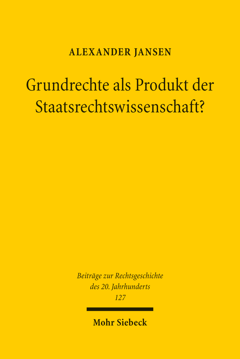
    BOOK: Alexander JANSEN, Grundrechte als Produkt der Staatsrechtswissenschaft? [Beiträge zur Rechtsgeschichte des 20. Jahrhunderts; 127] (Tübingen: Mohr Siebeck, 2024), 193 p., ISBN 978-3-16-163845-9


     Cover von 'undefined'
    ABOUT THE BOOK:
     
    Die Grundrechte des Grundgesetzes werden oft als Ergebnis eines Kompromisses verstanden. Dennoch postuliert das Bundesverfassungsgericht, dass sie »eine verfassungsrechtliche Grundentscheidung« enthalten und als solche »für alle Bereiche des Rechts« gelten. Der Aussage liegt damit der Gedanke einer bewussten Entscheidung des Verfassungsgebers zugrunde. Die Grundlage für die Entscheidung des Verfassungsgebers sucht Alexander Jansen in der Staatsrechtslehre. Er untersucht, ob die Lehren der Staatsrechtler Rudolf Smend, Carl Schmitt und Richard Thoma die Entstehung der Grundrechte des Grundgesetzes beeinflusst haben. Im Mittelpunkt stehen die Beratungen des Parlamentarischen Rates über die Grundrechte, die Aufschluss über die Vorstellungen dieser Wissenschaftler geben.
     
    TABLE OF CONTENTS:
     
    Einleitung
    A. Hinführung
    B. Untersuchungsgegenstand
    C. Fragestellung
    D. Thesen
    E. Forschungsstand
    F. Gang der Untersuchung
    G. Methodenfragen: Wissenschafts- und Dogmengeschichte

    Kapitel 1: Integration durch Grundrechte (Rudolf Smend)
    A. Vorbemerkung: Die Integrationslehre als Grundlage der Grundrechtskonzeption?
    B. Wissenschaftliche Kurzbiographie
    C. Die Integrationslehre als Ausgangspunkt der Grundrechtslehre
    D. Die Integrationslehre im Parlamentarischen Rat
    E. Fazit: Wider die integrative Grundrechtstheorie

    Kapitel 2: Dezision und Grundrechte (Carl Schmitt)
    A. Vorbemerkung: Der Mythos Carl Schmitt
    B. Wissenschaftliche Kurzbiographie
    C. Die Grundrechtslehre Carl Schmitts im Parlamentarischen Rat
    D. Fazit: Der, dessen Name nicht genannt werden darf

    Kapitel 3: Rechtsstaat und Grundrechte (Richard Thoma
    A. Vorbemerkung: Thoma als Transporteur liberaler Grundrechtslehren?
    B. Wissenschaftliche Kurzbiographie
    C. Grundrechtstheorie: Grundrechte als individuelle Abwehrrechte
    D. Rolle im Parlamentarischen Rat
    E. Die Vorbehaltslehre Thomas im Parlamentarischen Rat
    F. Fazit: Lösungsdivergenz trotz Systemkonvergenz

    Schluss
    A. Kenner der Grundrechtslehren
    B. Grundrechte ohne Staatsrechtswissenschaft
    C. Grundrechte als Vergangenheitsbewältigung
    D. Verwaiste Verfassungsväter
     
    Read more here

    12 June 2024

    BOOK: La sûreté: un principe ambivalent. Ses rapports à l'individu et à l'État. Approche historique et comparée [Dikè, ed. Ludovic AZÉMA; 4] (Toulouse: Université Toulouse Capitole/CTHDIP, 2024), ISBN 9782361702946 (OPEN ACCESS)


    (image source: CTHDIP)

    Abstract:
    La notion de sûreté est une notion difficile à appréhender. Les révolutionnaires français en ont fait un droit naturel dans l’article 2 de la Déclaration des droits de l’homme et du citoyen de 1789. Ce droit est au cœur de l’ordre libéral qu’ils entendaient organiser. Pourtant, il semble bien difficile de circonscrire une notion qui évoluera selon les époques jusqu’à devenir une menace même pour les droits individuels qu’elle entendait défendre. La sûreté révolutionnaire n’est pas celle du XIXe siècle qui, elle-même, n’est plus celle des XXe et XXIe siècles. Comment dès lors trouver une acception commune qui permette d’en comprendre l’essence ? Car celle-ci est devenue une notion « attrape-tout » (F. Luchaire) avec deux écueils fondamentaux. Celui de devenir une notion dangereuse susceptible de justifier toute intervention législative quelle qu’elle soit. Ou, au contraire, de devenir une notion tellement large qu’inopérante et insusceptible d’utilisation. C’est toute la difficulté du Conseil constitutionnel hésite à s’en référer à ce droit naturel pourtant intégré dans le bloc de constitutionnalité. C’est encore toute la question de sa substitution par la sécurité des biens et des personnes qui ne saurait l’appréhender dans sa globalité. Finalement, la sûreté est au cœur d’une dialectique complexe entre exigences d’ordre public et protection des droits individuels. Alors que la sûreté révolutionnaire semblait dirigée contre les lettres de cachet et l’arbitraire royal, il faut se rappeler les mémoires policiers du XVIIIe siècle qui vantaient au contraire la sûreté de la ville de Paris malgré des moyens tant décriés. La sûreté est-elle un droit protecteur de l’individu contre l’Etat ? L’Etat est, par ailleurs, garant de l’ordre public, condition de l’exercice des libertés individuelles. D’une certaine manière, garantir la sûreté de l’Etat ne serait ce pas garantir la sûreté individuelle ? Pour ces raisons, nous proposons une seconde journée d’étude Dikè. La première était consacrée à cette articulation entre l’individu et le collectif. L’interrogation fondamentale reste la même durant cette seconde journée qui est en continuité avec nos réflexions précédentes. La démarche, dans la tradition de ces journées Dikè, se veut historique et comparative. Nos intervenants traiteront ainsi de l’évolution de la notion de sûreté depuis le siècle des Lumières, notamment à travers l’influence physiocratique. La notion a ensuite évolué tout au long du XIXe siècle jusqu’à la période contemporaine. Les évènements liés au terrorisme et à la situation de pandémie interrogent ainsi en Europe sur le lien entre la notion de sûreté et le renforcement du pouvoir exécutif.

    Authors:

    Thérence Carvalho, Professeur d’Histoire du droit - Laboratoire Droit et Changement Social (UMR CNRS 6297) - Nantes Université François Godicheau, Professeur en Histoire contemporaine – UMR FRAMESPA - Université Toulouse II- Jean Jaurès François Moncassin, Docteur en Histoire du droit – Université Toulouse-Capitole, Enseignant-chercheur contractuel (ECER) en Histoire du droit - Université d’Angers Hanan Qazbir, Maître de conférences en Droit public – IDETCOM – Université Toulouse Capitole

    Download the full book herehere


    06 September 2023

    JOURNAL: Fundamental rights. Rivista di studi giuridici, storici e antropologici II (2022/2). OPEN ACCESS

    (Image source: Fundamental rights)


    ARTICLES

    1. Ezequiel ABASOLO, Camillo Viterbo y sus puntos de vista sobre el sentido y alcance de los seminarios en la formación jurídica. Una relevante intersección de experiencias académicas europeas y discusiones pedagógicas sudamericanas;

    This article examines a specific case of transfer of European legal pedagogical orientations to the South American scenario. Examine the incidents that accompanied the exile of Camillo Viterbo -removed from his University as a consequence of the fascist racial legislation of 1938. Also, the prolonged impact of its recommendations on university law education had in Argentina and the rest of the subcontinental academic sphere.

    It is not possible to assess the meaning and the impact of the death penalty outside of historical and cultural contexts in which it is applied. An approach, that is also thanatological, seems necessary. In many cases (in ancient, medieval, modern and contemporary history) societies and cultures have been based on taxonomies of values, in which death is not only the worst of evils, but on the contrary is an aspiration. Suicide by proxy, widespread between the 17th and 19th centuries especially in Central and Northern Europe, is a revealing example.

    3. Viviana MOLASCHI, Algoritmi e discriminazione;

    Algorithms bring both economic and social benefits and can help fight social inequalities. However, they do not escape the ambivalence that characterizes technological progress: they can cause discrimination and marginalization. After disproving the myth of algorithmic infallibility and neutrality, the paper brings to attention some examples of algorithmic discrimination that have occurred in public activity. Once the issue has been exemplified, it investigates how discriminatory algorithms are generated (however, these mechanisms are not entirely perspicuous and this lack of clarity is itself part of the problem). Finally, the paper focuses on the solutions given by law, with particular reference to the algorithmic decision-making principles of the GDPR and the proposed EU regulation on artificial intelligence. Since the current regulatory system, as well as those envisaged in the future, have inherent limitations due to the speed and unpredictability of technological developments, the analysis concludes by underlining the need for a responsible education both of developers, who design algorithms, and of users of digital instruments.

    Presentazione della sezione dedicata agli 80 anni del Codice civile;

    4. Rocco FAVALE, Conclusione del contratto ed evoluzione del Codice civile;

    The essay examines some of the most important issues concerning the formation of the contract, through the path of the proposal, acceptance and their intersection. The analysis focuses on the discipline contained in the Italian civil code in the light of the German contract law contained in the famous First Book of the BGB dedicated to the General Part and to the various legislative or soft law interventions of a supranational nature, such as CSIG-Vienna Convention on the Sale of Goods, Unidroit-PICC and European projects on contract law (code européen des contrats, PECL, CESL).

    5. Maria Paola MANTOVANI, Il valore storico-culturale della giurisprudenza come fattore di evoluzione del diritto;

    Jurisprudence has historically been a factor in the evolution of law and this is evident both in models with a jurisprudential vocation and in models based on the primacy of written law. In the codified legal systems, the dialogue between the judge and the jurist has become increasingly intense over time and, thanks also to the comparative methodology, has favoured the construction of a European law as an expression of a framework of shared principles and values It is not possible to assess the meaning and the impact of the death penalty outside of historical and cultural contexts in which it is applied. An approach, that is also thanatological, seems necessary. In many cases (in ancient, medieval, modern and contemporary history) societies and cultures have been based on taxonomies of values, in which death is not only the worst of evils, but on the contrary is an aspiration. Suicide by proxy, widespread between the 17th and 19th centuries especially in Central and Northern Europe, is a revealing example.

    6. Felice MERCOGLIANO, Sulle tracce romanistiche del Codice civile;

    The essay includes at the beginning some brief considerations about the concepts of ‘diligentia of pater familias” coming from the Roman law, and incorporated in the art. 1176, first clause, of the Italian Civil Code of 1942; after, it mentions the concept of juristic act (that was not included in the Code) with particular respect to the elements of will and cause, in light of the vision dating back to Emilio Betti.

    READINGS

    7. Aldo Andrea CASSI, G. Maglio, Lezioni di filosofia dei diritti umani, Edizioni Messaggero Padova – Facoltà teologica del Triveneto, Padova, 2021.


    More information can be found here.

    30 August 2023

    JOURNAL: Fundamental Rights. Rivista di studi giuridici, storici e antropologici II (2022/1). OPEN ACCESS

    (Image source: Fundamental Rights)

    ARTICLES

    1. Antonella PIGA, Diverse interpretazioni della deontologia medica e diritti dei singoli, alla fine della vita;

    The Hippocratic oath clearly states: «I will not give a lethal drug to anyone if I am asked». Recent advances in the biomedical sciences, however, have transformed the process of dying so that doctors are now asked to help sick people who wish to escape «from an artificial maintenance in life that is no longer wanted». After the sentence of the Constitutional Court on medically assisted suicide, the National Federation of the Orders of Doctors modified the Code of Medical Ethics by introducing a «guidance to the application» to the article on «Acts aimed at causing death». The study aims to focus on the ‘compromise’ between two antithetical ways of understanding professional ethics, which risks negatively affecting the rights of the sick

    2. Massimo PARODI, Globalizzazione e Città di Dio. Ricerca dell’assoluto per i diritti umani;

    Two recent proposals to guarantee a universal value to fundamental rights come from very different sides. Luigi Ferrajoli, from a secular point of view, advances the hypothesis of a Constitution for the whole Earth, while Pope Francis identifies in brotherhood the possibility of recognizing common rights to all men. Both, however, arrive to the question of foundations and converge in the search for an absolute capable of justifying their different proposals.

    3. Agostina LATINO, Brevi riflessioni sulla natura giuridica del diritto alla verità;

    This essay focuses on the right to truth as a specific guarantee of the human person, characterized by a dimension that is both individual and collective, especially in the context of transitional justice, through a normative analysis that highlights its development in three phases (at first exclusively in the framework of international humanitarian law, then circumscribed to the context of enforced disappearances, today applicable in any case of gross violation) and the decisions of international courts and human rights control mechanisms. The purpose is to highlight how the right to truth, far from constituting an aspiration more ethical than legal or a mere explication of pre-existing rights already established, can, if crystallized, serve the pursuit of its own objectives, difficult to achieve in its absence.

    4. Maria Lucia DI BITONTO, I ‘doveri di solidarietà’ declinati dal codice di procedura penale: la testimonianza;

    The other side of fundamental rights which have to be granted in criminal proceedings concerns those obligations imposed on anyone who is able to give any evidence in a trial. The necessity to discover and trial people who committed a crime pushes legal systems to establish specific rules aimed at punishing people who refused to give evidence or lied on the stand. Because of this, the Italian Code of Criminal procedure imposes some obligations on everyone who has been called to give evidence as a witness.

    5. Carlotta LATINI, “Una solidarietà latente d’interessi”. Stato, solidarietà e funzione sociale dell’impresa tra Otto e Novecento.

    Starting with an examination of the social question and its repercussions, the essay discusses, in the light of the boundaries between commercial law and private law, the entry of the social into the sphere of commercial law and the Commercial Code.


    READINGS

    More information can be found here.

    23 August 2023

    JOURNAL: Fundamental rights. Rivista di studi giuridici, storici e antropologici III (2023/1). OPEN ACCESS

    (Source: Fundamental Rights


    The contribution proposes some interpretations of Sophocles' tragedy that shed new light (and new darkness) on the conception of justice and law underlying the work. A textual analysis of it contradicts many fixed points of the 'vulgate' that rigidly contrasts written and oral law, positive and natural law, 'good' Antigone and 'bad' Creon.

    The essay is a study on the evolution of freedom of information and the media in the 1960s. The author highlights the complex case of the RAI monopoly, under investigation by the Constitutional Court, before the reform law of 1975, but also the attitude of the jurisprudence of the Italian courts, with regard to press crimes and the evolution of new rights, paying attention to the change of mentality of judges.

    3. Ishvarananda CUCCO, Reciprocità e fiducia come fondamenti impliciti della cultura giuridica cinese;

    This article aims to uncover the evidence of reciprocity and trust within the Chinese juridical culture. To do this, we will use as a field of investigation an ancient arrangement of land transfer named Qiyue. In order to overcome the threats of cultural distance, the investigation method will use the tools of legal anthropology, in particular the examination of conceptual categories within their linguistic environment, the constant look at the specific cultural framework in which legal practice fits, but, above all, the paradigm of the gift as the keystone to distinguish in the practice of Qiyue what anticipates modern contract law and what refers to forms of ceremonial exchange that are typical of ancient or native cultures.

    The work starts from the analysis of a sentence of the italian Constitutional Court, with which the proposal for a referendum relating to the abrogation of the crime of killing of a consenting person was declared inadmissible, and analyzes the problems concerning the positive obligations of criminal protection of the right to life

    5. Paola MANFREDI, Curare la rabbia, rifiutare la violenza.

    The paper proposes a reflection on a particular aspect of violence, namely that linked to inadequate anger management. In particular, it is shown how such anger can be interpreted as an attempt to adapt to injuries in primary functioning. This term refers to those primary acquisitions that constitute the basic trust and are articulated in the continuity of the self, the perception of boundaries and the sense of belonging. By means of a clinical vignette, some of these fragilities are exemplified and the issues of justice and care, and the appropriateness of caring for fragilities and protecting society are questioned.


    More information can be found here.

    02 May 2022

    BOOK : Jean-Pierre MARGUENAUD (dir), Claire VIAL (dir), Droits des êtres humains et droits des autres entités : une nouvelle frontière ?, (Mare & Martin, 2022), ISBN : 978-2-8493-4510-8, pp. 300, 33€


     (Source : univ-droit)


    A propos de l'ouvrage : 


    Les droits garantis aux êtres humains ont profondément évolué. Si l'on conçoit désormais que des droits attribués à l'homme puissent également l'être à l'humanité ou aux humains et post-humains à l'ère de l'homme augmenté, il reste difficile d'envisager que d'autres entités, comme la nature, les robots ou les animaux, puissent se voir également reconnaître de tels droits. L'opération n'est pourtant pas juridiquement impossible. La question est alors de savoir s'il est opportun d'attribuer des droits fondamentaux à d'autres que les êtres humains, les rapports entre les uns et les autres pouvant en être profondément bouleversés.


    A propos des directeurs de l'ouvrage 


    Jean-pierre MARGUENAUD est professeur des universités en Droit privé et sciences criminelles à l'université de Limoges

    Claire VIAL est professeure des universités en Droit public à l'université de Montpellier.


    21 September 2021

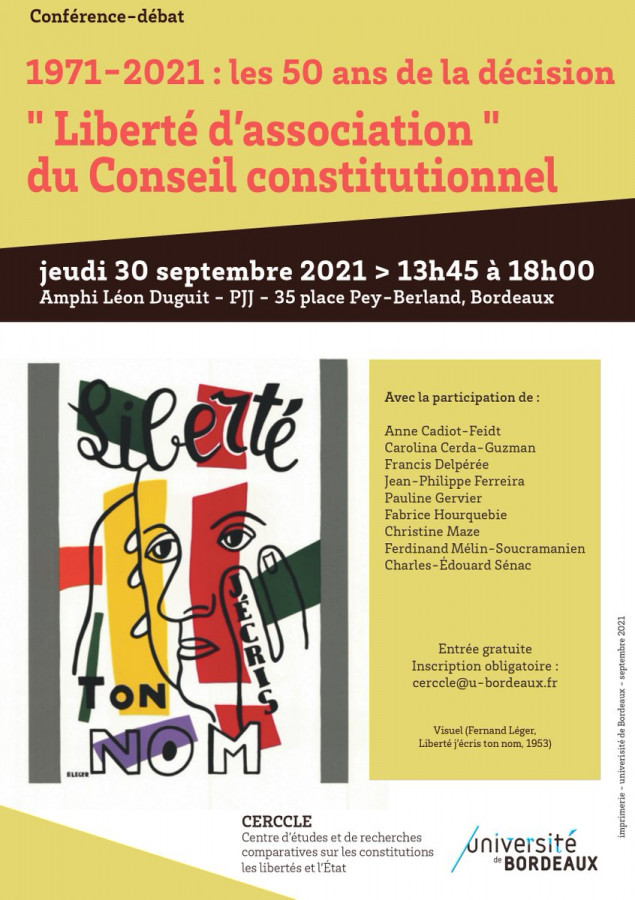
    CONFERENCE: 1971-2021 : Les 50 ans de la décision "Liberté d'association" du Conseil constitutionnel (Bordeaux: Université de Bordeaux, 30 SEP 2021)

    (image source: univ-droit)


     Program:

    13h45 : Accueil du public

    14h00 : Propos introductifs
    Charles-Edouard Sénac, Professeur, Université de Bordeaux


    La décision "Liberté d'association" : rétrospective

    Présidence : Carolina Cerda Guzman, Maître de conférences, Université de Bordeaux

    14h20 : Petites délibérations pour une grande décision
    Fabrice Hourquebie, Professeur, Université de Bordeaux, Directeur du CERCCLE

    14h45 : La décision Liberté d'association et Les grandes décisions du Conseil constitutionnel (Dalloz) : l'origine du mythe
    Ferdinand Mélin-Soucramanien, Professeur, Université de Bordeaux

    15h10 : Trois regards sur la décision Liberté d'association
    Francis Delpérée, Professeur, Université de Louvain, Sénateur honoraire

    15h35 : Les bases administratives d'une jurisprudence constitutionnelle
    Jean-Philippe Ferreira, Professeur, Université de Bordeaux

    15h50 : Discussion


    16h30 : Table ronde - La décision "Liberté d'association" : perspectives

    Modération : Pauline Gervier, Maître de conférences, Université de Bordeaux, Directrice adjointe du CERCCLE

    Intervenants :
    Anne Cadiot-Feidt, Avocate, Barreau de Bordeaux ; EDA Aliénor
    Francis Delpérée, Professeur, Université de Louvain
    Fabrice Hourquebie, Professeur, Université de Bordeaux
    Christine Maze, Avocate, Barreau de Bordeaux
    Ferdinand Mélin-Soucramanien, Université de Bordeaux

    17h30 : Discussion

    18h00 : Clôture de la conférence-débat

    (source: univ-droit)

    16 September 2021

    JOURNAL: Fundamental rights. Rivista di studi giuridici, storici e antropologici (I, 2021/2). OPEN ACCESS


    INDEX OF THE SECOND ISSUE

    The Declarations of Rights, approved by revolutionary assembly between XVII and XVIII Centuries, represented a turning point for the western world that, about inalienable rights that had to be identified, had built the bases of its cultural identity. Their history after the end of the revolutionary period, as demonstrated by the essay, was very contrasted especially for political reasons: only after the end of the Second World War there was a reevaluation of them, inaugurated by the Universal Declaration of Human Rights. However, the new sceneries that have been spread after the fall of the Berlin Wall and the end of the "Cold War", with the problems connected to the relationships between West and East and, since the new millennium, with the management of terroristic and epidemic emergencies, have opened an intense debate, the results of which seems to be crucial for the future of the humanity
    The coronavirus emergency led to a particularly serious situation; the responses of the prison system have produced heterogeneous consequences, in some cases resulting in violent acts, re-writing the internal rules previously applied. Among the mentioned changes, it worth to consider the limitations to the right to be transferred from one facility to another, that in normal condition represent one of the basis for the social reintegration whose impact, in case of the Covid Pandemic, has been understudied
    In Schelling's vision, mythology, as the product of a necessary process of consciousness, parallel to that which concerns the history of nature, finds its specific space, which cannot be exhausted in a subordinate of history. By coming into contact with powers that myth figuratively dramatizes in supra-human beings, the human spirit expresses an imaginative force of elements of objective reality that cannot be reduced to the categories of rational thought. Inextricably linked to the era of the founding of Rome, the Romulean saga records the thickening of the fundamental aspects that characterize the dawn of the singular civil identity off the Roman people, already open to the supra-political dimension of the ius
    The paper intends to propose a critical analysis, on a textual basis, of the actual contribution of Francisco de Vitoria, founder of the "School of Salamanca" to the "theory of human rights". First of all, the historiographical category of "Escuela de Salamanca" is problematized; the argumenta iuris formulated by Vitoria are then addressed, noting that the affirmation of certain fundamental principles (first of all the appetitus societatis) involves the recognition of "natural rights" (first of all the ius transiti and the ius commercii), which are configured in relation to their qualification as legitimate rights to call a bellum iustum. Finally, it is pointed out that Vitoria himself affirms that he did not want to formulate a definitive doctrine on issues that required further reflection; a warning that is rarely followed by today's readers of this complex figure of "theologian-jurist" protagonist of the cultural debate of the Siglo de Oro
    The aim of the article is to propose a possible path in the history of European thought in order to explore the question concerning the gnoseological foundation of the sharing of human rights, given the pluralist context of our contemporary world. Starting from two concepts that have a rhetorical and juridical origin, namely constitutio and apparentia in philosophers as distant in time as Cicero, Nicholas of Autrecourt and Edmund Husserl, we can trace the traits of three figures of critical reason as a possible condition of a dialogical perspective for the gnoseological foundation of the sharing of human rights
    The paper examines some events of the protection of individuals within organized communities in the historical perspective. The community phenomenon is an essential element of the social organization and the legal system. Today, the guarantee of individual rights within social formations takes on particular importance in order to avoid homologation phenomena of limitation of freedom of conscience
    Through the writings of Francesco Ruffini and Piero Calamandrei, the essay examines the evolution of the rights of liberty in the constitutional process of the Twentieth century, which saw the traditional political freedoms consecrated in the French declaration of 1789 being flanked by a new category of citizens- rights, called “social rights”, aimed at guaranteeing everyone a minimum of economic well/being, indispensable for freeing the poor from the slavery of need and putting them in a position to make use of those political freedoms that are proclaimed in law as equal for all


    Detailed information can be found at the following pagehttps://fundamentalrights.it


    26 May 2021

    NEW JOURNAL: Fundamental rights. Rivista di studi giuridici, storici e antropologici (I, 2021/1). OPEN ACCESS


    ABOUT THE JOURNAL 
    FundamentalRights.it was born from an idea of ​​Carlotta Latini and Aldo Andrea Cassi, or rather from the meeting of their respective scientific and educational experiences.
    The PhD cycle based at the University of Camerino dedicated to Fundamental Rights, coordinated by Carlotta Latini, was an excellent training ground for studies and the development of research on fundamental rights. The research doctorate is in fact the place of choice in which new theories and studies are experimented.
    The teaching of Legal Anthropology activated at the University of Brescia in 2015, strongly supported by Aldo Andrea Cassi, who is still the owner, in addition to encountering the growing lively interest of future jurists, has gradually become a laboratory of “Epistemological experimentation” in the analysis of intercultural approaches to the idea of ​​’Justice’ and to the aspiration of a ‘Law’ which is its historical implementation.
    These two experiences found an encounter (sometimes becoming a ‘clash’, however it proved to be very fertile) on land as mined as it was necessary to cross. In fact, we believe that despite (or, on the contrary, precisely because) there is much talk of “fundamental rights” (or “human”, “inviolable”, “non-negotiable”, “natural” etc .: semantic focus is one of the fields of the challenge), a rigorous reflection is required in argumento.
    Considerations that the journal intends to conduct intersecting research, skills, experiences and methodologies that are not homologated (within narrow and segmented “scientific-competitive” perimeters as the current bureaucratic matrix of the Italian University requires), but on the contrary characterized by epistemological interrelations harbingers of perspective openings.
    We have in fact relied on historians, jurists, psychologists, philosophers, medical examiners, both at the level of the Scientific Committee and that of the authors invited to contribute, in the belief that the challenge of which, as Directors of the Journal, we are standard bearers (undeservedly and recklessly, but with authentic ethical and scientific conviction), requires a cultural paraphernalia characterized by a high scientific level and a multidimensional epistemological status.
    The idea for the magazine matured during the first spread of the Covid-19 epidemic: during the experience of “great segregation” that our generation suffered, while the virus was spreading, it made sense to question the course, and also on the new course, which fundamental rights have had, in the awareness that the discussion on these rights touches naked nerves, complex and often angular issues (including, for example, the role of constitutions, the latitude of fundamental freedoms and of individual rights in the face of an essential protection of a “common good”) to be dealt with in the complex, unresolved relationship between authority and freedom.
    The natural, ratione materiae, juridical vocation of the Journal is therefore accompanied by vocations (and sometimes pro-vocations) afferent to other fields of knowledge and research, diversi sed non adversi.


    INDEX OF THE FIRST ISSUE


    Choices between medial needs and available resources have always been a relevant ethical issue - they are in fact called tragic choices -, and this issue has definetely grown acute during the Codiv-19 pandemic. Among the criteria identified by the bioethical Literature for these so called tragic choices, we find the "utilitarian" one: it consists in calculating how many extra lives can be saved of how many more years of life can be guaranteed by making a choice. This criterion, if applied to these choice of favoring young people to the detriment of the elderly, may fall under a discriminatory attitude called ageism, in analogy with racism and sexism. 


    One of the most fundamental rights of the 1989 UN Convention on the Rights of Children is the right to be heard (art. 12). When developed into the right to participate, it questions adult's daily practices to interact with children. in this respect, promoting the right to participate in the alternative care field calls for a peculiar act of balancing the rights of children with the rights of other relational stakeholders (parents, relatives, social worker and so forth). Drawing on ethnographical data gathered in research experiences, trainings and experiences in the field, this contribution analyzes children's participation in alternative care as a right, a process, a practice and a form, revisiting children's agency and their involvement as co-authors and co-constructors of their life-contexts


    This paper focuses on the lawfulness of the practice of fetus' burial, following the interruption of pregnancy, without the woman's consent and with the indication of her surname. Subsequently, the legislative gap about the definition of "stillborn" is investigated, with the consequent registration of the birth certificate


    This article looks for defining and shaping the concept of free development of one's personality as a fundamental human right. In order to meet such goal, the starting point is the concept of fundamental human rights as defined in international instruments as the Universal Declaration or Human right issued by the General Assembly of the United Nations Organization in 1948. Afterward, attention is be paid to the effectiveness of such rights, affirming the historical need and opportunity to achiede standards of basic equality among all human beings without exclusions and the importance of obtaining wide consensus about the metrics of human development such as the Human Development Index created by the United Nations Development Program, that should go far beyond economic parameters


    This essay means to highlight anthropological aspects which explain the current distance between the "Declarations of human/fundamental rights" and the "Asian values". Moreover, it regard the extraordinary figure of Raimon Panikkar as a possible interface between these two worlds. It finally indicates in Pope Francis' encyclical letter Fratelli tutti the key to approach the "fundamental rights" more compatibly with the holistic demands of the eastern anthropology and culture


    The contemporary financial word places at the center the homo oeconomicus, videns et consumans, with his individual desires raised to inalienable rights. The positive law and the law in general have now fallen into a state of "legal entropy", wich requires to re-think the role of the judge and to leave more and more rooms for ADRs, as instruments of better and more appropriate search for the right solution for the concrete case, the result of autonomy of the parties rather than heteronomous authoritative imposition. Hence the opportunity, argued in the essay, to abandon the logic of adjudication of litigation, to make room for more effective and appropriate methods of dispute resolution, in a social and economic context compared to which long and complex judicial procedures are now obsolete, inadeguate and unimprovable.


    These pages deal with the sad case of Richard Meade, an American merchant based in Cadiz. The problems in collecting his claims against the Spanish government (1812) and the aggressive response of the institutions raised serious doubts about the effectiveness of constitutional guarantees of personal security


    Violet Gibson is known to have been the assailant of Benito Mussolini. Her history, that is far from to have been completely written, still causes doubts and interest. In this context the meeting between Enrico Ferri and Violet Gibson because of her defense will be examined

     Letture 


    Detailed information can be found at the following pagehttps://fundamentalrights.it