Search

Showing posts with label Constitutional Law History. Show all posts

05 June 2026

CLH ARTICLE: William PARTLETT, Constitutional nationalism and remembered history: the post-Soviet example (Comparative Legal History, XIII (2025), nr. 2 (December), pp. 277-305)

(Image source: Taylor&Francis)


Abstract:

This article will argue that national history can further the project of constitutional self-government even in formerly authoritarian countries. Examining the former Soviet republics, it will describe how remembering forgotten or suppressed democratic constitutional ideas and arguments from national history can help support the project of constitutional self-government. This form of ‘constitutional nationalism’ counters arguments that constitutional self-government is a project of convergence with western best practices. It instead links it to long-standing national struggles to adapt the balanced constitution of constitutional self-government to the national context. ‘Constitutional nationalism’ therefore relies on a different approach to history. Rather than understanding national history in countries with a long history of authoritarianism as something to ignore or overcome, it views this history as a potential source of (often suppressed) ideas and inspiration for helping the project of constitutional self-government today.


To read the article, please click here. Online access is free for members of the European Society for Comparative Legal History.

DOI: 10.1080/2049677X.2025.2579474


03 March 2026

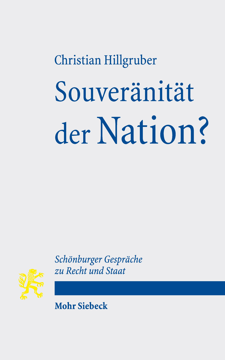
BOOK: Christian HILLGRUBER, Souveränität oder Nation? Die politische und rechtliche Schlüsselfrage der Revolution von 1848/49 oder: Der lange deutsche Weg zur Anerkennung der Volkssouveränität [Schönburger Gespräche zu Recht und Staat] (Tübingen: Mohr Siebeck, 2025), 55 p., ISBN 978-3-16-164892-2

 Cover von 'undefined'

 
ABOUT THE BOOK:
 
Die deutsche Revolution von 1848/49 war verfassungsrechtlich wie politisch vom Ringen um die verfassunggebende Gewalt geprägt. Das von der Frankfurter Nationalversammlung reklamierte Prinzip der Volkssouveränität forderte das überkommene monarchische Prinzip heraus. In der Folge stand dem vom Paulskirchenparlament geltend gemachten Alleinentscheidungsrecht über eine neue gesamtdeutsche Verfassung das von den monarchischen Regierungen der Einzelstaaten verfochtene Mitentscheidungsrecht gegenüber, das auf eine Vereinbarungslösung drängte. In dieser Auseinandersetzung konnte sich der Grundsatz der Volkssouveränität gegen die überlegenen Kräfte der Beharrung noch nicht durchsetzen. Erst die mit der Novemberrevolution 1918 errungene verfassunggebende Gewalt des deutschen Volkes schuf die Basis der Weimarer Reichsverfassung. Sie bildet auch die Legitimationsgrundlage des Grundgesetzes.
 
TABLE OF CONTENT:
 
I. Einleitung
II. Die Spaltung der nationalen Verfassungsbewegung in Liberale und Demokraten
III. Die Spannungen zwischen Demokraten und Liberalen in der Heidelberger Versammlung und die unterschiedliche Haltung gegenüber dem Bundestag
IV. Die Perspektive einer Verständigungslösung
V. Die Debatten im Vorparlament
VI. Der „kühne Griff" nach der politischen Macht im Namen der Volkssouveränität
VII. Der tiefere Grunddissens: Ganze oder geteilte Souveränität?
VIII. Das Ende aller Hoffnungen: Weder Republik noch konstitutionelle Monarchie
IX. Nachspiel: Von Frankfurt über Erfurt nach Berlin/Versailles
X. Weimar: Das Reich, das sind wir.
XI. Bonn: Das Grundgesetz als Ausprägung des Prinzips der Volkssouveränität
 
ABOUT THE AUTHOR:
 
Christian Hillgruber Geboren 1963; Studium der Rechtswissenschaft an der Universität zu Köln; 1988 Erste Juristische Staatsprüfung; 1991 Promotion (Köln); 1997 Habilitation (Köln); Professur an den Universitäten Heidelberg und Erlangen-Nürnberg; Inhaber eines Lehrstuhls für Öffentliches Recht an der Universität Bonn und Direktor des dortigen Instituts für Kirchenrecht.
 
Find more here.  
 

15 January 2025

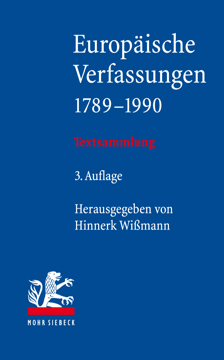
BOOK: Hinnerk WISSMANN (ed.), Europäische Verfassungen 1789-1990 (Tübingen: Mohr Siebeck, 2024), 585 p., ISBN 978-3-16-164214-2

 Cover von 'undefined'
ABOUT THE BOOK:
 
Die neue Auflage der Textsammlung erscheint als Beitrag zum Verfassungsjahr 2024. Nach 75 Jahren Grundgesetz, das hier in seiner Ursprungsfassung abgedruckt wird, lässt sich erkennen: Freiheit, Demokratie und Rechtsstaat müssen immer wieder neu errungen, verteidigt und bewahrt werden, nach außen wie nach innen. Die hier versammelten historischen Verfassungstexte bezeugen das gemeinsame »Projekt Verfassungsstaat«, das Europa seit Beginn der staatsrechtlichen Moderne geprägt hat. Einen Schwerpunkt bilden deutsche (Reichs- und Landes-)Verfassungen des 19. und 20. Jahrhunderts, die typischerweise für einschlägige Lehrveranstaltungen herangezogen werden. Hinzu kommen (in deutscher Übersetzung) besonders wichtige Verfassungen europäischer Staaten ebenso wie zwischenstaatliche Vertragswerke im Zeitraum bis 1990. Ergänzt wird die Sammlung im Anhang durch die Verfassung der USA und wichtige Texte der vormodernen englischen Rechtstradition. Neu abgedruckt wird die Bill of Rights (Amendments 1-10), mit der die amerikanische Bundesverfassung 1789/1791 grundlegende Bürgerrechte aufnahm.
 
Find more here.

28 October 2024

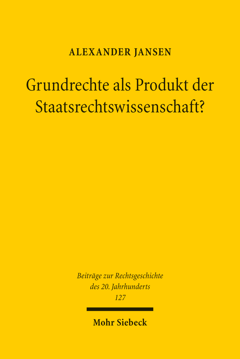
BOOK: Alexander JANSEN, Grundrechte als Produkt der Staatsrechtswissenschaft? [Beiträge zur Rechtsgeschichte des 20. Jahrhunderts; 127] (Tübingen: Mohr Siebeck, 2024), 193 p., ISBN 978-3-16-163845-9


 Cover von 'undefined'
ABOUT THE BOOK:
 
Die Grundrechte des Grundgesetzes werden oft als Ergebnis eines Kompromisses verstanden. Dennoch postuliert das Bundesverfassungsgericht, dass sie »eine verfassungsrechtliche Grundentscheidung« enthalten und als solche »für alle Bereiche des Rechts« gelten. Der Aussage liegt damit der Gedanke einer bewussten Entscheidung des Verfassungsgebers zugrunde. Die Grundlage für die Entscheidung des Verfassungsgebers sucht Alexander Jansen in der Staatsrechtslehre. Er untersucht, ob die Lehren der Staatsrechtler Rudolf Smend, Carl Schmitt und Richard Thoma die Entstehung der Grundrechte des Grundgesetzes beeinflusst haben. Im Mittelpunkt stehen die Beratungen des Parlamentarischen Rates über die Grundrechte, die Aufschluss über die Vorstellungen dieser Wissenschaftler geben.
 
TABLE OF CONTENTS:
 
Einleitung
A. Hinführung
B. Untersuchungsgegenstand
C. Fragestellung
D. Thesen
E. Forschungsstand
F. Gang der Untersuchung
G. Methodenfragen: Wissenschafts- und Dogmengeschichte

Kapitel 1: Integration durch Grundrechte (Rudolf Smend)
A. Vorbemerkung: Die Integrationslehre als Grundlage der Grundrechtskonzeption?
B. Wissenschaftliche Kurzbiographie
C. Die Integrationslehre als Ausgangspunkt der Grundrechtslehre
D. Die Integrationslehre im Parlamentarischen Rat
E. Fazit: Wider die integrative Grundrechtstheorie

Kapitel 2: Dezision und Grundrechte (Carl Schmitt)
A. Vorbemerkung: Der Mythos Carl Schmitt
B. Wissenschaftliche Kurzbiographie
C. Die Grundrechtslehre Carl Schmitts im Parlamentarischen Rat
D. Fazit: Der, dessen Name nicht genannt werden darf

Kapitel 3: Rechtsstaat und Grundrechte (Richard Thoma
A. Vorbemerkung: Thoma als Transporteur liberaler Grundrechtslehren?
B. Wissenschaftliche Kurzbiographie
C. Grundrechtstheorie: Grundrechte als individuelle Abwehrrechte
D. Rolle im Parlamentarischen Rat
E. Die Vorbehaltslehre Thomas im Parlamentarischen Rat
F. Fazit: Lösungsdivergenz trotz Systemkonvergenz

Schluss
A. Kenner der Grundrechtslehren
B. Grundrechte ohne Staatsrechtswissenschaft
C. Grundrechte als Vergangenheitsbewältigung
D. Verwaiste Verfassungsväter
 
Read more here

23 September 2024

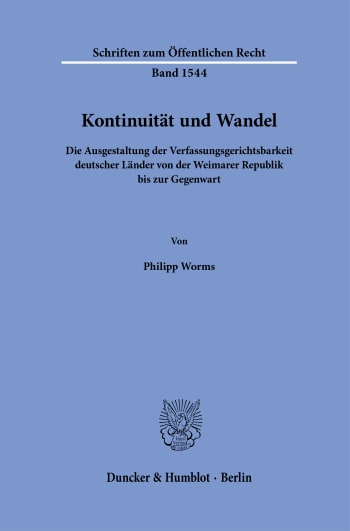
BOOK: Philipp WORMS, Kontinuität und Wandel. Die Ausgestaltung der Verfassungsgerichtsbarkeit deutscher Länder von der Weimarer Republik bis zur Gegenwart [Schriften zum Öffentlichen Recht; 1544] (Berlin: Duncker & Humblot, 2024), 310 p., ISBN 978-3-428-19237-3

 Cover: Kontinuität und Wandel

ABOUT THE BOOK:

Die Abhandlung widmet sich der geschichtlichen Entwicklung der Verfassungsgerichte der Länder, um auf diese Weise einen Beitrag zur näheren Bestimmung des Verhältnisses zwischen der gegenwärtigen Landesverfassungsgerichtsbarkeit und ihren historischen Vorbildern zu leisten. Dabei untersucht der Autor in einem ersten Schritt, inwieweit die Weimarer Landesstaatsgerichtshöfe prägend waren für die Entwicklung und die Ausgestaltung der Landesverfassungsgerichte wie wir sie heute kennen. Anhand der Länder Baden-Württemberg, Bayern, Hessen und Thüringen zeigt der Autor auf, dass die Weimarer Landesstaatsgerichtshöfe trotz ihrer vergleichsweise schmalen Kompetenzkataloge den Vätern und Müttern der westdeutschen Landesverfassungen nach 1945 als Anknüpfungspunkt für die Konzeption der Landesverfassungsgerichte dienten. Dass die Weimarer Landesstaatsgerichtshöfe gleichwohl nicht den einzigen Traditionsstrang darstellten, wird ebenso deutlich. Daher beleuchtet der Autor in einem zweiten Schritt, welchen übrigen Einflussfaktoren die Ausgestaltung der Verfassungsgerichtsbarkeit nach 1945 ausgesetzt war und wie unterschiedlich stark sich diese Faktoren in den jeweiligen Ländern auswirkten.

TABLE OF CONTENTS:

A. Einleitung

B. Methodik

Zur Auswahl der betrachteten Länder – Vorgehensweise – Maßstabsbestimmung

C. Historische Wurzeln der Verfassungsgerichtsbarkeit seit 1815
Auf Ebene des Bundes und des Reiches – Auf Ebene der Gliedstaaten

D. Staatsgerichtsbarkeit in der Weimarer Republik
Der Staatsgerichtshof für das Deutsche Reich – Allgemeine Situation der Staatsgerichtsbarkeit in den Ländern

E. Entwicklung und Ausgestaltung ausgewählter Landesverfassungsgerichte
Baden-Württemberg – Bayern – Hessen – Thüringen

F. Landesübergreifende Parallelen
Landesverfassungsgerichte als solitäre Institutionen – Parallele Entwicklungslinien

G. Landesspezifische Aspekte
Baden-Württemberg – Bayern – Hessen – Thüringen

H. Maßgebliche Einflussfaktoren
Grundgesetz und Bundesverfassungsgericht – Eigene historische Landesverfassungen – Weimarer Reichsverfassung – Andere Landesverfassungen – Ausländische Vorbilder – Besatzungsmächte – Persönlichkeiten – Gesamtwürdigung der Einflussfaktoren

I. Schlussbetrachtung

Anlage: Relevante Vorschriften zur Verfassungsgerichtsbarkeit seit 1919

Read more here.


23 June 2021

JOURNAL. Juspoliticum, nº 25. Les doctrines autoritaires et totalitaires du droit constitutionnel. OPEN ACCESS


(Source: http://juspoliticum.com/numero/Les-doctrines-autoritaires-et-totalitaires-du-droit-constitutionnel-78.html)

The french journal Juspoliticum has published its 25th edition, with a forum section on authoritarian and totalitarian doctrines of constitutional law.


Doctrines autoritaires et totalitaires du droit constitutionnel

Autour de J.-M. Denquin, Penser le droit constitutionnel

Varia

Recensions

Mémoires

03 May 2021

BOOK: Akhil REED AMAR, The Words That Made Us - America's Constitutional Conversation, 1760-1840 (New York: Basic Books, 2021). ISBN 9780465096350, 40.00 USD.


(Source: Basic Books)

Basic Books is publishing a book on the formative decades of the American Constitution.

ABOUT THE BOOK

When the US Constitution won popular approval in 1788, it was the culmination of thirty years of passionate argument over the nature of government. But ratification hardly ended the conversation. For the next half century, ordinary Americans and statesmen alike continued to wrestle with weighty questions in the halls of government and in the pages of newspapers. Should the nation’s borders be expanded? Should America allow slavery to spread westward? What rights should Indian nations hold? What was the proper role of the judicial branch?


In The Words that Made Us, Akhil Reed Amar unites history and law in a vivid narrative of the biggest constitutional questions early Americans confronted, and he expertly assesses the answers they offered. His account of the document’s origins and consolidation is a guide for anyone seeking to properly understand America’s Constitution today.

ABOUT THE AUTHOR

Akhil Reed Amar is the Sterling professor of law and political science at Yale University and the author of several books on constitutional law and history, including America’s Constitution: A Biography and America’s Unwritten Constitution. He lives in Woodbridge, Connecticut.


More info here

11 January 2021

BOOK: Martin P. SCHENNACH, Austria inventa? Zu den Anfängen der österreichischen Staatsrechtslehre (Frankfurt: Klostermann Verlag, 2020). ISBN 978-3-465-04414-7, 98.00 EUR


(Source: Klostermann)

Klostermann Verlag published “Austria inventa? Zu den Anfängen der österreichischen Staatsrechtslehre” at the end of last year.

ABOUT THE BOOK

This is the first work of its kind devoted to Austrian constitutional law, which has so far received little attention in (legal) historical research. It examines its origins, its authors, its connection with the “Reichspublizistik”, its sources and methods as well as its contents and, last but not least, its role in university teaching. Of all the particular state rights in the Holy Roman Empire, its subject was probably the one most intensively discussed. In the second half of the 18th century, Austrian constitutional law was a flourishing genre of literature promoted by the Habsburg dynasty. This is accounted for by its main themes: It flanked the process of internal integration of the heterogeneous Habsburg ruling complex and aimed at the discursive and legal construction of an Austrian state as a whole and the legitimation of absolutism.


The table of contents can be found here


More info here

03 December 2020

BOOK: Michal GALEDEK, National Tradition or Western Pattern? Concepts of New Administrative System for the Congress Kingdom of Poland (1814-1815) (Leiden-New York: Brill, 2020). ISBN 978-90-04-43268-0, 114.00 EUR


(Source: Brill)


Brill has published a new book on the constitutional Duchy of Warsaw and the Kingdom of Poland in 1814-1815.

ABOUT THE BOOK

In the history of the development of Polish law and administration, the short period of the constitutional Duchy of Warsaw, and next of the Kingdom of Poland, was a special time. This is because it was the only moment in the 19th century when the Polish elites gained an opportunity to concentrate their efforts on the organization of the modern state machinery. This book presents the process of restructuring the administrative structures following the collapse of the Napoleonic Duchy of Warsaw and before the establishment of the Kingdom of Poland in 1815. The author focuses on the approach of the Polish elites to the nascent modern state, increasing importance of administration within it and to the young Polish bureaucrats.

ABOUT THE AUTHOR

Michał Gałędek, Ph.D. (2010), Professor of University of Gdańsk, Head of the Department of Legal History, Faculty of Law and Administration. In his research he focuses on the Polish administration, judiciary, codification, constitutionalism, and political thought at the beginning of 19th century and in the interwar period.

TABLE OF CONTENTS

   Introduction

  1 Concept of Administrative Thought

  2 Public Administration

  3 Construction of the Work

  4 Methodology

  5 Source Basis of and Literature


  1 Administration and Administrative Thought in the Late 18th and Early 19th Centuries 26

  1 The Specificity of the Administrative System under the Reign of Stanisław August Poniatowski

  2 Determinants of Administrative Development in Early 19th-century Europe

  3 Controversies Around the Administrative System of the Duchy of Warsaw

  4 Administrative Concepts in the Lithuanian Constitutional Drafts of 1811 and 1812


  2 The Course of Works on the Preparation of Administrative System Reforms

  1 Summer Breakthrough of 1814: establishment of the Civil Reform Committee and the Drafting of Constitutional Principles for the Kingdom of Poland

  2 The Course of Works in the Civil Reform Committee (1814–1815)

  3 Works on the Provisional Organization of Central Administration in 1815

  4 New Plan of Works on Administration for the Second Half of 1815

  5 Works on the Constitution and on Organic Statutes


  3 The Central Government

  1 The Principle of Monarchical Sovereignty and the Polish Political Situation in the Years 1814 to 1815

  2 The Principle of Monarchical Sovereignty in the Course of Works on the Constitution

  3 Ministerial Accountability in the Course of Works on the Constitution

  4 Influence of the Seym ( sejm) on the Executive Power

  5 Namiestnik or a Collegial Government? The Problem of the Royal Deputy

  6Council of State


  4 Ministries

  1 Collegiality and One-man Management

  2 Organization of Ministries

  3 Ministry of Education

  4 Ministry of War

  5 Ministry of Justice


  5 Territorial Administration

  1 Points of Reference and Inspirations

  2 Collegiality

  3 Scope of Operations

  4 Influence of Voivodeship Councils on the Administration

  5 District Administration

  6 Municipal Administration

  7 Rural Administration


  6 Attitude Towards Bureaucrats

  1 Foundations of the Republican Traditionalist Concept

  2 The Moderate Concept of Maintaining Bureaucracy


   Conclusions

  1 Summary of the Course of Works on the Administrative System

  2 “Enlightened Liberalism” and the Issue of the Unity of Political and Administrative Thought

  3 A Summary Evaluation of the Concepts of Administrative System Reforms


   Sources

  1 Archival Sources (Manuscripts)

  2 Printed Sources


   Literature


   Index


More info here


01 December 2020

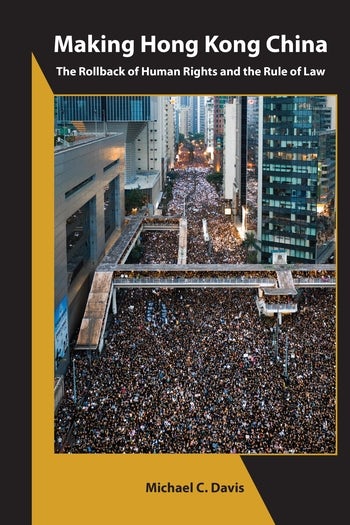
BOOK: Michael C. DAVIS, Making Hong Kong China - The Rollback of Human Rights and the Rule of Law (New York: Columbia University Press, 2020). ISBN 9781952636134, 16.00 USD


Columbia University Press has published a new book on the legal history of Hong Kong since 1997.

ABOUT THE BOOK

How can one of the world’s most free-wheeling cities transition from a vibrant global center of culture and finance into a subject of authoritarian control? As Beijing's anxious interference has grown, the “one country, two systems” model China promised Hong Kong has slowly drained away in the years since the 1997 handover. As “one country” seemed set to gobble up “two systems," the people of Hong Kong riveted the world’s attention in 2019 by defiantly demanding the autonomy, rule of law and basic freedoms they were promised. In 2020, the new National Security Law imposed by Beijing aimed to snuff out such resistance. Will the Hong Kong so deeply held in the people’s identity and the world’s imagination be lost? Professor Michael Davis, who has taught human rights and constitutional law in this city for over three decades, and has been one of its closest observers, takes us on this constitutional journey.

ABOUT THE AUTHOR

Professor Michael C. Davis is in the Fall of 2020 a Visiting Professor in the Faculty of Law at the University of Hong Kong where he teaches core courses on international human rights. He is also currently a Global Fellow at the Woodrow Wilson International Center for Scholars in Washington DC, a Senior Research Scholar at the Weatherhead East Asia Institute at Columbia University and a Professor of Law and International Affairs at O.P. Jindal Global University in India (where he is in residence each spring). A professor in the Law Faculty at the University of Hong Kong until late 2016, he has held a number of distinguished visiting professorships, including the J. Landis Martin Visiting Professor of Human Rights Law at Northwestern University (2005-6), the Robert and Marion Short Visiting Professor of Human Rights at the University of Notre Dame (2004-5) and the Frederick K. Cox Visiting Professor of Law at Case Western Reserve University (2000).


More info here

27 November 2020

BOOK: Max EDLING, Perfecting the Union National and State Authority in the US Constitution (Oxford: Oxford University Press, 2020). ISBN 9780197534717, 29.95 USD


(Source: OUP)

OUP is publishing a new book on national and state authority in the US constitution.

ABOUT THE BOOK

For most of the twentieth century, the American founding has been presented as a struggle between social classes over issues arising primarily within, rather than outside, the United States. But in recent years, new scholarship has instead turned to the international history of the American union to interpret both the causes and the consequences of the US Constitution.

In Perfecting the Union, Max M. Edling argues that the Constitution was created to defend US territorial integrity and the national interest from competitors in the western borderlands and on the Atlantic Ocean, and to defuse inter-state tension within the union. By replacing the defunct Articles of Confederation, the Constitution profoundly transformed the structure of the American union by making the national government more effective. But it did not transform the fundamental purpose of the union, which remained a political organization designed to manage inter-state and international relations. And in contrast to what many scholars claim, it was never meant to eclipse the state governments.

The Constitution created a national government but did not significantly extend its remit. The result was a dual structure of government, in which the federal government and the states were both essential to the people's welfare. Getting the story about the Constitution straight matters, Edling claims, because it makes possible a broader assessment of the American founding as both a transformative event, aiming at territorial and economic expansion, and as a conservative event, aiming at the preservation of key elements of the colonial socio-political order.

ABOUT THE AUTHOR

Max M. Edling is Reader in Early American History at the King's College, London. He is the author of A Revolution in Favor of Government: The Origin of the US Constitution and the Making of the American State and A Hercules in the Cradle: War, Money, and the American State, 1783-1867.

TABLE OF CONTENTS

Introduction: Revisiting the Critical Period

Chapter One: Peace Pact and Nation, The Constitution as a Compact between States

Chapter Two: Union, Empowering a New National Government

Chapter Three: Internal Police, The Residual Power of the States

Chapter Four: Legislation, Implementing the Constitution

Conclusion: Toward a New Understanding of the Founding

Notes

Index


More info here

23 September 2020

BOOK: Francesco BIAGI, Justin O. FROSINI, and Jason MAZZONE, eds., Comparative Constitutional History - Principles, Developments, Challenges (Leiden-New York: Brill, 2020). ISBN 978-90-04-39211-3, EUR 115.00


(Source: Brill)

Brill is publishing a book on comparative constitutional history.

ABOUT THE BOOK

While comparative constitutional law is a well-established field, less attention has been paid so far to the comparative dimension of constitutional history. The present volume, edited by Francesco Biagi, Justin O. Frosini and Jason Mazzone, aims to address this shortcoming by bringing focus to comparative constitutional history, which holds considerable promise for engaging and innovative work along several key avenues of inquiry. The essays contained in this volume focus on the origins and design of constitutional governments and the sources that have impacted the ways in which constitutional systems began and developed, the evolution of the principle of separation of powers among branches of government, as well as the origins, role and function of constitutional and supreme courts.

ABOUT THE EDITORS

Francesco Biagi (Ph.D., University of Ferrara, 2012) is Senior Assistant Professor of Comparative Public Law at the University of Bologna Department of Legal Studies. His latest book is European Constitutional Courts and Transitions to Democracy (CUP, 2020). 

Justin O. Frosini is Associate Professor of Comparative Public Law at the Bocconi University in Milan and Adjunct Professor of Constitutional Law at Johns Hopkins University. He earned his law degree and his doctorate from the University of Bologna. 

Jason Mazzone is the Albert E. Jenner, Jr. Professor at the University of Illinois at Urbana-Champaign where he also serves as Director of the Program in Constitutional Theory, History and Law. He earned undergraduate and law degrees from Harvard University and his doctorate from Yale University.

TABLE OF CONTENTS

Acknowledgments
Notes on Contributors

Introduction
  Francesco Biagi, Justin O. Frosini and Jason Mazzone

Part 1
Constitutional Origins
1 George Bancroft in Göttingen: an American Reception of German Legal Thought
  Mark Somos
2 Uniformity and Diversity. a Confrontation between French and Dutch Thought on Citizenship
  Gohar Karapetian
3 The Historical and Legal Significance of Constitutional Preambles: a Case Study on the Ukrainian Constitution of 1996   Justin O. Frosini and Viktoriia Lapa
4 How the Court of Final Appeal of Hong Kong Should Re-assert Its Power to Review Acts of the Standing Committee
  Miguel Manero de Lemos

Part 2
Challenges of Executive and Legislative Power
5 The Separation of Powers and Forms of Government in the mena Region Following the “Arab Spring”: a Break with the Past?
  Francesco Biagi
6 ‘The Constitution Will Be Our Last Hope in the Momentary Storm.’ Institutions of Constitutional Protection and Oversight in Mexico and Their Contribution to Atlantic Constitutional Thought (1821–1841)   Catherine Andrews

Part 3
Judicial Authority and Its Limits
7 Judicial Review of Legislation in Portugal: Genealogy and Critique
  Gonçalo de Almeida Ribeiro
8 Defending the Judiciary? Judicial Review of Constitutional Amendments on the Judiciary in Colombia
  Mario Alberto Cajas Sarria
9 Direct Individual Access to Constitutional Justice in South Korea and Taiwan
  Fabian Duessel 

More info here

26 May 2020

BOOK: Maurizio FIORAVANTI, Il cerchio e l'ellisse. I fondamenti dello Stato costituzionale (Bari: Editori Laterza, 2020). ISBN: 9788858141229, pp. 120, € 15,00.

Amazon.it: Il cerchio e l'ellisse. I fondamenti dello Stato ...
(Source: Editori Laterza)


ABOUT THE BOOK

L’ordine costituzionale non può avere padroni. È pertanto in pericolo ogni volta che qualcuno pretenda di appropriarsene. Uno dei più autorevoli storici del costituzionalismo indica con chiarezza le basi costituzionali su cui si fonda la nostra democrazia.

ABOUT THE AUTHOR

Maurizio Fioravanti è professore emerito di storia del diritto medievale e moderno nell’Università di Firenze. Ha insegnato anche nelle Università di Macerata e di Modena e si è occupato soprattutto di storia delle dottrine costituzionali. Per Laterza ha pubblicato: Lo Stato moderno in Europa. Istituzioni e diritto (a cura di, 2002), Costituzionalismo. Percorsi della storia e tendenze attuali (2009) e Il valore della Costituzione. L’esperienza della democrazia repubblicana (a cura di, 2009).

TABLE OF CONTENTS

Prefazione: La mano di Giotto, p. v
I. Lo Stato moderno e lo Stato costituzionale, p. 3
II. Le Costituzioni democratiche del Novecento, p. 43
III. La vera storia della prima sentenza della Corte, p. 79
Indice dei nomi, p. 99

More information with the publisher.

30 April 2020

BOOK: Paolo AVAZZI DEL FRATE (a cura di), Costituzione Francese [1814] (Macerata: Liberilibri, 2018). ISBN: 9788898094523, pp. XLII-31, 14,00 €

(Source: liberlibri)

ABOUT THE BOOK

Collana: il Monitore Costituzionale

Frutto di un compromesso tra assolutismo e liberalismo, tra “principio monarchico” e “principio rappresentativo”, la Carta francese del 1814 riproduceva nei suoi tratti essenziali la forma costituzio­nale della monarchia britannica nella sua purezza, pur senza registrarvi le evoluzioni che avevano con­dotto il sistema parlamentare verso la modernità. Superati dunque i residui dell’antico monarchismo, questa Carta inaugurò la stagione che avrebbe prodotto il costituzionalismo “liberale conservatore” e, insieme alla Carta del 1830 che se­gnerà la transizione verso la concezione orleanista del potere, diede forma a quell’ordinamento della monarchia limitata che fu un riferimento nel­l’Europa continentale del XIX se­colo per i Paesi che vollero dotarsi di costituzioni scritte, ivi incluso lo Statuto Albertino del Regno di Sardegna.

ABOUT THE AUTHOR

Paolo Avazzi del Frate è professore ordinario di Storia del diritto medievale e moderno presso il Di­par­timento di giu­risprudenza dell’Università Roma Tre. Le sue ricerche hanno affrontato pre­valentemente temi inerenti alla storia della giustizia e degli ordinamenti giudiziari e alla storia della cultura giuridica francese. Tra le pubblicazioni più recenti, le mo­no­grafie Giu­risprudenza e référé législatif in Francia nel pe­riodo rivoluzionario e napoleonico (2005); Il costituzionalismo moderno (2007); Giustizia e garanzie giu­risdi­zio­nali (2011); Gli ordinamenti co­sti­­tu­zio­nali, in Tempi del diritto: età me­die­vale, moderna, contemporanea (2016).


More information available with the publisher.

17 April 2020

BOOK: Donald G. NIEMAN, Promises to Keep African Americans and the Constitutional Order, 1776 to the Present (Oxford: Oxford University Press, 2020). ISBN 9780190071639, $99.00


(Source: OUP)

Oxford University Press has published a new edition (2nd) of a book treating the role of race in the development of the US constitution.

ABOUT THE BOOK

Widely considered the first history of US Constitutionalism that places African Americans at the center, Promises to Keep is a compelling overview of how conflict over African Americans' place in American society has shaped the Constitution, law, and our understanding of citizenship and rights. Both authoritative and accessible, this revised and expanded second edition incorporates key insights from the last three decades of scholarship and makes sense of recent developments in civil rights, from the War on Drugs to the rise of Black Lives Matter. Promises to Keep shows how African Americans have played a critical role in transforming the Constitution from a bulwark of slavery to a document that is truer to the nation's promise of equality. The book begins by examining debates about race from the Revolutionary Era at the Constitutional Convention and covers the establishment of civil rights protections during Reconstruction, the Jim Crow backlash, and the evolution of the civil rights movement, from the formation of the National Association for the Advancement for Colored People to legal victories and massive organized protests. Comprehensive in scope, this book moves from debates over slavery at the nation's founding to contemporary discussions of affirmative action, voting rights, mass incarceration, and police brutality. In the process, it provides readers with a historical perspective critical to understanding some of today's most important social and political issues.

ABOUT THE AUTHOR

Donald G. Nieman is Provost and Executive Vice President for Academic Affairs at Binghamton University, State University of New York. He is the author or editor of six books, including the first edition of Promises to Keep (Oxford).

TABLE OF CONTENTS

Acknowledgments
Preface
1 With Liberty for Some: The Old Constitution and African American Rights
2 Law and Liberty, 1830-1860
3 The National Commitment to Civil Equality, 1861-1870
4 Equality Deferred, 1870-1900
5 The Age of Segregation, 1900-1950
6 The Civil Rights Movement and American Law, 1950-1969
7 The Elusive Quest for Equality, 1969-1989
8 The Color-Blind Challenge to Civil Rights, 1989-Present
Notes
Bibliographical Essay
Table of Cases
Index

More info here

07 February 2020

BOOK : Barbara J. SHAPIRO, Law Reform in Early Modern England, (Hart publishing), ISBN : 9781509934218, £63.18

(Source : Hart publishing


ABOUT THE BOOK : Law Reform in Early Modern England, Crown, Parliament and the Press.

This book provides an illuminating commentary of law reform in the early modern era (1500–1740) and views the moves to improve law and legal institutions in the context of changing political and governmental environments.
Although lawyers have often been seen as the chief obstacles to law reform, this book emphasises their contributions – particularly their role in legislation and in reforming the corpus of legal materials – and highlights the previously ignored reform efforts of Lord Chancellors.

ABOUT THE AUTHOR : Barbara J Shapiro is Professor Emerita and Professor in the Graduate School at the University of California, Berkeley.

TABLE OF CONTENTS :

1. Introduction
2. The Early Tudors and Law Reform 1509–58
3. The Elizabethan Era 1558–1603
4. The Early Stuarts 1603–40
5. The Civil War and Parliamentary Rule 1640–49
6. Commonwealth and Protectorate 1649–60
7. The Restoration Era 1660–88
8. Revolution and Beyond 1688–1740
9. Conclusion


02 December 2019

BOOK: Edward B. FOLEY, Presidential Elections and Majority Rule The Rise, Demise, and Potential Restoration of the Jeffersonian Electoral College (Oxford: Oxford University Press, 2019). ISBN 9780190060152, $29.95


(Source: OUP

Oxford University Press has published a book on the history of American presidential elections.

ABOUT THE BOOK

The Electoral College that governs America has been with us since 1804, when Thomas Jefferson's supporters redesigned it for his re-election. The Jeffersonians were motivated by the principle of majority rule. Gone were the days when a president would be elected by acclamation, as George Washington had been. Instead, given the emergence of intense two-party competition, the Jeffersonians wanted to make sure that the Electoral College awarded the presidency to the candidate of the majority, rather than minority, party. They also envisioned that a candidate would win by amassing a majority of Electoral College votes secured from states where the candidate's party was in the majority.

For most of American history, this system has worked as intended, producing presidents who won Electoral College victories derived from state-based majorities. In the last quarter-century, however, there have been three significant aberrations from the Jeffersonian design: 1992, 2000, and 2016. In each of these years, the Electoral College victory depended on states where the winner received only a minority of votes.

In this authoritative history of the American Electoral College system, Edward Foley analyzes the consequences of the unparalleled departure from the Jeffersonians' original intent-and delineates what we can do about it. He explains how states, by simply changing their Electoral College procedures, could restore the original Jeffersonian commitment to majority rule. There are various ways to do this, all of which comply with the Constitution. If only a few states had done so before 2016, the outcome might have been different. Doing so before future elections can prevent another victory that, contrary to the original Jeffersonian intent, a majority of voters did not want.

ABOUT THE AUTHOR

Edward B. Foley directs the election law program at Ohio State University, where he also holds the Ebersold Chair in Constitutional Law. Previously, Foley clerked for Chief Judge Patricia M. Wald of the U.S. Court of Appeals for the D.C. Circuit and Justice Harry Blackmun of the United States Supreme Court. He has also served as State Solicitor in the office of Ohio's Attorney General, where he was responsible for the state's appellate and constitutional litigation. He is the author of the acclaimed book Ballot Battles: The History of Disputed Elections in the United States (Oxford University Press) and co-author of Election Law and Litigation: The Judicial Regulation of Politics.

TABLE OF CONTENTS

Preface
Introduction

Part One: The Rise of the Jeffersonian Electoral College
1: The Electoral College of 1787
2: The First Four Elections
3: The Electoral College of 1803

Part Two: The Demise of the Jeffersonian Electoral College
4: The Jeffersonian Electoral College in the 19th Century
5: The Jeffersonian Electoral College in the 20th Century

Part Three: The Potential Restoration of the Jeffersonian Electoral College
7: A Recommitment to Majority Rule
8: An Exploration of Alternatives
9: A Feasible Reform

Conclusion
Notes
Index

More info here

BOOK: Sarah BURNS, The Politics of War Powers - The Theory and History of Presidential Unilateralism (Kansas: University Press of Kansas, 2019). ISBN 978-0-7006-2873-5, $27.95


The University Press of Kansas is publishing a new book on the history of war powers in the United States.

ABOUT THE BOOK

The Constitution of the United States divides war powers between the executive and legislative branches to guard against ill-advised or unnecessary military action. This division of powers compels both branches to hold each other accountable and work in tandem. And yet, since the Cold War, congressional ambition has waned on this front. Even when Congress does provide initial authorization for larger operations, they do not provide strict parameters or clear end dates. As a result, one president after another has initiated and carried out poorly developed and poorly executed military policy. The Politics of War Powers offers a measured, deeply informed look at how the American constitutional system broke down, how it impacts decision-making today, and how we might find our way out of this unhealthy power division.

Sarah Burns starts with a nuanced account of the theoretical and historical development of war powers in the United States. Where discussions of presidential power often lean on the concept of the Lockean Prerogative, Burns locates a more constructive source in Montesquieu. Unlike Locke, Montesquieu combines universal normative prescriptions with an emphasis on tailoring the structure to the unique needs of a society. In doing so, the separation of powers can be customized while maintaining the moderation needed to create a healthy institutional balance. He demonstrates the importance of forcing the branches into dialogue, putting them, as he says, “in a position to resist” each other. Burns’s conclusion—after tracing changes through Franklin Delano Roosevelt’s administration, the Cold War, and the War on Terror—is that presidents now command a dangerous degree of unilateral power.

ABOUT THE AUTHOR

Sarah Burns is assistant professor of political science at Rochester Institute of Technology.

More info here