Search

Showing posts with label german constitutional law. Show all posts

07 July 2026

BOOK: Dieter GRIMM, Constitutional Effectiveness. The Case of Germany's Basic Law (London: Bloomsbury, 2026), 232 p. ISBN 9781509988891


(image source: Bloomsbury)

Abstract:

This book presents a unique account of the social and political impacts of the German Basic Law on the German Republic from 1949 to the present day. It considers the way in which the history of the Federal Republic of Germany has been decisively influenced by its Constitution, the Basic Law of 1949, and by the jurisprudence of the Federal Constitutional Court. The book argues that the historiography of the Federal Republic does little to reflect this influence. The Basic Law is mentioned and so occasionally rulings of the Federal Constitutional Court. But the reader does not get the impression that they were of specific importance in Germany before and after reunification. Legal scholars, on the other hand, are concerned about the legal consequences of the Basic Law, but do not analyse its impact in the real world. There is, thus, a gap between the two disciplines – one not being familiar with social reality, the other not familiar with the normativity of the law. The history of the effectiveness of the constitution falls into this gap. In this book, Dieter Grimm, himself a Justice of the Federal Constitutional Court from 1987 to 1999 and an expert on interdisciplinary research in law, history and political science, guides the reader through important developments and events that were determined or influenced by the constitution and its judicial interpretation.

Table of contents:

Preface
Preliminary Remark on the Selection of Historical Literature for Examination
1. Constitutional History and General History
2. Genesis and Content of the Basic Law3. The Beginnings of Constitutional Adjudication4. Constitutional Evolution Through Amendments5. Moves Towards a Total Revision of the Basic Law6. The Constitutional Question in the Reunification Process7. The Liberalisation of Society as a Question of Fundamental Rights8. Influence of the Constitution on the Media System9. The Social Democratic-Liberal Reforms under Scrutiny10. The Taming of the Party State11. Achieving Gender Equality12. The Basic Law in the Risk Society13. The Constitution in the East-West Approximation Process14. The Federal Republic as Member State of the European Union15. The Underestimated Constitutionalisation of PoliticsAppendix: The Significance of Law in the History of Society: A Query

 Read more here.


03 March 2026

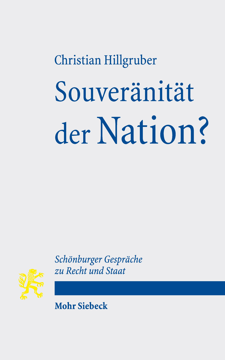
BOOK: Christian HILLGRUBER, Souveränität oder Nation? Die politische und rechtliche Schlüsselfrage der Revolution von 1848/49 oder: Der lange deutsche Weg zur Anerkennung der Volkssouveränität [Schönburger Gespräche zu Recht und Staat] (Tübingen: Mohr Siebeck, 2025), 55 p., ISBN 978-3-16-164892-2

 Cover von 'undefined'

 
ABOUT THE BOOK:
 
Die deutsche Revolution von 1848/49 war verfassungsrechtlich wie politisch vom Ringen um die verfassunggebende Gewalt geprägt. Das von der Frankfurter Nationalversammlung reklamierte Prinzip der Volkssouveränität forderte das überkommene monarchische Prinzip heraus. In der Folge stand dem vom Paulskirchenparlament geltend gemachten Alleinentscheidungsrecht über eine neue gesamtdeutsche Verfassung das von den monarchischen Regierungen der Einzelstaaten verfochtene Mitentscheidungsrecht gegenüber, das auf eine Vereinbarungslösung drängte. In dieser Auseinandersetzung konnte sich der Grundsatz der Volkssouveränität gegen die überlegenen Kräfte der Beharrung noch nicht durchsetzen. Erst die mit der Novemberrevolution 1918 errungene verfassunggebende Gewalt des deutschen Volkes schuf die Basis der Weimarer Reichsverfassung. Sie bildet auch die Legitimationsgrundlage des Grundgesetzes.
 
TABLE OF CONTENT:
 
I. Einleitung
II. Die Spaltung der nationalen Verfassungsbewegung in Liberale und Demokraten
III. Die Spannungen zwischen Demokraten und Liberalen in der Heidelberger Versammlung und die unterschiedliche Haltung gegenüber dem Bundestag
IV. Die Perspektive einer Verständigungslösung
V. Die Debatten im Vorparlament
VI. Der „kühne Griff" nach der politischen Macht im Namen der Volkssouveränität
VII. Der tiefere Grunddissens: Ganze oder geteilte Souveränität?
VIII. Das Ende aller Hoffnungen: Weder Republik noch konstitutionelle Monarchie
IX. Nachspiel: Von Frankfurt über Erfurt nach Berlin/Versailles
X. Weimar: Das Reich, das sind wir.
XI. Bonn: Das Grundgesetz als Ausprägung des Prinzips der Volkssouveränität
 
ABOUT THE AUTHOR:
 
Christian Hillgruber Geboren 1963; Studium der Rechtswissenschaft an der Universität zu Köln; 1988 Erste Juristische Staatsprüfung; 1991 Promotion (Köln); 1997 Habilitation (Köln); Professur an den Universitäten Heidelberg und Erlangen-Nürnberg; Inhaber eines Lehrstuhls für Öffentliches Recht an der Universität Bonn und Direktor des dortigen Instituts für Kirchenrecht.
 
Find more here.  
 

09 July 2025

BOOK: Thomas KLEINLEIN (ed.), Weimar: une constitution mondiale? Contexte et réception de la constitution de 1919 (transl. Guy MONARD & Clothilde MELIN; preface Aurore GAILLET) (Paris: La Mémoire du Droit, 2024), € 64


(image source: MDD)

Abstract:

Ce volume est consacré au contexte international et à la réception internationale de la Constitution du Reich de Weimar. Des juristes, des politologues et des historiens procèdent à une mise en perspective internationale de la Constitution de 1919 et des discours qui s’y réfèrent. Leurs contributions mettent en évidence aussi bien les références transversales contemporaines que sa réception internationale sur l’axe historique longitudinal. Le contexte international de la Constitution de Weimar est examiné dans le sens d’une comparaison transversale. À quelles influences intellectuelles a­t­elle été soumise ? Quels modèles étrangers ont été utilisés, lesquels ont été sciemment rejetés ? L’histoire de la réception internationale de la Constitution de Weimar constitue un deuxième point fort. Quel a été son impact direct sur l’époque ? Où et quand « Weimar » a­t­il été un argument ? Quels enseignements ont été tirés ailleurs lors des débats constitutionnels ? Quels sont les effets à long terme qui se manifestent au niveau international dans les discours juridiques et intellectuels ?

Read more here