Search

Showing posts with label Legal Education. Show all posts

26 May 2026

SEMINAR: Diritto Romano e mestiere del giurista. Esperienze, confronti, prospettive [Associazione Italiana di Diritto Romano] (Università degli Studi di Milano, 4–5 JUN 2026)

Diritto Romano e mestiere del giurista. Esperienze, confronti, prospettive

Associazione Italiana di Diritto Romano
Convegno: in presenza

Luogo: Aula 431, Università degli Studi di Milano — Via Festa del Perdono 3, Milano
4–5 giugno 2026

Contatti: Segreteria organizzativa (aidrmilano2026@unimi.it)

Per il programma completo del convegno (PDF): UniMil


Programma:


Giovedì 4 giugno 2026


Ore 14.30
Saluti istituzionali

Stefano Simonetta — Prorettore
Giuseppe Ondei — Presidente Corte d’Appello di Milano
Angela Santangelo — Direttore Dipartimento di diritto privato e storia del diritto
Carla Masi Doria — Presidente AIDR


Prima sessione. Il diritto come scienza per l’uomo. Omne ius hominum causa constitutum
Presiede Chiara Tenella Sillani

Francesco Fasolino — Ordinario di Diritto romano, Università degli Studi di Salerno
Alberto Venturelli — Ordinario di Diritto civile, Università degli Studi di Brescia


Discussione


Ore 17.00
Seconda sessione. Diritto romano e teoria generale del diritto
Presiede Claudio Luzzati

Luigi Garofalo — Ordinario di Diritto romano, Università degli Studi di Padova
Carlo Nitsch — Ordinario di Filosofia del diritto, Università degli Studi di Napoli Federico II


Discussione


Cena sociale


Venerdì 5 giugno 2026


Ore 9.30
Terza sessione. Il metodo esegetico al vaglio della contemporaneità
Presiede Sandro Schipani

Pietro Sirena — Ordinario di Diritto civile, Università Commerciale “Luigi Bocconi”


Discussione


Ore 11.00
Tavola rotonda
Presiede Patrizia Giunti

Giovanni Canzio — Già primo Presidente di Cassazione
Francesco Della Rocca — Notaio, Consigliere e Coordinatore delle Commissioni scientifiche del CNN
Antonio Genovese — Già Presidente di Sezione di Cassazione
C. Orisel Hernández Aguilar — “Titular” di Diritto romano, Università di Pinar del Río (Cuba)
Thomas Rüfner — Ordinario di Diritto romano e Diritto civile, Università di Treviri (Germania); Giudice presso la Corte d’Appello di Coblenza
Aldo Schiavone — Emerito di Diritto romano, Scuola Normale Superiore


Discussione


Ore 14.30
Assemblea dei soci
Elezione dei rappresentanti nel Direttivo

01 September 2025

BOOK: Caroline DERRY & Carol HOWELLS (eds.), Legal History in the Curriculum. Comparative Perspectives, Critical Approaches and Future Directions (London and New York: Routledge, 2025), 242 p. ISBN 9781032754970, € 116

(Image source: Taylor&Francis Group)

About the book:

As legal education faces fresh challenges and opportunities, and a growing literature calls for subversive new approaches, this book engages with vital questions about the place of history in the law school. How and why should we teach legal history? What is its place in the curriculum? What can different jurisdictions learn from each other?

This collection offers an overview and examples of cutting-edge practice in teaching legal history across the law curriculum, challenging expectations of its place and potential. The book’s three sections explore practices and possibilities in the core curriculum, in dedicated legal history courses and in law schools across the world. They highlight how legal history offers diverse and inclusive content, global perspectives, and transnational understandings to students. By exploring contributors’ own purposes and practices, they provide insight and fresh ideas on how and why readers can incorporate legal histories into their own teaching.


Table of contents:

Introduction (Caroline Derry, Carol Howells)

Legal history in the curriculum

    • Contextualising law for both scholarship and practice. The contribution of legal history (Nandini Boodia-Canoo)
    • Feminist legal history at the heart of the law curriculum (Caroline Derry)
    • Teaching public law through empire's archive (Tom Frost)
    • Using history to contextualise, diversify and critique the contract law curriculum (Fred Motson)

Legal history courses

    • An immersive, cross-disciplinary approach to teaching undergraduate legal history. ‘A Public Spectacle’: Murder and the Law in Nineteenth Century Newcastle (Jennifer Aston, Helen Rutherford)
    • Opportunities in teaching global legal history (Lorren Eldridge)
    • Anachronisms in legal historical education. Pitfalls, benefits and their importance for every lawyer (Mariken Lenaerts)

International perspectives

    • Teaching English legal history at the continental university. A case study of the University of Lodz (Łukasz Jan Korporowicz)
    • The purpose(s) of teaching legal history in contemporary Poland. Current situation and future perspectives (Tomasz Kucharski)
    • Tracing threads. Brazilian legal history's evolution, research reflections and educational perspectives (Kauan Juliano Cangussu)
    • The contribution of legal history to the curriculum of the modern law school. The Argentinian perspective 1 (Viviana Kluger)

Conclusion. The law schools of tomorrow: a collection of future legal histories (Russell Sandberg)


 On the editors:

Caroline Derry is Professor of Feminism, Law and History at the Open University, UK, and a fellow of the Royal Historical Society. She teaches across all levels from access to PhD. Her research focuses on gender, sexuality and the criminal law, legal history and transformative approaches to legal education

Carol Howells is a Senior Lecturer in Law at the Open University, UK. Her research interests include constitutional histories and legal traditions, histories of legal education, and marginalised legal histories


More information can be found here

16 April 2025

CONFERENCE: Learning about the Law: Historical Perspectives on Public Legal Education for Laypersons and Underprivileged Groups (Helsinki: University of Helsinki, 20-21 MAY 2025)


LEARNING ABOUT THE LAW: HISTORICAL PERSPECTIVES ON PUBLIC LEGAL EDUCATION FOR LAYPERSONS AND UNDERPRIVILEGED GROUPS 

20-21 May 2025, University of Helsinki

Venue: Porthania building, room P673 (address: Yliopistonkatu 3, 6th floor)


Tuesday 20 May 2025 

9.15-9.30 Registration 

9.30-9.45 Opening of the conference 

9.45-10.45 Keynote lecture (chair: Marianne Vasara-Aaltonen)

Elsa Trolle Önnerfors (Lund University): Women educating women: the first female lawyers in Sweden and their part in legal education to the public in the early 20th century

10.45-10.55 Break

10.55-12.25 Panel 1 (chair: Mia Korpiola) 

Alessia Maria Di Stefano (University of Catania): ‘What Italy does for its emigrants’: public and private initiatives to promote legal knowledge of emigration laws during the liberal period (1870-1920) among emigrants 

Talia Diskin (University of Haifa): Shaping Legal Consciousness Through Children’s Media: A Historical Analysis of Israeli Children’s Weeklies (1948-1958) 

Charles Ho Wang Mak (Robert Gordon University): Legal Education and Sign Language: Historical Perspectives on Deaf Access to Justice
 
12.25-13.10 Lunch: Porthania 6th floor

13.10-14.40 Panel 2 (chair: Kate Bradley)

Joaquim Verges (University of Bordeaux): Labour law magazines: a literary genre easily understood for workers (1890s-1914) 

Virginia Amorosi (University of Naples Federico II): ‘A uso degli operai’. Legal education and social legislation in Italy between the 19th and 20th centuries 

Marianne Vasara-Aaltonen (University of Helsinki): Educating the Working Class: Newspapers, Calendars, and Books as Sources of Legal Knowledge in Early-20th-Century Finland

14.40-15.00 Coffee 

15.00-16.00 Panel 3 (chair: Frederik Dhondt)

Mia Korpiola (University of Turku): Legal Knowledge for Finnish Housewives: Articles on Law in the Women's Magazine 'Kotiliesi' 1922-1939 

Piotr Owsiak (City Office of Cracow): Liechtenstein’s Afterwar Women’s Associations – Activity & Struggle for Voting Rights 

16.30-17.30 (optional): guided tour of the National Library of Finland 

18.30→ Conference dinner: Restaurant Salutorget


Wednesday 21 May 2025 

9.15-10.45 Panel 4 (chair Bruno Debaenst)

Airton Ribeiro (Scuola Superiore Meridionale): Lay Advocates in Portuguese America: Unraveling the Acquisition of Legal Literacy in the Colonial Context 

Emmanuel Berger (ISCTE - University Institute of Lisbon): How can laypersons be turned into judges? A study of strategies and methods of public legal education for criminal jurors; France, 1789-1848 

Rafael I. Pardo (Washington University in St. Louis): Publicizing Bankruptcy Rights Through the Antebellum Party Press 

10.45-11.00 Break 

11.00-12.30 Panel 5 (chair: Mia Korpiola)

Frederik Dhondt (Vrije Universiteit Brussel): Educating the Good Citizen: the Belgian Electoral Exam (1883-1893) 

Marco Castelli (University of Milan): Popularizing Constitutional Principles: The Educational and State-Building Functions of the ‘Festa dello Statuto’ in Liberal Italy 

Kati Katajisto (University of Helsinki): Universal and equal municipal suffrage reform in Finland – Municipal councils as forums for practical learning of legal knowledge 

12.30-14.00 Lunch: Restaurant Sunn 

14.00-15.30 Panel 6 (chair: Elsa Trolle Önnerfors) 

Michael H. Hoeflich (University of Kansas) & John Lewis Moreland (Stanford University): Pocket-Sized Education: How Small Legal Handbooks Impacted the Legal Knowledge of Everyday Americans in the Early Republic 

Bruno Debaenst (Uppsala University): Follow the guide! The case of the 1843 “Belgium as she is” guidebook by Henry Robert Addison (1805-1876) 

Filippo Rossi (University of Milan): State Building and Popular Media in Liberal Italy (1850-1919). Exploring the Role of Popular Magazines and Encyclopedias in Spreading Legal Knowledge 

15.30-15.50 Coffee 

15.50-16.50 Keynote lecture (chair: Marianne Vasara-Aaltonen) 

Kate Bradley (University of Kent): Faring well in modern times: the dynamics of social change, citizenship and the law in the late 19th and early 20th century 

16.50-17.00 Closing remarks 

19.00→ Dinner: Restaurant Rodolfo 


27 May 2024

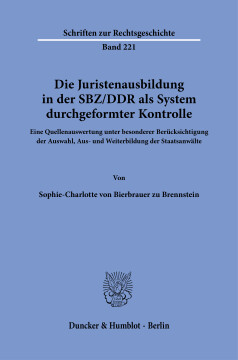
BOOK: Sophie-Charlotte von BIERBRAUER zu BRENNSTEIN, Die Juristenausbildung in der SBZ/DDR als System durchgeformter Kontrolle. Eine Quellenaswertung unter besonderer Berücksichtigung der Auswahl, Aus- und Weiterbildung der Staatsanwälte [Schriftenreihe zur Rechtsgeschichte; 221] (Berlin: Duncker & Humblot, 2024), 378 p. ISBN 9783428590544, € 99,9


(image source: Duncker & Humblot)

Abstract:
»Law Studies in the SBZ/GDR as a System of Organized Control. Evaluation of Sources with Special Consideration of the Selection, Education and Further Training of Public Prosecutors«: Using the original sources kept in the Federal Archives, this work examines the requirements placed on law studies in the GDR and the circumstances under which legal training took place. The analysis of the archive material leads to the conclusion that the education and training of GDR lawyers was determined by a systematic political-ideological education and control to ensure the goals of the socialist party.

 Table of contents:

Vorwort5
Inhaltsverzeichnis9
Abbildungsverzeichnis12
Anlagenverzeichnis15
Abkürzungsverzeichnis16
A. Themenstellung17
I. Untersuchungsgegenstand und Methode17
II. Gang der Untersuchung21
III. Forschungsstand21
B. Die juristische Ausbildung in der SBZ/DDR von 1945–1989/199026
I. Erste Hochschulreform26
1. Richter/Staatsanwälte „im Soforteinsatz“28
2. „Volksrichterlehrgänge“29
a) Erste Lehrgänge für „Volksrichter und -staatsanwälte“ ab 194629
b) Erhöhung des „gesellschaftswissenschaftlichen“ Anteils ab 194941
c) Zentralisierung der „Volksrichterausbildung“ ab 195046
3. Universitätsstudium ab 194555
a) Wiedereröffnung der Universitäte55
b) Studienpläne von 1949 und 195064
c) Zulassung73
d) Referendarprüfung und Vorbereitungsdienst77
e) Assessorprüfung85
4. Zwischenergebnis88
II. Zweite Hochschulreform91
1. Neuorganisation des Hochschulwesens ab 195192
2. Studienplan von 195195
a) Ablauf des Studiums96
b) Praktika101
c) Zwischenprüfungen und Abschlussprüfung103
3. Studienplan von 1952107
a) Praktika108
b) Zwischenprüfunge110
c) Änderung des Studienplans 1953111
4. Abschaffung der zweiten juristischen Staatsprüfung111
5. Prüfungsordnung von 1953114
6. Zulassung und „Absolventenlenkung“117
7. Studienplan von 1955 und Prüfungsordnung von 1956118
8. Auswirkungen der „Babelsberger Konferenz“ und des V. Parteitages der SED123
a) Studienplan von 1959130
b) Erhöhung der Praktikantenzeit für Richter und Staatsanwälte140
c) Einheitliche Prüfungsordnung für alle Fachbereiche141
9. Zwischenergebnis143
III. Dritte Hochschulreform145
1. „Rechtspflegeerlass“ und Rahmenstudienplan von 1963147
2. „Vorverträge“ und „Vertragsstudenten“156
3. „Sozialistische Hochschulreform“ ab 1967162
a) „Wissenschaftlich-produktives“ Studium163
b) Studienablauf167
c) Zulassung171
d) Wiedereinführung des Vorbereitungsdienstes174
e) Einführung des Diplom-Grades176
4. Zwischenergebnis178
IV. 1971 bis zur Wiedervereinigung Deutschlands181
1. Studienplan von 1974183
2. Zulassung193
3. Erste Absolventenordnung202
4. Studienplan von 1982 und Entwicklung bis 1989/1990204
5. Zwischenergebnis205
C. Die „Kaderarbeit“ der DDR-Justiz unter besonderer Berücksichtigung der Staatsanwaltschaft208
I. Staatsanwaltschaft als Organ der „sozialistischen Rechtspflege“208
II. Gewinnung und Auswahl des Nachwuchses217
III. Einflussnahme auf die Ausbildung der Staatsanwälte224
1. Betreuungsverhältnis während des Studiums224
2. Zusatzvereinbarungen mit den Universitäte225
3. Zusammenarbeit mit der FDJ232
4. Einflussnahme in Praktika, „Assistentenzeit“ und „Aspirantur“233
IV. Weiterbildung der Staatsanwälte234
1. Erste Fortbildungsmaßnahmen und „Breitenschulung“235
2. System der Aus- und Weiterbildung der „Rechtspflegekader“ ab 1963242
3. Aufbau eines Weiterbildungssystems der Staatsanwaltschaft ab 1966244
a) „Führungskaderlehrgänge“ an der DASR248
aa) Erster Turnus 1966–1971252
bb) Zweiter Turnus 1972–1976253
cc) Dritter Turnus 1977–1981254
dd) Vierter Turnus 1981–1986255
ee) Fünfter Turnus 1986–1990258
b) „Postgraduales Studium“263
aa) Erster Lehrgang ab 1970264
bb) Zweiter Lehrgang ab 1973268
cc) Dritter Lehrgang ab 1976269
dd) Vierwöchige zentrale postgraduale Lehrgänge in Reichwalde ab 1978269
c) „Instruktionsschulungen“279
d) „Spezialistenlehrgänge“ und „Parteihochschulen“284
4. Weiterbildung bis zur Wiedervereinigung286
V. Zwischenergebnis286
D. Zusammenfassung und Fazit292
I. Das rechtswissenschaftliche Studium von 1945–1951292
II. Das rechtswissenschaftliche Studium von 1951–1961294
III. Das rechtswissenschaftliche Studium von 1961–1971297
IV. Das rechtswissenschaftliche Studium von 1971–1990300
V. Die „Kaderarbeit“ der Rechtspflegeorgane301
1. Gewinnung und Auswahl302
2. Betreuung während des Studiums303
3. Weiterbildung304
VI. Fazit305
Anlage308
Anlage 1: Gesichtetes Archivmaterial308
Anlage 2: Studienplan für die zwölfmonatigen „Volksrichterlehrgänge“ (1947)314
Anlage 3: Studienplan der „Volksrichterschulen“ der Länder (1. Januar 1949)315
Anlage 4: Studienplan für die Zweijahreslehrgänge an der „Zentralen Richterschule“ (1. Juni 1950)317
Anlage 5: Studienplan für den juristischen Nachwuchs der DDR (1. Februar 1950)325
Anlage 6: Vorläufiger Studienplan für die juristischen Fakultäten (22. August 1949)335
Anlage 7: Studienplan für das juristische Studium (27. Januar 1950)338
Anlage 8: Studienplan für das Fach „Rechtswissenschaft“ (Studienplan Nr. 63) (1. August 1951) (Auszug)343
Anlage 9: Studienplan für das Fach „Rechtswissenschaft“ (Studienplan Nr. 63) (1. September 1952) (Auszug)345
Anlage 10: Änderungen im Studienplan (10. August 1953)347
Anlage 11: Prüfungsordnung für die rechtswissenschaftlichen Fakultäten (1. Dezember 1953) (Auszug)350
Anlage 12: Auflistung vorgeschlagener Diplomarbeitsthemen im Strafrecht (1966) (Auszug)351
Anlage 13: Stundentafel des Studienplans für die Grundstudienrichtung „Rechtswissenschaft“ (1974)352
Anlage 14: Stand der Kadergewinnung zur Veranschaulichung der dokumentierten Eigenschaften (1977)355
Anlage 15: Empfehlung einer Bewerberin durch das BG Magdeburg (9. Mai 1977)356
Anlage 16: Zusammenfassender Bericht des MdJ über den Stand der Gewinnung und die Auswahl von Nachwuchskadern (30. März 1978)360
Anlage 17: Stundentafel des Studienplans für die Grundstudienrichtung „Rechtswissenschaft“ (1982)362
Literaturverzeichnis364
Archive372
Stichwortverzeichnis373
Read more here: DOI 10.3790/978-3-428-59054-4.