Search

04 September 2025

BOOK: Thomas LE ROUX & Raphaël MORERA (eds.), La nature sous contrat. Concession, histoire et environnement (XVIe-XXIe siècle) (Rennes: Presses Universitaires de Rennes, 2025), 322 p. ISBN 9782753598140, € 25


About the book:

Dans un monde toujours plus habité et exploité, dans lequel l’environnement se dégrade sous la pression anthropique et où la concurrence pour l’accès aux sources de la vie s’accroît, la question de l’appropriation des ressources est brûlante. À différentes échelles et sur des espaces variés, la « concession » a été de longue date un outil d’exploitation largement utilisé par les pouvoirs pour compenser leur manque de moyens en s’associant à des acteurs privés. La démarche transversale de cet ouvrage autour d’un thème inédit en histoire ouvre des perspectives insoupçonnées. Depuis le Moyen Âge, la concession n’a cessé de redéfinir les modalités de la propriété, entre communs et propriété pure. Conçue en tant que créatrice de légitimités nécessaires à l’exploitation des ressources, elle s’est avérée être un instrument de stabilité efficace. Outil juridique, comme l’assurance peut l’être pour l’État social, la concession participe d’un objectif politique : ancrée dans un univers social, elle est mise au service de stratégies comme l’occupation territoriale ou l’affirmation de la souveraineté. Ce faisant, elle est une forme spécifique d’expression du pouvoir. Ce volume explore les multiples facettes d’une forme d’exploitation de l’environnement dont les logiques font écho aux temps présents.


Table of contents:

SOUVERAINETÉ ET POLITIQUE

    • Concession seigneuriale et concession féodale. Des instruments pour l’aménagement du territoire dans la France d’Ancien Régime
    • Vers un éco-pouvoir ouvrier. Critiques du droit de concession et projets de nationalisation des mines (France, XIXe siècle)
    • « Sans porter préjudice au public » ? Concéder l’eau à Marseille et Paris au XVIIe siècle

EMPIRES

    • Concéder les rivières pour coloniser les terres. Le droit de pêche comme outil de développement du Canada sous le Régime français (1663-1759)
    • Poissons et baleines de l’empire. Concessions, conservation et souveraineté maritime en AOF et en AEF (1900-1940)
    • Les concessions aux îles australes françaises (1893-1939). Prédation des ressources, protection de la nature et manifestations de la souveraineté
    • Concession minière, conquête coloniale et transformations environnementales. La mine de fer d’Aïn Mokra et son système concessionnaire articulé (1845 – fin du XIXe siècle)

RESSOURCES ET USAGES CONCURRENTS

    • La concession du minerai de fer dans l’approvisionnement des hauts fourneaux de l’abbaye de Clairvaux à l’époque moderne
    • « Limites à bois » et « billets de location ». La concession comme mode de régulation de la ressource forestière (Québec, XIXe-XXe siècles)

MARCHANDISATION DU PAYSAGE

    • Concéder l’indisponible. Une socio-histoire des concessions de plage : le cas de Pampelonne (Var, 1922-1974)
    • Concéder la montagne touristique au XIXe siècle (Pyrénées françaises)

LA MISE EN FLUX

    • Les concessions royales et la seigneurie des eaux du Lez. Le partage contesté d’un petit fleuve méditerranéen sous le règne de Louis XIV (Montpellier, bas Languedoc)
    • Mettre la Durance au travail. Hydroélectricité, concession et environnement (1950-2020)
    • Concéder la gestion du Rhône sans les inondations ?


On the editors:
Thomas Le Roux est chargé de recherche au CNRS (Centre de recherches historiques, CNRS/EHESS). Ses recherches portent sur l’impact de l’industrialisation sur l’environnement aux XVIIIe et XIXe siècles.
Raphaël Morera est chargé de recherche au CNRS (Centre de recherches historiques, CNRS/ EHESS). Ses recherches portent sur la maîtrise de l’eau au cours de l’époque moderne.

More information can be found here.

03 September 2025

BOOK: Allison POWERS, Arbitrating Empire. United States Expansion and the Transformation of International Law [Oxford Legal History] (Oxford: Oxford University Press, 2024), ISBN 9780190093006, 125 USD


(image source: OUP)

Abstract:

Arbitrating Empire offers a new history of the emergence of the United States as a global power-one shaped as much by attempts to insulate the US government from international legal scrutiny as it was by efforts to project influence across the globe. Drawing on extensive archival research in the United States, Mexico, Panama, and the United Kingdom, the book traces how thousands of dispossessed residents of US-annexed territories petitioned international Claims Commissions between the 1870s and the 1930s to charge the United States with violating international legal protections for life and property. Through attention to the consequences of their unexpected claims, Allison Powers demonstrates how colonized subjects, refugees from slavery, and migrant workers transformed a series of tribunals designed to establish the legality of US imperial interventions into sites through which to challenge the legitimacy of US colonial governance. One of the first social histories of international law, the book argues that contests over meanings of sovereignty and state responsibility that would reshape the mid-twentieth-century international order were waged not only at diplomatic conferences, but also in Arizona copper mines, Texas cotton fields, Samoan port cities, Cuban sugar plantations, and the locks and stops of the Panama Canal. Arbitrating Empire uncovers how ordinary people used international law to hold the United States accountable for state-sanctioned violence during the decades when the nation was first becoming a global empire-and demonstrates why State Department attempts to erase their claims transformed international law in ways that continue to shield the US government from liability to this day.

Table of contents:

Introduction: The Subjects of International Law

Part I: Dispossessions
Chapter 1: Arbitrating Debt
Chapter 2: Arbitrating War
Chapter 3: Arbitrating Citizenship
Part II: Exposures
Chapter 4: The World's Easement
Chapter 5: Dangerous Precedents
Part III: Foreclosures
Chapter 6: Sovereign Inequalities
Chapter 7: The Specter of Compensation

Conclusion: Life and Property

On the author:

Allison Powers is Assistant Professor of History at the University of Wisconsin-Madison. 

Read more here. 

(source: Legal History Blog)

02 September 2025

CALL FOR PAPERS: Legal History in Asia and Beyond: Lessons from the Past for the Present (Chinese University of Hong Kong: Hong Kong, 17-18 MAR 2026 & Oxford University: Oxford, 23 MAR 2026) [DEADLINE 31 OCT 2025]


(Source: CUHK Law)


Legal History in Asia and Beyond: Lessons from the Past for the Present 

Hong Kong, 17-18 March 2026 & Oxford, 23 March 2026 

CALL FOR PAPERS 


The Transnational Legal History Group, part of the Centre for Comparative and Transnational Law within the Faculty of Law at the Chinese University of Hong Kong, the Oxford Programme in Asian Laws of the Faculty of Law at the University of Oxford and the Asian Legal History Association are jointly hosting a conference on “Legal History in Asia and Beyond: Lessons from the Past for the Present.” The conference will take place in two parts: first on 17 and 18 March 2026 in Hong Kong, and then on 23 March 2026 in Oxford. Applicants should specify at which venue they would prefer to present when making their application. There is no obligation or expectation to attend both sessions, but participants are welcome to do so. 

This unique cross-jurisdictional event will also serve to mark the institutionalization of the Asian Legal History Association (ALHA). The ALHA, which has its Secretariat at CUHK, brings together faculties and institutes from more than a dozen jurisdictions, collectively committed to promoting the study and knowledge of transnational legal history generally, enhancing the status and role of Asia as a generator and hub of global legal history knowledge, and developing collaborative relationships between universities in Asia and around the world. 

Theme 

Studying legal history requires a great deal of time and knowledge, and sensitivity to context. Care is necessary to minimize the extent to which our interpretations are overly influenced by contemporary concerns and modes of understanding. At the same time, history is one of the most fertile and productive arenas in which we can come to a better understanding concerning the complex dynamics of human society, different modes of organization and their relationship to individual and collective wellbeing and equality (or their absence). We welcome papers on the history of law that carry lessons relative to the future. Among other topics, papers might address issues such as: 

• Past laws, institutions and practices structuring public governance and state capacity in general; 

• Private law regimes, their formation, evolution and impacts; 

• The laws and institutions structuring economic life; 

• The history of the welfare state, of employment and labor, of development and of socio-economic rights; 

• Environmental law histories; 

• The evolution of criminal laws, institutions and punishments over time;

• Family law systems and laws governing gender and sexuality; 

• The development of judicial decision-making systems and of legal communities, including lawyers and law schools; 2 • Legal pluralism and the encounter between and interaction of multiple legal orders, including indigenous legal regimes; 

• The history of international law. 

We also welcome papers that challenge the frame and grapple with the complexities involved in seeking lessons for the present in the past, or which address (legal) history methodologies as such. 

Publication 

The organizers hope to assemble a selection of the papers from the conference for publication, potentially via a special edition of a journal, an edited volume, or both. Participants who wish for their piece to be considered for publication should submit a draft of at least 5,000 words (including footnotes) by 28 February 2026. 

Travel and Accommodation

 • The conference will be in person. 

• Applicants will be responsible for their own transportation and accommodation costs. 

• We will suggest hotels in due course. 

Timeline 

• Submission of Abstract: midnight (Hong Kong time) on 31 October 2025 

• Notification of selection: 1 December 2025 

• Conference Days: 17 & 18 March 2026 (Hong Kong), 23 March 2026 (Oxford) 

• Draft paper submission (for participants interested in publication in a special issue or edited volume): 28 February 2026 

Application 

• Proposals may be for individual papers or panels. 

• Individual paper proposals should include a 150-300 word abstract. 

 • Panel proposals should include a brief description of the panel as well as 150-300 word abstracts of three to five individual papers. 

• Applicants should specify at which venue they would like to present their papers. 

• Applicants should indicate their academic affiliations on their applications. 

• Applications should be submitted via the following link: https://cloud.itsc.cuhk.edu.hk/webform/view.php?id=13715426 

• Inquires may be addressed to: alha@cuhk.edu.hk

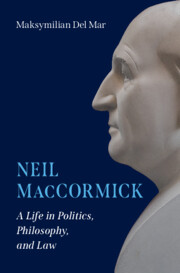
BOOK: Maksymilian DEL MAR, Neil MacCormick. A Life in Politics, Philosophy, and Law (Cambridge: Cambridge University Press, 2025), ISBN 9781009609937, €58,36


(image source: CUP)

Abstract:

Neil MacCormick (1941–2009) was one of the twentieth century's most important legal philosophers and one of Scotland's most influential public intellectuals. This book tells the story of his political and philosophical life, from his intensely political childhood as the son of 'King John', one of the founders of the Scottish National Party, through to his involvement in Scottish politics – especially as the author of SNP's constitutional policy – and his role as a Member of the European Parliament, helping to draft the European Constitution. With special attention to MacCormick's character, this book offers a reading of his entire oeuvre, covering his contributions to theories of legal and moral reasoning, institutional legal theory, nationalism, post-sovereignty, subsidiarity, and constitutional pluralism in Europe. This book reads MacCormick as a highly creative thinker who excelled in the art of constructing inclusive middles and thereby developed his own distinctive approach to politics and philosophy.

Read more here: DOI 10.1017/9781009609937. 

(source: Legal History Blog)

01 September 2025

BOOK: Caroline DERRY & Carol HOWELLS (eds.), Legal History in the Curriculum. Comparative Perspectives, Critical Approaches and Future Directions (London and New York: Routledge, 2025), 242 p. ISBN 9781032754970, € 116

(Image source: Taylor&Francis Group)

About the book:

As legal education faces fresh challenges and opportunities, and a growing literature calls for subversive new approaches, this book engages with vital questions about the place of history in the law school. How and why should we teach legal history? What is its place in the curriculum? What can different jurisdictions learn from each other?

This collection offers an overview and examples of cutting-edge practice in teaching legal history across the law curriculum, challenging expectations of its place and potential. The book’s three sections explore practices and possibilities in the core curriculum, in dedicated legal history courses and in law schools across the world. They highlight how legal history offers diverse and inclusive content, global perspectives, and transnational understandings to students. By exploring contributors’ own purposes and practices, they provide insight and fresh ideas on how and why readers can incorporate legal histories into their own teaching.


Table of contents:

Introduction (Caroline Derry, Carol Howells)

Legal history in the curriculum

    • Contextualising law for both scholarship and practice. The contribution of legal history (Nandini Boodia-Canoo)
    • Feminist legal history at the heart of the law curriculum (Caroline Derry)
    • Teaching public law through empire's archive (Tom Frost)
    • Using history to contextualise, diversify and critique the contract law curriculum (Fred Motson)

Legal history courses

    • An immersive, cross-disciplinary approach to teaching undergraduate legal history. ‘A Public Spectacle’: Murder and the Law in Nineteenth Century Newcastle (Jennifer Aston, Helen Rutherford)
    • Opportunities in teaching global legal history (Lorren Eldridge)
    • Anachronisms in legal historical education. Pitfalls, benefits and their importance for every lawyer (Mariken Lenaerts)

International perspectives

    • Teaching English legal history at the continental university. A case study of the University of Lodz (Łukasz Jan Korporowicz)
    • The purpose(s) of teaching legal history in contemporary Poland. Current situation and future perspectives (Tomasz Kucharski)
    • Tracing threads. Brazilian legal history's evolution, research reflections and educational perspectives (Kauan Juliano Cangussu)
    • The contribution of legal history to the curriculum of the modern law school. The Argentinian perspective 1 (Viviana Kluger)

Conclusion. The law schools of tomorrow: a collection of future legal histories (Russell Sandberg)


 On the editors:

Caroline Derry is Professor of Feminism, Law and History at the Open University, UK, and a fellow of the Royal Historical Society. She teaches across all levels from access to PhD. Her research focuses on gender, sexuality and the criminal law, legal history and transformative approaches to legal education

Carol Howells is a Senior Lecturer in Law at the Open University, UK. Her research interests include constitutional histories and legal traditions, histories of legal education, and marginalised legal histories


More information can be found here

29 August 2025

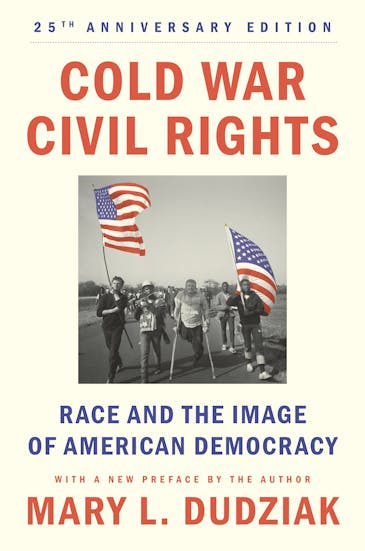
BOOK: Mary L. DUDZIAK, Cold War Civil Rights: Race and the Image of American Democracy (Princeton: Princeton University Press, 2025), 360 p. ISBN 9780691274324, 32 USD


(image source: Princeton)

Abstract:

In 1958, an African American handyman named Jimmy Wilson was sentenced to die in Alabama for stealing less than two dollars. Shocking as this sentence was, it was overturned only after intense international attention and the interference of Secretary of State John Foster Dulles. Soon after World War II, American racism became a major concern of US allies, a chief Soviet propaganda theme, and an obstacle to American Cold War goals throughout Africa, Asia, and Latin America. Racial segregation undermined the American image, harming foreign relations in every administration from Truman to Johnson. Mary Dudziak shows how the Cold War helped to facilitate desegregation and other key social reforms at home as the United States sought to polish its image abroad, yet how a focus on appearances over substance limited the nature and extent of progress. Cold War Civil Rights situates the Cold War in civil rights history while giving an international perspective to the fight for racial justice in America.

On the author:

Mary L. Dudziak is the Asa Griggs Candler Professor of Law at Emory University. Her books include War Time: An Idea, Its History, Its Consequences and Exporting American Dreams: Thurgood Marshall’s African Journey.

Read more here. 

(source: Legal History Blog)

BOOK REVIEW: Zeynep AĞDEMIR on Studies in the history of tax law (vol. 11), edited by Dominic De Cogan and Peter Harris (Comparative Legal History, XIII (2025), nr. 1, June, pp. 126-129)

(Image source: Taylor&Francis)

This volume of Studies in the History of Tax Law is a publication of selected conference papers presented at the Tax Law History Conference held in Cambridge in 2022. The book is divided into 18 rather lengthy chapters. The principal authors come from law faculties, although there are a few contributions by social scientists. The book also contains an intriguing co-authored chapter (Chapter 2) examining the effect of legislation taxing alcohol on production technology: one author is an expert in engineering, and the other in law.
It is worth noting that a body of literature on tax history known as ‘New Fiscal History’ already exists, as mentioned by Manse and Varding (235), together with the concept of the fiscal-military state. The influence of these approaches may be seen in recent fiscal history literature. However, these approaches are not adopted in the chapters contained in this volume. Methodologically, most of the chapters emphasise the significant impact of individuals or institutions on tax policy and tax laws.
A wide range of issues is explored in the book, including the taxation of the Royal Forests, the origins of tax law, the taxation of alcohol, tax regions (the geographic units used for tax assessments), parliamentary time for tax legislation, colonial taxation, income and corporation tax, and international taxation. Matters such as international taxation, income tax, and corporation tax appear to be recurring themes in other volumes of Studies in the History of Tax Law as well.

To read the full review, please click here. Online access is free for members of the European Society for Comparative Legal History. 
DOI: 10.1080/2049677X.2025.2500205


28 August 2025

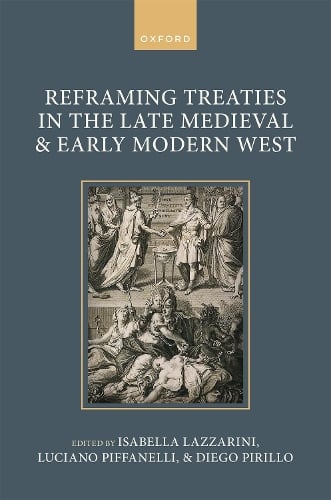
BOOK: Isabella LAZZARINI, Luciano PIFFANELLI & Diego PIRILLO (eds.), Reframing Treaties in the Late Medieval and Early Modern West (Oxford: Oxford University Press, 2025), 496 p. ISBN 9780198958475, 119 GBP


(image source: Waterstones)

Abstract:

Peace treaties were an important, dynamic, and varied element of late medieval and early modern diplomacy and international relations. But study of peace-making in the pre-modern period has often been limited to a focus on singular treaties and case studies, or presented as the historical prelude to the singular and inevitable 'universal' international order of the modern period. Seeking to counter this one-dimensional and Eurocentric teleology, this multi-authored volume conceives of peace treaties very broadly—as a range of successful and failed agreements, settlements, truces, oaths, and other forms conflict resolution—across a wide geopolitical and constitutional range of case studies not limited to Europe, but including also the Mediterranean and Atlantic worlds. Considered in this way, they become a means to reevaluate thoroughly the premodern peace-making process and the broader flow of negotiations that shaped late medieval and early modern political interactions; not as a discrete series of treaties but as a constitutive element of politics (a 'political grammar'), both within and outside frontiers and borders, whose complexity and adaptability are reflected in the diversity of its forms and the variety of the sources that recorded it. In so doing, and across 21 multi-disciplinary chapters, contributors show pre-modern peace-making to have been a multi-layered and varied phenomenon, the understanding of which has important implications for all those working on medieval and early modern international relations, diplomacy, and the new diplomatic history.

(source: Waterstones) 

27 August 2025

CALL FOR PAPERS: Between Institutions and Geography: Cities as Hubs of Medieval River Transport and Trade (EAUH 2026 Barcelona, 5-6 SEP 2026); DEADLINE 22 OCT 2025


Call for Papers: Between Institutions and Geography: Cities as Hubs of Medieval River Transport and Trade (EAUH 2026 Barcelona)


(image source: Wikimedia Commons)


17th European Association for Urban History Conference (Barcelona)


Dr. Marco in ‘t Veld (Tilburg University), dr. Bart Holterman (Forschungsstelle für die Geschichte der Hanse und des Ostseeraums), and dr. Maurits den Hollander (Tilburg University) warmly invite all academics interested in medieval river trade in an urban context to submit their paper proposals for our main session (nr. 3) at the EAUH conference in Barcelona, 2-5 September 2026.


Session Abstract


It is commonly acknowledged that waterways are of crucial importance for trade. They allow for relatively efficient transportation of goods. Cities served as hubs in medieval trade, as providers of the necessary institutions and services. While the relation between geography and the early modern economy is well-studied, we know much less about the interaction between geography and these urban institutions. This session will therefore investigate how urban governance was influenced by the geography of rivers. Did cities cooperate to ensure the efficient passage of ships? Were they developing common trade policies, or rather competing? To what extent did they copy legislation or exchange professionals?


In general, cities kept a close eye on legislation and institutions in other cities. Historians, particularly in the tradition of the New Institutional Economics, have underlined the importance of these social and legal norms for facilitating economic growth. Others, like Fernand Braudel, have focused on the more stable preconditions of economic prosperity, such as the position of a city in geographically determined commercial systems. This session draws on both academic traditions. For example, the city of Dordrecht possessed important staple rights in the wine trades along the Rhine river. These privileges were opposed by other cities and would have hindered commercial activity, but on the other hand cities also cooperated to divide the river into spheres of exclusive economic influence, such as Hamburg and Magdeburg on the Elbe or Wroclaw, Frankfurt and Szczecin on the Oder river. As such, they can be considered both as pillars in the economic system as well as crucial institutions in the economic organisation of trade.


However, our focus on cities also raises additional questions. How were privileges concretely enforced and how was infrastructure maintained? Staple rights, as well as toll rights, for example, were mostly privileges of the sovereign. On the other hand, it was often up to the guilds or merchant associations to prevent harbours and canals from freezing up in winter. As such rivers, while crossing several jurisdictions, seem to have necessitated cities to participate in special forms of multi-level governance, both external (inter-city communications, relations with princely authorities) and internal (urban professionals, guilds).


Although these examples are derived from the context of the northern European lowlands, the organisers believe that these questions are relevant in relation to many river systems. It is worthwhile to compare the specific dynamics of rivers from an economic, geographic, and legal point of view. Therefore, we would like to invite scholars from all over the world to contribute, preferably based on original archival research, to the analysis of the role of cities in transport and trade along rivers.


Paper Submissions


We encourage interested scholars with a diverse, global range of perspectives on this topic to submit abstracts for our session according to the general conference guidelines. Presentations should aim to be between 10 – 15 minutes, with additional space for discussion. Abstracts of max. 2500 characters can be submitted through this link ultimately Wednesday 22 October 2025. Please note that you will have to register on the website first, before being able to submit. Select ‘session 3’ when submitting your abstract.

BOOK: Donald S. PRUDLO (ed.), A Companion to the History of the Roman Curia [Brill's Companions to the Christian Tradition, ed. Christopher M. BELLITTO; 107] (Leiden/Boston: Brill, 2025), XVI+390 p. ISBN: 9789004184626, € 251,22

(Image source: Brill)

About the book:
The Roman Curia is the oldest extant body of institutional administration in the world. Indeed, it was the prototype for the development of centralized government in the monarchies of the Middle Ages. Further, it was the administrative backbone of the first worldwide organization in human history. It developed policies, laws, and procedures that continue to affect the entire world. This book offers scholarly contributions from the origins of the Curia to the early modern period.

Table of contents:

The Early Evolution of the Structures of the Roman Curia
1. The Versatility of the Early Medieval Papal Officials in the Light of the Liber pontificalis (Rosamond McKitterick)
2. Laying Down Papal Law: Archiving Controversy in the Letters of the Collectio Avellana (Bronwen Neil)
3. The Bishop of Rome and His Entourage: the Origins of the Papal Curia (Rita Lizzi Testa)
4. Ex codicibus et ex antiquis polypticis scrinii Sanctae Sedis Apostolicae: Canonical Collections and Archives of the Church of Rome in Antiquity (Dominic Moreau)

Forming the Medieval Curia
5. “Time and Money”: Regulating Appeals to the Roman Curia in the Second Half of the Twelfth Century (Bruce Brasington)
6. Papal Councils and the Curia in the ‘Long’ Twelfth Century, 1088–1215 (Danica Summerlin)
7. A Most Fortuitous Alliance: the Roman Curia and the Mendicant Orders in the Thirteenth Century (Donald S. Prudlo)

Roman Church Governance in the Late Medieval Period
8. Nepotism and the Papal Curia between the Eleventh and the Fifteenth Centuries (Sandro Carocci)
9. From the lectores curie romane to the Magistri Sancti Palatii: Education at the Medieval Roman Curia (Anthony John Lappin)
10. The Papal Penitentiary in the Later Middle Ages (Peter D. Clarke)
11. Administrative and Diplomatic Practices at the Papal Curia between the Thirteenth and Fourteenth Centuries: the Chancery (Barbara Bombi)
12. Sacra Romana Rota – the Papal Tribunal of Tribunals? (Kirsi Salonen)

The Curia in the Early Modern World
13. Locating the Renaissance Curia, c.1420–c.1530 (Miles Pattenden)
14. Europe and the Roman Curia: Conflicts of the Counter Reformation (Elena Bonora)
15. The Congregation of the Council and the Worldwide Provincial Councils, 1564–1622 (Maria Teresa Fattori)
16. The Roman Curia and the Eastern Churches, 1500–1800: Diplomacy, Cultural Policy, Mission, and Confessional Control (Cesare Santus)
17. Two Bodies and One Soul: Papal Finances in the Modern Age (1564–1800) (Massimo Carlo Giannini)
18. The New World by Francesco Ingoli, First Secretary of Propaganda Fide (Giovanni Pizzorusso)

On the editor:
Donald S. Prudlo, Ph.D. (2004, University of Virginia) holds the Warren Chair of Catholic Studies at the University of Tulsa. His research focuses on medieval religious history and thought, on saints and sainthood, and on the Dominican order. He is the author of Thomas Aquinas: A Historical, Theological, and Environmental Portrait (2020), Certain Sainthood (2015), and The Martyred Inquisitor (2009).


More information can be found here: DOI 10.1163/9789004723665.

26 August 2025

BOOK: Justin M. ANDERSON and Atria A. LARSON (eds.), Thomas Aquinas and Medieval Canon Law (Washington D.C.: Catholic University of America Press, 2025), 402 p. ISBN: 9780813239347

Abstract: 

Thomas Aquinas and Medieval Canon Law bridges, for the first time, two worlds of scholarship that have never been explored in book-length form and investigates an under-researched area in Thomistic studies, namely the question of how Thomas Aquinas engaged the ecclesiastical law and jurisprudence of his day.

Neither historians of medieval canon law nor experts on Thomas’s thought have previously paid much attention to the canon law tradition as a source for Thomas’s work and an influence on his thought. But, as this volume shows, his consideration of mendicant life, law, justice, oaths, penance, clerical orders, the Eucharist, baptism, property, commerce, marriage and more reveal engagement with key canon law texts and concepts and with the jurisprudence of major canonists. The book uncovers how Aquinas encountered canonical regulations and jurisprudence as a Dominican, an educator in both theology and pastoral care, and a participant in the secular-mendicant controversy. In his life, education, community, and his way of thought, Thomas Aquinas could not avoid and necessarily encountered and dealt with the canonical tradition. He did so in a distinctive way, working as he did with his theological and philosophical source material to craft his own great synthesis. What this volume shows, if nothing else, is that the canon law tradition should be taken into consideration when assessing Thomas’s synthetic thought.

Following the editors’ introduction, thirteen scholarly contributions and an epilogue explore Aquinas’s interaction with medieval canon law through four major themes: Dominican Matters; Foundations Matters of Faith, Truth, and Law; Moral Matters; and Sacramental Matters. Approximately half the contributors are specialists from the field of medieval canon law, and half are grounded in Thomistic tradition. The result is a unique and scholarly contribution to two major research areas that may open avenues for similar studies of other key figures in the scholastic tradition.

About the editors:
Justin M. Anderson is professor and Chair of Moral Theology at Immaculate Conception Seminary School of Theology at Seton Hall University. 
Atria A. Larson is associate professor of medieval christianity at Saint Louis University, and the author of Gratian's Tractatus de penitentia: A New Latin Edition with English Translation and Master of Penance: Gratian and the Development of Penitential Thought and Law in the Twelfth Century.


More information can be found here.

25 August 2025

BOOK: Ernst KANTOROWICZ, Radiances. Unpublished Essays on Gods, Kingship, and Images of the State (Ithaca: Cornell University Press, 2025), 258 p. ISBN 9781501782534

(Image source: Cornell University Press)

Abstract:
Radiances gathers previously unpublished essays by one of the greatest historians of the twentieth century. Although best known for The King's Two Bodies (1957), Ernst Kantorowicz's scholarly expertise ranged from classical antiquity to early modernity and from political pageantry to numismatics. These essays traverse the breadth of his expertise, exploring "radiations" of the themes that were central to his published work: sovereignty, theology, law, and iconography.
The radiations in these engaging essays include the imagery of throne-sharing from the Hellenistic era and Pharaonic Egypt to early Christianity, coronation ceremonies in Byzantium and the West, the Carolingian and Burgundian Renaissances, the relationship between Rome and Christianity, the importance of history as a humanistic pursuit, and the significance of postage stamps in political myth-building. Robert E. Lerner discusses each essay's composition, themes, and place in Kantorowicz's oeuvre. Combining vast knowledge with intellectual delight, Radiances teems with the profound historical insights that distinguished Kantorowicz's scholarship.

On the author:
Ernst Kantorowicz (1895–1963) taught at the University of Frankfurt and University of California, Berkeley, and was a member of the Institute for Advanced Study in Princeton.

More information can be found here.

22 August 2025

BOOK REVIEW: Manuel BASTIAS SAAVEDRA on The Cambridge history of Latin American law in global perspective, edited by Thomas Duve and Tamar Herzog, and A companion to Latin American legal history, edited by Matthew C. Mirow and Victor Uribe-Uran (Comparative Legal History XIII (2025) nr. 1, June, pp. 112-122)

(Image source: Taylor&Francis)

There has been an increasing interest in the legal history of Latin America in recent decades. Largely restricted to law faculties and considered to be the domain of legal scholars until the late twentieth century, since the early 2000s legal history has steadily become an established research field in the context of a wider historiography concerned with questions of colonialism and empire, race and status, slavery and labour, Indigenous peoples, nation and state-building, among others.
Many parallel developments can arguably account for this. One longer-term development has been the influence that prominent legal historians, such as Paolo Grossi, Víctor Tau Anzoátegui, Michael Stolleis, António Manuel Hespanha, and Bartolomé Clavero, have had in rejuvenating the field, not only through their works but mainly through their students and adherents, who have come to occupy positions in both history and law departments and have driven the emergence of a new legal history in the Latin American context. Another somewhat parallel development was the interest that social and ethnohistorians – mostly in Latin America and the United States of America – were taking to the use of judicial archives and sources, promoting what has been alternatively called sociolegal history and history of justice. Finally, a more recent development worth mentioning was the appointment in 2009 of Thomas Duve as director of the Max-Planck-Institut für europäische Rechtsgeschichte, which gave one of the world’s leading legal historical institutions a global historical agenda with regional focus on Latin America and encouraged both scholarly output and networking in the field.
The publication in 2024 of the two edited volumes that are the subject of this review can be seen as confirmation of this trend. But it also marks an inflection point in the historiography of law in Latin America, since what had been developing through the discrete accumulation of research across two decades has now become a field that is engaging in critical self-reflection about its objectives, methods, aims, and its future.

To read the full review, please click here. Online access is free for members of the European Society for Comparative Legal History.
DOI: 10.1080/2049677X.2025.2500187


21 August 2025

BOOK: Sari KATAJALA-PELTOMAA (ed.), A Companion to Medieval Canonization Processes. New Contexts, Perspectives, and Comparisons [Brill's Companions to the Christian Tradition, ed. Christopher M. BELLITTO; vol. 109] (Leiden/Boston: Brill, 2025), XII + 341 p. ISBN: 9789004516298, € 168,54

(Image source: Brill)


About the book:

Canonizations, which officially proclaimed a person’s sanctity, were complex, embracing theological, judicial, social, and cultural aspects of medieval Christianity. The dossiers manifest the theological ponderings while also revealing the devotional practices, daily life, and troubles of those not learned in canon law or theology.

This volume offers tools for comprehending canonization processes by investigating their judicial background and structural elements, as well as devotional aspects reflected in the depositions. It approaches canonization processes in a three-fold way: as a phenomenon of the past, as a source material with methodological challenges, and as a specific field of historical studies. Furthermore, this volume engages in innovative methodological discussions and illuminates the state-of-the-art and topical new themes.


Table of contents

Introduction: Canonization Processes in Context and Comparison (Sari Katajala-Peltomaa)

1. The Papacy on the Canonization of Saints: between Appropriation, Regulation, and Disinterest (Christian Krötzl)

2. God’s Ordinary and Extraordinary Speech: the Determination of Miracles by the Roman Congregation of Rites in the Early Modern Era (Maria Teresa Fattori)

3. Transforming an Individual into a Saint and an Accused into a Criminal. Judicial Procedure in Canonization Processes and libri maleficiorum of Italian Communes at the End of the Middle Ages (Didier Lett)

4. The Construction of Information in the Records of Medieval Canonization and Heresy Inquests: a Methodological Comparison (Saku Pihko)

5. Testimonies of the Life of the Saint in the Context of Canonization (Jenni Kuuliala)

6. Safe and Dangerous Names: Uncovering Connections and Boundaries in the Canonization Inquest for Countess Delphine de Puimichel, 1363 (Nicole Archambeau)

7. Disability, Miracle, and Sainthood in Early Fourteenth-Century Canonization Dossiers (Adelheid Russenberger)

8. “Are You Content to Die?” Death Acceptance and Death Denial in Depositions of Canonization Processes (Jyrki Nissi)

9. Writing Microhistory from the Canonizations of Bernardino of Siena and Vincent Ferrer (Laura Ackerman Smoller)

10. Experiencing the Miraculous: Lived Religion in the Depositions (Sari Katajala-Peltomaa)

11. Scent, Sight, Awe: Examining the Bodily Signs of Sainthood in the Canonization Processes of Dominican Saints (Marika Räsänen)

12. Canonizations and Jesuit Saints: the Lives and Images amid the Causes for Ignatius Loyola and Francis Xavier (Jonathan Greenwood)

On the editor

Sari Katajala-Peltomaa is currently Professor of Cultural History at the University of Turku, Finland. She has specialized in lived religion, gender, and family. Her recent publications on canonization processes include Demonic Possession and Lived Religion in Later Medieval Europe (Oxford: Oxford University Press, 2020) and edited with Christian Krötzl, Miracles in Medieval Canonization Processes: Structures, Functions, and Methodologies (Turnhout: Brepols, 2018).

More information can be found here: 10.1163/9789004726833.

20 August 2025

BOOK: Richard PRIMUS, The Oldest Constitutional Question. Enumeration and Federal Power (Cambridge (Mass.): Harvard University Press, 2025, 448 p. ISBN 9780674293595, € 45,95


(image source: Harvard)


Abstract:
A groundbreaking challenge to a core principle of constitutional law, arguing that congressional action is not limited by the legislative branch’s textually enumerated powers. Every law student learns that the federal government is constrained to act only according to its enumerated powers, meaning that Congress can do what the Constitution expressly authorizes it to and nothing more. Yet Richard Primus contends that this longstanding orthodoxy—allegedly required by the text of the Constitution, the Framers’ vision, and the logic of federalism—is fundamentally flawed.

On the author:

 Richard Primus is Theodore J. St. Antoine Collegiate Professor at the University of Michigan Law School. He clerked for Justice Ruth Bader Ginsburg at the US Supreme Court and is the author of The American Language of Rights.

(source: Legal History Blog) 

Read more here. 

19 August 2025

ARTICLE: Leon CASTELLANOS-JANKIEWICZS & Momchil MILANOV, "A Well-known Stranger: André Mandelstam – From Empire to Human Rights" (European Journal of International Law XXXVI (2025), nr. 1 (Feb), 263-270


(image source: OUP)

Introduction:

André Mandelstam delivered four courses at the Hague Academy between its inaugural session in 1923 and 1934, making him one of the most frequent lecturers of the interwar period. Two studies in particular – on the rights of minorities (1923) and on human rights (1931) – made outsized contributions to the theoretical and practical understandings of human rights as group rights, which, until then, had only been addressed by a smattering of authors.1 Because of this, Mandelstam has sometimes been celebrated as a human rights lawyer avant la lettre, but more recent scholarship has rightly positioned him as a transitional figure mediating between imperial and liberal mindsets within the epistemic community of international lawyers.2 The tension between these two attitudes provides the backdrop for the following considerations. These explore the ‘Realpolitik’ underlying Mandelstam’s humanitarian thought and its uneasy coexistence with his solidarist view of international law, which was largely set aside by mainstream scholarship after World War II to make way for individualistic approaches to human rights.3

Read more here: DOI 10.1093/ejil/chaf020.

18 August 2025

BOOK: Laura CULBERTSON & Susan LONGFIELD KARR (eds.), Framing Devices and Global Legal Traditions. From the Ancient World to the Modern Nation State [Routledge Studies in Comparative Legal History, eds. Aniceto MASFERRER DOMINGO & Heikki PIHLAJAMÄKI] (London: Routledge, 2025), 432 p. ISBN 9781032849447, 116 GBP


(image source: Routledge)

Abstract:

This collection explores prefaces, prologues, paratexts, and other types of framing devices. Across world history, these devices have introduced the law, articulated its context and audience, identified the basis of legal and moral authority, critiqued existing conditions, or even tried to “restore” something that never was. Scribes, lawmakers, and legal theorists also used frames to position the law in time and space, purporting to define populations and their identities. Despite the ubiquity and complexity of these phenomena, few studies have drawn out methods for studying their role in constructing, fortifying, or reimagining legal frameworks within legal cultures or traditions. This volume offers new ways to consider the significance of framing apparatuses regarding how and why they are created, remembered, forgotten, utilized, and recovered within legal traditions. The studies range from the ancient world to the modern nation-state system, aiming to explore the intersections and collisions between juridical and political interpretation practices. The book will be of interest to academics and researchers in the areas of Legal History, Comparative Law, Legal Cultures and Traditions, Legal Theory, Jurisprudence, Constitutional Law and Legislative Drafting.

Table of contents:

1. More than Marginal: The Complex Work of Framing Devices

Laura Culbertson and Susan Longfield Karr

Part 1: Pulling Together

2. The Preambles to Archaic Greek Interstate Treaties at Olympia: A Study in the Diffusion of Diplomatic Language

Nicholas D. Cross

3. Prefaces of Legal Documents in Late Imperial China

Frédéric Constant

4. The Conservative Case for Warrior Law: Legal Change in Medieval Japan

Christopher Bovbjerg

5. Bodies of Law in Early Medieval England and Scotland

Andrew Rabin

6. Preface to the Indian Penal Code, as Originally Drafted (October 1837)

Elizabeth Lhost

Part 2: Breaking Apart

7. (Re-)framing Hammurabi’s Laws: Worldbuilding with Prologues and Epilogues in the Ancient Near East

Laura Culbertson

8. Prefaces in the Legal Texts of the Crusader Kingdoms of Jerusalem and Cyprus

Adam M. Bishop

9. No Mere Metaphor: The State of Nature as Framing Device

Susan Longfield Karr

10. Jefferson's Preambles, Prefaces, and Persistence

Matthew Crow

11. Martens' Clause and Ambiguity at the Birth of Modern Humanitarian Law

Daimeon Shanks-Dumont

12. Searching for Meaning In the Utah Constitution's Free Market Preamble

Jorge Contreras

 On the editors:

Laura Culbertson (PhD Michigan, Near Eastern Studies) is a professor of Middle East Studies at American Public University. Her background is in Ancient Near Eastern history and archaeology, and her recent research interests include slavery and ancient law. On the topic of slavery, she edited Slaves and Households in the Near East and co-edited Society and the Individual in Mesopotamia, which includes a contribution Mesopotamian slavery. Other recent publications discuss legal pluralism and the social contexts of Mesopotamian law. Susan Longfield Karr (Ph.D. University of Chicago, History): Longfield Karr’s teaching and research focus on state- and empire-state formation and the emergence of the so-called modern rule of law within communities (constitutions) and between them (international law) from the late medieval through the early modern period. Her work pays particular attention to the meaning and significance of legal vocabularies within cultural, political, and juridical frameworks that accompany the history and development of rights (customary, civic, and natural) in the context of state and empire formation in Italy, Germany, France, and England. Most recently, she published On Justice and Right: Jus gentium in Humanist Jurisprudence, wherein she explored the transformation of fundamental categories of Roman law such as ius and ius gentium by the fathers of legal humanism, Guillaume Budé, Ulrich Zasius, and Andrea Alciati (Brill, 2022). Dr. Longfield Karr is an Associate Professor of History at the University of Cincinnati.

Read more here. 

18 July 2025

SUMMER BREAK (18 JUL-18 AUG)


(Lesende und singende Gesellschaft bei Kerzenlicht by Peter Vischer d. J. (Zugeschrieben an) - Albertina, Austria - Public Domain; source: Europeana).

The ESCLH blog will take a Summer break until 18 August (we will be back with more news on that day). We wish our readers a pleasant Summer.

ARTICLE: Niccolò RIDI & Thomas SCHULTZ, "Distantly Reading the Recueil des Cours: Authority and Authorities in the History of the Hague Academy of International Law" (European Journal of International Law XXXVI (2025), nr. 1 (Feb), 247-262


(image source: OUP)

First paragraph:

The Hague Academy recently turned 100 years old. What has its role been as a site of authority in international law? This study undertakes a large-scale quantitative analysis of its corpus of lectures to answer that question. We apply computational and scientometric methods and use citation data and network analysis techniques to analyse patterns and trends across the entire Recueil des cours de l’Academie de droit international de la Haye, thus ‘distantly reading’ them in the tradition of Franco Moretti.1

Read the article here: DOI 10.1093/ejil/chaf019. 

BOOK REVIEW: Rebecca RIEDEL on Justifying transgression: Muslims, Christians, and the law – 1200 to 1700 by Gijs Kruijtzer (Comparative Legal History, 2025-1, June, pp. 122-125)

(Image source: Taylor&Francis)

Justifying Transgression adopts a comparative approach, focusing on Muslims and Christians across Europe and Asia between 1200–1700. Across this 500-year period, Gijs Kruijtzer reveals that individuals were very much concerned with the various different dimensions of proscribed practices. The central argument, along with its supporting strands, is both intellectually profound and straightforward. As a result, the book will appeal to historians and non-historians alike, including those without religious expertise and those unfamiliar with the law during this period. This is perhaps particularly true for those who are not familiar with the subject matter or the original source material; Kruijtzer presents the information found in the original sources in a transparent, palatable way, and guides the reader through them.
Indeed, the introduction to the text offers a valuable explanation of the worlds discussed – that is, the Persian and the Latin worlds – as well offering justification as to why they were chosen for study (1–22). As such, Justifying Transgression looks, in detail, towards three understudied – yet very much linked – transgressive acts: sodomy, idolatry, and usury. Kruijtzer explains that he chose these acts because individuals throughout the historical period explored were in search of answers as to why these particular acts were proscribed during this period. [...]

To read the full review, please click here. Online access is free for members of the European Society for Comparative Legal History.

For further information about the volume on our blog, please visit here.


17 July 2025

CALL FOR ABSTRACTS: Between State Authority and Legal Supremacy – (Legal) Historical Perspectives on Administrative Justice in Germany and Europe (Regensburg: University of Regensburg, 19-20 MAR 2026) [DEADLINE 5 OCT 2025]

(Image source: The organisers of the Conference)


The history of administrative jurisdiction is a central topic in the history of law and public administration, as well as in the political development of Germany and Europe.

Administrative courts play a significant role in overseeing state action and upholding the principles of the rule of law. Their origin, development and function reflect historical processes of transformation and are closely linked to social, political and legal change.

Since the 19th century, different forms of judicial oversight of administration have emerged across Europe within this context. This heterogeneity of administrative jurisdiction has proven particularly relevant in recent history, especially in light of the influence of European law on individual nation-states.

Since their inception, administrative courts have operated within multiple areas of tension, such as between the protection of individual rights and the objective oversight of legality. Moreover, the role of administrative courts also had to be renegotiated within the constitutional and judicial framework.

The planned research symposium offers an opportunity to present and discuss current research on this field.

A key aim is to foster interdisciplinary exchange and to open perspectives from legal history, administrative sciences, political science, history and related disciplines.

Various research approaches will be brought together, and a wide range of topics will be explored, including the legislative history at national and international levels, comparative law analyses of different systems of administrative justice, and the practical work of administrative courts, particularly through rulings and decisions.

In addition, the sociography of administrative judges as well as the impact of individual personalities is to be brought into focus.

Possible approaches to the topic include:

  • The emergence and development of administrative jurisdiction in Germany and other European countries
  • Comparative perspectives on administrative justice across different legal systems
  • The relationship between administrative courts and other courts, as well as their position within the constitutional framework
  • The influence of European law and European institutions on national systems of administrative justice
  • The impact of political, social, and economic upheavals on administrative jurisdiction
  • The role of administrative courts in the constitutional democracy

The conference theme is deliberately broad in scope and aims to open up various aspects and perspectives on the role of administrative jurisdiction in Germany and Europe.


Conditions of Participation:

This call for abstracts is specifically aimed at early-career researchers working within the relevant disciplinary fields. We therefore welcome submissions from students, doctoral candidates, postdoctoral researchers and scholars pursuing habilitation.

Each presentation will be allocated a 45-minute time slot, with the talk itself expected to last approximately 20 minutes, allowing ample time for subsequent discussion.


Submission:

Interested applicants are invited to submit an abstract (max. 500 words) along with a short academic CV (max. 1 page) by 5 October 2025 to michael.reichenthaler@jura.uni-regensburg.de.

Notification of acceptance will be provided by end of October 2025.


Event Details:

The symposium will take place on 19–20 March 2026 at the University of Regensburg. Participation and/or presentations may also be possible digitally upon prior arrangement.

Acommodation costs for the night of 19 to 20 March can be covered. At present, travel expenses of up to €100 per person can also be reimbursed.

Following the symposium, the publication of the contributions is planned with Rechtskultur Verlag.

Further information will be provided upon acceptance of the submissions.


Contact:

Michael Reichenthaler, Research Assistant

  • Chair of Civil Law, German and European Legal History and Canon Law (Prof. Dr. Martin Löhnig, University of Regensburg)
  • michael.reichenthaler[at]jura.uni-regensburg.de


16 July 2025

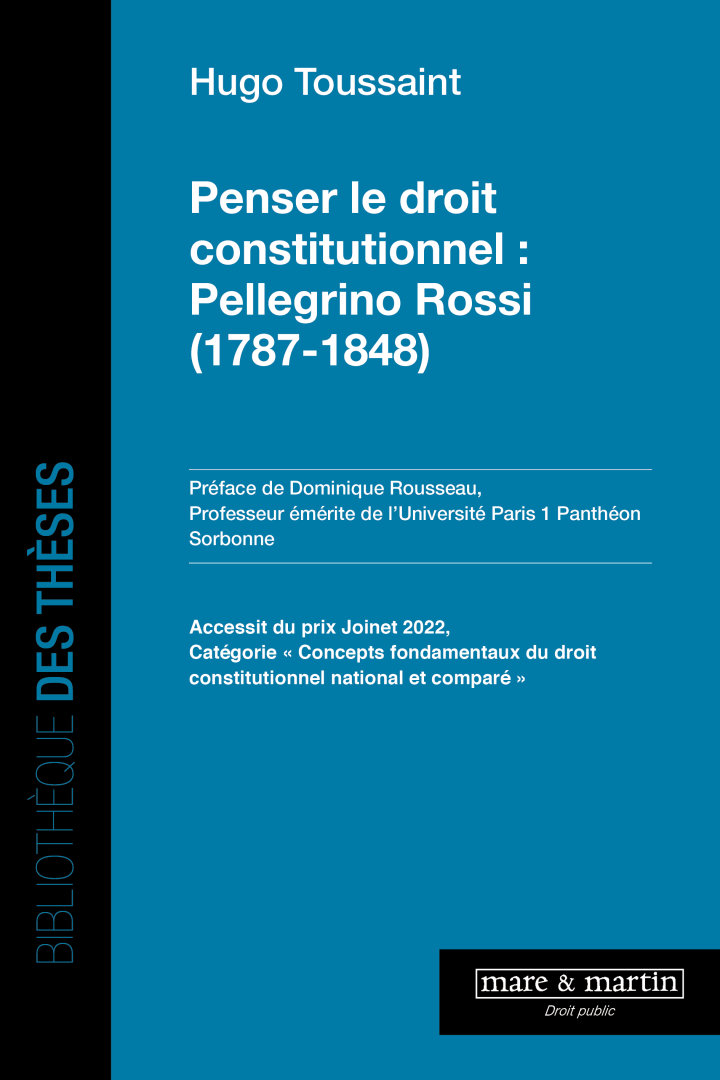
BOOK: Hugo TOUSSAINT, Penser le droit constitutionnel: Pellegrino Rossi (1787-1848) [Droit public - Bibliothèque des Thèses] (Paris: Mare & Martin, 2025), 592 p. ISBN 9782386000980, € 54

(image source: Mare & Martin)


Abstract:

Premier titulaire de la chaire de droit constitutionnel de la Faculté de droit à Paris, Pellegrino Rossi (1787-1848) demeure aujourd’hui encore une figure méconnue. Doyen de la Faculté, pair de France, académicien puis ministre du Pape Pie IX, le constitutionnaliste est une figure incontournable de la doctrine juridique du XIXe siècle. L’ouvrage se propose de mettre au jour les outils épistémologiques avec lesquels Pellegrino Rossi construit sa pensée constitutionnelle et politique. À travers l’étude des notions de personne humaine, de société et d’État, l’ouvrage démontre le ralliement de Rossi à l’éclectisme philosophiquede son temps en soulignant ses diverses inspirations comme l’historicisme et l’organicisme allemands ainsi que l’utilitarisme anglais. L’ouvrage reconstitue également le logique juridique mais également politique de la pensée de Pellegrino Rossi. En ce sens, est mis au jour le but politique de la pensée constitutionnelle de Rossi entièrement tournée vers la promotion de l’unité nationale. Enfin, l’étude se propose d’interroger la figure - communément répandue - d’un Pellegrino Rossi « libéral ». En effet, sa vision inégalitaire de la société politique, sa conception capacitaire du gouvernement représentatif ainsi que sa virulente critique de l’égalité des conditions décrite par Tocqueville dans la Démocratie en Amérique interrogent de plus en plus sa stature de « penseur libéral ».

Read more here. 

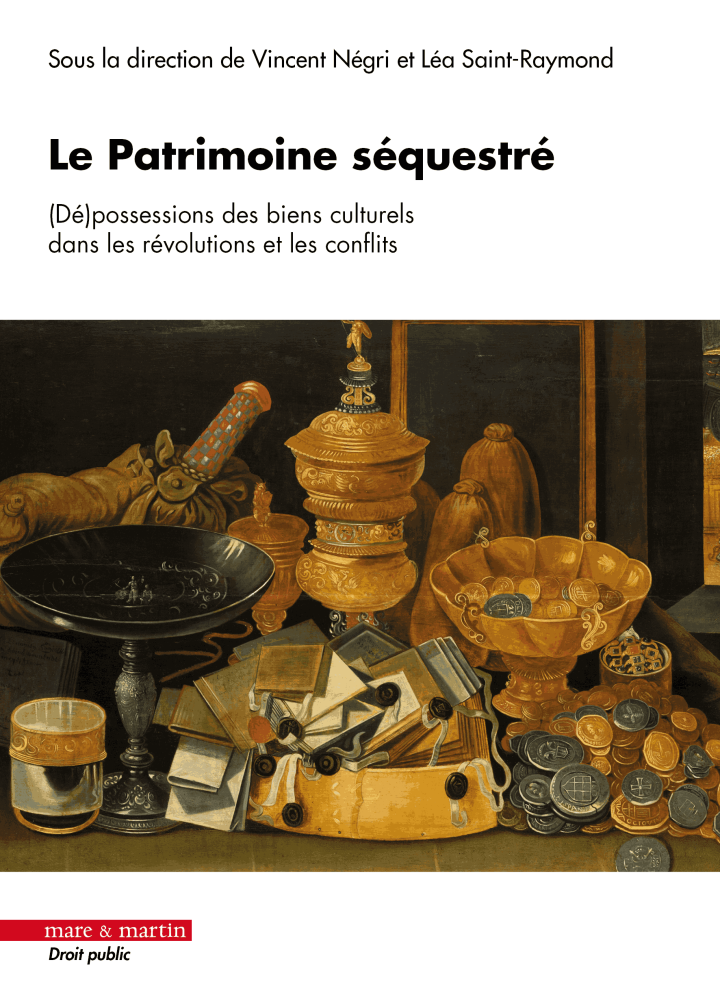
BOOK: Vincent NÉGRI & Léa SAINT-RAYMOND (dir.), Le Patrimoine séquestré. (Dé)possessions des biens culturels dans les révolutions et les conflits [Droit public] (Paris: Mare & Martin, 2025), 300 p. ISBN 978-2-84934-734-8, €26


Abstract:

La guerre en Ukraine a redonné une malheureuse actualité aux séquestres de biens culturels. Encore peu étudiée – contrairement aux « saisies », aux « confiscations » et aux « spoliations » – la notion de « séquestre » mérite d’être interrogée et replacée dans un temps long. Telle est l’ambition de cet ouvrage, mobilisant les apports croisés de l’histoire, de l’histoire de l’art, du droit, des sciences politiques, de l’économie et de la sociologie. Lors des conflits, les séquestres de biens culturels sont motivés par une certaine conception de « l’intérêt général » et relèvent d’intentions et d’opportunités politiques, que cet ouvrage met également en lumière.

 Read more here.

15 July 2025

ARTICLE: Ignacio DE LA RASILLA, "Building Up Inclusiveness for Women in the History of International Law? (Netherlands International Law Review LXXII (2025), 1-30)


(image source: Springer)

Abstract:

Building and expanding on recent historiographical developments in rewriting the history of international law, this article provides a non-exhaustive ten-fold list of inclusive-oriented interventions to address the gendered formation of the dominant accounts and narratives of the history of international law. The first category comprises four critical deconstructivist interventions targeted at decentring the still hegemonically male-centred field of international legal history. The second category includes four contributionist interventions targeted at remedying the invisibility of women in the history of international law and to lay the ground for, and to encourage further research work on, the history of women in international law. The third and final category includes two further dissemination interventions targeted at further remedying the generalized lack of knowledge about the contribution of women to international law in a historical perspective. The conclusion reflects on the potential and limits of efforts at building up inclusiveness for women in the history of international law.

Read more here: DOI  10.1007/s40802-025-00276-w.

14 July 2025

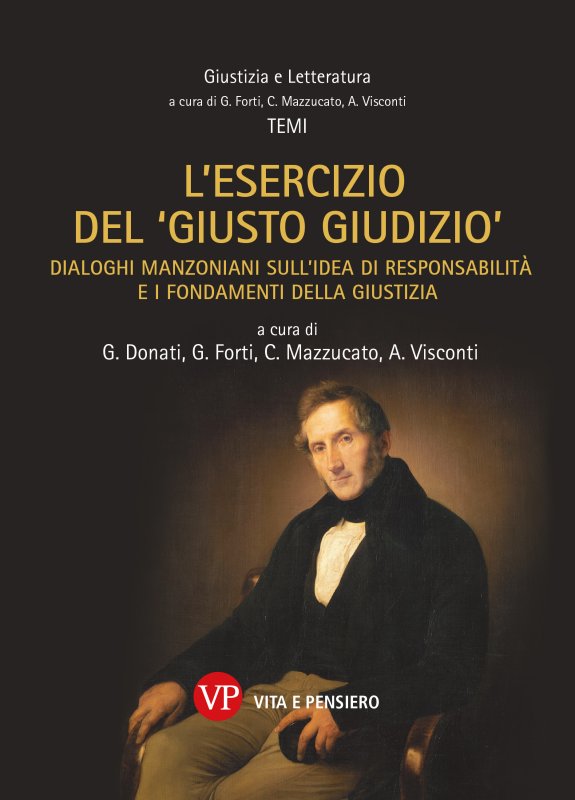
BOOK: Gabrio FORTI, Gaia DONATI, Claudia MAZZUCATO & Arianna VISCONTI (eds.), L'esercizio del 'giusto giudizio'. Dialoghi manzoniani sull'idea di responsabilità e i fondamenti della giustizia (Milano: Vita e Pensiero, 2025), 504 p. ISBN 9788834357873, € 34


(iamge source: Vita e Pensiero)

Abstract:

Che cosa rende ‘giusto’ l’esercizio del ‘giudizio’? Quanto, come e perché il ‘giudicare’ non si lascia ridurre al semplice ‘spiegare’? Queste le domande che si dischiudono non appena si mette a tema il ‘giudizio’, tanto più in un contesto socio-culturale, oltre che giuridico-istituzionale, nel quale si assiste, a tutti i livelli, a un ‘infuriare’ di giudizi ‘sommari’, il cui assordante rumore di fondo sembra renderci orfani di giudizi veri e, appunto, giusti. Le opere letterarie prese in considerazione in questo volume lasciano intravedere spiragli di risposta a tali secolari quesiti dell’umanità. La Storia della colonna infame, che è il luogo del giudizio e del giudizio sul giudizio, ma anche I promessi sposi, dove il giudizio è più squisitamente narrativo, pongono le basi per scandagliare, con Alessandro Manzoni, la dimensione etica della vita e il delicato equilibrio tra giudizio e comprensione. Un interrogativo che si ripropone nel dialogo con Leonardo Sciascia e Primo Levi, ma anche con molti altri autori e pensatori, attualizzato, ad esempio, nella serrata discussione critica con la tendenza, espressione di una crescente ‘ansia punitiva’, a mal sopportare i tempi e i vincoli di garanzia dello stesso procedimento penale, in favore del ben più rapido, ed emotivo, ‘giudizio mediatico’. Congiungendo competenze teoriche e sensibilità applicative, esperienze giuridiche e prospettive filosofiche, sociologiche, psicologiche e criminologiche, il volume incoraggia il lettore, tanto più quello interessato al livello di civiltà giuridica (e, dunque, di civiltà tout court) della società in cui vive, a dipanare l’intreccio tra responsabilità, giudizio, riparazione e pena, «tutte categorie che evocano situazioni di sofferenza». La risposta alla perturbante domanda «Ma come rispondere diversamente?» sta nel prendere sulle spalle un «pezzetto della croce della società», aprendosi a un’idea di giustizia come ascolto e attenzione.

Contributors:

Con i contributi di: Carla Bagnoli, Giuliano Balbi, Mauro Bertolotti, Giovanni Canzio, Lucia Castellano, Patrizia Catellani, Maurizio Catino, Adolfo Ceretti, Paola Corvi, Franca D’Agostini, Francesco D’Alessandro, Cristina de Maglie, Gaia Donati, Luciano Eusebi, Luigi Ferrarella, Gabriele Fornasari, Gabrio Forti, Pierantonio Frare, Loredana Garlati, Diletta Giuffrida, Fausto Giunta, Aldo Grasso, Natalino Irti, Claudia Mazzucato, Isabella Merzagora, Niccolò Nisivoccia, Carlo Enrico Paliero, Mauro Palma, Silvano Petrosino, Antonio Sichera, Francesco Viganò, Arianna Visconti.

On the editors:

L’Alta Scuola “Federico Stella” sulla Giustizia Penale (ASGP), istituita presso l’Università Cattolica del Sacro Cuore, rappresenta un unicum nel panorama culturale e professionale italiano. È un laboratorio di analisi e progettazione che si dedica alla ricerca di soluzioni regolative e applicative in tutti gli ambiti – giuridici, economici e sociali – connessi alla giustizia penale. Il suo metodo è il confronto serrato con l’‘immane concretezza’ dei problemi di oggi, reso esperto e consapevole grazie al dialogo costante tra docenti e ricercatori italiani e stranieri, nonché tra qualificate realtà istituzionali, professionali e imprenditoriali. Le iniziative didattiche e scientifiche dell’Alta Scuola, diretta da Gabrio Forti, hanno principalmente a oggetto, oltre all’esplorazione del rapporto tra diritto/giustizia e letteratura, i crimini d’impresa, le condizioni della compliance nelle organizzazioni complesse, la prevenzione della corruzione, la responsabilità in campo sanitario e il problema della gestione del rischio clinico, le misure patrimoniali di contrasto alla criminalità organizzata, le nuove frontiere della giustizia riparativa (restorative justice), la riforma dell’ordinamento penitenziario, la tutela del patrimonio culturale e dell’ambiente.

More information here. 


JOURNAL: Journal of the History of International Law/Revue d'histoire du droit international XXVII (2025), nr. 2 (Jun)


(image source: Brill)


Towards Comparative International Legal History? (Ignacio de la Rasilla)
DOI 10.1163/15718050-bja10112
Abstract:
The great rejuvenation known by the history of international law and, in its wake, the recent engagement with its national dimensions begs the question of whether they and comparative international law are providing the hitherto missing building blocks for the often invoked yet never realized emergence of comparative international legal history. Section I examines the recent revival of study of the national dimension of the history of international law with reference to three main categories: national histories of international law of great Western powers; of semi-peripheral Western countries and of non-Western countries. Section II then examines some of the normative, sociological, methodological and historiographical arguments in favor of the complementary use of the national lens in researching the history of international law from the perspective of its epistemological completeness but also some of its possible dark sides. Section III explores the potential development of comparative international legal history as an embryonic field by retracing the intellectual development of comparative international law in a historical perspective and examining its most recent revival. The article concludes by arguing that existing scholarship already offers the building blocks for the materialization of comparative international legal history as an interdisciplinary field and by illustrating some of its features.

Theories of State Development at the Dawn of the International Covenant on Economic, Social and Cultural Rights (Pádraig McAuliffe) [OPEN ACCESS]
DOI 10.1163/15718050-bja10116
Abstract:

There is a significant temporal gap between the finalisation of the text of the International Covenant on Economic, Social and Cultural Rights in 1966 and its doctrinal elaboration from the late 1980s onwards. This article shows how the Covenant was imagined at the height of the 50s and 60s era of decolonisation, modernisation theory and development planning. This was a time when there was a widespread hope that states of the Third World could soon replicate the socio-economic, industrial and stateness levels of the developed North. The Covenant was a decidely teleological mix of Western social democracy, Soviet-inspired social provision and Third World developmentalism. The Preamble and the provisions therein represented a confidence about the role that developmental, state-consolidating politics could play in the Global South. Before the doctrinal implications of these assumptions could be played out, the Covenant went into abeyance as it waited for the requisite numbers of ratifications through the 1970s and the elaboration of doctrinal machinery in the 1980s. As such, the context of drafting was distinctly different from the neoliberal milieu in which the Covenant was interpreted after the foundation of the Committee Economic, Social and Cultural Rights in the late 80s. This doctrinal elaboration whittled away and narrowed the Covenant’s Article 2(1) bedrock principle of progressive realisation. This process occurred with little reference to the history of the Covenant. It has meant that a somewhat defensive approach to the principle, one in which aspects like justiciability, non-retrogression, minimum core and a violations approach have grown from marginal to defining features, while the teleology implicit in the drafting process has shifted in the opposite direction from pivotal to peripheral. The doctrinal elaboration of these aspects is presented as an essentially timeless, organic emanation from the text. This presentation and understanding of the Covenant elides not only the extent to which other interpretations are possible, but the extent to which other, more expansive, less legalistic interpretations of Article 2(1) were latent at the time the Covenant was agreed.

The Enduring Influence of the Late Medieval Conception of Universal Monarchy on the Theories of Governance in the International Community (Niccolò Lanzoni)
DOI 10.1163/15718050-bja10124
Abstract:

This article explores the enduring influence of the late medieval conception of universal monarchy on the theories of governance in the international community. It argues that, despite shifts in vocabulary and institutions, the core idea that a supranational politico-legal authority governing international affairs is necessary for the pursuit of peace, justice, and the welfare of humankind has ‘haunted’ international legal thought and remains central to debates on governance. The analysis begins by examining 14th century writings on universal monarchy, highlighting both commonalities and divergences among authors. It then investigates how the discovery of the New World and the rise of Habsburg Spain shaped discussions on global governance and the role of universal monarchy. The article traces the evolution of this concept in the post-Westphalian period, where it adapted to new vocabularies and ideas. Additionally, it examines the revival of universal monarchy, particularly through the work of Hans Kelsen, and with reference to Dante’s De Monarchia, in the first half of the 20th century. In conclusion, the article argues that the essence of the late medieval idea of universal monarchy, centred on the notion of community through hierarchy, is still relevant today and continues to resonate in the discussion on theories of global governance (and their balance with state sovereignty).

Book reviews

  • Pax Economica: Left-Wing Visions of a Free Trade World, written by Marc-William Palen (Christopher A. Casey)
  • Le Saint-Empire face au monde. Contestations et redéfinitions de l’impérialité XV e–XIX e siècle, written by Indravati Félicité (Elisabetta Fiocchi Malaspina)
Read the full issue here.