Search

Showing posts with label history of environmental law. Show all posts

04 September 2025

BOOK: Thomas LE ROUX & Raphaël MORERA (eds.), La nature sous contrat. Concession, histoire et environnement (XVIe-XXIe siècle) (Rennes: Presses Universitaires de Rennes, 2025), 322 p. ISBN 9782753598140, € 25


About the book:

Dans un monde toujours plus habité et exploité, dans lequel l’environnement se dégrade sous la pression anthropique et où la concurrence pour l’accès aux sources de la vie s’accroît, la question de l’appropriation des ressources est brûlante. À différentes échelles et sur des espaces variés, la « concession » a été de longue date un outil d’exploitation largement utilisé par les pouvoirs pour compenser leur manque de moyens en s’associant à des acteurs privés. La démarche transversale de cet ouvrage autour d’un thème inédit en histoire ouvre des perspectives insoupçonnées. Depuis le Moyen Âge, la concession n’a cessé de redéfinir les modalités de la propriété, entre communs et propriété pure. Conçue en tant que créatrice de légitimités nécessaires à l’exploitation des ressources, elle s’est avérée être un instrument de stabilité efficace. Outil juridique, comme l’assurance peut l’être pour l’État social, la concession participe d’un objectif politique : ancrée dans un univers social, elle est mise au service de stratégies comme l’occupation territoriale ou l’affirmation de la souveraineté. Ce faisant, elle est une forme spécifique d’expression du pouvoir. Ce volume explore les multiples facettes d’une forme d’exploitation de l’environnement dont les logiques font écho aux temps présents.


Table of contents:

SOUVERAINETÉ ET POLITIQUE

    • Concession seigneuriale et concession féodale. Des instruments pour l’aménagement du territoire dans la France d’Ancien Régime
    • Vers un éco-pouvoir ouvrier. Critiques du droit de concession et projets de nationalisation des mines (France, XIXe siècle)
    • « Sans porter préjudice au public » ? Concéder l’eau à Marseille et Paris au XVIIe siècle

EMPIRES

    • Concéder les rivières pour coloniser les terres. Le droit de pêche comme outil de développement du Canada sous le Régime français (1663-1759)
    • Poissons et baleines de l’empire. Concessions, conservation et souveraineté maritime en AOF et en AEF (1900-1940)
    • Les concessions aux îles australes françaises (1893-1939). Prédation des ressources, protection de la nature et manifestations de la souveraineté
    • Concession minière, conquête coloniale et transformations environnementales. La mine de fer d’Aïn Mokra et son système concessionnaire articulé (1845 – fin du XIXe siècle)

RESSOURCES ET USAGES CONCURRENTS

    • La concession du minerai de fer dans l’approvisionnement des hauts fourneaux de l’abbaye de Clairvaux à l’époque moderne
    • « Limites à bois » et « billets de location ». La concession comme mode de régulation de la ressource forestière (Québec, XIXe-XXe siècles)

MARCHANDISATION DU PAYSAGE

    • Concéder l’indisponible. Une socio-histoire des concessions de plage : le cas de Pampelonne (Var, 1922-1974)
    • Concéder la montagne touristique au XIXe siècle (Pyrénées françaises)

LA MISE EN FLUX

    • Les concessions royales et la seigneurie des eaux du Lez. Le partage contesté d’un petit fleuve méditerranéen sous le règne de Louis XIV (Montpellier, bas Languedoc)
    • Mettre la Durance au travail. Hydroélectricité, concession et environnement (1950-2020)
    • Concéder la gestion du Rhône sans les inondations ?


On the editors:
Thomas Le Roux est chargé de recherche au CNRS (Centre de recherches historiques, CNRS/EHESS). Ses recherches portent sur l’impact de l’industrialisation sur l’environnement aux XVIIIe et XIXe siècles.
Raphaël Morera est chargé de recherche au CNRS (Centre de recherches historiques, CNRS/ EHESS). Ses recherches portent sur la maîtrise de l’eau au cours de l’époque moderne.

More information can be found here.

10 December 2024

PhD SCHOLARSHIP: Megaconferences and Climate Governance: a Sociolegal History of the 1992 Earth Summit (Paris: CNRS, DEADLINE 15 JAN 2025)

(image source: Wikimedia Commons)

The Centre de Théorie et d'Analyse du Droit (Paris-Nanterre/CNRS) has a vacancy for a fulltime PhD student on the history of environmental law.

Succinct data:

Les candidatures doivent être envoyées à anne-charlotte.martineau@cnrs.fr avant le 15 janvier 2025. Le dossier doit inclure un curriculum vitae (avec deux contacts de référents), une copie des diplômes et une lettre de motivation. Thèmes de recherche : droit international ; histoire ; Brésil ; climat ; institution internationale Recherche intitulée : « Mégaconférences et gouvernance climatique : une histoire socio-juridique du Sommet de la Terre de 1992 » Direction : Anne-Charlotte Martineau, chargée de recherche HDR au CNRS Laboratoire de recherche : rattachement au CTAD UMR 7074 (Centre de théorie et analyse du droit) en France ; un statut de chercheur participant à l’IRL Mondes en transition est possible à l’université de São Paulo. Durée : 3 ans Début : 1er février 2025

More information here.

08 November 2024

WORKSHOP: Online Workshop on Environment, Law, and History convened by Susian BARTIE & David SCHORR (Zoom, 15 NOV 2024)

(image source: Wikimedia Commons)
 

While environmental history and legal history are well-developed fields with dedicated forums for discussion new scholarship, those of us interested in the intersection of these two fields have to date had a harder time meeting up with scholars with similar interests. After successful sessions at last year's conference of the European Society for Environmental History and this past summer's meeting of the World Congress of Environmental History, we will finally be kicking off an ongoing online workshop, in which we will discuss pre-circulated drafts with the authors from around the world. We plan to meet on Zoom a few times a year, for about an hour each time.


Our first workshop session will take place 15 November 2024 at 8 am GMT. We will discuss with David Wilson of the Department of Humanities at the University of Strathclyde his paper, "Towards an Optimum Yield: Science, Technology, and Fisheries Development in Lake Malawi, 1930-1964". The following session, in January 2025, will feature Rebecca McLennan of the UC Berkeley History Department. 


To receive a copy of David's paper and a Zoom link, or to ask to be put on the list for messages about future workshop sessions, please email one of us. 


Best wishes,


Susan Bartie (susan.bartie[at]anu.edu.au)

David Schorr (dschorr[at]tauex.tau.ac.il)


08 December 2022

BOOK: Daniel P. SELMI, Dawn at Mineral King Valley: The Sierra Club, the Disney Company, and the Rise of Environmental Law (Chicago, IL: University of Chicago Press, 2022), 344 pp., ISBN 9780226816197, $30


(image source: University of Chicago Press)
Book description: 
The story behind the historic Mineral King Valley case, which reveals how the Sierra Club battled Disney’s ski resort development and launched a new environmental era in America.
 
In our current age of climate change–induced panic, it’s hard to imagine a time when private groups were not actively enforcing environmental protection laws in the courts. It wasn’t until 1972, however, that a David and Goliath–esque Supreme Court showdown involving the Sierra Club and Disney set a revolutionary legal precedent for the era of environmental activism we live in today.
 
Set against the backdrop of the environmental movement that swept the country in the late 1960s and early 1970s, Dawn at Mineral King Valley tells the surprising story of how the US Forest Service, the Disney company, and the Sierra Club each struggled to adapt to the new, rapidly changing political landscape of environmental consciousness in postwar America. Proposed in 1965 and approved by the federal government in 1969, Disney’s vast development plan would have irreversibly altered the practically untouched Mineral King Valley, a magnificently beautiful alpine area in the Sierra Nevada mountains. At first, the plan met with unanimous approval from elected officials, government administrators, and the press—it seemed inevitable that this expanse of wild natural land would be radically changed and turned over to a private corporation. Then the scrappy Sierra Club forcefully pushed back with a lawsuit that ultimately propelled the modern environmental era by allowing interest groups to bring litigation against environmentally destructive projects.
 
An expert on environmental law and appellate advocacy, Daniel P. Selmi uses his authoritative narrative voice to recount the complete history of this revolutionary legal battle and the ramifications that continue today, almost 50 years later.

Table of contents: 

Principal Participants
Prologue: In the Supreme Court
A Ski Development at Mineral King
1. A Resort in the American Alps
2. An Invitation from the Forest Service
3. Dueling Applications
4. A Cabinet Brawl
5. A Recreation and Conservation Plan
The New World of the Courts
6. Formulating a Lawsuit
7. A Shocking Injunction
8. The Shutout
9. Standing Front and Center
10. Opening the Courthouse Door
The Fate of Mineral King
11. Cracks in the Wall of Support
12. A Park-Barrel Bill
Epilogue: The Inflection Point
Acknowledgments
Notes on Sources and Abbreviations
Notes
Bibliography
Index

About the author: 

Daniel P. Selmi is the Fritz B. Burns Chair in Real Property Emeritus at Loyola Law School, Loyola Marymount University, Los Angeles.

More information can be found here.  

14 June 2021

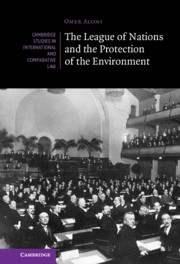
BOOK: Omer ALONI, The League of Nations and the Protection of the Environment (Cambridge: CUP, 2021). ISBN 9781108838191, 85.00 GBP


(Source: CUP)

CUP has published a new book on the League of Nations and environmental protection.

ABOUT THE BOOK

In the history of how the law has dealt with environmental issues over the last century or so, the 1920s and 30s and the key role of the League of Nations in particular remain underexplored by scholars. By delving into the League's archives, Omer Aloni uncovers the story of how the interwar world expressed similar concerns to those of our own time in relation to nature, environmental challenges and human development, and reveals a missing link in understanding the roots of our ecological crisis. Charting the environmental regime of the League, he sheds new light on its role as a centre of surprising environmental dilemmas, initiatives, and solutions. Through a number of fascinating case studies, the hidden interests, perceptions, motivations, hopes, agendas and concerns of the League are revealed for the first time. Combining legal thought, historical archival research and environmental studies, a fascinating period in legal-environmental history is brought to life.

ABOUT THE AUTHOR

Omer Aloni, Bar-Ilan University, Israel

Omer Aloni is Research and Postdoctoral Fellow in the Faculty of Social Sciences, University of Bar-Ilan, Ramat-Gan, Israel. He received his Ph.D. from Tel-Aviv University (Faculty of Law). He holds research affiliations with the University of Potsdam, the Rachel Carson Center for Environment and Society (LMU Munich) and the Max Planck Institute. He was awarded the Tallinn Prize by the European Society for Environmental History for the best research in 2018 and 2019.

TABLE OF CONTENTS

1. Fighting pollution made by humankind: the League of Nations and the endeavors of the convention against the pollution of the sea by oil

2. The League of Nations and the whaling dilemma

3. Sanitation, spreading diseases, and the environmental concerns: the League of Nations' campaign for rural hygiene

4. Raw materials, the timber crisis, and fears of deforestation during the interwar period

5. Evaluating the environmental regime of the League of Nations: comparative discussion

6. Conclusion.

More info here

16 October 2020

BOOK: Tullio BERLENGHI, Storia del diritto ambientale (Padova: Primiceri Editore, 2018). ISBN 978-88-3300-052-7, pp. 292, € 20.00


(Source: pe Editore)

ABOU THE BOOK

Questo saggio ha l’obiettivo di ricostruire la storia del diritto ambientale, partendo dalle primissime organizzazioni sociali fino ai giorni nostri. Il saggio, dallo stile divulgativo, è destinato a chiunque sia interessato ai temi ambientali, anche senza avere una formazione giuridica. Il testo è diviso in quattro parti che prevedono: un inquadramento complessivo di quella branca del diritto che si occupa della tutela dell’ambiente e degli ecosistemi; un excursus storico che individua, nell’ambito dell’evoluzione dei sistemi giuridici, gli ambiti di intervento che – a vario titolo – possano essere ricondotti, ancorché indirettamente, nell’alveo del diritto ambientale, si passa così dal Codice di Hammurabi alle XII tavole, dal Medioevo allo Statuto Albertino; il fulcro vero e proprio del saggio ovvero la storia del diritto ambientale a partire dalla nascita della Repubblica e dall’approvazione della Carta Costituzionale, tenendo conto dei rilevanti fattori – sociali, culturali, politici ed etici – che hanno determinato i molteplici cambiamenti registrati in materia di diritto ambientale; da ultimo si offre una analisi su come l’esigenza di tutela ambientale abbia condizionato l’evoluzione del diritto internazionale e di quello dell’Unione Europea. In particolar modo, in questa ultima parte, si sottolinea l’importanza di alcuni storici summit internazionali – come la Conferenza di Stoccolma del 1972 e la Conferenza di Rio de Janeiro del 1992 – che hanno impresso una significativa accelerazione alla costruzione di un quadro giuridico mondiale di tutela dell’ambiente e degli ecosistemi, nonché del costante sviluppo del quadro normativo eurounitario.

ABOUT THE AUTHOR

Tullio Berlenghi è nato a La Spezia il 27 agosto 1963 e vive a Labico in provincia di Roma. Si occupa di politiche ambientali, di urbanistica e mobilità sostenibile. Ha collaborato con le riviste Ciclismo, Ecomondo e Modus Vivendi, con il quotidiano Terra e con il periodico Notizie Verdi. Nel 2005 ha pubblicato il saggio, con illustrazioni di Sergio Staino, Come difendersi dagli ambientalisti. Dal 1997 al 2006 ha collaborato alla realizzazione di Stradarolo, Festival internazionale dell’arte su strada, organizzato dai Tetes de Bois. Dal 2007 è membro della Giuria del premio internazionale Giornalisti nell’erba. Dal 2013 al 2017 è stato nel direttivo Federazione italiana Media Ambientali e attualmente fa parte del Gruppo di Lavoro del Forum nazionale Salviamo il Paesaggio. Nel 2017 ha pubblicato Alle Colonne d’Ercole, in cui racconta il suo viaggio in bicicletta di 2300 chilometri in solitaria da Genova allo Stretto di Gibilterra.


More information with the publisher.