Search

Showing posts with label Asian legal history. Show all posts

15 July 2026

BOOK: Maria Adèle CARRAI & Surabhi RANGANATHAN (eds.), The Cambridge History of International Law, vol. II: International Law in Asia [The Cambridge History of International Law, ed. Randall LESAFFER] (Cambridge: Cambridge University Press, 2026), ISBN 9781009121972, € 163,39

(image source: CUP)

Abstract:
Volume II of The Cambridge History of International Law breaks the mould of Eurocentric histories in the field by exploring international law in Asia from antiquity to decolonisation. Its twenty-six chapters span a vast geography, covering both the landmass and the oceans; offering accounts of statecraft and diplomacy, war and trade; marriage and gift-giving; treaty-making and dispute settlement; ideas of the human and 'the other'; and entanglements of political authority with mercantile, corporate and religious orders. The chapters introduce readers to a diverse cast of characters, from scholars, scientists, geographers, mapmakers; to traders, merchants, shipowners and entrepreneurs; and to women, revolutionaries, pirates, labourers, and monks. The volume explains leading historiographical trends, ponders the challenges of writing Asian histories of international law, highlights available materials and methods, and showcases the conceptual purchase of Asian histories for thinking about international law.

Read more here: DOI  10.1017/9781009121972.


02 September 2025

CALL FOR PAPERS: Legal History in Asia and Beyond: Lessons from the Past for the Present (Chinese University of Hong Kong: Hong Kong, 17-18 MAR 2026 & Oxford University: Oxford, 23 MAR 2026) [DEADLINE 31 OCT 2025]


(Source: CUHK Law)


Legal History in Asia and Beyond: Lessons from the Past for the Present 

Hong Kong, 17-18 March 2026 & Oxford, 23 March 2026 

CALL FOR PAPERS 


The Transnational Legal History Group, part of the Centre for Comparative and Transnational Law within the Faculty of Law at the Chinese University of Hong Kong, the Oxford Programme in Asian Laws of the Faculty of Law at the University of Oxford and the Asian Legal History Association are jointly hosting a conference on “Legal History in Asia and Beyond: Lessons from the Past for the Present.” The conference will take place in two parts: first on 17 and 18 March 2026 in Hong Kong, and then on 23 March 2026 in Oxford. Applicants should specify at which venue they would prefer to present when making their application. There is no obligation or expectation to attend both sessions, but participants are welcome to do so. 

This unique cross-jurisdictional event will also serve to mark the institutionalization of the Asian Legal History Association (ALHA). The ALHA, which has its Secretariat at CUHK, brings together faculties and institutes from more than a dozen jurisdictions, collectively committed to promoting the study and knowledge of transnational legal history generally, enhancing the status and role of Asia as a generator and hub of global legal history knowledge, and developing collaborative relationships between universities in Asia and around the world. 

Theme 

Studying legal history requires a great deal of time and knowledge, and sensitivity to context. Care is necessary to minimize the extent to which our interpretations are overly influenced by contemporary concerns and modes of understanding. At the same time, history is one of the most fertile and productive arenas in which we can come to a better understanding concerning the complex dynamics of human society, different modes of organization and their relationship to individual and collective wellbeing and equality (or their absence). We welcome papers on the history of law that carry lessons relative to the future. Among other topics, papers might address issues such as: 

• Past laws, institutions and practices structuring public governance and state capacity in general; 

• Private law regimes, their formation, evolution and impacts; 

• The laws and institutions structuring economic life; 

• The history of the welfare state, of employment and labor, of development and of socio-economic rights; 

• Environmental law histories; 

• The evolution of criminal laws, institutions and punishments over time;

• Family law systems and laws governing gender and sexuality; 

• The development of judicial decision-making systems and of legal communities, including lawyers and law schools; 2 • Legal pluralism and the encounter between and interaction of multiple legal orders, including indigenous legal regimes; 

• The history of international law. 

We also welcome papers that challenge the frame and grapple with the complexities involved in seeking lessons for the present in the past, or which address (legal) history methodologies as such. 

Publication 

The organizers hope to assemble a selection of the papers from the conference for publication, potentially via a special edition of a journal, an edited volume, or both. Participants who wish for their piece to be considered for publication should submit a draft of at least 5,000 words (including footnotes) by 28 February 2026. 

Travel and Accommodation

 • The conference will be in person. 

• Applicants will be responsible for their own transportation and accommodation costs. 

• We will suggest hotels in due course. 

Timeline 

• Submission of Abstract: midnight (Hong Kong time) on 31 October 2025 

• Notification of selection: 1 December 2025 

• Conference Days: 17 & 18 March 2026 (Hong Kong), 23 March 2026 (Oxford) 

• Draft paper submission (for participants interested in publication in a special issue or edited volume): 28 February 2026 

Application 

• Proposals may be for individual papers or panels. 

• Individual paper proposals should include a 150-300 word abstract. 

 • Panel proposals should include a brief description of the panel as well as 150-300 word abstracts of three to five individual papers. 

• Applicants should specify at which venue they would like to present their papers. 

• Applicants should indicate their academic affiliations on their applications. 

• Applications should be submitted via the following link: https://cloud.itsc.cuhk.edu.hk/webform/view.php?id=13715426 

• Inquires may be addressed to: alha@cuhk.edu.hk

13 September 2024

TALK: Carl LANDAUER, "Twentieth-Century India Reads its Ancient Law of Nations Past" (Berkeley: Institute for South Asia Studies/Center on Contemporary India, 24 SEP 2024) [LIVE VIA FACEBOOK]


(image source: Berkeley)

Abstract:

The talk will cover two waves of Indian readings—one in the 1920s and a second after Independence—of India’s ancient inter-polity law, with their focus on Kautilya’s “Arthashastra,” the “Code of Manu,” and the “Shanti Parva” of the “Mahabharata,” and how those readings framed versions of Indian nationalism.

On the speaker:

Carl Landauer is a visiting scholar at the Institute for South Asia Studies. He taught history at Yale, Stanford, and McGill and international legal theory at UC Berkeley Law School. He publishes broadly on the history of international legal thought, with emphasis on the Global South and South Asia.

The event will be livestreamed on Facebook, 5-6:30 PM California Time. 

Read more here.

19 June 2024

BOOK SERIES: Legal History of Asia (eds. Kentaro MATSUBARA & Fernanda PIRIE) (Leiden/Boston: Martinus Nijhoff/Brill)


(image source: Brill)

As Asian societies play increasingly significant roles in the political economy of the world, it becomes crucially important to understand their laws and values in historical context. In fact, many of the longest-lived and most intricate legal traditions come from Asia. This series offers studies of historic legal systems, texts, jurisprudence, legal practices and everyday experiences of law from this complex and diverse region. Volumes encompass both formal laws and broader legal practices. The editors particularly encourage work that analyses laws in their social and political contexts, as well as scholarship that assesses Asian laws comparatively. The authors bring multiple perspectives to these subjects, and the series offers resources for regional specialists, legal and other historians, and comparative lawyers, whose fields of scholarship are being enriched by the broadening interest in historic Asia. The series welcomes the submission of standard monographs and edited volumes (80.000 - 120.000 words). Exceptions to this wordcount can be discussed with the Publisher. Prospective authors are cordially invited to submit enquiries and proposals to the series editors, Kentaro Matsubara and Fernanda Pirie, or the Publisher at Brill, Alessandra Giliberto. Brill is in full support of Open Access publishing and offers the option to publish your monograph, edited volume, or chapter in Open Access. Our Open Access services are fully compliant with funder requirements. We support Creative Commons licenses. For more information, please visit Brill Open or contact us at openacess@brill.com.

Read more herehere.

19 October 2023

JOURNAL: Law and History Review XLI (2023), No. 3


(image source: CUP)

Articles

Paper Empires: Layers of Law in Colonial South Asia and the Indian Ocean (Nandini Chatterjee, Alicia Schrikker & Dries Lyna)
DOI 10.1017/S0738248023000081
Abstract:
Anthropologists and historians have recently underscored the ways in which European colonialism created novel regimes of legality and record-keeping, associated with ambitious and exclusive state-centered claims to both truth and rights, while being inevitably and constantly sucked into eddies of forgery and corruption. However, attention so far has been focused on English/European-language records and the colonial institutions that produced, stored, and deployed them. This has communicated a monolithic sense of power and normativity that unwittingly replicates the aspirations of colonial states. Drawing on eight case studies from in and around South Asia from the eighteenth to the twentieth centuries, we propose instead that the law of empires was rooted in the highly localized, often multilingual, and fragmented bureaucracies that produced its records. Here, historians of pre-colonial Indian regimes join hands with historians of British, Dutch, and French colonialism in order to unearth the genealogies of records written in Bengali, Marathi, Persian, Sinhala, and Tamil, as well as in French, Dutch, and English. This special issue collectively excavates the many layers, regimes, and languages in which legally effective records were produced by imperial regimes in South Asia and its much larger watery penumbra, the Indian Ocean.

An Empire in Disguise: The Appropriation of Pre-Existing Modes of Governance in Dutch South Asia, 1650–1800 (Alicia Schrkker & Byapti Sur) (OPEN ACCESS)
DOI 10.1017/S0738248022000554
Abstract:

This article presents an analysis of the paper- and office work at two South Asian corners in the early modern Dutch empire. The article engages with current approaches to the histories of bureaucracy and empire that emphasize the lived experience of “paperwork” in order to gain a localized understanding of what constituted empire. The article focuses on the production and use of pattas, olas, and thombos in the offices of the Dutch zamindar-fiscaal in Chinsurah (Bengal) and the Dutch disāva in Jaffna (Sri Lanka). Dutch bureaucracy in these spaces was entrenched in local practices, and created through processes of layering and blending, as evidenced by material and linguistic characteristics. The deeds and registers recorded essential aspects of life such as labor, marriage, and transactions of property, and the article shows how such paperwork mattered to villagers in Chinsurah and Jaffna. The production of the deeds and registers itself could include a public spectacle, and we argue that this performative aspect of the local bureaucracy added to the perceived relevance of the paperwork. Furthermore, through an analysis of legal cases we reconstruct the use and abuse of these bureaucracies by Dutch officials and local inhabitants, which signifies a parasitical relationship that is characteristic of so many imperial and colonial spaces. Through a focus on the local bureaucratic practices, the authors shed new light on questions about the character of the Dutch empire, where things never turned out to be exactly as they appeared at first sight.

Material Pluralism and Symbolic Violence: Palm Leaf Deeds and Paper Land Grants in Colonial Sri Lanka, 1680–1795 (Dries Lyna & Luc Bulten) (OPEN ACCESS)
DOI 10.1017/S0738248022000426
Abstract:

This article studies the registration practices of land and property on palm leaf deeds (olas) in Sri Lanka, in relationship to the advent of paper land grants (giftebrieven) under the Dutch East India Company (VOC)’s rule in the long eighteenth century. A database of about 2500 Dutch land grant deeds and translated olas, ranging from 1685 to 1795 are contextualised via judicial records of Dutch civil courts, where (translated) olas were regularly used as evidence. Not only does this allow us to track the geographical encroachment of Dutch power over coastal Sri Lanka as part of a colonial transition, but at the same time shift the perspective to study which individuals and communities on the island engaged with Dutch land bureaucracy. In doing so, we showcase the continued importance of traditional ola deeds and (pre-)colonial registers for both local land owners and the colonial bureaucracy itself, regardless of the Dutch government’s push for paper, attempted to delegitimise the local ola recordings, and acts of symbolic violence to infringe on both the materiality as well as the perceived importance of palm leaf deeds. In the long eighteenth century several paper and palm leaf realities coexisted in Sri Lanka and at times conflicted, entangled, and convoluted within and outside the bureaucratic institutions to form what ‘material pluralism’ within a larger context of legal pluralities. 

The Power of Parwanas: Indo-Persian Grants and the Making of Empire in Eighteenth-Century Southern India (Leonard R. Hodges & Nandi Chatterjee) (OPEN ACCESS)
DOI 10.1017/S073824802200044X
Abstract:

This article examines Persian-language orders—parwanas—issued by regimes that succeeded the Mughal Empire in South Asia, to European trading companies. Focussing in particular on the mid-eighteenth-century exchanges between the Nizam of Hyderabad; the Nawab of Arcot; and the French Compagnie des Indes, we see how Mughal-style parwanas, or sub-imperial orders, previously used to give instructions or to make or withdraw grants, were transformed into a form of political currency. They were now used to exchange military and fiscal resources between South Asian state-builders and militarised European corporations, and to secure political legitimacy for all within a putative Mughal imperium. Moreover, the legal fiction of Mughal sovereignty led to a grants race, such that rivals—European and South Asian—sought more and more parwanas, while also querying the legitimacy of authorities that issued them. The very fragility of the Mughal empire and the lability of the political landscape in eighteenth-century South Asia was thus generative of prolific Persian legal documentation, as well as its rewiring to novel uses. European empire-builders negotiated this legal landscape with only partial literacy, consequently fetishizing the material aspects and ceremonial accompaniments of Persian legal documents, and according them power beyond their immediate substance. 

Registering and Regulating Family Life: The School Thombos in Dutch Sri Lanka (Bente de Leede & Nadeera Rupesinghe) (OPEN ACCESS)
DOI 10.1017/S0738248022000499
Abstract:

In eighteenth-century, colonial Sri Lanka, the Dutch church kept extensive registers of the local population. These “school thombos” contain individual registration of baptism, marriage, school attendance and death. This article argues that the school thombos reveal moral control over family life by the Dutch East India Company and the Dutch Reformed Church, while offering locals a legal and religious identity to employ in negotiating the Dutch colonial bureaucracy. These rarely studied registers shed new light on Sri Lankan family history and the practices of Dutch colonialism. What do they tell us about conjunctures of locals with colonial religion in eighteenth-century Sri Lanka? The school thombo was an instrument used to register and regulate family life, with specific functions and uses by different actors. This article explores the format, objectives and use of the school thombo. Why was the school thombo created and who were registered in these sources? What were the micro practices of drawing up the school thombo? The article is supported by several case studies that illustrate how the school thombo found its way into family life while demonstrating the value of written identities.

A New Language of Rule: Alwar's Administrative Experiment, c. 1838–58 (Elizabeth M. Thelen)
DOI 10.1017/S0738248022000657 (OPEN ACESS)
Abstract:

Many rulers of newly formed Indian Princely States enacted substantial administrative reforms in the first half of the nineteenth century as they sought to reinforce their power and secure revenue in the wake of British colonial conquest. In one such case, the ruler of Alwar, Banni Singh, recruited Aminullah Khan, a former record-keeper in Delhi's colonial courts, to serve as diwan (chief minister) and undertake administrative reforms starting in 1838. These reforms focused on agrarian taxation, the civil courts, and the military, and included changes to the roles of local officials, methods of record-keeping, and the language of governance. The reforms were encoded in seven slim volumes of regulations and model forms, handwritten in Persian. Through a study of these regulations, I situate the reforms of Alwar's administration within Banni Singh's broader self-fashioning as a modern ruler in a Mughal mode and show how the reforms drew from both Mughal and colonial ideas of statecraft. The regulations represented a shift toward a legalistic conception of that state as seen in the ideals of good governance that they espoused, and they constructed contractual relationships among villagers, low-level officials in the districts, and the central state through the extensive bureaucratic procedures that they encoded.

A True Copy? Documents and the Production of Legality in the Bombay Inam Commission (Dominic Vendell) (OPEN ACCESS)
DOI  10.1017/S0738248022000372
Abstract:

This essay examines the role of Indian-language documentation in the production of legality in colonial western India, focusing on the workings of the Bombay Inam Commission (1852-1863). It situates legal validation of claims to tax-free land revenue within the broader process of securing, organizing, classifying, and registering Marathi- and Persian-language documents. Combating the effects of rain, dirt, and pests on old state records often sold as “waste paper,” the Inam Commission deployed material interventions to secure a legal archive for verifying individual claims to property. While such evidence weighed heavily in the evaluation of the testimony and corroborating documents of an individual claimant’s case-file, questions of writing also shaped the legal reasoning of the Commission. Inquiries about any given document’s conformity to or deviation from conventional style figured prominently in judgments about its authenticity. The scribe Sayyid Usman’s investigation in 1856 of a date in a Persian document attributed to the Mysore ruler Tipu Sultan struggled to establish the parameters of conventional style against the plurality of entangled regimes of property. I argue that a material approach to writing allows us to better understand the imperfect and dispersed production of legal truth in imperial settings.

Oceanic Mobility and the Empire of the Pass System (Bhavani Raman) 
DOI 10.1017/S0738248022000542
Abstract:

From the age of empires to the apartheid regime in South Africa, pass laws have defined the scope of the mobility of subjects by relying on a paper document, the pass. This essay focusses on the pass document to understand the governance of mobility in the Indian ocean. In doing so, it shows how the pass document in its various forms through many centuries in fact, illuminates a form of inter-legal governance through which racialized life came to be constituted via convention and statute.

The Sailing Scribes: Circulating Law in the Twentieth-Century Indian Ocean (Fahad Ahmad Bishara)
DOI 10.1017/S0738248022000402
Abstract:

What did the practice of law look like on the high seas? This has been a matter of some discussion among legal historians, with the bulk of the evidence coming from encounters between European ships in the Atlantic and Asia. This article takes a different tack, taking as its starting point a series of contracts copied into the logbook of the early-twentieth century Arab dhow captain (nakhoda) ‘Abdulmajeed Al-Failakawi. Although some of these appear to have been contracts that the nakhoda entered into or witnessed, most were contractual templates that presented formulas for a variety of written obligations between members of the Indian Ocean maritime community. In reading these formulas alongside contracts left behind by Al-Failakawi and other Indian Ocean nakhodas, I reflect on how law circulated by members of an itinerant society of mariners that sought to forge the contours of a commercial world on their ships and across the waters, and weave it through an imperial seascape. I explore how workaday forms of law and legal epistemologies circulated around the maritime marketplaces of the Indian Ocean world, at the margins of a colonial and imperial political economy, through actors who read across different genres of literature, and who moved between the multiple roles of captain, navigator, supercargo, and scribe.

Persistence of Practice in Law's Parwana and Palm Leaf Empire (Paul D. Halliday)
DOI  10.1017/S0738248023000305
Abstract:

The essays in this forum demonstrate how attending to the intricacies of documentary practice provides a way to see legal practices over the long haul. Different materials—for instance, paper and palm leaves—manifested different ways of understanding and doing law. But change from one way of doing law to another is sticky; old practices persist alongside new ones. Appreciating this helps us see past apparent ruptures in ways of living brought about by states and empires as they come and go. By looking closely at the routines and physical materials through which law works, we can look past simple binaries: European vs. indigenous; pre-colonial vs. colonial; resistance vs. accommodation; oral vs. literate; manuscript vs. print; paper vs. palm leaf.

Read the articles here. 

18 October 2023

JOURNAL: Law and History Review XLI (2023), No. 2


(image source: CUP)

Law, Courts, and Constitutions in Twentieth-Century South Asia (Saumya Saxena & Alastair McClure)
DOI 10.1017/S0738248023000093 (OPEN ACCESS)
Abstract:

This special issue brings together scholars from multiple disciplines and with varied research and geographic expertise to study the historical role played by the law in governing the political, social, and cultural life of twentieth-century South Asia. These articles have not emerged in a vacuum, but rather build on an exciting turn in South Asian history that is placing new focus on the legal and constitutional work that accompanied the post-colonial moment. This introduction examines some of the important historiographical and methodological interventions made by scholars working in this field, before outlining the specific themes connecting the articles in this issue.

The Drafting of the Constitution of the Union of Burma in 1947: Dominion Status, Indo–Burmese Relations, and the Irish Example (Donal K. Coffey)
DOI 10.1017/S0738248022000487 (OPEN ACCESS)
Abstract:

This paper aims to consider four elements of Burmese constitutional history between 1946 and 1948. The first section considers the negotiations between Burma and the United Kingdom and argues that the debate about whether Burma wanted Dominion status has overlooked the crucial transitional government period. The second section gives a brief overview of the drafting process, paying particular attention to the links between the Indian Constituent Assembly in Delhi and Rangoon. The third section outlines the comparative influences on the Burmese Constitution using the digital humanities and illustrates that the biggest foreign influence was the Irish Constitution of 1937. The final section looks at the Burmese political leadership after World War II along two dimensions—at a nationalist level and at an elite level—and traces some of the links between Burma and Ireland.

Nepal's Constitutional Foundations between Revolution and Cold War (1950–60) (Mara Malagodi)
DOI 10.1017/S0738248022000724 (OPEN ACCESS)
Abstract:

The 1950s represent a foundational decade in Nepal's constitutional history. In the wake of decolonization in British India, the “year 7 revolution” (1950–51) grew out of the alliance between King Tribhuvan Shah and Nepal's democratic political parties created in India against the Rana autocratic regime in Kathmandu. Eventually the pro-democracy forces prevailed, and a crucial political transition began. Two constitutions were promulgated, the 1951 Interim Constitution and the 1959 Constitution. Both short lived and only partially implemented, these documents, however, laid the foundations of Nepal's constitutional edifice for years to come. Constitution building became a marker of sovereignty understood in terms of independence and an assertion of popular sovereignty. However, in the fraught Cold War context, the preoccupation with securing political stability by constitutional means that centered around the Shah monarchy prevailed, even at the expense of democracy. As such, the shift from a traditional notion of sovereignty from above to a modern concept of sovereignty from below remained incomplete. These aspirations, however, were not extinguished even by 30 years of royal autocracy under the Panchayat regime (1960–90) and lived on to this day to inform demands for constitutional reform, democratization, and inclusion. The present analysis is based on Nepali primary legal sources, archival material from the United Kingdom and United States National Archives, and the Ivor Jennings Private Papers. 

Constitutions and Modernity in Post-Colonial Afghanistan: Ethnolinguistic Nationalism and the Making of an Afghan Nation-State (Elisabeth Leake) 
DOI 10.1017/S0738248022000530 (OPEN ACCESS)
Abstract:

In recent decades, the rule of law has not been commonly associated with Afghanistan. Instead, its politics have been more likely to be framed in terms of lawlessness and ungovernability. But this trope does not do justice to Afghanistan's longer history of statehood or experiences of constitution-making. Over the course of the twentieth century, Afghan leaders drafted seven constitutions (in 1923, 1931, 1964, 1976, 1980, 1987, and 1990). These constitutions represented leaders’ attempts to assert their legitimacy and enforce their vision of an Afghan nation-state. This article sheds fresh light on Afghan elites’ top-down framing of Afghan national identity through ethnolinguism, exploring the legalization of Pashto as both an official and national language in Afghanistan's constitutions. Reformers intended Pashto to transgress community, kinship, and regional boundaries and act as a source of unity (though one in which ethnolinguistic minorities had little say). Tracing Afghanistan's constitutional history from 1923–90, this article reveals language as a constitutional arena for debating Afghan modernity and identity. As such, this article integrates Afghanistan into legal histories of South Asia while emphasizing how Afghan constitutionalists engaged in the process of law-making as a means of expressing Afghanistan's own independence and ideas of modernity.

Negotiating Nationhood: Constitutional Warfare, International Law, and the Birth of Bangladesh (Cynthia Farid) (OPEN ACCESS)
DOI 10.1017/S073824802300007X
Abstract:

This paper argues the Government in Exile (GIE), the first government of independent Bangladesh, played an important role in framing the founding moment in legal terms. The GIE's constitutional warfare through its adherence to legalism, and subsequent internationalization of the conflict significantly shaped the independence movement of 1971. The GIE was composed of leaders who were lawyers, economists and other intellectuals who sought refuge in neighboring India. The agency of the founders and their allegiance to constitutional principles catalyzed the founding moment, oversaw the transition to an independent state and ultimately led to a swift adoption of a constitution that endures despite much instability. This national struggle of 1971 also played out in the international arena. In the process, lawyers from the so-called Third World articulated, reshaped, and generated new debates about international legal principles such as sovereignty, territoriality, and self-determination (and criterion for legitimacy of exiled governments)—most of which were considered to be well-settled at the time.

Policing Sati: Law, Order, and Spectacle in Postcolonial India (Saumya Saxena)
DOI  10.1017/S0738248022000591 (OPEN ACCESS)
Abstract:

This article explores the response of the postcolonial state to the question of widow immolation – sati. It demonstrates that the conversation on the practice of sati at the high point of Hindu law reform in the 1950s reflected the simultaneous pressures on the new democracy to establish rule of law while also accommodating the renewed reverence for tradition and religious custom in an independent nation state. Distinct from the colonial response to sati that treated women as either “helpless and pathetic” or “brave and valiant,” post-independence police records describe women committing sati mostly as “insane” or “not in their senses,” and yet chiefly responsible for their actions. The article contrasts administrative and parliamentary narratives of the crime. Local belief in miracles surrounding the performance of sati not only obscured the experience of the woman's suffering but also made collection of evidence in such a case particularly difficult. This rendered convictions of the abettors of such “painless suicide by insane women” weaker. Legal interventions in sati eventually prompted administrative responses to shift from emphasizing the “uncontrollability” of the spectacle to deeming the spectacle a necessary precondition in distinguishing a sati from suicide.

Killing in the Name Of? Capital Punishment in Colonial and Postcolonial India (Alastair McClure)
DOI 10.1017/S0738248022000335 (OPEN ACCESS)
Abstract:

Unlike whipping, which was quickly abolished following independence, India has continued to hold tightly to the noose’s rope and remains a retentionist country to our present day. Notably, though the number of executions would fall dramatically in the first decades of India’s postcolonial history, the list of crimes made punishable by death has grown ever longer in recent years. Rather than positing the continued presence of the death penalty as an anachronism ill-suited for a modern democracy, this article takes seriously the legal and discursive developments that allowed the most infamous of penal institutions to travel safely across India’s twentieth century. From something that begun as a distilled expression of racialised colonial state power, like many other state institutions during this period, the death penalty would undergo a series of changes to remain relevant amidst new organizing political principles of representative democracy and popular will. Moving from the first formal efforts at abolition in the 1920s, through constitutional assembly debates in the 1940s, and Supreme Court judgements between 1967-83, the article positions capital punishment as a product of both deep colonial inheritances, and a particular process of postcolonial translation. Becoming fully couched in the language of popular sentiment by the culmination of this legal transformation, this violence would become well-positioned to grow within a national political culture increasingly organised around majoritarian expressions of national belonging.

Mergers and Legal Fictions: Coverture and Intermarried Women in India (Leilah Vevaina)
DOI 10.1017/S0738248023000068 (OPEN ACCESS)
Abstract:

Within India's system of plural personal laws, the rights of women in matters of marriage, divorce, and inheritance are solely based on their natal communal identity. While we see many examples of women appealing to courts to secure or improve their rights vis-à-vis personal laws, marriage outside the community has often occluded these rights completely. Marital property, inheritance, and even access to sacred space are in a gray zone of differentiated rights between natal and marital community customs. One intermarried woman, Goolrukh Gupta, sued the trust that managed the town's sacred space in the High Court to confirm her rights to enter sacred space. The Court ruled that she was removed from her natal community even though she had married under the Special Marriage Act of 1954, as she had “merged personality with her husband.” While British women's property was held under coverture through the nineteenth century, these laws were never transferred over to the Indian colony. Through the legal appeals of intermarried women, this article explores the shifting and unstable rights of intermarried women in India.

Courts and Constitutions in South Asia and the Global South: A View from the Middle East (Faiz Ahmed)
DOI 10.1017/S073824802200058X 
Abstract:

Not long ago, the study of comparative law in U.S. law schools was dominated by North American and European constitutional systems. Thanks to the contributions of a new generation of legal historians, including those canvassed in this special issue, the landscape is changing. In this special issue, scholars of courts and constitutions in twentieth century Afghanistan, Bangladesh, Burma, India, and Nepal have come together to share novel sources, perspectives, and analyses of significant constitutional experiments in the Global South, specifically twentieth century South Asia. This afterword reflects on these important scholarly contributions by highlighting common threads and divergences in the case studies presented in this volume—from the perspective of a legal historian of the late Ottoman Empire and modern Middle East. Ultimately, the author concludes that the articles in this special issue persuasively stamp modern South Asian legal history “on the map” not only for specialists of this large and populous region, but for students and scholars of comparative constitutionalism and global legal history more broadly.

Read the whole issue here.

20 October 2020

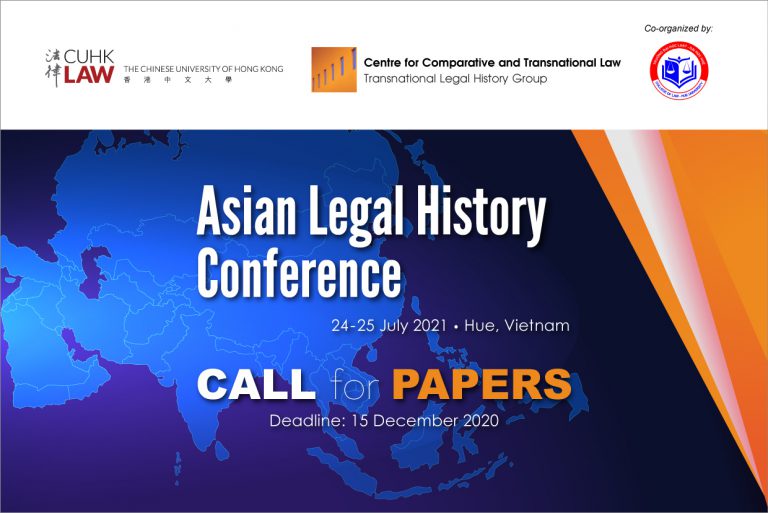
CALL FOR PAPERS : Asian Legal History Conference (24-25 July 2021, Hue – Vietnam) (DEADLINE: 15 December 2020)

(Source: Law.cuhk)


We received news of the call for papers for the Asian Legal History Conference 2021.

The CCTL Transnational Legal History Group of the CUHK LAW and the University of Law – Hue University will be jointly organizing a conference on the theme of Asian Legal History at the University of Law – Hue University, Hue, Vietnam, on 24-25 July 2021. Convened by Bui Ngoc Son and Christopher Roberts, Assistant Professors at CUHK LAW, the conference aims to bring together a diverse and interdisciplinary group of scholars, researchers, and graduate students to share their research findings on topics relating to legal history in Asia.

Confirmed Keynote Speakers:

1. Andrew Harding, Visiting Research Professor, National University of Singapore, Faculty of Law
2. Pip Nicholson, Dean, William Hearn Professor of Law, Melbourne Law School
3. Radhika Singha, Professor of Modern Indian History, Jawaharlal Nehru University
4. Lutz-Christian Wolff, Dean, Wei Lun Professor of Law, CUHK LAW

Call for Papers:

The organizers invite proposals for individual papers and panels. Submissions on any subject, providing it pertains to legal history in Asia, will be considered. General topics may include:

⦁ The historical evolution of common law, civil law, and socialist law traditions in Asia;
⦁ Legal pluralism and jurisdictional clashes;
⦁ Dynastic law;
⦁ Colonial law;
⦁ Customary law and village law;
⦁ Buddhist Law, Confucian Law, Hindu Law, and Islamic Law;
⦁ The history of a particular area of law (constitutional law, property law, criminal law, etc);
⦁ Theoretical and methodological issues involved in studying Asian legal history.

The conference organizers are particularly interested in papers addressing the following subjects:

  • Asian approaches to and impacts upon the historical development of international law;
  • Transnational legal history;
  • The relationship between metropolitan and colonial approaches to law;
  • The history of law, gender and sexuality;
  • The evolution of, and contestations around, legal positivism;
  • The history of law schools and of the formation of the judiciary and of members of the legal profession;
  • The history of public order law;
  • The history of law and violence.

Individual paper proposals should include a 300-word abstract and the author’s contact information.

Panel proposals should include a 300-word description of the panel, 300-word abstracts of three to four individual papers, contact information for each person on the panel, and contact information for the chairs of the panel.

Registration Fee: HK$ 200 per participant

Conference organizers will provide two lunches, one dinner, and refreshments. Participants are responsible for their own travel and accommodation costs.

Important dates:

  • 5 October 2020: Online abstract submission opens
  • 15 December 2020: Abstract submission deadline
  • 15 February 2021: Notification of acceptance
  • 15 March 2021: Registration opens
  • 30 April 2021: Early registration and payment closes
  • 25 June 2021: Regular registration and payment closes
  • 24-25 July 2021: The conference takes place

Please submit the abstracts via online form by 15 December 2020.


More info here

24 September 2020

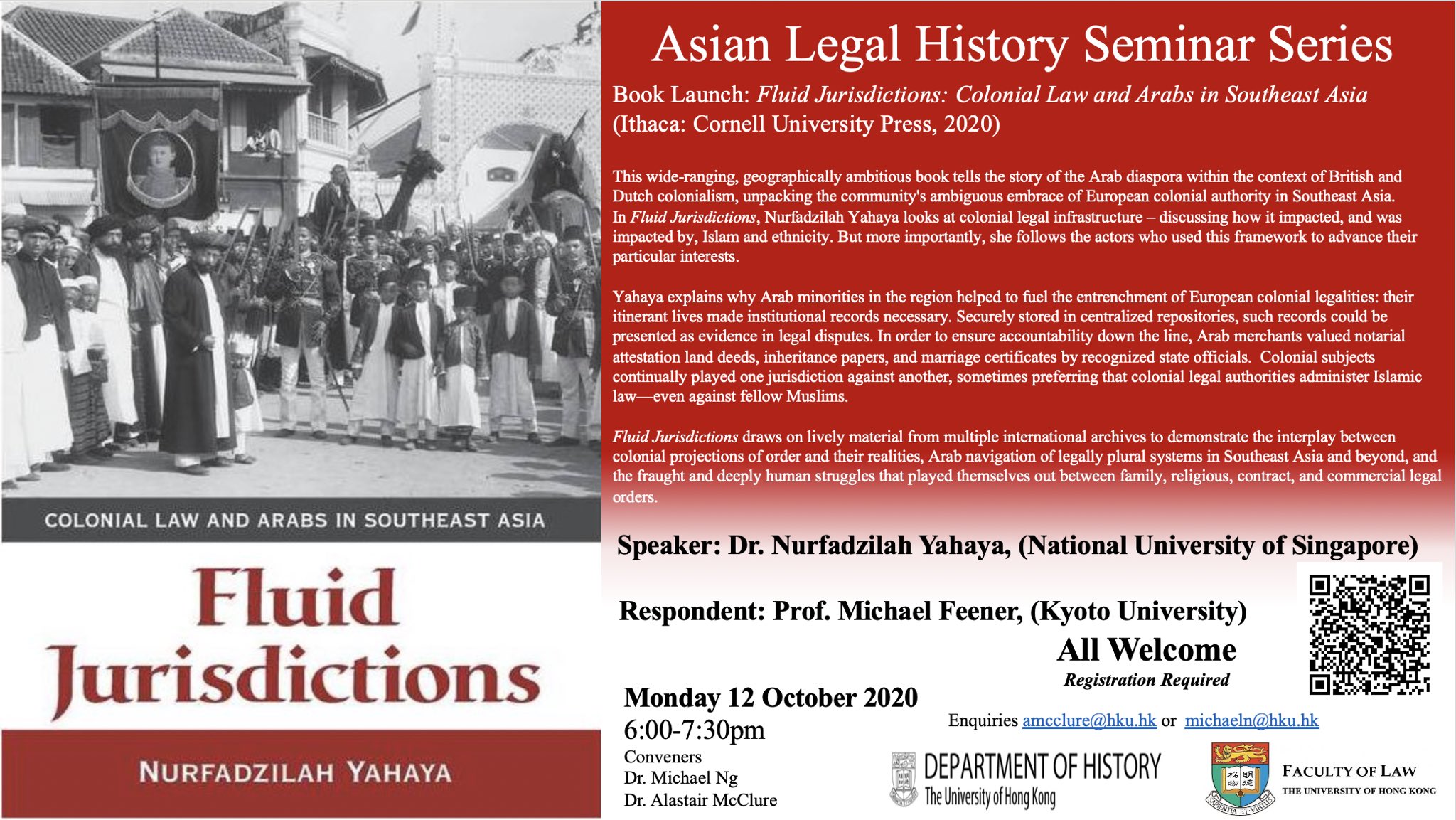
WEBINAR: Asian Legal History Seminar Series (12 October, University of Hong Kong)


(Source: Twitter)

We learned that the University of Hong Kong is organizing an Asian Legal History Seminar series. The first event of 12 October is the book launch of Dr. Yahaya’s (NUS) book “Fluid Jurisdictions: Colonial Law and Arabs in Southeast Asia”. More info about registration here

21 February 2020

BOOK: Richard CULLEN, Hong Kong Constitutionalism : The British Legacy and the Chinese Future (London: Routledge, 2019). ISBN 9781138320130, £96.00


(Source: Routledge)

Routledge is publishing a new book on the history of Hong Kong constitutionalism.

ABOUT THE BOOK

Hong Kong is widely regarded as an exemplar of authoritarian jurisdictions with a positive history of adhering to Rule of Law shaped governance systems. British Hong Kong provides a remarkable story of the effective development and consolidation of such a system, which has continued to apply since 1997 when it became the Hong Kong Special Administrative Region (HKSAR) within the People’s Republic of China (PRC).

This book adopts a fresh approach in examining the evolution of Hong Kong’s political-legal experience. It establishes that these prominent governance achievements were built on particular British constitutional foundations forged over many centuries. The work shows how the analysis of the British theorist Albert Dicey and, in particular, `Diceyan Constitutionalism’ was fundamental, within the pivotal context of `Chinese Familism’, in shaping the development of governance institutions and operational procedures within the new British Colony.

It discusses how Hong Kong’s system of Authoritarian Legality has come to pass. Exploring the essence of that system, the study probes how thoroughly it has been stress-tested, not least in 2019, and how well it may be placed to cope with tests yet to come. It also analyzes Hong Kong–Beijing relations and the long-term prospects for the HKSAR within the PRC based on a balanced contemporary assessment of China’s exceptional One Party State.

ABOUT THE AUTHOR

Richard Cullen is a Visiting Professor in the Faculty of Law, University of Hong Kong. He first began working in Hong Kong in 1991. His research interests are in Public Law, Taxation Law, Comparative Law, Fundamentals of the Common Law, and Media Law. He has published extensively on these and related areas.

More info here

30 January 2020

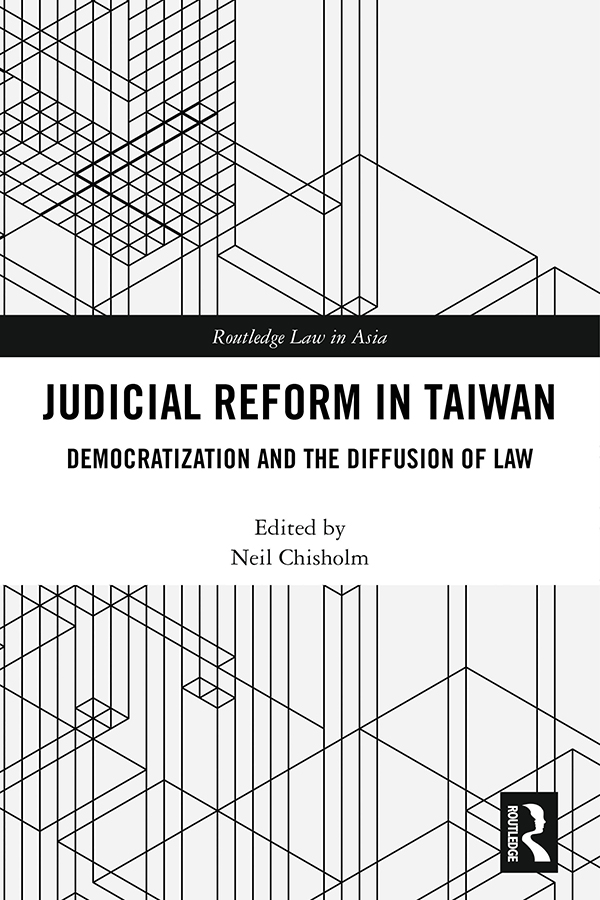
BOOK: Neil CHISHOLM (Ed.), Judicial Reform in Taiwan : Institutionalising Democracy and the Diffusion of Law (London: Routledge, 2019). ISBN 9780415855297, £115.00


(Source: Routledge)


Routledge has published a book dealing with the Taiwanese judicial reforms of 1999 and following years, and which includes legal historical contributions.

ABOUT THE BOOK

This book examines Taiwan’s judicial reform process, which began three years after the 1996 transition to democracy, in 1999, when Taiwanese legal and political leaders began discussing how to reform Taiwan’s judicial system to meet the needs of the new social and political conditions. Covering different areas of the law in a comprehensive way, the book considers, for each legal area, problems related to rights and democracy in that field, the debates over reform, how foreign systems inspired reform proposals, the political process of change, and the substantive legal changes that ultimately emerged. The book also sets Taiwan’s legal reforms in their historical and comparative context, and discusses how the reform process continues to evolve.

ABOUT THE EDITOR

Neil Chisholm is a Visiting Scholar at the Academy of East Asian Studies at Sungkyunkwan University, South Korea.

TABLE OF CONTENTS

Foreword; Weng Yue-Sheng; Part 1 Taiwan’s Judicial Reforms in Comparative and Historical Context; 1 Taiwan’s Judicial Reform Process: East Asian Context, Democratization, and Diffusion, Neil Chisholm; 2 The Long Century of Taiwan’s Westernized Justice System: Historicizing the Dynamics of Her Judicial Reform of 1999, Tzung-Mou Wu; 3 The Development and Reform of Taiwan’s Prosecutorial System: 1945-2014, Heng-da Hsu; Part 2 Institutional Transformations; 4 Separation of the Judiciary and the Public Prosecution: The Cornerstone of Judicial Reform in Taiwan, Yue-Sheng Weng & Chien-Liang Lee; 5 Regime Unchanged: The Organization and Failed Reorganization of Taiwan’s Judicial Yuan, Yen-tu Su; 6 Reform and Resistance: Restructuring Taiwan’s Appeals Process and the Internal Culture of Taiwan’s Supreme Court, Puma Shen; 7 Adopting a Lay Participation System in Taiwan: The Trial Observer Reform Attempt, Mong-Hwa Chin; 8 Transformation from the Top-down or Bottom-up? Legal Education Reform as a Microcosm of Taiwan’s Inconclusive Judicial Reform Process, Neil Chisholm & Hwei-Syin Chen; Part 3 The Procedural Revolution; 9 Conscience and Convenience: Taiwan’s Rocky Road to Adopting the Adversarial System in Criminal Procedure, Chia-Wen Lee; 10 The Evolution of the Right to Counsel in Taiwan, Rong-Geng Li; 11 A Leap Forward Not Yet Achieved: Civil Procedure Reform in Taiwan, Jing-Huey Shao; 12 Administrative Law Reform in Taiwan, Ching-Hui Chen; Afterword: President Tsai’s 2017 National Conference on Judicial Reform, Neil Chisholm

More info here

08 January 2020

BOOK: Emily WHEWELL, Law Across Imperial Borders : British Consuls and Colonial Connections on China’s Western Frontiers, 1880-1943 (Manchester: Manchester University Press, 2020). ISBN 9781526140029, 105,43 €


(Source: Bookdepository)

Manchester University Press is publishing a new book on law across the imperial borders (focused on Britain and its presence in Western China, Burma and India)

ABOUT THE BOOK

Law across imperial borders offers new perspectives on the complex legal connections between Britain's presence in Western China in the western frontier regions of Yunnan and Xinjiang, and the British colonies of Burma and India. Bringing together a transnational methodology with a social-legal focus, it demonstrates how inter-Asian mobility across frontiers shaped British authority in contested frontier regions of China. It examines the role of a range of actors who helped create, constitute and contest legal practice on the frontier-including consuls, indigenous elites and cultural mediators. The book will be of interest to historians of China, the British Empire in Asia and legal history. -- .

ABOUT THE AUTHOR

Emily Whewell is a Senior Researcher at the Max Planck Institute for European Legal History, Frankfurt

TABLE OF CONTENTS

Introduction

Part I: The Burma-China frontier
1 Treaty-making and treaty-breaking: transfrontier salt and opium, 1904-1911
2 On the move: people crossing the frontier, 1911-25
3 Consuls and Frontier Meetings, 1909-31

Part II: Through the mountains and across the desert: Xinjiang
4 Isolation and connection: law between semicolonial China and the Raj
5 Administering justice and mediating local custom
6 The British end game in Xinjiang: the decline of consular rights, 1917-39

Conclusion

Key terms
Select bibliography

More information here

17 December 2019

CONFERENCE: Relocating Governance in Asia: state and society in South- and Southeast Asia, c. 1800-2000 (22-24 January 2020, Leiden)


We learned of a conference on state and society in South- and Southeast Asia (c. 1800-2000) at the Universiteit Leiden.

Conference

Over the last decades, the study of governance in Asia has increasingly expanded to include a focus upon non-state entities. Historians have realized that engagement with local intermediaries, civil society organizations, power brokers, and interest groups has been crucial to the day-to-day administration of European colonies and postcolonial states alike. Historically, colonial regimes contended and interacted with pre-existing political and socioeconomic structures of the regions they occupied and sought to reshape. Simultaneously there has been a continued awareness that ideas, methods and policies did not develop in isolation in each colony, but instead circulated in trans-imperial networks. Similarly, nation states in postcolonial republics from Indonesia to India and Pakistan have been compelled to seek dialogue with non-state actors, even as their solutions to challenges from these quarters have been informed by wider discourses on statecraft.

This conference seeks to bring together these different insights in comparative perspective, to shed light on the many paradoxes, differences and continuities of (post)colonial rule across Asia. We seek to highlight the different sources and brokers of power in colonial and postcolonial societies, and the manner in which these interacted, contradicted, overlapped with and challenged the authority of the state. The aim is to bring this wider context of governance into focus, by crossing regional and temporal boundaries and including colonial and postcolonial states in the same framework of research.

Confirmed keynote speakers are prof. dr. Indrani Chatterjee (University of Texas at Austin), prof dr. Robert Cribb (Australian National University) and dr. Farish A. Noor (Nanyang Technological University, Singapore).

This is a N.W. Posthumus conference co-sponsored by the programme AMT: Asian Modernities and Traditions, the Vereniging KITLV / Royal Netherlands Institute of Southeast Asian and Caribbean Studies, the Institute for History (Leiden University) and the Faculty of Law (Leiden University).

Conference programme and attendance

We welcome all interested visitors to attend the panels and keynote lectures. Attendance is free. We kindly ask visitors to register their attendance by sending an e-mail to: relocatinggovernance2020@hum.leidenuniv.nl before 15 January.

Please indicate if you wish to attend the whole conference or only part of the programme”.

For more information, please read the full (provisional) conference programme.

More info here

10 September 2019

ARTICLE: Pallavi RAGHAVAN, Partition: An International History (The International History Review, Volume XLI, Issue 5)


Pallavi Raghavan (Ashoka University) has published “Parition: An international history” in the latest issue of The International History Review.

In trying to assemble the structure through which bilateral relations between India and Pakistan could be conducted, policy makers drew heavily from European models of inter-state peace-making evolved in the inter-war decades. The aftermath of the break-up of large multinational empires along ethnic-majoritarian lines posed administrative questions that were, in many ways, also similar to the aftermath of the partition of the subcontinent along religious lines. In this article, I attempt to relate these developments with the signing of the Nehru–Liaquat Pact of 1950, between the governments of India and Pakistan. According to this Pact, both governments would now be accountable to one another for the protection of their minorities in the Bengal province. I argue that this approach to dealing with the question of minority populations after a partition, had been initially developed by the League of Nations, and that emulating these models were part of an attempt by India and Pakistan to borrow from, but also further refine models of European statehood for their own purposes after their partition. This article attempts to evaluate the extent to which these expectations were met in the making of a ‘minorities’ regime’ in South Asia.

The full article can be read here

29 May 2019

BOOK: Kevin TAN and Bui NGOC SON (Eds.), Constitutional Foundings in Southeast Asia (Oxford: Hart Publishing, 2019). ISBN 9781509918928, £70.00


(Source: Bloomsbury)

Bloomsbury is publishing a new book on the first constitutions at the founding of modern nation-states in Southeast Asia.

ABOUT THE BOOK

This volume focuses on the making, nature, and role of the first modern constitutions at the founding of the modern nation-states in Southeast Asia. These historical essays add richly to our understanding and appreciation of the founding moments and to the theory and practice of constitutionalism in these states. This volume makes three significant contributions. First, it helps plug the wide knowledge gap in comparative constitutional history in Southeast Asia. Second, it furthers our understanding of contemporary constitutional practice and also anticipates possible developmental trajectories in light of the foundational values embedded in and manifested through these constitutions. Third, through the comparative historical study of these early constitutions, plausible theoretical insights may be gained to further our understanding of Southeast Asia's constitutional history. The book is essential reading for those wishing to obtain a deeper understanding of the constitutional foundings of Southeast Asia.

ABOUT THE EDITORS

Kevin YL Tan is a leading scholar of Singapore's constitution and has written and edited over 30 books on the law, politics and history of Singapore. He is currently Adjunct Professor at both the Faculty of Law, National University of Singapore and the S Rajaratnam School of International Studies, Nanyang Technological University. He is also Executive Editor of the Asian Journal of Comparative Law and Editor-in-Chief of the Asian Yearbook of International Law.

Bui Ngoc Son is an Assistant Professor at the Faculty of Law at the Chinese University of Hong Kong.

TABLE OF CONTENTS

1. Kevin YL Tan & Bui Ngoc Son, 'Southeast Asian Constitutional Foundings: A Constitutional-History Perspective'
2. Leia Castañeda Anastacio, 'Keeping Close to Shore: Preserving Colonial Legacies in the 1935 Philippine Constitution'
3. Koichi Kawamura, 'The Origins of the 1945 Indonesian Constitution'
4. Leigh-Ashley Lipscomb, 'Timor-Leste's Post-Revolutionary Constitution: From Foundations to Practice
5. Maitrii Aung-Thwin, 'The Making of Myanmar's 1947 Constitution: Geography, Ethnicity, and Law'
6. H. Kumarasingham, 'A Foreign Commission for Domestic Needs: The Constitutional Founding of Malaysia'
7. Kevin YL Tan, 'Foundational Moments: The 'Singapore Constitution'
8. BA Hussainmiya, 'The Making of the Brunei's 1959 Constitution'
9. Stein Tønnesson, 'Not Meant to Last: Vietnam's First Constitution'
10. Martin Stuart-Fox, 'The Lao Constitution of 1947/1949: Creating a Nation-State
11. Teilee Kuong, 'The First Constitution-Making in Cambodia: Colonialism, Modernism, Nationalism and the Implications'
12. Eugenie Mérieau, 'The 1932 Compromise Constitution: Matrix of Thailand's Permanent Constitutional Instability'

More information here

24 May 2019

CALL FOR APPLICATIONS: Translation and Transitions. Legal Practice in 19th Century Japan, China, and the Ottoman Empire, Max Planck Institute for European Legal History (DEADLINE: 31 MAY 2019)


The Max Planck Research Group “Translation and Transitions. Legal Practice in 19th Century Japan, China, and the Ottoman Empire” invites researchers of related fields to work with the group for a period of 1-3 months in the calendar year 2020.

The research group has started its work in 2017. Its aim is to compare the legal transformations that took place in 19th and early 20th century Japan, China and the Ottoman Empire. Even though not being colonized, all three countries faced the pressure to adopt Western standards.

Applications are possible for researchers of any stage, starting from advanced PhD students who have been working on their project for at least two years. 

Please contact for further information the head of the research group Dr. Lena Foljanty (
foljanty@rg.mpg.de). If you are interested in this program, please send a description of your project (2-3 pages) and a CV before 31st May 2019 to the same email address.


21 March 2019

ARTICLE: Delia LIN & Susan TREVASKES, "Creating a Virtuous Leviathan: The Party, Law, and Socialist Core Values" (Asian Journal of Law and Society 2019)

(image source: Cambridge Core)

Abstract:
In recent years, the Chinese Communist Party has declared that its governance must dominate over all aspects of law-making and enforcement, declaring that its leadership must be implemented across the entire process of governing the country in accordance with the law. Contemporaneous to this new way of thinking about the law-Party nexus is a propaganda push to integrate moral values into the law. This paper is about moralizing governance in the Xi Jinping era. It explores the ideology behind the promotion of this morals–law integration, focusing on the Socialist Core Values in the legal realm under the current Xi Jinping administration. We do so from two interrelated perspectives. The first examines the relationship between law and morality. Here, we argue that the Party’s calls for a law–morality amalgam can be understood as a form of “pan-moralism.” The second looks at the supremacy of Party rule, extending the theory of the “Leviathan” proposed by Thomas Hobbes to take into account the Party’s morality push. This two-pronged argument enables us to assert that the Xi Jinping administration is creating a “virtuous Leviathan.
Read the full article on Cambridge Core.

18 March 2019

CALL FOR PAPERS: Ordering the Anthropocene: Law & the Environment in the Indian Ocean World (Philadelphia, 4-5 October 2019) (DEADLINE: 15 May 2019)


(Source: H-Announce)

Via H-Announce, we learned of a workshop that aims to bring together senior and junior scholars of law and/or environment who are working in the field of Indian Ocean World history.

Type: 
Workshop
Date: 
May 15, 2019
Location: 
Pennsylvania, United States
Subject Fields: 
Asian History / Studies, Colonial and Post-Colonial History / Studies, Environmental History / Studies, Law and Legal History, Maritime History / Studies

Ordering the Anthropocene: Law & the Environment in the Indian Ocean World  A workshop convened by Debjani Bhattacharyya (Drexel University) and Laurie Wood (Florida State University)4-5th October 2019Hosted by the Department of History,  Drexel University, with the generous sponsorship of the American Society for Legal History & Drexel University

What can historians of law achieve from engaging with their colleagues studying environmental changes over time? How have emerging regulatory regimes (imperial, property-oriented, maritime, medical, etc.) joined the domains of science and law in new ways? And how can legal historians retool their methods to study deep histories of landscape transformations and climate? These questions are especially pertinent for the Indian Ocean region, where these concerns have both past and contemporary relevance: e.g. rising sea levels in the Maldives and Andaman Islands; coastal erosion and disputes over new-land formation along the littorals of Bay of Bengal; island-building in Singapore (with sand from Gulf states); disaster relief following the 2004 tsunami and earthquake, which especially affected Indonesia and Malaysia; food security around the Horn of Africa; and some of the world’s busiest shipping routes.

Time shapes the traffic in what constitutes truth in these two broad disciplinary arenas. Legal historians typically analyze cases, each with a specific lifespan of years or decades. Environmental phenomena, by contrast, often span centuries or even geological epochs. We propose a workshop to address the temporality of expertise and evidence which will bring legal historians whose disciplinary focus is bounded by the temporality of a case, together with environmental historians and historians of science who are increasingly doing histories of deep-time. For instance, when legal historians study regulatory regimes of intellectual property to material cultures. It works with an anthropogenic lifespan: copyrights, patents, objects, labor, commodities. Whereas environmental phenomenon, which are increasingly entering regulatory domains, work with long timescales spanning geological, seasonal and solar temporalities. As states are beginning to exert regulatory powers increasingly in legal and scientific regimes, the legal timescale of a case is getting entangled in deep historical timescales.

We invite abstracts for an exploratory workshop, where we will discuss articles/chapters in progress and which have not been submitted for publication. Articles which are in preliminary review stages are welcome, but not those in galley proofs. The purpose of the workshop is to receive comments and feedback on works in progress with the possibility for incorporating the discussions of the workshop. The presenters will be paired with senior discussants who will offer feedback on their articles/chapters and then open it up for discussion. Presenters will be required to submit their articles/chapters of 8000 words and no more than 12,000 words by 30 August 2019. All presenters and discussants will be required to read the articles beforehand which will be made available through a secure dropbox account. We will also conduct a half-day field-trip on October 5th. The purpose of the workshop is to:

  • Bring together senior and junior scholars of law and/or environment who are working in the newly-vibrant field of Indian Ocean World history.
  • Generate a methodological conversation between legal historians and historians of environment and science anchored on the category of time and how differing notions shape practices of evidence selection, gathering and testimony in the court and laboratory.
The workshop will consist of 4 panels, with 2 presenters in each panel. We will pair legal historians with historians of environment to explore how common terminology around evidence, witness, reason, expertise is affected by concepts of time that are distinct in each discipline. We welcome papers exploring the following questions broadly:

  • Where does law/do legal regimes collide with the material world?
  • Where/when/how/why do natural phenomena become entangled in ordering regimes?
  • How do these relationships (re)configure the human as social (e.g. relational, hierarchical, vocal) and material (e.g. embodied, constrained by lifespan, etc.)?
Application Instructions
Interested applicants should submit a 300-word abstract and short c.v. to the conveners by 15 May 2019: Debjani Bhattacharyya (db893@drexel.edu) and Laurie Wood (lmwood@fsu.edu ). Article-length papers (8,000-10,000 words) will be due for circulation among participants and invited commentators by 30 August 2019. Domestic airfare, accommodation, and most meals will be provided thanks to support from the American Society for Legal History and Drexel University. 

Contact Info: 
Debjani Bhattacharyya (db893@drexel.edu) and Laurie Wood (lmwood@fsu.edu )
Contact Email: 

More info here

29 October 2018

JOURNAL: Journal of the Economic and Social History of the Orient, Vol. LXI (Special issue on Repossessing Property in South Asia: Land, Rights, and Law across the Early Modern/Modern Divide)


(Source: Brill)

We learned of a special issue of the Journal of the Economic and Social History of the Orient on Repossessing Property in South Asia: Land, Rights, and Law across the Early Modern/Modern Divide.

TABLE OF CONTENTS

Repossessing Property in South Asia: Land, Rights, and Law across the Early Modern/Modern Divide-Introduction; Author: Faisal Chaudhry; pp.: 759–802 (44)
The Theory and Practice of Property in Premodern South Asia: Disparities and Convergences; Author: Timothy Lubin; pp.: 803–850 (48)
Property and Social Relations in Mughal India: Litigations and Disputes at the Qazi’s Court in Urban Localities, 17th-18th Centuries; Author: Farhat Hasan; pp.: 851–877 (27)
Revenue Farming Reconsidered: Tenurial Rights and Tenurial Duties in Early Modern India, ca. 1556-1818; Author: Sudev Sheth; pp.: 878–919 (42)
Property and Its Rule (in Late Indo-Islamicate and Early Colonial) South Asia: What’s in a Name?; Author: Faisal Chaudhry; pp.: 920–975 (56)
Sovereignty, Property and Land Development: The East India Company in Madras; Author: Bhavani Raman; pp.: 976–1004 (29)
The Problem of Property: Local Histories and Political-Economic Categories in British India; Author: Upal Chakrabarti; pp.: 1005–1035 (31)
Fluid Histories: Swamps, Law and the Company-State in Colonial Bengal; Author: Debjani Bhattacharyya; pp.: 1036–1073 (38)

More information here